TITANIUM ALLOYS
CLINICAL APPLICATIONS
AAMIR GODIL
FIRST YEAR P.G.
DEPARTMENT OF PROSTHODONTICS
M.A.R.D.C.
OUTLINE
• INTRODUCTION
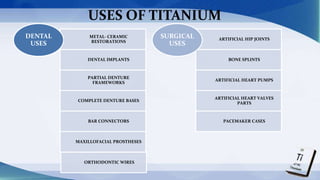
• USES OF TITANIUM
• CRYSTALLINE FORMS AND GRADES OF TITANIUM
• MECHANICAL AND CHEMICAL PROPERTIES
• APPLICATIONS IN DENTISTRY
– TITANIUM AND COMPLETE DENTURES
– TITANIUM AND CAST PARTIAL DENTURE FRAMEWORK
– TITANIUM AND FIXED PARTIAL DENTURES
– TITANIUM AND IMPLANTS
– TITANIUM AND MAXILLOFACIAL PROSTHESES
• TITANIUM PROCESSING
• CONCLUSION
TITANIUM
• Abundant in earth’s crust at oxide = Rutile: TiO2
• Refined to metallic titanium by Kroll’s process
• Historically used extensively in
– Aerospace
– Aeronautical engineering
– Marine equipments
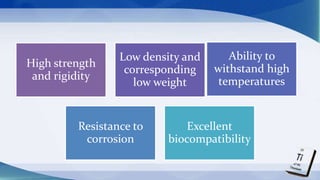
High strength
and rigidity
Low density and
corresponding
low weight
Ability to
withstand high
temperatures
Resistance to
corrosion
Excellent
biocompatibility
USES OF TITANIUM
METAL- CERAMIC
RESTORATIONS
DENTAL IMPLANTS
PARTIAL DENTURE
FRAMEWORKS
COMPLETE DENTURE BASES
BAR CONNECTORS
MAXILLOFACIAL PROSTHESES
ORTHODONTIC WIRES
DENTAL
USES
ARTIFICIAL HIP JOINTS
BONE SPLINTS
ARTIFICIAL HEART PUMPS
ARTIFICIAL HEART VALVES
PARTS
PACEMAKER CASES
SURGICAL
USES
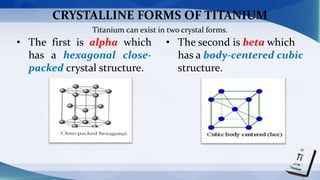
CRYSTALLINE FORMS OF TITANIUM
• The first is alpha which
has a hexagonal close-
packed crystal structure.
• The second is beta which
has a body-centered cubic
structure.
Titanium can exist in two crystal forms.
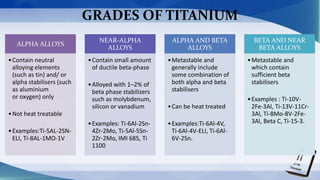
GRADES OF TITANIUM
ALPHA ALLOYS
•Contain neutral
alloying elements
(such as tin) and/ or
alpha stabilisers (such
as aluminium
or oxygen) only
•Not heat treatable
•Examples:Ti-5AL-2SN-
ELI, Ti-8AL-1MO-1V
NEAR-ALPHA
ALLOYS
•Contain small amount
of ductile beta-phase
•Alloyed with 1–2% of
beta phase stabilizers
such as molybdenum,
silicon or vanadium
•Examples: Ti-6Al-2Sn-
4Zr-2Mo, Ti-5Al-5Sn-
2Zr-2Mo, IMI 685, Ti
1100
ALPHA AND BETA
ALLOYS
•Metastable and
generally include
some combination of
both alpha and beta
stabilisers
•Can be heat treated
•Examples:Ti-6Al-4V,
Ti-6Al-4V-ELI, Ti-6Al-
6V-2Sn.
BETA AND NEAR
BETA ALLOYS
•Metastable and
which contain
sufficient beta
stabilisers
•Examples : Ti-10V-
2Fe-3Al, Ti-13V-11Cr-
3Al, Ti-8Mo-8V-2Fe-
3Al, Beta C, Ti-15-3.
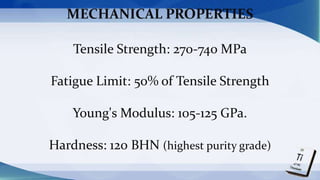
MECHANICAL PROPERTIES
Tensile Strength: 270-740 MPa
Fatigue Limit: 50% of Tensile Strength
Young's Modulus: 105-125 GPa.
Hardness: 120 BHN (highest purity grade)
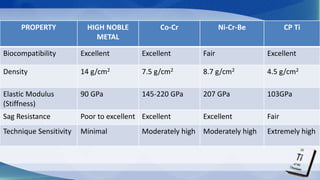
PROPERTY HIGH NOBLE
METAL
Co-Cr Ni-Cr-Be CP Ti
Biocompatibility Excellent Excellent Fair Excellent
Density 14 g/cm2 7.5 g/cm2 8.7 g/cm2 4.5 g/cm2
Elastic Modulus
(Stiffness)
90 GPa 145-220 GPa 207 GPa 103GPa
Sag Resistance Poor to excellent Excellent Excellent Fair
Technique Sensitivity Minimal Moderately high Moderately high Extremely high
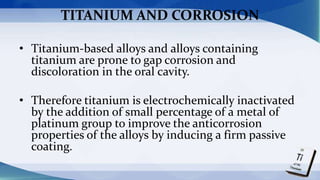
TITANIUM AND CORROSION
• Titanium-based alloys and alloys containing
titanium are prone to gap corrosion and
discoloration in the oral cavity.
• Therefore titanium is electrochemically inactivated
by the addition of small percentage of a metal of
platinum group to improve the anticorrosion
properties of the alloys by inducing a firm passive
coating.
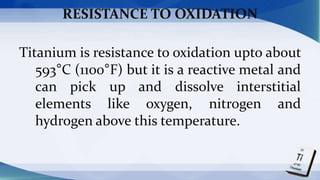
RESISTANCE TO OXIDATION
Titanium is resistance to oxidation upto about
593°C (1100°F) but it is a reactive metal and
can pick up and dissolve interstitial
elements like oxygen, nitrogen and
hydrogen above this temperature.
TITANIUM IN CONTACT WITH
OTHER METALS
In most environments the potential of passive titanium and
stainless steel are similar, so galvanic effects do not occur
when these metals are connected.
Titanium usually functions as an efficient cathode, and its
contact will not lead to significant attack but can cause
adverse galvanic effects upon other metals.
TITANIUM IN CHEMICAL
ENVIRONMENT
Dry chlorine attacks titanium but is resistant to wet chlorine.
In citric acid 50% strength and trichloracetic acid there is significant
corrosion.
It is also resistant to mercury upto 150°C.
In strong solution of caustic alkalis, titanium tends to form soluble titanates
and in moderate or low concentration of alkali, there is no significant
attack.
APPLICATIONS IN DENTISTRY
• REMOVABLE PARTIAL DENTURE FRAMEWORKS,
COMPLETE DENTURES AND OVERDENTURES
• IN FIXED PARTIAL DENTURE
• IMPLANTS
• ORAL AND MAXILLOFACIAL PROSTHESIS
TITANIUM AND COMPLETE
DENTURES
The retention of acrylic resin to the titanium base
is an important consideration.
Noriyuki Wakabayashi et al confirmed that bond
strength between a denture-base resin containing
an adhesion-promoting monomer and Ti-6Al-4V
alloy that had been airborne particle abraded
using aluminum oxide particles was statistically
equivalent to that between the same resin and a
cobalt-chromium alloy casting.
TITANIUM AND CAST PARTIAL
DENTURE FRAMEWORK
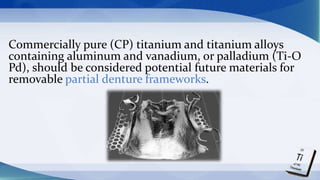
Commercially pure (CP) titanium and titanium alloys
containing aluminum and vanadium, or palladium (Ti-O
Pd), should be considered potential future materials for
removable partial denture frameworks.
The usefulness of Ti as a metal for removable partial denture (RPD) and
complete-denture frameworks has been evaluated.
Removable partial denture frameworks that were 0.70 mm thick had
better castability than did 0.35 mm thick RPD frameworks, suggesting
that if Ti is used for RPD frameworks, a thicker wax pattern is needed
than is used in casting of a conventional denture framework with Co-Cr
alloys.
 In the same study, Ti commonly failed to cast perfect mesh
specimens, but Co-Cr alloys did not have this problem.
TITANIUM AND FIXED PARTIAL
DENTURES
The low coefficient of thermal expansion (CTE) of
titanium (about 10 x 10-6/ºC) compared to those of
the conventional low-fusing porcelains (about 13 x
10-6/°C) raised the concern of thermal compatibility.
The difference in the coefficient of the expansion between the
alloy and porcelain should be within ±1x10⁻⁶ /°C to obtain
sufficient bonding strength.
Coefficients of thermal expansion of pure titanium and Ti-6A1-
4V are 10.37 x 10⁻⁶ and 12.43 x 10⁻⁶ /ºC, respectively, which are
considerably smaller than those of commercial porcelain
materials which is about 14 x l0-6 /°C.
• Firing of porcelain over titanium requires a special
protocol.
• Metal exposure to temperatures that exceed 8000C leads
to the absorption of oxygen and nitrogen, providing the
formation of a thick superficial layer of oxide that may
attain a thickness up to 1mm and harms the bonding of
ceramic to substrate.
Wilson José Garbelini. Evaluation of low-fusing ceramic systems combined with titanium grades ii
and v by bending test and scanning electron microscopy; J Appl Oral Sci 2003; 11(4): 354-60
• Hence compliance with these criteria, low
fusion ceramics are used with Titanium.
• Low fusing porcelains are required to
adequately match the thermal expansion
coefficient of titanium to reduce residual
stress, which may result in failure of overlying
ceramic.
TITANIUM AND IMPLANTS
Titanium and its alloys are important in dental and
surgical implants because of their high degree of
biocompatibility, strength and corrosion resistance.
Pure titanium, theoretically, may form several
oxides.
Among these . TiO, Ti02 and Ti2 03. Of these, TiO2 is
the most stable and therefore the most commonly
used under physiologic conditions. These oxides
form spontaneously on exposure of Ti to air.
Titanium, both as a pure metal and as an alloy, is
easily passivated, forming a stable Ti02 surface
oxide that makes the metal corrosion resistant.
This oxide will repair itself instantaneously on
damage thatmight occur during insertion of an
implant.
The normal level of Ti in human tissue is 50 ppm.
Values of 100 to 300 ppm are frequently observed in
soft tissues surrounding Ti implants.
At these levels, tissue discoloration with Ti pigments
can be seen.
This rate of dissolution is one of the lowest of all
passivated implant metals and seems to be well
tolerated by the body.
TITANIUM AND MAXILLOFACIAL
PROSTHESES
CRANIAL PROSTHESIS:
Titanium has been recently used in fashioning cranial
prostheses
This metal is a strong but light material that is soft enough to
be swaged in a die-counterdie system.
Moreover it can be strain hardened and thus become stronger
with manipulation. Sheets that are 0.6 1mm thick are adequate
and its radiodensity permits most radiographic studies.
After the metal prosthesis is shaped, trimmed, and
polished, tissue acceptance of the implant is enhanced by
anodizing it in a solution of 80% phosphoric acid, 10%
sulphuric acid, and 10% water (Gordon and Blair, 1974).
Titanium trays offer the best combination of strength and
rigidity with the least bulk of any implant material
currently available for restoration of mandibular defects.
Titanium frameworks are also used for rehabilitation of
maxillary and mandibular defects like cleft palate.
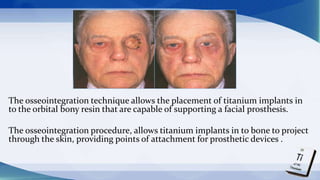
The osseointegration technique allows the placement of titanium implants in
to the orbital bony resin that are capable of supporting a facial prosthesis.
The osseointegration procedure, allows titanium implants in to bone to project
through the skin, providing points of attachment for prosthetic devices .
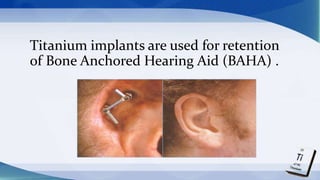
Titanium implants are used for retention
of Bone Anchored Hearing Aid (BAHA) .
TITANIUM PROCESSING
Processing of Titanium in the Dental
Laboratory
– Dental Melting and Casting Technology
– CAD/CAM Technique
Titanium and Titanium Alloys: Fundamentals and Applications, by Dr. Christoph Leyens,
CASTING
Difficulties in casting Titanium:
– High melting point
– High reactivity
– Low casting efficiency
– Inadequate expansion of investment
– Casting porosity
– Requires expensive equipments
• Titanium requires special melting and casting technology and
requires some modification of relevant working steps in the dental
lab.
• The metal is melted using an electric plasma arc or inductive
heating in a melting chamber filled with inert gas or held in a
vacuum.
• Pure titanium is usually melted today by argon-arc melting using a
copper crucible.
• Casting is done by a vacuum-pressure casting
technique.
• Due to the requirements for precision, special
investment materials based mainly on silica or silica-
modifications are used in dental casting technology.
• Binders used for the investment powder are ethyl-
silicates or phosphate/magnesium oxide systems.
Titanium and Titanium Alloys: Fundamentals and Applications, by Dr. Christoph Leyens,
• Since the reactivity of molten titanium with
these types of investments is very high, they
cannot be used for dental titanium castings due
to formation of a large α case layer with micro-
cracks and increased hardness that renders
dental processing extremely difficult.
• This thin layer can be removed completely by
usual dental surface treatments like griniding.
Titanium and Titanium Alloys: Fundamentals and Applications, by Dr. Christoph Leyens,
• Investment materials used for casting
titanium are refractory materials in which
the reactivity with titanium is reduced by
using components with low standard free
energy of oxide, such as alumina,
magnesia and zirconium oxide.
Wagner Sotero Fragoso et al, The influence of mold temperature on the fit of cast crowns
with commercially pure titanium; Braz Oral Res 2005;19(2):139-43
• Yu Guilin et al conducted a study to evaluate the
effects of different investment materials on the
formation of α case layer on the titanium casting.
• Conclusion:- Based on the thickness of the surface
reaction layer and the surface microhardness of
titanium castings, MgO based investment
materials may be the best choice for casting these
materials.
Yu Guilin, PhD, The effects of different types of investments on the alpha-case layer
of titanium castings; J Prosthet Dent 2007;97:157-64.
• One study has shown that use of Zirconia-
based coating on the wax pattern
substantially reduced the thickness of the
complex reaction layer with the investment
and yeilded titanium castings with a high-
quality surface.
Luo XP, et al: Titanium casting into phosphate bonded investment with
zirconate. Dental Mater 18:512,2002.
• The castability of titanium can be influenced by the mold
temperature.
• Low mold temperatures have been used to accelerate the
solidification of molten titanium, reducing the reactivity
with the investment.
• As a result, manufacturers have recommended low mold
temperatures to minimize the formation of the reaction
layer.
Wagner Sotero Fragoso et al, The influence of mold temperature on the fit of cast crowns
with commercially pure titanium; Braz Oral Res 2005;19(2):139-43
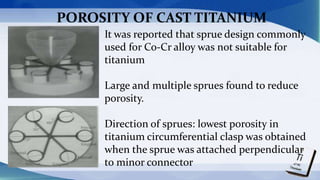
It was reported that sprue design commonly
used for Co-Cr alloy was not suitable for
titanium
Large and multiple sprues found to reduce
porosity.
Direction of sprues: lowest porosity in
titanium circumferential clasp was obtained
when the sprue was attached perpendicular
to minor connector
POROSITY OF CAST TITANIUM
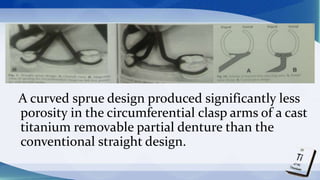
A curved sprue design produced significantly less
porosity in the circumferential clasp arms of a cast
titanium removable partial denture than the
conventional straight design.
• New alloys of titanium with nickel that can be cast by
more conventional methods are being developed.
• These are reported to release very little ionic nickel and
bond well to porcelain.
• New methods of forming titanium crowns and copings
by CAD/CAM (computer-aided design/computer-
aided milling) technology avoid the problems of
casting.
Fundamentals of Fixed Prosthodontics, 3rd edition, Shillingburg
CAD/CAM TECHNIQUE
• An optical scanner conducts the data generation from the master
model.
• The design is accomplished by CAD software, adapted to the
special demands of dental technology.
• Data generation of milling tracks and manufacturing are done
automatically.
• The process starts from rods or plates depending on the system
used.
Titanium and Titanium Alloys: Fundamentals and Applications, by Dr. Christoph
Leyens, Dr. Manfred Peters
CONCLUSION
• Titanium is a useful biomaterial. It will probably continue
to dominate the implant market in the future.
• Titanium is economical and readily available, but the
technologies of machining, casting, welding, and veneering
it for dental prostheses are new.
• Increased use of titanium in prosthodontics depends on
research and clinical trials to compare its effectiveness, as
an equivalent or superior metal, to existing metals. The
future of titanium in dentistry looks promising.
Thank You

Titanium Alloys: Clinical Applications

  • 1.
    TITANIUM ALLOYS CLINICAL APPLICATIONS AAMIRGODIL FIRST YEAR P.G. DEPARTMENT OF PROSTHODONTICS M.A.R.D.C.
  • 2.
    OUTLINE • INTRODUCTION • USESOF TITANIUM • CRYSTALLINE FORMS AND GRADES OF TITANIUM • MECHANICAL AND CHEMICAL PROPERTIES • APPLICATIONS IN DENTISTRY – TITANIUM AND COMPLETE DENTURES – TITANIUM AND CAST PARTIAL DENTURE FRAMEWORK – TITANIUM AND FIXED PARTIAL DENTURES – TITANIUM AND IMPLANTS – TITANIUM AND MAXILLOFACIAL PROSTHESES • TITANIUM PROCESSING • CONCLUSION
  • 3.
    TITANIUM • Abundant inearth’s crust at oxide = Rutile: TiO2 • Refined to metallic titanium by Kroll’s process • Historically used extensively in – Aerospace – Aeronautical engineering – Marine equipments
  • 4.
    High strength and rigidity Lowdensity and corresponding low weight Ability to withstand high temperatures Resistance to corrosion Excellent biocompatibility
  • 5.
    USES OF TITANIUM METAL-CERAMIC RESTORATIONS DENTAL IMPLANTS PARTIAL DENTURE FRAMEWORKS COMPLETE DENTURE BASES BAR CONNECTORS MAXILLOFACIAL PROSTHESES ORTHODONTIC WIRES DENTAL USES ARTIFICIAL HIP JOINTS BONE SPLINTS ARTIFICIAL HEART PUMPS ARTIFICIAL HEART VALVES PARTS PACEMAKER CASES SURGICAL USES
  • 6.
    CRYSTALLINE FORMS OFTITANIUM • The first is alpha which has a hexagonal close- packed crystal structure. • The second is beta which has a body-centered cubic structure. Titanium can exist in two crystal forms.
  • 7.
    GRADES OF TITANIUM ALPHAALLOYS •Contain neutral alloying elements (such as tin) and/ or alpha stabilisers (such as aluminium or oxygen) only •Not heat treatable •Examples:Ti-5AL-2SN- ELI, Ti-8AL-1MO-1V NEAR-ALPHA ALLOYS •Contain small amount of ductile beta-phase •Alloyed with 1–2% of beta phase stabilizers such as molybdenum, silicon or vanadium •Examples: Ti-6Al-2Sn- 4Zr-2Mo, Ti-5Al-5Sn- 2Zr-2Mo, IMI 685, Ti 1100 ALPHA AND BETA ALLOYS •Metastable and generally include some combination of both alpha and beta stabilisers •Can be heat treated •Examples:Ti-6Al-4V, Ti-6Al-4V-ELI, Ti-6Al- 6V-2Sn. BETA AND NEAR BETA ALLOYS •Metastable and which contain sufficient beta stabilisers •Examples : Ti-10V- 2Fe-3Al, Ti-13V-11Cr- 3Al, Ti-8Mo-8V-2Fe- 3Al, Beta C, Ti-15-3.
  • 8.
    MECHANICAL PROPERTIES Tensile Strength:270-740 MPa Fatigue Limit: 50% of Tensile Strength Young's Modulus: 105-125 GPa. Hardness: 120 BHN (highest purity grade)
  • 9.
    PROPERTY HIGH NOBLE METAL Co-CrNi-Cr-Be CP Ti Biocompatibility Excellent Excellent Fair Excellent Density 14 g/cm2 7.5 g/cm2 8.7 g/cm2 4.5 g/cm2 Elastic Modulus (Stiffness) 90 GPa 145-220 GPa 207 GPa 103GPa Sag Resistance Poor to excellent Excellent Excellent Fair Technique Sensitivity Minimal Moderately high Moderately high Extremely high
  • 11.
    TITANIUM AND CORROSION •Titanium-based alloys and alloys containing titanium are prone to gap corrosion and discoloration in the oral cavity. • Therefore titanium is electrochemically inactivated by the addition of small percentage of a metal of platinum group to improve the anticorrosion properties of the alloys by inducing a firm passive coating.
  • 12.
    RESISTANCE TO OXIDATION Titaniumis resistance to oxidation upto about 593°C (1100°F) but it is a reactive metal and can pick up and dissolve interstitial elements like oxygen, nitrogen and hydrogen above this temperature.
  • 13.
    TITANIUM IN CONTACTWITH OTHER METALS In most environments the potential of passive titanium and stainless steel are similar, so galvanic effects do not occur when these metals are connected. Titanium usually functions as an efficient cathode, and its contact will not lead to significant attack but can cause adverse galvanic effects upon other metals.
  • 14.
    TITANIUM IN CHEMICAL ENVIRONMENT Drychlorine attacks titanium but is resistant to wet chlorine. In citric acid 50% strength and trichloracetic acid there is significant corrosion. It is also resistant to mercury upto 150°C. In strong solution of caustic alkalis, titanium tends to form soluble titanates and in moderate or low concentration of alkali, there is no significant attack.
  • 15.
    APPLICATIONS IN DENTISTRY •REMOVABLE PARTIAL DENTURE FRAMEWORKS, COMPLETE DENTURES AND OVERDENTURES • IN FIXED PARTIAL DENTURE • IMPLANTS • ORAL AND MAXILLOFACIAL PROSTHESIS
  • 16.
  • 17.
    The retention ofacrylic resin to the titanium base is an important consideration. Noriyuki Wakabayashi et al confirmed that bond strength between a denture-base resin containing an adhesion-promoting monomer and Ti-6Al-4V alloy that had been airborne particle abraded using aluminum oxide particles was statistically equivalent to that between the same resin and a cobalt-chromium alloy casting.
  • 18.
    TITANIUM AND CASTPARTIAL DENTURE FRAMEWORK
  • 19.
    Commercially pure (CP)titanium and titanium alloys containing aluminum and vanadium, or palladium (Ti-O Pd), should be considered potential future materials for removable partial denture frameworks.
  • 20.
    The usefulness ofTi as a metal for removable partial denture (RPD) and complete-denture frameworks has been evaluated. Removable partial denture frameworks that were 0.70 mm thick had better castability than did 0.35 mm thick RPD frameworks, suggesting that if Ti is used for RPD frameworks, a thicker wax pattern is needed than is used in casting of a conventional denture framework with Co-Cr alloys.  In the same study, Ti commonly failed to cast perfect mesh specimens, but Co-Cr alloys did not have this problem.
  • 21.
    TITANIUM AND FIXEDPARTIAL DENTURES
  • 22.
    The low coefficientof thermal expansion (CTE) of titanium (about 10 x 10-6/ºC) compared to those of the conventional low-fusing porcelains (about 13 x 10-6/°C) raised the concern of thermal compatibility.
  • 23.
    The difference inthe coefficient of the expansion between the alloy and porcelain should be within ±1x10⁻⁶ /°C to obtain sufficient bonding strength. Coefficients of thermal expansion of pure titanium and Ti-6A1- 4V are 10.37 x 10⁻⁶ and 12.43 x 10⁻⁶ /ºC, respectively, which are considerably smaller than those of commercial porcelain materials which is about 14 x l0-6 /°C.
  • 24.
    • Firing ofporcelain over titanium requires a special protocol. • Metal exposure to temperatures that exceed 8000C leads to the absorption of oxygen and nitrogen, providing the formation of a thick superficial layer of oxide that may attain a thickness up to 1mm and harms the bonding of ceramic to substrate. Wilson José Garbelini. Evaluation of low-fusing ceramic systems combined with titanium grades ii and v by bending test and scanning electron microscopy; J Appl Oral Sci 2003; 11(4): 354-60
  • 25.
    • Hence compliancewith these criteria, low fusion ceramics are used with Titanium. • Low fusing porcelains are required to adequately match the thermal expansion coefficient of titanium to reduce residual stress, which may result in failure of overlying ceramic.
  • 26.
  • 27.
    Titanium and itsalloys are important in dental and surgical implants because of their high degree of biocompatibility, strength and corrosion resistance. Pure titanium, theoretically, may form several oxides. Among these . TiO, Ti02 and Ti2 03. Of these, TiO2 is the most stable and therefore the most commonly used under physiologic conditions. These oxides form spontaneously on exposure of Ti to air.
  • 28.
    Titanium, both asa pure metal and as an alloy, is easily passivated, forming a stable Ti02 surface oxide that makes the metal corrosion resistant. This oxide will repair itself instantaneously on damage thatmight occur during insertion of an implant.
  • 29.
    The normal levelof Ti in human tissue is 50 ppm. Values of 100 to 300 ppm are frequently observed in soft tissues surrounding Ti implants. At these levels, tissue discoloration with Ti pigments can be seen. This rate of dissolution is one of the lowest of all passivated implant metals and seems to be well tolerated by the body.
  • 30.
  • 31.
    CRANIAL PROSTHESIS: Titanium hasbeen recently used in fashioning cranial prostheses This metal is a strong but light material that is soft enough to be swaged in a die-counterdie system. Moreover it can be strain hardened and thus become stronger with manipulation. Sheets that are 0.6 1mm thick are adequate and its radiodensity permits most radiographic studies.
  • 32.
    After the metalprosthesis is shaped, trimmed, and polished, tissue acceptance of the implant is enhanced by anodizing it in a solution of 80% phosphoric acid, 10% sulphuric acid, and 10% water (Gordon and Blair, 1974). Titanium trays offer the best combination of strength and rigidity with the least bulk of any implant material currently available for restoration of mandibular defects. Titanium frameworks are also used for rehabilitation of maxillary and mandibular defects like cleft palate.
  • 33.
    The osseointegration techniqueallows the placement of titanium implants in to the orbital bony resin that are capable of supporting a facial prosthesis. The osseointegration procedure, allows titanium implants in to bone to project through the skin, providing points of attachment for prosthetic devices .
  • 34.
    Titanium implants areused for retention of Bone Anchored Hearing Aid (BAHA) .
  • 35.
  • 36.
    Processing of Titaniumin the Dental Laboratory – Dental Melting and Casting Technology – CAD/CAM Technique Titanium and Titanium Alloys: Fundamentals and Applications, by Dr. Christoph Leyens,
  • 37.
    CASTING Difficulties in castingTitanium: – High melting point – High reactivity – Low casting efficiency – Inadequate expansion of investment – Casting porosity – Requires expensive equipments
  • 38.
    • Titanium requiresspecial melting and casting technology and requires some modification of relevant working steps in the dental lab. • The metal is melted using an electric plasma arc or inductive heating in a melting chamber filled with inert gas or held in a vacuum. • Pure titanium is usually melted today by argon-arc melting using a copper crucible.
  • 39.
    • Casting isdone by a vacuum-pressure casting technique. • Due to the requirements for precision, special investment materials based mainly on silica or silica- modifications are used in dental casting technology. • Binders used for the investment powder are ethyl- silicates or phosphate/magnesium oxide systems. Titanium and Titanium Alloys: Fundamentals and Applications, by Dr. Christoph Leyens,
  • 40.
    • Since thereactivity of molten titanium with these types of investments is very high, they cannot be used for dental titanium castings due to formation of a large α case layer with micro- cracks and increased hardness that renders dental processing extremely difficult. • This thin layer can be removed completely by usual dental surface treatments like griniding. Titanium and Titanium Alloys: Fundamentals and Applications, by Dr. Christoph Leyens,
  • 41.
    • Investment materialsused for casting titanium are refractory materials in which the reactivity with titanium is reduced by using components with low standard free energy of oxide, such as alumina, magnesia and zirconium oxide. Wagner Sotero Fragoso et al, The influence of mold temperature on the fit of cast crowns with commercially pure titanium; Braz Oral Res 2005;19(2):139-43
  • 42.
    • Yu Guilinet al conducted a study to evaluate the effects of different investment materials on the formation of α case layer on the titanium casting. • Conclusion:- Based on the thickness of the surface reaction layer and the surface microhardness of titanium castings, MgO based investment materials may be the best choice for casting these materials. Yu Guilin, PhD, The effects of different types of investments on the alpha-case layer of titanium castings; J Prosthet Dent 2007;97:157-64.
  • 43.
    • One studyhas shown that use of Zirconia- based coating on the wax pattern substantially reduced the thickness of the complex reaction layer with the investment and yeilded titanium castings with a high- quality surface. Luo XP, et al: Titanium casting into phosphate bonded investment with zirconate. Dental Mater 18:512,2002.
  • 44.
    • The castabilityof titanium can be influenced by the mold temperature. • Low mold temperatures have been used to accelerate the solidification of molten titanium, reducing the reactivity with the investment. • As a result, manufacturers have recommended low mold temperatures to minimize the formation of the reaction layer. Wagner Sotero Fragoso et al, The influence of mold temperature on the fit of cast crowns with commercially pure titanium; Braz Oral Res 2005;19(2):139-43
  • 45.
    It was reportedthat sprue design commonly used for Co-Cr alloy was not suitable for titanium Large and multiple sprues found to reduce porosity. Direction of sprues: lowest porosity in titanium circumferential clasp was obtained when the sprue was attached perpendicular to minor connector POROSITY OF CAST TITANIUM
  • 46.
    A curved spruedesign produced significantly less porosity in the circumferential clasp arms of a cast titanium removable partial denture than the conventional straight design.
  • 47.
    • New alloysof titanium with nickel that can be cast by more conventional methods are being developed. • These are reported to release very little ionic nickel and bond well to porcelain. • New methods of forming titanium crowns and copings by CAD/CAM (computer-aided design/computer- aided milling) technology avoid the problems of casting. Fundamentals of Fixed Prosthodontics, 3rd edition, Shillingburg
  • 48.
    CAD/CAM TECHNIQUE • Anoptical scanner conducts the data generation from the master model. • The design is accomplished by CAD software, adapted to the special demands of dental technology. • Data generation of milling tracks and manufacturing are done automatically. • The process starts from rods or plates depending on the system used. Titanium and Titanium Alloys: Fundamentals and Applications, by Dr. Christoph Leyens, Dr. Manfred Peters
  • 49.
    CONCLUSION • Titanium isa useful biomaterial. It will probably continue to dominate the implant market in the future. • Titanium is economical and readily available, but the technologies of machining, casting, welding, and veneering it for dental prostheses are new. • Increased use of titanium in prosthodontics depends on research and clinical trials to compare its effectiveness, as an equivalent or superior metal, to existing metals. The future of titanium in dentistry looks promising.
  • 50.

Editor's Notes

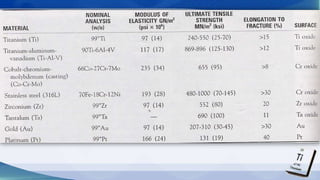
  • #9 Brinnel Hardness Number
  • #11 Titanium has poor shear strength and wear resistance, however making it unsuitable for articulating surface or bone screw applications . Compared with Co-Cr-Mo alloys, titanium alloy is almost twice as strong and has half the elastic modulus. Compared with 316L stainless steel, the Ti-6A1-4V alloy is roughly equal in strength, but again, it has half the modulus.