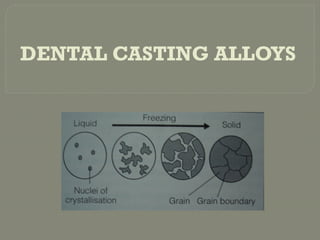
DENTAL CASTING ALLOYS
DESIRABLE PROPERTIES OF
DENTAL CASTING ALLOYS
 Biocompatibility
 Ease of melting
 Ease of casting
 Ease of brazing (soldering)
 Ease of polishing
 Little solidification shrinkage
 Minimal reactivity with the mold material
 good wear resistance
 High strength
 Excellent corrosion resistance
 Porcelain Bonding
CLASSIFICATION OF DENTAL
CASTING ALLOYS
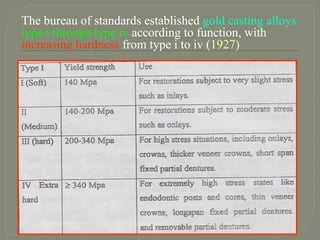
The bureau of standards established gold casting alloys
type i through type iv according to function, with
increasing hardness from type i to iv (1927)
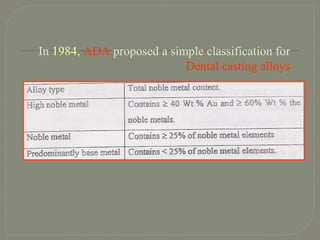
In 1984, ADA proposed a simple classification for
Dental casting alloys
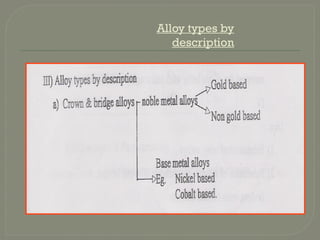
Alloy types by
description
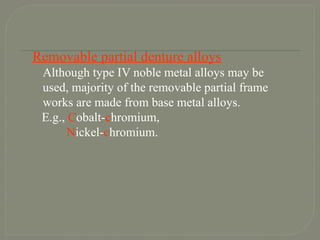
Removable partial denture alloys
Although type IV noble metal alloys may be
used, majority of the removable partial frame
works are made from base metal alloys.
E.g., Cobalt-chromium,
Nickel-chromium.
ALLOY TYPE BY MAJOR ELEMENTS:
Gold-based,
palladium-based,
silver-based, nickel-based,
cobalt-based and
titanium-based .
ALLOY TYPE BY PRINCIPAL THREE
ELEMENTS:
Au-Pd-Ag,
Pd-Ag-Sn,
Ni-Cr-Be,
Co-Cr-Mo,
Ti-Al-V and
Fe-Ni-Cr
ALLOY TYPE BY DOMINANT PHASE
SYSTEM:
Single phase [isomorphous],
eutectic,
peritectic and
intermetallic.
GOLD CASTING ALLOYS
 ADA specification No. 5 classify dental gold
casting alloys as:
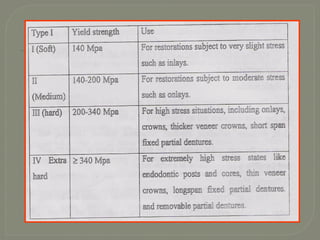
1. High Gold Alloys Type I
Type II
Type III
Type IV
2.Low Gold Alloys
3.White Gold Alloys
HEAT TREATMENT OF GOLD
ALLOYS:
 Heat treatment of alloys is done in order to alter its
mechanical properties.
 Gold alloys can be heat treated if it contains sufficient
amount of copper. Only type III and type IV gold alloys can
be heat-treated.
 There are two types of heat treatment.
1.Softening Heat Treatment (Solution heat treatment)
2.Hardening Heat Treatment (Age hardening
 SOFTENING HEAT TREATMENT
Softening heat treatment increased ductility, but reduces
tensile strength, proportional limit, and hardness.
Indications:
It is indicated for appliances that are to be grounded,
shaped, or otherwise cold worked in or outside the mouth.
Method:
 The casting is placed in an electric furnace for 10
minutes at a temperature of 700oC and then it is quenched
in water. During this period, all intermediate phases are
presumably changed to a disordered solid solution, and
the rapid quenching prevents ordering from occurring
during cooling.

 HARDENING HEAT TREATMENT
Hardening heat treatment increases strength, proportional
limit, and hardness, but decreases ductility. It is the copper
present in gold alloys, which helps in the age hardening
process.
 Indications:
It is indicated for metallic partial dentures, saddles,
bridges and other similar structures. It is not employed for
smaller structures such as inlays.
 Method:
It is done by “soaking” or ageing the casting at a specific
temperature for a definite time, usually 15 to 30 minutes. It is
then water quenched.The aging temperature is generally
between 200°C and 450°C.
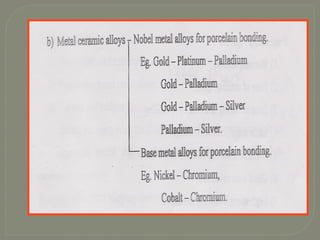
METAL CERAMIC ALLOYS
The main function of metal-ceramic
alloys is to reinforce porcelain, thus
increasing its resistance to fracture
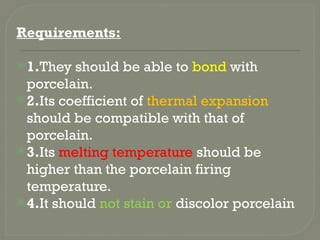
Requirements:
1.They should be able to bond with
porcelain.
2.Its coefficient of thermal expansion
should be compatible with that of
porcelain.
3.Its melting temperature should be
higher than the porcelain firing
temperature.
4.It should not stain or discolor porcelain
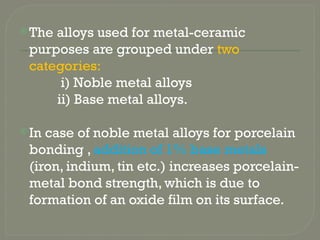
The alloys used for metal-ceramic
purposes are grouped under two
categories:
i) Noble metal alloys
ii) Base metal alloys.
In case of noble metal alloys for porcelain
bonding , addition of 1% base metals
(iron, indium, tin etc.) increases porcelain-
metal bond strength, which is due to
formation of an oxide film on its surface.
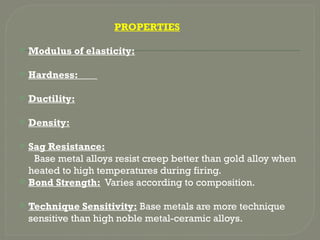
PROPERTIES
 Modulus of elasticity:
 Hardness:
 Ductility:
 Density:
 Sag Resistance:
Base metal alloys resist creep better than gold alloy when
heated to high temperatures during firing.
 Bond Strength: Varies according to composition.
 Technique Sensitivity: Base metals are more technique
sensitive than high noble metal-ceramic alloys.
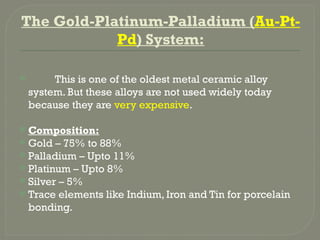
The Gold-Platinum-Palladium (Au-Pt-
Pd) System:
 This is one of the oldest metal ceramic alloy
system. But these alloys are not used widely today
because they are very expensive.
 Composition:
 Gold – 75% to 88%
 Palladium – Upto 11%
 Platinum – Upto 8%
 Silver – 5%
 Trace elements like Indium, Iron and Tin for porcelain
bonding.
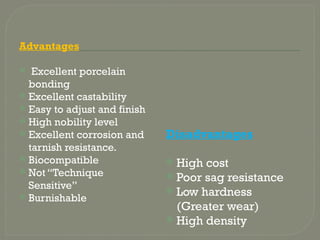
Advantages
 Excellent porcelain
bonding
 Excellent castability
 Easy to adjust and finish
 High nobility level
 Excellent corrosion and
tarnish resistance.
 Biocompatible
 Not “Technique
Sensitive”
 Burnishable
Disadvantages
 High cost
 Poor sag resistance
 Low hardness
(Greater wear)
 High density
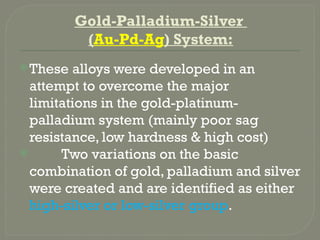
Gold-Palladium-Silver
(Au-Pd-Ag) System:
These alloys were developed in an
attempt to overcome the major
limitations in the gold-platinum-
palladium system (mainly poor sag
resistance, low hardness & high cost)
 Two variations on the basic
combination of gold, palladium and silver
were created and are identified as either
high-silver or low-silver group.
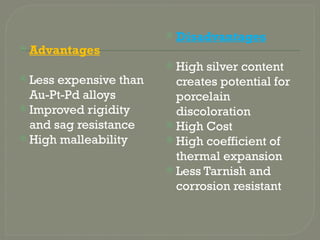
 Advantages
 Less expensive than
Au-Pt-Pd alloys
 Improved rigidity
and sag resistance
 High malleability
 Disadvantages
 High silver content
creates potential for
porcelain
discoloration
 High Cost
 High coefficient of
thermal expansion
 Less Tarnish and
corrosion resistant
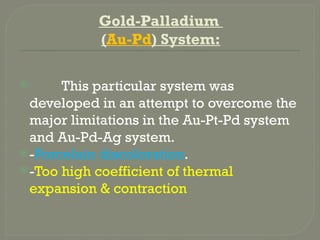
Gold-Palladium
(Au-Pd) System:
 This particular system was
developed in an attempt to overcome the
major limitations in the Au-Pt-Pd system
and Au-Pd-Ag system.
-Porcelain discoloration.
-Too high coefficient of thermal
expansion & contraction
Palladium-Silver
(Pd-Ag) System
This was the first gold free system to be
introduced in the United States (1974)
that still contained a noble metal
(palladium). It was offered as an
economical alternative to the more
expensive gold-platinum-silver and gold-
palladium-silver (gold based) alloy
systems
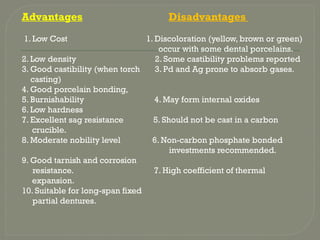
Advantages Disadvantages
1. Low Cost 1. Discoloration (yellow, brown or green)
occur with some dental porcelains.
2. Low density 2. Some castibility problems reported
3. Good castibility (when torch 3. Pd and Ag prone to absorb gases.
casting)
4. Good porcelain bonding,
5. Burnishability 4. May form internal oxides
6. Low hardness
7. Excellent sag resistance 5. Should not be cast in a carbon
crucible.
8. Moderate nobility level 6. Non-carbon phosphate bonded
investments recommended.
9. Good tarnish and corrosion
resistance. 7. High coefficient of thermal
expansion.
10. Suitable for long-span fixed
partial dentures.
BASE METAL ALLOYS
-Nickel based
-Cobalt based
Alloys in both systems contain
chromium as the second largest
constituent.
Nickel-chromium
(Ni-Cr) System
 These metal-ceramic alloy offer such
economy that they are also used for
complete crown and all metal fixed
partial denture prosthesis
The system contains two major groups:
-Beryllium free (class 1)
-Beryllium (class 2)
Of the two, Ni-Cr-Beryllium alloy are
generally regarded as possessing
superior properties
NICKEL-CHROMIUM BERYLLIUM
FREE ALLOYS
Composition:
 Nickel – 62% to 77% Chromium – 11% to 22%
 Boron , iron, molybdenum, Niobium or columbium and tantalum
(trace elements).
Advantages Disadvantages
1. Do not contain beryllium 1. Cannot use with Nickel
sensitive patients.
2. Low cost 2. Cannot be etched.
(Cr doesn’t dissolve in acid)
3. Low density means more casting 3. May not cast as well as Ni-
Cr-Be alloys
per ounce 4. Produces more oxide than
Ni-Cr-Be
DISADVANTAGES OF NICKEL-
CHROMIUM ALLOYS
Nickel may produce allergic reactions in some
individuals (contact dermatitis).
It is also a potential carcinogen.
Inhalation of beryllium containing dust or
fumes is the main route of exposure. It causes
a condition know as ‘berylliosis’. It is
characterized by flu-like symptoms and
granulomas of the lungs.
COBALT CHROMIUM ALLOYS
 They possess high strength.
 Their excellent corrosion resistance
especially at high temperatures makes
them useful for a number of applications.
 These alloys are also known as ‘satellite’
because they maintained their shiny, star-
like appearance under different conditions.
 They have bright lustrous, hard, strong
and non-tarnishing qualities
APPLICATIONS:
1. Denture base
2. Cast removable partial denture
framework.
3. Surgical implants.
4. turbine blades
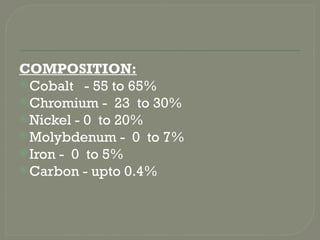
COMPOSITION:
Cobalt - 55 to 65%
Chromium - 23 to 30%
Nickel - 0 to 20%
Molybdenum - 0 to 7%
Iron - 0 to 5%
Carbon - upto 0.4%
TITANIUM AND TITANIUM ALLOYS
Titanium is called “material of choice” in
dentistry.
This is attributed to the oxide formation
property which forms basis for corrosion
resistance and biocompatibility of this
material.
Uses:
Commercially pure titanium is used for
dental implants,
surface coatings,
crowns,
partial dentures,
complete dentures and
orthodontic wires
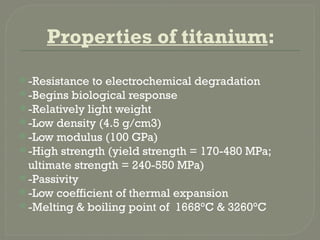
Properties of titanium:
 -Resistance to electrochemical degradation
 -Begins biological response
 -Relatively light weight
 -Low density (4.5 g/cm3)
 -Low modulus (100 GPa)
 -High strength (yield strength = 170-480 MPa;
ultimate strength = 240-550 MPa)
 -Passivity
 -Low coefficient of thermal expansion
 -Melting & boiling point of 1668°C & 3260°C
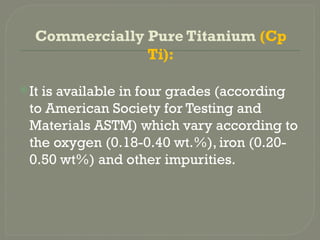
Commercially Pure Titanium (Cp
Ti):
It is available in four grades (according
to American Society for Testing and
Materials ASTM) which vary according to
the oxygen (0.18-0.40 wt.%), iron (0.20-
0.50 wt%) and other impurities.
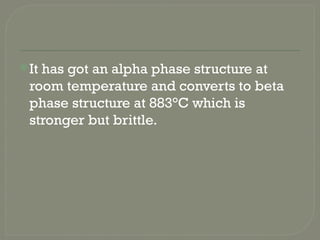
It has got an alpha phase structure at
room temperature and converts to beta
phase structure at 883°C which is
stronger but brittle.
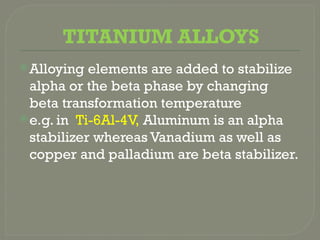
TITANIUM ALLOYS
Alloying elements are added to stabilize
alpha or the beta phase by changing
beta transformation temperature
e.g. in Ti-6Al-4V, Aluminum is an alpha
stabilizer whereas Vanadium as well as
copper and palladium are beta stabilizer.
Alpha titanium is weld able but difficult
to work with at room temperature.
Beta titanium is malleable at room
temperature and is used in orthodontics,
but is difficult to weld.
Pure titanium is used to cast crowns,
partial denture, and complete denture.
Difficulties in casting Titanium :
-High melting point
-High reactivity
-Low casting efficiency
-Inadequate expansion of investment
-Casting porosity
-Difficulty in finishing
-Difficulty in welding
-Requires expensive equipments

dental casting alloys class.pptx important

  • 1.
  • 2.
    DESIRABLE PROPERTIES OF DENTALCASTING ALLOYS  Biocompatibility  Ease of melting  Ease of casting  Ease of brazing (soldering)  Ease of polishing  Little solidification shrinkage  Minimal reactivity with the mold material  good wear resistance  High strength  Excellent corrosion resistance  Porcelain Bonding
  • 3.
  • 4.
    The bureau ofstandards established gold casting alloys type i through type iv according to function, with increasing hardness from type i to iv (1927)
  • 5.
    In 1984, ADAproposed a simple classification for Dental casting alloys
  • 6.
  • 8.
    Removable partial denturealloys Although type IV noble metal alloys may be used, majority of the removable partial frame works are made from base metal alloys. E.g., Cobalt-chromium, Nickel-chromium.
  • 9.
    ALLOY TYPE BYMAJOR ELEMENTS: Gold-based, palladium-based, silver-based, nickel-based, cobalt-based and titanium-based .
  • 10.
    ALLOY TYPE BYPRINCIPAL THREE ELEMENTS: Au-Pd-Ag, Pd-Ag-Sn, Ni-Cr-Be, Co-Cr-Mo, Ti-Al-V and Fe-Ni-Cr
  • 11.
    ALLOY TYPE BYDOMINANT PHASE SYSTEM: Single phase [isomorphous], eutectic, peritectic and intermetallic.
  • 12.
    GOLD CASTING ALLOYS ADA specification No. 5 classify dental gold casting alloys as: 1. High Gold Alloys Type I Type II Type III Type IV 2.Low Gold Alloys 3.White Gold Alloys
  • 14.
    HEAT TREATMENT OFGOLD ALLOYS:  Heat treatment of alloys is done in order to alter its mechanical properties.  Gold alloys can be heat treated if it contains sufficient amount of copper. Only type III and type IV gold alloys can be heat-treated.  There are two types of heat treatment. 1.Softening Heat Treatment (Solution heat treatment) 2.Hardening Heat Treatment (Age hardening
  • 15.
     SOFTENING HEATTREATMENT Softening heat treatment increased ductility, but reduces tensile strength, proportional limit, and hardness. Indications: It is indicated for appliances that are to be grounded, shaped, or otherwise cold worked in or outside the mouth. Method:  The casting is placed in an electric furnace for 10 minutes at a temperature of 700oC and then it is quenched in water. During this period, all intermediate phases are presumably changed to a disordered solid solution, and the rapid quenching prevents ordering from occurring during cooling. 
  • 16.
     HARDENING HEATTREATMENT Hardening heat treatment increases strength, proportional limit, and hardness, but decreases ductility. It is the copper present in gold alloys, which helps in the age hardening process.  Indications: It is indicated for metallic partial dentures, saddles, bridges and other similar structures. It is not employed for smaller structures such as inlays.  Method: It is done by “soaking” or ageing the casting at a specific temperature for a definite time, usually 15 to 30 minutes. It is then water quenched.The aging temperature is generally between 200°C and 450°C.
  • 17.
    METAL CERAMIC ALLOYS Themain function of metal-ceramic alloys is to reinforce porcelain, thus increasing its resistance to fracture
  • 18.
    Requirements: 1.They should beable to bond with porcelain. 2.Its coefficient of thermal expansion should be compatible with that of porcelain. 3.Its melting temperature should be higher than the porcelain firing temperature. 4.It should not stain or discolor porcelain
  • 19.
    The alloys usedfor metal-ceramic purposes are grouped under two categories: i) Noble metal alloys ii) Base metal alloys. In case of noble metal alloys for porcelain bonding , addition of 1% base metals (iron, indium, tin etc.) increases porcelain- metal bond strength, which is due to formation of an oxide film on its surface.
  • 20.
    PROPERTIES  Modulus ofelasticity:  Hardness:  Ductility:  Density:  Sag Resistance: Base metal alloys resist creep better than gold alloy when heated to high temperatures during firing.  Bond Strength: Varies according to composition.  Technique Sensitivity: Base metals are more technique sensitive than high noble metal-ceramic alloys.
  • 21.
    The Gold-Platinum-Palladium (Au-Pt- Pd)System:  This is one of the oldest metal ceramic alloy system. But these alloys are not used widely today because they are very expensive.  Composition:  Gold – 75% to 88%  Palladium – Upto 11%  Platinum – Upto 8%  Silver – 5%  Trace elements like Indium, Iron and Tin for porcelain bonding.
  • 22.
    Advantages  Excellent porcelain bonding Excellent castability  Easy to adjust and finish  High nobility level  Excellent corrosion and tarnish resistance.  Biocompatible  Not “Technique Sensitive”  Burnishable Disadvantages  High cost  Poor sag resistance  Low hardness (Greater wear)  High density
  • 23.
    Gold-Palladium-Silver (Au-Pd-Ag) System: These alloyswere developed in an attempt to overcome the major limitations in the gold-platinum- palladium system (mainly poor sag resistance, low hardness & high cost)  Two variations on the basic combination of gold, palladium and silver were created and are identified as either high-silver or low-silver group.
  • 24.
     Advantages  Lessexpensive than Au-Pt-Pd alloys  Improved rigidity and sag resistance  High malleability  Disadvantages  High silver content creates potential for porcelain discoloration  High Cost  High coefficient of thermal expansion  Less Tarnish and corrosion resistant
  • 25.
    Gold-Palladium (Au-Pd) System:  Thisparticular system was developed in an attempt to overcome the major limitations in the Au-Pt-Pd system and Au-Pd-Ag system. -Porcelain discoloration. -Too high coefficient of thermal expansion & contraction
  • 26.
    Palladium-Silver (Pd-Ag) System This wasthe first gold free system to be introduced in the United States (1974) that still contained a noble metal (palladium). It was offered as an economical alternative to the more expensive gold-platinum-silver and gold- palladium-silver (gold based) alloy systems
  • 27.
    Advantages Disadvantages 1. LowCost 1. Discoloration (yellow, brown or green) occur with some dental porcelains. 2. Low density 2. Some castibility problems reported 3. Good castibility (when torch 3. Pd and Ag prone to absorb gases. casting) 4. Good porcelain bonding, 5. Burnishability 4. May form internal oxides 6. Low hardness 7. Excellent sag resistance 5. Should not be cast in a carbon crucible. 8. Moderate nobility level 6. Non-carbon phosphate bonded investments recommended. 9. Good tarnish and corrosion resistance. 7. High coefficient of thermal expansion. 10. Suitable for long-span fixed partial dentures.
  • 28.
    BASE METAL ALLOYS -Nickelbased -Cobalt based Alloys in both systems contain chromium as the second largest constituent.
  • 29.
    Nickel-chromium (Ni-Cr) System  Thesemetal-ceramic alloy offer such economy that they are also used for complete crown and all metal fixed partial denture prosthesis
  • 30.
    The system containstwo major groups: -Beryllium free (class 1) -Beryllium (class 2) Of the two, Ni-Cr-Beryllium alloy are generally regarded as possessing superior properties
  • 31.
    NICKEL-CHROMIUM BERYLLIUM FREE ALLOYS Composition: Nickel – 62% to 77% Chromium – 11% to 22%  Boron , iron, molybdenum, Niobium or columbium and tantalum (trace elements). Advantages Disadvantages 1. Do not contain beryllium 1. Cannot use with Nickel sensitive patients. 2. Low cost 2. Cannot be etched. (Cr doesn’t dissolve in acid) 3. Low density means more casting 3. May not cast as well as Ni- Cr-Be alloys per ounce 4. Produces more oxide than Ni-Cr-Be
  • 32.
    DISADVANTAGES OF NICKEL- CHROMIUMALLOYS Nickel may produce allergic reactions in some individuals (contact dermatitis). It is also a potential carcinogen. Inhalation of beryllium containing dust or fumes is the main route of exposure. It causes a condition know as ‘berylliosis’. It is characterized by flu-like symptoms and granulomas of the lungs.
  • 33.
    COBALT CHROMIUM ALLOYS They possess high strength.  Their excellent corrosion resistance especially at high temperatures makes them useful for a number of applications.  These alloys are also known as ‘satellite’ because they maintained their shiny, star- like appearance under different conditions.  They have bright lustrous, hard, strong and non-tarnishing qualities
  • 34.
    APPLICATIONS: 1. Denture base 2.Cast removable partial denture framework. 3. Surgical implants. 4. turbine blades
  • 35.
    COMPOSITION: Cobalt - 55to 65% Chromium - 23 to 30% Nickel - 0 to 20% Molybdenum - 0 to 7% Iron - 0 to 5% Carbon - upto 0.4%
  • 36.
    TITANIUM AND TITANIUMALLOYS Titanium is called “material of choice” in dentistry. This is attributed to the oxide formation property which forms basis for corrosion resistance and biocompatibility of this material.
  • 37.
    Uses: Commercially pure titaniumis used for dental implants, surface coatings, crowns, partial dentures, complete dentures and orthodontic wires
  • 38.
    Properties of titanium: -Resistance to electrochemical degradation  -Begins biological response  -Relatively light weight  -Low density (4.5 g/cm3)  -Low modulus (100 GPa)  -High strength (yield strength = 170-480 MPa; ultimate strength = 240-550 MPa)  -Passivity  -Low coefficient of thermal expansion  -Melting & boiling point of 1668°C & 3260°C
  • 39.
    Commercially Pure Titanium(Cp Ti): It is available in four grades (according to American Society for Testing and Materials ASTM) which vary according to the oxygen (0.18-0.40 wt.%), iron (0.20- 0.50 wt%) and other impurities.
  • 40.
    It has gotan alpha phase structure at room temperature and converts to beta phase structure at 883°C which is stronger but brittle.
  • 41.
    TITANIUM ALLOYS Alloying elementsare added to stabilize alpha or the beta phase by changing beta transformation temperature e.g. in Ti-6Al-4V, Aluminum is an alpha stabilizer whereas Vanadium as well as copper and palladium are beta stabilizer.
  • 42.
    Alpha titanium isweld able but difficult to work with at room temperature. Beta titanium is malleable at room temperature and is used in orthodontics, but is difficult to weld. Pure titanium is used to cast crowns, partial denture, and complete denture.
  • 43.
    Difficulties in castingTitanium : -High melting point -High reactivity -Low casting efficiency -Inadequate expansion of investment -Casting porosity -Difficulty in finishing -Difficulty in welding -Requires expensive equipments