Professional Med J 2017;24(2):352-356. www.theprofesional.com
β THALASSEMIA
352
The Professional Medical Journal
www.theprofesional.com
β THALASSEMIA;
A CASE REPORT OF ORAL AND MAXILLOFACIAL MANIFESTATION FROM
POPULATION OF KARACHI PAKISTAN
Dr. Syed Muhammad Ali1
, Prof. Dr. Syed Mahmood Haider2
CASE REPORT PROF-3556
ABSTRACT: Thalassemia is a single gene inherited blood diseases. Its causes abnormalities
in in various human organ including oral and maxillofacial regions. A case report of 25 years
old, β thalassemia patient from Karachi Pakistan. It is evident from this case report that if blood
transfusion start regularly from early age and iron overload is controlled by proper drugs, then
intensity of manifestation in oral and maxillofacial regions becomes less and thus increasing
life span probability.
Key words:	 β-thalassemia, Oral and Maxillofacial manifestation.
1. BDS, MS Scholar 0ral Surgery,
	 Karachi Medical and Dental
College, University of Karachi
(Karachi Medical and Dental
College)
2. BDS, MSc, FDSRCS, FFDRCSI,
FCPS, FDS, RCPS
	 Professor, Head Department of Oral
Surgery, Head of Dentistry and Vice
Principal Karachi
	 Medical and Dental College.
Correspondence Address:
Dr. Syed Muhammad Ali
Department of Oral Surgery
Karachi Medical and Dental College
alischolar14@gmail.com
Article received on:
02/08/2016
Accepted for publication:
15/12/2016
Received after proof reading:
14/02/2017
Article Citation: 	Ali SM, Haider SM. β thalassemia; a case report of oral and maxillofacial
manifestation from population of Karachi Pakistan. Professional Med J
2017;24(2):352-356. DOI: 10.17957/TPMJ/17.3556
INTRODUCTION
Thalassemia is an inherited, autosomal,
single gene recessive blood disease which is
characterized by reduced or absent amount of
hemoglobin.1-3
The disease is common in peoples
living in Mediterranean geographical region.4
It is also very common in low socio-economic
groups and countries5
and in families where
consanguineous marriages are common.6,7
Hemoglobin is composed of four protein chains,
two α and two β globin chains arranged into a
hetro-tetramer.8
In thalassemia patients defects
have in either the α or β globin chain causing
production of abnormal red blood cells.2
β-thalassemia in patients occur in two ways. (1.
Transfer of recessive gene from parents to off
spring 2) Due to mutations in the HB β gene on
autosomal chromosome No. 11. The severity of
the disease depends on No. of mutation of genes
present in patients. Mutations are characterized
as either βo
or β.+. According to the severity,
β-thalassemia are classified into three type
of β-thalassemia. 1) Thalassemia major, 2)
Thalassemia intermediate, and 3). Thalassemia
minor.12
In thalassemia due to lack of total or partial pro-
duction of α or β or globin results serious effects
on their bodies,2,3,9,11,13-16
Beta thalassemia is also
responsible of causing various manifestations
and complications, resulting multisystem com-
plications due to chronic anemia, iron overload,
adverse effects of chelation, and infection due to
transfusion. Thus, just a simple hemolytic disease
‘anemia’ change to a chronic disease with involv-
ing various organs with various degree of defor-
mities.1,17–27
Anemia due to thalassemia causes body system
more physiological activate and bone marrow to
compensate blood deficiency.
In thalassemia major, involvement of the facial
skeleton resulting in severe disfigurement has
been described in several reports.17-19,23,25,33,28-36
Under the influence of the disorder the typical
facial appearance develops; high and bulging
cheek bones, retraction of the upper lip, protrusion
of the anterior teeth and spacing in other teeth,
over- bite or open-bite, and varying degrees
of malocclusion. The skeletal changes are the
result of proliferation of the bone marrow in the
facial skeleton.22
The proliferated bone marrow
is extensively used as an ancillary hematopoietic
organ to compensate for the chronic hemolysis.
Usually the mandible becomes less enlarged
than the maxilla. The dense cortical plates of the
DOI: 10.17957/TPMJ/17.3556
Professional Med J 2017;24(2):352-356. www.theprofesional.com
β THALASSEMIA
353
2
mandible apparently prevent the expansion. The
bony changes may occur early in life and tend
to persist, particularly in skull.16,25,32,36
Furthermore
tint of lemon color is observed in oral mucosa.
CASE REPORT
A registered 25year old male β thalassemic
patient coming at Husaini blood bank and
Institute of Hematological diseases Karachi for
blood transfusion and iron therapy was randomly
selected for Clinical and Radiological Studies
of Oral and Maxillofacial manifestation as case
report. He is habitual of pan and betel nut chewing
since childhood. His mother tongue is Sindhi. He
belongs to a low income family and is not able
to afford thalassemic treatment expenses. His
family consist of 9 members. Mother and father
are normal (carrier). One sister of 12 years and
one brother of 11 years died in β - thalassemia.
Rest of four members are phenotypically healthy
(Carrier). Patient was regularly blood transfused
from the age of 5years. From the last three years,
he has been coming to Husaini blood bank and
InstituteofHematologicaldiseasesKarachiforfree
blood transfusion and iron over loaded treatment
and his blood transfusion motivation is internal.
He has enlarged spleen but Spleenectomy was
not carried out. He has complain of pain in his
joints for last three months and also complain
of bleeding gum during brushing and sensitive
teeth to hot and cold.
On general examination, he looks under-built,
under-nourished and short stature, with evident
icterus, and yellow tinged finger nails. Intra oral
examination showed intra oral pigmentation on
hard palate and buccal mucosa. Spacing are not
evident. Proclination of upper anterior teeth are
prominent. Multiple decayed teeth with heavy
deposition of calculus and plaque on upper
and lower teeth with dark stains are prominent.
Mamelons are not present and intra oral color of
mucosa is pale yellow.
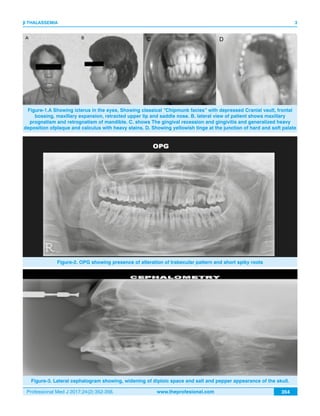
Extra oral examination findings, disclosed that
color of skin is light muddy black. Frontal and
parietal bossing are present. Depressed nasal
bridge is evident. Maxillary pragmatism is present.
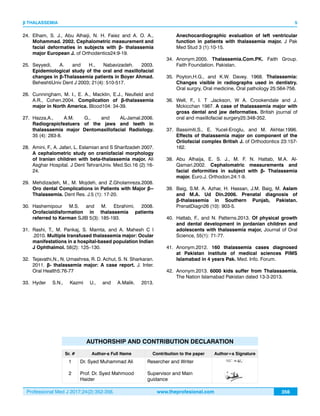
Radiographic findings(X- ray cephlomatric lateral
view) illustrated that class 2 skeletal patterns,
Mandibular retrognatism, high angle in dental
analysis, bimaxillary proclination in soft tissue
analysis, in competent lips, deep mento labial
sulcus skeletal high angle case and increase
lower facial height, widening of diploic space and
salt and pepper appearance of skull are present.
X ray OPG findings disclose that all permanent
teeth are presents. All 3rd
molar are present and
erupted. Periodontal recession of upper and low
anterior teeth vertical bone lose. Short spiky roots
and alteration of trabecular pattern is evident.
DISCUSSION
Generally the findings recorded in this case
confirm the work carried out by different worker
throughout the world19,23,25,30,32
Elhametal., (2002)19
and Hashemipour etal. (2007)22
, Bassimiti et al.
(1996)29
described mandible less enlarged than
maxilla and it is also found in the present case
report. Class 2 skeletal pattern was reported by
Aminiet al. (2007)24
Hattab &Patterns. (2013)27
and
in the present study the skeletal pattern class 2.
Depressednasalbridge,yellowtingeoralmucusa,
bimaxillary proclination, maxillary prognatism are
reported by Amini et al. (2007)20
Hashemipouri et
al. (2007)22
,Babu & Amitha (2014).31
Nagaraj et al.
(2011).42
And these all features are also present in
present study confirm their results. Malnourished,
underweight and short stature are very common
in thalassemic patient Anonym (2012)37
and it is
also true and found in present study. Generally
the skin color in thalassemic patient were reported
pale yellow.1,10,12,16
However skin muddy black is
also reported [41]. In our case the skin color of
patient is muddy black. Mamelons and space
between teeth are generally found in thalassemic
patient40,41
, but these features are not found in
this case. Short spiky roots and diploic space
reported by Patil [2006)17
, Hazza. etal. (2006)22
,
Rashin etal. (2010)23
, Babu & Amitha (2014)40
and
Nagaraj et al. (2011).41
Professional Med J 2017;24(2):352-356. www.theprofesional.com
β THALASSEMIA
354
3
Figure-1.A Showing icterus in the eyes, Showing classical “Chipmunk facies” with depressed Cranial vault, frontal
bossing, maxillary expansion, retracted upper lip and saddle nose. B. lateral view of patient shows maxillary
prognatism and retrognatism of mandible. C. shows The gingival recession and gingivitis and generalized heavy
deposition ofplaque and calculus with heavy stains. D. Showing yellowish tinge at the junction of hard and soft palate
Figure-2. OPG showing presence of alteration of trabecular pattern and short spiky roots
Figure-3. Lateral cephalogram showing, widening of diploic space and salt and pepper appearance of the skull.
Professional Med J 2017;24(2):352-356. www.theprofesional.com
β THALASSEMIA
355
4
CONCLUSION
Findings found In this case report are generally
agree with the previous work done in other
parts of world. However in the present study
teeth spaces among the teeth are not present.
Manifestation intensity in oral and maxillofacial
organs are comparatively low and this seems to
be due to starting of early age blood transfusion
and control on iron over load and thus the
abnormalities are not so prominent, where as
in the same family where blood transfusion was
not started early and properly two members of
the family died in thalassemia. In present study
patient with minimum abnormalities and reaching
the 25 years age is an achievement with the hope
that if patient will continue blood transfusion
regularly and continued treatment of over loading
of iron then, he will have a long spin of life.
Copyright© 15 Dec, 2016.
REFERENCES
1.	 Rund, D. and E. Rachmilewitz.2005. Medical progress
β-Thalassemia. NEJM353 (11): 1135-1146.
2.	 Verma, I. C., R. Saxena, and S. Kohli. 2011. Past,
present & future scenario of thalassaemic care &
control in India. Indian J Med Res134: 507-521.
3.	 Flint, J., F.M. Harding, A. J., Boyce and J. B., Clegg.1998.
The population genetics of haemoglobinopathies.
Bailliere;s Clin. Haematol.11 (1):1-15.
4.	 Hussain, R. 2000. Socio-demorphic correlates of in
Muslim population of Ind. J. BiosocialSci.32:433-444.
5.	 Jaber, L., G. J. Halpern, and M. Shohat.1998. The
impact of consanguinity worldwide. Community
Genetics 1: 12-17
6.	 Naidu L.D., S. M. Raju, and G, sumit. 2010. Effect of
consanguineous marriages on oral and cariofacial
structure: A study on dental patients in north India.
Annals Essences of Dentistry 2(4): 199-203
7.	 Thein, S. L., (2005). Genetic modifiers of β
-thalassamia. Haematologia. 90: 649-660.
8.	S. Riazuddin and R. Galanello. 2000. Identification of
three rare β-thalassemia mutations in the Pakistani
population. Hemoglobin24(1):15-22.
9.	 Raihan, S., G. Farooq, A., Salman and K., Mohammad.
2009. Thalassemia Major. Journal of the Pakistan
Medical Association 59(6):388-90.
10.	Galanello, R., and R. Origa. 2010. β-thalassemia
Orphanet Journal of Rare Diseases 2010, 5:11.
11.	 Khan, S. A., S.A., Khattak, A. Jaleel, N.A. Anwar, H.S.
Kashif. 2012. β-thalassemia and its association with
haematological parameters. J Pak Med Assoc. 62
(1):40-3.
12.	 Bejaoui, M and N. Guirat. 2013. β-Thalassemia Major
in a Developing Country: Epidemiological, Clinical
and Evolutionary Aspects Mediterr. J.Hemato. Infect.
Dis. 5(1): e2013002.
13.	 Kang, J. H. B. R. Park, K. S. Kim, D. Y. Kim, H. J. Huh,
S. L. Chae, S. J. Shin. 2013. β -Thalassemia Minor
Is Associated with IgA Nephropathy. Ann Lab Med
33(2): 153 – 155.
14.	Bunn.H.F.F.B.1984. Hamoglobin Moleculare Genetics
and clinical assessment. W. B. Saunders Copampany.
15.	Bridge, K., 1998. How do people get thalassemia?
Information center for sickle cell and thalassemia
disorder [cited 16/11/2007, available from http//
sickle bwh. Harvared. Edu / tha inheritance.html,].
16.	 Patil, S. 2006, Clinical and Radiological study of Oro-
facial manifestation in Thalassemia. Thesis of Master
of Dental surgery in oral Medicine and surgery. Deptt. of
Oral.
17.	 VandisM.L.andR.P.,Langlias.1986.Thethalassaemia:
Oral manifestations and complications. Oral surgery,
Oral Medicine, Oral Pathology62:229-223.
18.	Higgs, D. R., S. L, Thein and W.G.Wood., 2001.The
molecular pathology of thalassemias.
19.	 Old, J.M., N.I.Oliveri and S.L., Thein. 2001. Diagnosis
and management of Thalassemia in: Weather all, D.
J., B., Clegg, eds. The thalassemia syndromes 4th ed.
Oxford, England: Blackwell Sciene. 30-685.
20.	 Weatherall, D. J., B., Clegg, eds 2005. The thalassemia
syndromes 4th ed. Oxford, England: Blackwell Sciene.
30-685.
21.	Chakraborty and S.P. Basu. 1971. Observations
on radiological changes of bones in thalassemia
syndrome. J. Indian Medical Association 57:90-95.
22.	 Logothetis, J., J. Economidou, M. Constantoulakis, O.
Augoustaki, R.B. Lowe and M.
23.	 Bilek. 1971. Cephalo facial deformities in thalassemia
major (Cooley’s anemia): A corrective study among
138 cases. American J. Diseases in children 121:300-
306.
Professional Med J 2017;24(2):352-356. www.theprofesional.com
β THALASSEMIA
356
24.	 Elham, S. J., Abu Alhaiji, N. H. Faiez and A. O. A.,
Mohammad. 2002. Cephalometric measurement and
facial deformaties in subjects with β- thalassemia
major European J. of Orthodentics24:9-19.
25.	Seyyedi, A. and H., Nabavizadeh. 2003.
Epidemiological study of the oral and maxillofacial
changes in β-Thalassemia patients in Boyer Ahmad.
BeheshtiUniv Dent J 2003; 21(4): 510-517.
26.	 Cunningham, M. I., E. A., Macklin, E.J., Neufield and
A.R., Cohen.2004. Complication of β-thalassemia
major in North America. Blood104: 34-39.
27.	 Hazza,A., A.M. G., and AL-Jamal.2006.
Radiograpicfeatuers of the jaws and teeth in
thalassaemia major Dentomaxillofacial Radiology.
35 (4): 283-8.
28.	 Amini, F., A. Jafari, L. Eslamian and S Sharifzadeh 2007.
A cephalometric study on craniofacial morphology
of Iranian children with beta-thalassemia major. Ali
Asghar Hospital. J Dent TehranUniv. Med.Sci.16 (2):16-
24.
29.	 Mehdizadeh, M., M. Mojdeh, and Z.Gholamreza.2008.
Oro dental Complications in Patients with Major β--
Thalassemia. Dent Res. J.5 (1): 17-20.
30.	Hashemipour M.S. and M. Ebrahimi. 2008.
Orofacialdisformation in thalassemia patients
referred to Kerman SJIB 5(3): 185-193.
31.	Rashi, T., M. Pankaj, S. Mamta, and A. Mahesh C l
.2010. Multiple transfused thalassemia major: Ocular
manifestations in a hospital-based population Indian
J Ophthalmol. 58(2): 125–130.
32.	 Tejavathi,N., N. Umashrea, R. D. Achut, S. N. Sharkaran.
2011. β- thalassemia major: A case report. J. Inter.
Oral Health5:76-77
33.	Hyder S.N., Kazmi U., and A.Malik. 2013.
Anechocardiographic evaluation of left ventricular
function in patients with thalassemia major. J Pak
Med Stud 3 (1):10-15.
34.	Anonym.2005. Thalassemia.Com.PK. Faith Group.
Faith Foundation. Pakistan.
35.	Poyton,H.G., and K.W. Davey. 1968. Thalassemia:
Changes visible in radiographs used in dentistry.
Oral surgry, Oral medicine, Oral pathology 25:564-756.
36.	Well, F., I. T .Jackson, W A. Crookendale and J.
Mckicchan 1987. A case of thalassaemia major with
gross dental and jaw deformaties. British journal of
oral and maxillofacial surgery25:348-352.
37.	 Bassimiti,S., E. Yucel-Eroglu, and M. Akhtar.1996.
Effects of thalassemia major on component of the
Oriiofacial complex British J. of Orthodontics 23:157-
162.
38.	 Abu Alhaija, E. S. J., M. F. N. Hattab, M.A. Al-
Qamari.2002. Cephalomatric measurements and
facial deformities in subject with β- Thalassemia
major. Euro.J. Orthodon.24:1-9.
39.	 Baig, S.M. A. Azhar, H. Hassan, J.M. Baig, M. Aslam
and M.A. Ud Din.2006. Prenatal diagnosis of
β-thalassemia in Southern Punjab, Pakistan.
PrenatDiagn26 (10): 903-5.
40.	 Hattab, F., and N. Patterns.2013. Of physical growth
and dental development in jordanian children and
adolescents with thalassemia major, Journal of Oral
Science, 55(1): 71-77.
41.	Anonym.2012. 160 thalassemia cases diagnosed
at Pakistan institute of medical sciences PIMS
Islamabad in 4 years Pak. Med. Info. Forum.
42.	Anonym.2013. 6000 kids suffer from Thalassaemia.
The Nation Islamabad Pakistan dated 13-3-2013.
5
AUTHORSHIP AND CONTRIBUTION DECLARATION
Sr. # Author-s Full Name Contribution to the paper Author=s Signature
1
2
Dr. Syed Muhammad Ali
Prof. Dr. Syed Mahmood
Haider
Resercher and Writer
Supervisor and Main
guidance

Prof 3556

  • 1.
    Professional Med J2017;24(2):352-356. www.theprofesional.com β THALASSEMIA 352 The Professional Medical Journal www.theprofesional.com β THALASSEMIA; A CASE REPORT OF ORAL AND MAXILLOFACIAL MANIFESTATION FROM POPULATION OF KARACHI PAKISTAN Dr. Syed Muhammad Ali1 , Prof. Dr. Syed Mahmood Haider2 CASE REPORT PROF-3556 ABSTRACT: Thalassemia is a single gene inherited blood diseases. Its causes abnormalities in in various human organ including oral and maxillofacial regions. A case report of 25 years old, β thalassemia patient from Karachi Pakistan. It is evident from this case report that if blood transfusion start regularly from early age and iron overload is controlled by proper drugs, then intensity of manifestation in oral and maxillofacial regions becomes less and thus increasing life span probability. Key words: β-thalassemia, Oral and Maxillofacial manifestation. 1. BDS, MS Scholar 0ral Surgery, Karachi Medical and Dental College, University of Karachi (Karachi Medical and Dental College) 2. BDS, MSc, FDSRCS, FFDRCSI, FCPS, FDS, RCPS Professor, Head Department of Oral Surgery, Head of Dentistry and Vice Principal Karachi Medical and Dental College. Correspondence Address: Dr. Syed Muhammad Ali Department of Oral Surgery Karachi Medical and Dental College alischolar14@gmail.com Article received on: 02/08/2016 Accepted for publication: 15/12/2016 Received after proof reading: 14/02/2017 Article Citation: Ali SM, Haider SM. β thalassemia; a case report of oral and maxillofacial manifestation from population of Karachi Pakistan. Professional Med J 2017;24(2):352-356. DOI: 10.17957/TPMJ/17.3556 INTRODUCTION Thalassemia is an inherited, autosomal, single gene recessive blood disease which is characterized by reduced or absent amount of hemoglobin.1-3 The disease is common in peoples living in Mediterranean geographical region.4 It is also very common in low socio-economic groups and countries5 and in families where consanguineous marriages are common.6,7 Hemoglobin is composed of four protein chains, two α and two β globin chains arranged into a hetro-tetramer.8 In thalassemia patients defects have in either the α or β globin chain causing production of abnormal red blood cells.2 β-thalassemia in patients occur in two ways. (1. Transfer of recessive gene from parents to off spring 2) Due to mutations in the HB β gene on autosomal chromosome No. 11. The severity of the disease depends on No. of mutation of genes present in patients. Mutations are characterized as either βo or β.+. According to the severity, β-thalassemia are classified into three type of β-thalassemia. 1) Thalassemia major, 2) Thalassemia intermediate, and 3). Thalassemia minor.12 In thalassemia due to lack of total or partial pro- duction of α or β or globin results serious effects on their bodies,2,3,9,11,13-16 Beta thalassemia is also responsible of causing various manifestations and complications, resulting multisystem com- plications due to chronic anemia, iron overload, adverse effects of chelation, and infection due to transfusion. Thus, just a simple hemolytic disease ‘anemia’ change to a chronic disease with involv- ing various organs with various degree of defor- mities.1,17–27 Anemia due to thalassemia causes body system more physiological activate and bone marrow to compensate blood deficiency. In thalassemia major, involvement of the facial skeleton resulting in severe disfigurement has been described in several reports.17-19,23,25,33,28-36 Under the influence of the disorder the typical facial appearance develops; high and bulging cheek bones, retraction of the upper lip, protrusion of the anterior teeth and spacing in other teeth, over- bite or open-bite, and varying degrees of malocclusion. The skeletal changes are the result of proliferation of the bone marrow in the facial skeleton.22 The proliferated bone marrow is extensively used as an ancillary hematopoietic organ to compensate for the chronic hemolysis. Usually the mandible becomes less enlarged than the maxilla. The dense cortical plates of the DOI: 10.17957/TPMJ/17.3556
  • 2.
    Professional Med J2017;24(2):352-356. www.theprofesional.com β THALASSEMIA 353 2 mandible apparently prevent the expansion. The bony changes may occur early in life and tend to persist, particularly in skull.16,25,32,36 Furthermore tint of lemon color is observed in oral mucosa. CASE REPORT A registered 25year old male β thalassemic patient coming at Husaini blood bank and Institute of Hematological diseases Karachi for blood transfusion and iron therapy was randomly selected for Clinical and Radiological Studies of Oral and Maxillofacial manifestation as case report. He is habitual of pan and betel nut chewing since childhood. His mother tongue is Sindhi. He belongs to a low income family and is not able to afford thalassemic treatment expenses. His family consist of 9 members. Mother and father are normal (carrier). One sister of 12 years and one brother of 11 years died in β - thalassemia. Rest of four members are phenotypically healthy (Carrier). Patient was regularly blood transfused from the age of 5years. From the last three years, he has been coming to Husaini blood bank and InstituteofHematologicaldiseasesKarachiforfree blood transfusion and iron over loaded treatment and his blood transfusion motivation is internal. He has enlarged spleen but Spleenectomy was not carried out. He has complain of pain in his joints for last three months and also complain of bleeding gum during brushing and sensitive teeth to hot and cold. On general examination, he looks under-built, under-nourished and short stature, with evident icterus, and yellow tinged finger nails. Intra oral examination showed intra oral pigmentation on hard palate and buccal mucosa. Spacing are not evident. Proclination of upper anterior teeth are prominent. Multiple decayed teeth with heavy deposition of calculus and plaque on upper and lower teeth with dark stains are prominent. Mamelons are not present and intra oral color of mucosa is pale yellow. Extra oral examination findings, disclosed that color of skin is light muddy black. Frontal and parietal bossing are present. Depressed nasal bridge is evident. Maxillary pragmatism is present. Radiographic findings(X- ray cephlomatric lateral view) illustrated that class 2 skeletal patterns, Mandibular retrognatism, high angle in dental analysis, bimaxillary proclination in soft tissue analysis, in competent lips, deep mento labial sulcus skeletal high angle case and increase lower facial height, widening of diploic space and salt and pepper appearance of skull are present. X ray OPG findings disclose that all permanent teeth are presents. All 3rd molar are present and erupted. Periodontal recession of upper and low anterior teeth vertical bone lose. Short spiky roots and alteration of trabecular pattern is evident. DISCUSSION Generally the findings recorded in this case confirm the work carried out by different worker throughout the world19,23,25,30,32 Elhametal., (2002)19 and Hashemipour etal. (2007)22 , Bassimiti et al. (1996)29 described mandible less enlarged than maxilla and it is also found in the present case report. Class 2 skeletal pattern was reported by Aminiet al. (2007)24 Hattab &Patterns. (2013)27 and in the present study the skeletal pattern class 2. Depressednasalbridge,yellowtingeoralmucusa, bimaxillary proclination, maxillary prognatism are reported by Amini et al. (2007)20 Hashemipouri et al. (2007)22 ,Babu & Amitha (2014).31 Nagaraj et al. (2011).42 And these all features are also present in present study confirm their results. Malnourished, underweight and short stature are very common in thalassemic patient Anonym (2012)37 and it is also true and found in present study. Generally the skin color in thalassemic patient were reported pale yellow.1,10,12,16 However skin muddy black is also reported [41]. In our case the skin color of patient is muddy black. Mamelons and space between teeth are generally found in thalassemic patient40,41 , but these features are not found in this case. Short spiky roots and diploic space reported by Patil [2006)17 , Hazza. etal. (2006)22 , Rashin etal. (2010)23 , Babu & Amitha (2014)40 and Nagaraj et al. (2011).41
  • 3.
    Professional Med J2017;24(2):352-356. www.theprofesional.com β THALASSEMIA 354 3 Figure-1.A Showing icterus in the eyes, Showing classical “Chipmunk facies” with depressed Cranial vault, frontal bossing, maxillary expansion, retracted upper lip and saddle nose. B. lateral view of patient shows maxillary prognatism and retrognatism of mandible. C. shows The gingival recession and gingivitis and generalized heavy deposition ofplaque and calculus with heavy stains. D. Showing yellowish tinge at the junction of hard and soft palate Figure-2. OPG showing presence of alteration of trabecular pattern and short spiky roots Figure-3. Lateral cephalogram showing, widening of diploic space and salt and pepper appearance of the skull.
  • 4.
    Professional Med J2017;24(2):352-356. www.theprofesional.com β THALASSEMIA 355 4 CONCLUSION Findings found In this case report are generally agree with the previous work done in other parts of world. However in the present study teeth spaces among the teeth are not present. Manifestation intensity in oral and maxillofacial organs are comparatively low and this seems to be due to starting of early age blood transfusion and control on iron over load and thus the abnormalities are not so prominent, where as in the same family where blood transfusion was not started early and properly two members of the family died in thalassemia. In present study patient with minimum abnormalities and reaching the 25 years age is an achievement with the hope that if patient will continue blood transfusion regularly and continued treatment of over loading of iron then, he will have a long spin of life. Copyright© 15 Dec, 2016. REFERENCES 1. Rund, D. and E. Rachmilewitz.2005. Medical progress β-Thalassemia. NEJM353 (11): 1135-1146. 2. Verma, I. C., R. Saxena, and S. Kohli. 2011. Past, present & future scenario of thalassaemic care & control in India. Indian J Med Res134: 507-521. 3. Flint, J., F.M. Harding, A. J., Boyce and J. B., Clegg.1998. The population genetics of haemoglobinopathies. Bailliere;s Clin. Haematol.11 (1):1-15. 4. Hussain, R. 2000. Socio-demorphic correlates of in Muslim population of Ind. J. BiosocialSci.32:433-444. 5. Jaber, L., G. J. Halpern, and M. Shohat.1998. The impact of consanguinity worldwide. Community Genetics 1: 12-17 6. Naidu L.D., S. M. Raju, and G, sumit. 2010. Effect of consanguineous marriages on oral and cariofacial structure: A study on dental patients in north India. Annals Essences of Dentistry 2(4): 199-203 7. Thein, S. L., (2005). Genetic modifiers of β -thalassamia. Haematologia. 90: 649-660. 8. S. Riazuddin and R. Galanello. 2000. Identification of three rare β-thalassemia mutations in the Pakistani population. Hemoglobin24(1):15-22. 9. Raihan, S., G. Farooq, A., Salman and K., Mohammad. 2009. Thalassemia Major. Journal of the Pakistan Medical Association 59(6):388-90. 10. Galanello, R., and R. Origa. 2010. β-thalassemia Orphanet Journal of Rare Diseases 2010, 5:11. 11. Khan, S. A., S.A., Khattak, A. Jaleel, N.A. Anwar, H.S. Kashif. 2012. β-thalassemia and its association with haematological parameters. J Pak Med Assoc. 62 (1):40-3. 12. Bejaoui, M and N. Guirat. 2013. β-Thalassemia Major in a Developing Country: Epidemiological, Clinical and Evolutionary Aspects Mediterr. J.Hemato. Infect. Dis. 5(1): e2013002. 13. Kang, J. H. B. R. Park, K. S. Kim, D. Y. Kim, H. J. Huh, S. L. Chae, S. J. Shin. 2013. β -Thalassemia Minor Is Associated with IgA Nephropathy. Ann Lab Med 33(2): 153 – 155. 14. Bunn.H.F.F.B.1984. Hamoglobin Moleculare Genetics and clinical assessment. W. B. Saunders Copampany. 15. Bridge, K., 1998. How do people get thalassemia? Information center for sickle cell and thalassemia disorder [cited 16/11/2007, available from http// sickle bwh. Harvared. Edu / tha inheritance.html,]. 16. Patil, S. 2006, Clinical and Radiological study of Oro- facial manifestation in Thalassemia. Thesis of Master of Dental surgery in oral Medicine and surgery. Deptt. of Oral. 17. VandisM.L.andR.P.,Langlias.1986.Thethalassaemia: Oral manifestations and complications. Oral surgery, Oral Medicine, Oral Pathology62:229-223. 18. Higgs, D. R., S. L, Thein and W.G.Wood., 2001.The molecular pathology of thalassemias. 19. Old, J.M., N.I.Oliveri and S.L., Thein. 2001. Diagnosis and management of Thalassemia in: Weather all, D. J., B., Clegg, eds. The thalassemia syndromes 4th ed. Oxford, England: Blackwell Sciene. 30-685. 20. Weatherall, D. J., B., Clegg, eds 2005. The thalassemia syndromes 4th ed. Oxford, England: Blackwell Sciene. 30-685. 21. Chakraborty and S.P. Basu. 1971. Observations on radiological changes of bones in thalassemia syndrome. J. Indian Medical Association 57:90-95. 22. Logothetis, J., J. Economidou, M. Constantoulakis, O. Augoustaki, R.B. Lowe and M. 23. Bilek. 1971. Cephalo facial deformities in thalassemia major (Cooley’s anemia): A corrective study among 138 cases. American J. Diseases in children 121:300- 306.
  • 5.
    Professional Med J2017;24(2):352-356. www.theprofesional.com β THALASSEMIA 356 24. Elham, S. J., Abu Alhaiji, N. H. Faiez and A. O. A., Mohammad. 2002. Cephalometric measurement and facial deformaties in subjects with β- thalassemia major European J. of Orthodentics24:9-19. 25. Seyyedi, A. and H., Nabavizadeh. 2003. Epidemiological study of the oral and maxillofacial changes in β-Thalassemia patients in Boyer Ahmad. BeheshtiUniv Dent J 2003; 21(4): 510-517. 26. Cunningham, M. I., E. A., Macklin, E.J., Neufield and A.R., Cohen.2004. Complication of β-thalassemia major in North America. Blood104: 34-39. 27. Hazza,A., A.M. G., and AL-Jamal.2006. Radiograpicfeatuers of the jaws and teeth in thalassaemia major Dentomaxillofacial Radiology. 35 (4): 283-8. 28. Amini, F., A. Jafari, L. Eslamian and S Sharifzadeh 2007. A cephalometric study on craniofacial morphology of Iranian children with beta-thalassemia major. Ali Asghar Hospital. J Dent TehranUniv. Med.Sci.16 (2):16- 24. 29. Mehdizadeh, M., M. Mojdeh, and Z.Gholamreza.2008. Oro dental Complications in Patients with Major β-- Thalassemia. Dent Res. J.5 (1): 17-20. 30. Hashemipour M.S. and M. Ebrahimi. 2008. Orofacialdisformation in thalassemia patients referred to Kerman SJIB 5(3): 185-193. 31. Rashi, T., M. Pankaj, S. Mamta, and A. Mahesh C l .2010. Multiple transfused thalassemia major: Ocular manifestations in a hospital-based population Indian J Ophthalmol. 58(2): 125–130. 32. Tejavathi,N., N. Umashrea, R. D. Achut, S. N. Sharkaran. 2011. β- thalassemia major: A case report. J. Inter. Oral Health5:76-77 33. Hyder S.N., Kazmi U., and A.Malik. 2013. Anechocardiographic evaluation of left ventricular function in patients with thalassemia major. J Pak Med Stud 3 (1):10-15. 34. Anonym.2005. Thalassemia.Com.PK. Faith Group. Faith Foundation. Pakistan. 35. Poyton,H.G., and K.W. Davey. 1968. Thalassemia: Changes visible in radiographs used in dentistry. Oral surgry, Oral medicine, Oral pathology 25:564-756. 36. Well, F., I. T .Jackson, W A. Crookendale and J. Mckicchan 1987. A case of thalassaemia major with gross dental and jaw deformaties. British journal of oral and maxillofacial surgery25:348-352. 37. Bassimiti,S., E. Yucel-Eroglu, and M. Akhtar.1996. Effects of thalassemia major on component of the Oriiofacial complex British J. of Orthodontics 23:157- 162. 38. Abu Alhaija, E. S. J., M. F. N. Hattab, M.A. Al- Qamari.2002. Cephalomatric measurements and facial deformities in subject with β- Thalassemia major. Euro.J. Orthodon.24:1-9. 39. Baig, S.M. A. Azhar, H. Hassan, J.M. Baig, M. Aslam and M.A. Ud Din.2006. Prenatal diagnosis of β-thalassemia in Southern Punjab, Pakistan. PrenatDiagn26 (10): 903-5. 40. Hattab, F., and N. Patterns.2013. Of physical growth and dental development in jordanian children and adolescents with thalassemia major, Journal of Oral Science, 55(1): 71-77. 41. Anonym.2012. 160 thalassemia cases diagnosed at Pakistan institute of medical sciences PIMS Islamabad in 4 years Pak. Med. Info. Forum. 42. Anonym.2013. 6000 kids suffer from Thalassaemia. The Nation Islamabad Pakistan dated 13-3-2013. 5 AUTHORSHIP AND CONTRIBUTION DECLARATION Sr. # Author-s Full Name Contribution to the paper Author=s Signature 1 2 Dr. Syed Muhammad Ali Prof. Dr. Syed Mahmood Haider Resercher and Writer Supervisor and Main guidance