By: Slide_Maker4u
(Abhishek Sharma)
Introduction
 Tipu Sultan was a ruler of the
Kingdom of Mysore renowned for
his bravery in the wars against the
British East India Company. Well
known for his valor and courage,
he is regarded as the first freedom
fighter of India for his fierce battles
against the British who tried to
conquer the territories under the
sultan’s rule. The Treaty of
Mangalore, which he signed with
the British East India Company to
bring an end to the Second Anglo-
Mysore War, was the last occasion
when an Indian king dictated
terms to the British. As the eldest
son of Sultan Hyder Ali of Mysore,
Tipu Sultan ascended to the throne
after the death of his father in
1782.
Childhood & Early Life
 Tipu Sultan was born on 20 November 1750 in
present-day Bengaluru Rural district to Hyder
Ali. His father was a military officer in service
to the Kingdom of Mysore in southern India
who rapidly rose in power to become the de
facto ruler of the Kingdom of Mysore in 1761.
 Hyder Ali, who himself was illiterate, was very
particular about giving his eldest son a good
education befitting a prince. Tipu Sultan
received education in subjects like Hindustani
language (Hindi-Urdu), Persian, Arabic,
Kannada, Quran, Islamic jurisprudence,
riding, shooting and fencing.
 His father had political relations with the
French and thus the young prince was trained
in military and political affairs by highly
efficient French officers. He was just 15 when
he accompanied his father against the British
in the First Mysore War in 1766.
 Over the years Hyder went on to become the
most powerful ruler in the entire southern
India and Tipu Sultan played significant roles
in his father’s successful military campaigns.
 In 1779, the British captured the French-
controlled port of Mahé, which was under Tipu’s
protection. Hyder Ali opened hostilities against
the British in retaliation in 1780, and achieved
significant success in early campaigns of what
became known as Second Anglo-Mysore War.
However as the war progressed, Hyder Ali
became ill with cancer and died in December
1782.
 Following the death of his father, Tipu Sultan
was made the ruler of Mysore on 22 December
1782. He immediately started working on
military strategies to check the advances of the
British by making alliances with the Marathas
and the Mughals. Eventually he was successful
in signing the Treaty of Mangalore with the
British in 1784, bringing an end to the Second
Mysore War.
 As a ruler, Tipu Sultan proved to be an efficient
one. He completed the projects left behind by
his father, built roads, bridges, public buildings,
ports, etc. and also made numerous military
innovations in the use of rocketry in wars.
Through his determined efforts, he built a
formidable military force that inflicted serious
damages to the British forces.
 The Maharajah of Travancore appealed to
the East India Company for help, and in
response, Lord Cornwallis formed
alliances with the Marathas and the
Nizam of Hyderabad to oppose Tipu and
built a strong military force.
 The company forces attacked Tipu Sultan
in 1790 and soon took control over much
of the Coimbatore district. Tipu
counterattacked, but was not much
successful in his campaigns. The conflicts
continued for over two years and ended
only after he signed the Treaty of
Seringapatam in 1792 which resulted in
his losing a number of territories,
including Malabar and Mangalore.
 Even though he had lost many of his
territories, the courageous Tipu Sultan
was still considered a formidable enemy
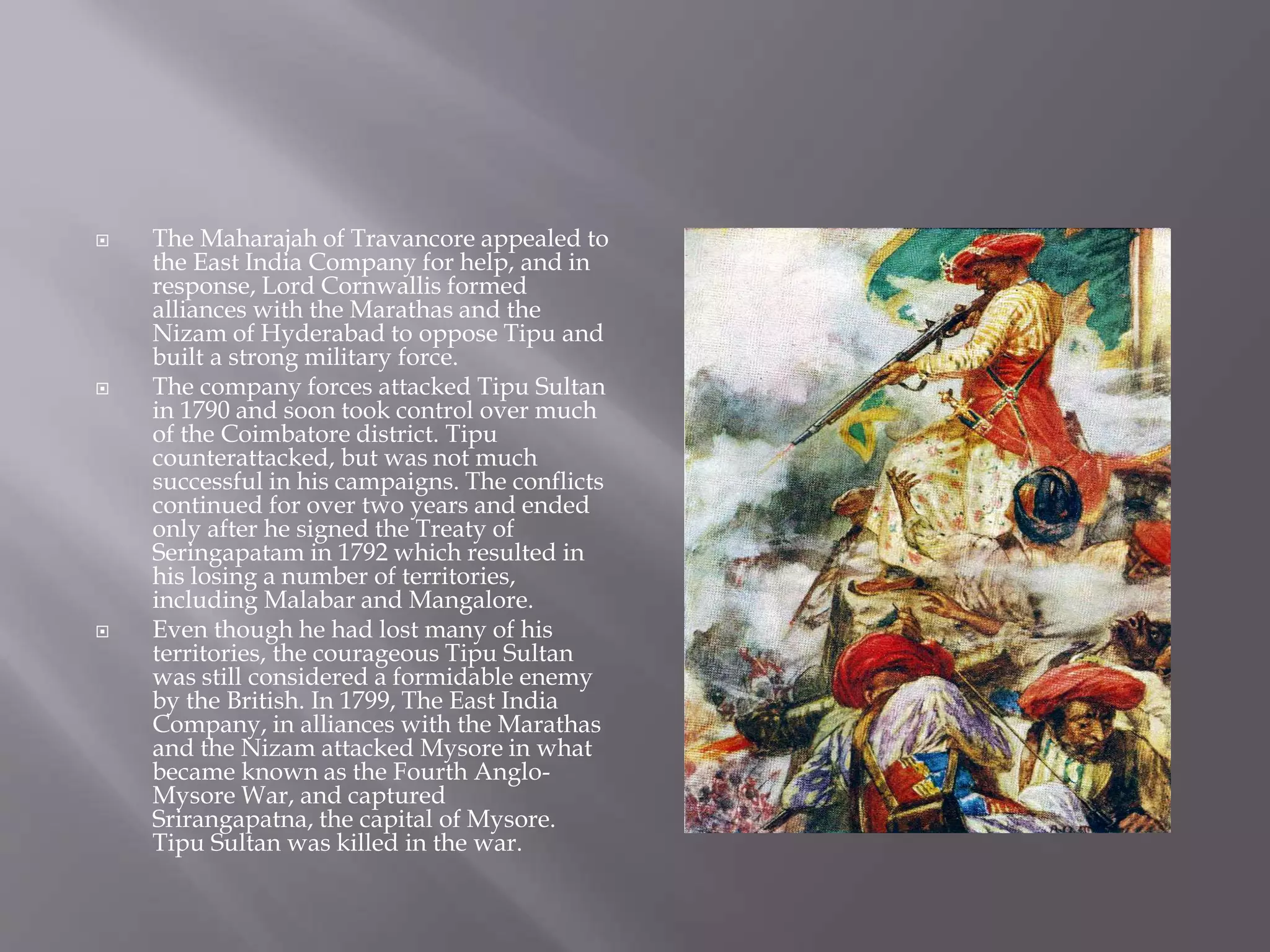
by the British. In 1799, The East India
Company, in alliances with the Marathas
and the Nizam attacked Mysore in what
became known as the Fourth Anglo-
Mysore War, and captured
Srirangapatna, the capital of Mysore.
Tipu Sultan was killed in the war.
Major Wars
 He was a brave warrior and proved his
mettle in the Second Anglo-Mysore
War. Dispatched by his father to fight
the British forces, he displayed great
courage in the initial conflicts. His
father died in the middle of the war and
he succeeded him as the ruler of
Mysore in 1782 and successfully ended
the war with the Treaty of Mangalore in
1784.
 The Third Anglo-Mysore War was
another major war he fought against
the British forces. This war, however,
proved to be a major failure and cost
the sultan dearly. The war ended with
the Treaty of Seringapatam according
to which he had to give up about one-
half of his territories to the other
signatories which included the British
East India Company, representatives of
the Nizam of Hyderabad and the
Mahratta Empire.
Personal Life & Legacy
 Tipu Sultan had several wives and
numerous children including Shahzada
Hyder Ali Sultan, Shahzada Abdul
Khaliq Sultan, Shahzada Muhi-ud-din
Sultan, and Shahzada Mu'izz-ud-din
Sultan.
 A brave warrior, he died on 4 May 1799
while fighting the British forces in the
Fourth Anglo-Mysore War. As one of
the first Indian kings to have died on
the battlefield while defending his
kingdom against the Colonial British,
he was officially recognized by the
Government of India as a freedom
fighter.
 While he is revered as a hero of the
Indian independence movement in
several regions in India and Pakistan,
he is also regarded as a tyrannical ruler
in certain regions in India.
 The British Army's National Army
Museum ranked Tipu Sultan among the
greatest enemy commanders the British
Army ever faced.
Trivia
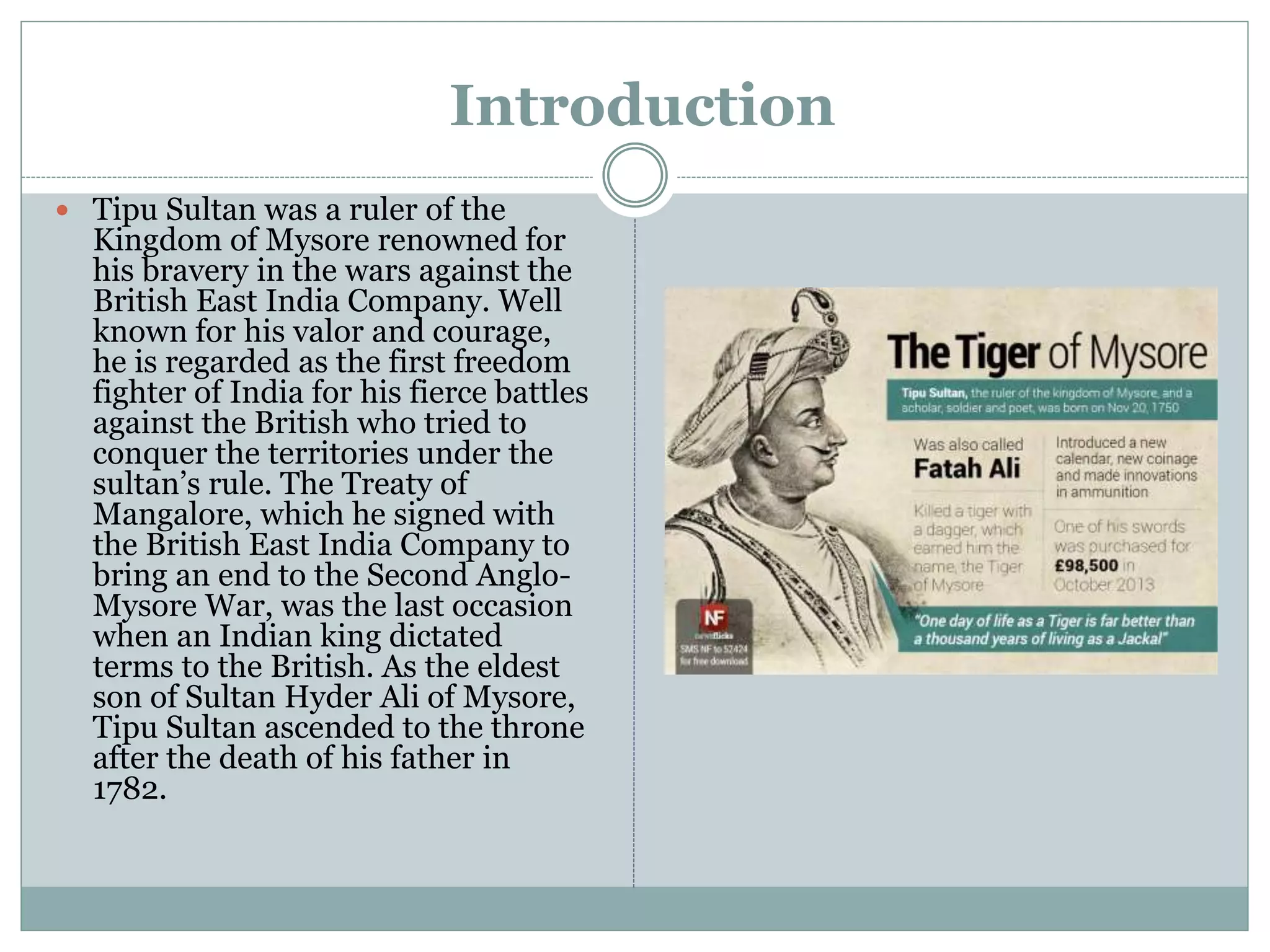
 Tipu was commonly
known as the Tiger of
Mysore and he adopted
this animal as the symbol
(bubri/ babri) of his rule.
 Dr APJ Abdul Kalam, the
former President of
India, called Tipu Sultan
the innovator of the
world's first war rocket.
Here is another creative presentation by your slide
maker on the topic
“Tipu Sultan".
Hope you like it. If you like it then please, *like*,
*Download* and *Share*.
By- Slide_maker4u (Abhishek Sharma)
*******For presentation Orders, contact me on
the Email addresses Written below********
Email- Sharmaabhishek576@gmail.com
or
Sharmacomputers87@gmail.com
*******THANK YOU***************
Tipu sultan

Tipu sultan

  • 1.
  • 2.
    Introduction  Tipu Sultanwas a ruler of the Kingdom of Mysore renowned for his bravery in the wars against the British East India Company. Well known for his valor and courage, he is regarded as the first freedom fighter of India for his fierce battles against the British who tried to conquer the territories under the sultan’s rule. The Treaty of Mangalore, which he signed with the British East India Company to bring an end to the Second Anglo- Mysore War, was the last occasion when an Indian king dictated terms to the British. As the eldest son of Sultan Hyder Ali of Mysore, Tipu Sultan ascended to the throne after the death of his father in 1782.
  • 3.
    Childhood & EarlyLife  Tipu Sultan was born on 20 November 1750 in present-day Bengaluru Rural district to Hyder Ali. His father was a military officer in service to the Kingdom of Mysore in southern India who rapidly rose in power to become the de facto ruler of the Kingdom of Mysore in 1761.  Hyder Ali, who himself was illiterate, was very particular about giving his eldest son a good education befitting a prince. Tipu Sultan received education in subjects like Hindustani language (Hindi-Urdu), Persian, Arabic, Kannada, Quran, Islamic jurisprudence, riding, shooting and fencing.  His father had political relations with the French and thus the young prince was trained in military and political affairs by highly efficient French officers. He was just 15 when he accompanied his father against the British in the First Mysore War in 1766.  Over the years Hyder went on to become the most powerful ruler in the entire southern India and Tipu Sultan played significant roles in his father’s successful military campaigns.
  • 4.
     In 1779,the British captured the French- controlled port of Mahé, which was under Tipu’s protection. Hyder Ali opened hostilities against the British in retaliation in 1780, and achieved significant success in early campaigns of what became known as Second Anglo-Mysore War. However as the war progressed, Hyder Ali became ill with cancer and died in December 1782.  Following the death of his father, Tipu Sultan was made the ruler of Mysore on 22 December 1782. He immediately started working on military strategies to check the advances of the British by making alliances with the Marathas and the Mughals. Eventually he was successful in signing the Treaty of Mangalore with the British in 1784, bringing an end to the Second Mysore War.  As a ruler, Tipu Sultan proved to be an efficient one. He completed the projects left behind by his father, built roads, bridges, public buildings, ports, etc. and also made numerous military innovations in the use of rocketry in wars. Through his determined efforts, he built a formidable military force that inflicted serious damages to the British forces.
  • 5.
     The Maharajahof Travancore appealed to the East India Company for help, and in response, Lord Cornwallis formed alliances with the Marathas and the Nizam of Hyderabad to oppose Tipu and built a strong military force.  The company forces attacked Tipu Sultan in 1790 and soon took control over much of the Coimbatore district. Tipu counterattacked, but was not much successful in his campaigns. The conflicts continued for over two years and ended only after he signed the Treaty of Seringapatam in 1792 which resulted in his losing a number of territories, including Malabar and Mangalore.  Even though he had lost many of his territories, the courageous Tipu Sultan was still considered a formidable enemy by the British. In 1799, The East India Company, in alliances with the Marathas and the Nizam attacked Mysore in what became known as the Fourth Anglo- Mysore War, and captured Srirangapatna, the capital of Mysore. Tipu Sultan was killed in the war.
  • 6.
    Major Wars  Hewas a brave warrior and proved his mettle in the Second Anglo-Mysore War. Dispatched by his father to fight the British forces, he displayed great courage in the initial conflicts. His father died in the middle of the war and he succeeded him as the ruler of Mysore in 1782 and successfully ended the war with the Treaty of Mangalore in 1784.  The Third Anglo-Mysore War was another major war he fought against the British forces. This war, however, proved to be a major failure and cost the sultan dearly. The war ended with the Treaty of Seringapatam according to which he had to give up about one- half of his territories to the other signatories which included the British East India Company, representatives of the Nizam of Hyderabad and the Mahratta Empire.
  • 7.
    Personal Life &Legacy  Tipu Sultan had several wives and numerous children including Shahzada Hyder Ali Sultan, Shahzada Abdul Khaliq Sultan, Shahzada Muhi-ud-din Sultan, and Shahzada Mu'izz-ud-din Sultan.  A brave warrior, he died on 4 May 1799 while fighting the British forces in the Fourth Anglo-Mysore War. As one of the first Indian kings to have died on the battlefield while defending his kingdom against the Colonial British, he was officially recognized by the Government of India as a freedom fighter.  While he is revered as a hero of the Indian independence movement in several regions in India and Pakistan, he is also regarded as a tyrannical ruler in certain regions in India.  The British Army's National Army Museum ranked Tipu Sultan among the greatest enemy commanders the British Army ever faced.
  • 8.
    Trivia  Tipu wascommonly known as the Tiger of Mysore and he adopted this animal as the symbol (bubri/ babri) of his rule.  Dr APJ Abdul Kalam, the former President of India, called Tipu Sultan the innovator of the world's first war rocket.
  • 9.
    Here is anothercreative presentation by your slide maker on the topic “Tipu Sultan". Hope you like it. If you like it then please, *like*, *Download* and *Share*. By- Slide_maker4u (Abhishek Sharma) *******For presentation Orders, contact me on the Email addresses Written below******** Email- Sharmaabhishek576@gmail.com or Sharmacomputers87@gmail.com *******THANK YOU***************