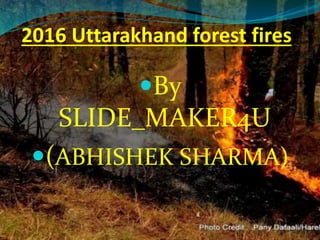
2016 Uttarakhand forest fires
By
SLIDE_MAKER4U
(ABHISHEK SHARMA)
Introduction
 In 2016, forest fires have been noted in
numerous places across the Indian state
of Uttarakhand. These fires, set mainly
in pine forests in the slopes of the sub-
Himalayan region, produced clouds of
smoke. Widespread comments in the
Indian news media led to the
government taking action, deploying
the National Disaster Response
Force and making use of Indian Air
Force Mi-17helicopters fitted
with "Bambi buckets" to douse the fires
with water.[2] The forest department
estimated that 3,500 hectares (8,600
acres) of forest had been burnt.[1] Nearly
1,600 incidences of fires were detected
which were brought under control by 2
May. The rains on 3 May helped in
reducing the impact of fires.
 Human-made forest fires in the Himalayan state of
Uttarakhand have been a regular and historic
feature. Major fires have been noted in 1911, 1921,
1930, 1931, 1939, 1945, 1953, 1954, 1957, 1958,
1959, 1961, 1964, 1966, 1968, 1970, 1972 and 1995.
Some fires during 1921, 1930 and 1942 have been
associated with popular movements against the
then British government's forestry policies and for
independence. Most of these fires occur in the chir
pine zone. Forests with chir pine (Pinus roxburghii)
are very prone to fire, as their foliage easily catches
fire. But the pine itself is resistant to it and these
fires help in their regeneration by reducing coverage
of broad-leaf trees leading to an increase in the land
covered by chir pine.The broad-leaved forest is
dominated by oak species, including Banj oak
(Quercus leucotrichophora).
 Resin is harvested from these
pines, and fires are often
intentionally set to remove the
carpet of pine needles that come
in the way of harvesting
activity.In June 1981, a blanket
ban was introduced against
felling of standing trees
1000 metres above sea level, and
this ban comes in the way of
removing pine trees in the areas
where they are invading. Apart
from accidental fires, a number of
causes and motivations for setting
fires have been noted which
include encroachment on forest
lands and concealing illegal
timber extraction. Fires are also
set by honey and sal seed
collectors, to scare away wild
animals, or to improve grass
growth.
 Fires destroy biodiversity
directly and have more
indirect long-term impacts
including the encouragement
of fire and pioneer species. It
has been suggested that the
dark carbon dust emitted by
the fires deposited on
Himalayan glaciers could
hasten their melting. This
could affect the hydrology of
the rivers that are a source of
water for human populations
in northern India.[8]The
average temperature of
northern India saw increase
of 0.2°C.
 Seven fatalities were reported as of 4 May
2016.[1] The Pinegrove School, a boarding
school at Kasauli, was evacuated as fires
had reached the compound
walls.[10] Tourism and wildlife at theCorbett
National Park and Rajaji Tiger
reserve regions were affected.[11] Various
other locations in these Himalayan states
of Uttarakhand and Himachal Pradesh are
tourist attractions in summer, and they now
face heavy air pollution.[12] The forest fires
also disrupted the functioning of theKalka–
Shimla Railway line.[13] On 3 May, the
forest department estimated the monetary
losses at approximately ₹29
lakh (US$43,000). The estimate is based
on the standard rule book followed by the
department with empirical formulae for
such calculations. Various ecologists and
environmental activists have disregarded
the estimate, noting that it does not take
into account ecological and wildlife losses.
They added that these fires have also
destroyed vegetation which holds rainfall,
which might result in floods in the monsoon
season.
 Scientists of the Govind Ballabh
Pant Institute of Himalayan
Environment and
Development formed a team to
survey the area and study the
effects of the fires on the melting
of glaciers.[9] Ecologists
suggested that clearing of forest
floors of the fallen pine leaves,
which are readily combustible,
should be undertaken by forest
department as well as locals on a
grassroots level to prevent such
major fire outbreaks. Production
of biomass briquettes from these
pine needles should be
promoted, serving as a source of
fuel as well as a solution to
prevent wildfires.
 Various incidences of fires were
reported in the month of April.[16] On
30 April, National Disaster Response
Force was deployed for rescue
operations in
the Kumaon andGarhwal areas.
Around 6,000 personnel from the
Forest Department were deployed. As
of 30 April 2016, 922 incidences of
fire were reported affecting around
2,000 hectares (4,900 acres) of
forest area.[2] The Mi-17 helicopters
of the Indian Air Force with "Bambi
buckets" were used to douse the fires
with water. However, the
heavy smog that developed in the
area affected the aerial operations of
the army.[17] The affected area later
increased to around 3,500 hectares
(8,600 acres), extending
into Himachal Pradesh. The regions
saw rainfalls on 3 May ranging from
7 mm to 11 mm, which helped in
controlling the fire.
 Reports were published in the local
media which variously blamed local
people and timber mafia for the
forest fires. Environmental
journalist Bahar Dutt blamed the
television media for their "Delhi-
centric world view" that disregarded
the historical and ecological natural
causes of fire, due to the high
density of pine trees that increases
the fire hazards.[18] Various tourism-
related associations noted that the
exaggerated representation of the
fires by the media could reduce
tourism, a major part of the state
economy. Drops in tourism were
seen after the 2013 North India
floods and April 2015 Nepal
earthquake due to media reports
Here is another creative presentation by your slide maker on
the topic
“2016 UTTARAKHAND FOREST FIRES". Hope you like it. If
you like it then please, *like*, *Download* and *Share*.
By- Slide_maker4u (Abhishek Sharma)
*******For presentation Orders, contact me on the Email
addresses Written below********
Email- Sharmaabhishek576@gmail.com
or
Sharmacomputers87@gmail.com
*******THANKYOU***************
Forest fires in india

Forest fires in india

  • 1.
    2016 Uttarakhand forestfires By SLIDE_MAKER4U (ABHISHEK SHARMA)
  • 2.
    Introduction  In 2016,forest fires have been noted in numerous places across the Indian state of Uttarakhand. These fires, set mainly in pine forests in the slopes of the sub- Himalayan region, produced clouds of smoke. Widespread comments in the Indian news media led to the government taking action, deploying the National Disaster Response Force and making use of Indian Air Force Mi-17helicopters fitted with "Bambi buckets" to douse the fires with water.[2] The forest department estimated that 3,500 hectares (8,600 acres) of forest had been burnt.[1] Nearly 1,600 incidences of fires were detected which were brought under control by 2 May. The rains on 3 May helped in reducing the impact of fires.
  • 3.
     Human-made forestfires in the Himalayan state of Uttarakhand have been a regular and historic feature. Major fires have been noted in 1911, 1921, 1930, 1931, 1939, 1945, 1953, 1954, 1957, 1958, 1959, 1961, 1964, 1966, 1968, 1970, 1972 and 1995. Some fires during 1921, 1930 and 1942 have been associated with popular movements against the then British government's forestry policies and for independence. Most of these fires occur in the chir pine zone. Forests with chir pine (Pinus roxburghii) are very prone to fire, as their foliage easily catches fire. But the pine itself is resistant to it and these fires help in their regeneration by reducing coverage of broad-leaf trees leading to an increase in the land covered by chir pine.The broad-leaved forest is dominated by oak species, including Banj oak (Quercus leucotrichophora).
  • 4.
     Resin isharvested from these pines, and fires are often intentionally set to remove the carpet of pine needles that come in the way of harvesting activity.In June 1981, a blanket ban was introduced against felling of standing trees 1000 metres above sea level, and this ban comes in the way of removing pine trees in the areas where they are invading. Apart from accidental fires, a number of causes and motivations for setting fires have been noted which include encroachment on forest lands and concealing illegal timber extraction. Fires are also set by honey and sal seed collectors, to scare away wild animals, or to improve grass growth.
  • 5.
     Fires destroybiodiversity directly and have more indirect long-term impacts including the encouragement of fire and pioneer species. It has been suggested that the dark carbon dust emitted by the fires deposited on Himalayan glaciers could hasten their melting. This could affect the hydrology of the rivers that are a source of water for human populations in northern India.[8]The average temperature of northern India saw increase of 0.2°C.
  • 6.
     Seven fatalitieswere reported as of 4 May 2016.[1] The Pinegrove School, a boarding school at Kasauli, was evacuated as fires had reached the compound walls.[10] Tourism and wildlife at theCorbett National Park and Rajaji Tiger reserve regions were affected.[11] Various other locations in these Himalayan states of Uttarakhand and Himachal Pradesh are tourist attractions in summer, and they now face heavy air pollution.[12] The forest fires also disrupted the functioning of theKalka– Shimla Railway line.[13] On 3 May, the forest department estimated the monetary losses at approximately ₹29 lakh (US$43,000). The estimate is based on the standard rule book followed by the department with empirical formulae for such calculations. Various ecologists and environmental activists have disregarded the estimate, noting that it does not take into account ecological and wildlife losses. They added that these fires have also destroyed vegetation which holds rainfall, which might result in floods in the monsoon season.
  • 7.
     Scientists ofthe Govind Ballabh Pant Institute of Himalayan Environment and Development formed a team to survey the area and study the effects of the fires on the melting of glaciers.[9] Ecologists suggested that clearing of forest floors of the fallen pine leaves, which are readily combustible, should be undertaken by forest department as well as locals on a grassroots level to prevent such major fire outbreaks. Production of biomass briquettes from these pine needles should be promoted, serving as a source of fuel as well as a solution to prevent wildfires.
  • 8.
     Various incidencesof fires were reported in the month of April.[16] On 30 April, National Disaster Response Force was deployed for rescue operations in the Kumaon andGarhwal areas. Around 6,000 personnel from the Forest Department were deployed. As of 30 April 2016, 922 incidences of fire were reported affecting around 2,000 hectares (4,900 acres) of forest area.[2] The Mi-17 helicopters of the Indian Air Force with "Bambi buckets" were used to douse the fires with water. However, the heavy smog that developed in the area affected the aerial operations of the army.[17] The affected area later increased to around 3,500 hectares (8,600 acres), extending into Himachal Pradesh. The regions saw rainfalls on 3 May ranging from 7 mm to 11 mm, which helped in controlling the fire.
  • 9.
     Reports werepublished in the local media which variously blamed local people and timber mafia for the forest fires. Environmental journalist Bahar Dutt blamed the television media for their "Delhi- centric world view" that disregarded the historical and ecological natural causes of fire, due to the high density of pine trees that increases the fire hazards.[18] Various tourism- related associations noted that the exaggerated representation of the fires by the media could reduce tourism, a major part of the state economy. Drops in tourism were seen after the 2013 North India floods and April 2015 Nepal earthquake due to media reports
  • 10.
    Here is anothercreative presentation by your slide maker on the topic “2016 UTTARAKHAND FOREST FIRES". Hope you like it. If you like it then please, *like*, *Download* and *Share*. By- Slide_maker4u (Abhishek Sharma) *******For presentation Orders, contact me on the Email addresses Written below******** Email- Sharmaabhishek576@gmail.com or Sharmacomputers87@gmail.com *******THANKYOU***************