Mahmud of Ghazni and
 Mohammad of Ghur
       Lesson - 2
The name Turk was first applied
to a clan of tribal chieftains who
founded         the        nomadic
Göktürk Empire            (“present
Turkey"). These nomads roamed
in the Altai Mountains in northern
Mongolia and on the steppes of
Central Asia. The Göktürks were
ruled by Khans whose influences
extended during the sixth to
eighth     centuries   from     the
Aral Sea to the Hindu Kush
Cities of Ghazni and Ghur
• In the 9th century Arab Empire started disintegrating and
declined.
• Two kingdoms emerged prominent, the two cities of Ghazni
and Ghur which are in present day Afghanistan.
•The rulers of these two kingdoms invaded and plundered the
Indian Subcontinent in the 11th and 12th centuries.
•By the 10th and 11th century the North India had disintegrated
into many small kingdoms which gave huge advantage to these
rulers.
•These attacks were done to finance their ambition of expanding
their empire.
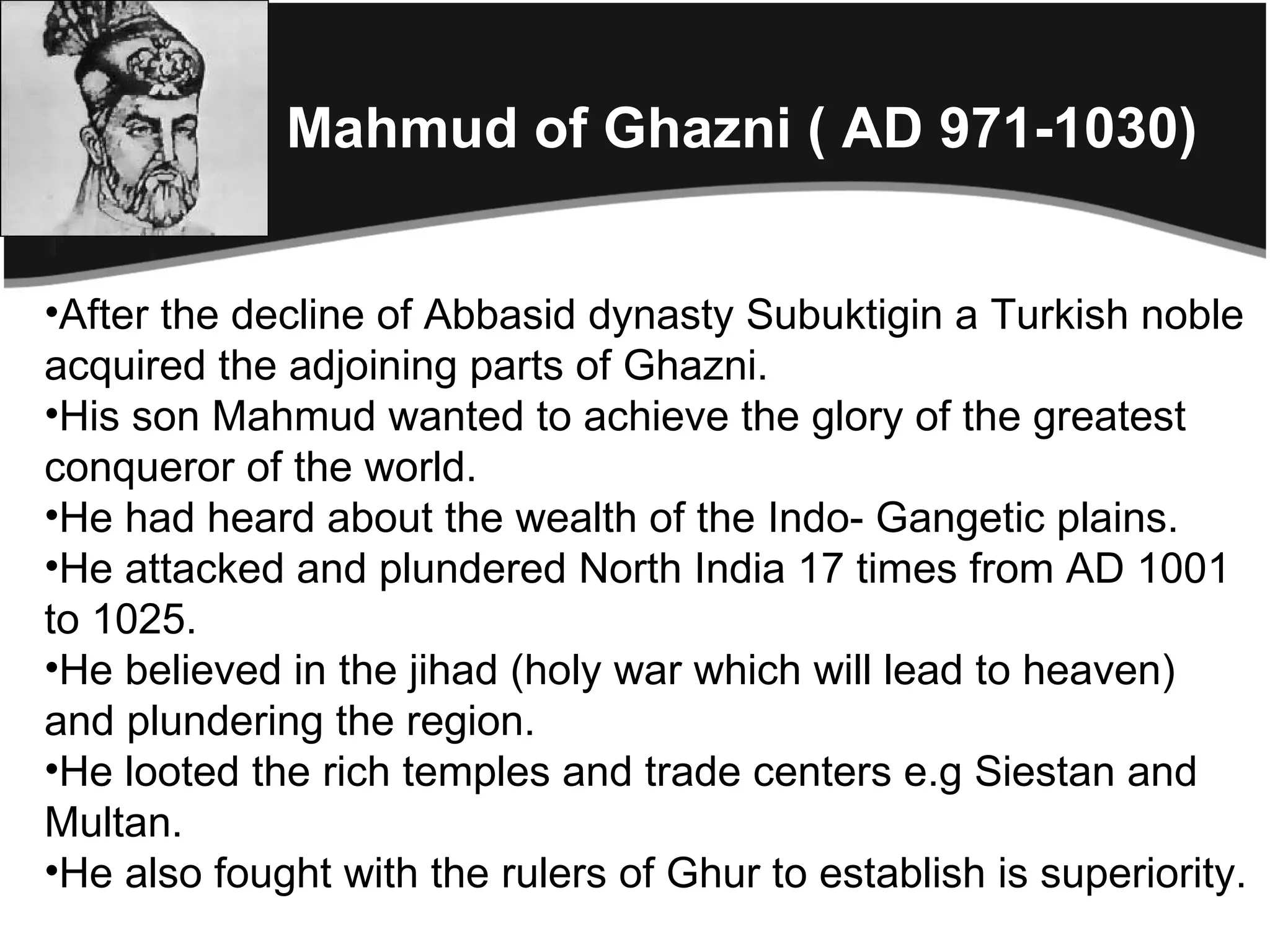
Mahmud of Ghazni ( AD 971-1030)


•After the decline of Abbasid dynasty Subuktigin a Turkish noble
acquired the adjoining parts of Ghazni.
•His son Mahmud wanted to achieve the glory of the greatest
conqueror of the world.
•He had heard about the wealth of the Indo- Gangetic plains.
•He attacked and plundered North India 17 times from AD 1001
to 1025.
•He believed in the jihad (holy war which will lead to heaven)
and plundering the region.
•He looted the rich temples and trade centers e.g Siestan and
Multan.
•He also fought with the rulers of Ghur to establish is superiority.
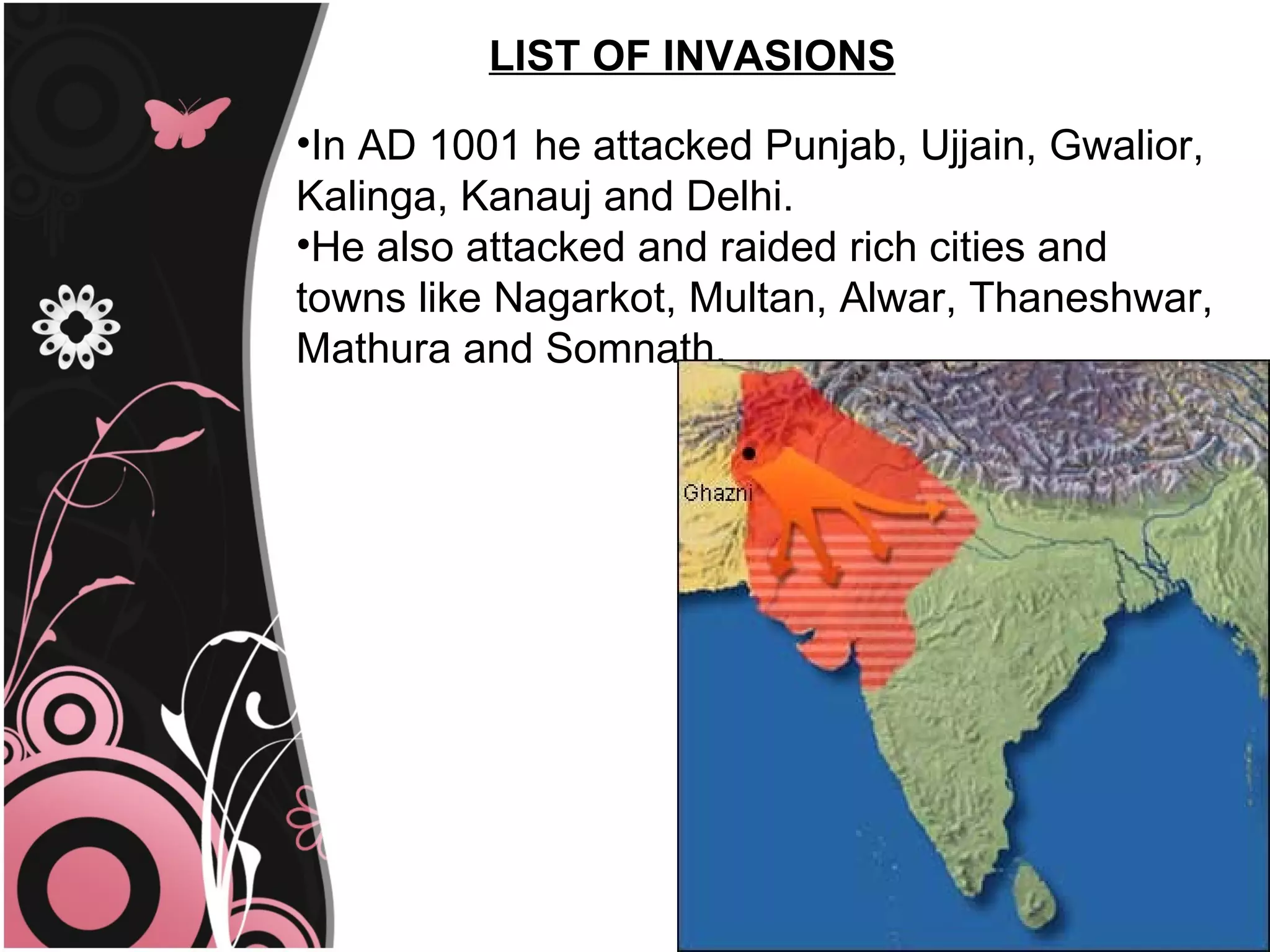
LIST OF INVASIONS

•In AD 1001 he attacked Punjab, Ujjain, Gwalior,
Kalinga, Kanauj and Delhi.
•He also attacked and raided rich cities and
towns like Nagarkot, Multan, Alwar, Thaneshwar,
Mathura and Somnath.
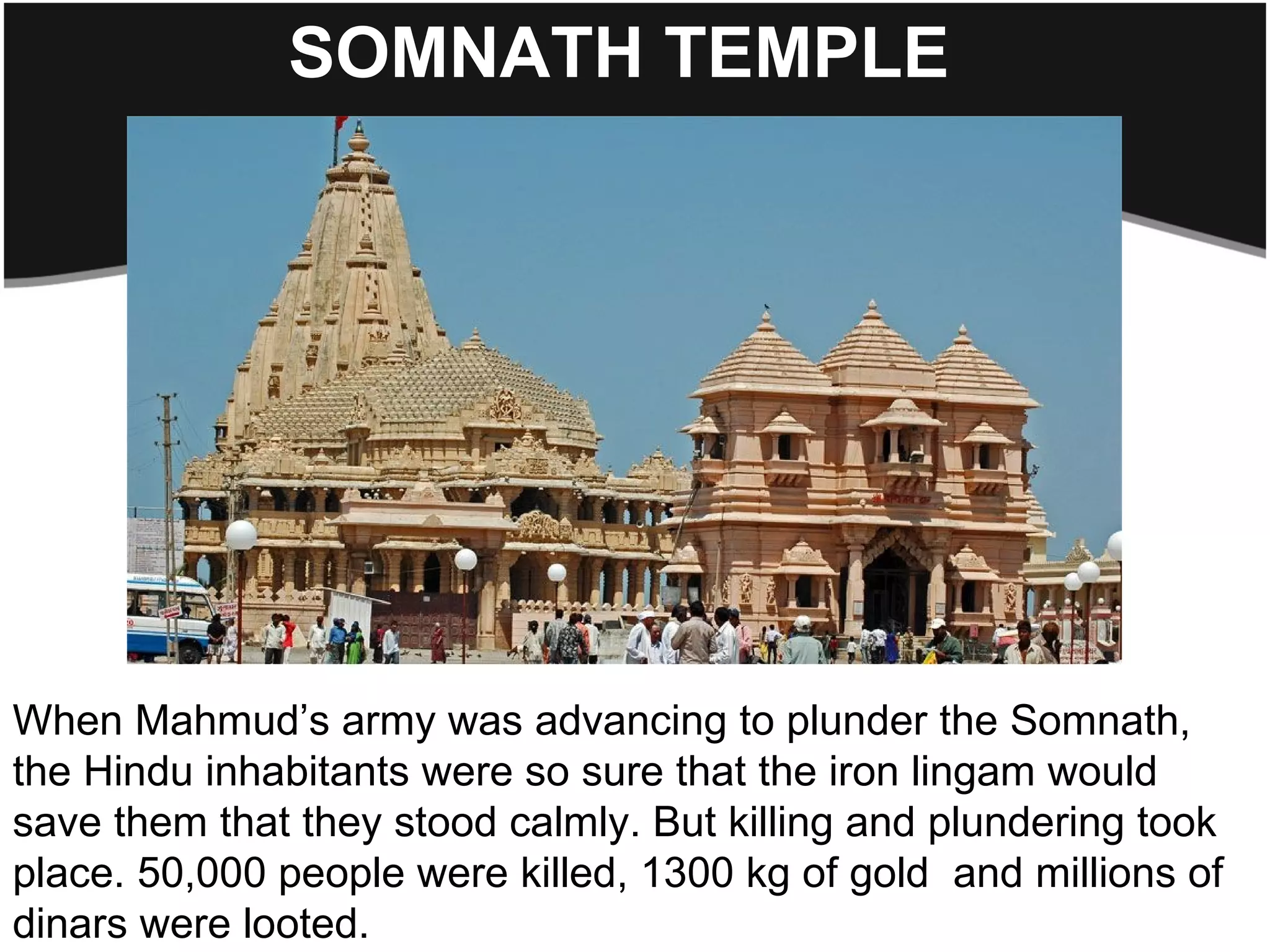
SOMNATH TEMPLE


When Mahmud’s army was advancing to plunder the Somnath,
the Hindu inhabitants were so sure that the iron lingam would
save them that they stood calmly. But killing and plundering took
place. 50,000 people were killed, 1300 kg of gold and millions of
dinars were looted.
Mahmud was a successful
                general and a conqueror
                who never suffered
                defeat.
                Apart from war , he was a
                patron of art , architecture
                and literature.
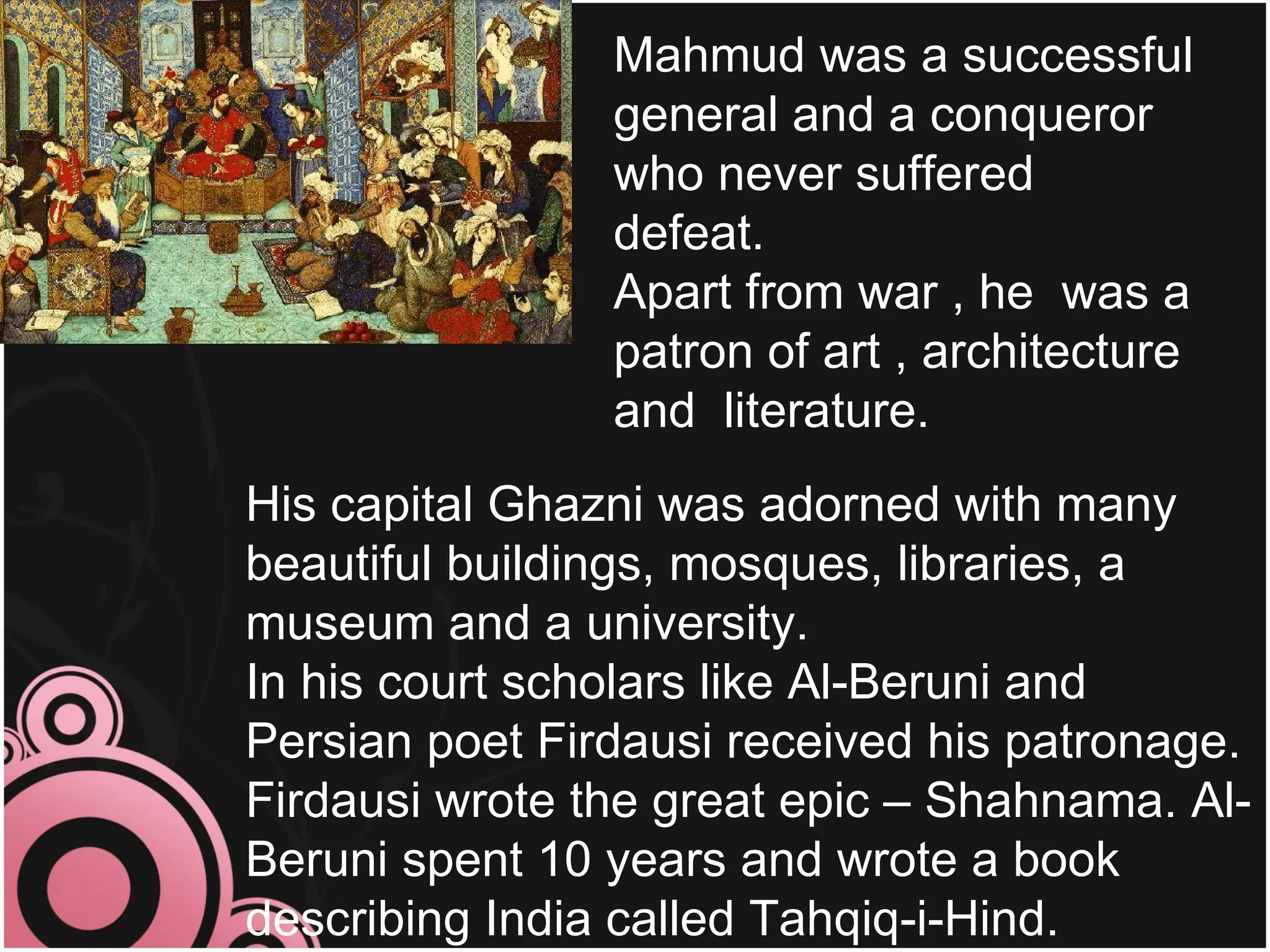
His capital Ghazni was adorned with many
beautiful buildings, mosques, libraries, a
museum and a university.
In his court scholars like Al-Beruni and
Persian poet Firdausi received his patronage.
Firdausi wrote the great epic – Shahnama. Al-
Beruni spent 10 years and wrote a book
describing India called Tahqiq-i-Hind.
DEATH OF MAHMUD OF GHAZNI


•Before Mahmud died he annexed Punjab.
•He died in AD 1030.His death brought an end
to his empire and the frequent raids to the
Indian sub-continent.
•He was truly a warrior more than a man of
faith.
•He used the wealth plundered from the
temples to protect his empire from the
expanding kingdoms of Central Asia.
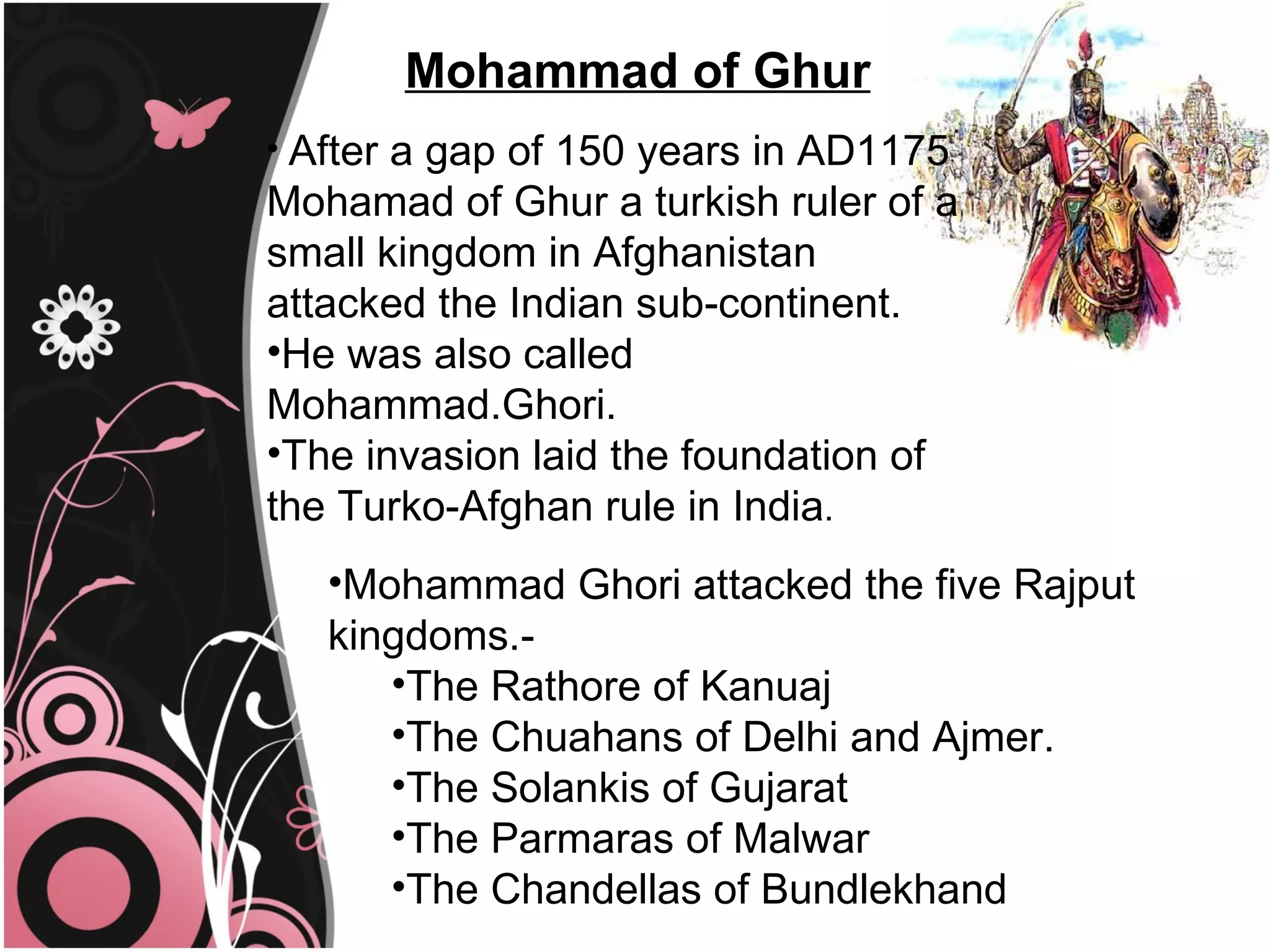
Mohammad of Ghur
• After a gap of 150 years in AD1175
Mohamad of Ghur a turkish ruler of a
small kingdom in Afghanistan
attacked the Indian sub-continent.
•He was also called
Mohammad.Ghori.
•The invasion laid the foundation of
the Turko-Afghan rule in India.
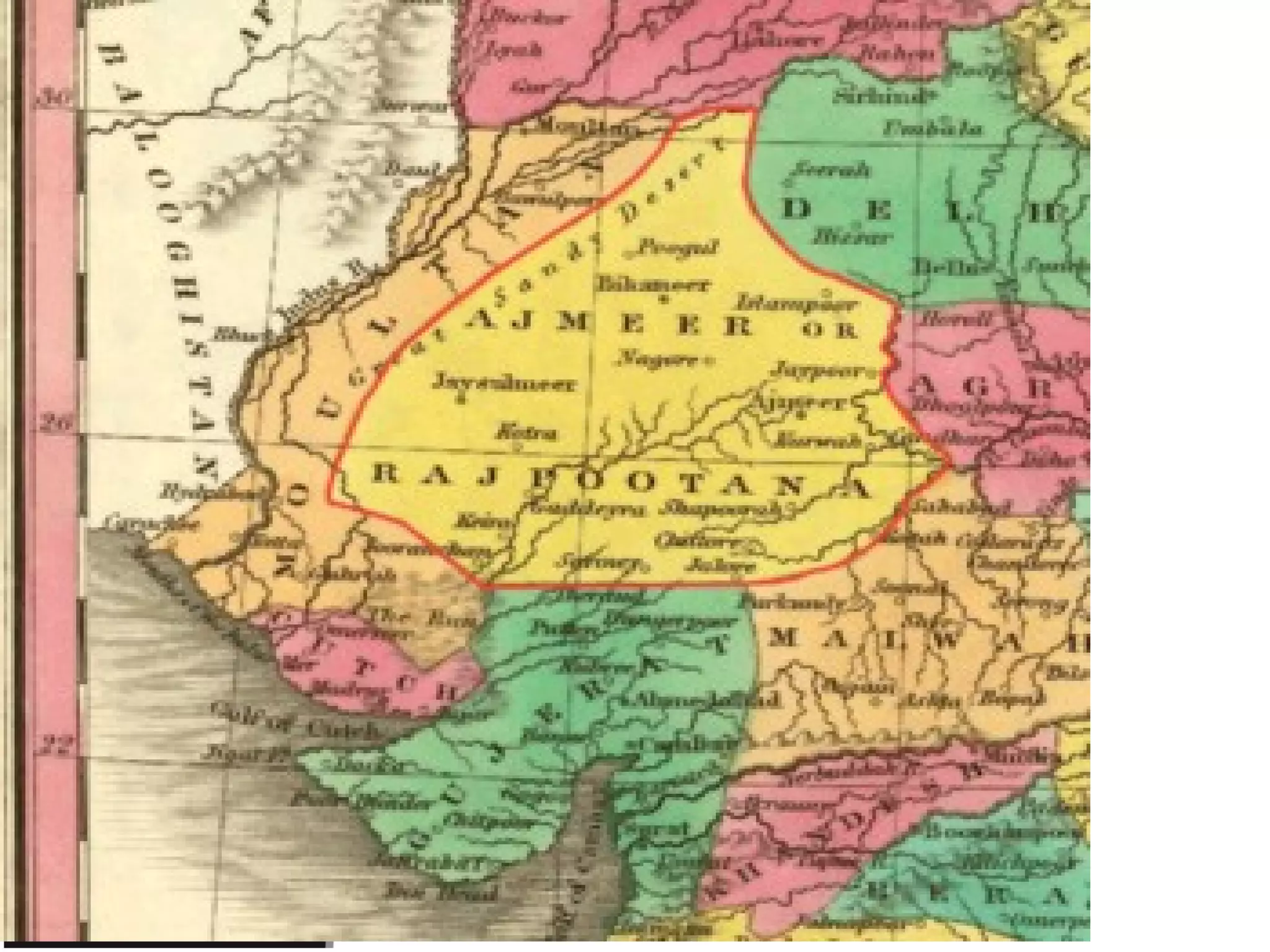
   •Mohammad Ghori attacked the five Rajput
   kingdoms.-
      •The Rathore of Kanuaj
      •The Chuahans of Delhi and Ajmer.
      •The Solankis of Gujarat
      •The Parmaras of Malwar
      •The Chandellas of Bundlekhand
MOHAMMAD GHORI’S CONQUEST


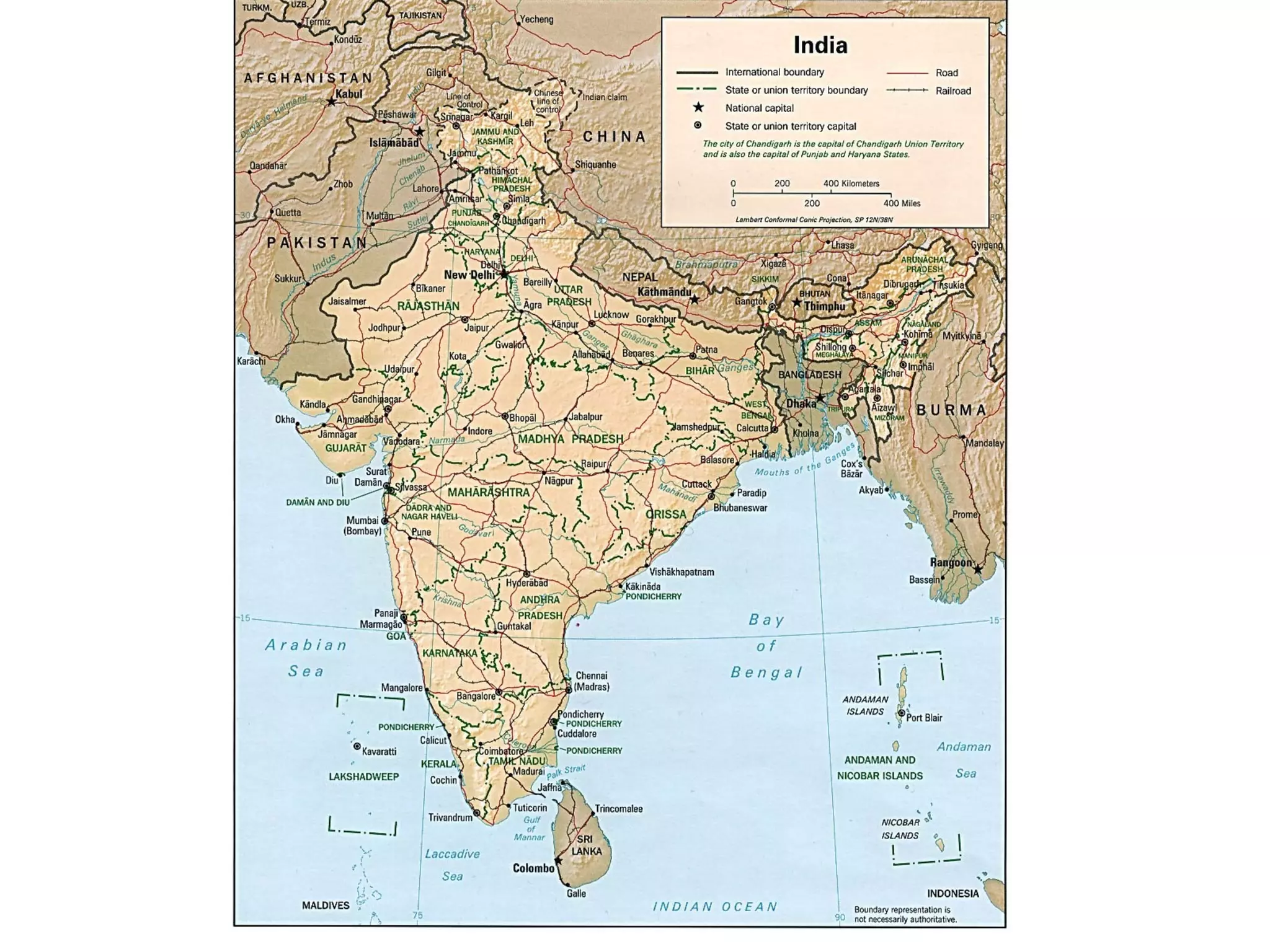
•In AD 1175, he captured Multan.
•Later he defeated the Solanki of Gujarat.
•He conquered Peshawar, Sialkot and Punjab
•In the First Battle of Tarain Mohammad Ghori
defeated Prithviraj Chauhan but he narrowly escaped
from being killed.
•In the Second Battle of Tarain he defeated Prithviraj.
•Later he also defeated Jaichand of the ruler of
Kanuaj in AD 1198
•The Second Battle of Tarain put an end to the
Rajput Dynasty.
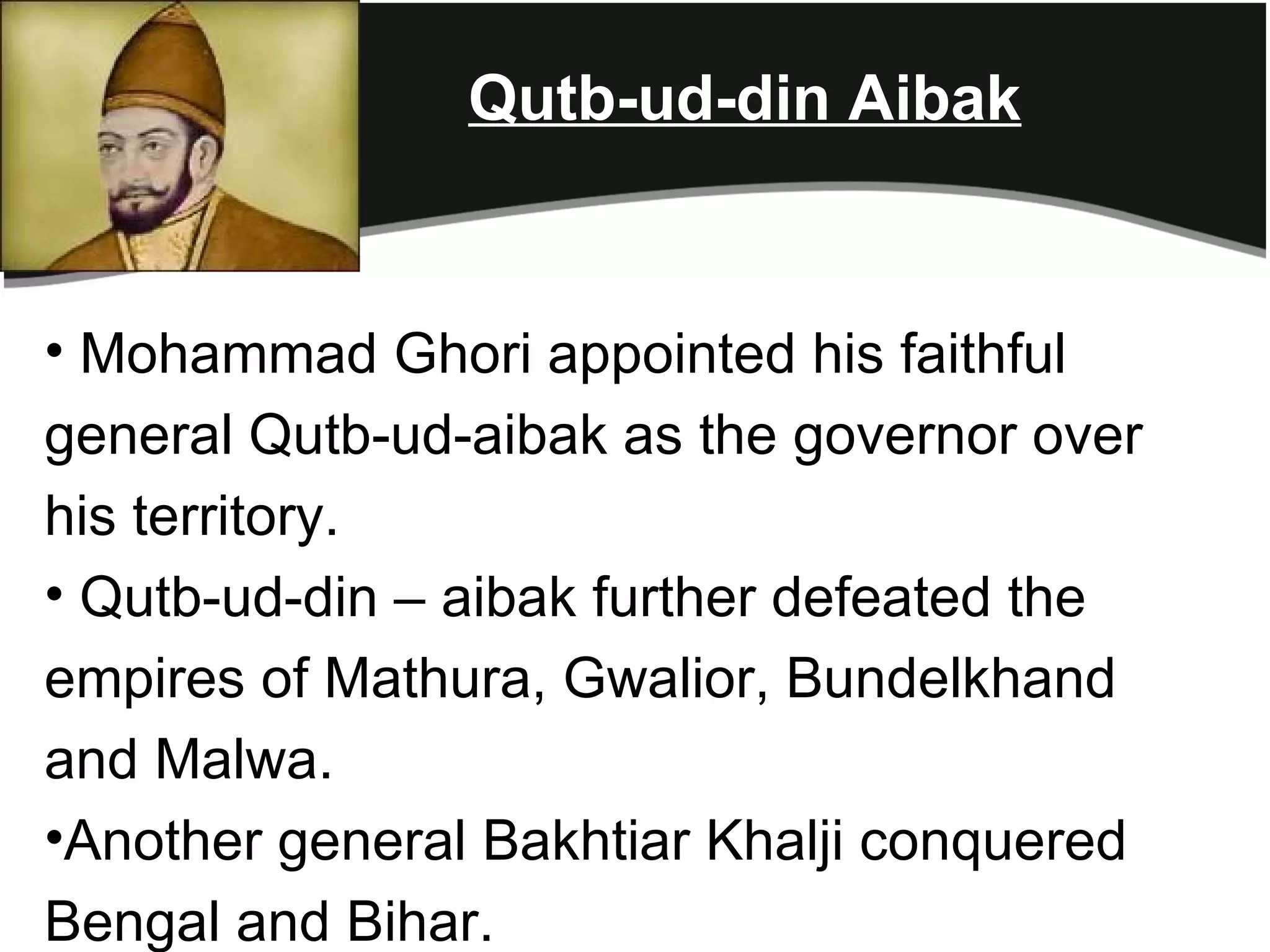
Qutb-ud-din Aibak


• Mohammad Ghori appointed his faithful
general Qutb-ud-aibak as the governor over
his territory.
• Qutb-ud-din – aibak further defeated the
empires of Mathura, Gwalior, Bundelkhand
and Malwa.
•Another general Bakhtiar Khalji conquered
Bengal and Bihar.
DEATH OF MOHAMMAD GHORI


•Mohammad Ghori died while trying to suppress the
revolt of the Khokhars.
•He did not have any son, so his governors became
independent rulers.
•Fight for power broke out among these governors
and Qutb-ub-din aibak asserted his supremacy.
•This is laid the foundation of the Turko-Afghan rule in
India.
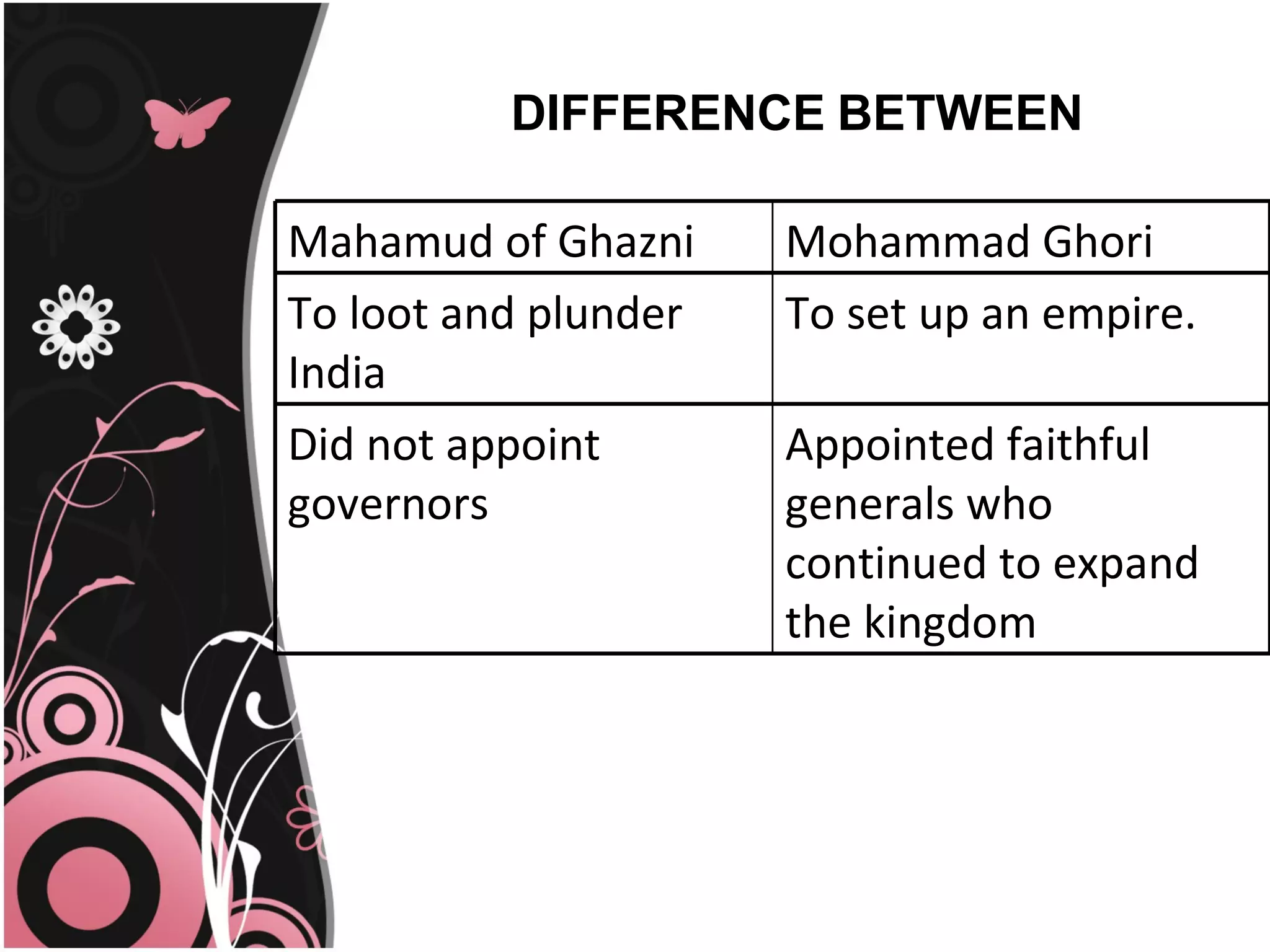
DIFFERENCE BETWEEN

Mahamud of Ghazni     Mohammad Ghori
To loot and plunder   To set up an empire.
India
Did not appoint       Appointed faithful
governors             generals who
                      continued to expand
                      the kingdom
CAUSES OF
    THE
 SUCCESS
     OF
 INVASION
There were number of reasons that
 led to the defeat of the Rajputs.

• Weak war machinery- Slow moving
  elephants Vs guerilla warriors.
• Jealousy and hatred- Prithviraj
  Chauhan and Jaichand
• Feudatory nature of the society – no
  standing army.
• Fighting between the feudal lords.
• Lacked vigour and determination.
• No outstanding leader.
Impact of the raids.

•Intermingling of cultures. –lot to give and take
between Hindu and Muslim culture.
•Sharing of knowledge.
•Composite culture- manifested in architecture,
language, music and food.
•Migration of large number of people-soldiers,
traders, workers.
•Laid the foundation of the slave dynasty.
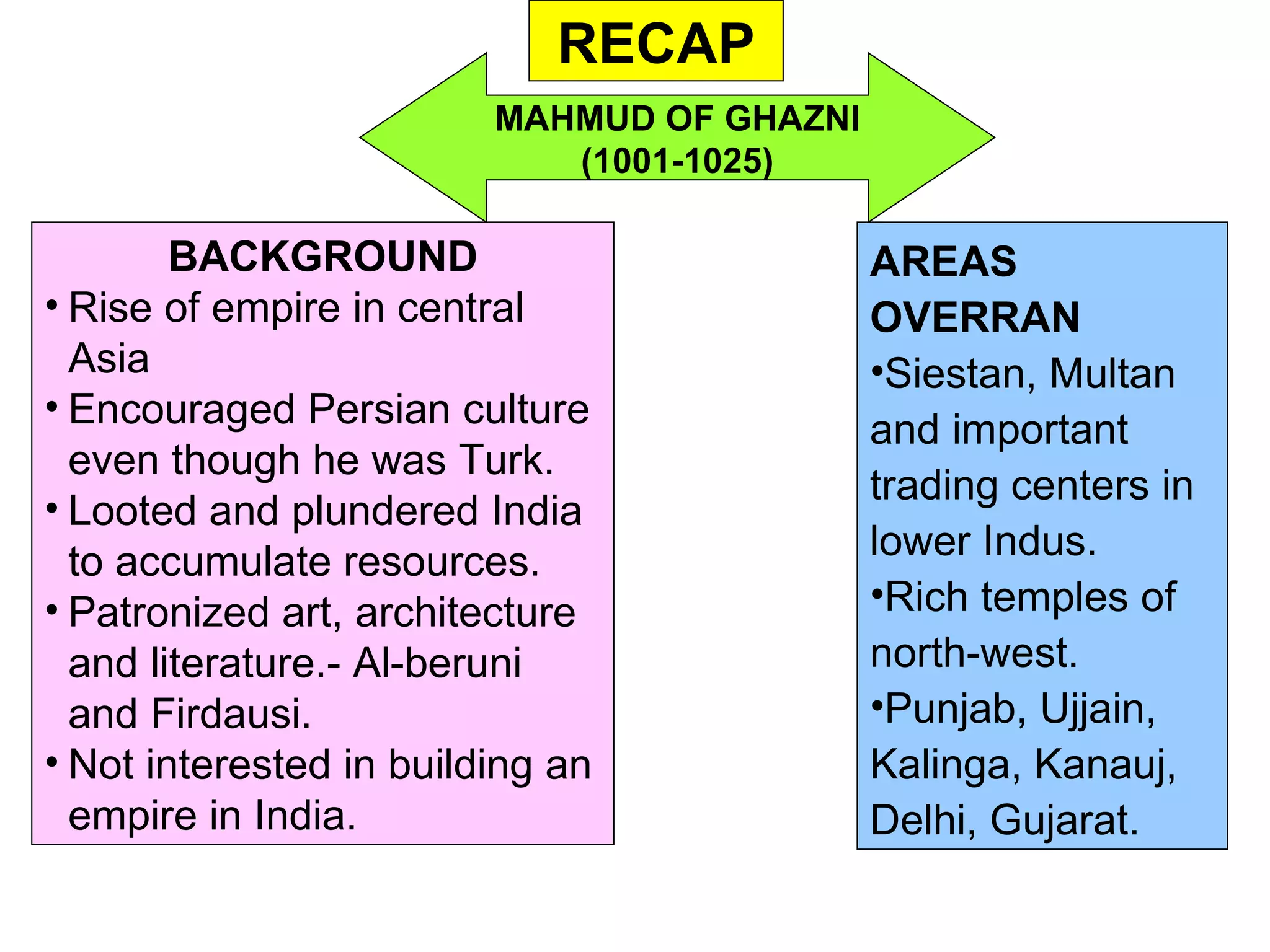
RECAP
                         MAHMUD OF GHAZNI
                            (1001-1025)

        BACKGROUND                          AREAS
• Rise of empire in central                 OVERRAN
  Asia                                      •Siestan, Multan
• Encouraged Persian culture
                                            and important
  even though he was Turk.
                                            trading centers in
• Looted and plundered India
  to accumulate resources.                  lower Indus.
• Patronized art, architecture              •Rich temples of
  and literature.- Al-beruni                north-west.
  and Firdausi.                             •Punjab, Ujjain,
• Not interested in building an             Kalinga, Kanauj,
  empire in India.                          Delhi, Gujarat.
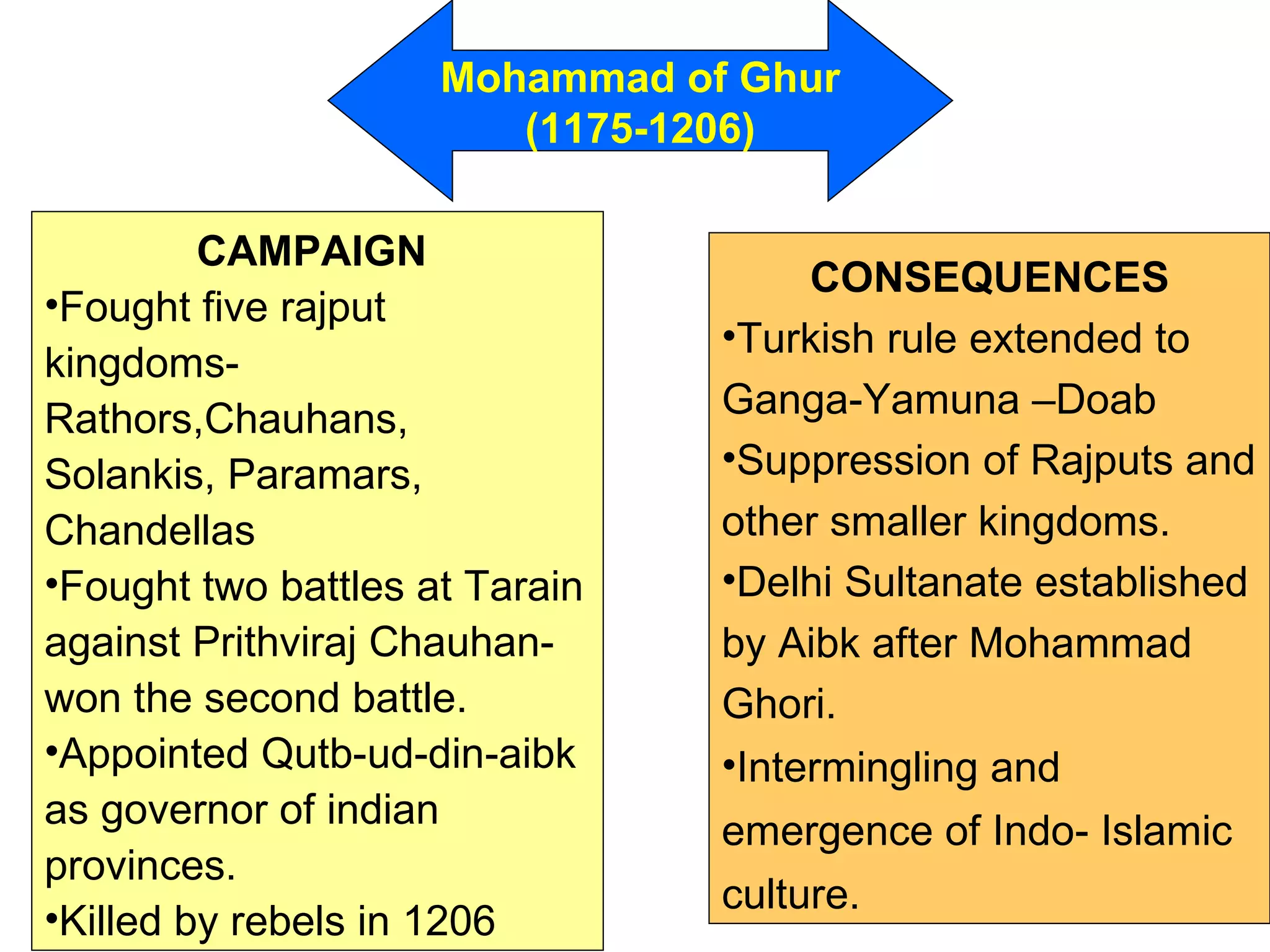
Mohammad of Ghur
                        (1175-1206)

         CAMPAIGN
                                     CONSEQUENCES
•Fought five rajput
                                •Turkish rule extended to
kingdoms-
Rathors,Chauhans,               Ganga-Yamuna –Doab
Solankis, Paramars,             •Suppression of Rajputs and
Chandellas                      other smaller kingdoms.
•Fought two battles at Tarain   •Delhi Sultanate established
against Prithviraj Chauhan-     by Aibk after Mohammad
won the second battle.          Ghori.
•Appointed Qutb-ud-din-aibk     •Intermingling and
as governor of indian
                                emergence of Indo- Islamic
provinces.
                                culture.
•Killed by rebels in 1206

Mahamud of ghazni and mohammad of ghur

  • 1.
    Mahmud of Ghazniand Mohammad of Ghur Lesson - 2
  • 2.
    The name Turkwas first applied to a clan of tribal chieftains who founded the nomadic Göktürk Empire (“present Turkey"). These nomads roamed in the Altai Mountains in northern Mongolia and on the steppes of Central Asia. The Göktürks were ruled by Khans whose influences extended during the sixth to eighth centuries from the Aral Sea to the Hindu Kush
  • 3.
    Cities of Ghazniand Ghur • In the 9th century Arab Empire started disintegrating and declined. • Two kingdoms emerged prominent, the two cities of Ghazni and Ghur which are in present day Afghanistan. •The rulers of these two kingdoms invaded and plundered the Indian Subcontinent in the 11th and 12th centuries. •By the 10th and 11th century the North India had disintegrated into many small kingdoms which gave huge advantage to these rulers. •These attacks were done to finance their ambition of expanding their empire.
  • 4.
    Mahmud of Ghazni( AD 971-1030) •After the decline of Abbasid dynasty Subuktigin a Turkish noble acquired the adjoining parts of Ghazni. •His son Mahmud wanted to achieve the glory of the greatest conqueror of the world. •He had heard about the wealth of the Indo- Gangetic plains. •He attacked and plundered North India 17 times from AD 1001 to 1025. •He believed in the jihad (holy war which will lead to heaven) and plundering the region. •He looted the rich temples and trade centers e.g Siestan and Multan. •He also fought with the rulers of Ghur to establish is superiority.
  • 5.
    LIST OF INVASIONS •InAD 1001 he attacked Punjab, Ujjain, Gwalior, Kalinga, Kanauj and Delhi. •He also attacked and raided rich cities and towns like Nagarkot, Multan, Alwar, Thaneshwar, Mathura and Somnath.
  • 6.
    SOMNATH TEMPLE When Mahmud’sarmy was advancing to plunder the Somnath, the Hindu inhabitants were so sure that the iron lingam would save them that they stood calmly. But killing and plundering took place. 50,000 people were killed, 1300 kg of gold and millions of dinars were looted.
  • 7.
    Mahmud was asuccessful general and a conqueror who never suffered defeat. Apart from war , he was a patron of art , architecture and literature. His capital Ghazni was adorned with many beautiful buildings, mosques, libraries, a museum and a university. In his court scholars like Al-Beruni and Persian poet Firdausi received his patronage. Firdausi wrote the great epic – Shahnama. Al- Beruni spent 10 years and wrote a book describing India called Tahqiq-i-Hind.
  • 9.
    DEATH OF MAHMUDOF GHAZNI •Before Mahmud died he annexed Punjab. •He died in AD 1030.His death brought an end to his empire and the frequent raids to the Indian sub-continent. •He was truly a warrior more than a man of faith. •He used the wealth plundered from the temples to protect his empire from the expanding kingdoms of Central Asia.
  • 10.
    Mohammad of Ghur •After a gap of 150 years in AD1175 Mohamad of Ghur a turkish ruler of a small kingdom in Afghanistan attacked the Indian sub-continent. •He was also called Mohammad.Ghori. •The invasion laid the foundation of the Turko-Afghan rule in India. •Mohammad Ghori attacked the five Rajput kingdoms.- •The Rathore of Kanuaj •The Chuahans of Delhi and Ajmer. •The Solankis of Gujarat •The Parmaras of Malwar •The Chandellas of Bundlekhand
  • 11.
    MOHAMMAD GHORI’S CONQUEST •InAD 1175, he captured Multan. •Later he defeated the Solanki of Gujarat. •He conquered Peshawar, Sialkot and Punjab •In the First Battle of Tarain Mohammad Ghori defeated Prithviraj Chauhan but he narrowly escaped from being killed. •In the Second Battle of Tarain he defeated Prithviraj. •Later he also defeated Jaichand of the ruler of Kanuaj in AD 1198 •The Second Battle of Tarain put an end to the Rajput Dynasty.
  • 13.
    Qutb-ud-din Aibak • MohammadGhori appointed his faithful general Qutb-ud-aibak as the governor over his territory. • Qutb-ud-din – aibak further defeated the empires of Mathura, Gwalior, Bundelkhand and Malwa. •Another general Bakhtiar Khalji conquered Bengal and Bihar.
  • 15.
    DEATH OF MOHAMMADGHORI •Mohammad Ghori died while trying to suppress the revolt of the Khokhars. •He did not have any son, so his governors became independent rulers. •Fight for power broke out among these governors and Qutb-ub-din aibak asserted his supremacy. •This is laid the foundation of the Turko-Afghan rule in India.
  • 16.
    DIFFERENCE BETWEEN Mahamud ofGhazni Mohammad Ghori To loot and plunder To set up an empire. India Did not appoint Appointed faithful governors generals who continued to expand the kingdom
  • 17.
    CAUSES OF THE SUCCESS OF INVASION
  • 18.
    There were numberof reasons that led to the defeat of the Rajputs. • Weak war machinery- Slow moving elephants Vs guerilla warriors. • Jealousy and hatred- Prithviraj Chauhan and Jaichand • Feudatory nature of the society – no standing army. • Fighting between the feudal lords. • Lacked vigour and determination. • No outstanding leader.
  • 19.
    Impact of theraids. •Intermingling of cultures. –lot to give and take between Hindu and Muslim culture. •Sharing of knowledge. •Composite culture- manifested in architecture, language, music and food. •Migration of large number of people-soldiers, traders, workers. •Laid the foundation of the slave dynasty.
  • 22.
    RECAP MAHMUD OF GHAZNI (1001-1025) BACKGROUND AREAS • Rise of empire in central OVERRAN Asia •Siestan, Multan • Encouraged Persian culture and important even though he was Turk. trading centers in • Looted and plundered India to accumulate resources. lower Indus. • Patronized art, architecture •Rich temples of and literature.- Al-beruni north-west. and Firdausi. •Punjab, Ujjain, • Not interested in building an Kalinga, Kanauj, empire in India. Delhi, Gujarat.
  • 23.
    Mohammad of Ghur (1175-1206) CAMPAIGN CONSEQUENCES •Fought five rajput •Turkish rule extended to kingdoms- Rathors,Chauhans, Ganga-Yamuna –Doab Solankis, Paramars, •Suppression of Rajputs and Chandellas other smaller kingdoms. •Fought two battles at Tarain •Delhi Sultanate established against Prithviraj Chauhan- by Aibk after Mohammad won the second battle. Ghori. •Appointed Qutb-ud-din-aibk •Intermingling and as governor of indian emergence of Indo- Islamic provinces. culture. •Killed by rebels in 1206