QUIT INDIA MOVEMENT
LAST GREAT STRUGGLE OF THE CONGRESS TO OUST THE IMPERIALISTS
Quit India Movement
• Circumstances leading to Quit India Movement.
• ‘Quit India’ resolution, August 8, 1942.

• Phase of the ‘Quit India’ Movement.
• Importance of the movement.
• Causes of the failure of the 1942 Movement.
Circumstances leading
to QIM
 On April 11, 1942,suddenly the Cripps proposals were withdrawn. Before the outside world, Britishers
painted a dark picture of India as a divided house unfit for the immediate freedom, but in India there
was utter frustration and disgust.
 The government had acquired a vast land for military purpose in East Bengal. Thousands of farmers
were thrown out of their ancestral fields. They destroyed country-made boats which were the principal
means of livelihood for lakhs of people.
 The mational leaders were convinced that the English were too weak to defend India. They felt that
Japanese had a grudge only with the British and if they left India immediately, the Japanese might give
up the idea of invading India.
QUIT INDIA MOVEMENT
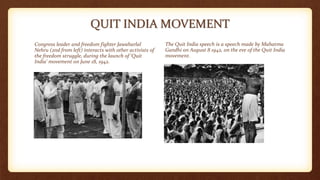
Congress leader and freedom fighter Jawaharlal
Nehru (2nd from left) interacts with other activists of
the freedom struggle, during the launch of 'Quit
India' movement on June 18, 1942.

The Quit India speech is a speech made by Mahatma
Gandhi on August 8 1942, on the eve of the Quit India
movement.
‘Quit India’ resolution, August 8, 1942
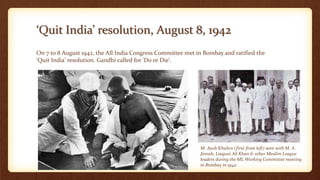
On 7 to 8 August 1942, the All India Congress Committee met in Bombay and ratified the
'Quit India' resolution. Gandhi called for 'Do or Die'.

M. Ayub Khuhro (first from left) seen with M. A.
Jinnah, Liaquat Ali Khan & other Muslim League
leaders during the ML Working Committee meeting
in Bombay in 1942.
PHASES OF QIM
The movement passed through four phases:
1.
The first phase began from the day of Mahatma Gandhi’s arrest, i.e.,
9th August, 1942. it lasted for 3-4 days. Strikes, demonstrations,
meetings etc. greatest enthusiasm was shown by labourers in mills
and factories which affected the textile mills particularly in
Ahmedabad and Madras. In Bombay, police opened fire as many as
13 times till 2:30 p.m. in a single day on 11th August, 1942. this
discrimination changed the character of movement which turned
into a riot.
2.

The people raided municipal and other government buildings.
Railway stations (max. damage in madras), police stations, post
offices were also attacked. In some parts the mob tried to burn the
records and loot the govt. treasury. As a result troops were called to
terrorize the mob by firing and other atrocious measures.

3.

Indian Express

procession

The movement entered its third phase in September, 1942.. In sheer
desperation the mob restored to armed attacks as happened in
Madras and Bengal.

4.

Bombay firing

In its fourth phase, the movement became mild again as in its first
phase. It continued till Mahatma Gandhi’s release in May, 1944.. The
muslims generally kept aloof.
Mahatma Gandhi greeting people
at Juhu Beach in May, 1944.
IMPORTANCE
The importance of the Quit India Movement can never be undermined. It witnessed nationalistic
feeling of the people at the zenith. For the first time, the government was astonished by observing
the powerful nationalistic feelings of the Indians added with anti-British feeling.

Over 100,000 arrests were
made, mass fines were
levied and demonstrators
were subjected to public
flogging. Hundreds of
civilians were killed in
violence many shot by
the police army. Many
national leaders went
underground and
continued their struggle
by broadcasting
messages over
clandestine radio
stations, distributing
pamphlets and
establishing parallel
governments.
CAUSES OF FAILURE
A 1942 group photo of freedom fighters and sympathisers of the 'Quit India'
movement

 The revolt of 1942 lasted
for three months only.
 It failed in its attempt to
paralyze the government
machinery in order to
seize power. The three
main causes of failure acc.
to Dr. Amba Prasad are:
1.

Tactical mistakes of
organization and
planning;

2.

Loyalty of the
services;

3.

Superior physical
strength of the
government.
THANK YOU
BY:
DHANVARSHA SAINI

Quit India Movement-1942

  • 1.
    QUIT INDIA MOVEMENT LASTGREAT STRUGGLE OF THE CONGRESS TO OUST THE IMPERIALISTS
  • 2.
    Quit India Movement •Circumstances leading to Quit India Movement. • ‘Quit India’ resolution, August 8, 1942. • Phase of the ‘Quit India’ Movement. • Importance of the movement. • Causes of the failure of the 1942 Movement.
  • 3.
    Circumstances leading to QIM On April 11, 1942,suddenly the Cripps proposals were withdrawn. Before the outside world, Britishers painted a dark picture of India as a divided house unfit for the immediate freedom, but in India there was utter frustration and disgust.  The government had acquired a vast land for military purpose in East Bengal. Thousands of farmers were thrown out of their ancestral fields. They destroyed country-made boats which were the principal means of livelihood for lakhs of people.  The mational leaders were convinced that the English were too weak to defend India. They felt that Japanese had a grudge only with the British and if they left India immediately, the Japanese might give up the idea of invading India.
  • 4.
    QUIT INDIA MOVEMENT Congressleader and freedom fighter Jawaharlal Nehru (2nd from left) interacts with other activists of the freedom struggle, during the launch of 'Quit India' movement on June 18, 1942. The Quit India speech is a speech made by Mahatma Gandhi on August 8 1942, on the eve of the Quit India movement.
  • 5.
    ‘Quit India’ resolution,August 8, 1942 On 7 to 8 August 1942, the All India Congress Committee met in Bombay and ratified the 'Quit India' resolution. Gandhi called for 'Do or Die'. M. Ayub Khuhro (first from left) seen with M. A. Jinnah, Liaquat Ali Khan & other Muslim League leaders during the ML Working Committee meeting in Bombay in 1942.
  • 6.
    PHASES OF QIM Themovement passed through four phases: 1. The first phase began from the day of Mahatma Gandhi’s arrest, i.e., 9th August, 1942. it lasted for 3-4 days. Strikes, demonstrations, meetings etc. greatest enthusiasm was shown by labourers in mills and factories which affected the textile mills particularly in Ahmedabad and Madras. In Bombay, police opened fire as many as 13 times till 2:30 p.m. in a single day on 11th August, 1942. this discrimination changed the character of movement which turned into a riot. 2. The people raided municipal and other government buildings. Railway stations (max. damage in madras), police stations, post offices were also attacked. In some parts the mob tried to burn the records and loot the govt. treasury. As a result troops were called to terrorize the mob by firing and other atrocious measures. 3. Indian Express procession The movement entered its third phase in September, 1942.. In sheer desperation the mob restored to armed attacks as happened in Madras and Bengal. 4. Bombay firing In its fourth phase, the movement became mild again as in its first phase. It continued till Mahatma Gandhi’s release in May, 1944.. The muslims generally kept aloof. Mahatma Gandhi greeting people at Juhu Beach in May, 1944.
  • 7.
    IMPORTANCE The importance ofthe Quit India Movement can never be undermined. It witnessed nationalistic feeling of the people at the zenith. For the first time, the government was astonished by observing the powerful nationalistic feelings of the Indians added with anti-British feeling. Over 100,000 arrests were made, mass fines were levied and demonstrators were subjected to public flogging. Hundreds of civilians were killed in violence many shot by the police army. Many national leaders went underground and continued their struggle by broadcasting messages over clandestine radio stations, distributing pamphlets and establishing parallel governments.
  • 8.
    CAUSES OF FAILURE A1942 group photo of freedom fighters and sympathisers of the 'Quit India' movement  The revolt of 1942 lasted for three months only.  It failed in its attempt to paralyze the government machinery in order to seize power. The three main causes of failure acc. to Dr. Amba Prasad are: 1. Tactical mistakes of organization and planning; 2. Loyalty of the services; 3. Superior physical strength of the government.
  • 9.