DERMATOPHYTES
Dr. R. Ralte
Associate Professor
KCVAS, Amritsar
General characteristics
• Phylum: Ascomycota
• Strict aerobes
• Septate hyphae
• Requires and use keratin for growth
– Invade superficial keratinized structures such as skin, hair, claws etc
• Recognized in 3 anamorphic state/genera
– Microsporum
– Trichophyton
– Epidermophyton
• Teleomorphic genus –
– Arthroderma
• Zoophilic and anthropophillic dermatophytes – obligate parasites
• Geophilic dermatophytes – Saprophytes in soil.
• Dermatophytes characteristically cause circular skin infection
termed’RINGWORM"
Affects animal species mainly
Species Host Preferences Hosts Geographical distribution
M. canis Zoophilic Cats, dogs Worldwide
M. gallinae Zoophilic Chickens, Turkeys Worldwide
T. Equinum Zoophilic Horses Worldwide
T. mentagrophyte Zoophilic Rodents, dogs,
horses etc
Worldwide
T.verrucosum Zoophilic Cattle Worldwide
M. cookeii Geophilic
M. gypseum Geophilic Horses, dogs,
rodents
Worldwide
M.nanum Geophilic Pigs North and South America,
Europe and Australasia
T. simii Geophilic Monkeys, Poultry,
Dogs
India, Brazil, Guinea
E. floccosum Anthropophilic Humans
M. audouinii Anthropophilic Humans
M. ferrugineum Anthropophilic Humans
T. rubrum Anthropophilic Humans
T. schoenleinii Anthropophilic Humans
Clinical Presentation
• Dermatophytosis can be focal or generalized1,3
affecting
• Face
• Ears
• Legs
• Tail
• +/- trunk
• Most patients have little to no evidence of pruritus, although
chronic and extensive cases can be severely pruritic.
On skin, clinical presentation most often involves1-5
• Partial to complete alopecia
• Scale/dry or greasy seborrhea
• Erythema
• Papules
• Pustules
• Crusts
• Epidermal collarettes (ringlike appearance)
• +/- feline miliary dermatitis (crusted papules)
• Nodules, draining tracts, feline chin acne, paronychia (inflammation of the
claw fold), onychomycosis (fungal infection of the claw), or onychodystrophy
(abnormal growth of the claw) occur less commonly
Laboratory Diagnosis
• Identification of individual species depends
mainly on
colonial morphology
Microscopic appearance of macroconidia
Chlamydospores etc
KOH mount of infected skin scales (left) and nail material (right) showing typical
dermatophyte hyphae breaking up into ARTHROCONIDIA (arthrospores)
Note:
1. Arthrospores are the infectious form associated with tissue invasion
2. Released by fragmentation of hyphae in keratinized structures, and form a sheath
around the infected structures.
3. Resistant forms can remain viable for more than 12 months in a suitable environment.
DIRECT MICROSCOPY
Tinea capitis
Tinea capitis refers to dermatophytosis of the scalp. Three types of in vivo hair invasion are
recognised:
1. KOH mount of infected hairs showing
"small spored" ectothrix invasion by M.
canis
2. KOH mount of infected hairs showing "large
spored" ectothrix invasion by M. gypseum.
1. Ectothrix invasion
• development of arthroconidia on the outside of the hair shaft.
• The cuticle of the hair is destroyed and infected hairs usually fluoresce a bright
greenish yellow colour under Wood's ultraviolet light.
• Common agents include M. canis, M. gypseum, T. equinum and T. verrucosum.
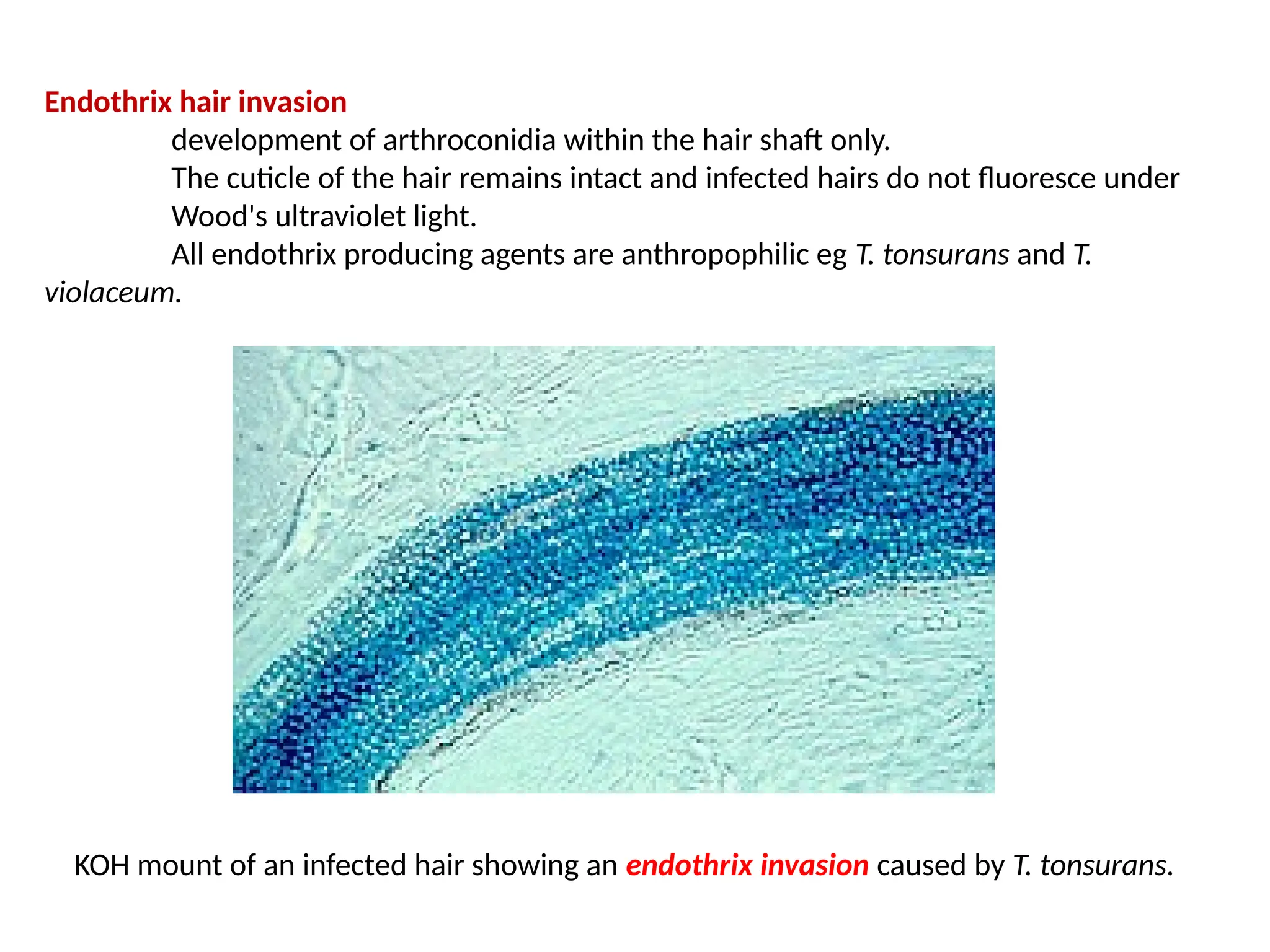
Endothrix hair invasion
development of arthroconidia within the hair shaft only.
The cuticle of the hair remains intact and infected hairs do not fluoresce under
Wood's ultraviolet light.
All endothrix producing agents are anthropophilic eg T. tonsurans and T.
violaceum.
KOH mount of an infected hair showing an endothrix invasion caused by T. tonsurans.
Favus
• produces favus-like crusts or scutula and corresponding hair loss.
• usually caused by T. schoenleinii, M. gypseum
• The fungus is entirely confined within the hair shaft but does NOT fragment into
arthroconidia (thus the infected hair commonly grows to normal lengths). The
relatively few hyphae run intact through the hair, forming tunnels within its
structure. When first immersed in KOH,
air is initially trapped around the hyphae forming the characteristic, long air spaces.
These rapidly fill in with KOH, when the hyphae themselves become visible.
IN VITRO HAIR PERFORATION TEST
CULTURE
• Aerobic
• Slow growth on SDA, DTM with some species
requiring additional growth factor.
• Tolerate cycloheximide in media
• Colonies are often pigmented
• Macroconidia formed in cultures.
Obverse: white to
buff with bright
orange periphery.
Reverse: yelowish
orange or yelowish
brown.
Dysgonic type M. canis
Obverse: yellow brown, heaped
and folded.
Reverse: colorless pale yellow
Macroconidia: usually absent
Obverse: flat, spreading
suede-like to granular,
tawny-buff cinnamon
color
Reverse: yellowish brown
or reddish brown
pigmentation.
Obverse: flat,
spreading suede-like
to downy in testure
and white to buff in
color
Reverse: deep-yellow
submerged fringe
and reverse, later
becomes dark red in
the centre
Abundant microconidia, sessile and pyriform,
stallked or spherical
Clavate, smooth, thin-walled, variable
size, rarely produced
Abundant microconidia, and
macroconidia is cigar shaped
with 7 septa.
Obverse: flat, white
to cream color,
powdery to granular
surface, red-brown
fringed periphery
Reverse: dark red
reverse pigment

Varous Fungal agents causing dermatitis in human and animals.

  • 1.
    DERMATOPHYTES Dr. R. Ralte AssociateProfessor KCVAS, Amritsar
  • 2.
    General characteristics • Phylum:Ascomycota • Strict aerobes • Septate hyphae • Requires and use keratin for growth – Invade superficial keratinized structures such as skin, hair, claws etc • Recognized in 3 anamorphic state/genera – Microsporum – Trichophyton – Epidermophyton • Teleomorphic genus – – Arthroderma • Zoophilic and anthropophillic dermatophytes – obligate parasites • Geophilic dermatophytes – Saprophytes in soil. • Dermatophytes characteristically cause circular skin infection termed’RINGWORM" Affects animal species mainly
  • 3.
    Species Host PreferencesHosts Geographical distribution M. canis Zoophilic Cats, dogs Worldwide M. gallinae Zoophilic Chickens, Turkeys Worldwide T. Equinum Zoophilic Horses Worldwide T. mentagrophyte Zoophilic Rodents, dogs, horses etc Worldwide T.verrucosum Zoophilic Cattle Worldwide M. cookeii Geophilic M. gypseum Geophilic Horses, dogs, rodents Worldwide M.nanum Geophilic Pigs North and South America, Europe and Australasia T. simii Geophilic Monkeys, Poultry, Dogs India, Brazil, Guinea E. floccosum Anthropophilic Humans M. audouinii Anthropophilic Humans M. ferrugineum Anthropophilic Humans T. rubrum Anthropophilic Humans T. schoenleinii Anthropophilic Humans
  • 4.
    Clinical Presentation • Dermatophytosiscan be focal or generalized1,3 affecting • Face • Ears • Legs • Tail • +/- trunk • Most patients have little to no evidence of pruritus, although chronic and extensive cases can be severely pruritic.
  • 5.
    On skin, clinicalpresentation most often involves1-5 • Partial to complete alopecia • Scale/dry or greasy seborrhea • Erythema • Papules • Pustules • Crusts • Epidermal collarettes (ringlike appearance) • +/- feline miliary dermatitis (crusted papules) • Nodules, draining tracts, feline chin acne, paronychia (inflammation of the claw fold), onychomycosis (fungal infection of the claw), or onychodystrophy (abnormal growth of the claw) occur less commonly
  • 6.
    Laboratory Diagnosis • Identificationof individual species depends mainly on colonial morphology Microscopic appearance of macroconidia Chlamydospores etc
  • 7.
    KOH mount ofinfected skin scales (left) and nail material (right) showing typical dermatophyte hyphae breaking up into ARTHROCONIDIA (arthrospores) Note: 1. Arthrospores are the infectious form associated with tissue invasion 2. Released by fragmentation of hyphae in keratinized structures, and form a sheath around the infected structures. 3. Resistant forms can remain viable for more than 12 months in a suitable environment. DIRECT MICROSCOPY
  • 8.
    Tinea capitis Tinea capitisrefers to dermatophytosis of the scalp. Three types of in vivo hair invasion are recognised:
  • 9.
    1. KOH mountof infected hairs showing "small spored" ectothrix invasion by M. canis 2. KOH mount of infected hairs showing "large spored" ectothrix invasion by M. gypseum. 1. Ectothrix invasion • development of arthroconidia on the outside of the hair shaft. • The cuticle of the hair is destroyed and infected hairs usually fluoresce a bright greenish yellow colour under Wood's ultraviolet light. • Common agents include M. canis, M. gypseum, T. equinum and T. verrucosum.
  • 10.
    Endothrix hair invasion developmentof arthroconidia within the hair shaft only. The cuticle of the hair remains intact and infected hairs do not fluoresce under Wood's ultraviolet light. All endothrix producing agents are anthropophilic eg T. tonsurans and T. violaceum. KOH mount of an infected hair showing an endothrix invasion caused by T. tonsurans.
  • 11.
    Favus • produces favus-likecrusts or scutula and corresponding hair loss. • usually caused by T. schoenleinii, M. gypseum • The fungus is entirely confined within the hair shaft but does NOT fragment into arthroconidia (thus the infected hair commonly grows to normal lengths). The relatively few hyphae run intact through the hair, forming tunnels within its structure. When first immersed in KOH, air is initially trapped around the hyphae forming the characteristic, long air spaces. These rapidly fill in with KOH, when the hyphae themselves become visible.
  • 12.
    IN VITRO HAIRPERFORATION TEST
  • 13.
    CULTURE • Aerobic • Slowgrowth on SDA, DTM with some species requiring additional growth factor. • Tolerate cycloheximide in media • Colonies are often pigmented • Macroconidia formed in cultures.
  • 14.
    Obverse: white to buffwith bright orange periphery. Reverse: yelowish orange or yelowish brown. Dysgonic type M. canis Obverse: yellow brown, heaped and folded. Reverse: colorless pale yellow Macroconidia: usually absent
  • 15.
    Obverse: flat, spreading suede-liketo granular, tawny-buff cinnamon color Reverse: yellowish brown or reddish brown pigmentation.
  • 16.
    Obverse: flat, spreading suede-like todowny in testure and white to buff in color Reverse: deep-yellow submerged fringe and reverse, later becomes dark red in the centre Abundant microconidia, sessile and pyriform, stallked or spherical Clavate, smooth, thin-walled, variable size, rarely produced
  • 17.
    Abundant microconidia, and macroconidiais cigar shaped with 7 septa. Obverse: flat, white to cream color, powdery to granular surface, red-brown fringed periphery Reverse: dark red reverse pigment