Rolling Mill Industry Training:
Bearing Fundamentals
WORLDWIDE LEADER IN BEARINGS AND STEEL
Rolling Mill Industry Training Bearing Fundamentals
Bearing Types and Features
Tapered Roller Bearing Details
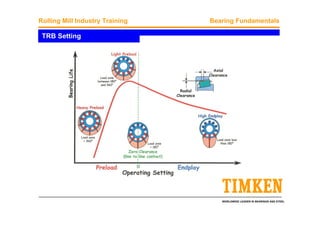
TRB Setting
TRB Mounting
Bearing Metallurgy & Fatigue
Mechanism
TRB Fitting Practice
Lubrication
Agenda
WORLDWIDE LEADER IN BEARINGS AND STEEL
Rolling Mill Industry Training Bearing Fundamentals
Bearing Types
Friction bearings
Plain
Bushing
Oil sleeve
Anti-friction bearings
Ball bearings
Needle roller bearings
Spherical roller bearings
Cylindrical roller bearings
Tapered roller bearings
WORLDWIDE LEADER IN BEARINGS AND STEEL
Rolling Mill Industry Training Bearing Fundamentals
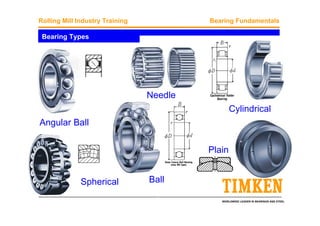
Angular Ball
Spherical Ball
Needle
Plain
Cylindrical
Bearing Types
WORLDWIDE LEADER IN BEARINGS AND STEEL
Rolling Mill Industry Training Bearing Fundamentals
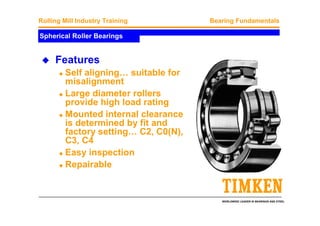
Spherical Roller Bearings
Features
Self aligning… suitable for
misalignment
Large diameter rollers
provide high load rating
Mounted internal clearance
is determined by fit and
factory setting… C2, C0(N),
C3, C4
Easy inspection
Repairable
WORLDWIDE LEADER IN BEARINGS AND STEEL
Rolling Mill Industry Training Bearing Fundamentals
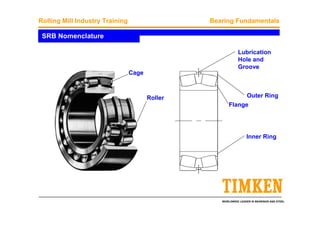
Outer Ring
Inner Ring
Lubrication
Hole and
Groove
Cage
Roller
Flange
SRB Nomenclature
WORLDWIDE LEADER IN BEARINGS AND STEEL
Rolling Mill Industry Training Bearing Fundamentals
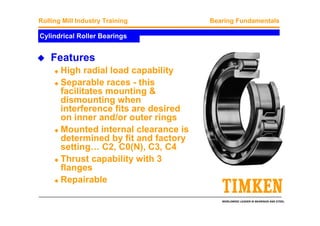
Cylindrical Roller Bearings
Features
High radial load capability
Separable races - this
facilitates mounting &
dismounting when
interference fits are desired
on inner and/or outer rings
Mounted internal clearance is
determined by fit and factory
setting… C2, C0(N), C3, C4
Thrust capability with 3
flanges
Repairable
WORLDWIDE LEADER IN BEARINGS AND STEEL
Rolling Mill Industry Training Bearing Fundamentals
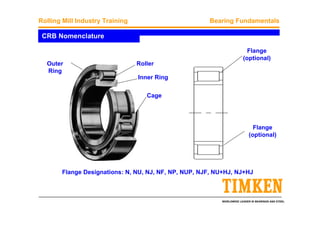
CRB Nomenclature
Outer
Ring
Inner Ring
Cage
Roller
Flange
(optional)
Flange
(optional)
Flange Designations: N, NU, NJ, NF, NP, NUP, NJF, NU+HJ, NJ+HJ
WORLDWIDE LEADER IN BEARINGS AND STEEL
Rolling Mill Industry Training Bearing Fundamentals
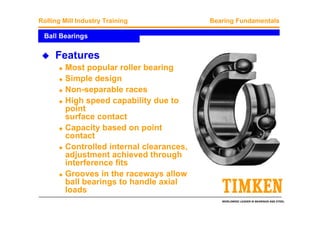
Ball Bearings
Features
Most popular roller bearing
Simple design
Non-separable races
High speed capability due to
point
surface contact
Capacity based on point
contact
Controlled internal clearances,
adjustment achieved through
interference fits
Grooves in the raceways allow
ball bearings to handle axial
loads
WORLDWIDE LEADER IN BEARINGS AND STEEL
Rolling Mill Industry Training Bearing Fundamentals
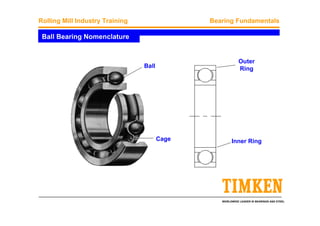
Ball Bearing Nomenclature
Outer
Ring
Inner RingCage
Ball
WORLDWIDE LEADER IN BEARINGS AND STEEL
Rolling Mill Industry Training Bearing Fundamentals
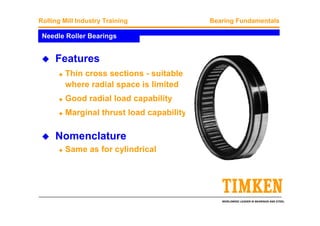
Needle Roller Bearings
Features
Thin cross sections - suitable
where radial space is limited
Good radial load capability
Marginal thrust load capability
Nomenclature
Same as for cylindrical
WORLDWIDE LEADER IN BEARINGS AND STEEL
Rolling Mill Industry Training Bearing Fundamentals
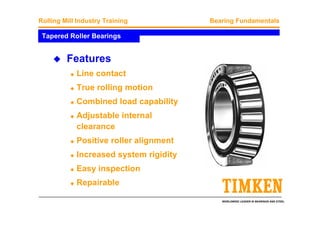
Tapered Roller Bearings
Features
Line contact
True rolling motion
Combined load capability
Adjustable internal
clearance
Positive roller alignment
Increased system rigidity
Easy inspection
Repairable
WORLDWIDE LEADER IN BEARINGS AND STEEL
Rolling Mill Industry Training Bearing Fundamentals
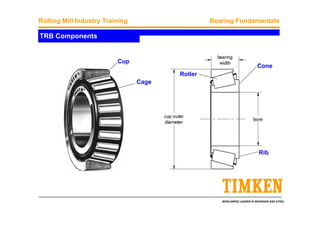
TRB Components
Cup
Cone
Cage
Roller
Rib
WORLDWIDE LEADER IN BEARINGS AND STEEL
Rolling Mill Industry Training Bearing Fundamentals
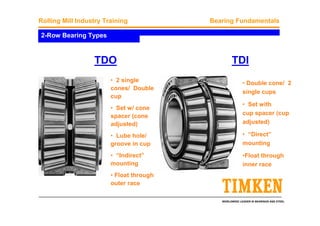
2-Row Bearing Types
TDITDO
• 2 single
cones/ Double
cup
• Set w/ cone
spacer (cone
adjusted)
• Lube hole/
groove in cup
• “Indirect”
mounting
• Float through
outer race
• Double cone/ 2
single cups
• Set with
cup spacer (cup
adjusted)
• “Direct”
mounting
•Float through
inner race
WORLDWIDE LEADER IN BEARINGS AND STEEL
Rolling Mill Industry Training Bearing Fundamentals
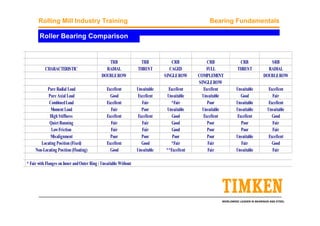
Roller Bearing Comparison
TRB TRB CRB CRB CRB SRB
CHARACTERISTIC RADIAL THRUST CAGED FULL THRUST RADIAL
DOUBLEROW SINGLEROW COMPLEMENT DOUBLEROW
SINGLEROW
Pure Radial Load Excellent Unsuitable Excellent Excellent Unsuitable Excellent
Pure Axial Load Good Excellent Unsuitable Unsuitable Good Fair
CombinedLoad Excellent Fair *Fair Poor Unsuitable Excellent
Moment Load Fair Poor Unsuitable Unsuitable Unsuitable Unsuitable
High Stiffness Excellent Excellent Good Excellent Excellent Good
QuietRunning Fair Fair Good Poor Poor Fair
LowFriction Fair Fair Good Poor Poor Fair
Misalignment Poor Poor Poor Poor Unsuitable Excellent
Locating Position (Fixed) Excellent Good *Fair Fair Fair Good
Non-Locating Position (Floating) Good Unsuitable **Excellent Fair Unsuitable Fair
* Fair with Flanges on Inner andOuter Ring / Unsuitable Without
WORLDWIDE LEADER IN BEARINGS AND STEEL
Rolling Mill Industry Training Bearing Fundamentals
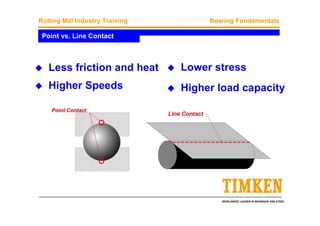
Point vs. Line Contact
Less friction and heat
Higher Speeds
Lower stress
Higher load capacity
WORLDWIDE LEADER IN BEARINGS AND STEEL
Rolling Mill Industry Training Bearing Fundamentals
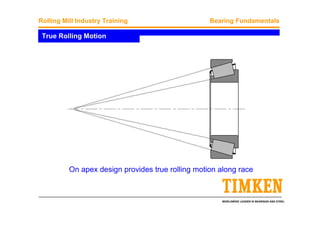
True Rolling Motion
On apex design provides true rolling motion along race
Apex
WORLDWIDE LEADER IN BEARINGS AND STEEL
Rolling Mill Industry Training Bearing Fundamentals
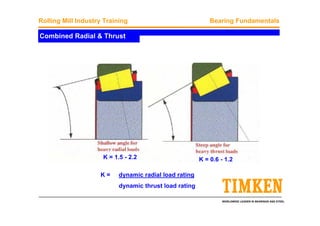
K = 1.5 - 2.2 K = 0.6 - 1.2
Combined Radial & Thrust
K = dynamic radial load rating
dynamic thrust load rating
WORLDWIDE LEADER IN BEARINGS AND STEEL
Rolling Mill Industry Training Bearing Fundamentals
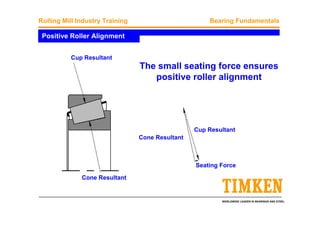
Positive Roller Alignment
The small seating force ensures
positive roller alignment
Cup Resultant
Cone Resultant
Seating Force
Cup Resultant
Cone Resultant
WORLDWIDE LEADER IN BEARINGS AND STEEL
Rolling Mill Industry Training Bearing Fundamentals
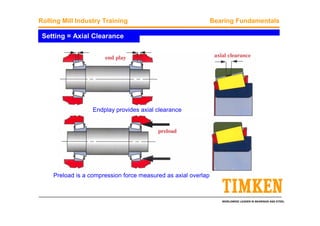
Setting = Axial Clearance
Endplay provides axial clearance
Preload is a compression force measured as axial overlap
WORLDWIDE LEADER IN BEARINGS AND STEEL
Rolling Mill Industry Training Bearing Fundamentals
TRB Setting
WORLDWIDE LEADER IN BEARINGS AND STEEL
Rolling Mill Industry Training Bearing Fundamentals
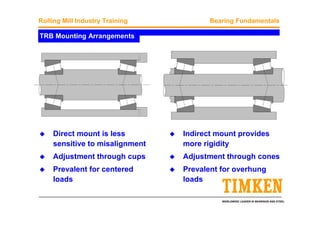
TRB Mounting Arrangements
Direct mount is less
sensitive to misalignment
Adjustment through cups
Prevalent for centered
loads
Indirect mount provides
more rigidity
Adjustment through cones
Prevalent for overhung
loads
WORLDWIDE LEADER IN BEARINGS AND STEEL
Rolling Mill Industry Training Bearing Fundamentals
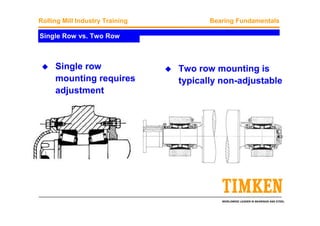
Single Row vs. Two Row
Single row
mounting requires
adjustment
Two row mounting is
typically non-adjustable
WORLDWIDE LEADER IN BEARINGS AND STEEL
Rolling Mill Industry Training Bearing Fundamentals
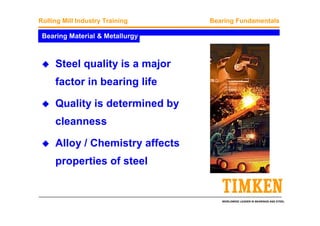
Bearing Material & Metallurgy
Steel quality is a major
factor in bearing life
Quality is determined by
cleanness
Alloy / Chemistry affects
properties of steel
WORLDWIDE LEADER IN BEARINGS AND STEEL
Rolling Mill Industry Training Bearing Fundamentals
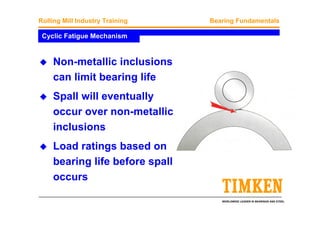
Cyclic Fatigue Mechanism
Non-metallic inclusions
can limit bearing life
Spall will eventually
occur over non-metallic
inclusions
Load ratings based on
bearing life before spall
occurs
WORLDWIDE LEADER IN BEARINGS AND STEEL
Rolling Mill Industry Training Bearing Fundamentals
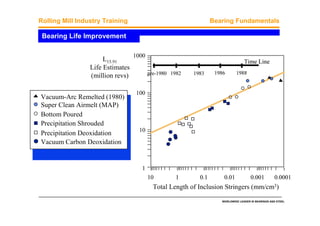
Bearing Life Improvement
1
10
100
1000
Total Length of Inclusion Stringers (mm/cm3)
0.00010.0010.010.1110
Time Line
1988198619831982pre-1980
0.00010.0010.010.1110
Time Line
1988198619831982pre-1980
L15.91
Life Estimates
(million revs)
Bottom Poured
Precipitation Shrouded
Precipitation Deoxidation
Super Clean Airmelt (MAP)
Vacuum Carbon Deoxidation
Vacuum-Arc Remelted (1980)
Bottom Poured
Precipitation Shrouded
Precipitation Deoxidation
Super Clean Airmelt (MAP)
Vacuum Carbon Deoxidation
Vacuum-Arc Remelted (1980)
WORLDWIDE LEADER IN BEARINGS AND STEEL
Rolling Mill Industry Training Bearing Fundamentals
Fitting Practice
Tight fits for rotating race
Exceptions: low speed applications,
TQO work and back-up rolls, keyed
bores
Heavy duty tight fits for heavy loads
and high speed (Limits for TH product)
Loose or split fits suggested when
adjustment is necessary and for
stationary races
WORLDWIDE LEADER IN BEARINGS AND STEEL
Rolling Mill Industry Training Bearing Fundamentals
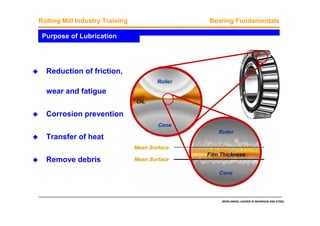
Purpose of Lubrication
Reduction of friction,
wear and fatigue
Corrosion prevention
Transfer of heat
Remove debris
WORLDWIDE LEADER IN BEARINGS AND STEEL
Rolling Mill Industry Training Bearing Fundamentals
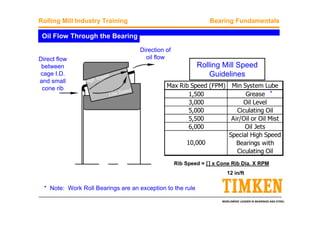
Oil Flow Through the Bearing
Direct flow
between
cage I.D.
and small
cone rib
Direction of
oil flow
High Speed
High Speed
Low Speed
Low Speed
Rolling Mill Speed
Guidelines
Max Rib Speed (FPM) Min System Lube
1,500 Grease
3,000 Oil Level
5,000 Ciculating Oil
5,500 Air/Oil or Oil Mist
6,000 Oil Jets
Special High Speed
Bearings with
Ciculating Oil
10,000
Rib Speed = ∏∏∏∏ x Cone Rib Dia. X RPM
12 in/ft
* Note: Work Roll Bearings are an exception to the rule
*

Timken bearing fundamentals

  • 1.
    Rolling Mill IndustryTraining: Bearing Fundamentals WORLDWIDE LEADER IN BEARINGS AND STEEL
  • 2.
    WORLDWIDE LEADER INBEARINGS AND STEEL Rolling Mill Industry Training Bearing Fundamentals Bearing Types and Features Tapered Roller Bearing Details TRB Setting TRB Mounting Bearing Metallurgy & Fatigue Mechanism TRB Fitting Practice Lubrication Agenda
  • 3.
    WORLDWIDE LEADER INBEARINGS AND STEEL Rolling Mill Industry Training Bearing Fundamentals Bearing Types Friction bearings Plain Bushing Oil sleeve Anti-friction bearings Ball bearings Needle roller bearings Spherical roller bearings Cylindrical roller bearings Tapered roller bearings
  • 4.
    WORLDWIDE LEADER INBEARINGS AND STEEL Rolling Mill Industry Training Bearing Fundamentals Angular Ball Spherical Ball Needle Plain Cylindrical Bearing Types
  • 5.
    WORLDWIDE LEADER INBEARINGS AND STEEL Rolling Mill Industry Training Bearing Fundamentals Spherical Roller Bearings Features Self aligning… suitable for misalignment Large diameter rollers provide high load rating Mounted internal clearance is determined by fit and factory setting… C2, C0(N), C3, C4 Easy inspection Repairable
  • 6.
    WORLDWIDE LEADER INBEARINGS AND STEEL Rolling Mill Industry Training Bearing Fundamentals Outer Ring Inner Ring Lubrication Hole and Groove Cage Roller Flange SRB Nomenclature
  • 7.
    WORLDWIDE LEADER INBEARINGS AND STEEL Rolling Mill Industry Training Bearing Fundamentals Cylindrical Roller Bearings Features High radial load capability Separable races - this facilitates mounting & dismounting when interference fits are desired on inner and/or outer rings Mounted internal clearance is determined by fit and factory setting… C2, C0(N), C3, C4 Thrust capability with 3 flanges Repairable
  • 8.
    WORLDWIDE LEADER INBEARINGS AND STEEL Rolling Mill Industry Training Bearing Fundamentals CRB Nomenclature Outer Ring Inner Ring Cage Roller Flange (optional) Flange (optional) Flange Designations: N, NU, NJ, NF, NP, NUP, NJF, NU+HJ, NJ+HJ
  • 9.
    WORLDWIDE LEADER INBEARINGS AND STEEL Rolling Mill Industry Training Bearing Fundamentals Ball Bearings Features Most popular roller bearing Simple design Non-separable races High speed capability due to point surface contact Capacity based on point contact Controlled internal clearances, adjustment achieved through interference fits Grooves in the raceways allow ball bearings to handle axial loads
  • 10.
    WORLDWIDE LEADER INBEARINGS AND STEEL Rolling Mill Industry Training Bearing Fundamentals Ball Bearing Nomenclature Outer Ring Inner RingCage Ball
  • 11.
    WORLDWIDE LEADER INBEARINGS AND STEEL Rolling Mill Industry Training Bearing Fundamentals Needle Roller Bearings Features Thin cross sections - suitable where radial space is limited Good radial load capability Marginal thrust load capability Nomenclature Same as for cylindrical
  • 12.
    WORLDWIDE LEADER INBEARINGS AND STEEL Rolling Mill Industry Training Bearing Fundamentals Tapered Roller Bearings Features Line contact True rolling motion Combined load capability Adjustable internal clearance Positive roller alignment Increased system rigidity Easy inspection Repairable
  • 13.
    WORLDWIDE LEADER INBEARINGS AND STEEL Rolling Mill Industry Training Bearing Fundamentals TRB Components Cup Cone Cage Roller Rib
  • 14.
    WORLDWIDE LEADER INBEARINGS AND STEEL Rolling Mill Industry Training Bearing Fundamentals 2-Row Bearing Types TDITDO • 2 single cones/ Double cup • Set w/ cone spacer (cone adjusted) • Lube hole/ groove in cup • “Indirect” mounting • Float through outer race • Double cone/ 2 single cups • Set with cup spacer (cup adjusted) • “Direct” mounting •Float through inner race
  • 15.
    WORLDWIDE LEADER INBEARINGS AND STEEL Rolling Mill Industry Training Bearing Fundamentals Roller Bearing Comparison TRB TRB CRB CRB CRB SRB CHARACTERISTIC RADIAL THRUST CAGED FULL THRUST RADIAL DOUBLEROW SINGLEROW COMPLEMENT DOUBLEROW SINGLEROW Pure Radial Load Excellent Unsuitable Excellent Excellent Unsuitable Excellent Pure Axial Load Good Excellent Unsuitable Unsuitable Good Fair CombinedLoad Excellent Fair *Fair Poor Unsuitable Excellent Moment Load Fair Poor Unsuitable Unsuitable Unsuitable Unsuitable High Stiffness Excellent Excellent Good Excellent Excellent Good QuietRunning Fair Fair Good Poor Poor Fair LowFriction Fair Fair Good Poor Poor Fair Misalignment Poor Poor Poor Poor Unsuitable Excellent Locating Position (Fixed) Excellent Good *Fair Fair Fair Good Non-Locating Position (Floating) Good Unsuitable **Excellent Fair Unsuitable Fair * Fair with Flanges on Inner andOuter Ring / Unsuitable Without
  • 16.
    WORLDWIDE LEADER INBEARINGS AND STEEL Rolling Mill Industry Training Bearing Fundamentals Point vs. Line Contact Less friction and heat Higher Speeds Lower stress Higher load capacity
  • 17.
    WORLDWIDE LEADER INBEARINGS AND STEEL Rolling Mill Industry Training Bearing Fundamentals True Rolling Motion On apex design provides true rolling motion along race Apex
  • 18.
    WORLDWIDE LEADER INBEARINGS AND STEEL Rolling Mill Industry Training Bearing Fundamentals K = 1.5 - 2.2 K = 0.6 - 1.2 Combined Radial & Thrust K = dynamic radial load rating dynamic thrust load rating
  • 19.
    WORLDWIDE LEADER INBEARINGS AND STEEL Rolling Mill Industry Training Bearing Fundamentals Positive Roller Alignment The small seating force ensures positive roller alignment Cup Resultant Cone Resultant Seating Force Cup Resultant Cone Resultant
  • 20.
    WORLDWIDE LEADER INBEARINGS AND STEEL Rolling Mill Industry Training Bearing Fundamentals Setting = Axial Clearance Endplay provides axial clearance Preload is a compression force measured as axial overlap
  • 21.
    WORLDWIDE LEADER INBEARINGS AND STEEL Rolling Mill Industry Training Bearing Fundamentals TRB Setting
  • 22.
    WORLDWIDE LEADER INBEARINGS AND STEEL Rolling Mill Industry Training Bearing Fundamentals TRB Mounting Arrangements Direct mount is less sensitive to misalignment Adjustment through cups Prevalent for centered loads Indirect mount provides more rigidity Adjustment through cones Prevalent for overhung loads
  • 23.
    WORLDWIDE LEADER INBEARINGS AND STEEL Rolling Mill Industry Training Bearing Fundamentals Single Row vs. Two Row Single row mounting requires adjustment Two row mounting is typically non-adjustable
  • 24.
    WORLDWIDE LEADER INBEARINGS AND STEEL Rolling Mill Industry Training Bearing Fundamentals Bearing Material & Metallurgy Steel quality is a major factor in bearing life Quality is determined by cleanness Alloy / Chemistry affects properties of steel
  • 25.
    WORLDWIDE LEADER INBEARINGS AND STEEL Rolling Mill Industry Training Bearing Fundamentals Cyclic Fatigue Mechanism Non-metallic inclusions can limit bearing life Spall will eventually occur over non-metallic inclusions Load ratings based on bearing life before spall occurs
  • 26.
    WORLDWIDE LEADER INBEARINGS AND STEEL Rolling Mill Industry Training Bearing Fundamentals Bearing Life Improvement 1 10 100 1000 Total Length of Inclusion Stringers (mm/cm3) 0.00010.0010.010.1110 Time Line 1988198619831982pre-1980 0.00010.0010.010.1110 Time Line 1988198619831982pre-1980 L15.91 Life Estimates (million revs) Bottom Poured Precipitation Shrouded Precipitation Deoxidation Super Clean Airmelt (MAP) Vacuum Carbon Deoxidation Vacuum-Arc Remelted (1980) Bottom Poured Precipitation Shrouded Precipitation Deoxidation Super Clean Airmelt (MAP) Vacuum Carbon Deoxidation Vacuum-Arc Remelted (1980)
  • 27.
    WORLDWIDE LEADER INBEARINGS AND STEEL Rolling Mill Industry Training Bearing Fundamentals Fitting Practice Tight fits for rotating race Exceptions: low speed applications, TQO work and back-up rolls, keyed bores Heavy duty tight fits for heavy loads and high speed (Limits for TH product) Loose or split fits suggested when adjustment is necessary and for stationary races
  • 28.
    WORLDWIDE LEADER INBEARINGS AND STEEL Rolling Mill Industry Training Bearing Fundamentals Purpose of Lubrication Reduction of friction, wear and fatigue Corrosion prevention Transfer of heat Remove debris
  • 29.
    WORLDWIDE LEADER INBEARINGS AND STEEL Rolling Mill Industry Training Bearing Fundamentals Oil Flow Through the Bearing Direct flow between cage I.D. and small cone rib Direction of oil flow High Speed High Speed Low Speed Low Speed Rolling Mill Speed Guidelines Max Rib Speed (FPM) Min System Lube 1,500 Grease 3,000 Oil Level 5,000 Ciculating Oil 5,500 Air/Oil or Oil Mist 6,000 Oil Jets Special High Speed Bearings with Ciculating Oil 10,000 Rib Speed = ∏∏∏∏ x Cone Rib Dia. X RPM 12 in/ft * Note: Work Roll Bearings are an exception to the rule *