P.T. International Corp.
       Metric & American Standard
       Power Transmission Products
       Global Production
       Broad Euro Product Range
       Global Markets Prefer Metric -
       Easier to Source Spare Parts
Mounted Bearings, Drive Products &
European Linear Components
P.T. International Corp.
Headquartered in Charlotte NC
80,000 Ft² - 25,000 SKU’s
Global Manufacturing &
Sourcing
Engineering and Design
Capabilities
Sales Reps in US, Canada and
Europe
ISO 9001:2008 Certified
Inspection & Warehouse


                      Shaft Center Height
                                            PTI Warehouse


Bore Measurement
with Sylvac Digital    Go/No Go Gauges,
   Instruments          Thread Gauges &
                      Taper Bore Gauges
Mounted Roller Bearings
               SAFS/SDAF Split Pillow
               Blocks thru 21” Shaft
               Diameter and Multiple Seal
               Options


         SN/SD Split Plummer
          Blocks thru 400mm
              Bores in stock
Standard Split Block Components


                                                       Tapered Spherical
                  Split Housing      Tapered Adapter       Bearing


LER Triple Labyrinth Seal   Fixing Ring     Lock Nut   Lock Washer or Clip
Optional Components


Hydraulic Adapter      PER Seals           End Cover     Taconite     Lock Nut with
                       w/ O-ring                           Seal      Mounting Screws


Hydraulic Nut (Tool)   LER-DC Dust Cover               PTV Seal for PER
Introduction – Housing Features


                       Optional Oil Sight Glass   Large Lube Plugs/Drains & Face
Optional Temp. Strip     (cross-port drilled)      Grooves for Dust Cover Seal


Matched Cap & Base,     Offset Dowel for              Solid Base for Strength
 & Large Pry Slots      Proper Assembly                 and Oil Cross-port
SAF Complete Unit Nomenclature
 SAF 22528 x 4-15/16 Includes:

  SAF 528 Housing, Seals, and Fixing Ring
  22228K C3 W33 Spherical Bearing
    K = Tapered Bore
    C3 = Internal Clearance
    W33 Lube groove on OD of Bearing

  SNW 28 x 4-15/16 Adapter (or H3128 x 4-15/16)
    SNW = Sleeve, Nut, Washer – Inch Treads (H=Metric Thds.)
SAF Housing Nomenclature
 SAF – Cast Iron Housing (Std U.S.)
 SAFD – Ductile Housing (Std Canada)
 SAFS – Steel Housing
 FSAF – Standard Four Bolt Base
   SAF 509 to SAF511 - 2 Bolt Base (Housing Only_
   SAF513 to SAF520 - 2 Bolt Base
   FSAF 513 to FSAF 520 - 4 Bolt Bases
   SAF 522 & Up - 4 Bolt Bases only


 Bearing Nomenclature: Last 2 digits x 5 = Bore in
 mm.
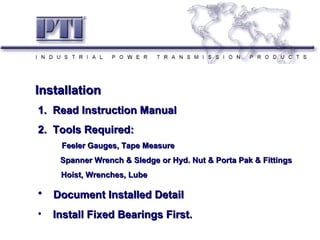
Installation
Installation
1. Read Instruction Manual
2. Tools Required:
      Feeler Gauges, Tape Measure
      Spanner Wrench & Sledge or Hyd. Nut & Porta Pak & Fittings
      Hoist, Wrenches, Lube

• Document Installed Detail
•   Install Fixed Bearings First.
Shaft and Housing Fits
  Installation


1. SAF Blocks have
   Clearance fits, Typically
   H8 to allow the bearing to
   float within the housing      Housing
   for expansion.
2. Each shaft requires 1
   fixed bearing and 1
   bearing to float to handle
   expansion.
3. Typical fit to the shaft is
   0.0005” interference per
   inch of shaft diameter.        Shaft
Documentation - Measure & Record the
Un-mounted Internal Bearing Clearance
  Installation

1. On free standing Spherical
Bearings, the clearance is at the top
between roller and outer race.


                         2. For Spherical Bearings hanging free on a
                         shaft, the clearance is between the lowest
                         roller and inner race, but difficult to measure
                         there. So carefully measure between the
                         roller and outer race.
3. Document measurements for future reference.
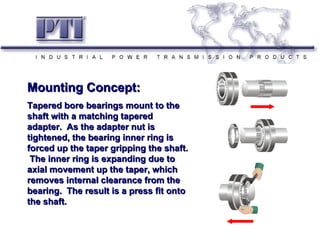
Mounting Concept:
Tapered bore bearings mount to the
shaft with a matching tapered
adapter. As the adapter nut is
tightened, the bearing inner ring is
forced up the taper gripping the shaft.
 The inner ring is expanding due to
axial movement up the taper, which
removes internal clearance from the
bearing. The result is a press fit onto
the shaft.
Spanner Wrench Mounting
2. Hand Tighten Nut without Lockwasher
3. Do not use hammer and drift. The drift
   will severely damage the nut
4. Use a spanner wrench and hammer.
   This method will only work for smaller
   shaft diameters.
5. For larger shaft sizes, use Hydraulic Nut
   or Micro - mount screw method.
Mounting with Hydraulic Nut
As an option the bearing can also be
mounted with the help of a hydraulic nut.
This is especially helpful for large diameter
units. Pressure from the piston within the
nut presses the bearing inner ring up the
tapered adapter, expanding the inner ring
slightly. Axial movement of the bearing
and clearance removed during the process
can be measured.
As the final internal clearance is achieved,
release the pressure and remove the
Hydraulic nut, Replace it with the standard
nut and washer or locking clip.
Mounting with Hydraulic Nut                  Spherical Bering
                                             with Tapered Bore
  Hydraulic Pressure Inlet
                                                       Tapered
              Hydraulic                                Adapter
                   Nut


                             Piston of Hydraulic Nut
                                 presses on Bearing
                                         Inner Ring
Mounting with Hydraulic Nut (cont’d)

Once the Hydraulic nut                       1. Re-install Nut
                                             & Lockwasher.
has been removed, install
the lockwasher and
tighten the standard nut.
Once tight, bend the most
                                                        2. Tighten Nut.
convenient tang of the
washer into the slot on
the OD of the nut. This
acts as a lock washer.
Larger units use a locking                                       3. Bend
                                                                 washer tang or
clip.                                                            install locking
Do not drive the bearing further up the taper!                   clip.
Tips for Measuring the Clearance
During installation of the bearing, which is likely
hanging on the shaft, it may be very helpful to
sling the bearing, shifting the internal clearance
to the top where clearance is easier to measure.
As a comparison, clearance measure on the
bottom should be the same as that measured on
the top. Due to the weight of the rollers and
sliding the feeler gauge under the roller,
clearances tend to be a little more difficult and
tend to read less than on the top. Practice will
minimize the differences. Clearance can be
measured on each side for verification.

Note: Do not roll the bearing over the feeler gauge in
an attempt to measure the clearance. This will not
yield an accurate result of clearance!
More Tips when Measuring….
BEARING
 As a measurement suggestion and prior to each
 measurement, roll the bearing to center rollers
 for measurement. A helpful tip is to lightly press
 the roller inward with your thumb, i.e…. toward
 the center of the bearing, so it remains stable.
 This also creates a consistent measurement
 technique. Make sure the feeler gauge passes
 over the top of the roller and not the edge. A
 light saw-tooth action will help the feeler to pass.
  The roller is crowned so the measurement at the
 edge will be slightly larger than at the center.

  Measure clearance with feeler gauge over the center of the roller.
  Document the measurements for order documentation.
Mounted Spherical Bearings Applications
         Mining Conveyors
         – Underground &
             Overland


                                Other
                             Applications -
                             Fans, Shaker
                               Screens,
                            Industrial Fans
Example: SAF 22528 x 4-15/16, Bearing 22228K C3 W33, (Bore 140mm)
Example:
 SAF22528 x 4-15/16
 Bearing 22228 K C3


Pressure: 339 psi

Clearance Reduction
         0.025” min.

Axial Drive Up:
0.0317”


Measure To Be Sure!
Optional Mounting Method….
 Installation
Adapter Nut with Mounting Screws


                           Tighten Oval Point Set Screws using a
                           torque wrench pressing on the bearing
                           inner ring, removing the clearance as
                           torque increases. Measuring clearance at
                           each torque interval.
Housing, Seals and Lube
BEARING
  Once the bearing has been properly tightened and the final running
  clearance documented, housing assembly can begin.
  Position the seals so they align with the housing and lower the
  bearing into the housing. The seals should fit into the seal grooves.
  Hand pack the seal grooves in the housing base with grease. Also
  hand pack the bearing between all of the rollers with grease once the
  bearing is resting in the housing base. The base should then be
  filled 1/3 to 1/2 full as a guide.
  To assist final housing mounting, the fixing ring can be installed on
  either side of the bearing to help with base bolt hole positioning.
  One bearing must have the fixing ring, the other end should remain
  free to float (no fixing ring). Position the floating bearing in the center
  of the bearing area so it can expand or contract as needed.
Installation
Bearing Removal and Reuse?
1. Visually inspect the Spherical Roller Bearing for
   surface defects including brinelling, pits, staining,
   or graying of the races. See included defect chart.
2. The Housing cost is usually less than the SRB,
   and seal grooves wear, inspect before re-use.
3. Always replace the Adapter and Seals.
4. In general, it is not advisable to re-use bearings.
Introduction – Housing Features
BEARING


                         Optional Oil Sight Glass   Large Lube Plugs/Drains & Face
                           (cross-port drilled)      Grooves for Dust Cover Seal
  Optional Temp. Strip


  Matched Cap & Base,      Offset Dowel for             Solid Base for Strength
   & Large Pry Slots       Proper Assembly                and Oil Cross-port
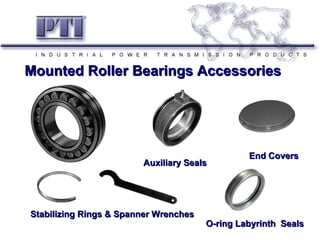
Mounted Roller Bearings Accessories
BEARING


                                                 End Covers
                         Auxiliary Seals


 Stabilizing Rings & Spanner Wrenches
                                        O-ring Labyrinth Seals
Mounted Spherical Bearing Accessories
BEARING
                    Hydraulic Nuts
                       for Bearing
                       Installation


Hydraulic Adapter
Sleeves for
Assisted Bearing
Removal
P.T. International Corp.

                  SAF, SDAF &
                  Metric Split Blocks
                  Installation &
                  General Training
Bearing Autopsy
  Installation
1. Bearings are a systems flight
   recorder. Wear patterns on the
   races tell a story and provide
   helpful application information.
                                          Part: Outer ring of a spherical roller bearing
2. When the shaft rotates, the history    Symptom: Peeling occurs near the shoulder of
                                          the raceway over the entire circumference and on
   builds on the Outer race.              the center of the rolling surfaces below
                                          Cause: Poor lubrication
3. Careful inspection review of load
   zone, wear pattern, surface marks
   and discolorations will guide the
   user as to why the failure occurred.
Bearing Autopsy – Typical Problems 1
 Installation


Part: Inner ring of a spherical    Part: Outer ring of a spherical
roller bearing                     roller bearing
                                   Symptom: Creep occurs over
Symptom: Creep accompanied         entire circumference of outside
by scoring of bore surface         surface
Cause: Insufficient interference   Cause: Loose fit between outer
                                   ring and housing
Bearing Autopsy – Typical Problems 2
   Installation


Part: Outer ring of a spherical roller   Part: Outer ring of a Cylindrical
bearing                                  bearing
                                         Symptom: False brinelling occurs
Symptom: Wear having a wavy or
                                         on the raceway
concave-and-convex texture on
loaded side of raceway surface           Cause: Vibration from an external
                                         source while stationary
Cause: Entry of debris under
repeated vibration while stationary
Bearing Autopsy – Typical Problems 3
 Installation


Part: Inner ring of an angular    Part: Outer ring in Photo
contact ball bearing
                                  Symptom: Raceway discoloration,
Symptom: Raceway discoloration,   melting occurs at ball pitch
melting occurs at ball pitch      intervals
intervals
                                  Cause: Excessive preload
Cause: Excessive preload
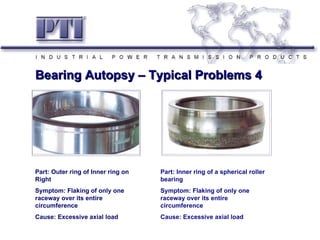
Bearing Autopsy – Typical Problems 4
 Installation


Part: Outer ring of Inner ring on   Part: Inner ring of a spherical roller
Right                               bearing
Symptom: Flaking of only one        Symptom: Flaking of only one
raceway over its entire             raceway over its entire
circumference                       circumference
Cause: Excessive axial load         Cause: Excessive axial load
After Hours Service 7-24

   Toll Free 1-800-763-4434

       www.ptintl.com

Thank You!
Split block installation and trouble shooting 2011

Split block installation and trouble shooting 2011

  • 1.
    P.T. International Corp. Metric & American Standard Power Transmission Products Global Production Broad Euro Product Range Global Markets Prefer Metric - Easier to Source Spare Parts
  • 2.
    Mounted Bearings, DriveProducts & European Linear Components
  • 3.
    P.T. International Corp. Headquarteredin Charlotte NC 80,000 Ft² - 25,000 SKU’s Global Manufacturing & Sourcing Engineering and Design Capabilities Sales Reps in US, Canada and Europe ISO 9001:2008 Certified
  • 4.
    Inspection & Warehouse Shaft Center Height PTI Warehouse Bore Measurement with Sylvac Digital Go/No Go Gauges, Instruments Thread Gauges & Taper Bore Gauges
  • 5.
    Mounted Roller Bearings SAFS/SDAF Split Pillow Blocks thru 21” Shaft Diameter and Multiple Seal Options SN/SD Split Plummer Blocks thru 400mm Bores in stock
  • 6.
    Standard Split BlockComponents Tapered Spherical Split Housing Tapered Adapter Bearing LER Triple Labyrinth Seal Fixing Ring Lock Nut Lock Washer or Clip
  • 7.
    Optional Components Hydraulic Adapter PER Seals End Cover Taconite Lock Nut with w/ O-ring Seal Mounting Screws Hydraulic Nut (Tool) LER-DC Dust Cover PTV Seal for PER
  • 8.
    Introduction – HousingFeatures Optional Oil Sight Glass Large Lube Plugs/Drains & Face Optional Temp. Strip (cross-port drilled) Grooves for Dust Cover Seal Matched Cap & Base, Offset Dowel for Solid Base for Strength & Large Pry Slots Proper Assembly and Oil Cross-port
  • 9.
    SAF Complete UnitNomenclature SAF 22528 x 4-15/16 Includes: SAF 528 Housing, Seals, and Fixing Ring 22228K C3 W33 Spherical Bearing K = Tapered Bore C3 = Internal Clearance W33 Lube groove on OD of Bearing SNW 28 x 4-15/16 Adapter (or H3128 x 4-15/16) SNW = Sleeve, Nut, Washer – Inch Treads (H=Metric Thds.)
  • 10.
    SAF Housing Nomenclature SAF – Cast Iron Housing (Std U.S.) SAFD – Ductile Housing (Std Canada) SAFS – Steel Housing FSAF – Standard Four Bolt Base SAF 509 to SAF511 - 2 Bolt Base (Housing Only_ SAF513 to SAF520 - 2 Bolt Base FSAF 513 to FSAF 520 - 4 Bolt Bases SAF 522 & Up - 4 Bolt Bases only Bearing Nomenclature: Last 2 digits x 5 = Bore in mm.
  • 11.
    Installation Installation 1. Read InstructionManual 2. Tools Required: Feeler Gauges, Tape Measure Spanner Wrench & Sledge or Hyd. Nut & Porta Pak & Fittings Hoist, Wrenches, Lube • Document Installed Detail • Install Fixed Bearings First.
  • 12.
    Shaft and HousingFits Installation 1. SAF Blocks have Clearance fits, Typically H8 to allow the bearing to float within the housing Housing for expansion. 2. Each shaft requires 1 fixed bearing and 1 bearing to float to handle expansion. 3. Typical fit to the shaft is 0.0005” interference per inch of shaft diameter. Shaft
  • 13.
    Documentation - Measure& Record the Un-mounted Internal Bearing Clearance Installation 1. On free standing Spherical Bearings, the clearance is at the top between roller and outer race. 2. For Spherical Bearings hanging free on a shaft, the clearance is between the lowest roller and inner race, but difficult to measure there. So carefully measure between the roller and outer race. 3. Document measurements for future reference.
  • 14.
    Mounting Concept: Tapered borebearings mount to the shaft with a matching tapered adapter. As the adapter nut is tightened, the bearing inner ring is forced up the taper gripping the shaft. The inner ring is expanding due to axial movement up the taper, which removes internal clearance from the bearing. The result is a press fit onto the shaft.
  • 15.
    Spanner Wrench Mounting 2.Hand Tighten Nut without Lockwasher 3. Do not use hammer and drift. The drift will severely damage the nut 4. Use a spanner wrench and hammer. This method will only work for smaller shaft diameters. 5. For larger shaft sizes, use Hydraulic Nut or Micro - mount screw method.
  • 16.
    Mounting with HydraulicNut As an option the bearing can also be mounted with the help of a hydraulic nut. This is especially helpful for large diameter units. Pressure from the piston within the nut presses the bearing inner ring up the tapered adapter, expanding the inner ring slightly. Axial movement of the bearing and clearance removed during the process can be measured. As the final internal clearance is achieved, release the pressure and remove the Hydraulic nut, Replace it with the standard nut and washer or locking clip.
  • 17.
    Mounting with HydraulicNut Spherical Bering with Tapered Bore Hydraulic Pressure Inlet Tapered Hydraulic Adapter Nut Piston of Hydraulic Nut presses on Bearing Inner Ring
  • 18.
    Mounting with HydraulicNut (cont’d) Once the Hydraulic nut 1. Re-install Nut & Lockwasher. has been removed, install the lockwasher and tighten the standard nut. Once tight, bend the most 2. Tighten Nut. convenient tang of the washer into the slot on the OD of the nut. This acts as a lock washer. Larger units use a locking 3. Bend washer tang or clip. install locking Do not drive the bearing further up the taper! clip.
  • 19.
    Tips for Measuringthe Clearance During installation of the bearing, which is likely hanging on the shaft, it may be very helpful to sling the bearing, shifting the internal clearance to the top where clearance is easier to measure. As a comparison, clearance measure on the bottom should be the same as that measured on the top. Due to the weight of the rollers and sliding the feeler gauge under the roller, clearances tend to be a little more difficult and tend to read less than on the top. Practice will minimize the differences. Clearance can be measured on each side for verification. Note: Do not roll the bearing over the feeler gauge in an attempt to measure the clearance. This will not yield an accurate result of clearance!
  • 20.
    More Tips whenMeasuring…. BEARING As a measurement suggestion and prior to each measurement, roll the bearing to center rollers for measurement. A helpful tip is to lightly press the roller inward with your thumb, i.e…. toward the center of the bearing, so it remains stable. This also creates a consistent measurement technique. Make sure the feeler gauge passes over the top of the roller and not the edge. A light saw-tooth action will help the feeler to pass. The roller is crowned so the measurement at the edge will be slightly larger than at the center. Measure clearance with feeler gauge over the center of the roller. Document the measurements for order documentation.
  • 21.
    Mounted Spherical BearingsApplications Mining Conveyors – Underground & Overland Other Applications - Fans, Shaker Screens, Industrial Fans
  • 22.
    Example: SAF 22528x 4-15/16, Bearing 22228K C3 W33, (Bore 140mm)
  • 23.
    Example: SAF22528 x4-15/16 Bearing 22228 K C3 Pressure: 339 psi Clearance Reduction 0.025” min. Axial Drive Up: 0.0317” Measure To Be Sure!
  • 24.
    Optional Mounting Method…. Installation Adapter Nut with Mounting Screws Tighten Oval Point Set Screws using a torque wrench pressing on the bearing inner ring, removing the clearance as torque increases. Measuring clearance at each torque interval.
  • 25.
    Housing, Seals andLube BEARING Once the bearing has been properly tightened and the final running clearance documented, housing assembly can begin. Position the seals so they align with the housing and lower the bearing into the housing. The seals should fit into the seal grooves. Hand pack the seal grooves in the housing base with grease. Also hand pack the bearing between all of the rollers with grease once the bearing is resting in the housing base. The base should then be filled 1/3 to 1/2 full as a guide. To assist final housing mounting, the fixing ring can be installed on either side of the bearing to help with base bolt hole positioning. One bearing must have the fixing ring, the other end should remain free to float (no fixing ring). Position the floating bearing in the center of the bearing area so it can expand or contract as needed.
  • 26.
    Installation Bearing Removal andReuse? 1. Visually inspect the Spherical Roller Bearing for surface defects including brinelling, pits, staining, or graying of the races. See included defect chart. 2. The Housing cost is usually less than the SRB, and seal grooves wear, inspect before re-use. 3. Always replace the Adapter and Seals. 4. In general, it is not advisable to re-use bearings.
  • 27.
    Introduction – HousingFeatures BEARING Optional Oil Sight Glass Large Lube Plugs/Drains & Face (cross-port drilled) Grooves for Dust Cover Seal Optional Temp. Strip Matched Cap & Base, Offset Dowel for Solid Base for Strength & Large Pry Slots Proper Assembly and Oil Cross-port
  • 28.
    Mounted Roller BearingsAccessories BEARING End Covers Auxiliary Seals Stabilizing Rings & Spanner Wrenches O-ring Labyrinth Seals
  • 29.
    Mounted Spherical BearingAccessories BEARING Hydraulic Nuts for Bearing Installation Hydraulic Adapter Sleeves for Assisted Bearing Removal
  • 30.
    P.T. International Corp. SAF, SDAF & Metric Split Blocks Installation & General Training
  • 31.
    Bearing Autopsy Installation 1. Bearings are a systems flight recorder. Wear patterns on the races tell a story and provide helpful application information. Part: Outer ring of a spherical roller bearing 2. When the shaft rotates, the history Symptom: Peeling occurs near the shoulder of the raceway over the entire circumference and on builds on the Outer race. the center of the rolling surfaces below Cause: Poor lubrication 3. Careful inspection review of load zone, wear pattern, surface marks and discolorations will guide the user as to why the failure occurred.
  • 32.
    Bearing Autopsy –Typical Problems 1 Installation Part: Inner ring of a spherical Part: Outer ring of a spherical roller bearing roller bearing Symptom: Creep occurs over Symptom: Creep accompanied entire circumference of outside by scoring of bore surface surface Cause: Insufficient interference Cause: Loose fit between outer ring and housing
  • 33.
    Bearing Autopsy –Typical Problems 2 Installation Part: Outer ring of a spherical roller Part: Outer ring of a Cylindrical bearing bearing Symptom: False brinelling occurs Symptom: Wear having a wavy or on the raceway concave-and-convex texture on loaded side of raceway surface Cause: Vibration from an external source while stationary Cause: Entry of debris under repeated vibration while stationary
  • 34.
    Bearing Autopsy –Typical Problems 3 Installation Part: Inner ring of an angular Part: Outer ring in Photo contact ball bearing Symptom: Raceway discoloration, Symptom: Raceway discoloration, melting occurs at ball pitch melting occurs at ball pitch intervals intervals Cause: Excessive preload Cause: Excessive preload
  • 35.
    Bearing Autopsy –Typical Problems 4 Installation Part: Outer ring of Inner ring on Part: Inner ring of a spherical roller Right bearing Symptom: Flaking of only one Symptom: Flaking of only one raceway over its entire raceway over its entire circumference circumference Cause: Excessive axial load Cause: Excessive axial load
  • 36.
    After Hours Service7-24 Toll Free 1-800-763-4434 www.ptintl.com Thank You!