
Bhausaheb Vartak Polytechnic
A PRESENTATION
ON
BEARING
Prepared By
AKASH PANCHAL
S.Y.P.T – 1429
Author - Akash Panchal 142912/18/2014
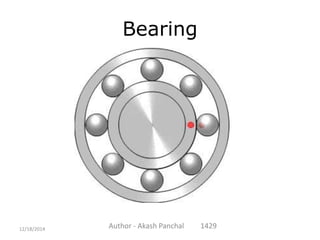
Bearing
Author - Akash Panchal 142912/18/2014
What Is Bearing
A bearing is a machine element that constrains
relative motion between moving parts to only
the desired motion..
The term "bearing" is derived from the verb "to
bear; a bearing being a machine element that
allows one part to bear (i.e., to support)
another.
Author - Akash Panchal 142912/18/2014
History
The invention of the rolling bearing, in the form of
wooden rollers supporting, or bearing, an object
being moved is of great antiquity, and may predate
the invention of the wheel.
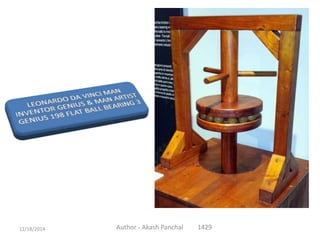
Leonardo da Vinci incorporated drawings of ball
bearings in his design for a helicopter around the
year 1500. This is the first recorded use of bearings in
an aerospace design.
Author - Akash Panchal 142912/18/2014
Today ball and roller bearings are used
in many applications which include a
rotating component. Examples include
ultra high speed bearings in dental
drills, Aerospace Bearings in the Mars
Rover, gearbox and wheel bearings on
automobiles, flexure bearings in
optical alignment systems and bicycle
wheel hubs.
Author - Akash Panchal 142912/18/2014
Function Of A Bearing
The main function of Bearing is rotating shaft is to
transmit power from one end of the line to the other.
It needs a good support to ensure stability and
frictionless rotation. The support for the shaft is
known as “bearing”.
The shaft has a “running fit” in a bearing. All bearing
are provided some lubrication arrangement to
reduced friction between shaft and bearing.
Author - Akash Panchal 142912/18/2014
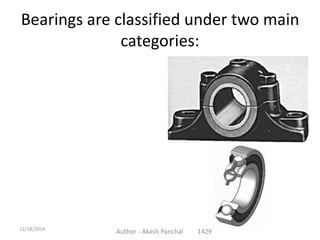
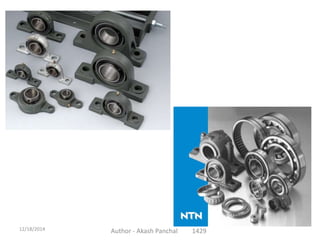
Bearings are classified under two main
categories:
Author - Akash Panchal 142912/18/2014
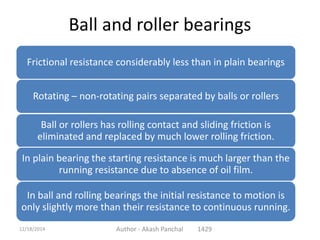
Ball and roller bearings
Frictional resistance considerably less than in plain bearings
Rotating – non-rotating pairs separated by balls or rollers
Ball or rollers has rolling contact and sliding friction is
eliminated and replaced by much lower rolling friction.
In plain bearing the starting resistance is much larger than the
running resistance due to absence of oil film.
In ball and rolling bearings the initial resistance to motion is
only slightly more than their resistance to continuous running.
Author - Akash Panchal 142912/18/2014
Types of rolling bearing
• Incorporating a deep hardened
raceway which makes them
suitable for radial and axial loads
in either direction, provided the
radial loads are greater than the
axial loads.
Single row
deep-groove
ball bearing:
• Roller bearing have a greater
load-carrying capacity than ball
bearing of equivalent size as they
make line contact rather than
point contact with their rings.
Single row
roller
bearing:
Author - Akash Panchal 142912/18/2014
Ball and Roller bearing
• The cages are made of low-carbon steel,
bronzes or brasses, though for high
temperature application case-hardened
and stainless steels are used.
Races and balls are high carbon
chrome steel (to provide resistance
to wear) machined and ground to
fine limits of 0.0025 mm, highly
polished and hardened.
Author - Akash Panchal 142912/18/2014
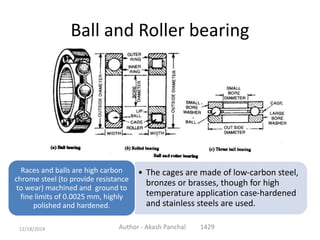
The Ball And Roller Bearing Consists Following Parts:-
 Inner ring or race which fits on
the shaft.
 Outer ring or race which fits
inside the housing.
 Ball and roller arranged
between the surfaces of two
races. These provide rolling
action between the races.
 The radius of the track for balls is
slightly greater 5 to 10 % than that
of the ball themselves.
 Note that the rotating surfaces
rotate in opposite directions.
 Cage which separates the balls
or rollers from one another.The Disadvantage of the ball and roller
bearings are high cost, they cannot be
used in half, and greater noise. Author - Akash Panchal 142912/18/2014
Author - Akash Panchal 142912/18/2014
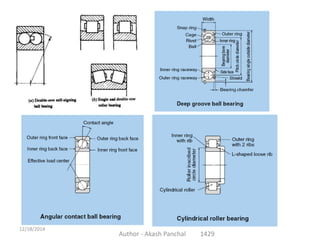
Types of ball bearings
Double Row Self-Aligning
Single And Double Row Roller Bearing
Deep grove ball bearing
Angular contact ball bearing
Cylindrical roller bearing
Tapered roller bearing
Self-aligning roller bearing
Needle ball bearing
Thrust ball bearing
Author - Akash Panchal 142912/18/2014
Prelubricated sealed ball bearing
Author - Akash Panchal 142912/18/2014
Author - Akash Panchal 1429
12/18/2014
Author - Akash Panchal 142912/18/2014
Selection of bearing through catalogue
Author - Akash Panchal 142912/18/2014
Bearing Arrangement
Shafts are generally supported by two
bearings in the radial and axial directions.
The side that fixes relative movement of the shaft and housing in the
axial direction is called the “fixed side bearing," and the side that allows
movement is called the "floating side bearing."
The floating side bearing is needed to absorb
mounting error and avoid stress caused by
expansion and contraction of the shaft due to
temperature change.
Author - Akash Panchal 1429
12/18/2014
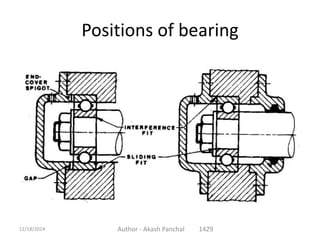
Positions of bearing
Author - Akash Panchal 142912/18/2014
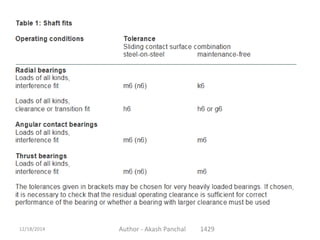
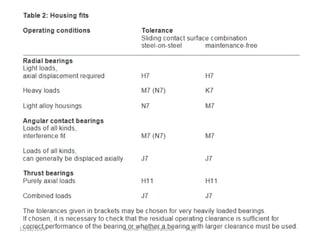
Bearing fits:
Extreme fits, whether loose or tight, are not
recommended. The effect of press fits on contact angle
or radial play must be considered.
Size tolerance of the shaft and housing should be equal
to those of the bearing bore .Surface finish should be
held as close as possible.
Extreme fits will depend upon tolerances on the
bearings, shaft, and housing
Author - Akash Panchal 142912/18/2014
Adhesives offer several advantages in producing proper fits:
End play can be removed by applying a light external thrust load during curing
time.
Extreme fits can be eliminated, since the adhesive will fill up any reasonable
clearance.
Rotational accuracy can be improved by driving the shaft at slow speed during
cure time.
Disadvantages to using adhesives include:
Certain adhesives are attacked by lubricants or solvents.
To ensure a good bond, bearing surface, shaft, and housing must be
thoroughly clean of oil and dirt.
Adhesives may get into the bearing and cause damage.
Author - Akash Panchal 1429
12/18/2014
Axial positioning:
Accurate axial positioning of the shaft relative to the housing requires shoulders,
snap rings, or bearing flanges.
Shaft and housing shoulders: Diameter of a shaft or housing shoulder must be
sufficient to ensure solid seating and support for applied thrust loads, yet small
enough to avoid interference with other parts of the bearing. Fit accuracy between
shoulder and mounting diameter should be as good as bearing accuracy.
The corner between the shoulder and mounting diameter should be undercut
because undercutting provides a more accurate machining of the shoulder surface.
However, a radius is permissible if proper clearance is allowed.
Author - Akash Panchal 142912/18/2014
Retaining rings: Certain cautions must be observed with this
method:
Recommendations as to the groove dimensions should be followed.
Locating grooves machined into the shaft or housing must be
controlled for squareness of groove face to bearing mounting
diameter. Recommended value is 0.0002-in.
Avoid a snap ring that locates directly on the shaft or housing
diameter (no groove) if heavy thrust loads are involved.
Flanges: Squareness of face-to-bore of the housing is critical and
should be maintained to within 0.0003-in
Author - Akash Panchal 142912/18/2014
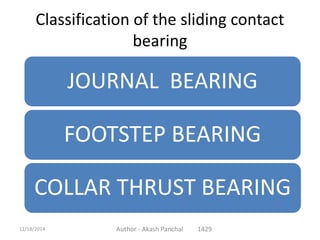
Classification of the sliding contact
bearing
JOURNAL BEARING
FOOTSTEP BEARING
COLLAR THRUST BEARING
Author - Akash Panchal 142912/18/2014
Journal bearing – in this the bearing pressure is exerted at right angles to the
axis of the axis of the shaft. The portion of the shaft lying within the bearing in
known as journal. Shaft are generally made of mild steel.
Foot step or pivot bearing – in this bearing the bearing pressure is exerted
parallel to the shaft whose axis is vertical. Note that in this case the end of the
shaft rests within the bearing.
• Thrust bearings
also known as
“collar
bearing”.
Thrust bearing – in this bearing supporting pressure is
parallel to the axis of the shaft having end thrust. Thrust
bearing are used in bevel mountings, propeller drives,
turbines, etc. note here the shaft ,unlike foot-strep
bearing passes through and beyond the bearing.
Author - Akash Panchal 1429
12/18/2014
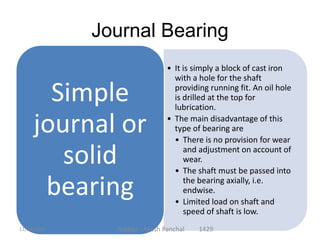
Journal Bearing
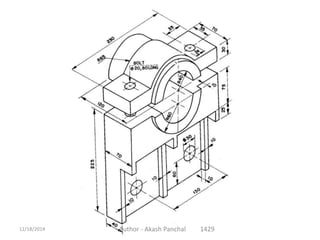
• It is simply a block of cast iron
with a hole for the shaft
providing running fit. An oil hole
is drilled at the top for
lubrication.
• The main disadvantage of this
type of bearing are
• There is no provision for wear
and adjustment on account of
wear.
• The shaft must be passed into
the bearing axially, i.e.
endwise.
• Limited load on shaft and
speed of shaft is low.
Simple
journal or
solid
bearing
Author - Akash Panchal 142912/18/2014
Footstep or pivot bearing
It suitable for supporting a vertical shaft with axial loads.
In a footstep bearing a gun metal bush having a collar on top is placed inside the
C.I. sole. The end of the shaft rests on a gun metal disc placed at the bottom in the
bush.
The disc is prevented from rotation with the help of a pin or sung fitted in the sole.
The disc act as a thrust bearing whereas the bush fitted in the casting supports the
shaft in position. The bush can take radial loads, if any, on the shaft.
The disadvantage of footstep bearing is that it cannot be efficiently lubricated and
there is unequal wear on the bottom disc.
Author - Akash Panchal 142912/18/2014
Thrust bearing
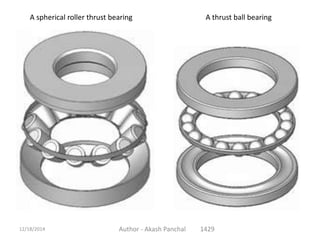
A thrust bearing is a particular type of
rotary bearing. Like other bearings they
permit rotation between parts, but they are
designed to support a high axial load .
• Thrust Ball Bearings
• Cylindrical Thrust Roller Bearings
• Tapered Roller Thrust Bearing s
• Spherical Roller Thrust Bearings
Thrust
Bearings come
in several
varieties.
Author - Akash Panchal 142912/18/2014
A spherical roller thrust bearing A thrust ball bearing
Author - Akash Panchal 142912/18/2014
Bush Bearing
In this the bush of soft material like
brass or gun metal is provided and the
body or main block is made of cast iron.
Bush is hollow cylindrical piece which is
fitted in a housing to accommodate the
mating part. When the bush gets worn
out it can be easily replaced.
Author - Akash Panchal 142912/18/2014
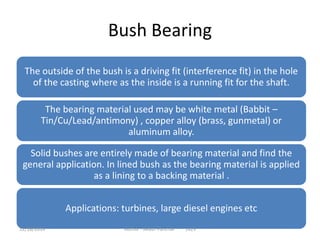
Bush Bearing
The outside of the bush is a driving fit (interference fit) in the hole
of the casting where as the inside is a running fit for the shaft.
The bearing material used may be white metal (Babbit –
Tin/Cu/Lead/antimony) , copper alloy (brass, gunmetal) or
aluminum alloy.
Solid bushes are entirely made of bearing material and find the
general application. In lined bush as the bearing material is applied
as a lining to a backing material .
Applications: turbines, large diesel engines etc
Author - Akash Panchal 142912/18/2014
Bush and Direct-lined housing
Author - Akash Panchal 142912/18/2014
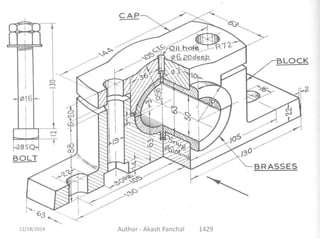
Plummer block or Pedestal bearing
It is a split type of bearing. This type of bearing is
used for higher speeds, heavy loads and large sizes.
• Cast iron pedestal or block with a sole
• Brass or gun-metal or phosphorus-bronze
“Brasses”, bushes or steps made in two halves.
• Cast iron cap.
• Two mild steel bolts and nuts.
The component of
the bearing:
This bearing facilitates the placements and removal
of the of the shaft from the bearing.
Author - Akash Panchal 142912/18/2014
Prevention of rotation of brasses
The steps are made octagonal on the outside and they are
made to fit inside a corresponding hole.
A snug is cast on the lower brass top which fits a
corresponding hole in the casting. The oil hole is drilled
through the sung.
Snug are provided at the side, and the corresponding
recesses left in the casting
The steps on the lower brass are made rectangular on the
outside and they are made to fit inside a corresponding
hole.
Author - Akash Panchal 142912/18/2014
Prevention of rotation of brasses
Author - Akash Panchal 142912/18/2014
Bearing Life Calculation
Calculations Rolling bearings Bearing life
Equivalent bearing loads and basic rating life
Minimum load
Viscosity
Dynamic axial load carrying capacity of cylindrical roller bearings
Frictional moment - power loss
Relubrication intervals
Grease life for sealed deep groove ball bearings
Bearing frequencies
Influence of load and oil viscosity on reference speed/permissible speed
CARB, axial displacement - misalignment
CARB, axial displacement - clearance
CARB, free space on the sides of the bearing
Shaft tolerances and resultant fits
Housing tolerances and resultant fits
SKF Bearing Select
SKF DialSet
Plain bearings Spherical plain bearings and rod ends - Basic rating service life
Frictional moment
Composite dry sliding bearings - Basic rating service life
Author - Akash Panchal 142912/18/2014
Advantages and disadvantages of the
plain bearing
Plain bearing are cheap to produce and have noiseless
operation. They can be easily machined, occupy small
radial space and have vibration damping properties.
Also they can cope with tapped foreign matter.
Disadvantages are they require large supply of
lubricating oil, they are suitable only for relative low
temperature and speed; and starting resistance is much
greater than running resistance due to slow build up of
lubricant film around the bearing surface.
Author - Akash Panchal 142912/18/2014

Bearing

  • 1.
    Bhausaheb Vartak Polytechnic APRESENTATION ON BEARING Prepared By AKASH PANCHAL S.Y.P.T – 1429 Author - Akash Panchal 142912/18/2014
  • 2.
    Bearing Author - AkashPanchal 142912/18/2014
  • 3.
    What Is Bearing Abearing is a machine element that constrains relative motion between moving parts to only the desired motion.. The term "bearing" is derived from the verb "to bear; a bearing being a machine element that allows one part to bear (i.e., to support) another. Author - Akash Panchal 142912/18/2014
  • 4.
    History The invention ofthe rolling bearing, in the form of wooden rollers supporting, or bearing, an object being moved is of great antiquity, and may predate the invention of the wheel. Leonardo da Vinci incorporated drawings of ball bearings in his design for a helicopter around the year 1500. This is the first recorded use of bearings in an aerospace design. Author - Akash Panchal 142912/18/2014
  • 5.
    Author - AkashPanchal 142912/18/2014
  • 6.
    Author - AkashPanchal 142912/18/2014
  • 7.
    Today ball androller bearings are used in many applications which include a rotating component. Examples include ultra high speed bearings in dental drills, Aerospace Bearings in the Mars Rover, gearbox and wheel bearings on automobiles, flexure bearings in optical alignment systems and bicycle wheel hubs. Author - Akash Panchal 142912/18/2014
  • 8.
    Function Of ABearing The main function of Bearing is rotating shaft is to transmit power from one end of the line to the other. It needs a good support to ensure stability and frictionless rotation. The support for the shaft is known as “bearing”. The shaft has a “running fit” in a bearing. All bearing are provided some lubrication arrangement to reduced friction between shaft and bearing. Author - Akash Panchal 142912/18/2014
  • 9.
    Bearings are classifiedunder two main categories: Author - Akash Panchal 142912/18/2014
  • 10.
    Author - AkashPanchal 142912/18/2014
  • 11.
    Author - AkashPanchal 142912/18/2014
  • 12.
    Ball and rollerbearings Frictional resistance considerably less than in plain bearings Rotating – non-rotating pairs separated by balls or rollers Ball or rollers has rolling contact and sliding friction is eliminated and replaced by much lower rolling friction. In plain bearing the starting resistance is much larger than the running resistance due to absence of oil film. In ball and rolling bearings the initial resistance to motion is only slightly more than their resistance to continuous running. Author - Akash Panchal 142912/18/2014
  • 13.
    Types of rollingbearing • Incorporating a deep hardened raceway which makes them suitable for radial and axial loads in either direction, provided the radial loads are greater than the axial loads. Single row deep-groove ball bearing: • Roller bearing have a greater load-carrying capacity than ball bearing of equivalent size as they make line contact rather than point contact with their rings. Single row roller bearing: Author - Akash Panchal 142912/18/2014
  • 14.
    Ball and Rollerbearing • The cages are made of low-carbon steel, bronzes or brasses, though for high temperature application case-hardened and stainless steels are used. Races and balls are high carbon chrome steel (to provide resistance to wear) machined and ground to fine limits of 0.0025 mm, highly polished and hardened. Author - Akash Panchal 142912/18/2014
  • 15.
    The Ball AndRoller Bearing Consists Following Parts:-  Inner ring or race which fits on the shaft.  Outer ring or race which fits inside the housing.  Ball and roller arranged between the surfaces of two races. These provide rolling action between the races.  The radius of the track for balls is slightly greater 5 to 10 % than that of the ball themselves.  Note that the rotating surfaces rotate in opposite directions.  Cage which separates the balls or rollers from one another.The Disadvantage of the ball and roller bearings are high cost, they cannot be used in half, and greater noise. Author - Akash Panchal 142912/18/2014
  • 16.
    Author - AkashPanchal 142912/18/2014
  • 17.
    Types of ballbearings Double Row Self-Aligning Single And Double Row Roller Bearing Deep grove ball bearing Angular contact ball bearing Cylindrical roller bearing Tapered roller bearing Self-aligning roller bearing Needle ball bearing Thrust ball bearing Author - Akash Panchal 142912/18/2014
  • 18.
    Prelubricated sealed ballbearing Author - Akash Panchal 142912/18/2014
  • 19.
    Author - AkashPanchal 142912/18/2014
  • 20.
    Author - AkashPanchal 1429 12/18/2014
  • 21.
    Author - AkashPanchal 142912/18/2014
  • 22.
    Author - AkashPanchal 142912/18/2014
  • 23.
    Selection of bearingthrough catalogue Author - Akash Panchal 142912/18/2014
  • 24.
    Bearing Arrangement Shafts aregenerally supported by two bearings in the radial and axial directions. The side that fixes relative movement of the shaft and housing in the axial direction is called the “fixed side bearing," and the side that allows movement is called the "floating side bearing." The floating side bearing is needed to absorb mounting error and avoid stress caused by expansion and contraction of the shaft due to temperature change. Author - Akash Panchal 1429 12/18/2014
  • 25.
    Positions of bearing Author- Akash Panchal 142912/18/2014
  • 26.
    Author - AkashPanchal 142912/18/2014
  • 27.
    Author - AkashPanchal 142912/18/2014
  • 28.
    Bearing fits: Extreme fits,whether loose or tight, are not recommended. The effect of press fits on contact angle or radial play must be considered. Size tolerance of the shaft and housing should be equal to those of the bearing bore .Surface finish should be held as close as possible. Extreme fits will depend upon tolerances on the bearings, shaft, and housing Author - Akash Panchal 142912/18/2014
  • 29.
    Adhesives offer severaladvantages in producing proper fits: End play can be removed by applying a light external thrust load during curing time. Extreme fits can be eliminated, since the adhesive will fill up any reasonable clearance. Rotational accuracy can be improved by driving the shaft at slow speed during cure time. Disadvantages to using adhesives include: Certain adhesives are attacked by lubricants or solvents. To ensure a good bond, bearing surface, shaft, and housing must be thoroughly clean of oil and dirt. Adhesives may get into the bearing and cause damage. Author - Akash Panchal 1429 12/18/2014
  • 30.
    Axial positioning: Accurate axialpositioning of the shaft relative to the housing requires shoulders, snap rings, or bearing flanges. Shaft and housing shoulders: Diameter of a shaft or housing shoulder must be sufficient to ensure solid seating and support for applied thrust loads, yet small enough to avoid interference with other parts of the bearing. Fit accuracy between shoulder and mounting diameter should be as good as bearing accuracy. The corner between the shoulder and mounting diameter should be undercut because undercutting provides a more accurate machining of the shoulder surface. However, a radius is permissible if proper clearance is allowed. Author - Akash Panchal 142912/18/2014
  • 31.
    Retaining rings: Certaincautions must be observed with this method: Recommendations as to the groove dimensions should be followed. Locating grooves machined into the shaft or housing must be controlled for squareness of groove face to bearing mounting diameter. Recommended value is 0.0002-in. Avoid a snap ring that locates directly on the shaft or housing diameter (no groove) if heavy thrust loads are involved. Flanges: Squareness of face-to-bore of the housing is critical and should be maintained to within 0.0003-in Author - Akash Panchal 142912/18/2014
  • 32.
    Classification of thesliding contact bearing JOURNAL BEARING FOOTSTEP BEARING COLLAR THRUST BEARING Author - Akash Panchal 142912/18/2014
  • 33.
    Author - AkashPanchal 142912/18/2014
  • 34.
    Journal bearing –in this the bearing pressure is exerted at right angles to the axis of the axis of the shaft. The portion of the shaft lying within the bearing in known as journal. Shaft are generally made of mild steel. Foot step or pivot bearing – in this bearing the bearing pressure is exerted parallel to the shaft whose axis is vertical. Note that in this case the end of the shaft rests within the bearing. • Thrust bearings also known as “collar bearing”. Thrust bearing – in this bearing supporting pressure is parallel to the axis of the shaft having end thrust. Thrust bearing are used in bevel mountings, propeller drives, turbines, etc. note here the shaft ,unlike foot-strep bearing passes through and beyond the bearing. Author - Akash Panchal 1429 12/18/2014
  • 35.
    Journal Bearing • Itis simply a block of cast iron with a hole for the shaft providing running fit. An oil hole is drilled at the top for lubrication. • The main disadvantage of this type of bearing are • There is no provision for wear and adjustment on account of wear. • The shaft must be passed into the bearing axially, i.e. endwise. • Limited load on shaft and speed of shaft is low. Simple journal or solid bearing Author - Akash Panchal 142912/18/2014
  • 36.
    Author - AkashPanchal 142912/18/2014
  • 37.
    Footstep or pivotbearing It suitable for supporting a vertical shaft with axial loads. In a footstep bearing a gun metal bush having a collar on top is placed inside the C.I. sole. The end of the shaft rests on a gun metal disc placed at the bottom in the bush. The disc is prevented from rotation with the help of a pin or sung fitted in the sole. The disc act as a thrust bearing whereas the bush fitted in the casting supports the shaft in position. The bush can take radial loads, if any, on the shaft. The disadvantage of footstep bearing is that it cannot be efficiently lubricated and there is unequal wear on the bottom disc. Author - Akash Panchal 142912/18/2014
  • 38.
    Author - AkashPanchal 142912/18/2014
  • 39.
    Thrust bearing A thrustbearing is a particular type of rotary bearing. Like other bearings they permit rotation between parts, but they are designed to support a high axial load . • Thrust Ball Bearings • Cylindrical Thrust Roller Bearings • Tapered Roller Thrust Bearing s • Spherical Roller Thrust Bearings Thrust Bearings come in several varieties. Author - Akash Panchal 142912/18/2014
  • 40.
    A spherical rollerthrust bearing A thrust ball bearing Author - Akash Panchal 142912/18/2014
  • 41.
    Bush Bearing In thisthe bush of soft material like brass or gun metal is provided and the body or main block is made of cast iron. Bush is hollow cylindrical piece which is fitted in a housing to accommodate the mating part. When the bush gets worn out it can be easily replaced. Author - Akash Panchal 142912/18/2014
  • 42.
    Bush Bearing The outsideof the bush is a driving fit (interference fit) in the hole of the casting where as the inside is a running fit for the shaft. The bearing material used may be white metal (Babbit – Tin/Cu/Lead/antimony) , copper alloy (brass, gunmetal) or aluminum alloy. Solid bushes are entirely made of bearing material and find the general application. In lined bush as the bearing material is applied as a lining to a backing material . Applications: turbines, large diesel engines etc Author - Akash Panchal 142912/18/2014
  • 43.
    Bush and Direct-linedhousing Author - Akash Panchal 142912/18/2014
  • 44.
    Plummer block orPedestal bearing It is a split type of bearing. This type of bearing is used for higher speeds, heavy loads and large sizes. • Cast iron pedestal or block with a sole • Brass or gun-metal or phosphorus-bronze “Brasses”, bushes or steps made in two halves. • Cast iron cap. • Two mild steel bolts and nuts. The component of the bearing: This bearing facilitates the placements and removal of the of the shaft from the bearing. Author - Akash Panchal 142912/18/2014
  • 45.
    Author - AkashPanchal 142912/18/2014
  • 46.
    Author - AkashPanchal 142912/18/2014
  • 47.
    Prevention of rotationof brasses The steps are made octagonal on the outside and they are made to fit inside a corresponding hole. A snug is cast on the lower brass top which fits a corresponding hole in the casting. The oil hole is drilled through the sung. Snug are provided at the side, and the corresponding recesses left in the casting The steps on the lower brass are made rectangular on the outside and they are made to fit inside a corresponding hole. Author - Akash Panchal 142912/18/2014
  • 48.
    Prevention of rotationof brasses Author - Akash Panchal 142912/18/2014
  • 49.
    Bearing Life Calculation CalculationsRolling bearings Bearing life Equivalent bearing loads and basic rating life Minimum load Viscosity Dynamic axial load carrying capacity of cylindrical roller bearings Frictional moment - power loss Relubrication intervals Grease life for sealed deep groove ball bearings Bearing frequencies Influence of load and oil viscosity on reference speed/permissible speed CARB, axial displacement - misalignment CARB, axial displacement - clearance CARB, free space on the sides of the bearing Shaft tolerances and resultant fits Housing tolerances and resultant fits SKF Bearing Select SKF DialSet Plain bearings Spherical plain bearings and rod ends - Basic rating service life Frictional moment Composite dry sliding bearings - Basic rating service life Author - Akash Panchal 142912/18/2014
  • 50.
    Advantages and disadvantagesof the plain bearing Plain bearing are cheap to produce and have noiseless operation. They can be easily machined, occupy small radial space and have vibration damping properties. Also they can cope with tapped foreign matter. Disadvantages are they require large supply of lubricating oil, they are suitable only for relative low temperature and speed; and starting resistance is much greater than running resistance due to slow build up of lubricant film around the bearing surface. Author - Akash Panchal 142912/18/2014
  • 51.
    Author - AkashPanchal 142912/18/2014