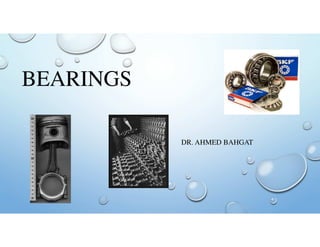
BEARINGS
DR. AHMED BAHGAT
CONTENTS
• CLASSIFICATION OF BEARINGS ACCORDING TO TYPE AND
LOADING DIRECTION
• ROLLING BEARINGS
• ROLLING BEARINGS INSTALLATION
• SELECTION OF ROLLING BEARINGS
• SHAFT FITS AND TOLERANCES
• BEARING LIFE ESTIMATION
Bearings
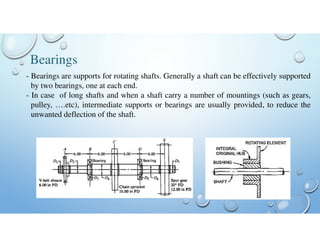
- Bearings are supports for rotating shafts. Generally a shaft can be effectively supported
by two bearings, one at each end.
- In case of long shafts and when a shaft carry a number of mountings (such as gears,
pulley, ….etc), intermediate supports or bearings are usually provided, to reduce the
unwanted deflection of the shaft.
CLASSIFICATION OF BEARINGS
Bearings
Sliding (journal
bearings)
Rolling
Bearings
According to type of contact of shaft with bearing or according to the kind of friction
generated in active surfaces:
A- Sliding bearings:
- Sliding bearings are those bearings where shaft is in direct contact with
bearing and is sliding on its cylindrical surfaces.
- Because of the nature of contact, the friction between the mating parts is
usually high, so these bearings require more lubrication.
- The lubrication does not totally eliminate contact between the surfaces.
- Advantages of Sliding Bearings:
1- They have a very low coefficient of friction if properly
designed and lubricated.
2- They have very high load-carrying capabilities.
3- Their resistance to shock and vibration is greater than rolling-contact
bearings.
4- The hydrodynamic oil film produced by plain bearings damps
vibration, so less noise is transmitted.
5- They are less sensitive to lubricant contamination than
rolling-contact bearings.
B- Anti-friction bearings (Rolling Bearings):
- These bearings are known as rolling bearings in which a pure rolling
motion is achieved in place of the sliding motion which occurs in
sliding bearings.
- As the rolling friction is much less than the sliding friction, rolling
friction are called anti-friction bearings.
- Advantages of rolling-contact bearings
1- At low speeds, ball and roller bearings produce much less
friction than plain bearings.
2- Certain types of rolling-contact bearings can support both
radial and thrust loading simultaneously.
3- Rolling bearings can operate with small amounts of
lubricant.
4- Rolling-contact bearings are relatively insensitive to
lubricant viscosity.
5- Rolling-contact bearings have low wear rates and require
little maintenance.
CLASSIFICATION OF BEARINGS:
Bearings
Radial
Bearings
Axial (Thrust)
Bearings
Combined
Loading
According to the direction of the applied load:
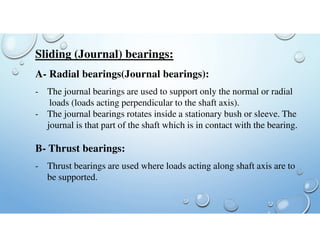
Sliding (Journal) bearings:
A- Radial bearings(Journal bearings):
- The journal bearings are used to support only the normal or radial
loads (loads acting perpendicular to the shaft axis).
- The journal bearings rotates inside a stationary bush or sleeve. The
journal is that part of the shaft which is in contact with the bearing.
B- Thrust bearings:
- Thrust bearings are used where loads acting along shaft axis are to
be supported.
Radial bearings
(Journal bearings)
Solid
bearing
Bushed
bearing
Pedestal (Split)
Bearing
Thrust Bearings
Pivot or
footstep bearing
Collar thrust
bearing
Roller Bearings
Ball Bearings
Roller Bearings
According to Rolling Element
Bearing components
Ball bearings
(a) straight roller;
(b) spherical roller, thrust;
(c) thrust tapered roller,
(d) needle
(e) Tapered roller;
(f ) steep-angle tapered roller.
Types of roller bearings
Roller/Ball
Bearings
Radial
bearings
Thrust
bearing
Radial-Thrust
bearings
According to Loading direction
Self-aligning rolling bearings
(a) Barrel roller bearings,
(b) Spherical roller bearings,
(c) Spherical roller thrust bearings,
(d) S-type bearings,
(e) Thrust ball bearings with a seating ring.
Mounted Bearing Types
Symbols for load carrying capacity, alignment and speed suitability
Angular contact ball bearings, single row
Deep groove ball bearings
Angular contact ball bearings, double row
Four-point bearings
Barrel roller bearings
Self-aligning ball bearings
Cylindrical roller bearings, single row and double row
Cylindrical roller bearings, single row and double row · Full complement cylindrical roller bearings
Tapered roller bearings
Spherical roller bearings
Angular contact thrust ball bearings
Thrust ball bearings
Cylindrical roller thrust bearings
Spherical roller thrust bearings
INSTALLATION OF ANTI-FRICTION BEARING
Across the ball system Leading system
System of leading bearing is used to compensate any elongation of the shaft due to
heating or another operating condition
LOCATING-FLOATING BEARING ARRANGEMENT
Leading system
Adjusted bearing arrangement
in O arrangement
Adjusted bearing arrangement
in X arrangement
Across the ball system
Axial Location of Bearings
BEARING ARRANGEMENT EXAMPLES
ENCLOSURES AND OIL SEALING
• To exclude dirt and foreign matter and to retain the lubricant, the bearing
mountings must include a seal. The three principal methods of sealing are the
felt seal, the commercial seal, and the labyrinth seal
Shaft and housing tolerances and fits
Recommended radial
rolling element bearing
fits for solid cylindrical
steel shafts
Recommended radial rolling
element bearing fits with
housings. This table is
applicable to cast iron and
steel housings.
For housings made of light
alloys, the interference
should be tighter than those
in this table
Bearing Designation
Bearing Life:
Rating Life (of a group of nominally identical ball or roller bearings) :
Is the number of revolutions or working hours of operation at a given constant speed,
that 90% of a group of bearings will complete or exceed before failure.
Rating life is termed as L10.
The life of an individual bearing is defined as
• Total number of revolutions of the inner ring
or
• Number of hours of use at a standard angular speed
of bearing operation until first
touchable evidence of fatigue.
The most commonly used rating life is 106 revolutions.
The Timken Company rating its bearings at 3 000 hours at 500 rev/min, [90(106)
revolutions].
Where:
a = 3 for ball bearings
a = 10/3 for roller bearings
Bearing load life:
If two groups of identical bearings tested under different loads F1, F2, they will have different
respective lives L1, L2, at 0.90 reliability, regression equation of the test data is:
A catalog load rating (C10 ) :
The radial load that causes 10 percent of a group of bearings to fail at the bearing
manufacturer’s rating life.
Or
When selecting a bearing for a given application, it is necessary to relate
The Desired load and life requirements
with
The published Catalog load Rating at the catalog rating life.
R for Rated D for Desired(Designed for)
LD & LR units : Revolutions
We can say L in Hours
n in RPM
at 0.90 reliability at 0.90 reliability
As Fr is an alternating notation of catalog load rating C10 so :
Reliability versus Life—The Weibull Distribution
The three parameter Weibull distribution is used exclusively for expressing
the reliability of rolling contact bearings.
Introducing the following equation to Relate Load, Life, and Reliability
Or
af application factor serves as a factor of safety to increase the design
load to take into account overload, dynamic loading, and uncertainty.
RD reliability
Bearing-Life Recommendations for Various Classes of Machinery
Load-Application Factors
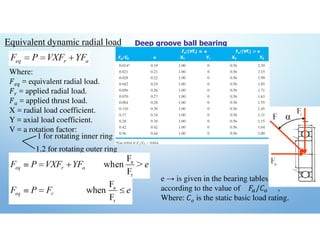
Equivalent dynamic radial load
Where:
= equivalent radial load.
= applied radial load.
= applied thrust load.
X = radial load coefficient.
Y = axial load coefficient.
V = a rotation factor:
1 for rotating inner ring
1.2 for rotating outer ring
Deep groove ball bearing
e → is given in the bearing tables
according to the value of / ,
Where: is the static basic load rating.
Selected
Bearing Tables
Static load ratings
The basic static load rating C0 is used under the following
conditions:
• very slow rotational speeds (n < 10 r/min)
• very slow oscillating movements
• stationary bearings under load for extended periods
Verification of static bearing loads is performed by checking the
static safety factor of the application, which is defined as:
where
s0 = static safety factor
C0 = basic static load rating [kN]
P0 = equivalent static bearing load [kN]
1- From Manufacturing Tables select the bearing
with bore diameter 25mm try bearing 6205
2- Calculate the ratio Fa/Co
3- From Table 11-1:
Interpolate for e between the indicated rows
4- Calculate
5-
6-
7- required load rating
8- Another Trail
Selection of Taper Roller Bearings:
The nomenclature for a taper roller bearings is shown in figure Below.
- The inner ring is called the cone, and
the outer ring is called the cup.
- It can be seen that, a tapered roller
bearing is separable in that the cup can
be removed from the cone and roller
assembly.
- This type of bearing can carry both
radial and axial loads or any
combinations of the two.
- However, even when an external
axial load is no present, the radial load
will induce a thrust (axial) reaction
within the bearing because of the taper.
- The mounting of bearings can be as follows:
a- O-configuration (back-to-back).
[Indirect Mounting]
b- X-configuration (face-to-face).
[Direct mounting]
- A radial load on a tapered roller bearing will induce a thrust reaction.
Timken provides the equation:
Where the K factor is geometry-specific, and is the ratio of the radial load rating to the thrust load rating.
- The K factor can be first approximated with 1.5 for a radial bearing and 0.75 for a steep angle bearing in
the preliminary selection process.
- After a possible bearing is identified, the exact value of K for each bearing can be found in the bearing
catalog.
Follow the equation:
- Timken recommends using X = 0.4 and V = 1 for all cases, and using the K factor for the specific
bearing for Y. This gives an equation:
- The axial load Fa is the net axial load carried by the bearing due to the
combination of the induced axial load from the other bearing and the external
axial load.
- However, only one of the bearings will carry the net axial load, and which one depends on the
direction the bearings are mounted, the relative magnitudes of the induced loads, the direction of
the external load, and whether the shaft or the housing is the moving part.
First determine visually which bearing is being “squeezed” by the external thrust load, and label it as
bearing A. Label the other bearing as bearing B.
Examples of determining which bearing carries the
external thrust load. In each case, the compressed
bearing is labeled as bearing A.
(a) External thrust applied to rotating shaft;
(b) External thrust applied to rotating cylinder.
- In any case, if the equivalent radial load is ever less than the
original radial load, then the original radial load should be used.
- Timken uses a Weibell model with:
Second, determine which bearing actually carries the net axial load. Generally, it would be expected that
bearing A would carry the axial load, since the external thrust Fae is directed toward A, along with the
induced thrust FiB from bearing B.
However, if the induced thrust FiA from bearing A happens to be larger than the combination of the external
thrust and the thrust induced by bearing B, then bearing B will carry the net thrust load.
An input shaft of a gear reducer is shown in figure 10-1. The forces on the bevel gear results
in a radial bearing force of 1000 N at A and 2400 N at B, in addition to an axial force of 700 N.
The same taper roller bearing is lo be used on both sides having a bore size diameter of 25
mm. Select the suitable bearings for a life of l2 kh (kilo hours) and 90% reliability if the shaft
speed is 900 rpm. (Nota: Bearing A carries the axiaI force.)
Try by yourself……
Try by yourself……
Try by yourself……

Bearings.pdf

  • 1.
  • 2.
    CONTENTS • CLASSIFICATION OFBEARINGS ACCORDING TO TYPE AND LOADING DIRECTION • ROLLING BEARINGS • ROLLING BEARINGS INSTALLATION • SELECTION OF ROLLING BEARINGS • SHAFT FITS AND TOLERANCES • BEARING LIFE ESTIMATION
  • 3.
    Bearings - Bearings aresupports for rotating shafts. Generally a shaft can be effectively supported by two bearings, one at each end. - In case of long shafts and when a shaft carry a number of mountings (such as gears, pulley, ….etc), intermediate supports or bearings are usually provided, to reduce the unwanted deflection of the shaft.
  • 4.
    CLASSIFICATION OF BEARINGS Bearings Sliding(journal bearings) Rolling Bearings According to type of contact of shaft with bearing or according to the kind of friction generated in active surfaces:
  • 5.
    A- Sliding bearings: -Sliding bearings are those bearings where shaft is in direct contact with bearing and is sliding on its cylindrical surfaces. - Because of the nature of contact, the friction between the mating parts is usually high, so these bearings require more lubrication. - The lubrication does not totally eliminate contact between the surfaces.
  • 6.
    - Advantages ofSliding Bearings: 1- They have a very low coefficient of friction if properly designed and lubricated. 2- They have very high load-carrying capabilities. 3- Their resistance to shock and vibration is greater than rolling-contact bearings. 4- The hydrodynamic oil film produced by plain bearings damps vibration, so less noise is transmitted. 5- They are less sensitive to lubricant contamination than rolling-contact bearings.
  • 7.
    B- Anti-friction bearings(Rolling Bearings): - These bearings are known as rolling bearings in which a pure rolling motion is achieved in place of the sliding motion which occurs in sliding bearings. - As the rolling friction is much less than the sliding friction, rolling friction are called anti-friction bearings.
  • 8.
    - Advantages ofrolling-contact bearings 1- At low speeds, ball and roller bearings produce much less friction than plain bearings. 2- Certain types of rolling-contact bearings can support both radial and thrust loading simultaneously. 3- Rolling bearings can operate with small amounts of lubricant. 4- Rolling-contact bearings are relatively insensitive to lubricant viscosity. 5- Rolling-contact bearings have low wear rates and require little maintenance.
  • 9.
    CLASSIFICATION OF BEARINGS: Bearings Radial Bearings Axial(Thrust) Bearings Combined Loading According to the direction of the applied load:
  • 10.
    Sliding (Journal) bearings: A-Radial bearings(Journal bearings): - The journal bearings are used to support only the normal or radial loads (loads acting perpendicular to the shaft axis). - The journal bearings rotates inside a stationary bush or sleeve. The journal is that part of the shaft which is in contact with the bearing. B- Thrust bearings: - Thrust bearings are used where loads acting along shaft axis are to be supported.
  • 11.
  • 12.
    Thrust Bearings Pivot or footstepbearing Collar thrust bearing
  • 13.
    Roller Bearings Ball Bearings RollerBearings According to Rolling Element
  • 14.
  • 15.
  • 16.
    (a) straight roller; (b)spherical roller, thrust; (c) thrust tapered roller, (d) needle (e) Tapered roller; (f ) steep-angle tapered roller. Types of roller bearings
  • 17.
  • 18.
    Self-aligning rolling bearings (a)Barrel roller bearings, (b) Spherical roller bearings, (c) Spherical roller thrust bearings, (d) S-type bearings, (e) Thrust ball bearings with a seating ring.
  • 19.
  • 20.
    Symbols for loadcarrying capacity, alignment and speed suitability
  • 21.
    Angular contact ballbearings, single row Deep groove ball bearings
  • 22.
    Angular contact ballbearings, double row Four-point bearings
  • 23.
  • 24.
    Cylindrical roller bearings,single row and double row Cylindrical roller bearings, single row and double row · Full complement cylindrical roller bearings
  • 25.
  • 26.
  • 27.
    Angular contact thrustball bearings Thrust ball bearings
  • 28.
    Cylindrical roller thrustbearings Spherical roller thrust bearings
  • 29.
    INSTALLATION OF ANTI-FRICTIONBEARING Across the ball system Leading system System of leading bearing is used to compensate any elongation of the shaft due to heating or another operating condition
  • 30.
  • 31.
    Adjusted bearing arrangement inO arrangement Adjusted bearing arrangement in X arrangement Across the ball system
  • 32.
  • 33.
  • 40.
    ENCLOSURES AND OILSEALING • To exclude dirt and foreign matter and to retain the lubricant, the bearing mountings must include a seal. The three principal methods of sealing are the felt seal, the commercial seal, and the labyrinth seal
  • 41.
    Shaft and housingtolerances and fits
  • 42.
    Shaft and housingtolerances and fits
  • 43.
    Shaft and housingtolerances and fits
  • 44.
    Recommended radial rolling elementbearing fits for solid cylindrical steel shafts
  • 45.
    Recommended radial rolling elementbearing fits with housings. This table is applicable to cast iron and steel housings. For housings made of light alloys, the interference should be tighter than those in this table
  • 46.
  • 48.
    Bearing Life: Rating Life(of a group of nominally identical ball or roller bearings) : Is the number of revolutions or working hours of operation at a given constant speed, that 90% of a group of bearings will complete or exceed before failure. Rating life is termed as L10. The life of an individual bearing is defined as • Total number of revolutions of the inner ring or • Number of hours of use at a standard angular speed of bearing operation until first touchable evidence of fatigue. The most commonly used rating life is 106 revolutions. The Timken Company rating its bearings at 3 000 hours at 500 rev/min, [90(106) revolutions].
  • 49.
    Where: a = 3for ball bearings a = 10/3 for roller bearings Bearing load life: If two groups of identical bearings tested under different loads F1, F2, they will have different respective lives L1, L2, at 0.90 reliability, regression equation of the test data is: A catalog load rating (C10 ) : The radial load that causes 10 percent of a group of bearings to fail at the bearing manufacturer’s rating life. Or
  • 50.
    When selecting abearing for a given application, it is necessary to relate The Desired load and life requirements with The published Catalog load Rating at the catalog rating life. R for Rated D for Desired(Designed for) LD & LR units : Revolutions We can say L in Hours n in RPM at 0.90 reliability at 0.90 reliability
  • 51.
    As Fr isan alternating notation of catalog load rating C10 so :
  • 52.
    Reliability versus Life—TheWeibull Distribution The three parameter Weibull distribution is used exclusively for expressing the reliability of rolling contact bearings. Introducing the following equation to Relate Load, Life, and Reliability Or af application factor serves as a factor of safety to increase the design load to take into account overload, dynamic loading, and uncertainty. RD reliability
  • 53.
    Bearing-Life Recommendations forVarious Classes of Machinery Load-Application Factors
  • 54.
    Equivalent dynamic radialload Where: = equivalent radial load. = applied radial load. = applied thrust load. X = radial load coefficient. Y = axial load coefficient. V = a rotation factor: 1 for rotating inner ring 1.2 for rotating outer ring Deep groove ball bearing e → is given in the bearing tables according to the value of / , Where: is the static basic load rating.
  • 55.
  • 57.
    Static load ratings Thebasic static load rating C0 is used under the following conditions: • very slow rotational speeds (n < 10 r/min) • very slow oscillating movements • stationary bearings under load for extended periods Verification of static bearing loads is performed by checking the static safety factor of the application, which is defined as: where s0 = static safety factor C0 = basic static load rating [kN] P0 = equivalent static bearing load [kN]
  • 59.
    1- From ManufacturingTables select the bearing with bore diameter 25mm try bearing 6205 2- Calculate the ratio Fa/Co 3- From Table 11-1: Interpolate for e between the indicated rows
  • 60.
    4- Calculate 5- 6- 7- requiredload rating 8- Another Trail
  • 61.
    Selection of TaperRoller Bearings: The nomenclature for a taper roller bearings is shown in figure Below. - The inner ring is called the cone, and the outer ring is called the cup. - It can be seen that, a tapered roller bearing is separable in that the cup can be removed from the cone and roller assembly. - This type of bearing can carry both radial and axial loads or any combinations of the two. - However, even when an external axial load is no present, the radial load will induce a thrust (axial) reaction within the bearing because of the taper.
  • 62.
    - The mountingof bearings can be as follows: a- O-configuration (back-to-back). [Indirect Mounting] b- X-configuration (face-to-face). [Direct mounting]
  • 63.
    - A radialload on a tapered roller bearing will induce a thrust reaction. Timken provides the equation: Where the K factor is geometry-specific, and is the ratio of the radial load rating to the thrust load rating. - The K factor can be first approximated with 1.5 for a radial bearing and 0.75 for a steep angle bearing in the preliminary selection process. - After a possible bearing is identified, the exact value of K for each bearing can be found in the bearing catalog. Follow the equation: - Timken recommends using X = 0.4 and V = 1 for all cases, and using the K factor for the specific bearing for Y. This gives an equation: - The axial load Fa is the net axial load carried by the bearing due to the combination of the induced axial load from the other bearing and the external axial load.
  • 64.
    - However, onlyone of the bearings will carry the net axial load, and which one depends on the direction the bearings are mounted, the relative magnitudes of the induced loads, the direction of the external load, and whether the shaft or the housing is the moving part. First determine visually which bearing is being “squeezed” by the external thrust load, and label it as bearing A. Label the other bearing as bearing B. Examples of determining which bearing carries the external thrust load. In each case, the compressed bearing is labeled as bearing A. (a) External thrust applied to rotating shaft; (b) External thrust applied to rotating cylinder.
  • 65.
    - In anycase, if the equivalent radial load is ever less than the original radial load, then the original radial load should be used. - Timken uses a Weibell model with: Second, determine which bearing actually carries the net axial load. Generally, it would be expected that bearing A would carry the axial load, since the external thrust Fae is directed toward A, along with the induced thrust FiB from bearing B. However, if the induced thrust FiA from bearing A happens to be larger than the combination of the external thrust and the thrust induced by bearing B, then bearing B will carry the net thrust load.
  • 70.
    An input shaftof a gear reducer is shown in figure 10-1. The forces on the bevel gear results in a radial bearing force of 1000 N at A and 2400 N at B, in addition to an axial force of 700 N. The same taper roller bearing is lo be used on both sides having a bore size diameter of 25 mm. Select the suitable bearings for a life of l2 kh (kilo hours) and 90% reliability if the shaft speed is 900 rpm. (Nota: Bearing A carries the axiaI force.)
  • 75.
  • 76.
  • 77.