MACHINE TOOL DESIGN - MECHANICAL
TOPIC : ANTI FRICTION BEARINGS
By:
HV RajaShekara
SENIOR DIRECTOR - Design Institute, IMTMA
BEARING
 Bearing is the mechanical element that
permits relative motion between two
parts, such as the shaft and the housing,
with minimum friction.
 Bearing ensures free rotation of the shaft
or an axle with minimum friction
 It supports the shaft or the axle and holds
it in the correct position
 It takes up the forces that act on the shaft
or the axle and transmits them to the
frame or the foundation.
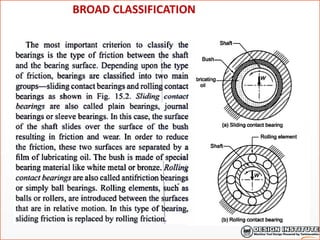
BROAD CLASSIFICATION
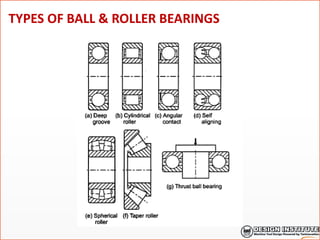
TYPES OF BALL & ROLLER BEARINGS
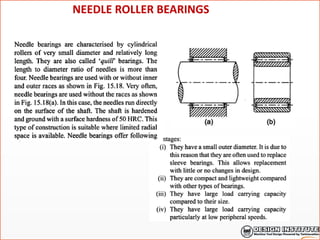
NEEDLE ROLLER BEARINGS
ANTIFRICTION BEARINGS
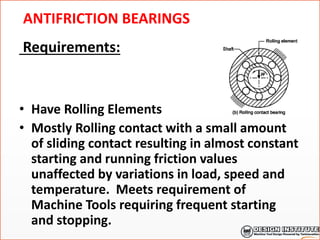
Requirements:
• Have Rolling Elements
• Mostly Rolling contact with a small amount
of sliding contact resulting in almost constant
starting and running friction values
unaffected by variations in load, speed and
temperature. Meets requirement of
Machine Tools requiring frequent starting
and stopping.
ANTIFRICTION BEARINGS
• Require little lubricant and maintenance
• Occupy less axial space
• Expensive and noisier than journal bearings
• Subjected to Fatigue failure and have limited
life
• Bearings for radial load, axial load and
combined radial and axial loads
TYPES OF BEARINGS
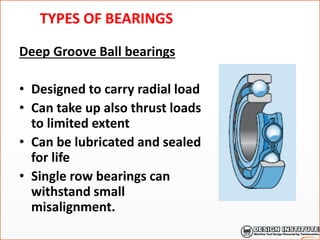
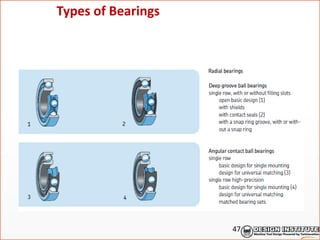
Deep Groove Ball bearings
• Designed to carry radial load
• Can take up also thrust loads
to limited extent
• Can be lubricated and sealed
for life
• Single row bearings can
withstand small
misalignment.
TYPES OF BEARINGS
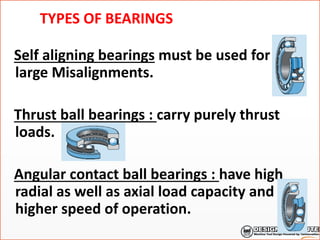
Self aligning bearings must be used for
large Misalignments.
Thrust ball bearings : carry purely thrust
loads.
Angular contact ball bearings : have high
radial as well as axial load capacity and
higher speed of operation.
TYPES OF BEARINGS
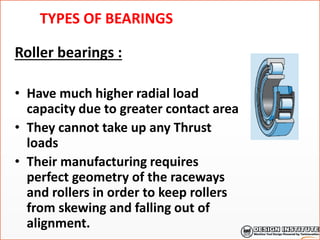
Roller bearings :
• Have much higher radial load
capacity due to greater contact area
• They cannot take up any Thrust
loads
• Their manufacturing requires
perfect geometry of the raceways
and rollers in order to keep rollers
from skewing and falling out of
alignment.
TYPES OF BEARINGS
• Roller bearings find more application in
Machine Tool Spindles
• For heavy loads and misalignments spherical
roller bearings must be used. Spherical
elements in addition have the advantage of
increasing their contact area as the load is
increased.
TYPES OF BEARINGS
• Needle bearings are very useful where high
radial capacity and minimum radial spare
are required.
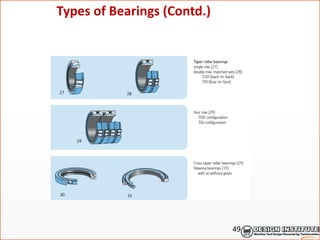
• Tapered roller bearings combine the
advantages of ball and roller bearings in
that they can accommodate radial or
Thrust loads or combinations of both, and
in addition, the load carrying capacity is
high.
ANTIFRICTION BEARINGS
Dimensional and Running Accuracies:
• For interchangeability, the boundary dimensions
and tolerances are standardized by ISO.
• Radial Run out and side run out with respect to the
bore, groove run out with respect to the side of the
inner ring and outer ring, axial groove run out with
respect to the face.
• These specifications must be checked especially for
precision applications.
ANTIFRICTION BEARINGS
Load carrying capacity and life:
• Life as applied to bearings is the number of working
hours while running at constant speed, which the
bearing can complete before fatigue failure is
evident on one of the bearing rings or rolling
elements.
• The other causes of bearing failure that can be
avoided by precautionary measures are:
ANTIFRICTION BEARINGS
Causes of bearing failure:
• Incorrect mounting
• Carelessness during assembly
• Inadequate or unsuitable lubrication
• Incorrect sealing
• Wrong fits etc.
ANTIFRICTION BEARINGS
Basic Dynamic capacity C
is the constant load with which the bearing can
reach a normal life of 1 million revolutions.
For radial bearings the basic capacity corresponds to
pure radial load and for thrust bearings a centrally
acting pure thrust load.
ANTIFRICTION BEARINGS
Static carrying capacity Co.
• Is the load capacity of a bearing when the bearing is
not rotating, but in this case the load limit is based
not on fatigue considerations but on permanent
deformations or fractures formed on the load
carrying members of the bearing.
• The criterion for the load rating is about when the
deformation of the rolling element and track is
0.0001 of the rolling element diameter.
ANTIFRICTION BEARINGS
Life of bearing L=[C/P]p or C/P = L1/p
Where,
C = basic dynamic capacity of the bearing in kg,
P = equivalent bearing load in kg,
C/P = loading ratio, p =3 for ball bearings and
p =10/3 for roller bearings,
L = Life in millions of revolutions.
ANTIFRICTION BEARINGS
To obtain Life in working hours as a function
of the Life in millions of revolutions we have
the relation:
L = 60nLh
1000000
Where
Lh = nominal life in working hours, and n is the speed
in rpm.
ANTIFRICTION BEARINGS
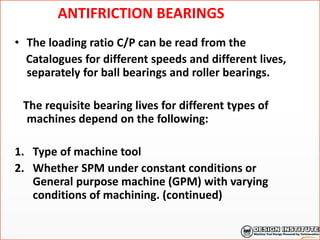
• The loading ratio C/P can be read from the
Catalogues for different speeds and different lives,
separately for ball bearings and roller bearings.
The requisite bearing lives for different types of
machines depend on the following:
1. Type of machine tool
2. Whether SPM under constant conditions or
General purpose machine (GPM) with varying
conditions of machining. (continued)
ANTIFRICTION BEARINGS
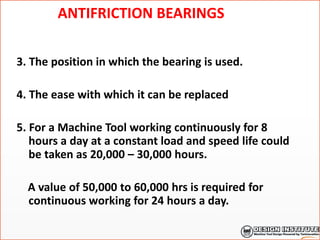
3. The position in which the bearing is used.
4. The ease with which it can be replaced
5. For a Machine Tool working continuously for 8
hours a day at a constant load and speed life could
be taken as 20,000 – 30,000 hours.
A value of 50,000 to 60,000 hrs is required for
continuous working for 24 hours a day.
ANTIFRICTION BEARINGS
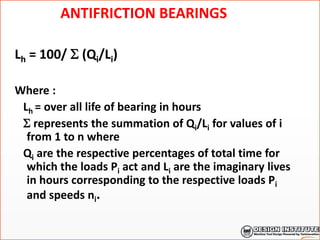
Lh = 100/  (Qi/Li)
Where :
Lh = over all life of bearing in hours
 represents the summation of Qi/Li for values of i
from 1 to n where
Qi are the respective percentages of total time for
which the loads Pi act and Li are the imaginary lives
in hours corresponding to the respective loads Pi
and speeds ni.
ANTIFRICTION BEARINGS
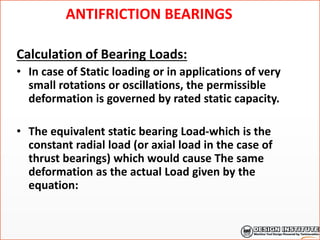
Calculation of Bearing Loads:
• In case of Static loading or in applications of very
small rotations or oscillations, the permissible
deformation is governed by rated static capacity.
• The equivalent static bearing Load-which is the
constant radial load (or axial load in the case of
thrust bearings) which would cause The same
deformation as the actual Load given by the
equation:
ANTIFRICTION BEARINGS
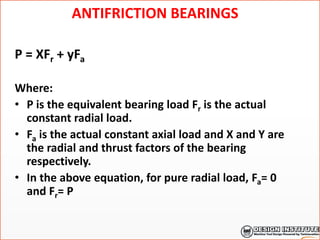
P = XFr + yFa
Where:
• P is the equivalent bearing load Fr is the actual
constant radial load.
• Fa is the actual constant axial load and X and Y are
the radial and thrust factors of the bearing
respectively.
• In the above equation, for pure radial load, Fa= 0
and Fr= P
ANTIFRICTION BEARINGS
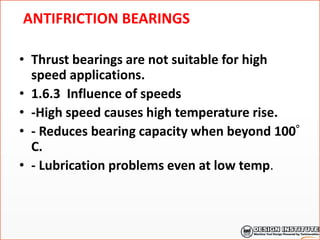
• Thrust bearings are not suitable for high
speed applications.
• 1.6.3 Influence of speeds
• -High speed causes high temperature rise.
• - Reduces bearing capacity when beyond 100
C.
• - Lubrication problems even at low temp.
ANTIFRICTION BEARINGS
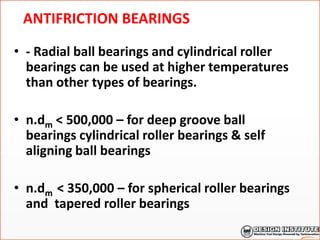
• - Radial ball bearings and cylindrical roller
bearings can be used at higher temperatures
than other types of bearings.
• n.dm < 500,000 – for deep groove ball
bearings cylindrical roller bearings & self
aligning ball bearings
• n.dm < 350,000 – for spherical roller bearings
and tapered roller bearings
ANTIFRICTION BEARINGS
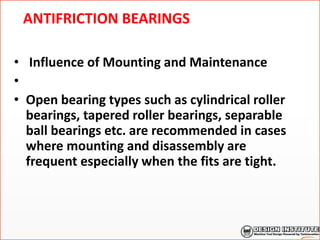
• Influence of Mounting and Maintenance
•
• Open bearing types such as cylindrical roller
bearings, tapered roller bearings, separable
ball bearings etc. are recommended in cases
where mounting and disassembly are
frequent especially when the fits are tight.
ANTIFRICTION BEARINGS
• Mounting is easier also with the tapered adaptor
sleeves and removable sleeves.
• Self aligning bearings must not be used in cases
where they are not accessible during their assembly
with other parts, since outer ring gets cocked easily
hindering assembly.
• Ball bearings are less demanding from the point of
view of lubrication.
ANTIFRICTION BEARINGS
• In all other types of bearings, proper lubrication
systems must be used to provide circulation or
retention of the lubricant.
• Securing of bearings
• Radial securing by proper selection of fits for
bearing races.
• Axial securing – the bearings must be held axially
against the forces tending to move the bearing
races.
ANTIFRICTION BEARINGS
• The inner rings are made to sit against a
shoulder of the shaft and held in position by
a retaining ring or a shaft nut.
• When a step is not possible and the bearings
are spaced far apart, then a long spacer may
be used with a relief along the shaft length.
ANTIFRICTION BEARINGS
• If a power transmission element is mounted close
to the bearing in question, then a distance piece
may be introduced.
• If there is no axial load, shoulder abutment without
axial retention of the inner ring is permissible,
provided the outer rings are secured tightly against
the housing. Any thrust load is taken up by the
respective farther bearing.
ANTIFRICTION BEARINGS
In case of angular contact bearings and
taper roller bearings which are usually
secured using shaft nuts, it will be
expedient to use a standard lock washer
and an additional thin washer, in
between in order enable reliable
securing.
ANTIFRICTION BEARINGS
• In the case of short shafts, both bearings
must be used for locating the shafts, - one in
each direction.
• In some cases, the locating bearing may be
positioned by inserting one or two locating rings.
• In the case of cylindrical roller bearings with flanges
on only one side, the roller set can move laterally
on the track of the ring. Thus the outer rings are
always axially located Fig. 8
ANTIFRICTION BEARINGS
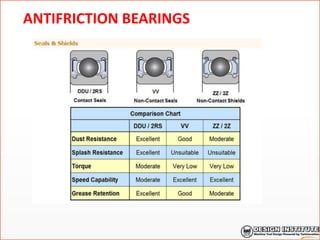
• Sealing of Rolling bearings
• Seals in bearings are helpful in retaining the
lubricant and preventing ingress of dirt entering
into the bearing elements.
• In places where effective sealing arrangements are
difficult within the spindle area, external sealing
arrangements are introduced outside the bearing
housing.
ANTIFRICTION BEARINGS
• Rubbing type seals provide effective sealing.
But introduce large friction torque and
heating.
• Labyrinth or clearance seals suitable for oil
and grease lubrication are applicable for high
speeds. Radial clearances of the order of 0.2
– 0.3 mm are to be maintained and any
collars located radially.
ANTIFRICTION BEARINGS
• The housings incorporating the seals should
be provided with adequate drainage
passages for the return of the oil to the base
of the bearing housing.
• Felt seals are employed when peripheral
speeds are less than 8 m/sec. Speeds of 10-
15 m/sec. are allowable for rotary shaft
seals.
ANTIFRICTION BEARINGS
• Bearing Mounting arrangements
• Table 2
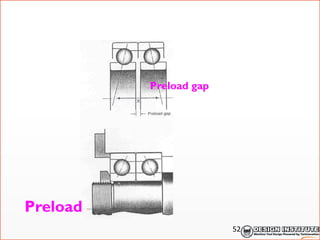
• Preloading of bearings.
• Preloading of bearings is a method using which the
bearing deflection under the working loads is
reduced. A permanent axial load is applied for
adjusting the two bearings against one another.
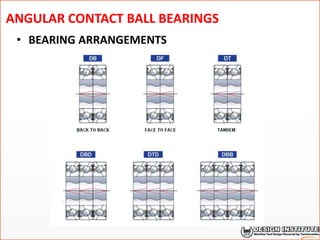
ANGULAR CONTACT BALL BEARINGS
• BEARING ARRANGEMENTS
ANTIFRICTION BEARINGS
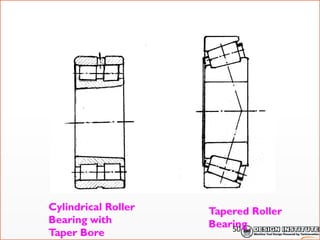
• In NNK type of double row cylindrical roller
bearings used on machine tool spindles, an
1:12 tapered bore in the inner ring is forced
against the corresponding tapered seating on
the spindle. The preloading thus created is
very steep. Care has to be taken to avoid
excessive load which will create overload and
over heating.
ANTIFRICTION BEARINGS
Rigidity Calculations for Machine Tool Spindles
• The Spindle running accuracy is influenced
by the elastic deformation of the Spindle, its
bearings, housings and other components of the
assembly.
• -The over all stiffness of the spindle system is
mainly affected by the stiffness of the bearings and
the spindle diameter. The housing stiffness has the
least effect.
ANTIFRICTION BEARINGS
• Thus we can write:
•  = 1 + 2 = P [(1/sA) {(a+L)/L}2 + (1/SB) (a/L)2
+ (a2/3E) (L/IL + a/Ia)]
• SA – Radial stiffness of the bearings nearer to
load P
• SB – Radial stiffness of the bearings farther to
load P
• a - overhang
ANTIFRICTION BEARINGS
• L – Span
• E – Youngs modulus of Elasticity
• IA – Area moment of Inertia of the
Section in the overhang region
• IL – Area moment of Inertia of the
Section in the Span region.
ANTIFRICTION BEARINGS
• In the above equation, if the bearings, diameter of
the Spindle and overhang of the Spindle are fixed,
then we note that the stiffness becomes a function
of the bearing span only. The optimum span Lo
based on Static stiffness that provides maximum
stiffness to the system can be derived as
• Lo  [6EIL(1/SA+1/SB)+(6EIL/a.SA)Q]1/3
• Where the iterative trial value Q is taken as 4a
initially and the value of Lo is derived.
ANTIFRICTION BEARINGS
• This derived value of Lo is used for Q in
subsequent iterations successively. A study
of the equation reveals that the effect of the
change of stiffness is more, when the span is
more than the optimum than when it is less.
For example when the span increases by 20%
beyond the optimum, the stiffness loss is
only 4%.
ANTIFRICTION BEARINGS
• Spindle bearing arrangements
The performance of a bearing arrangement in a
spindle being the main contributor to the quality of
work piece – tool complex, the spindle bearing
arrangement must posses the following
characteristics :
• Maximum rigidity : This is ensured by adequately
rigid spindle and by using bearings with minimum
deflections.
Types of Bearings
47
Types of Bearings (Contd.)
48
Types of Bearings (Contd.)
49
Cylindrical Roller
Bearing with
Taper Bore
Tapered Roller
Bearing
50
Contact
Angle
Contact Angle
Points of
Contact
51
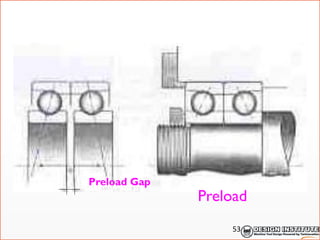
Preload
Preload gap
52
Preload Gap
Preload
53
Preload
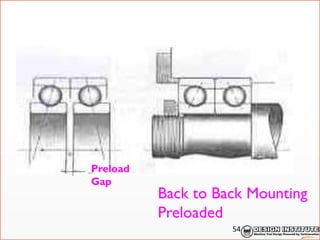
Gap
Back to Back Mounting
Preloaded
54
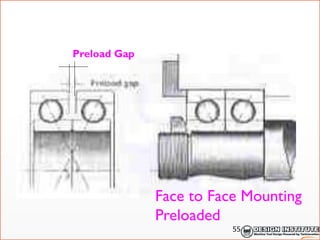
Preload Gap
Face to Face Mounting
Preloaded
55
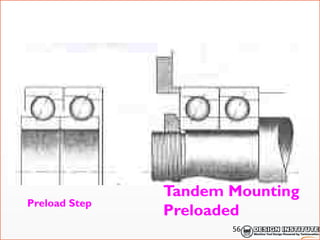
Preload Step
Tandem Mounting
Preloaded
56
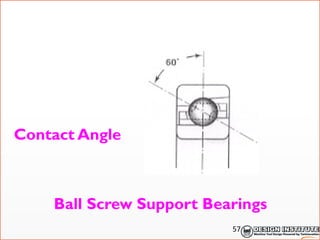
Contact Angle
Ball Screw Support Bearings
57
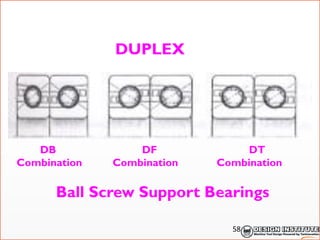
DB
Combination
DF
Combination
DT
Combination
Ball Screw Support Bearings
DUPLEX
58
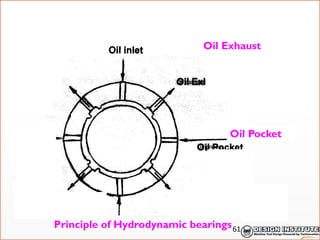
 Pressure of oil is created within the bearing by the rotation of
the spindle. As the spindle rotates the oil in contact with the
spindle is carried into wedge-shaped cavities between the
spindle and the bearing. The oil pressure is increased as the oil
is forced through the small clearances between the bearing and
the spindle.
 The main limitation in a Hydro Dynamic Bearing is that a
definite clearance must be provided for the oil film to be
maintained between the spindle and the bearing.
Principles of Hydro Dynamic Bearing
59
 This clearance may result in the centre of a spindle in the
bearing to change its position owing to variation in the
applied force. Clearances normally provided between the
spindle and the bore of the bearing for oil film vary from 50
to 100 Microns depending upon the diameter of the journal.
Principles of Hydro Dynamic Bearing
(contd.)
60
Principle of Hydrodynamic bearings
Oil Exhaust
Oil Pocket
61
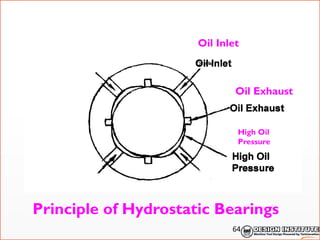
 For a hydrostatic bearing, the spindle is supported by a
relatively thick film of oil supplied under pressure , similar to
that used in the bearings for linear movements.
 The oil is pressurised by a pump external to the bearing.
Hydrostatic Bearings
62
 The load carrying capacity of this type of bearing is
independent of the rotational speed. They have high
damping properties, high running accuracy, high wear
resistance but are very expensive. These are used where
temperature effects cause problems in the part accuracy as
in the case of grinding machines and fine boring machines.
Principles of Hydrostatic Bearing
63
Oil Inlet
Oil Exhaust
High Oil
Pressure
Principle of Hydrostatic Bearings
64
 The ball and roller bearings have some amount of axial and
radial clearances. When a main spindle is mounted on the
bearings there should not be any axial or radial play in the main
spindle assembly. To achieve this the clearances in the bearings
have to be taken up by preloading them .
 In case of tapered roller bearings and angular contact ball
bearings, the axial and radial clearances can be taken up
simultaneously by preloading. Cylindrical roller bearings
(Double row ) with tapered bore are radially preloaded by
pushing the inner race against the taper on the spindle.
Preloading
65
 On the main spindle the following accuracies are defined
 Radial Run Out
 Axial Run Out
 The accuracy of spindle during running depends on the thermal
stability of the spindle. This is the most important aspect of spindle
design, especially for high speed and high accuracy spindles.
Considering the above, appropriate bearing lubrication and spindle
cooling systems should be adopted in the design of spindle for
machine tools.
Machine Tool Spindle Accuracy
66
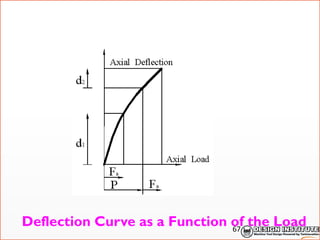
Deflection Curve as a Function of the Load
67
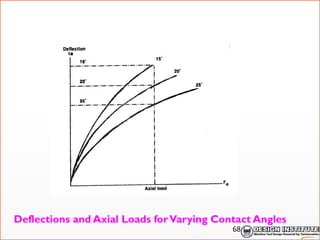
Deflections and Axial Loads forVarying Contact Angles
68
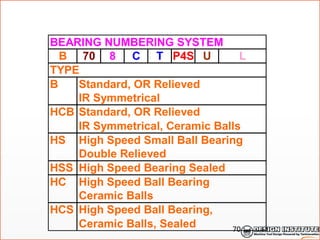
BEARING NUMBERING SYSTEM
B 70 8 C T P4S U L
TYPE Standard Preloads
B Standard L - Light
OR relieved M - Medium
IR Symmetrical H - Heavy
HCB Standard Bearing Sets
OR relieved U - Single Bearing
IR Symmetrical Universal
Ceramic Balls DU - Duplex Set
HS High Speed Small Universal
Ball Bearing TU - Triplex Set
Double Relieved Universal
HSS High Speed Bearing QU - Quadruplex Set
Sealed Universal
HC High Speed Ball PU - Pentaplex set
Bearing, Ceramic Balls Universal
HCS High Speed Ball DB - Duplex Set
Bearing, Ceramic Balls Back to Back
Sealed DT - Duplex Set
Tandem
SERIES TBT - Triplex Set
719 Light Series Tandem, Back to Back
70 Medium Series QBC - Quadruplex Set
72 Heavy Series Double Tandem
Back to Back
BORE DIAMETER
oo 10 mm PRECISION
o1 12 mm P4S - FAG Tolerance,
O2 15 mm better
thanISO P4
O3 17 mm
O4 4 x 5 20 mm CAGE
O5 5 x 5 25 mm T - Phenolic, OR Riding
CONTACT ANGLE M- Metalic, Brass
C 150
E 250
69
BEARING NUMBERING SYSTEM
B 70 8 C T P4S U L
TYPE
B Standard, OR Relieved
IR Symmetrical
HCB Standard, OR Relieved
IR Symmetrical, Ceramic Balls
HS High Speed Small Ball Bearing
Double Relieved
HSS High Speed Bearing Sealed
HC High Speed Ball Bearing
Ceramic Balls
HCS High Speed Ball Bearing,
Ceramic Balls, Sealed 70
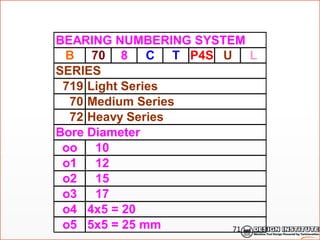
BEARING NUMBERING SYSTEM
B 70 8 C T P4S U L
SERIES
719 Light Series
70 Medium Series
72 Heavy Series
Bore Diameter
oo 10
o1 12
o2 15
o3 17
o4 4x5 = 20
o5 5x5 = 25 mm 71
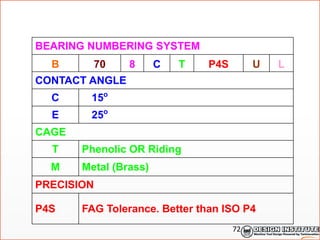
BEARING NUMBERING SYSTEM
B 70 8 C T P4S U L
CONTACT ANGLE
C 15o
E 25o
CAGE
T Phenolic OR Riding
M Metal (Brass)
PRECISION
P4S FAG Tolerance. Better than ISO P4
72
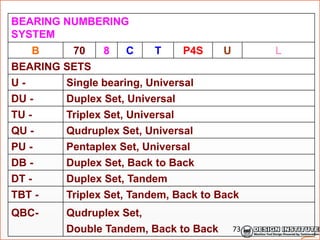
BEARING NUMBERING
SYSTEM
B 70 8 C T P4S U L
BEARING SETS
U - Single bearing, Universal
DU - Duplex Set, Universal
TU - Triplex Set, Universal
QU - Qudruplex Set, Universal
PU - Pentaplex Set, Universal
DB - Duplex Set, Back to Back
DT - Duplex Set, Tandem
TBT - Triplex Set, Tandem, Back to Back
QBC- Qudruplex Set,
Double Tandem, Back to Back 73
BEARING NUMBERING SYSTEM
B 70 8 C T P4S U L
Standard Preloads
L - Light
M - Medium
H - Heavy
74
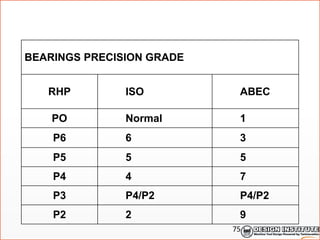
BEARINGS PRECISION GRADE
RHP ISO ABEC
PO Normal 1
P6 6 3
P5 5 5
P4 4 7
P3 P4/P2 P4/P2
P2 2 9
75
THANK YOU

ANTI FRICTION BEARINGS.pdf

  • 1.
    MACHINE TOOL DESIGN- MECHANICAL TOPIC : ANTI FRICTION BEARINGS By: HV RajaShekara SENIOR DIRECTOR - Design Institute, IMTMA
  • 2.
    BEARING  Bearing isthe mechanical element that permits relative motion between two parts, such as the shaft and the housing, with minimum friction.  Bearing ensures free rotation of the shaft or an axle with minimum friction  It supports the shaft or the axle and holds it in the correct position  It takes up the forces that act on the shaft or the axle and transmits them to the frame or the foundation.
  • 3.
  • 4.
    TYPES OF BALL& ROLLER BEARINGS
  • 5.
  • 6.
    ANTIFRICTION BEARINGS Requirements: • HaveRolling Elements • Mostly Rolling contact with a small amount of sliding contact resulting in almost constant starting and running friction values unaffected by variations in load, speed and temperature. Meets requirement of Machine Tools requiring frequent starting and stopping.
  • 7.
    ANTIFRICTION BEARINGS • Requirelittle lubricant and maintenance • Occupy less axial space • Expensive and noisier than journal bearings • Subjected to Fatigue failure and have limited life • Bearings for radial load, axial load and combined radial and axial loads
  • 8.
    TYPES OF BEARINGS DeepGroove Ball bearings • Designed to carry radial load • Can take up also thrust loads to limited extent • Can be lubricated and sealed for life • Single row bearings can withstand small misalignment.
  • 9.
    TYPES OF BEARINGS Selfaligning bearings must be used for large Misalignments. Thrust ball bearings : carry purely thrust loads. Angular contact ball bearings : have high radial as well as axial load capacity and higher speed of operation.
  • 10.
    TYPES OF BEARINGS Rollerbearings : • Have much higher radial load capacity due to greater contact area • They cannot take up any Thrust loads • Their manufacturing requires perfect geometry of the raceways and rollers in order to keep rollers from skewing and falling out of alignment.
  • 11.
    TYPES OF BEARINGS •Roller bearings find more application in Machine Tool Spindles • For heavy loads and misalignments spherical roller bearings must be used. Spherical elements in addition have the advantage of increasing their contact area as the load is increased.
  • 12.
    TYPES OF BEARINGS •Needle bearings are very useful where high radial capacity and minimum radial spare are required. • Tapered roller bearings combine the advantages of ball and roller bearings in that they can accommodate radial or Thrust loads or combinations of both, and in addition, the load carrying capacity is high.
  • 13.
    ANTIFRICTION BEARINGS Dimensional andRunning Accuracies: • For interchangeability, the boundary dimensions and tolerances are standardized by ISO. • Radial Run out and side run out with respect to the bore, groove run out with respect to the side of the inner ring and outer ring, axial groove run out with respect to the face. • These specifications must be checked especially for precision applications.
  • 14.
    ANTIFRICTION BEARINGS Load carryingcapacity and life: • Life as applied to bearings is the number of working hours while running at constant speed, which the bearing can complete before fatigue failure is evident on one of the bearing rings or rolling elements. • The other causes of bearing failure that can be avoided by precautionary measures are:
  • 15.
    ANTIFRICTION BEARINGS Causes ofbearing failure: • Incorrect mounting • Carelessness during assembly • Inadequate or unsuitable lubrication • Incorrect sealing • Wrong fits etc.
  • 16.
    ANTIFRICTION BEARINGS Basic Dynamiccapacity C is the constant load with which the bearing can reach a normal life of 1 million revolutions. For radial bearings the basic capacity corresponds to pure radial load and for thrust bearings a centrally acting pure thrust load.
  • 17.
    ANTIFRICTION BEARINGS Static carryingcapacity Co. • Is the load capacity of a bearing when the bearing is not rotating, but in this case the load limit is based not on fatigue considerations but on permanent deformations or fractures formed on the load carrying members of the bearing. • The criterion for the load rating is about when the deformation of the rolling element and track is 0.0001 of the rolling element diameter.
  • 18.
    ANTIFRICTION BEARINGS Life ofbearing L=[C/P]p or C/P = L1/p Where, C = basic dynamic capacity of the bearing in kg, P = equivalent bearing load in kg, C/P = loading ratio, p =3 for ball bearings and p =10/3 for roller bearings, L = Life in millions of revolutions.
  • 19.
    ANTIFRICTION BEARINGS To obtainLife in working hours as a function of the Life in millions of revolutions we have the relation: L = 60nLh 1000000 Where Lh = nominal life in working hours, and n is the speed in rpm.
  • 20.
    ANTIFRICTION BEARINGS • Theloading ratio C/P can be read from the Catalogues for different speeds and different lives, separately for ball bearings and roller bearings. The requisite bearing lives for different types of machines depend on the following: 1. Type of machine tool 2. Whether SPM under constant conditions or General purpose machine (GPM) with varying conditions of machining. (continued)
  • 21.
    ANTIFRICTION BEARINGS 3. Theposition in which the bearing is used. 4. The ease with which it can be replaced 5. For a Machine Tool working continuously for 8 hours a day at a constant load and speed life could be taken as 20,000 – 30,000 hours. A value of 50,000 to 60,000 hrs is required for continuous working for 24 hours a day.
  • 22.
    ANTIFRICTION BEARINGS Lh =100/  (Qi/Li) Where : Lh = over all life of bearing in hours  represents the summation of Qi/Li for values of i from 1 to n where Qi are the respective percentages of total time for which the loads Pi act and Li are the imaginary lives in hours corresponding to the respective loads Pi and speeds ni.
  • 23.
    ANTIFRICTION BEARINGS Calculation ofBearing Loads: • In case of Static loading or in applications of very small rotations or oscillations, the permissible deformation is governed by rated static capacity. • The equivalent static bearing Load-which is the constant radial load (or axial load in the case of thrust bearings) which would cause The same deformation as the actual Load given by the equation:
  • 24.
    ANTIFRICTION BEARINGS P =XFr + yFa Where: • P is the equivalent bearing load Fr is the actual constant radial load. • Fa is the actual constant axial load and X and Y are the radial and thrust factors of the bearing respectively. • In the above equation, for pure radial load, Fa= 0 and Fr= P
  • 25.
    ANTIFRICTION BEARINGS • Thrustbearings are not suitable for high speed applications. • 1.6.3 Influence of speeds • -High speed causes high temperature rise. • - Reduces bearing capacity when beyond 100 C. • - Lubrication problems even at low temp.
  • 26.
    ANTIFRICTION BEARINGS • -Radial ball bearings and cylindrical roller bearings can be used at higher temperatures than other types of bearings. • n.dm < 500,000 – for deep groove ball bearings cylindrical roller bearings & self aligning ball bearings • n.dm < 350,000 – for spherical roller bearings and tapered roller bearings
  • 27.
    ANTIFRICTION BEARINGS • Influenceof Mounting and Maintenance • • Open bearing types such as cylindrical roller bearings, tapered roller bearings, separable ball bearings etc. are recommended in cases where mounting and disassembly are frequent especially when the fits are tight.
  • 28.
    ANTIFRICTION BEARINGS • Mountingis easier also with the tapered adaptor sleeves and removable sleeves. • Self aligning bearings must not be used in cases where they are not accessible during their assembly with other parts, since outer ring gets cocked easily hindering assembly. • Ball bearings are less demanding from the point of view of lubrication.
  • 29.
    ANTIFRICTION BEARINGS • Inall other types of bearings, proper lubrication systems must be used to provide circulation or retention of the lubricant. • Securing of bearings • Radial securing by proper selection of fits for bearing races. • Axial securing – the bearings must be held axially against the forces tending to move the bearing races.
  • 30.
    ANTIFRICTION BEARINGS • Theinner rings are made to sit against a shoulder of the shaft and held in position by a retaining ring or a shaft nut. • When a step is not possible and the bearings are spaced far apart, then a long spacer may be used with a relief along the shaft length.
  • 31.
    ANTIFRICTION BEARINGS • Ifa power transmission element is mounted close to the bearing in question, then a distance piece may be introduced. • If there is no axial load, shoulder abutment without axial retention of the inner ring is permissible, provided the outer rings are secured tightly against the housing. Any thrust load is taken up by the respective farther bearing.
  • 32.
    ANTIFRICTION BEARINGS In caseof angular contact bearings and taper roller bearings which are usually secured using shaft nuts, it will be expedient to use a standard lock washer and an additional thin washer, in between in order enable reliable securing.
  • 33.
    ANTIFRICTION BEARINGS • Inthe case of short shafts, both bearings must be used for locating the shafts, - one in each direction. • In some cases, the locating bearing may be positioned by inserting one or two locating rings. • In the case of cylindrical roller bearings with flanges on only one side, the roller set can move laterally on the track of the ring. Thus the outer rings are always axially located Fig. 8
  • 34.
    ANTIFRICTION BEARINGS • Sealingof Rolling bearings • Seals in bearings are helpful in retaining the lubricant and preventing ingress of dirt entering into the bearing elements. • In places where effective sealing arrangements are difficult within the spindle area, external sealing arrangements are introduced outside the bearing housing.
  • 35.
    ANTIFRICTION BEARINGS • Rubbingtype seals provide effective sealing. But introduce large friction torque and heating. • Labyrinth or clearance seals suitable for oil and grease lubrication are applicable for high speeds. Radial clearances of the order of 0.2 – 0.3 mm are to be maintained and any collars located radially.
  • 36.
    ANTIFRICTION BEARINGS • Thehousings incorporating the seals should be provided with adequate drainage passages for the return of the oil to the base of the bearing housing. • Felt seals are employed when peripheral speeds are less than 8 m/sec. Speeds of 10- 15 m/sec. are allowable for rotary shaft seals.
  • 37.
    ANTIFRICTION BEARINGS • BearingMounting arrangements • Table 2 • Preloading of bearings. • Preloading of bearings is a method using which the bearing deflection under the working loads is reduced. A permanent axial load is applied for adjusting the two bearings against one another.
  • 38.
    ANGULAR CONTACT BALLBEARINGS • BEARING ARRANGEMENTS
  • 39.
  • 40.
    ANTIFRICTION BEARINGS • InNNK type of double row cylindrical roller bearings used on machine tool spindles, an 1:12 tapered bore in the inner ring is forced against the corresponding tapered seating on the spindle. The preloading thus created is very steep. Care has to be taken to avoid excessive load which will create overload and over heating.
  • 41.
    ANTIFRICTION BEARINGS Rigidity Calculationsfor Machine Tool Spindles • The Spindle running accuracy is influenced by the elastic deformation of the Spindle, its bearings, housings and other components of the assembly. • -The over all stiffness of the spindle system is mainly affected by the stiffness of the bearings and the spindle diameter. The housing stiffness has the least effect.
  • 42.
    ANTIFRICTION BEARINGS • Thuswe can write: •  = 1 + 2 = P [(1/sA) {(a+L)/L}2 + (1/SB) (a/L)2 + (a2/3E) (L/IL + a/Ia)] • SA – Radial stiffness of the bearings nearer to load P • SB – Radial stiffness of the bearings farther to load P • a - overhang
  • 43.
    ANTIFRICTION BEARINGS • L– Span • E – Youngs modulus of Elasticity • IA – Area moment of Inertia of the Section in the overhang region • IL – Area moment of Inertia of the Section in the Span region.
  • 44.
    ANTIFRICTION BEARINGS • Inthe above equation, if the bearings, diameter of the Spindle and overhang of the Spindle are fixed, then we note that the stiffness becomes a function of the bearing span only. The optimum span Lo based on Static stiffness that provides maximum stiffness to the system can be derived as • Lo  [6EIL(1/SA+1/SB)+(6EIL/a.SA)Q]1/3 • Where the iterative trial value Q is taken as 4a initially and the value of Lo is derived.
  • 45.
    ANTIFRICTION BEARINGS • Thisderived value of Lo is used for Q in subsequent iterations successively. A study of the equation reveals that the effect of the change of stiffness is more, when the span is more than the optimum than when it is less. For example when the span increases by 20% beyond the optimum, the stiffness loss is only 4%.
  • 46.
    ANTIFRICTION BEARINGS • Spindlebearing arrangements The performance of a bearing arrangement in a spindle being the main contributor to the quality of work piece – tool complex, the spindle bearing arrangement must posses the following characteristics : • Maximum rigidity : This is ensured by adequately rigid spindle and by using bearings with minimum deflections.
  • 47.
  • 48.
    Types of Bearings(Contd.) 48
  • 49.
    Types of Bearings(Contd.) 49
  • 50.
    Cylindrical Roller Bearing with TaperBore Tapered Roller Bearing 50
  • 51.
  • 52.
  • 53.
  • 54.
    Preload Gap Back to BackMounting Preloaded 54
  • 55.
    Preload Gap Face toFace Mounting Preloaded 55
  • 56.
  • 57.
    Contact Angle Ball ScrewSupport Bearings 57
  • 58.
  • 59.
     Pressure ofoil is created within the bearing by the rotation of the spindle. As the spindle rotates the oil in contact with the spindle is carried into wedge-shaped cavities between the spindle and the bearing. The oil pressure is increased as the oil is forced through the small clearances between the bearing and the spindle.  The main limitation in a Hydro Dynamic Bearing is that a definite clearance must be provided for the oil film to be maintained between the spindle and the bearing. Principles of Hydro Dynamic Bearing 59
  • 60.
     This clearancemay result in the centre of a spindle in the bearing to change its position owing to variation in the applied force. Clearances normally provided between the spindle and the bore of the bearing for oil film vary from 50 to 100 Microns depending upon the diameter of the journal. Principles of Hydro Dynamic Bearing (contd.) 60
  • 61.
    Principle of Hydrodynamicbearings Oil Exhaust Oil Pocket 61
  • 62.
     For ahydrostatic bearing, the spindle is supported by a relatively thick film of oil supplied under pressure , similar to that used in the bearings for linear movements.  The oil is pressurised by a pump external to the bearing. Hydrostatic Bearings 62
  • 63.
     The loadcarrying capacity of this type of bearing is independent of the rotational speed. They have high damping properties, high running accuracy, high wear resistance but are very expensive. These are used where temperature effects cause problems in the part accuracy as in the case of grinding machines and fine boring machines. Principles of Hydrostatic Bearing 63
  • 64.
    Oil Inlet Oil Exhaust HighOil Pressure Principle of Hydrostatic Bearings 64
  • 65.
     The balland roller bearings have some amount of axial and radial clearances. When a main spindle is mounted on the bearings there should not be any axial or radial play in the main spindle assembly. To achieve this the clearances in the bearings have to be taken up by preloading them .  In case of tapered roller bearings and angular contact ball bearings, the axial and radial clearances can be taken up simultaneously by preloading. Cylindrical roller bearings (Double row ) with tapered bore are radially preloaded by pushing the inner race against the taper on the spindle. Preloading 65
  • 66.
     On themain spindle the following accuracies are defined  Radial Run Out  Axial Run Out  The accuracy of spindle during running depends on the thermal stability of the spindle. This is the most important aspect of spindle design, especially for high speed and high accuracy spindles. Considering the above, appropriate bearing lubrication and spindle cooling systems should be adopted in the design of spindle for machine tools. Machine Tool Spindle Accuracy 66
  • 67.
    Deflection Curve asa Function of the Load 67
  • 68.
    Deflections and AxialLoads forVarying Contact Angles 68
  • 69.
    BEARING NUMBERING SYSTEM B70 8 C T P4S U L TYPE Standard Preloads B Standard L - Light OR relieved M - Medium IR Symmetrical H - Heavy HCB Standard Bearing Sets OR relieved U - Single Bearing IR Symmetrical Universal Ceramic Balls DU - Duplex Set HS High Speed Small Universal Ball Bearing TU - Triplex Set Double Relieved Universal HSS High Speed Bearing QU - Quadruplex Set Sealed Universal HC High Speed Ball PU - Pentaplex set Bearing, Ceramic Balls Universal HCS High Speed Ball DB - Duplex Set Bearing, Ceramic Balls Back to Back Sealed DT - Duplex Set Tandem SERIES TBT - Triplex Set 719 Light Series Tandem, Back to Back 70 Medium Series QBC - Quadruplex Set 72 Heavy Series Double Tandem Back to Back BORE DIAMETER oo 10 mm PRECISION o1 12 mm P4S - FAG Tolerance, O2 15 mm better thanISO P4 O3 17 mm O4 4 x 5 20 mm CAGE O5 5 x 5 25 mm T - Phenolic, OR Riding CONTACT ANGLE M- Metalic, Brass C 150 E 250 69
  • 70.
    BEARING NUMBERING SYSTEM B70 8 C T P4S U L TYPE B Standard, OR Relieved IR Symmetrical HCB Standard, OR Relieved IR Symmetrical, Ceramic Balls HS High Speed Small Ball Bearing Double Relieved HSS High Speed Bearing Sealed HC High Speed Ball Bearing Ceramic Balls HCS High Speed Ball Bearing, Ceramic Balls, Sealed 70
  • 71.
    BEARING NUMBERING SYSTEM B70 8 C T P4S U L SERIES 719 Light Series 70 Medium Series 72 Heavy Series Bore Diameter oo 10 o1 12 o2 15 o3 17 o4 4x5 = 20 o5 5x5 = 25 mm 71
  • 72.
    BEARING NUMBERING SYSTEM B70 8 C T P4S U L CONTACT ANGLE C 15o E 25o CAGE T Phenolic OR Riding M Metal (Brass) PRECISION P4S FAG Tolerance. Better than ISO P4 72
  • 73.
    BEARING NUMBERING SYSTEM B 708 C T P4S U L BEARING SETS U - Single bearing, Universal DU - Duplex Set, Universal TU - Triplex Set, Universal QU - Qudruplex Set, Universal PU - Pentaplex Set, Universal DB - Duplex Set, Back to Back DT - Duplex Set, Tandem TBT - Triplex Set, Tandem, Back to Back QBC- Qudruplex Set, Double Tandem, Back to Back 73
  • 74.
    BEARING NUMBERING SYSTEM B70 8 C T P4S U L Standard Preloads L - Light M - Medium H - Heavy 74
  • 75.
    BEARINGS PRECISION GRADE RHPISO ABEC PO Normal 1 P6 6 3 P5 5 5 P4 4 7 P3 P4/P2 P4/P2 P2 2 9 75
  • 76.