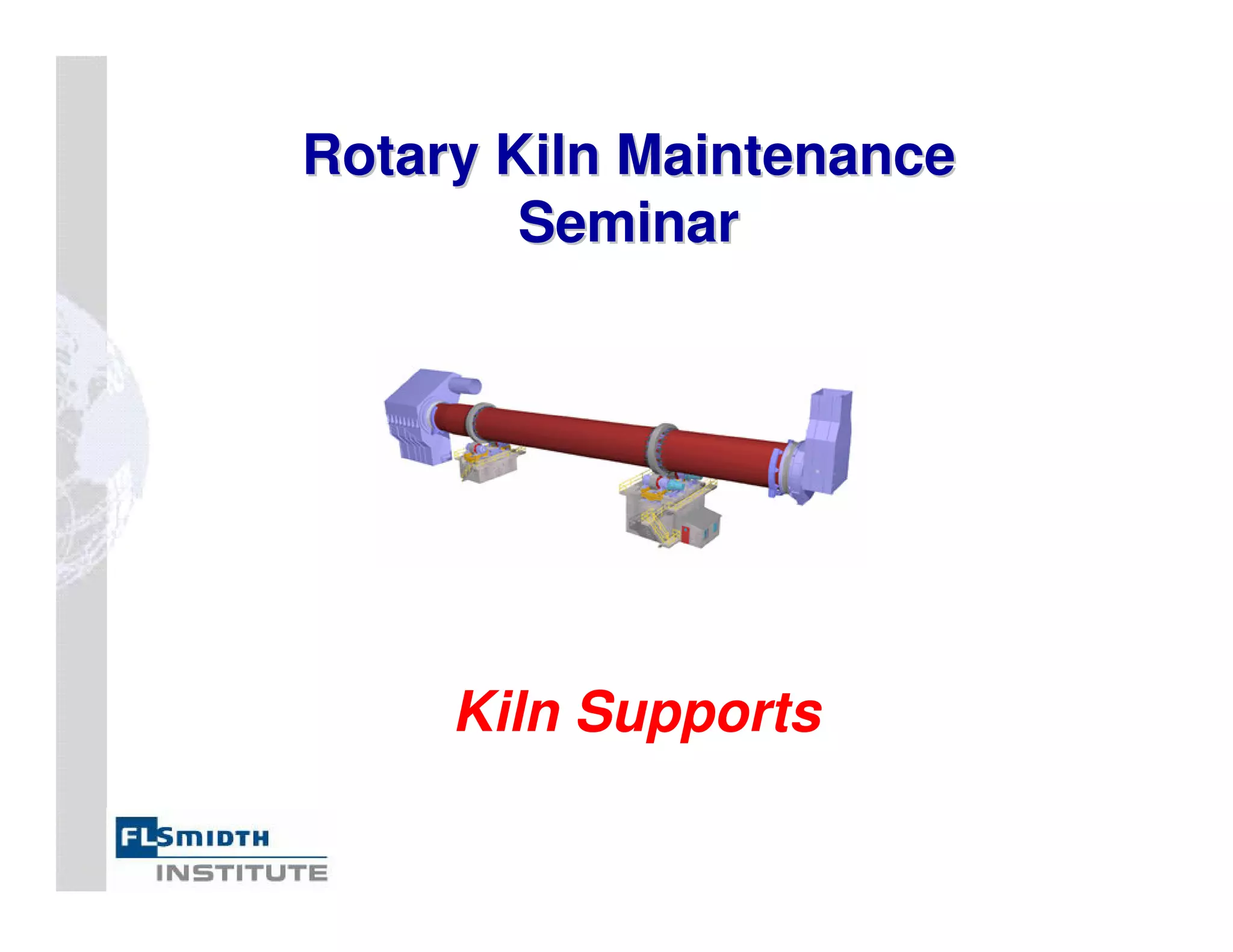
Rotary Kiln Maintenance
Seminar
Seminar
Kiln Supports
Kiln Supports
Kiln Supports
Types of Kiln Supports
Roller Adjustments
Roller Inclination
Roller and Tire Defects
Roller and Tire Re-
conditioning
Types of Kiln Supports
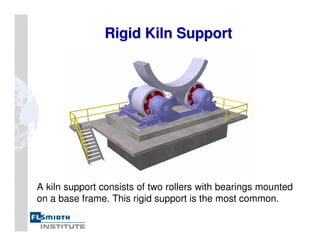
Rigid Kiln Support
Rigid Kiln Support
A kiln support consists of two rollers with bearings mounted
on a base frame. This rigid support is the most common.
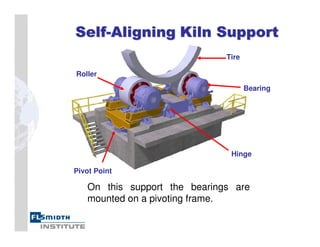
Tire
Roller
Bearing
Hinge
Pivot Point
On this support the bearings are
mounted on a pivoting frame.
Self
Self-
-Aligning
Aligning Kiln Support
Kiln Support
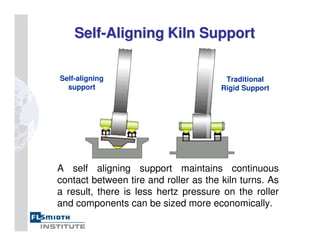
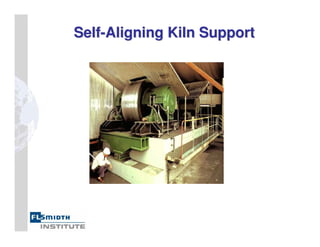
A self aligning support maintains continuous
contact between tire and roller as the kiln turns. As
a result, there is less hertz pressure on the roller
and components can be sized more economically.
Self-aligning
support
Traditional
Rigid Support
Self
Self-
-Aligning Kiln Support
Aligning Kiln Support
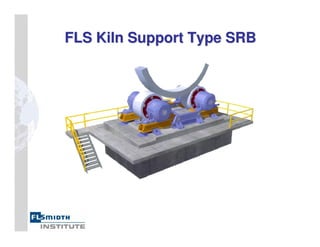
FLS Kiln Support Type SRB
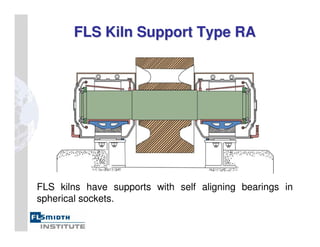
FLS Kiln Support Type RA
FLS kilns have supports with self aligning bearings in
spherical sockets.
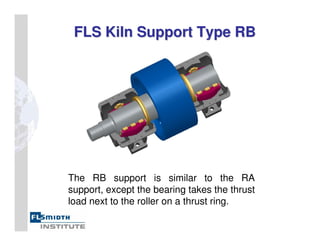
FLS Kiln Support Type RB
The RB support is similar to the RA
support, except the bearing takes the thrust
load next to the roller on a thrust ring.
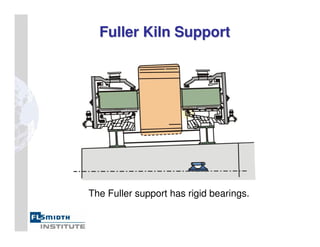
Fuller Kiln Support
Fuller Kiln Support
The Fuller support has rigid bearings.
Roller Adjustments
Roller Adjustments
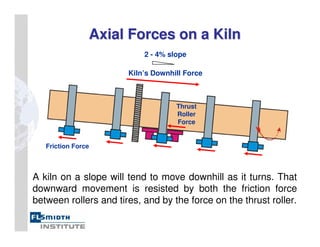
Axial Forces on a Kiln
A kiln on a slope will tend to move downhill as it turns. That
downward movement is resisted by both the friction force
between rollers and tires, and by the force on the thrust roller.
2 - 4% slope
Friction Force
Thrust
Roller
Force
Kiln’s Downhill Force
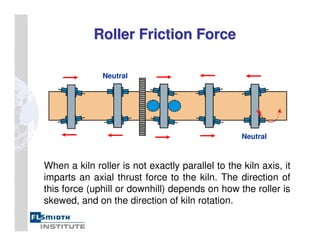
Roller Friction Force
When a kiln roller is not exactly parallel to the kiln axis, it
imparts an axial thrust force to the kiln. The direction of
this force (uphill or downhill) depends on how the roller is
skewed, and on the direction of kiln rotation.
Neutral
Neutral
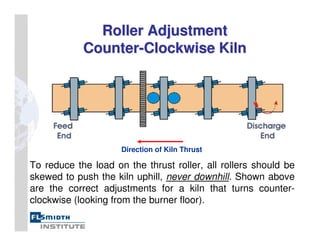
Roller Adjustment
Roller Adjustment
Counter
Counter-
-Clockwise Kiln
Clockwise Kiln
To reduce the load on the thrust roller, all rollers should be
skewed to push the kiln uphill, never downhill. Shown above
are the correct adjustments for a kiln that turns counter-
clockwise (looking from the burner floor).
Direction of Kiln Thrust
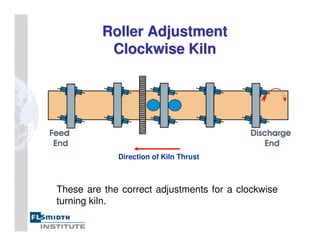
Roller Adjustment
Roller Adjustment
Clockwise Kiln
Clockwise Kiln
Direction of Kiln Thrust
These are the correct adjustments for a clockwise
turning kiln.
Roller Adjustment
Roller Adjustment
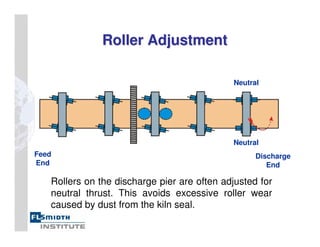
Rollers on the discharge pier are often adjusted for
neutral thrust. This avoids excessive roller wear
caused by dust from the kiln seal.
Neutral
Neutral
Feed
End
Discharge
End
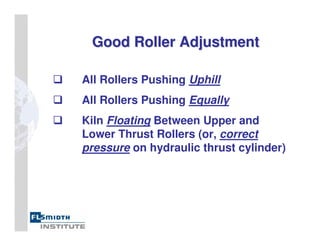
Good Roller Adjustment
All Rollers Pushing Uphill
All Rollers Pushing Equally
Kiln Floating Between Upper and
Lower Thrust Rollers (or, correct
pressure on hydraulic thrust cylinder)
Roller
Roller -
-Tire Forces
Tire Forces
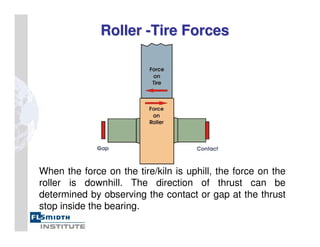
When the force on the tire/kiln is uphill, the force on the
roller is downhill. The direction of thrust can be
determined by observing the contact or gap at the thrust
stop inside the bearing.
Direction of Kiln Thrust
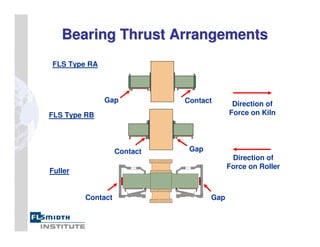
Bearing Thrust Arrangements
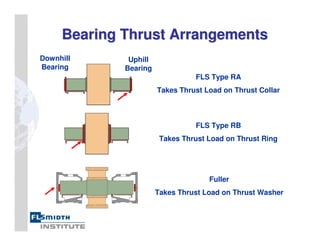
FLS Type RA
Takes Thrust Load on Thrust Collar
FLS Type RB
Takes Thrust Load on Thrust Ring
Fuller
Takes Thrust Load on Thrust Washer
Uphill
Bearing
Downhill
Bearing
Bearing Thrust Arrangements
FLS Type RA
FLS Type RB
Fuller
Contact
Contact
Contact
Gap
Gap
Gap
Direction of
Force on Kiln
Direction of
Force on Roller
FLS Bearing Type RA
FLS Bearing Type RA
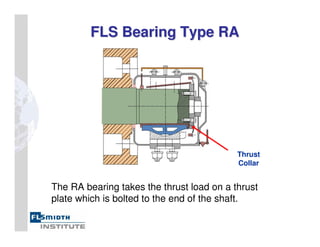
The RA bearing takes the thrust load on a thrust
plate which is bolted to the end of the shaft.
Thrust
Collar
FLS Bearing Type RA
FLS Bearing Type RA
FLS Bearing Type RB
FLS Bearing Type RB
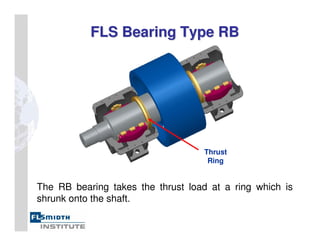
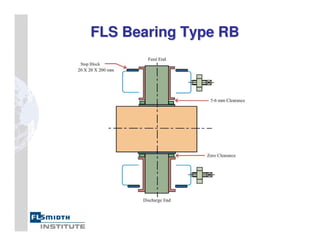
The RB bearing takes the thrust load at a ring which is
shrunk onto the shaft.
Thrust
Ring
FLS Bearing Type RB
FLS Bearing Type RB
Fuller Bearing
Fuller Bearing
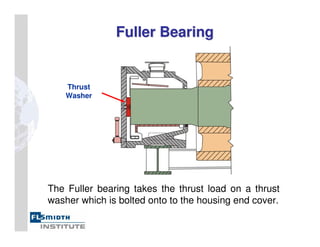
The Fuller bearing takes the thrust load on a thrust
washer which is bolted onto to the housing end cover.
Thrust
Washer
FLS Bearing Type RA
FLS Bearing Type RA
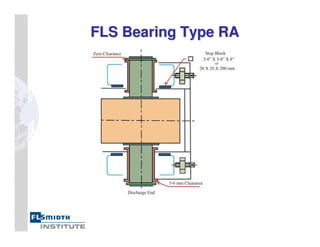
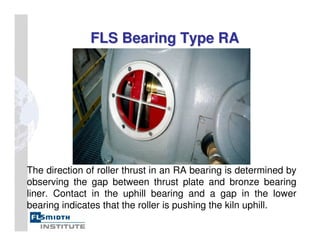
The direction of roller thrust in an RA bearing is determined by
observing the gap between thrust plate and bronze bearing
liner. Contact in the uphill bearing and a gap in the lower
bearing indicates that the roller is pushing the kiln uphill.
FLS Bearing Type RA
FLS Bearing Type RA
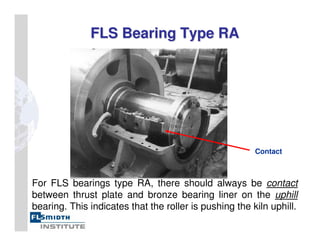
For FLS bearings type RA, there should always be contact
between thrust plate and bronze bearing liner on the uphill
bearing. This indicates that the roller is pushing the kiln uphill.
Contact
FLS Bearing Type RB
FLS Bearing Type RB
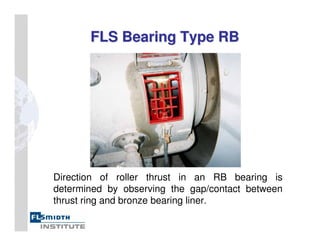
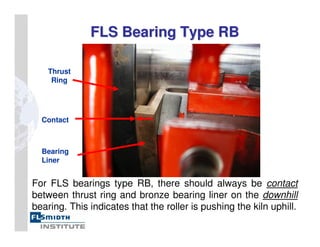
Direction of roller thrust in an RB bearing is
determined by observing the gap/contact between
thrust ring and bronze bearing liner.
FLS Bearing Type RB
FLS Bearing Type RB
For FLS bearings type RB, there should always be contact
between thrust ring and bronze bearing liner on the downhill
bearing. This indicates that the roller is pushing the kiln uphill.
Contact
Thrust
Ring
Bearing
Liner
FLS Bearing Type RB
FLS Bearing Type RB
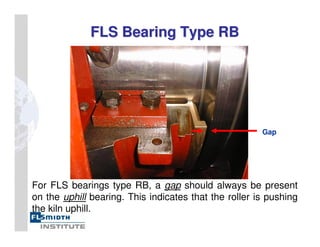
For FLS bearings type RB, a gap should always be present
on the uphill bearing. This indicates that the roller is pushing
the kiln uphill.
Gap
Fuller Bearing
Fuller Bearing
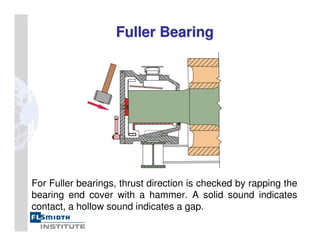
For Fuller bearings, thrust direction is checked by rapping the
bearing end cover with a hammer. A solid sound indicates
contact, a hollow sound indicates a gap.
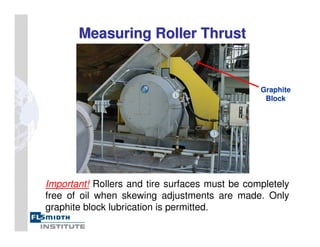
Measuring Roller Thrust
Important! Rollers and tire surfaces must be completely
free of oil when skewing adjustments are made. Only
graphite block lubrication is permitted.
Graphite
Block
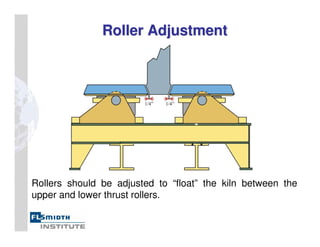
Rollers should be adjusted to “float” the kiln between the
upper and lower thrust rollers.
Roller Adjustment
Roller Adjustment
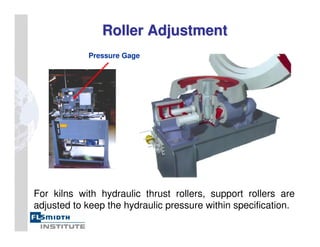
For kilns with hydraulic thrust rollers, support rollers are
adjusted to keep the hydraulic pressure within specification.
Pressure Gage
Roller Adjustment
Roller Adjustment
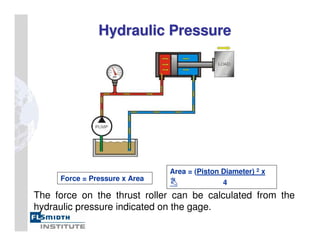
The force on the thrust roller can be calculated from the
hydraulic pressure indicated on the gage.
Hydraulic Pressure
Hydraulic Pressure
Force = Pressure x Area
Area = (Piston Diameter) 2 x
4
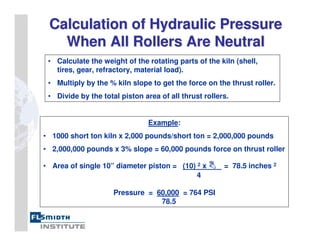
Calculation of Hydraulic Pressure
When All Rollers Are Neutral
• Calculate the weight of the rotating parts of the kiln (shell,
tires, gear, refractory, material load).
• Multiply by the % kiln slope to get the force on the thrust roller.
• Divide by the total piston area of all thrust rollers.
Example:
• 1000 short ton kiln x 2,000 pounds/short ton = 2,000,000 pounds
• 2,000,000 pounds x 3% slope = 60,000 pounds force on thrust roller
• Area of single 10” diameter piston = (10) 2 x = 78.5 inches 2
4
Pressure = 60,000 = 764 PSI
78.5
Roller Adjustment
Roller Adjustment
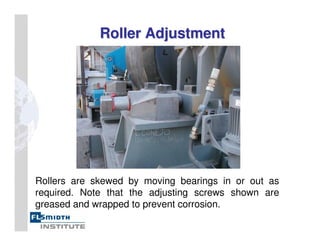
Rollers are skewed by moving bearings in or out as
required. Note that the adjusting screws shown are
greased and wrapped to prevent corrosion.
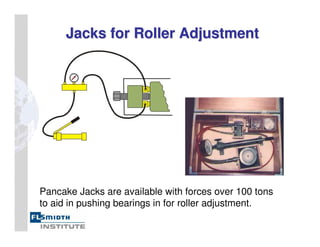
Jacks for Roller Adjustment
Pancake Jacks are available with forces over 100 tons
to aid in pushing bearings in for roller adjustment.
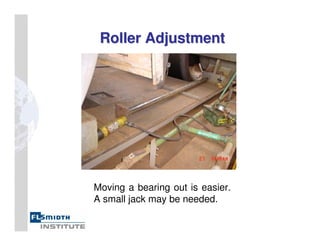
Roller Adjustment
Roller Adjustment
Moving a bearing out is easier.
A small jack may be needed.
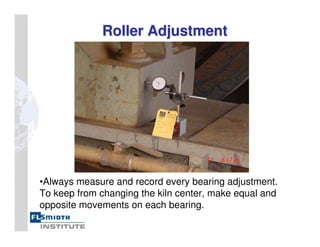
•Always measure and record every bearing adjustment.
To keep from changing the kiln center, make equal and
opposite movements on each bearing.
Roller Adjustment
Roller Adjustment
Measuring Roller Thrust
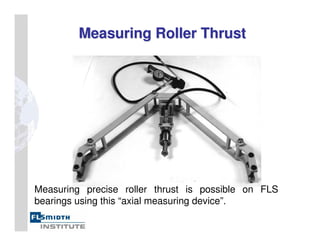
Measuring precise roller thrust is possible on FLS
bearings using this “axial measuring device”.
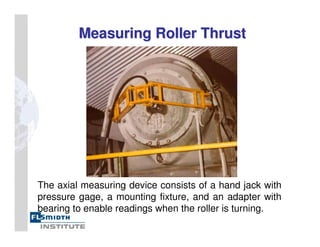
The axial measuring device consists of a hand jack with
pressure gage, a mounting fixture, and an adapter with
bearing to enable readings when the roller is turning.
Measuring Roller Thrust
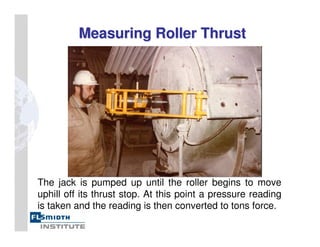
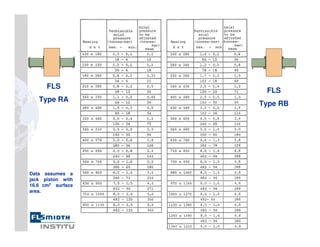
The jack is pumped up until the roller begins to move
uphill off its thrust stop. At this point a pressure reading
is taken and the reading is then converted to tons force.
FLS
Type RB
FLS
Type RA
Data assumes a
jack piston with
16.6 cm2 surface
area.
Measuring Roller Thrust
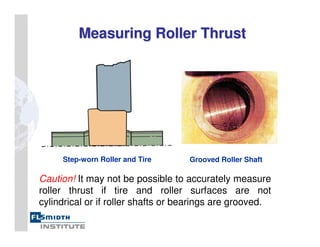
Caution! It may not be possible to accurately measure
roller thrust if tire and roller surfaces are not
cylindrical or if roller shafts or bearings are grooved.
Step-worn Roller and Tire Grooved Roller Shaft
Determining Roller Thrust
Trial and Error Method
Find the roller’s neutral point (parallel to kiln axis)
by adjusting the roller skew in small increments
until the bearing thrust contact/gap changes from
one bearing to the other.
Once the neutral point is determined, make a
small adjustment to push the kiln uphill.
While making an adjustment of an individual roller,
always observe the kiln’s thrust rollers to ensure
that they are not being overloaded.
Roller Inclination
Roller Inclination
Roller Inclination
Roller Inclination
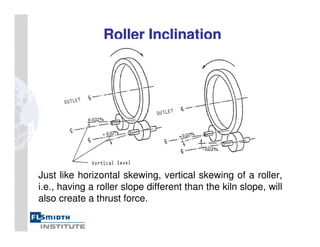
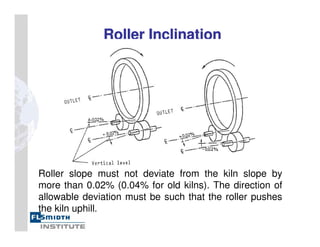
Just like horizontal skewing, vertical skewing of a roller,
i.e., having a roller slope different than the kiln slope, will
also create a thrust force.
Roller Inclination
Roller Inclination
Roller slope must not deviate from the kiln slope by
more than 0.02% (0.04% for old kilns). The direction of
allowable deviation must be such that the roller pushes
the kiln uphill.
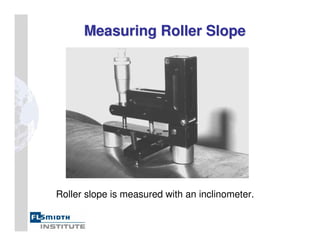
Measuring Roller Slope
Roller slope is measured with an inclinometer.
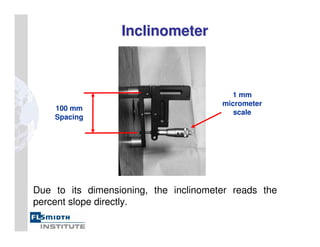
Inclinometer
Inclinometer
100 mm
Spacing
1 mm
micrometer
scale
Due to its dimensioning, the inclinometer reads the
percent slope directly.
Inclinometer
Inclinometer
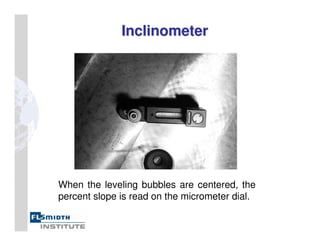
When the leveling bubbles are centered, the
percent slope is read on the micrometer dial.
Inclinometer
Inclinometer
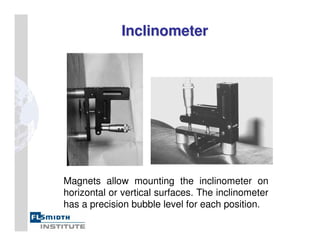
Magnets allow mounting the inclinometer on
horizontal or vertical surfaces. The inclinometer
has a precision bubble level for each position.
Inclinometer
Inclinometer
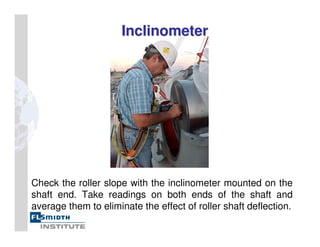
Check the roller slope with the inclinometer mounted on the
shaft end. Take readings on both ends of the shaft and
average them to eliminate the effect of roller shaft deflection.
Inclinometer
Inclinometer
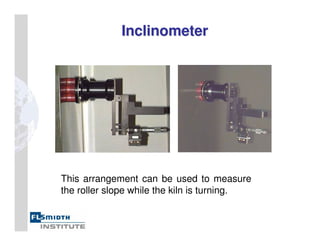
This arrangement can be used to measure
the roller slope while the kiln is turning.
Inclinometer
Inclinometer
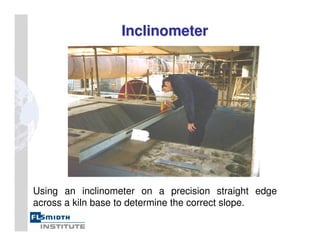
Using an inclinometer on a precision straight edge
across a kiln base to determine the correct slope.
Roller and Tire Defects
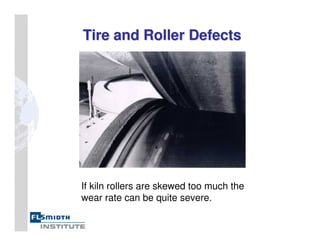
If kiln rollers are skewed too much the
wear rate can be quite severe.
Tire and Roller Defects
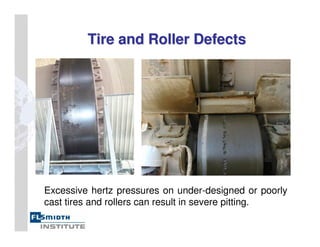
Excessive hertz pressures on under-designed or poorly
cast tires and rollers can result in severe pitting.
Tire and Roller Defects
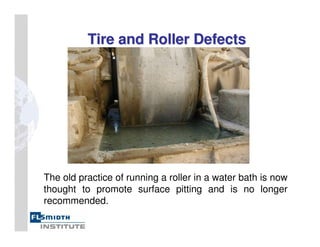
The old practice of running a roller in a water bath is now
thought to promote surface pitting and is no longer
recommended.
Tire and Roller Defects
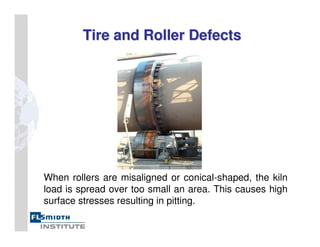
When rollers are misaligned or conical-shaped, the kiln
load is spread over too small an area. This causes high
surface stresses resulting in pitting.
Tire and Roller Defects
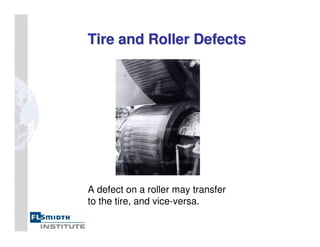
A defect on a roller may transfer
to the tire, and vice-versa.
Tire and Roller Defects
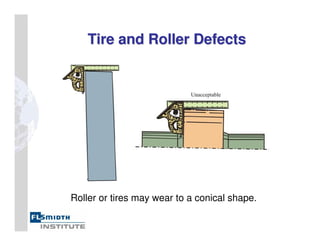
Roller or tires may wear to a conical shape.
Tire and Roller Defects
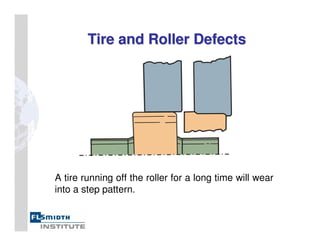
A tire running off the roller for a long time will wear
into a step pattern.
Tire and Roller Defects
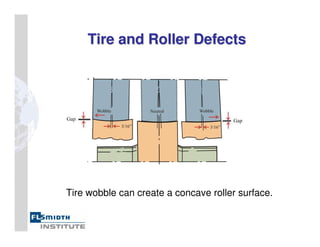
Tire wobble can create a concave roller surface.
Roller and Tire Re
Roller and Tire Re-
-conditioning
conditioning
Roller and Tire Re
Roller and Tire Re-
-conditioning
conditioning
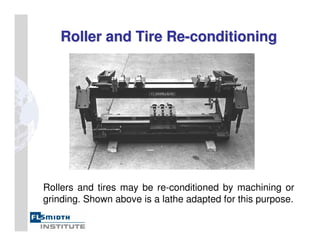
Rollers and tires may be re-conditioned by machining or
grinding. Shown above is a lathe adapted for this purpose.
Roller and Tire Re
Roller and Tire Re-
-conditioning
conditioning
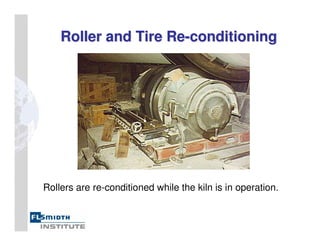
Rollers are re-conditioned while the kiln is in operation.
Roller and Tire Re
Roller and Tire Re-
-conditioning
conditioning
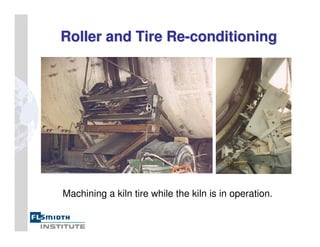
Machining a kiln tire while the kiln is in operation.
Roller and Tire Re
Roller and Tire Re-
-conditioning
conditioning
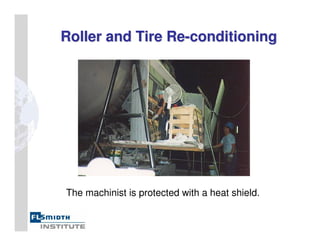
The machinist is protected with a heat shield.
Roller and Tire Re
Roller and Tire Re-
-conditioning
conditioning
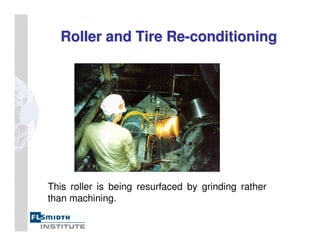
This roller is being resurfaced by grinding rather
than machining.
Roller and Tire Re
Roller and Tire Re-
-conditioning
conditioning
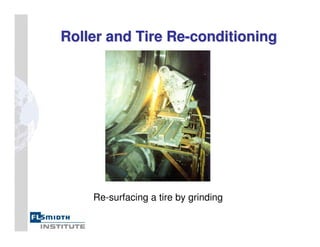
Re-surfacing a tire by grinding
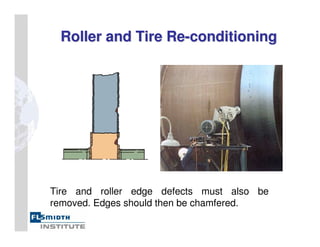
Tire and roller edge defects must also be
removed. Edges should then be chamfered.
Roller and Tire Re
Roller and Tire Re-
-conditioning
conditioning

304372123-4-Kiln-Supports.pdf

  • 1.
    Rotary Kiln Maintenance RotaryKiln Maintenance Seminar Seminar Kiln Supports
  • 2.
    Kiln Supports Kiln Supports Typesof Kiln Supports Roller Adjustments Roller Inclination Roller and Tire Defects Roller and Tire Re- conditioning
  • 3.
    Types of KilnSupports Types of Kiln Supports
  • 4.
    Rigid Kiln Support RigidKiln Support A kiln support consists of two rollers with bearings mounted on a base frame. This rigid support is the most common.
  • 5.
    Tire Roller Bearing Hinge Pivot Point On thissupport the bearings are mounted on a pivoting frame.
  • 6.
    Self Self- -Aligning Aligning Kiln Support KilnSupport A self aligning support maintains continuous contact between tire and roller as the kiln turns. As a result, there is less hertz pressure on the roller and components can be sized more economically. Self-aligning support Traditional Rigid Support
  • 7.
  • 8.
    FLS Kiln SupportType SRB FLS Kiln Support Type SRB
  • 9.
    FLS Kiln SupportType RA FLS Kiln Support Type RA FLS kilns have supports with self aligning bearings in spherical sockets.
  • 10.
    FLS Kiln SupportType RB FLS Kiln Support Type RB The RB support is similar to the RA support, except the bearing takes the thrust load next to the roller on a thrust ring.
  • 11.
    Fuller Kiln Support FullerKiln Support The Fuller support has rigid bearings.
  • 12.
  • 13.
    Axial Forces ona Kiln Axial Forces on a Kiln A kiln on a slope will tend to move downhill as it turns. That downward movement is resisted by both the friction force between rollers and tires, and by the force on the thrust roller. 2 - 4% slope Friction Force Thrust Roller Force Kiln’s Downhill Force
  • 14.
    Roller Friction Force RollerFriction Force When a kiln roller is not exactly parallel to the kiln axis, it imparts an axial thrust force to the kiln. The direction of this force (uphill or downhill) depends on how the roller is skewed, and on the direction of kiln rotation. Neutral Neutral
  • 15.
    Roller Adjustment Roller Adjustment Counter Counter- -ClockwiseKiln Clockwise Kiln To reduce the load on the thrust roller, all rollers should be skewed to push the kiln uphill, never downhill. Shown above are the correct adjustments for a kiln that turns counter- clockwise (looking from the burner floor). Direction of Kiln Thrust
  • 16.
    Roller Adjustment Roller Adjustment ClockwiseKiln Clockwise Kiln Direction of Kiln Thrust These are the correct adjustments for a clockwise turning kiln.
  • 17.
    Roller Adjustment Roller Adjustment Rollerson the discharge pier are often adjusted for neutral thrust. This avoids excessive roller wear caused by dust from the kiln seal. Neutral Neutral Feed End Discharge End
  • 18.
    Good Roller Adjustment GoodRoller Adjustment All Rollers Pushing Uphill All Rollers Pushing Equally Kiln Floating Between Upper and Lower Thrust Rollers (or, correct pressure on hydraulic thrust cylinder)
  • 19.
    Roller Roller - -Tire Forces TireForces When the force on the tire/kiln is uphill, the force on the roller is downhill. The direction of thrust can be determined by observing the contact or gap at the thrust stop inside the bearing. Direction of Kiln Thrust
  • 20.
    Bearing Thrust Arrangements BearingThrust Arrangements FLS Type RA Takes Thrust Load on Thrust Collar FLS Type RB Takes Thrust Load on Thrust Ring Fuller Takes Thrust Load on Thrust Washer Uphill Bearing Downhill Bearing
  • 21.
    Bearing Thrust Arrangements BearingThrust Arrangements FLS Type RA FLS Type RB Fuller Contact Contact Contact Gap Gap Gap Direction of Force on Kiln Direction of Force on Roller
  • 22.
    FLS Bearing TypeRA FLS Bearing Type RA The RA bearing takes the thrust load on a thrust plate which is bolted to the end of the shaft. Thrust Collar
  • 23.
    FLS Bearing TypeRA FLS Bearing Type RA
  • 24.
    FLS Bearing TypeRB FLS Bearing Type RB The RB bearing takes the thrust load at a ring which is shrunk onto the shaft. Thrust Ring
  • 25.
    FLS Bearing TypeRB FLS Bearing Type RB
  • 26.
    Fuller Bearing Fuller Bearing TheFuller bearing takes the thrust load on a thrust washer which is bolted onto to the housing end cover. Thrust Washer
  • 27.
    FLS Bearing TypeRA FLS Bearing Type RA The direction of roller thrust in an RA bearing is determined by observing the gap between thrust plate and bronze bearing liner. Contact in the uphill bearing and a gap in the lower bearing indicates that the roller is pushing the kiln uphill.
  • 28.
    FLS Bearing TypeRA FLS Bearing Type RA For FLS bearings type RA, there should always be contact between thrust plate and bronze bearing liner on the uphill bearing. This indicates that the roller is pushing the kiln uphill. Contact
  • 29.
    FLS Bearing TypeRB FLS Bearing Type RB Direction of roller thrust in an RB bearing is determined by observing the gap/contact between thrust ring and bronze bearing liner.
  • 30.
    FLS Bearing TypeRB FLS Bearing Type RB For FLS bearings type RB, there should always be contact between thrust ring and bronze bearing liner on the downhill bearing. This indicates that the roller is pushing the kiln uphill. Contact Thrust Ring Bearing Liner
  • 31.
    FLS Bearing TypeRB FLS Bearing Type RB For FLS bearings type RB, a gap should always be present on the uphill bearing. This indicates that the roller is pushing the kiln uphill. Gap
  • 32.
    Fuller Bearing Fuller Bearing ForFuller bearings, thrust direction is checked by rapping the bearing end cover with a hammer. A solid sound indicates contact, a hollow sound indicates a gap.
  • 33.
    Measuring Roller Thrust MeasuringRoller Thrust Important! Rollers and tire surfaces must be completely free of oil when skewing adjustments are made. Only graphite block lubrication is permitted. Graphite Block
  • 34.
    Rollers should beadjusted to “float” the kiln between the upper and lower thrust rollers. Roller Adjustment Roller Adjustment
  • 35.
    For kilns withhydraulic thrust rollers, support rollers are adjusted to keep the hydraulic pressure within specification. Pressure Gage Roller Adjustment Roller Adjustment
  • 36.
    The force onthe thrust roller can be calculated from the hydraulic pressure indicated on the gage. Hydraulic Pressure Hydraulic Pressure Force = Pressure x Area Area = (Piston Diameter) 2 x 4
  • 37.
    Calculation of HydraulicPressure Calculation of Hydraulic Pressure When All Rollers Are Neutral When All Rollers Are Neutral • Calculate the weight of the rotating parts of the kiln (shell, tires, gear, refractory, material load). • Multiply by the % kiln slope to get the force on the thrust roller. • Divide by the total piston area of all thrust rollers. Example: • 1000 short ton kiln x 2,000 pounds/short ton = 2,000,000 pounds • 2,000,000 pounds x 3% slope = 60,000 pounds force on thrust roller • Area of single 10” diameter piston = (10) 2 x = 78.5 inches 2 4 Pressure = 60,000 = 764 PSI 78.5
  • 38.
    Roller Adjustment Roller Adjustment Rollersare skewed by moving bearings in or out as required. Note that the adjusting screws shown are greased and wrapped to prevent corrosion.
  • 39.
    Jacks for RollerAdjustment Jacks for Roller Adjustment Pancake Jacks are available with forces over 100 tons to aid in pushing bearings in for roller adjustment.
  • 40.
    Roller Adjustment Roller Adjustment Movinga bearing out is easier. A small jack may be needed.
  • 41.
    •Always measure andrecord every bearing adjustment. To keep from changing the kiln center, make equal and opposite movements on each bearing. Roller Adjustment Roller Adjustment
  • 42.
    Measuring Roller Thrust MeasuringRoller Thrust Measuring precise roller thrust is possible on FLS bearings using this “axial measuring device”.
  • 43.
    The axial measuringdevice consists of a hand jack with pressure gage, a mounting fixture, and an adapter with bearing to enable readings when the roller is turning. Measuring Roller Thrust Measuring Roller Thrust
  • 44.
    Measuring Roller Thrust MeasuringRoller Thrust The jack is pumped up until the roller begins to move uphill off its thrust stop. At this point a pressure reading is taken and the reading is then converted to tons force.
  • 45.
    FLS Type RB FLS Type RA Dataassumes a jack piston with 16.6 cm2 surface area.
  • 46.
    Measuring Roller Thrust MeasuringRoller Thrust Caution! It may not be possible to accurately measure roller thrust if tire and roller surfaces are not cylindrical or if roller shafts or bearings are grooved. Step-worn Roller and Tire Grooved Roller Shaft
  • 47.
    Determining Roller Thrust DeterminingRoller Thrust Trial and Error Method Trial and Error Method Find the roller’s neutral point (parallel to kiln axis) by adjusting the roller skew in small increments until the bearing thrust contact/gap changes from one bearing to the other. Once the neutral point is determined, make a small adjustment to push the kiln uphill. While making an adjustment of an individual roller, always observe the kiln’s thrust rollers to ensure that they are not being overloaded.
  • 48.
  • 49.
    Roller Inclination Roller Inclination Justlike horizontal skewing, vertical skewing of a roller, i.e., having a roller slope different than the kiln slope, will also create a thrust force.
  • 50.
    Roller Inclination Roller Inclination Rollerslope must not deviate from the kiln slope by more than 0.02% (0.04% for old kilns). The direction of allowable deviation must be such that the roller pushes the kiln uphill.
  • 51.
    Measuring Roller Slope MeasuringRoller Slope Roller slope is measured with an inclinometer.
  • 52.
    Inclinometer Inclinometer 100 mm Spacing 1 mm micrometer scale Dueto its dimensioning, the inclinometer reads the percent slope directly.
  • 53.
    Inclinometer Inclinometer When the levelingbubbles are centered, the percent slope is read on the micrometer dial.
  • 54.
    Inclinometer Inclinometer Magnets allow mountingthe inclinometer on horizontal or vertical surfaces. The inclinometer has a precision bubble level for each position.
  • 55.
    Inclinometer Inclinometer Check the rollerslope with the inclinometer mounted on the shaft end. Take readings on both ends of the shaft and average them to eliminate the effect of roller shaft deflection.
  • 56.
    Inclinometer Inclinometer This arrangement canbe used to measure the roller slope while the kiln is turning.
  • 57.
    Inclinometer Inclinometer Using an inclinometeron a precision straight edge across a kiln base to determine the correct slope.
  • 58.
    Roller and TireDefects Roller and Tire Defects
  • 59.
    If kiln rollersare skewed too much the wear rate can be quite severe. Tire and Roller Defects Tire and Roller Defects
  • 60.
    Excessive hertz pressureson under-designed or poorly cast tires and rollers can result in severe pitting. Tire and Roller Defects Tire and Roller Defects
  • 61.
    The old practiceof running a roller in a water bath is now thought to promote surface pitting and is no longer recommended. Tire and Roller Defects Tire and Roller Defects
  • 62.
    Tire and RollerDefects Tire and Roller Defects When rollers are misaligned or conical-shaped, the kiln load is spread over too small an area. This causes high surface stresses resulting in pitting.
  • 63.
    Tire and RollerDefects Tire and Roller Defects A defect on a roller may transfer to the tire, and vice-versa.
  • 64.
    Tire and RollerDefects Tire and Roller Defects Roller or tires may wear to a conical shape.
  • 65.
    Tire and RollerDefects Tire and Roller Defects A tire running off the roller for a long time will wear into a step pattern.
  • 66.
    Tire and RollerDefects Tire and Roller Defects Tire wobble can create a concave roller surface.
  • 67.
    Roller and TireRe Roller and Tire Re- -conditioning conditioning
  • 68.
    Roller and TireRe Roller and Tire Re- -conditioning conditioning Rollers and tires may be re-conditioned by machining or grinding. Shown above is a lathe adapted for this purpose.
  • 69.
    Roller and TireRe Roller and Tire Re- -conditioning conditioning Rollers are re-conditioned while the kiln is in operation.
  • 70.
    Roller and TireRe Roller and Tire Re- -conditioning conditioning Machining a kiln tire while the kiln is in operation.
  • 71.
    Roller and TireRe Roller and Tire Re- -conditioning conditioning The machinist is protected with a heat shield.
  • 72.
    Roller and TireRe Roller and Tire Re- -conditioning conditioning This roller is being resurfaced by grinding rather than machining.
  • 73.
    Roller and TireRe Roller and Tire Re- -conditioning conditioning Re-surfacing a tire by grinding
  • 74.
    Tire and rolleredge defects must also be removed. Edges should then be chamfered. Roller and Tire Re Roller and Tire Re- -conditioning conditioning