
Timing and synchronization for 5G over optical networks
March 2022 , Nir Laufer, VP and PLM, Oscilloquartz, ADVA
Sub 100ns accuracy at cell sites over commercial WDM networks
© 2022 ADVA. All rights reserved.
2
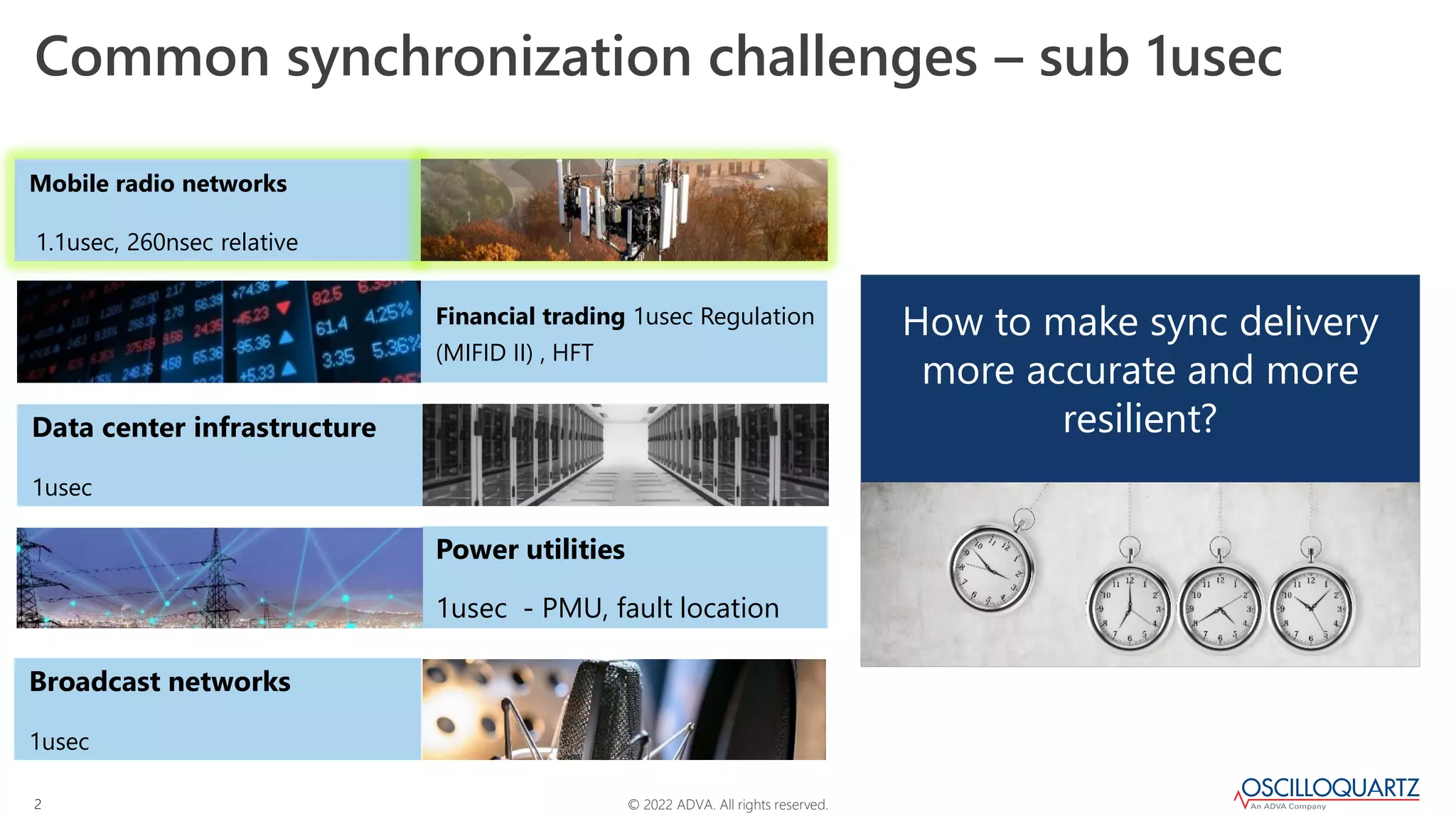
Common synchronization challenges – sub 1usec
Mobile radio networks
1.1usec, 260nsec relative
Financial trading 1usec Regulation
(MIFID II) , HFT
Power utilities
1usec - PMU, fault location
Data center infrastructure
1usec
Broadcast networks
1usec
How to make sync delivery
more accurate and more
resilient?
© 2022 ADVA. All rights reserved.
3
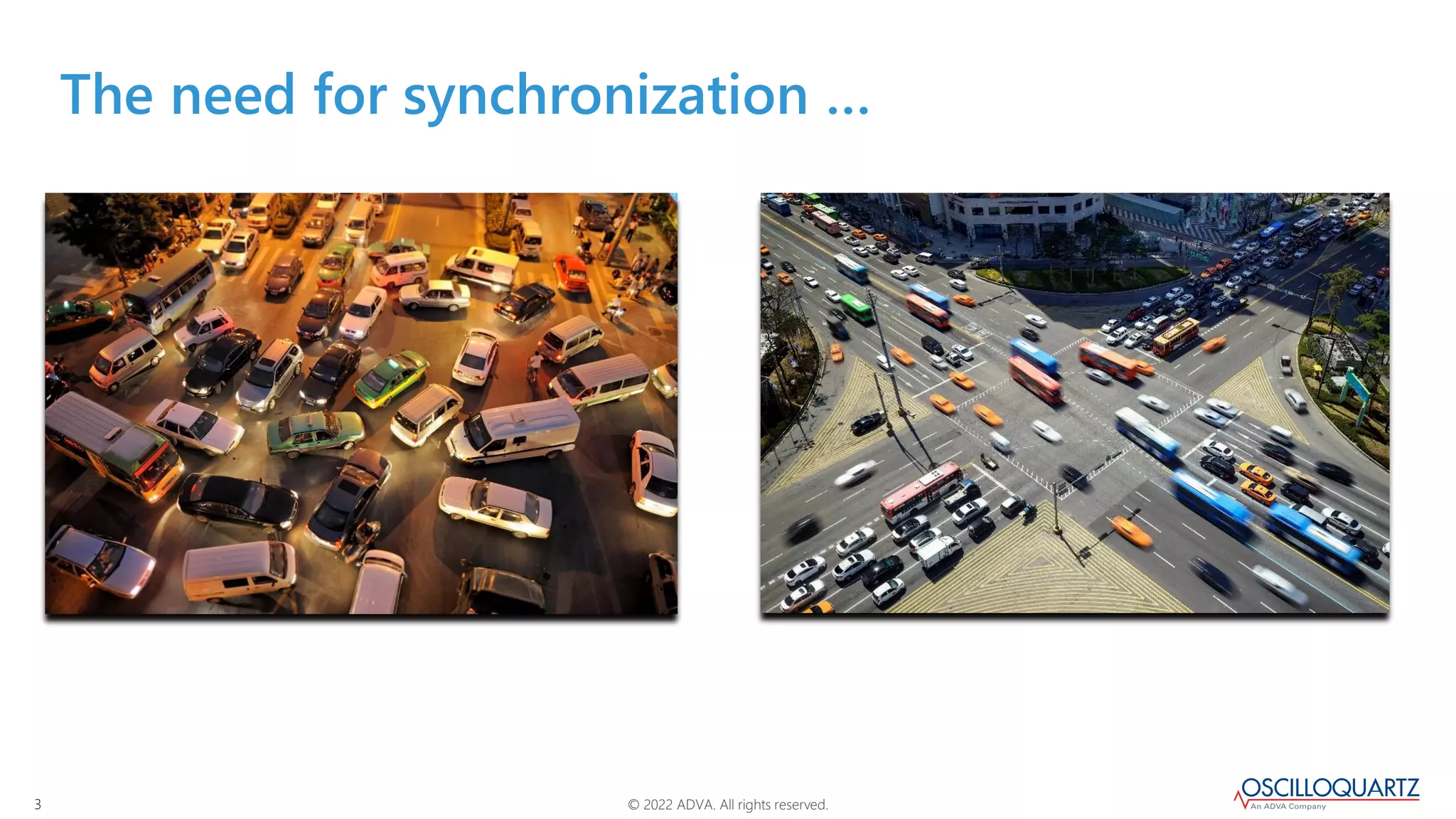
The need for synchronization …
© 2022 ADVA. All rights reserved.
4
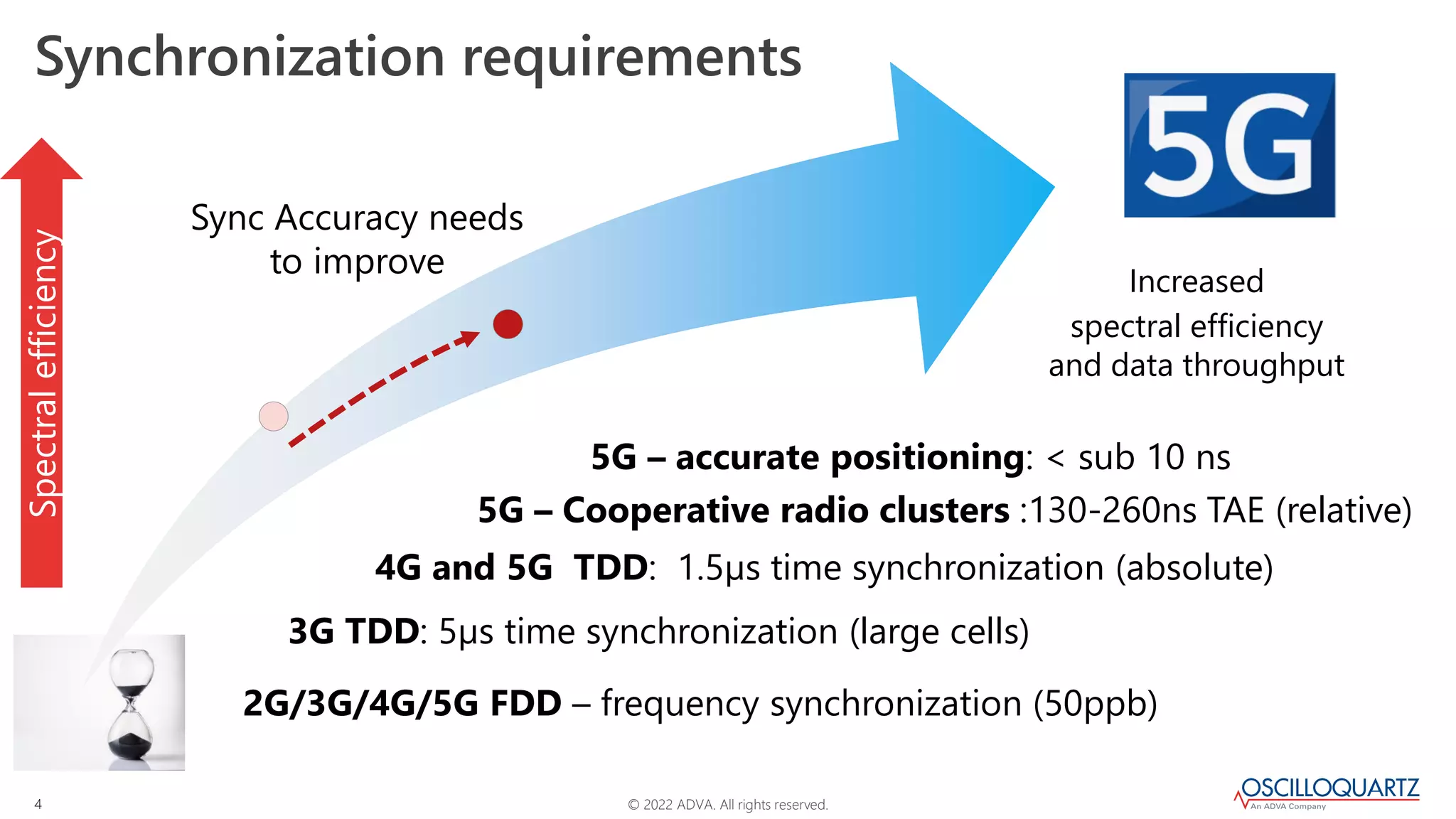
Synchronization requirements
2G/3G/4G/5G FDD – frequency synchronization (50ppb)
3G TDD: 5µs time synchronization (large cells)
4G and 5G TDD: 1.5µs time synchronization (absolute)
5G – accurate positioning: < sub 10 ns
5G – Cooperative radio clusters :130-260ns TAE (relative)
Sync Accuracy needs
to improve
Spectral
efficiency
Increased
spectral efficiency
and data throughput
© 2022 ADVA. All rights reserved.
5
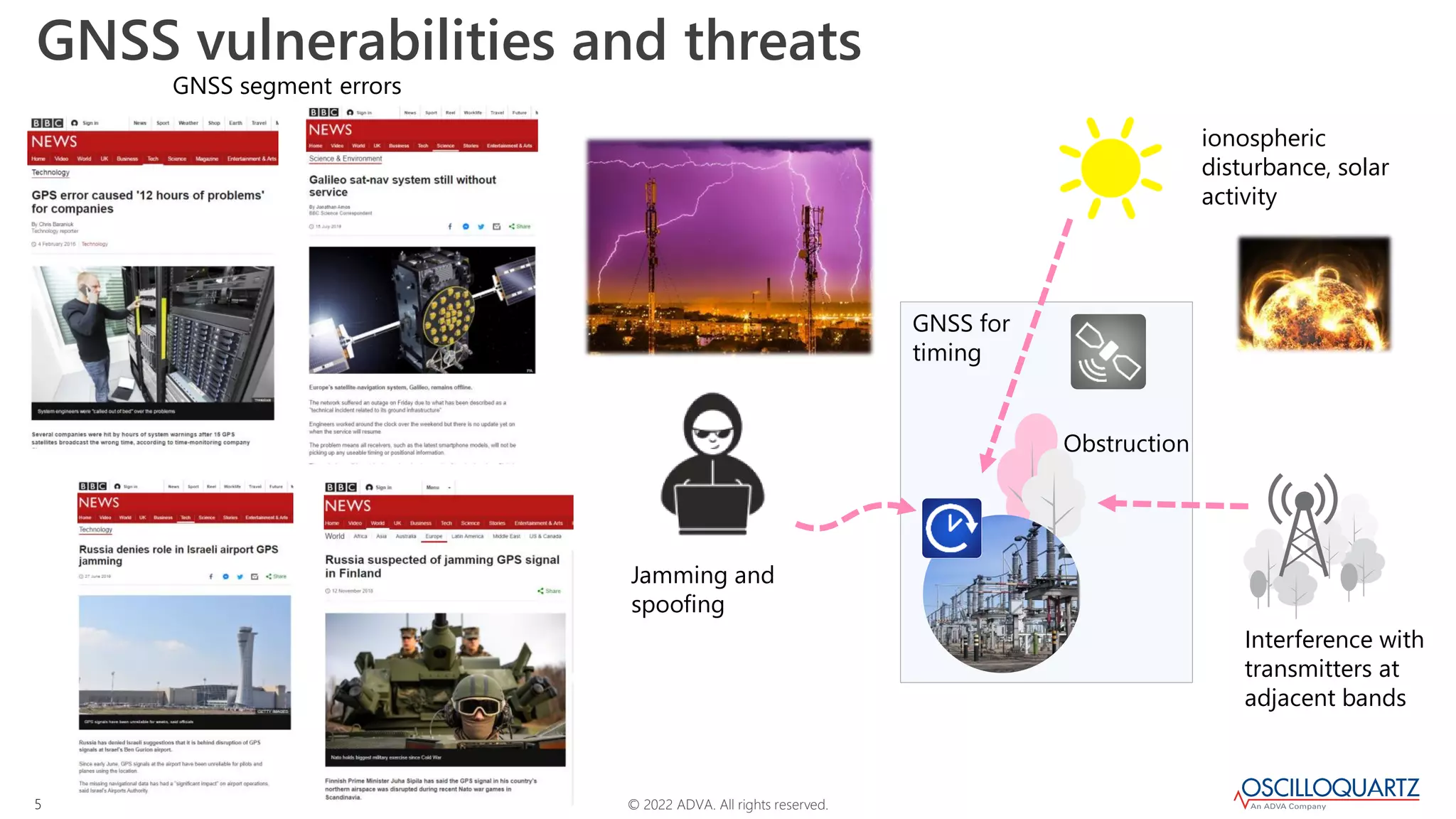
GNSS vulnerabilities and threats
GNSS for
timing
Jamming and
spoofing
Obstruction
Interference with
transmitters at
adjacent bands
ionospheric
disturbance, solar
activity
GNSS segment errors
© 2022 ADVA. All rights reserved.
6
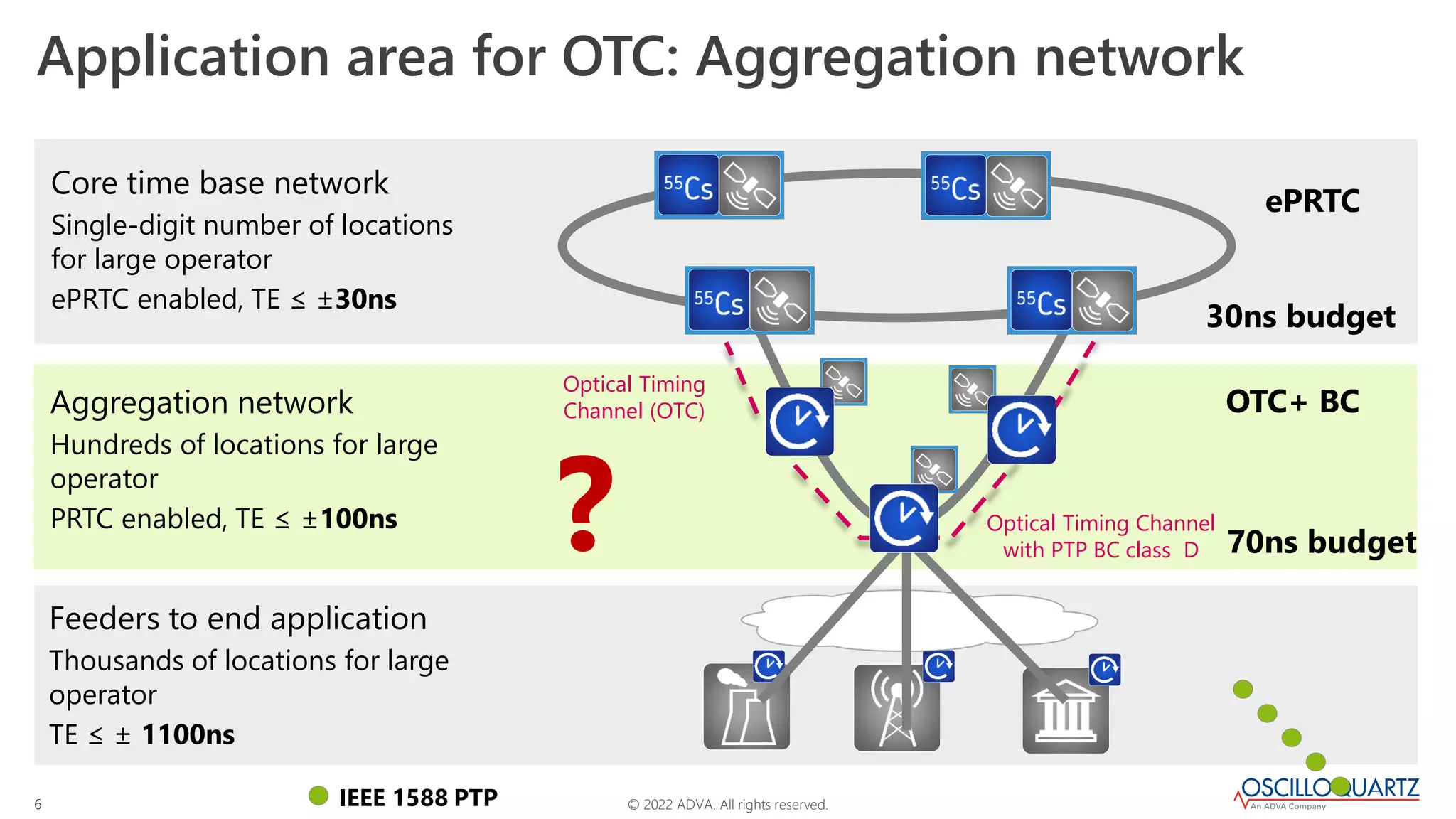
Application area for OTC: Aggregation network
Core time base network
Single-digit number of locations
for large operator
ePRTC enabled, TE ≤ ±30ns
Aggregation network
Hundreds of locations for large
operator
PRTC enabled, TE ≤ ±100ns
Feeders to end application
Thousands of locations for large
operator
TE ≤ ± 1100ns
Optical Timing
Channel (OTC)
Optical Timing Channel
with PTP BC class D 70ns budget
ePRTC
30ns budget
IEEE 1588 PTP
OTC+ BC
?
© 2022 ADVA. All rights reserved.
7
Cesium clock as time source
PRC (G.811)
Frequency
PRC : Cs or GNSS
NE NE NE
PRTC (G.8272)
Frequency + Phase
PRTC : GNSS
NE NE NE
ePRTC (G.8272.1)
Frequency + Phase
GNSS
NE NE NE
Cs
Combiner
SSU Packet Master Clock Packet Master Clock
Sync
Network
Sync
Network
Sync
Network
SSU Packet Slave Clock Packet Slave Clock
Cs as backup
© 2022 ADVA. All rights reserved.
8
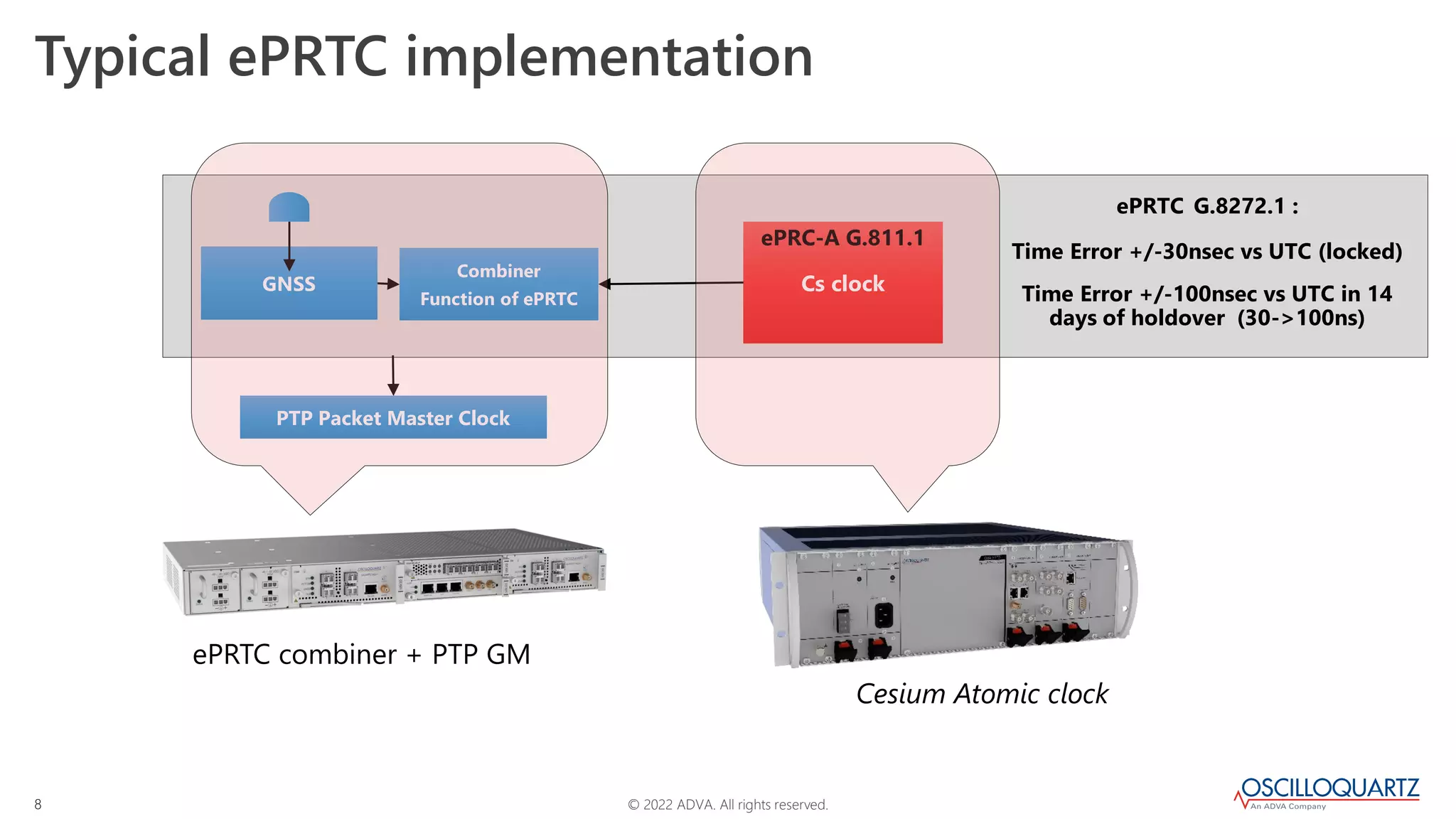
Typical ePRTC implementation
ePRTC G.8272.1 :
Time Error +/-30nsec vs UTC (locked)
Time Error +/-100nsec vs UTC in 14
days of holdover (30->100ns)
GNSS Cs clock
Combiner
Function of ePRTC
ePRC-A G.811.1
Cesium Atomic clock
PTP Packet Master Clock
ePRTC combiner + PTP GM
© 2022 ADVA. All rights reserved.
9
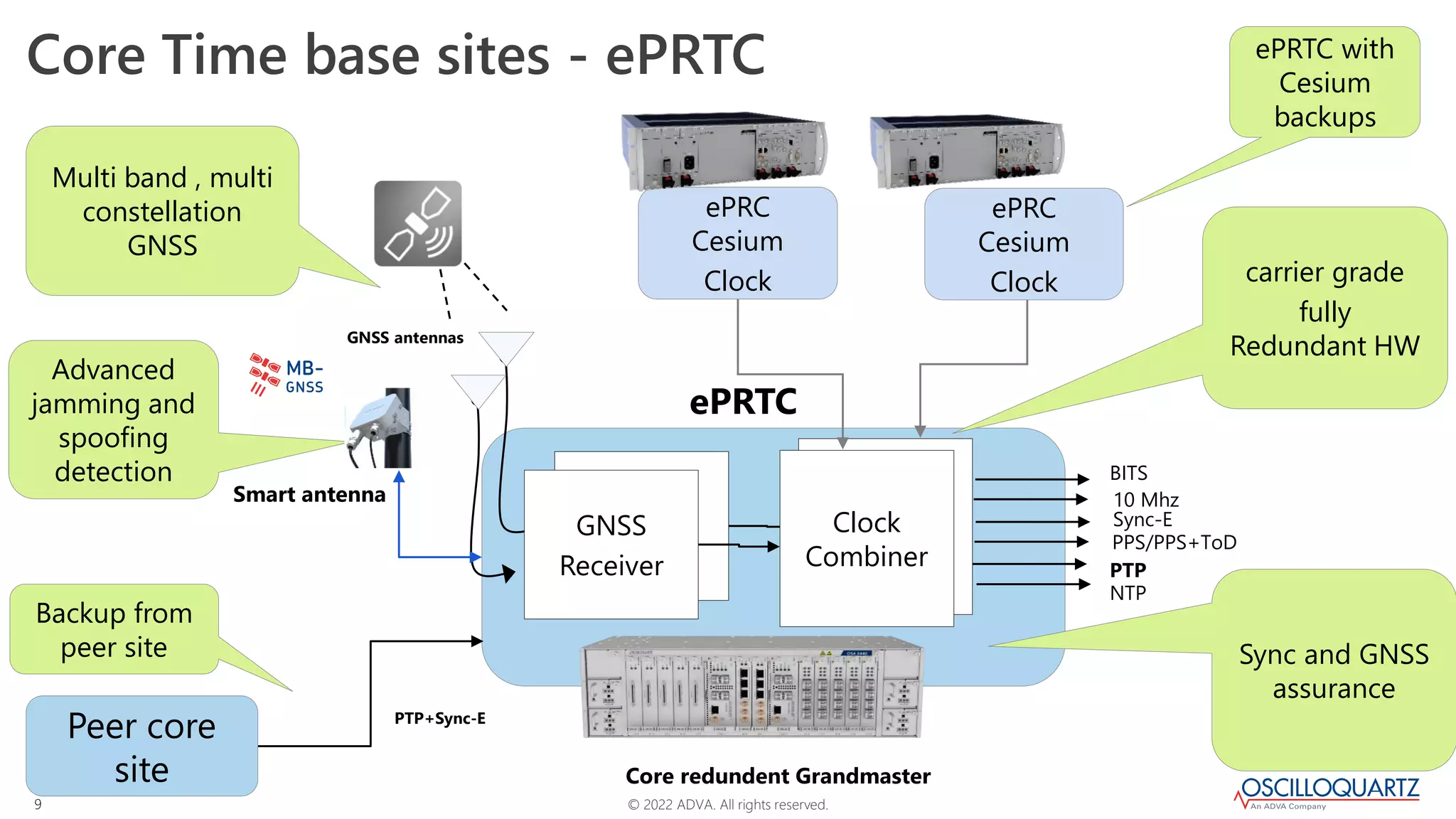
Core Time base sites - ePRTC
GNSS
Receiver
Clock
Combiner PPS/PPS+ToD
GNSS antennas
Core redundent Grandmaster
10 Mhz
BITS
Sync-E
PTP
NTP
Clock
Combiner
GNSS
Receiver
carrier grade
fully
Redundant HW
Multi band , multi
constellation
GNSS
PTP+Sync-E
Backup from
peer site
Peer core
site
ePRTC with
Cesium
backups
Smart antenna
Sync and GNSS
assurance
Advanced
jamming and
spoofing
detection
ePRTC
ePRC
Cesium
Clock
ePRC
Cesium
Clock
© 2022 ADVA. All rights reserved.
10
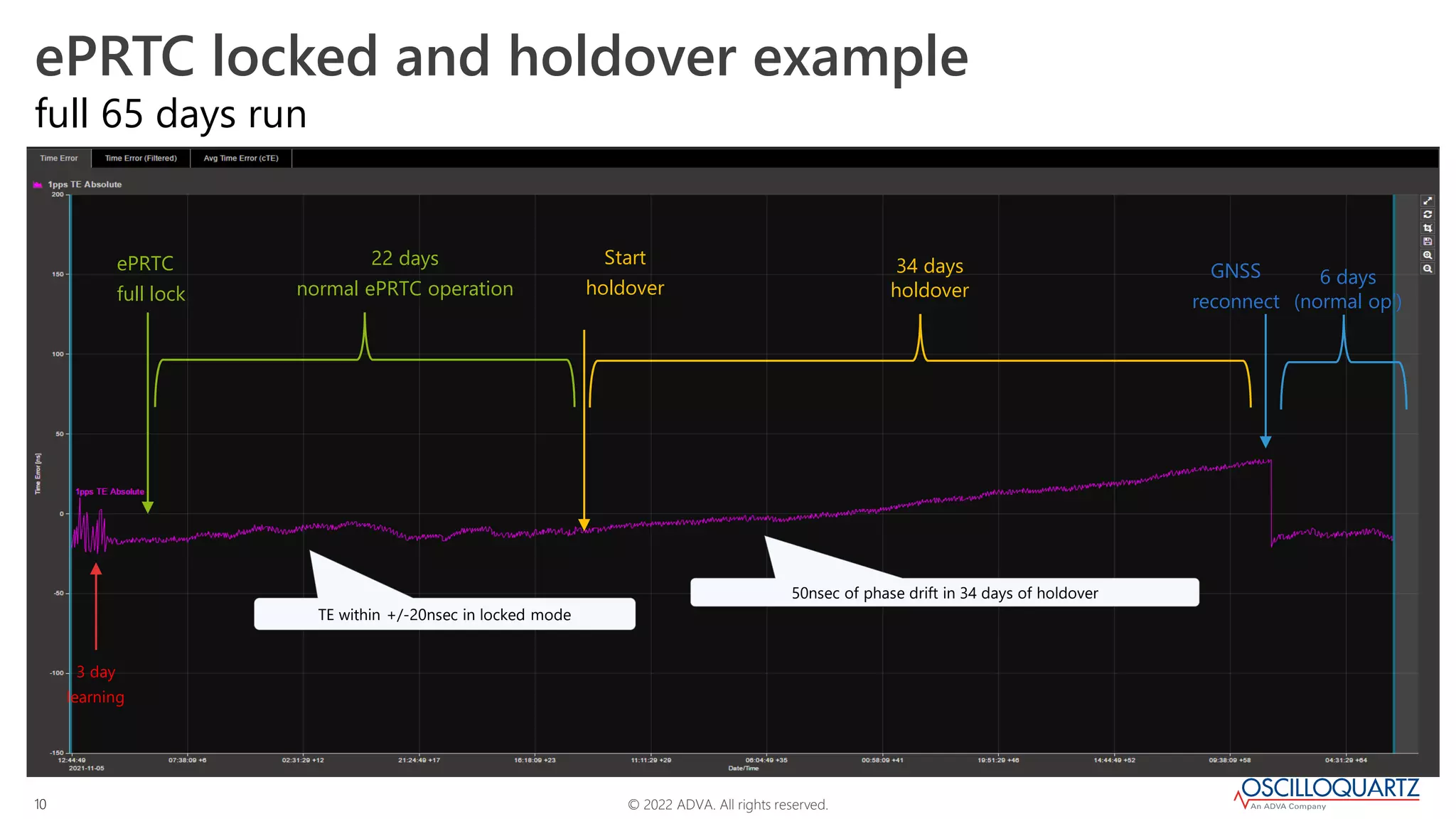
ePRTC locked and holdover example
full 65 days run
ePRTC
full lock
3 day
learning
Start
holdover
34 days
holdover
22 days
normal ePRTC operation
GNSS
reconnect
6 days
(normal op’)
TE within +/-20nsec in locked mode
50nsec of phase drift in 34 days of holdover
© 2022 ADVA. All rights reserved.
11
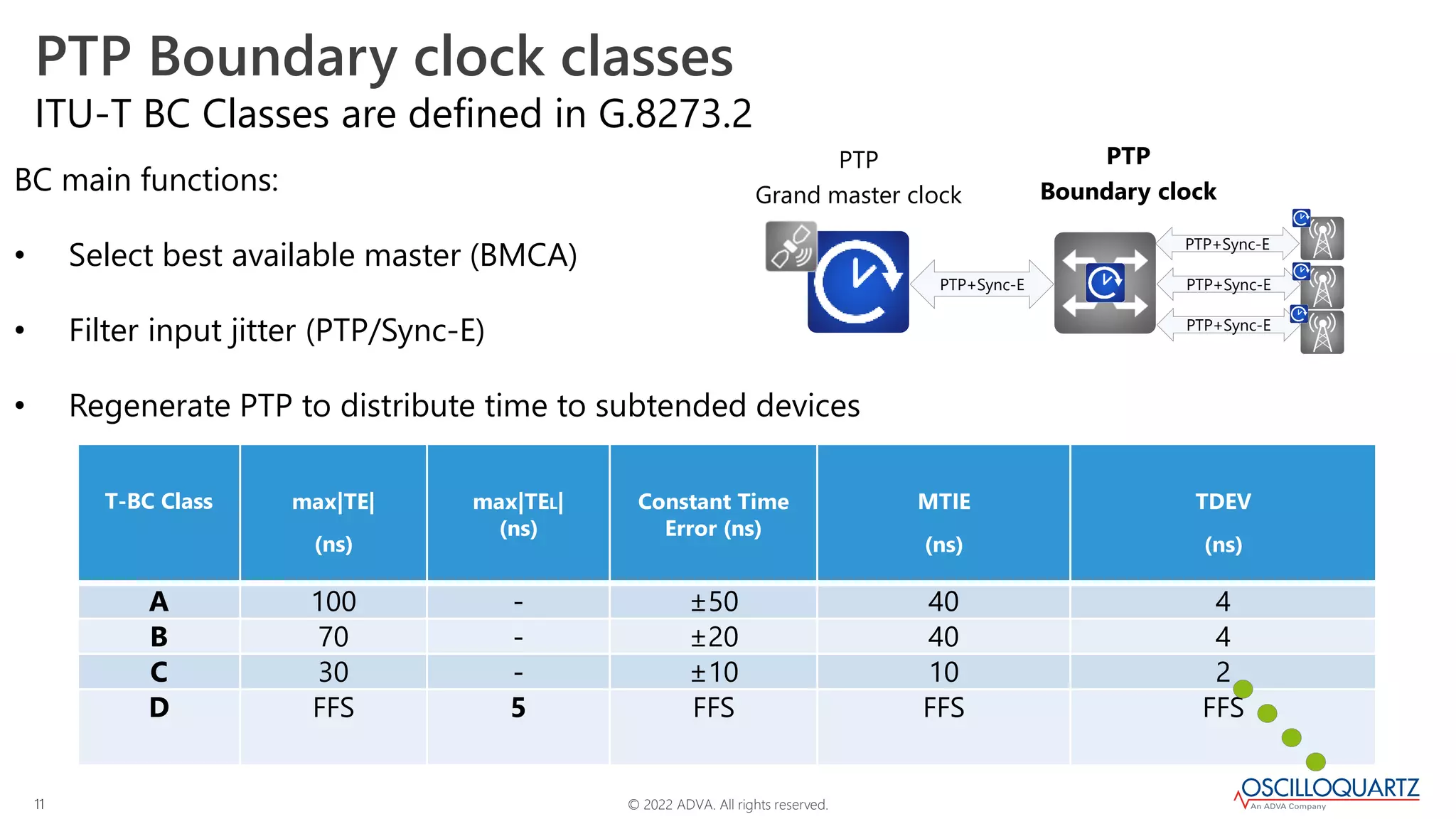
ITU-T BC Classes are defined in G.8273.2
PTP Boundary clock classes
T-BC Class max|TE|
(ns)
max|TEL|
(ns)
Constant Time
Error (ns)
MTIE
(ns)
TDEV
(ns)
A 100 - ±50 40 4
B 70 - ±20 40 4
C 30 - ±10 10 2
D FFS 5 FFS FFS FFS
PTP
Boundary clock
PTP+Sync-E
PTP
Grand master clock
PTP+Sync-E
PTP+Sync-E
PTP+Sync-E
BC main functions:
• Select best available master (BMCA)
• Filter input jitter (PTP/Sync-E)
• Regenerate PTP to distribute time to subtended devices
© 2022 ADVA. All rights reserved.
12
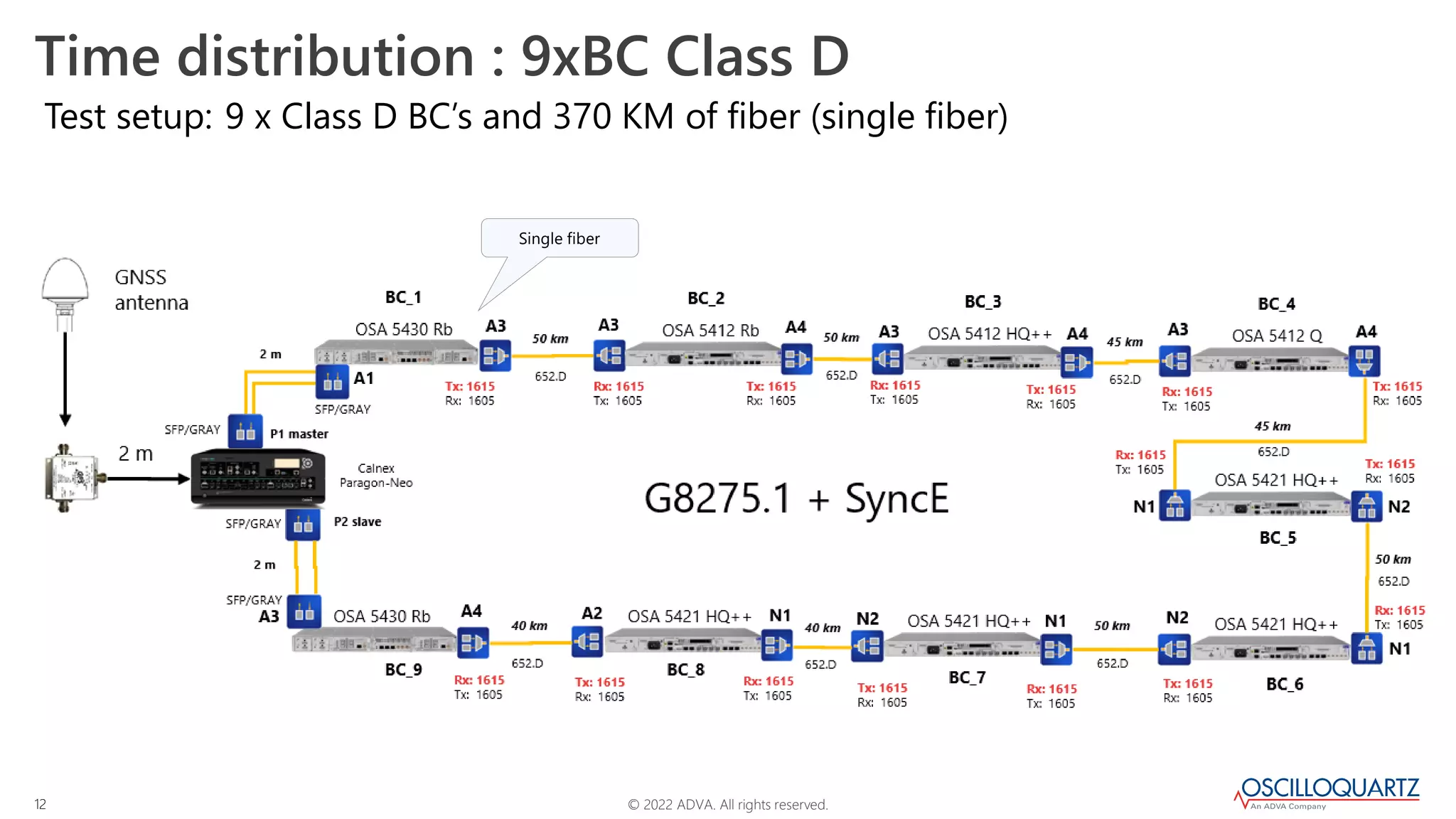
Time distribution : 9xBC Class D
Test setup: 9 x Class D BC’s and 370 KM of fiber (single fiber)
Single fiber
© 2022 ADVA. All rights reserved.
13
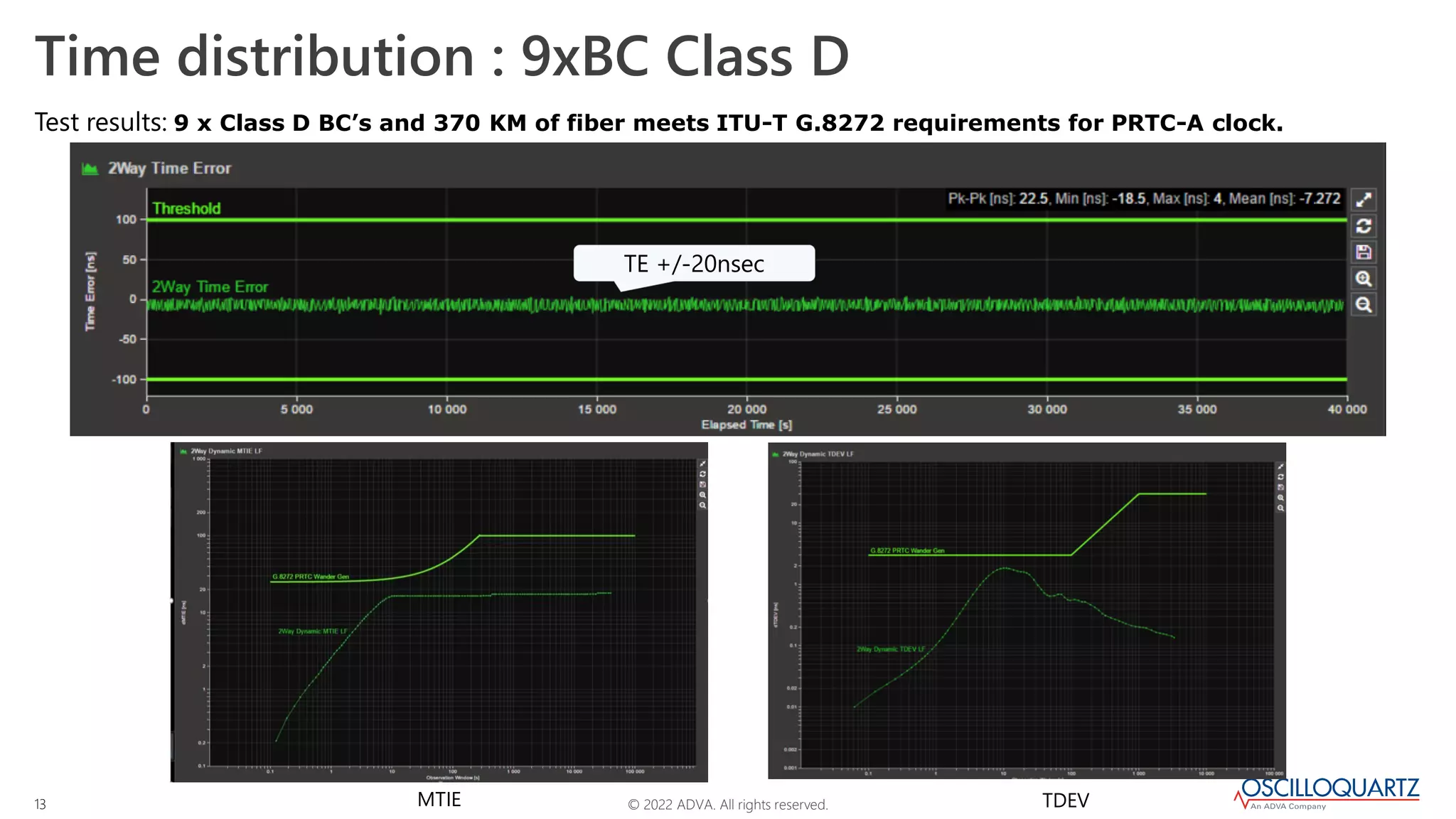
Time distribution : 9xBC Class D
Test results: 9 x Class D BC’s and 370 KM of fiber meets ITU-T G.8272 requirements for PRTC-A clock.
TE +/-20nsec
MTIE TDEV
© 2022 ADVA. All rights reserved.
14
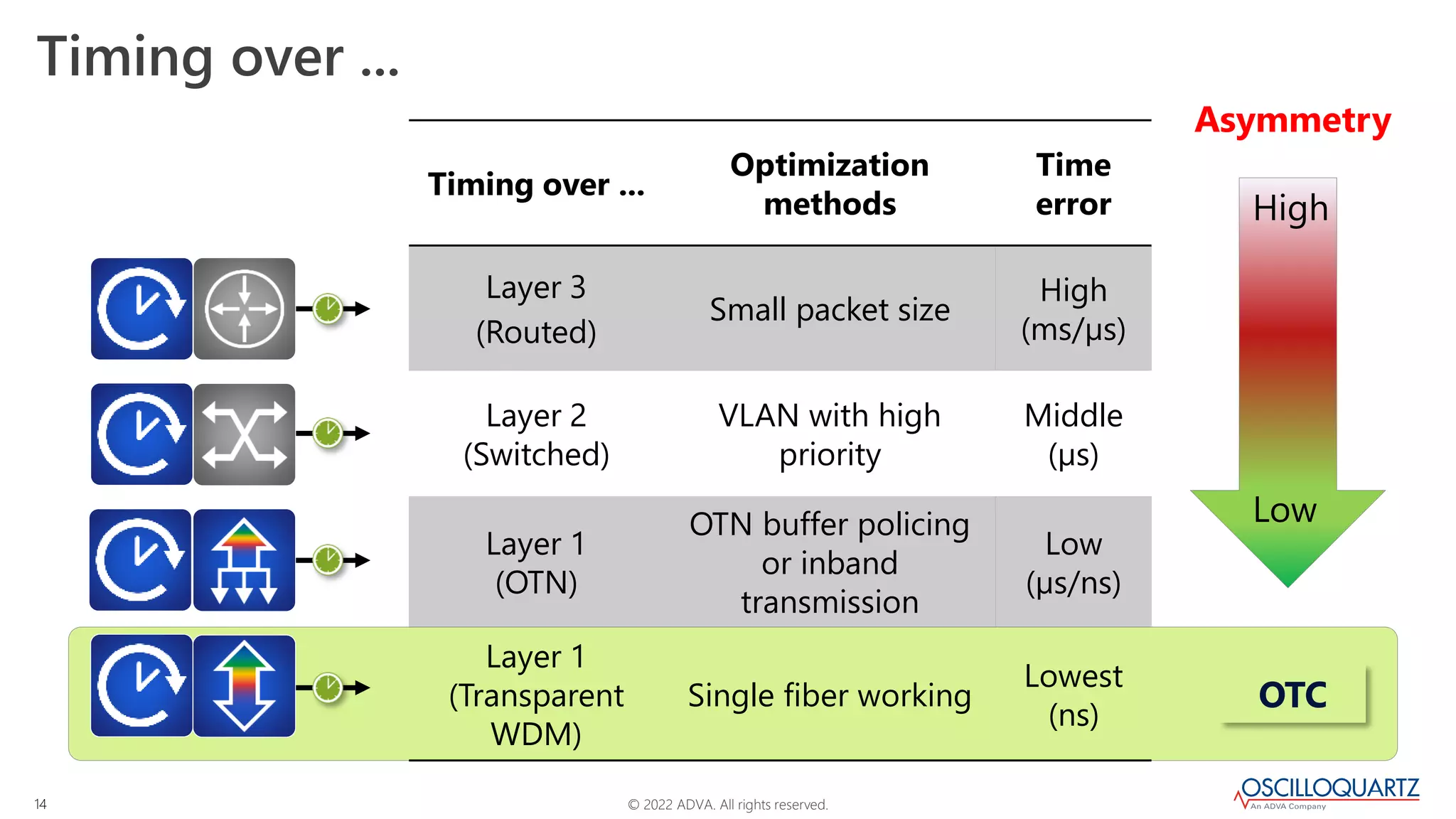
OTC
Timing over ...
Timing over ...
Optimization
methods
Time
error
Layer 3
(Routed)
Small packet size
High
(ms/µs)
Layer 2
(Switched)
VLAN with high
priority
Middle
(µs)
Layer 1
(OTN)
OTN buffer policing
or inband
transmission
Low
(µs/ns)
Layer 1
(Transparent
WDM)
Single fiber working
Lowest
(ns)
Asymmetry
High
Low
© 2022 ADVA. All rights reserved.
15
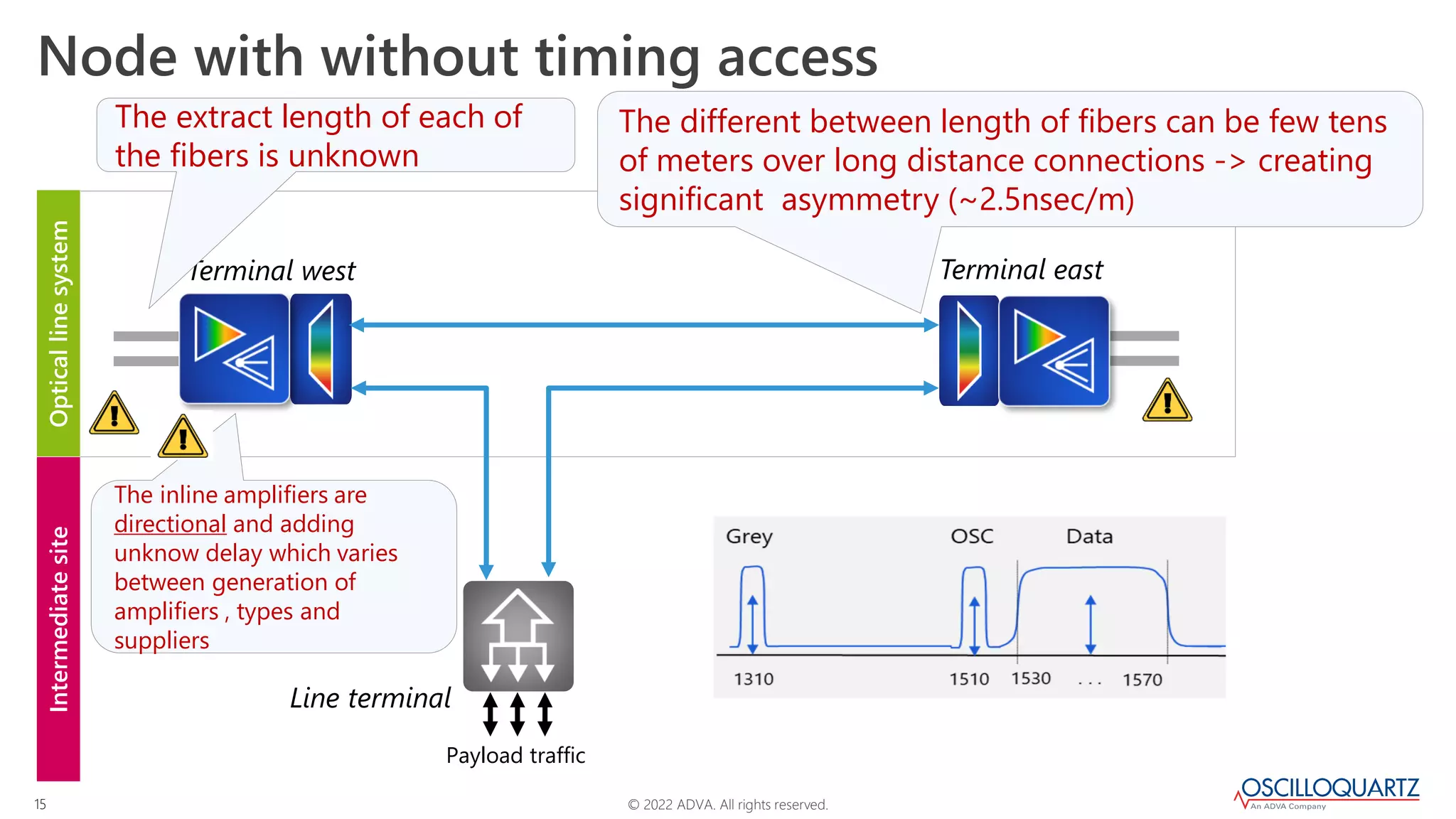
Optical
line
system
Intermediate
site
Node with without timing access
Terminal west Terminal east
Payload traffic
Line terminal
The extract length of each of
the fibers is unknown
The different between length of fibers can be few tens
of meters over long distance connections -> creating
significant asymmetry (~2.5nsec/m)
The inline amplifiers are
directional and adding
unknow delay which varies
between generation of
amplifiers , types and
suppliers
© 2022 ADVA. All rights reserved.
16
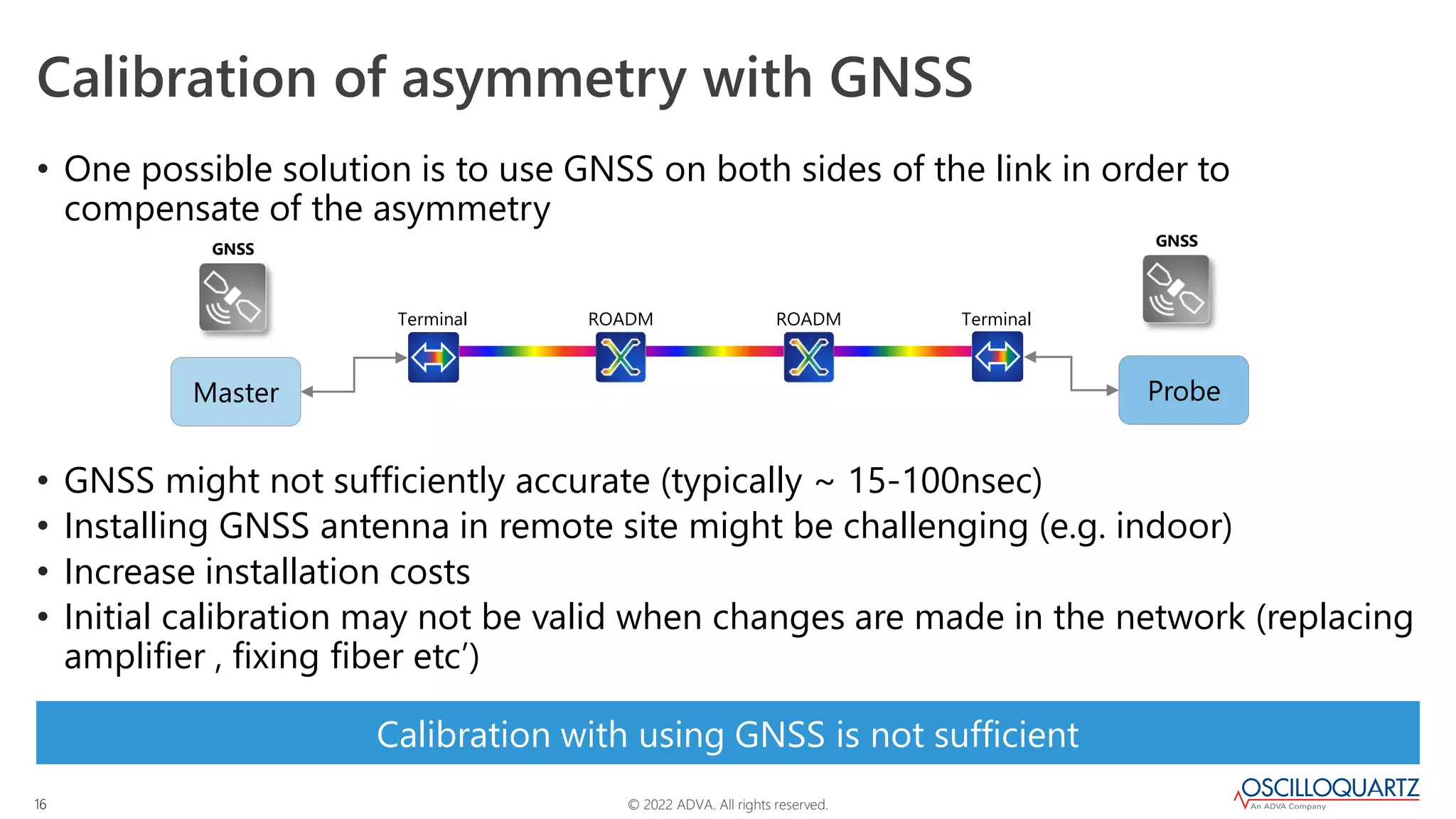
Calibration of asymmetry with GNSS
Calibration with using GNSS is not sufficient
• One possible solution is to use GNSS on both sides of the link in order to
compensate of the asymmetry
• GNSS might not sufficiently accurate (typically ~ 15-100nsec)
• Installing GNSS antenna in remote site might be challenging (e.g. indoor)
• Increase installation costs
• Initial calibration may not be valid when changes are made in the network (replacing
amplifier , fixing fiber etc’)
Terminal Terminal
ROADM ROADM
GNSS
Master Probe
GNSS
© 2022 ADVA. All rights reserved.
17
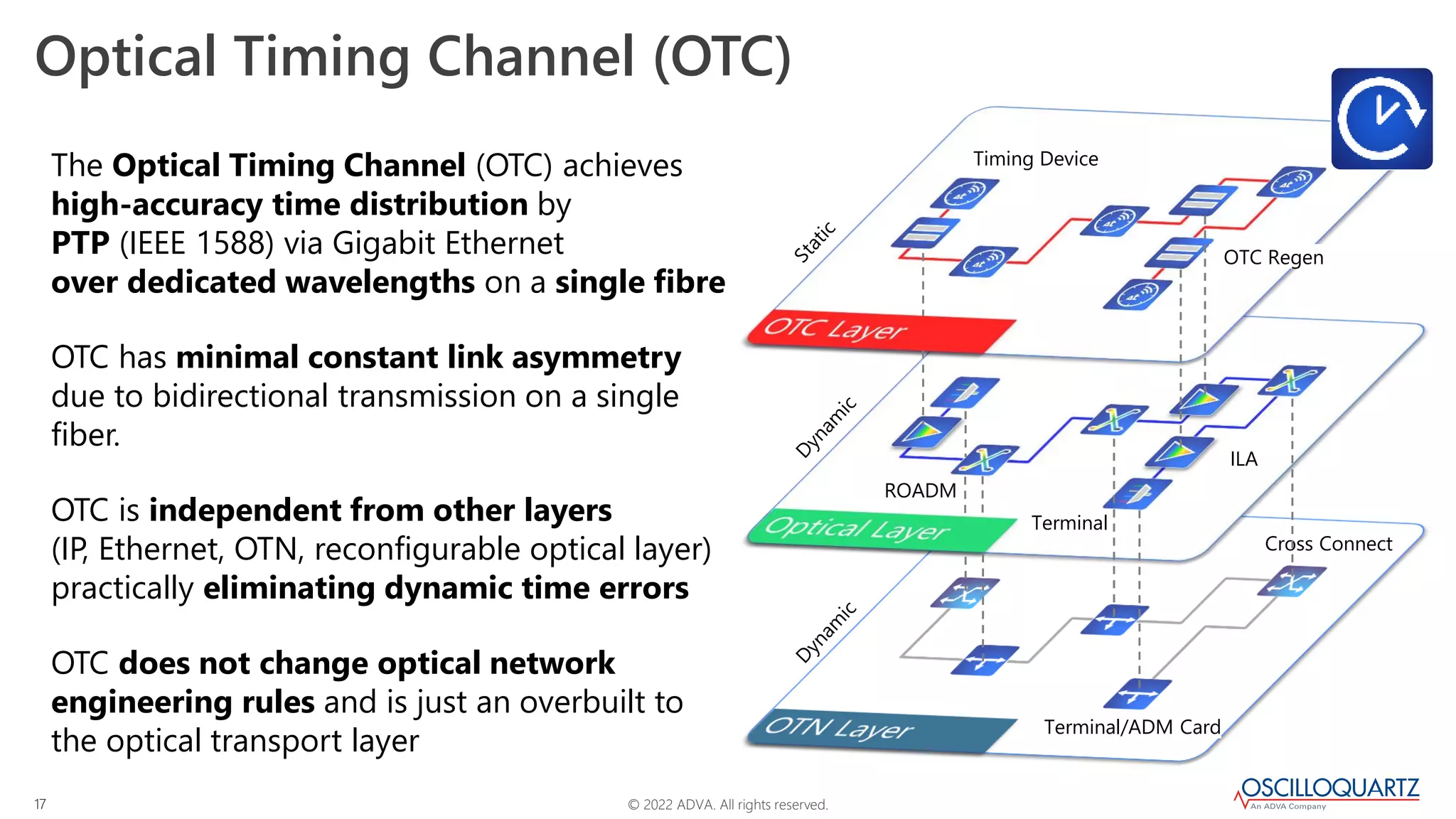
Timing Device
OTC Regen
ILA
ROADM
Terminal
Cross Connect
Terminal/ADM Card
Optical Timing Channel (OTC)
The Optical Timing Channel (OTC) achieves
high-accuracy time distribution by
PTP (IEEE 1588) via Gigabit Ethernet
over dedicated wavelengths on a single fibre
OTC has minimal constant link asymmetry
due to bidirectional transmission on a single
fiber.
OTC is independent from other layers
(IP, Ethernet, OTN, reconfigurable optical layer)
practically eliminating dynamic time errors
OTC does not change optical network
engineering rules and is just an overbuilt to
the optical transport layer
© 2022 ADVA. All rights reserved.
18
Optical
line
system
Intermediate
site
Node with timing access
Terminal west Terminal east
PTP over optical timing channel
Payload traffic
Timing device featuring
High accuracy PTP
boundary clock type D
BiDi transceivers
OTC provides ample optical budget:
Up to 30dB between two BiDi transceivers
Dispersion is irrelevant at GbE line rate
Line terminal
© 2022 ADVA. All rights reserved.
19
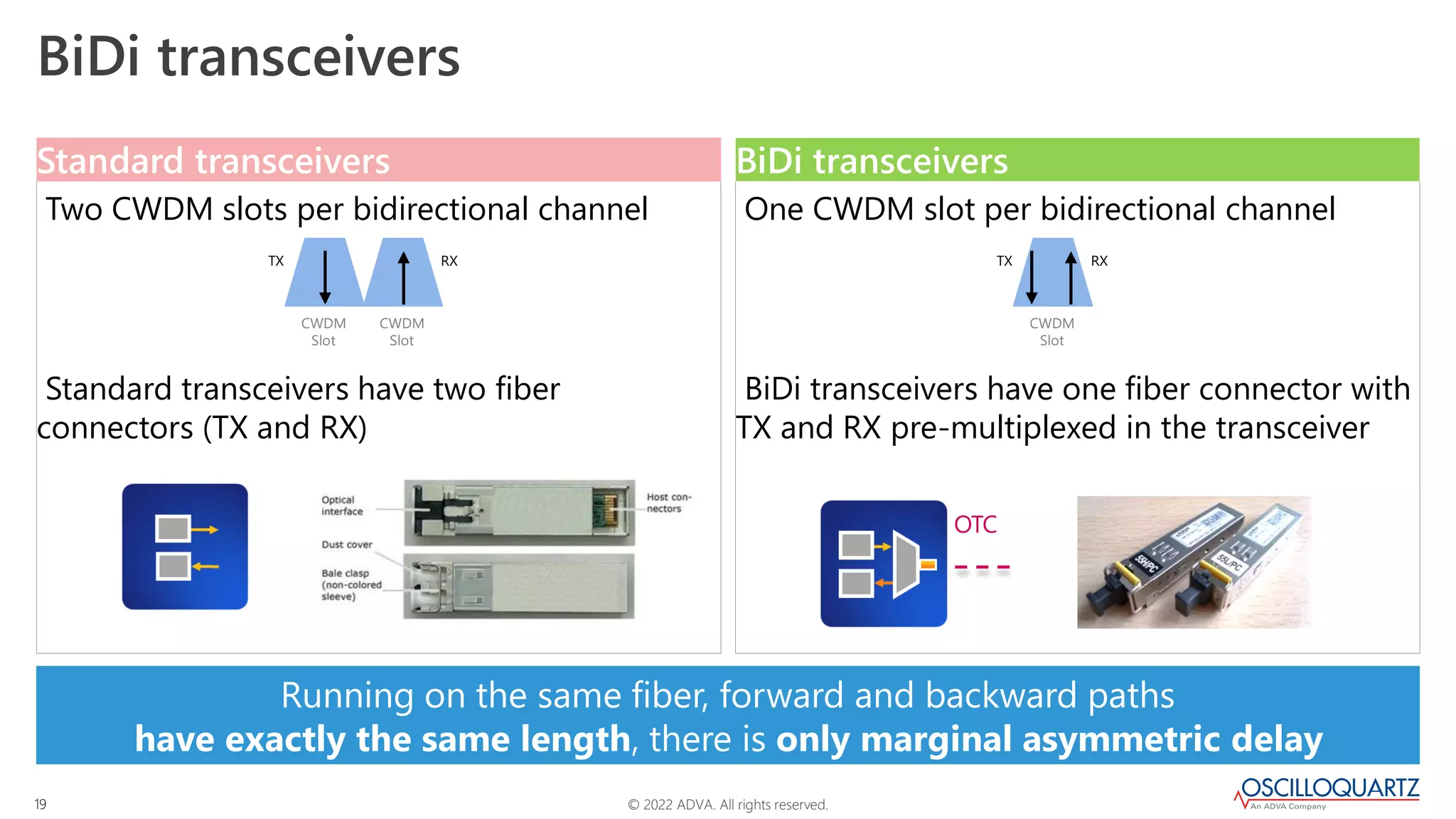
Two CWDM slots per bidirectional channel
Standard transceivers have two fiber
connectors (TX and RX)
One CWDM slot per bidirectional channel
BiDi transceivers have one fiber connector with
TX and RX pre-multiplexed in the transceiver
BiDi transceivers
Standard transceivers
Running on the same fiber, forward and backward paths
have exactly the same length, there is only marginal asymmetric delay
BiDi transceivers
CWDM
Slot
TX
CWDM
Slot
RX
CWDM
Slot
TX RX
OTC
© 2022 ADVA. All rights reserved.
20
Optical
line
system
Intermediate
site
Node with timing access
Redundant OTC
Terminal West Terminal East
PTP over
Optical Timing Channel
Anticlockwise
PTP over Optical Timing Channel
Clockwise
Two redundant
OTCs running on
two fibres
OTC
Regen
T-BC
T-BC
T-GM T-GM
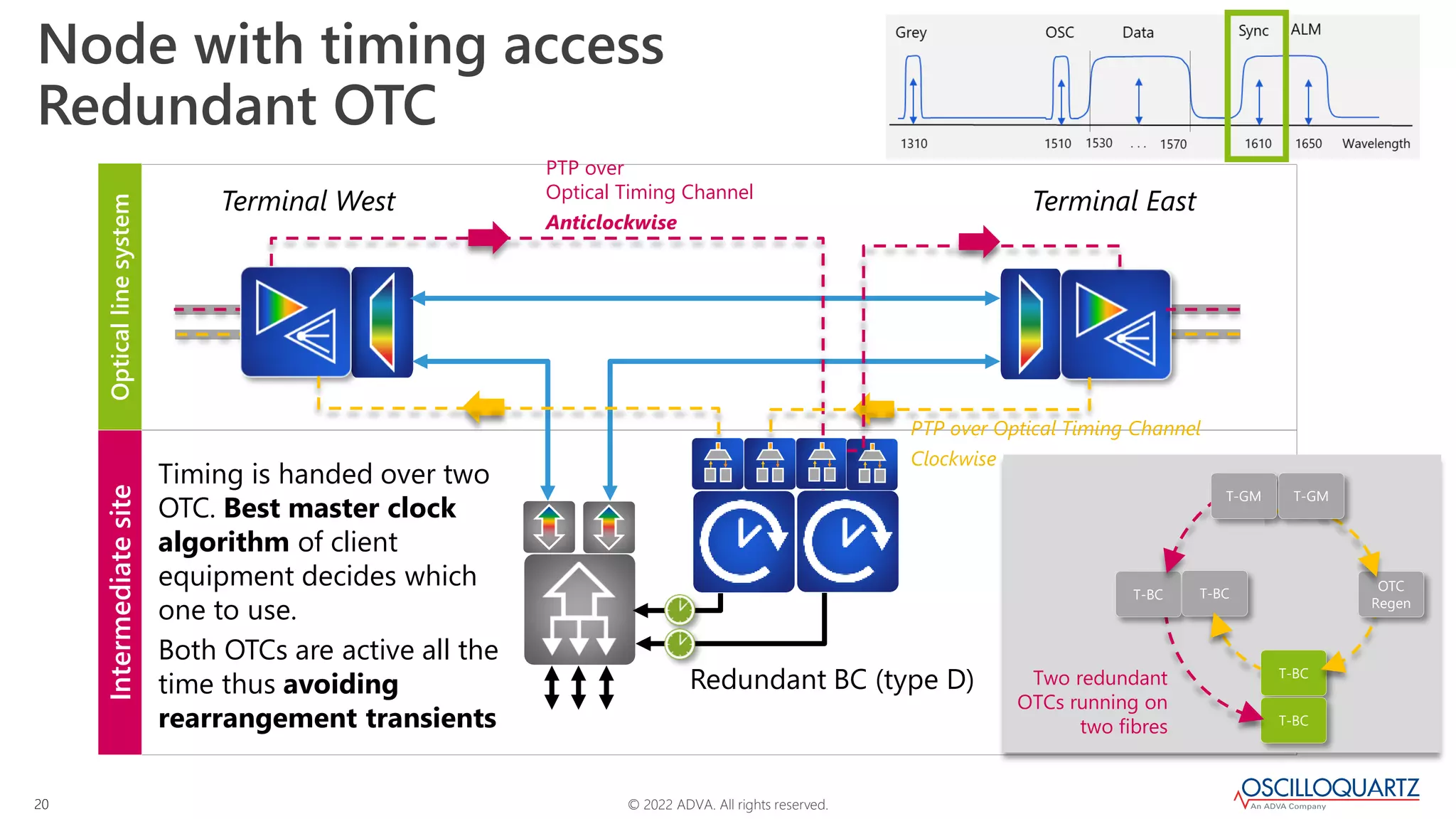
Timing is handed over two
OTC. Best master clock
algorithm of client
equipment decides which
one to use.
Both OTCs are active all the
time thus avoiding
rearrangement transients
T-BC
T-BC
Redundant BC (type D)
© 2022 ADVA. All rights reserved.
21
BC class D with HW redundancy for redundant OTC
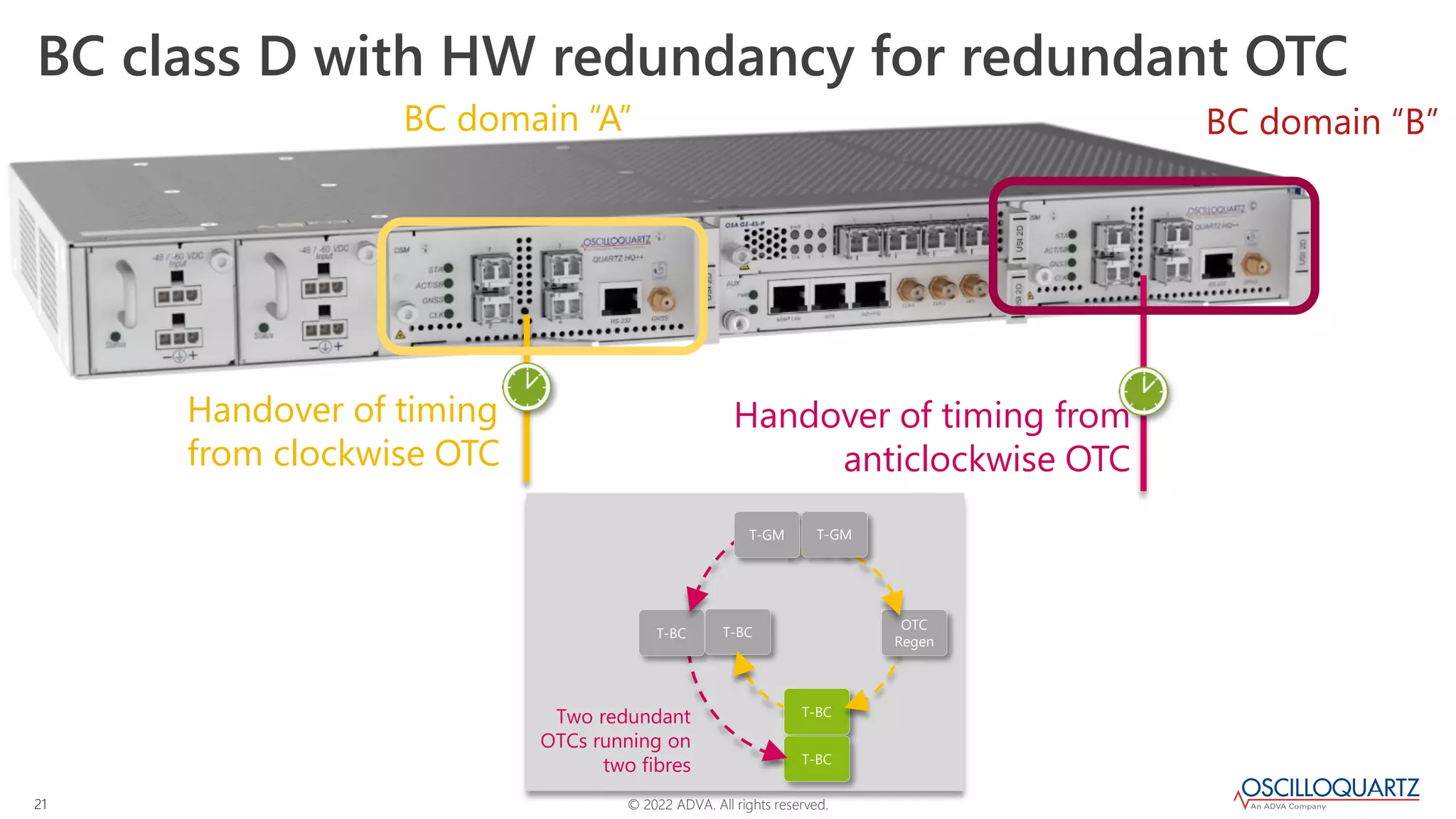
Handover of timing
from clockwise OTC
Handover of timing from
anticlockwise OTC
BC domain “A” BC domain “B”
Two redundant
OTCs running on
two fibres
OTC
Regen
T-BC
T-BC
T-GM T-GM
T-BC
T-BC
© 2022 ADVA. All rights reserved.
22
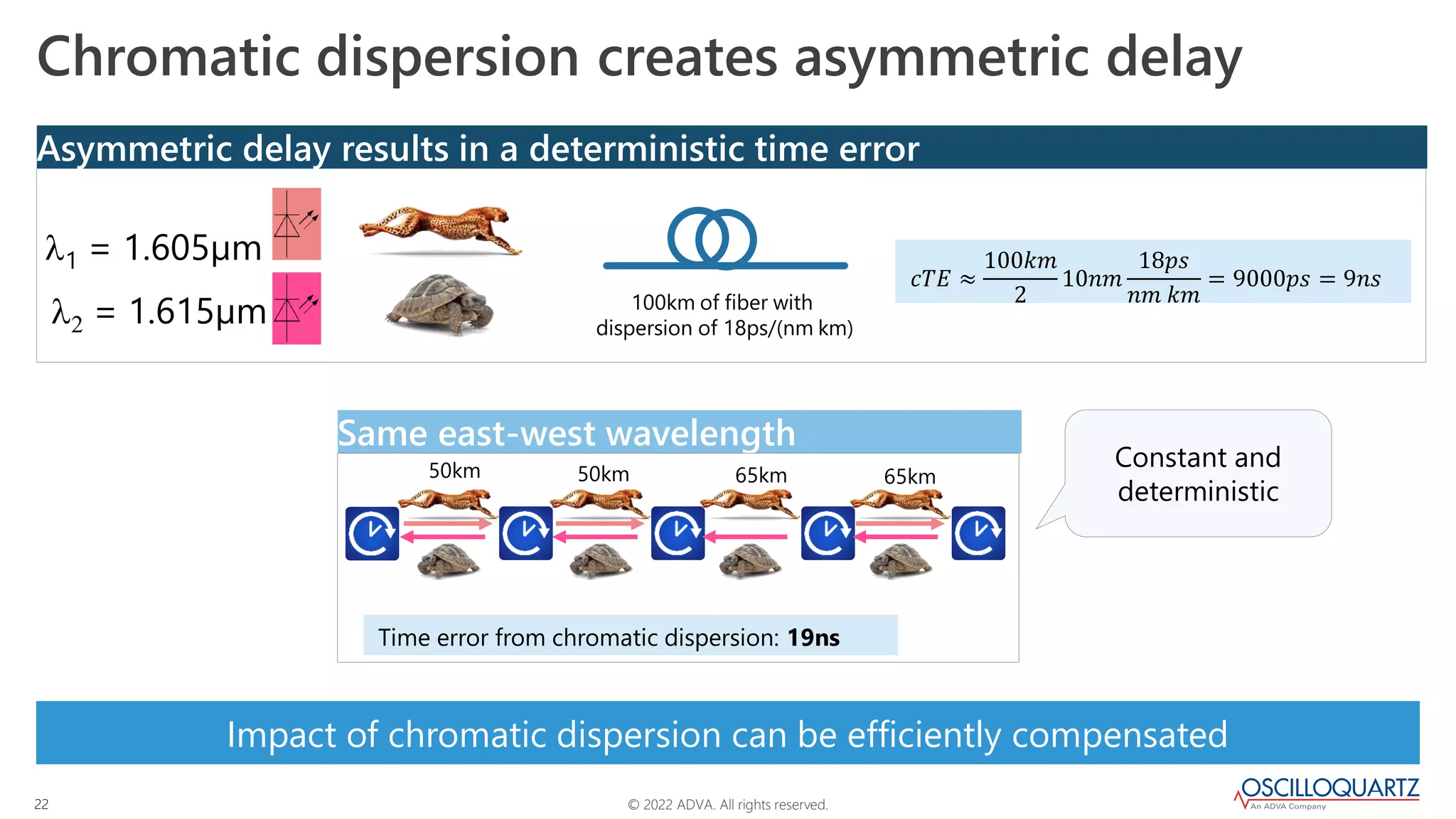
Impact of chromatic dispersion can be efficiently compensated
Same east-west wavelength
Asymmetric delay results in a deterministic time error
Chromatic dispersion creates asymmetric delay
100km of fiber with
dispersion of 18ps/(nm km)
l1 = 1.605µm
l2 = 1.615µm
𝑐𝑇𝐸 ≈
100𝑘𝑚
2
10𝑛𝑚
18𝑝𝑠
𝑛𝑚 𝑘𝑚
= 9000𝑝𝑠 = 9𝑛𝑠
50km 65km
50km 65km
Time error from chromatic dispersion: 19ns
Constant and
deterministic
© 2022 ADVA. All rights reserved.
23
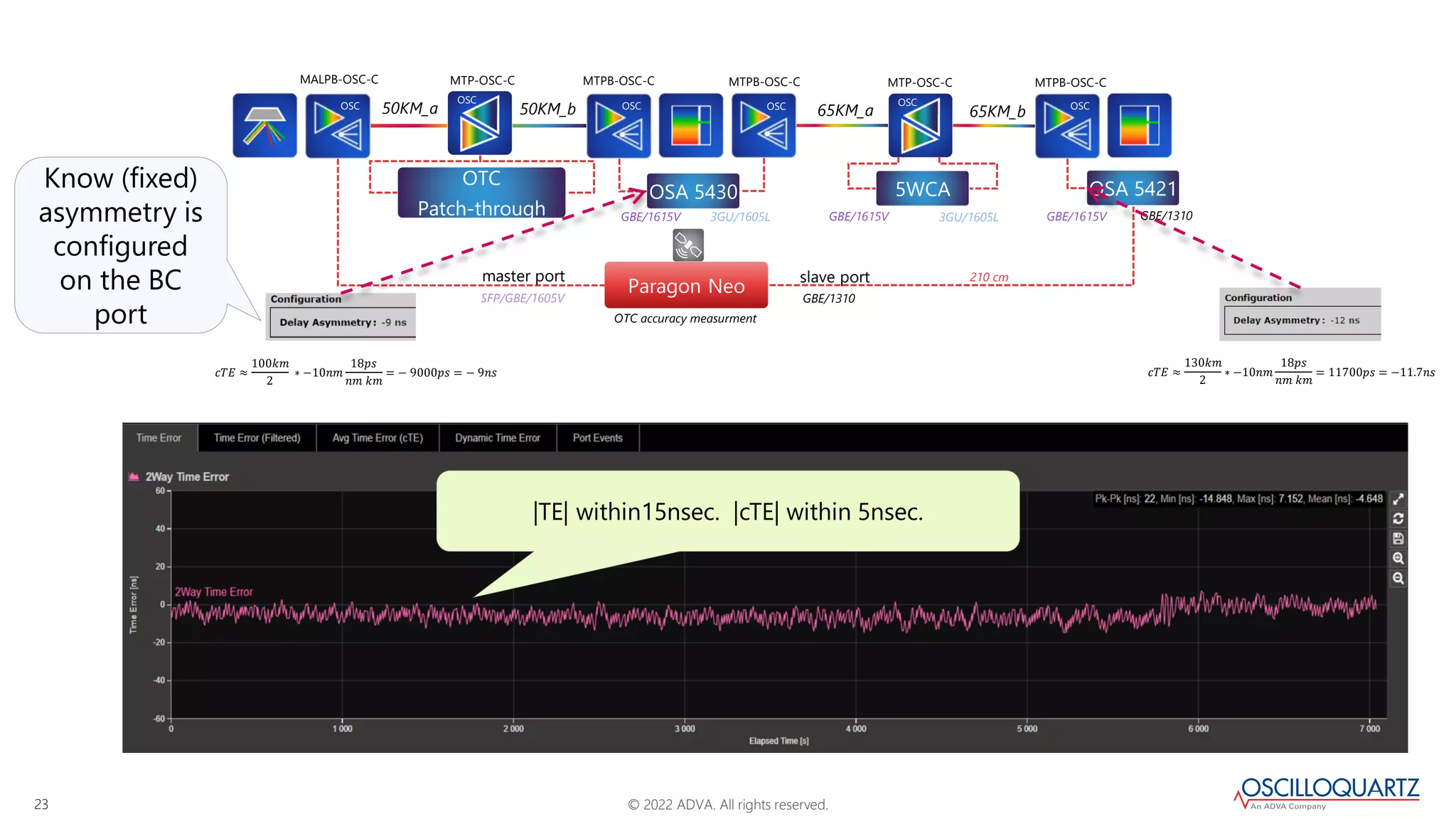
50KM_a
OSC OSC
OSC OSC OSC
Paragon Neo
OSA 5430 5WCA
OTC
Patch-through
master port slave port
OSC
OTC accuracy measurment
3GU/1605L
GBE/1615V 3GU/1605L
SFP/GBE/1605V
GBE/1615V GBE/1615V
MALPB-OSC-C MTP-OSC-C MTPB-OSC-C MTPB-OSC-C MTP-OSC-C MTPB-OSC-C
50KM_b 65KM_a 65KM_b
OSA 5421
GBE/1310
GBE/1310
210 cm
𝑐𝑇𝐸 ≈
100𝑘𝑚
2
∗ −10𝑛𝑚
18𝑝𝑠
𝑛𝑚 𝑘𝑚
= − 9000𝑝𝑠 = − 9𝑛𝑠 𝑐𝑇𝐸 ≈
130𝑘𝑚
2
∗ −10𝑛𝑚
18𝑝𝑠
𝑛𝑚 𝑘𝑚
= 11700𝑝𝑠 = −11.7𝑛𝑠
|TE| within15nsec. |cTE| within 5nsec.
Know (fixed)
asymmetry is
configured
on the BC
port
© 2022 ADVA. All rights reserved.
24
Summary
• 5G TDD and Cooperative radio clusters require stringent phase
synconization
• Accurate synchronization is a key enabler for higher throughput
• “GNSS everywhere” is subject to GNSS vulnerabilities (jamming /spoofing
etc’)
• Sub 100nsec accuracy can be delivered from core ePRTC sites to
aggregation site using optical timing channel combined with BC class D
• Pls contact me in case you have any comments or questions :
nlaufer@adva.com
Thank you
IMPORTANT NOTICE
ADVA is the exclusive owner or licensee of the content, material, and information in this presentation. Any reproduction, publication or reprint, in whole or in part, is strictly prohibited.
The information in this presentation may not be accurate, complete or up to date, and is provided without warranties or representations of any kind, either express or implied. ADVA shall not be responsible for and disclaims any liability for any loss or damages, including without limitation,
direct, indirect, incidental, consequential and special damages, alleged to have been caused by or in connection with using and/or relying on the information contained in this presentation.
Copyright © for the entire content of this presentation: ADVA.
info@adva.com
© 2022 ADVA. All rights reserved.
26
Oscilloquartz (OSA) at a glance
Innovation leader for timing distribution and assurance
• Member of the ADVA
• Focused in offerings sync solutions for communications, government and enterprise
applications
• Longstanding relationship with customers worldwide since 1949!
• Around 100 sync focused partners in about 80 countries around the globe
• State-of-the-art , End to End time phase and frequency innovative solutions
• Timing delivery and assurance excellency
• For more details –visit us at https://www.oscilloquartz.com/

Timing and synchronization for 5G over optical networks

  • 1.
    Timing and synchronizationfor 5G over optical networks March 2022 , Nir Laufer, VP and PLM, Oscilloquartz, ADVA Sub 100ns accuracy at cell sites over commercial WDM networks
  • 2.
    © 2022 ADVA.All rights reserved. 2 Common synchronization challenges – sub 1usec Mobile radio networks 1.1usec, 260nsec relative Financial trading 1usec Regulation (MIFID II) , HFT Power utilities 1usec - PMU, fault location Data center infrastructure 1usec Broadcast networks 1usec How to make sync delivery more accurate and more resilient?
  • 3.
    © 2022 ADVA.All rights reserved. 3 The need for synchronization …
  • 4.
    © 2022 ADVA.All rights reserved. 4 Synchronization requirements 2G/3G/4G/5G FDD – frequency synchronization (50ppb) 3G TDD: 5µs time synchronization (large cells) 4G and 5G TDD: 1.5µs time synchronization (absolute) 5G – accurate positioning: < sub 10 ns 5G – Cooperative radio clusters :130-260ns TAE (relative) Sync Accuracy needs to improve Spectral efficiency Increased spectral efficiency and data throughput
  • 5.
    © 2022 ADVA.All rights reserved. 5 GNSS vulnerabilities and threats GNSS for timing Jamming and spoofing Obstruction Interference with transmitters at adjacent bands ionospheric disturbance, solar activity GNSS segment errors
  • 6.
    © 2022 ADVA.All rights reserved. 6 Application area for OTC: Aggregation network Core time base network Single-digit number of locations for large operator ePRTC enabled, TE ≤ ±30ns Aggregation network Hundreds of locations for large operator PRTC enabled, TE ≤ ±100ns Feeders to end application Thousands of locations for large operator TE ≤ ± 1100ns Optical Timing Channel (OTC) Optical Timing Channel with PTP BC class D 70ns budget ePRTC 30ns budget IEEE 1588 PTP OTC+ BC ?
  • 7.
    © 2022 ADVA.All rights reserved. 7 Cesium clock as time source PRC (G.811) Frequency PRC : Cs or GNSS NE NE NE PRTC (G.8272) Frequency + Phase PRTC : GNSS NE NE NE ePRTC (G.8272.1) Frequency + Phase GNSS NE NE NE Cs Combiner SSU Packet Master Clock Packet Master Clock Sync Network Sync Network Sync Network SSU Packet Slave Clock Packet Slave Clock Cs as backup
  • 8.
    © 2022 ADVA.All rights reserved. 8 Typical ePRTC implementation ePRTC G.8272.1 : Time Error +/-30nsec vs UTC (locked) Time Error +/-100nsec vs UTC in 14 days of holdover (30->100ns) GNSS Cs clock Combiner Function of ePRTC ePRC-A G.811.1 Cesium Atomic clock PTP Packet Master Clock ePRTC combiner + PTP GM
  • 9.
    © 2022 ADVA.All rights reserved. 9 Core Time base sites - ePRTC GNSS Receiver Clock Combiner PPS/PPS+ToD GNSS antennas Core redundent Grandmaster 10 Mhz BITS Sync-E PTP NTP Clock Combiner GNSS Receiver carrier grade fully Redundant HW Multi band , multi constellation GNSS PTP+Sync-E Backup from peer site Peer core site ePRTC with Cesium backups Smart antenna Sync and GNSS assurance Advanced jamming and spoofing detection ePRTC ePRC Cesium Clock ePRC Cesium Clock
  • 10.
    © 2022 ADVA.All rights reserved. 10 ePRTC locked and holdover example full 65 days run ePRTC full lock 3 day learning Start holdover 34 days holdover 22 days normal ePRTC operation GNSS reconnect 6 days (normal op’) TE within +/-20nsec in locked mode 50nsec of phase drift in 34 days of holdover
  • 11.
    © 2022 ADVA.All rights reserved. 11 ITU-T BC Classes are defined in G.8273.2 PTP Boundary clock classes T-BC Class max|TE| (ns) max|TEL| (ns) Constant Time Error (ns) MTIE (ns) TDEV (ns) A 100 - ±50 40 4 B 70 - ±20 40 4 C 30 - ±10 10 2 D FFS 5 FFS FFS FFS PTP Boundary clock PTP+Sync-E PTP Grand master clock PTP+Sync-E PTP+Sync-E PTP+Sync-E BC main functions: • Select best available master (BMCA) • Filter input jitter (PTP/Sync-E) • Regenerate PTP to distribute time to subtended devices
  • 12.
    © 2022 ADVA.All rights reserved. 12 Time distribution : 9xBC Class D Test setup: 9 x Class D BC’s and 370 KM of fiber (single fiber) Single fiber
  • 13.
    © 2022 ADVA.All rights reserved. 13 Time distribution : 9xBC Class D Test results: 9 x Class D BC’s and 370 KM of fiber meets ITU-T G.8272 requirements for PRTC-A clock. TE +/-20nsec MTIE TDEV
  • 14.
    © 2022 ADVA.All rights reserved. 14 OTC Timing over ... Timing over ... Optimization methods Time error Layer 3 (Routed) Small packet size High (ms/µs) Layer 2 (Switched) VLAN with high priority Middle (µs) Layer 1 (OTN) OTN buffer policing or inband transmission Low (µs/ns) Layer 1 (Transparent WDM) Single fiber working Lowest (ns) Asymmetry High Low
  • 15.
    © 2022 ADVA.All rights reserved. 15 Optical line system Intermediate site Node with without timing access Terminal west Terminal east Payload traffic Line terminal The extract length of each of the fibers is unknown The different between length of fibers can be few tens of meters over long distance connections -> creating significant asymmetry (~2.5nsec/m) The inline amplifiers are directional and adding unknow delay which varies between generation of amplifiers , types and suppliers
  • 16.
    © 2022 ADVA.All rights reserved. 16 Calibration of asymmetry with GNSS Calibration with using GNSS is not sufficient • One possible solution is to use GNSS on both sides of the link in order to compensate of the asymmetry • GNSS might not sufficiently accurate (typically ~ 15-100nsec) • Installing GNSS antenna in remote site might be challenging (e.g. indoor) • Increase installation costs • Initial calibration may not be valid when changes are made in the network (replacing amplifier , fixing fiber etc’) Terminal Terminal ROADM ROADM GNSS Master Probe GNSS
  • 17.
    © 2022 ADVA.All rights reserved. 17 Timing Device OTC Regen ILA ROADM Terminal Cross Connect Terminal/ADM Card Optical Timing Channel (OTC) The Optical Timing Channel (OTC) achieves high-accuracy time distribution by PTP (IEEE 1588) via Gigabit Ethernet over dedicated wavelengths on a single fibre OTC has minimal constant link asymmetry due to bidirectional transmission on a single fiber. OTC is independent from other layers (IP, Ethernet, OTN, reconfigurable optical layer) practically eliminating dynamic time errors OTC does not change optical network engineering rules and is just an overbuilt to the optical transport layer
  • 18.
    © 2022 ADVA.All rights reserved. 18 Optical line system Intermediate site Node with timing access Terminal west Terminal east PTP over optical timing channel Payload traffic Timing device featuring High accuracy PTP boundary clock type D BiDi transceivers OTC provides ample optical budget: Up to 30dB between two BiDi transceivers Dispersion is irrelevant at GbE line rate Line terminal
  • 19.
    © 2022 ADVA.All rights reserved. 19 Two CWDM slots per bidirectional channel Standard transceivers have two fiber connectors (TX and RX) One CWDM slot per bidirectional channel BiDi transceivers have one fiber connector with TX and RX pre-multiplexed in the transceiver BiDi transceivers Standard transceivers Running on the same fiber, forward and backward paths have exactly the same length, there is only marginal asymmetric delay BiDi transceivers CWDM Slot TX CWDM Slot RX CWDM Slot TX RX OTC
  • 20.
    © 2022 ADVA.All rights reserved. 20 Optical line system Intermediate site Node with timing access Redundant OTC Terminal West Terminal East PTP over Optical Timing Channel Anticlockwise PTP over Optical Timing Channel Clockwise Two redundant OTCs running on two fibres OTC Regen T-BC T-BC T-GM T-GM Timing is handed over two OTC. Best master clock algorithm of client equipment decides which one to use. Both OTCs are active all the time thus avoiding rearrangement transients T-BC T-BC Redundant BC (type D)
  • 21.
    © 2022 ADVA.All rights reserved. 21 BC class D with HW redundancy for redundant OTC Handover of timing from clockwise OTC Handover of timing from anticlockwise OTC BC domain “A” BC domain “B” Two redundant OTCs running on two fibres OTC Regen T-BC T-BC T-GM T-GM T-BC T-BC
  • 22.
    © 2022 ADVA.All rights reserved. 22 Impact of chromatic dispersion can be efficiently compensated Same east-west wavelength Asymmetric delay results in a deterministic time error Chromatic dispersion creates asymmetric delay 100km of fiber with dispersion of 18ps/(nm km) l1 = 1.605µm l2 = 1.615µm 𝑐𝑇𝐸 ≈ 100𝑘𝑚 2 10𝑛𝑚 18𝑝𝑠 𝑛𝑚 𝑘𝑚 = 9000𝑝𝑠 = 9𝑛𝑠 50km 65km 50km 65km Time error from chromatic dispersion: 19ns Constant and deterministic
  • 23.
    © 2022 ADVA.All rights reserved. 23 50KM_a OSC OSC OSC OSC OSC Paragon Neo OSA 5430 5WCA OTC Patch-through master port slave port OSC OTC accuracy measurment 3GU/1605L GBE/1615V 3GU/1605L SFP/GBE/1605V GBE/1615V GBE/1615V MALPB-OSC-C MTP-OSC-C MTPB-OSC-C MTPB-OSC-C MTP-OSC-C MTPB-OSC-C 50KM_b 65KM_a 65KM_b OSA 5421 GBE/1310 GBE/1310 210 cm 𝑐𝑇𝐸 ≈ 100𝑘𝑚 2 ∗ −10𝑛𝑚 18𝑝𝑠 𝑛𝑚 𝑘𝑚 = − 9000𝑝𝑠 = − 9𝑛𝑠 𝑐𝑇𝐸 ≈ 130𝑘𝑚 2 ∗ −10𝑛𝑚 18𝑝𝑠 𝑛𝑚 𝑘𝑚 = 11700𝑝𝑠 = −11.7𝑛𝑠 |TE| within15nsec. |cTE| within 5nsec. Know (fixed) asymmetry is configured on the BC port
  • 24.
    © 2022 ADVA.All rights reserved. 24 Summary • 5G TDD and Cooperative radio clusters require stringent phase synconization • Accurate synchronization is a key enabler for higher throughput • “GNSS everywhere” is subject to GNSS vulnerabilities (jamming /spoofing etc’) • Sub 100nsec accuracy can be delivered from core ePRTC sites to aggregation site using optical timing channel combined with BC class D • Pls contact me in case you have any comments or questions : nlaufer@adva.com
  • 25.
    Thank you IMPORTANT NOTICE ADVAis the exclusive owner or licensee of the content, material, and information in this presentation. Any reproduction, publication or reprint, in whole or in part, is strictly prohibited. The information in this presentation may not be accurate, complete or up to date, and is provided without warranties or representations of any kind, either express or implied. ADVA shall not be responsible for and disclaims any liability for any loss or damages, including without limitation, direct, indirect, incidental, consequential and special damages, alleged to have been caused by or in connection with using and/or relying on the information contained in this presentation. Copyright © for the entire content of this presentation: ADVA. info@adva.com
  • 26.
    © 2022 ADVA.All rights reserved. 26 Oscilloquartz (OSA) at a glance Innovation leader for timing distribution and assurance • Member of the ADVA • Focused in offerings sync solutions for communications, government and enterprise applications • Longstanding relationship with customers worldwide since 1949! • Around 100 sync focused partners in about 80 countries around the globe • State-of-the-art , End to End time phase and frequency innovative solutions • Timing delivery and assurance excellency • For more details –visit us at https://www.oscilloquartz.com/