Meet stringent latency demands with time-sensitive
networking technology
November 2022
FSP 150-XG418 now features express forwarding for low-latency applications
© 2022 ADVA. All rights reserved.
2 - Classified s Confidential -
Latency-sensitive applications
Video studio
Mobile data processing
(distributed unit, DU)
Enterprise
headquarters
Industrial IoT requires fast,
reliable data delivery with very
low jitter
Video and audio bridging
does not tolerate
latency variations
Mobile fronthaul networks are
sensitive to one-way delays
• High loads create congestion and add latency
• Long frames need to be sent out before other traffic may follow
Challenges
© 2022 ADVA. All rights reserved.
4 - Classified s Confidential -
802.1Qbu/802.3br frame preemption and interspersing express traffic
Express traffic forwarding
Time
Critical traffic
Preemptable traffic
High
Low
Time
High
1 Low 2
In
In
Out
Time
Express traffic
Best-effort traffic
High
Low
Time
High
In
In
Out
No preemption
Low
With preemption
Latency improvement
MAC merge sublayer (IEEE 802.3br) intersperse express traffic with preemptable traffic
© 2022 ADVA. All rights reserved.
5 - Classified s Confidential -
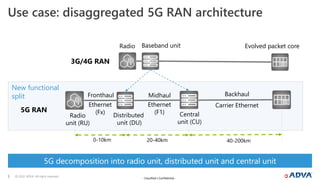
Use case: disaggregated 5G RAN architecture
Evolved packet core
3G/4G RAN
5G RAN
Backhaul
Carrier Ethernet
Midhaul
Ethernet
(F1)
New functional
split
40-200km
20-40km
0-10km
Radio
unit (RU)
Distributed
unit (DU)
Central
unit (CU)
Fronthaul
Radio Baseband unit
Ethernet
(Fx)
5G decomposition into radio unit, distributed unit and central unit
© 2022 ADVA. All rights reserved.
6 - Classified s Confidential -
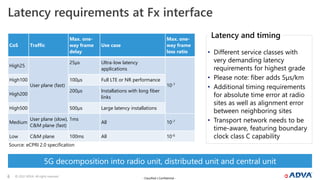
Latency requirements at Fx interface
CoS Traffic
Max. one-
way frame
delay
Use case
Max. one-
way frame
loss ratio
High25
User plane (fast)
25µs Ultra-low latency
applications
10-7
High100 100µs Full LTE or NR performance
High200
200µs Installations with long fiber
links
High500 500µs Large latency installations
Medium
User plane (slow),
C&M plane (fast)
1ms
All 10-7
Low C&M plane 100ms All 10-6
Source: eCPRI 2.0 specification
• Different service classes with
very demanding latency
requirements for highest grade
• Please note: fiber adds 5µs/km
• Additional timing requirements
for absolute time error at radio
sites as well as alignment error
between neighboring sites
• Transport network needs to be
time-aware, featuring boundary
clock class C capability
Latency and timing
5G decomposition into radio unit, distributed unit and central unit
© 2022 ADVA. All rights reserved.
7 - Classified s Confidential -
One-way delay performance in 5G fronthaul case
25GbE
FSP 150-XG418
Express forwarding meets even the most stringent CoS requirements in 5G fronthaul
Distributed
unit (DU)
Cell sites
hosting radio
unit (RU)
Latency Average Min Max
Express traffic 4,03µs 3,96µs 4,44µs
Preemptable
traffic
10,95µs 10,00µs 12,05µs
Latency Average Min Max
Express traffic 4,04µs 3,96µs 4,43µs
Preemptable
traffic
203,01µs 10,70µs 209,70µs
no impact
✓
No congestion High congestion
© 2022 ADVA. All rights reserved.
8 - Classified s Confidential -
A perfect solution for mobile fronthaul and other demanding applications
FSP 150-XG418 featuring express traffic forwarding
FSP 150-XG418 – 100Gbit/s demarcation
and edge aggregation
100G edge aggregation device for latency-sensitive applications
• Express forwarding of
eCPRI/latency-sensitive
traffic
• Classification of express
traffic based on VLANs
• Preemption of non-express
frames on 10/25G ports
• SyncE and PTP boundary
clock class C
Thank you
IMPORTANT NOTICE
ADVA is the exclusive owner or licensee of the content, material, and information in this presentation. Any reproduction, publication or reprint, in whole or in part, is strictly prohibited.
The information in this presentation may not be accurate, complete or up to date, and is provided without warranties or representations of any kind, either express or implied. ADVA shall not be responsible for and disclaims any liability for any loss or damages, including without limitation,
direct, indirect, incidental, consequential and special damages, alleged to have been caused by or in connection with using and/or relying on the information contained in this presentation.
Copyright © for the entire content of this presentation: ADVA.
www.adva.com | info@adva.com

Meet stringent latency demands with time-sensitive networking

  • 1.
    Meet stringent latencydemands with time-sensitive networking technology November 2022 FSP 150-XG418 now features express forwarding for low-latency applications
  • 2.
    © 2022 ADVA.All rights reserved. 2 - Classified s Confidential - Latency-sensitive applications Video studio Mobile data processing (distributed unit, DU) Enterprise headquarters Industrial IoT requires fast, reliable data delivery with very low jitter Video and audio bridging does not tolerate latency variations Mobile fronthaul networks are sensitive to one-way delays • High loads create congestion and add latency • Long frames need to be sent out before other traffic may follow Challenges
  • 3.
    © 2022 ADVA.All rights reserved. 4 - Classified s Confidential - 802.1Qbu/802.3br frame preemption and interspersing express traffic Express traffic forwarding Time Critical traffic Preemptable traffic High Low Time High 1 Low 2 In In Out Time Express traffic Best-effort traffic High Low Time High In In Out No preemption Low With preemption Latency improvement MAC merge sublayer (IEEE 802.3br) intersperse express traffic with preemptable traffic
  • 4.
    © 2022 ADVA.All rights reserved. 5 - Classified s Confidential - Use case: disaggregated 5G RAN architecture Evolved packet core 3G/4G RAN 5G RAN Backhaul Carrier Ethernet Midhaul Ethernet (F1) New functional split 40-200km 20-40km 0-10km Radio unit (RU) Distributed unit (DU) Central unit (CU) Fronthaul Radio Baseband unit Ethernet (Fx) 5G decomposition into radio unit, distributed unit and central unit
  • 5.
    © 2022 ADVA.All rights reserved. 6 - Classified s Confidential - Latency requirements at Fx interface CoS Traffic Max. one- way frame delay Use case Max. one- way frame loss ratio High25 User plane (fast) 25µs Ultra-low latency applications 10-7 High100 100µs Full LTE or NR performance High200 200µs Installations with long fiber links High500 500µs Large latency installations Medium User plane (slow), C&M plane (fast) 1ms All 10-7 Low C&M plane 100ms All 10-6 Source: eCPRI 2.0 specification • Different service classes with very demanding latency requirements for highest grade • Please note: fiber adds 5µs/km • Additional timing requirements for absolute time error at radio sites as well as alignment error between neighboring sites • Transport network needs to be time-aware, featuring boundary clock class C capability Latency and timing 5G decomposition into radio unit, distributed unit and central unit
  • 6.
    © 2022 ADVA.All rights reserved. 7 - Classified s Confidential - One-way delay performance in 5G fronthaul case 25GbE FSP 150-XG418 Express forwarding meets even the most stringent CoS requirements in 5G fronthaul Distributed unit (DU) Cell sites hosting radio unit (RU) Latency Average Min Max Express traffic 4,03µs 3,96µs 4,44µs Preemptable traffic 10,95µs 10,00µs 12,05µs Latency Average Min Max Express traffic 4,04µs 3,96µs 4,43µs Preemptable traffic 203,01µs 10,70µs 209,70µs no impact ✓ No congestion High congestion
  • 7.
    © 2022 ADVA.All rights reserved. 8 - Classified s Confidential - A perfect solution for mobile fronthaul and other demanding applications FSP 150-XG418 featuring express traffic forwarding FSP 150-XG418 – 100Gbit/s demarcation and edge aggregation 100G edge aggregation device for latency-sensitive applications • Express forwarding of eCPRI/latency-sensitive traffic • Classification of express traffic based on VLANs • Preemption of non-express frames on 10/25G ports • SyncE and PTP boundary clock class C
  • 8.
    Thank you IMPORTANT NOTICE ADVAis the exclusive owner or licensee of the content, material, and information in this presentation. Any reproduction, publication or reprint, in whole or in part, is strictly prohibited. The information in this presentation may not be accurate, complete or up to date, and is provided without warranties or representations of any kind, either express or implied. ADVA shall not be responsible for and disclaims any liability for any loss or damages, including without limitation, direct, indirect, incidental, consequential and special damages, alleged to have been caused by or in connection with using and/or relying on the information contained in this presentation. Copyright © for the entire content of this presentation: ADVA. www.adva.com | info@adva.com