The Why and How
of Scala at Twitter
Alex Payne (@al3x)
Twitter Infrastructure
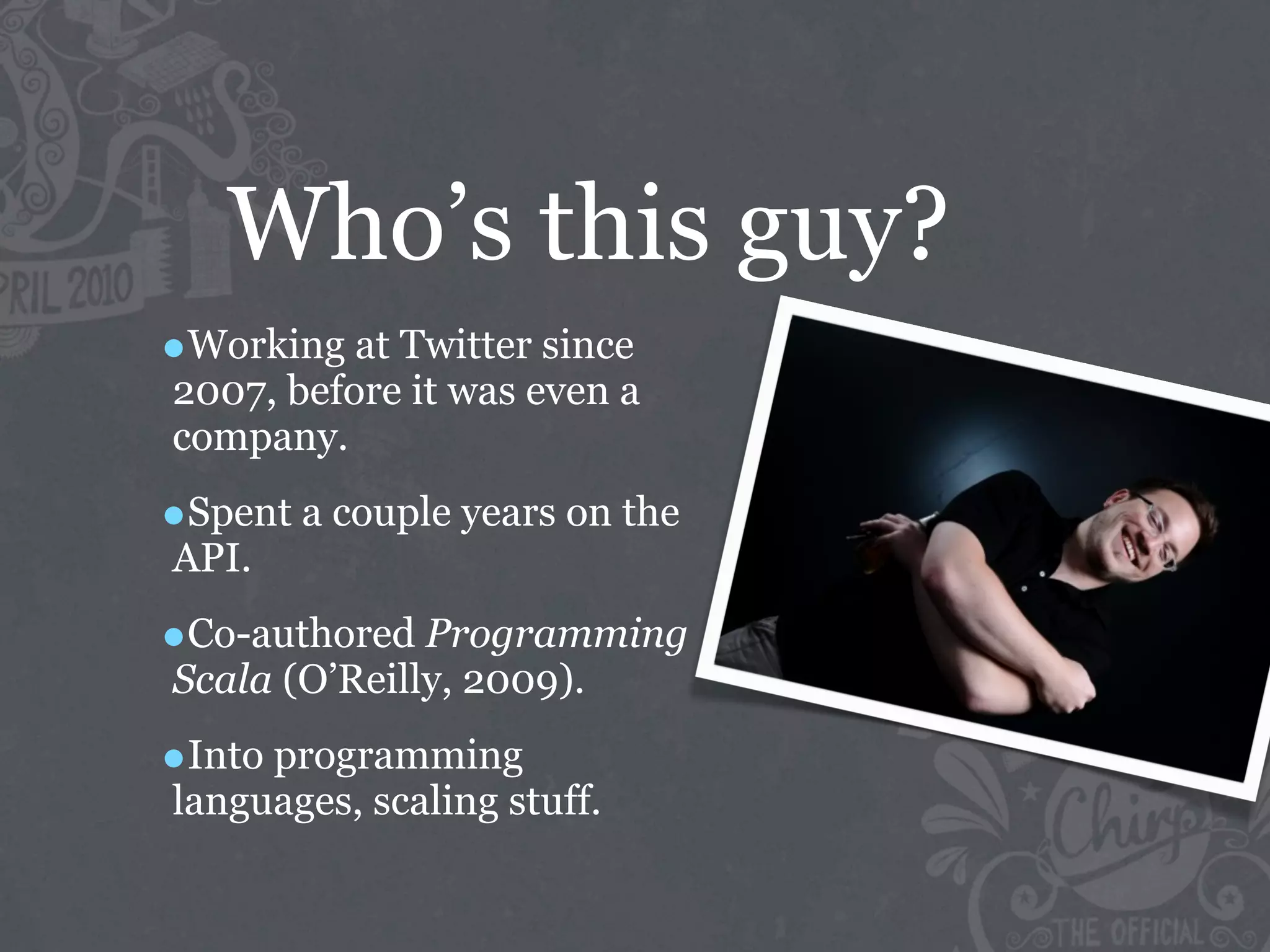
Who’s this guy?
•Working at Twitter since
2007, before it was even a
company.

•Spent a couple years on the
API.

•Co-authored Programming
Scala (O’Reilly, 2009).

•Into programming
languages, scaling stuff.
Part I:
Why Scala?
So, like, Ruby or Scala?
•Both!
•Ruby mostly on the
frontend.

•Scala mostly on the
backend.

•Thrift and data stores to
connect the two.
Elevator Pitch
•   It’s fun.

•   It’s fast.

•   It’s runs on a great virtual machine (JVM).

•   It’s got an awesome community.

•   It can borrow from Java.
No, seriously, why?
•   A rich static type system that gets out of your
    way when you don’t need it, is awesome when
    you do.

•   Flexible syntax makes it easy to write
    readable, maintainable code.

•   Traits for cross-cutting modularity.

•   Lots of OOP goodness.
I’m not sold yet.
•   How about the choice between immutable and
    mutable variables?

•   Powerful functional programming: mapping,
    filtering, folding, currying, so much more.

•   Lazy values.

•   Pattern matching.

•   XML literals, and clean syntax for working
    with XML documents built right in!
What about concurrency?
•   You can do Actor concurrency (message
    passing), kinda like Erlang.

•   Or, use threads.

•   Or, use all the java.util.concurrent tools.

•   Or, use other JVM concurrency frameworks
    (ex: Netty, Apache Mina).
Basically,
it’s the future.
Part II:
How do you guys
  do Scala?
We build services.
•   Isolated components, can swap them out.

•   Talk to the rest of the system via Thrift (for
    now, maybe Avro in the future).

•   Independently tested for correctness, load.

•   Can have custom operational properties.
Scala Services at Twitter
•   Kestrel: queuing.

•   Flock (and Gizzard): social graph store.

•   Hawkwind: people search.

•   Hosebird: streaming API.

•   more in the works all the time...
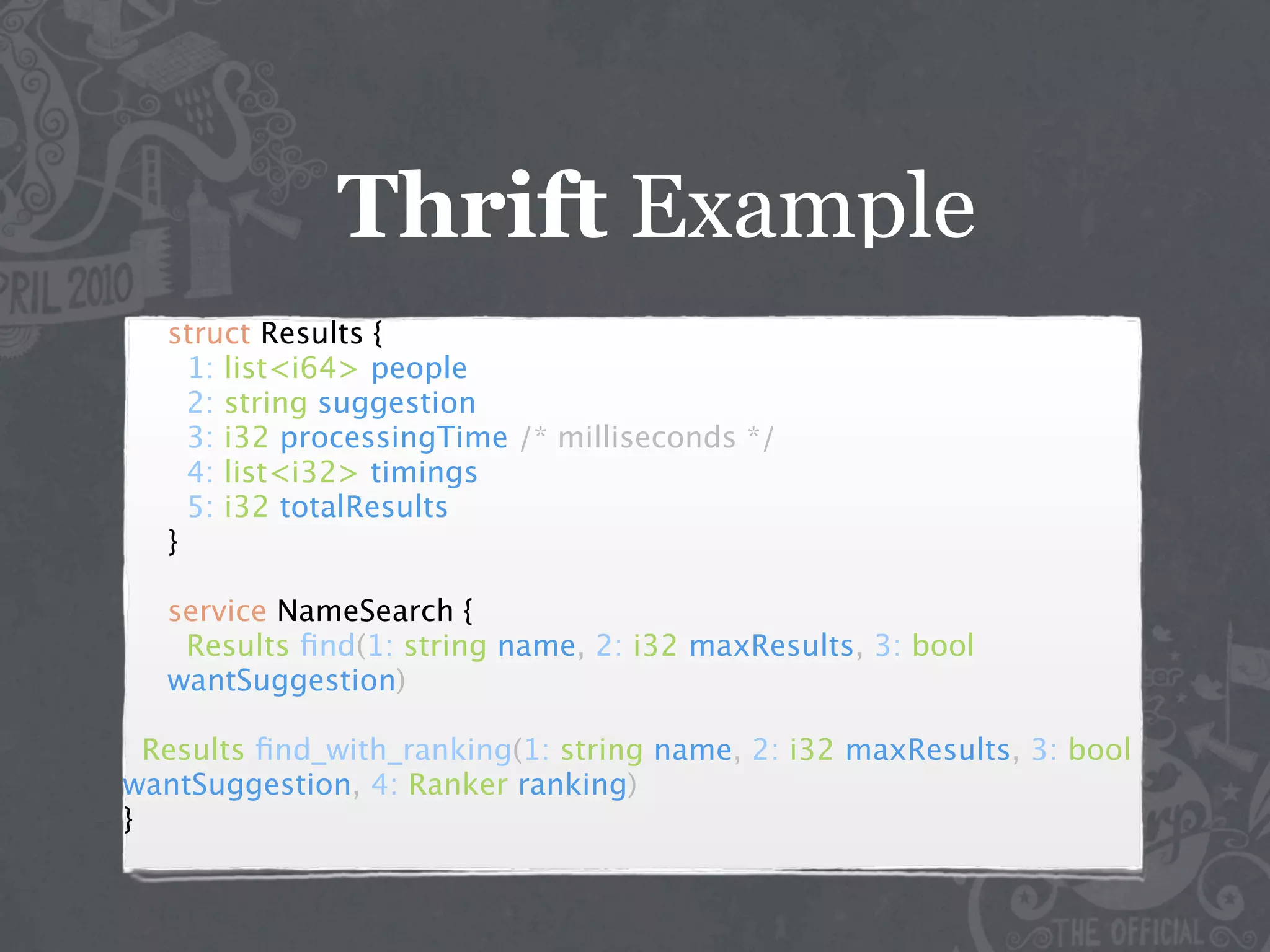
Thrift Example
   struct Results {
     1: list<i64> people
     2: string suggestion
     3: i32 processingTime /* milliseconds */
     4: list<i32> timings
     5: i32 totalResults
   }

   service NameSearch {
    Results find(1: string name, 2: i32 maxResults, 3: bool
   wantSuggestion)

  Results find_with_ranking(1: string name, 2: i32 maxResults, 3: bool
wantSuggestion, 4: Ranker ranking)
}
We build libraries.
•   Reusable chunks of code that we can share
    between projects.

•   We open source them.

•   We try to keep the “NIH” to a minimum, but
    we also have very particular requirements.
Ostrich
•   Gather stats from inside your running process.

•   Counters, gauges, and timings.

•   Share stats many ways: JMX, JSON-over-
    HTTP, plain text Telnet-style socket, log files.
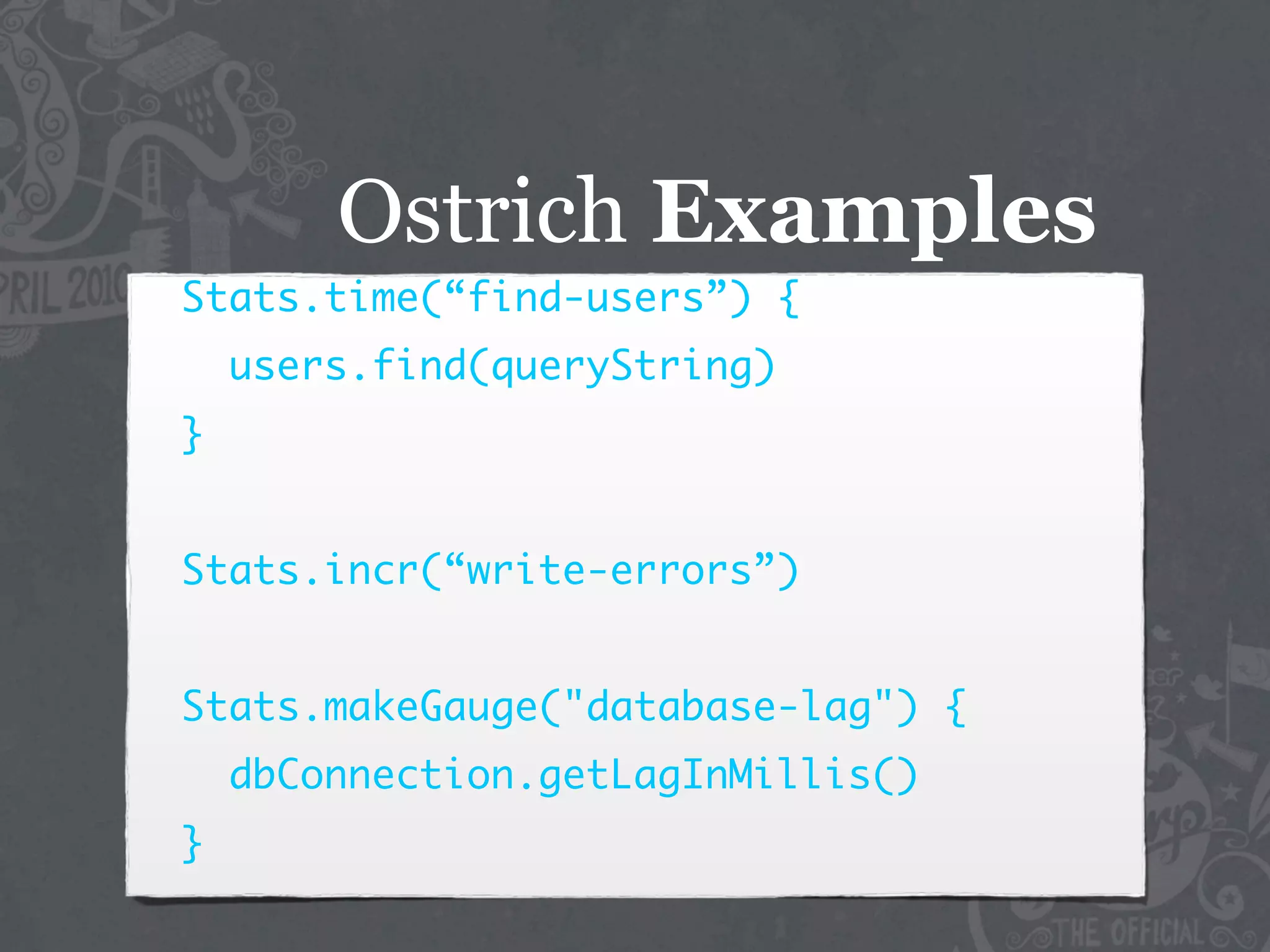
Ostrich Examples
Stats.time(“find-users”) {
    users.find(queryString)
}


Stats.incr(“write-errors”)


Stats.makeGauge("database-lag") {
    dbConnection.getLagInMillis()
}
Configgy
•   Configuration files and logging.

•   Flexible file format offers includes, more.

•   Inheritance, variable substitution.

•   Tunable logging, Scribe support.

•   Subscription API: push and validate
    configuration changes.

•   Ruby support, Emacs mode.
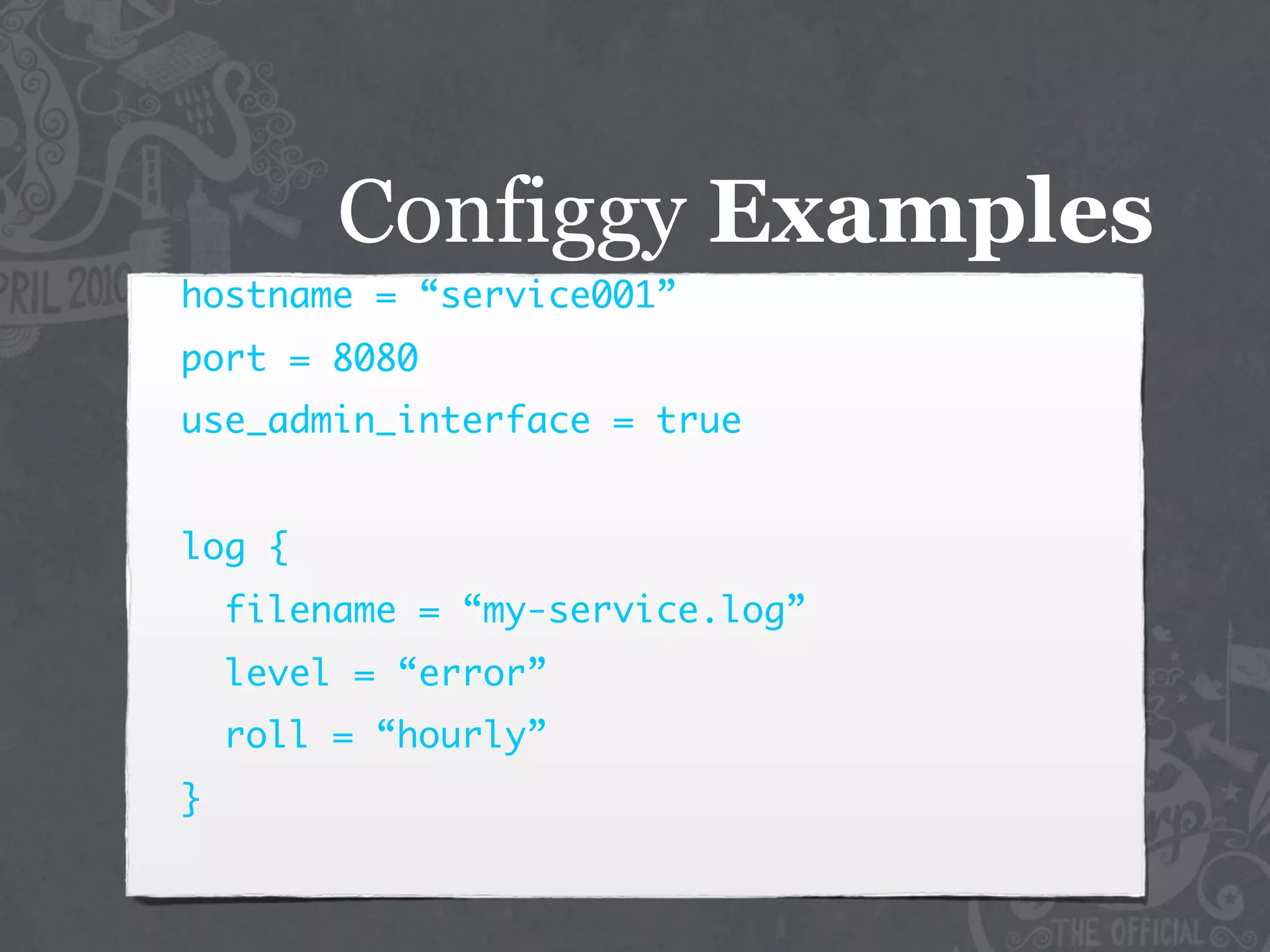
Configgy Examples
hostname = “service001”
port = 8080
use_admin_interface = true


log {
    filename = “my-service.log”
    level = “error”
    roll = “hourly”
}
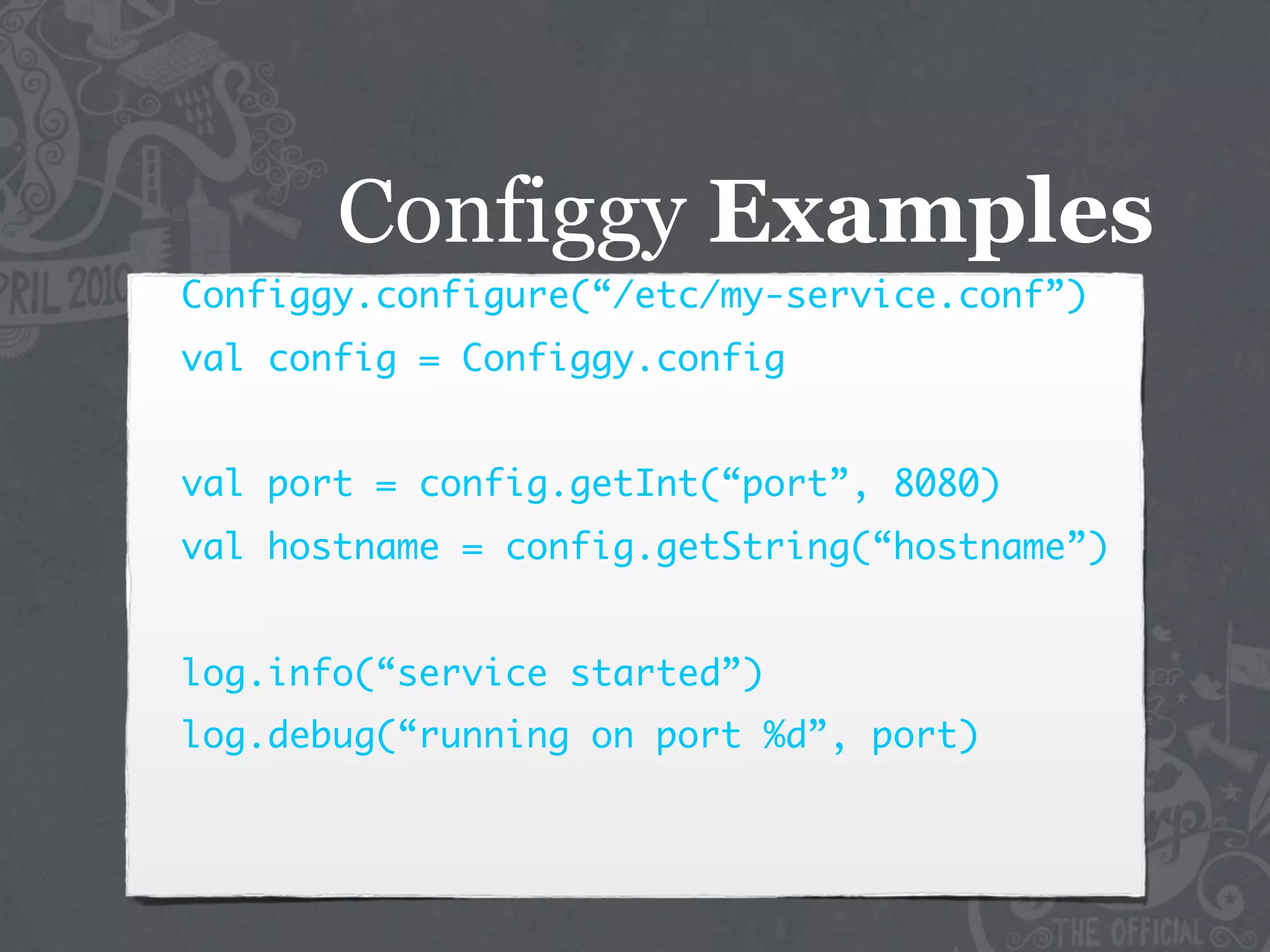
Configgy Examples
Configgy.configure(“/etc/my-service.conf”)
val config = Configgy.config


val port = config.getInt(“port”, 8080)
val hostname = config.getString(“hostname”)


log.info(“service started”)
log.debug(“running on port %d”, port)
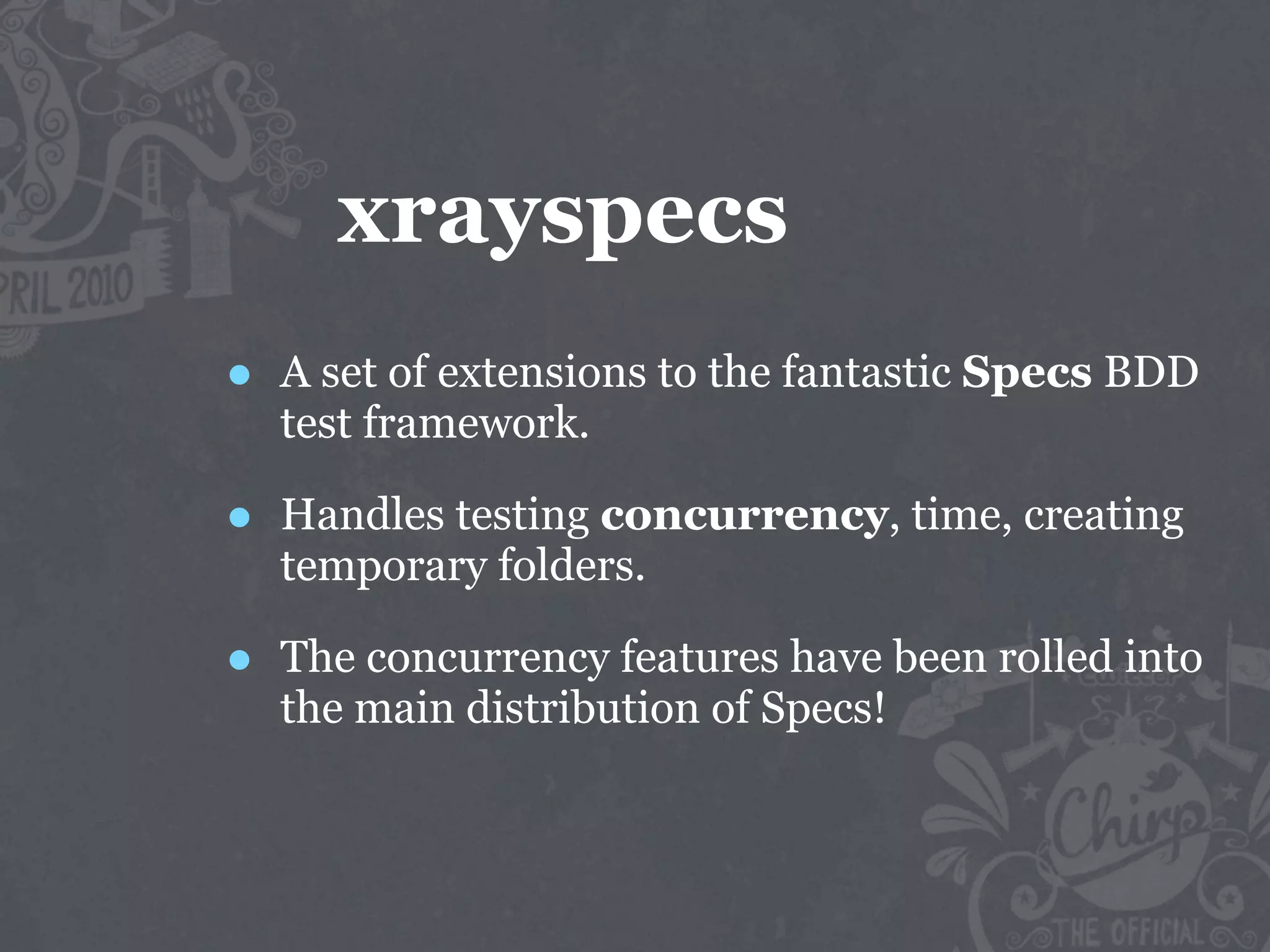
xrayspecs
•   A set of extensions to the fantastic Specs BDD
    test framework.

•   Handles testing concurrency, time, creating
    temporary folders.

•   The concurrency features have been rolled into
    the main distribution of Specs!
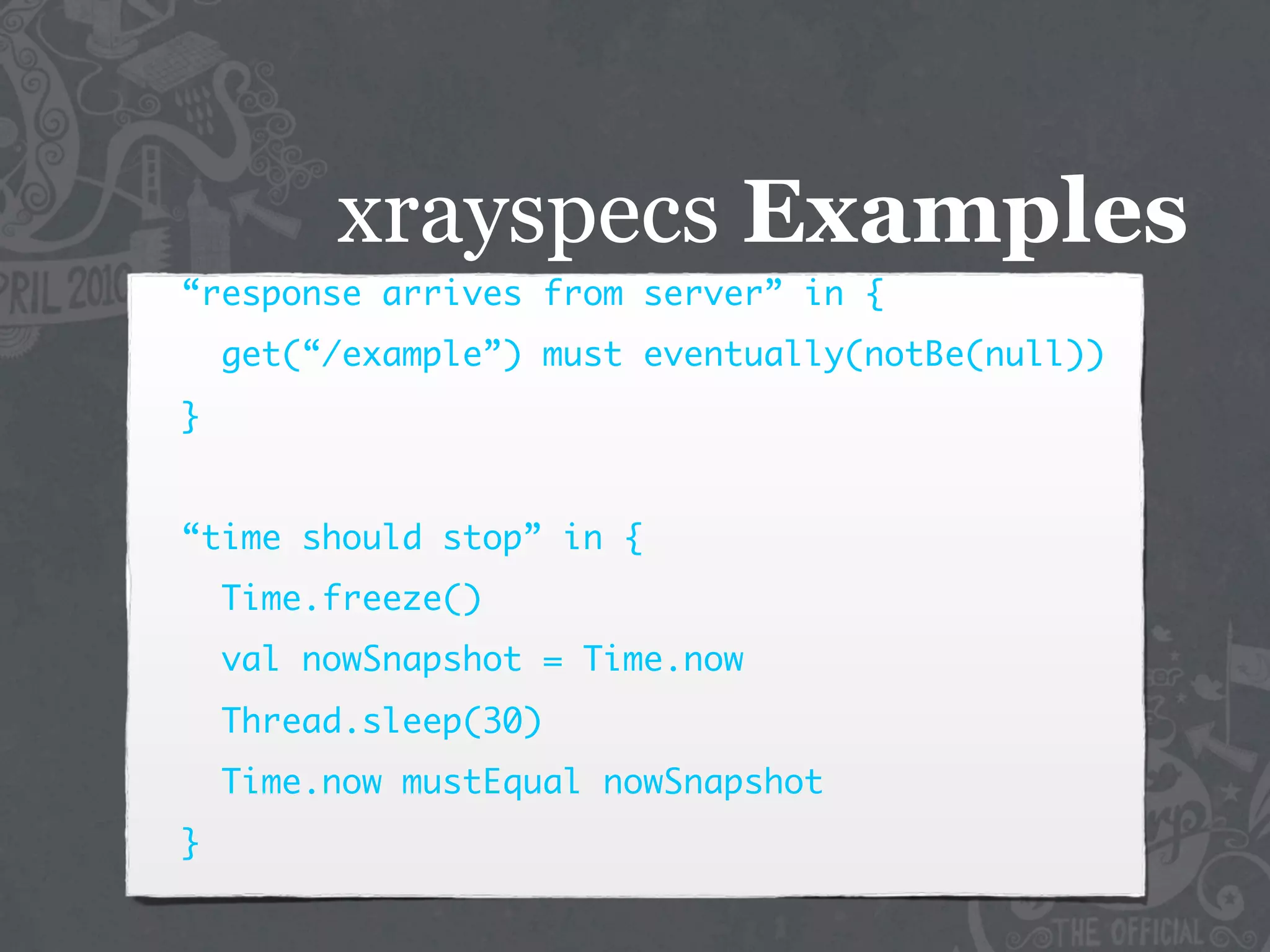
xrayspecs Examples
“response arrives from server” in {
    get(“/example”) must eventually(notBe(null))
}


“time should stop” in {
    Time.freeze()
    val nowSnapshot = Time.now
    Thread.sleep(30)
    Time.now mustEqual nowSnapshot
}
scala-json
•   A cleaned-up version of the official Scala JSON
    codec.

•   Makes clever use of parser combinators – a
    good way to learn about them.

•   Heavily tested, fixes a bunch of edge cases.
JSON Examples
val myJsonString = """
{"key": "value", "1": 2, "3": 4,
  "myList": [5, 6, 7]
"""
Json.parse(myJsonString)


Json.build(List("user_id", 666))
Other Twitter Libraries
• Naggati: build protocols for Apache Mina.
• Smile: a memcached client that uses Actors.
• Querulous: a nice database client.
• Jackhammer: a load testing framework
  (coming soon).

• probably stuff I'm leaving out...
Stuff We Use
•   There's great open source code in the Scala
    community.

•   We try to use and contribute back to third-
    party projects.

•   Follow @implicit_ly for new Scala releases.

•   Also subscribe to Repopular Scala.
sbt – the simple build tool
•   Scala’s answer to Ant and Maven.

•   Sets up new projects.

•   Maintains project configuration, build tasks,
    and dependencies in pure Scala. Totally open-
    ended.

•   Interactive console.

•   Will run tasks as soon as files in your project
    change – automatically compile and run tests!
specs
•   As aforementioned: great way to do BDD
    testing.

•   Set up pre- and post-conditions for
    individual tests, suites, etc.

•   Extremely flexible and extensible.

•   Great, responsive maintainer.

•   Supports mocking (we like Mockito).
The IDE Question
•   We've had the best luck with IntelliJ IDEA,
    but it's still pretty rough.

•   Most of us use a plain text editor like Emacs,
    VIM, or TextMate.

•   Combined with sbt, it's actually a really nice
    workflow!
Questions!
 Thanks for listening!

The Why and How of Scala at Twitter

  • 2.
    The Why andHow of Scala at Twitter Alex Payne (@al3x) Twitter Infrastructure
  • 3.
    Who’s this guy? •Workingat Twitter since 2007, before it was even a company. •Spent a couple years on the API. •Co-authored Programming Scala (O’Reilly, 2009). •Into programming languages, scaling stuff.
  • 4.
  • 5.
    So, like, Rubyor Scala? •Both! •Ruby mostly on the frontend. •Scala mostly on the backend. •Thrift and data stores to connect the two.
  • 6.
    Elevator Pitch • It’s fun. • It’s fast. • It’s runs on a great virtual machine (JVM). • It’s got an awesome community. • It can borrow from Java.
  • 7.
    No, seriously, why? • A rich static type system that gets out of your way when you don’t need it, is awesome when you do. • Flexible syntax makes it easy to write readable, maintainable code. • Traits for cross-cutting modularity. • Lots of OOP goodness.
  • 8.
    I’m not soldyet. • How about the choice between immutable and mutable variables? • Powerful functional programming: mapping, filtering, folding, currying, so much more. • Lazy values. • Pattern matching. • XML literals, and clean syntax for working with XML documents built right in!
  • 9.
    What about concurrency? • You can do Actor concurrency (message passing), kinda like Erlang. • Or, use threads. • Or, use all the java.util.concurrent tools. • Or, use other JVM concurrency frameworks (ex: Netty, Apache Mina).
  • 10.
  • 12.
    Part II: How doyou guys do Scala?
  • 13.
    We build services. • Isolated components, can swap them out. • Talk to the rest of the system via Thrift (for now, maybe Avro in the future). • Independently tested for correctness, load. • Can have custom operational properties.
  • 14.
    Scala Services atTwitter • Kestrel: queuing. • Flock (and Gizzard): social graph store. • Hawkwind: people search. • Hosebird: streaming API. • more in the works all the time...
  • 15.
    Thrift Example struct Results { 1: list<i64> people 2: string suggestion 3: i32 processingTime /* milliseconds */ 4: list<i32> timings 5: i32 totalResults } service NameSearch { Results find(1: string name, 2: i32 maxResults, 3: bool wantSuggestion) Results find_with_ranking(1: string name, 2: i32 maxResults, 3: bool wantSuggestion, 4: Ranker ranking) }
  • 16.
    We build libraries. • Reusable chunks of code that we can share between projects. • We open source them. • We try to keep the “NIH” to a minimum, but we also have very particular requirements.
  • 17.
    Ostrich • Gather stats from inside your running process. • Counters, gauges, and timings. • Share stats many ways: JMX, JSON-over- HTTP, plain text Telnet-style socket, log files.
  • 18.
    Ostrich Examples Stats.time(“find-users”) { users.find(queryString) } Stats.incr(“write-errors”) Stats.makeGauge("database-lag") { dbConnection.getLagInMillis() }
  • 19.
    Configgy • Configuration files and logging. • Flexible file format offers includes, more. • Inheritance, variable substitution. • Tunable logging, Scribe support. • Subscription API: push and validate configuration changes. • Ruby support, Emacs mode.
  • 20.
    Configgy Examples hostname =“service001” port = 8080 use_admin_interface = true log { filename = “my-service.log” level = “error” roll = “hourly” }
  • 21.
    Configgy Examples Configgy.configure(“/etc/my-service.conf”) val config= Configgy.config val port = config.getInt(“port”, 8080) val hostname = config.getString(“hostname”) log.info(“service started”) log.debug(“running on port %d”, port)
  • 22.
    xrayspecs • A set of extensions to the fantastic Specs BDD test framework. • Handles testing concurrency, time, creating temporary folders. • The concurrency features have been rolled into the main distribution of Specs!
  • 23.
    xrayspecs Examples “response arrivesfrom server” in { get(“/example”) must eventually(notBe(null)) } “time should stop” in { Time.freeze() val nowSnapshot = Time.now Thread.sleep(30) Time.now mustEqual nowSnapshot }
  • 24.
    scala-json • A cleaned-up version of the official Scala JSON codec. • Makes clever use of parser combinators – a good way to learn about them. • Heavily tested, fixes a bunch of edge cases.
  • 25.
    JSON Examples val myJsonString= """ {"key": "value", "1": 2, "3": 4, "myList": [5, 6, 7] """ Json.parse(myJsonString) Json.build(List("user_id", 666))
  • 26.
    Other Twitter Libraries •Naggati: build protocols for Apache Mina. • Smile: a memcached client that uses Actors. • Querulous: a nice database client. • Jackhammer: a load testing framework (coming soon). • probably stuff I'm leaving out...
  • 27.
    Stuff We Use • There's great open source code in the Scala community. • We try to use and contribute back to third- party projects. • Follow @implicit_ly for new Scala releases. • Also subscribe to Repopular Scala.
  • 28.
    sbt – thesimple build tool • Scala’s answer to Ant and Maven. • Sets up new projects. • Maintains project configuration, build tasks, and dependencies in pure Scala. Totally open- ended. • Interactive console. • Will run tasks as soon as files in your project change – automatically compile and run tests!
  • 29.
    specs • As aforementioned: great way to do BDD testing. • Set up pre- and post-conditions for individual tests, suites, etc. • Extremely flexible and extensible. • Great, responsive maintainer. • Supports mocking (we like Mockito).
  • 30.
    The IDE Question • We've had the best luck with IntelliJ IDEA, but it's still pretty rough. • Most of us use a plain text editor like Emacs, VIM, or TextMate. • Combined with sbt, it's actually a really nice workflow!
  • 31.