 Goal setting is a powerful process for
thinking about your ideal future, and for
motivating yourself to turn your vision of this
future into reality.
 The process of setting goals helps you
choose where you want to go in life
 First you create your "big picture" of what you
want to do with your life (or over, say, the
next 10 years), and identify the large-scale
goals that you want to achieve.
 Then, you break these down into the smaller
and smaller targets that you must hit to reach
your lifetime goals.
 Finally, once you have your plan, you start
working on it to achieve these goals.
 Lifetime Goals
what you want to achieve in your lifetime
 Smaller Goals
Then create a one-year plan, six-month
plan, and a one-month plan of progressively
smaller goals that you should reach to
achieve your lifetime goals
 Career – What level do you want to reach in your
career, or what do you want to achieve?
 Financial – How much do you want to earn, by
what stage? How is this related to your career
goals?
 Education – Is there any knowledge you want to
acquire in particular? What information and skills
will you need to have in order to achieve other
goals?
 Family – Do you want to be a parent? If so, how
are you going to be a good parent? How do you
want to be seen by a partner or by members of
your extended family?
 Artistic – Do you want to achieve any artistic goals?
 Attitude – Is any part of your mindset holding you
back? Is there any part of the way that you behave
that upsets you? (If so, set a goal to improve your
behavior or find a solution to the problem.)
 Physical – Are there any athletic goals that you want
to achieve, or do you want good health deep into old
age? What steps are you going to take to achieve this?
 Pleasure – How do you want to enjoy yourself? (You
should ensure that some of your life is for you!)
 Public Service – Do you want to make the world a
better place? If so, how?
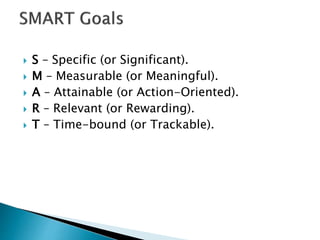
 S – Specific (or Significant).
 M – Measurable (or Meaningful).
 A – Attainable (or Action-Oriented).
 R – Relevant (or Rewarding).
 T – Time-bound (or Trackable).
 State each goal as a positive statement
 Be precise:
 Set priorities
 Write goals down
 Set performance goals, not outcome goals
 If you achieved the goal too easily, make your
next goal harder.
 If the goal took a dispiriting length of time to
achieve, make the next goal a little easier.
 If you learned something that would lead you
to change other goals, do so.
 If you noticed a deficit in your skills despite
achieving the goal, decide whether to set
goals to fix this.
 Career – "To be managing editor of the
magazine that I work for."
 Artistic – "To keep working on my illustration
skills. Ultimately I want to have my own show
in our downtown gallery."
 Physical – "To run a marathon."
 Five-year goal: "Become deputy editor."
 One-year goal: "Volunteer for projects that
the current Managing Editor is heading up."
 Six-month goal: "Go back to school and
finish my journalism degree."
 One-month goal: "Talk to the current
managing editor to determine what skills are
needed to do the job."
 One-week goal: "Book the meeting with the
Managing Editor."
 Deciding what you want to achieve in your
life.
 Separating what's important from what's
irrelevant, or a distraction.
 Motivating yourself.
 Building your self-confidence, based on
successful achievement of goals.

Goal setting

  • 2.
     Goal settingis a powerful process for thinking about your ideal future, and for motivating yourself to turn your vision of this future into reality.  The process of setting goals helps you choose where you want to go in life
  • 3.
     First youcreate your "big picture" of what you want to do with your life (or over, say, the next 10 years), and identify the large-scale goals that you want to achieve.  Then, you break these down into the smaller and smaller targets that you must hit to reach your lifetime goals.  Finally, once you have your plan, you start working on it to achieve these goals.
  • 4.
     Lifetime Goals whatyou want to achieve in your lifetime  Smaller Goals Then create a one-year plan, six-month plan, and a one-month plan of progressively smaller goals that you should reach to achieve your lifetime goals
  • 5.
     Career –What level do you want to reach in your career, or what do you want to achieve?  Financial – How much do you want to earn, by what stage? How is this related to your career goals?  Education – Is there any knowledge you want to acquire in particular? What information and skills will you need to have in order to achieve other goals?  Family – Do you want to be a parent? If so, how are you going to be a good parent? How do you want to be seen by a partner or by members of your extended family?
  • 6.
     Artistic –Do you want to achieve any artistic goals?  Attitude – Is any part of your mindset holding you back? Is there any part of the way that you behave that upsets you? (If so, set a goal to improve your behavior or find a solution to the problem.)  Physical – Are there any athletic goals that you want to achieve, or do you want good health deep into old age? What steps are you going to take to achieve this?  Pleasure – How do you want to enjoy yourself? (You should ensure that some of your life is for you!)  Public Service – Do you want to make the world a better place? If so, how?
  • 7.
     S –Specific (or Significant).  M – Measurable (or Meaningful).  A – Attainable (or Action-Oriented).  R – Relevant (or Rewarding).  T – Time-bound (or Trackable).
  • 8.
     State eachgoal as a positive statement  Be precise:  Set priorities  Write goals down  Set performance goals, not outcome goals
  • 9.
     If youachieved the goal too easily, make your next goal harder.  If the goal took a dispiriting length of time to achieve, make the next goal a little easier.  If you learned something that would lead you to change other goals, do so.  If you noticed a deficit in your skills despite achieving the goal, decide whether to set goals to fix this.
  • 10.
     Career –"To be managing editor of the magazine that I work for."  Artistic – "To keep working on my illustration skills. Ultimately I want to have my own show in our downtown gallery."  Physical – "To run a marathon."
  • 11.
     Five-year goal:"Become deputy editor."  One-year goal: "Volunteer for projects that the current Managing Editor is heading up."  Six-month goal: "Go back to school and finish my journalism degree."  One-month goal: "Talk to the current managing editor to determine what skills are needed to do the job."  One-week goal: "Book the meeting with the Managing Editor."
  • 12.
     Deciding whatyou want to achieve in your life.  Separating what's important from what's irrelevant, or a distraction.  Motivating yourself.  Building your self-confidence, based on successful achievement of goals.