Goal Setting Workshop 2008 GMR Group
Introductions Purpose of today’s Workshop Your Workbook Ground Rules
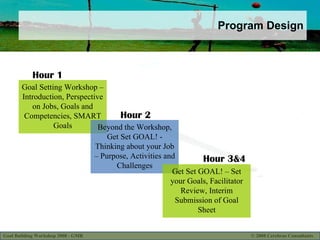
Program Design Goal Setting Workshop – Introduction, Perspective on Jobs, Goals and Competencies, SMART Goals Beyond the Workshop, Get Set GOAL! - Thinking about your Job – Purpose, Activities and Challenges Get Set GOAL! – Set your Goals, Facilitator Review, Interim Submission of Goal Sheet Hour 1 Hour 2 Hour 3&4
Business Context Multiple businesses / geographies  Different stages of maturity Project and SLA based organization
Design of the Workshop Emphasis on the Job route Your job    Your goals THE GOAL IS YOURS – OWN THE GOAL!
Objectives of the Workshop At the end of this workshop you should have an 85% complete  goal sheet  consisting of SMART goals
Some Typical Questions My role keeps changing My goals are not accurate I already have a goal sheet… My team has been setting goals every year What about the Balanced Score Card? Is this process going to make a difference? I do not have a fixed set of responsibilities
Understanding Jobs
Key Aspects Key Aspects of a Job Job Purpose Key responsibilities and Duties Key Activities and Tasks Interactions
Thinking about your Job – Perspective 1 What aspect of your job is… Strategic Managerial Operational Strategic  – Policy formulation and strategic decision making. Managerial  – effective acquisition, retention and development of resources Operational  – effective running of day to day activities/operations
Thinking about your Job – Perspective 2 Set Performance Goals Required Competencies Excellent Performance Focus on RESULTS Focus on BEHAVIOR & SKILLS WHAT HOW
Competencies An underlying characteristic that drives superior performance Behavioral Competencies Technical Competencies COMPETENCIES E.g.  Result Orientation  (Delivering the promise) – identifies, confronts and overcomes barriers to successful completion of a task or project. E.g.  Project Management  – apply project management principles to the initiation, planning, execution and closure stages of a project while efficiently managing cost, quality and time
How Many Goals “ If you chase two rabbits, both will escape…” Too many goals defeat the purpose A goal is something you want to achieve!
GMR PMP Process Assessment of  Values &  Beliefs Score  Achievement  of Goals Score 70% 30% Final Performance Score
GMR Goal Setting 2008 GMR Values & Beliefs Humility Respect for individual Learning Deliver the promise Social Responsibility Teamwork  & Relationship V & B Entrepreneurship
Types of Goals Problem Solving Goals – Solving specific issues. E.g. Reduce non-budgeted expenditure by 5% Maintenance Goals – Continuous job responsibilities. E.g. Generate pay checks by end of every month Majority of goals Project Goals – For specific one time projects, new services & operations. E.g. SAP implementation by June 3 rd Learning Goals - Learning a new job or developing a new skill. E.g. Improve written communication skills Types of Goals
SMART Goals Goals should be straightforward and specific.  Answer the questions – Who, What, Where, When, Which, Why Measuring your goals helps you stay on track. If you can’t measure it, you can’t manage it. How much? How many? A goal must be capable of being reached. The goal must be achievable and still stretching. So you feel you can do it and it will need a real commitment from you. S pecific M easurable A ttainable S M A R T R elevant T imeline
SMART Goals The goal must be able to produce an impact or change. In addition, the goal must also be important to the organization. Set a timeframe for the goal. Putting an end point on your goal gives you a clear target to work towards. R elevant T imeline S M A R T S pecific M easurable A ttainable
Example – SMART goals SMART Goal  – Appoint an external consultant with expertise in the area of Engineering and Design by June 3 rd  and draw a Service Level Agreement in adherence to the company’s policies. SMART Goal  – Respond to a RFP in adherence to the company’s policies within two weeks of receipt along with required inputs from the Construction as well as Engineering team. Goal  – Respond to a ‘Request for Proposal’ Goal  – Hire a consultant
Set Goals with Measurements Measurements provide a method of feedback and evaluation Objective Measurements – Quantitative measurement, specific end result e.g. Cost, Revenue, Output Subjective Measurements – Depends on a view point, subjective end result E.g. Opinions, Experience, Perception, Customer Satisfaction Goals with Measurements
Beyond Goals The Performance Management Cycle Review – Discuss results, Review and refine goals Assess – Development plans Planning – Set goals, Identify support and barriers
The Goal Setting Worksheet A Quick Job Analysis  – Activities, Responsibilities and Challenges Goal Setting  – Goals, Target, Responsibility, Support and Action Plans
Beyond This Workshop By the end of this workshop you should have a 85% completed goal sheet consisting of SMART goals Next Steps Review the goals that you have set in this workshop Discuss them with your supervisor Finalize your goal sheet Get a sign off from your supervisor Send us your completed goal sheet within 10 days from today
Contact Us Get in touch with your Trainer / Facilitator directly for any queries Contact us over email at the following address [email_address] Send in your final goal sheet at [email_address]
Prizes to be Won!! All participants to get souvenirs on submission of signed-off goal sheets. Early bird prizes for the first 100 completed goal sheets in each location Two prizes in each session for the best goal sheet All prizes and souvenirs will be announced at the end of all programs (mid-June)
Get Set GOAL!!

Goal Setting

  • 1.
    Goal Setting Workshop2008 GMR Group
  • 2.
    Introductions Purpose oftoday’s Workshop Your Workbook Ground Rules
  • 3.
    Program Design GoalSetting Workshop – Introduction, Perspective on Jobs, Goals and Competencies, SMART Goals Beyond the Workshop, Get Set GOAL! - Thinking about your Job – Purpose, Activities and Challenges Get Set GOAL! – Set your Goals, Facilitator Review, Interim Submission of Goal Sheet Hour 1 Hour 2 Hour 3&4
  • 4.
    Business Context Multiplebusinesses / geographies Different stages of maturity Project and SLA based organization
  • 5.
    Design of theWorkshop Emphasis on the Job route Your job  Your goals THE GOAL IS YOURS – OWN THE GOAL!
  • 6.
    Objectives of theWorkshop At the end of this workshop you should have an 85% complete goal sheet consisting of SMART goals
  • 7.
    Some Typical QuestionsMy role keeps changing My goals are not accurate I already have a goal sheet… My team has been setting goals every year What about the Balanced Score Card? Is this process going to make a difference? I do not have a fixed set of responsibilities
  • 8.
  • 9.
    Key Aspects KeyAspects of a Job Job Purpose Key responsibilities and Duties Key Activities and Tasks Interactions
  • 10.
    Thinking about yourJob – Perspective 1 What aspect of your job is… Strategic Managerial Operational Strategic – Policy formulation and strategic decision making. Managerial – effective acquisition, retention and development of resources Operational – effective running of day to day activities/operations
  • 11.
    Thinking about yourJob – Perspective 2 Set Performance Goals Required Competencies Excellent Performance Focus on RESULTS Focus on BEHAVIOR & SKILLS WHAT HOW
  • 12.
    Competencies An underlyingcharacteristic that drives superior performance Behavioral Competencies Technical Competencies COMPETENCIES E.g. Result Orientation (Delivering the promise) – identifies, confronts and overcomes barriers to successful completion of a task or project. E.g. Project Management – apply project management principles to the initiation, planning, execution and closure stages of a project while efficiently managing cost, quality and time
  • 13.
    How Many Goals“ If you chase two rabbits, both will escape…” Too many goals defeat the purpose A goal is something you want to achieve!
  • 14.
    GMR PMP ProcessAssessment of Values & Beliefs Score Achievement of Goals Score 70% 30% Final Performance Score
  • 15.
    GMR Goal Setting2008 GMR Values & Beliefs Humility Respect for individual Learning Deliver the promise Social Responsibility Teamwork & Relationship V & B Entrepreneurship
  • 16.
    Types of GoalsProblem Solving Goals – Solving specific issues. E.g. Reduce non-budgeted expenditure by 5% Maintenance Goals – Continuous job responsibilities. E.g. Generate pay checks by end of every month Majority of goals Project Goals – For specific one time projects, new services & operations. E.g. SAP implementation by June 3 rd Learning Goals - Learning a new job or developing a new skill. E.g. Improve written communication skills Types of Goals
  • 17.
    SMART Goals Goalsshould be straightforward and specific. Answer the questions – Who, What, Where, When, Which, Why Measuring your goals helps you stay on track. If you can’t measure it, you can’t manage it. How much? How many? A goal must be capable of being reached. The goal must be achievable and still stretching. So you feel you can do it and it will need a real commitment from you. S pecific M easurable A ttainable S M A R T R elevant T imeline
  • 18.
    SMART Goals Thegoal must be able to produce an impact or change. In addition, the goal must also be important to the organization. Set a timeframe for the goal. Putting an end point on your goal gives you a clear target to work towards. R elevant T imeline S M A R T S pecific M easurable A ttainable
  • 19.
    Example – SMARTgoals SMART Goal – Appoint an external consultant with expertise in the area of Engineering and Design by June 3 rd and draw a Service Level Agreement in adherence to the company’s policies. SMART Goal – Respond to a RFP in adherence to the company’s policies within two weeks of receipt along with required inputs from the Construction as well as Engineering team. Goal – Respond to a ‘Request for Proposal’ Goal – Hire a consultant
  • 20.
    Set Goals withMeasurements Measurements provide a method of feedback and evaluation Objective Measurements – Quantitative measurement, specific end result e.g. Cost, Revenue, Output Subjective Measurements – Depends on a view point, subjective end result E.g. Opinions, Experience, Perception, Customer Satisfaction Goals with Measurements
  • 21.
    Beyond Goals ThePerformance Management Cycle Review – Discuss results, Review and refine goals Assess – Development plans Planning – Set goals, Identify support and barriers
  • 22.
    The Goal SettingWorksheet A Quick Job Analysis – Activities, Responsibilities and Challenges Goal Setting – Goals, Target, Responsibility, Support and Action Plans
  • 23.
    Beyond This WorkshopBy the end of this workshop you should have a 85% completed goal sheet consisting of SMART goals Next Steps Review the goals that you have set in this workshop Discuss them with your supervisor Finalize your goal sheet Get a sign off from your supervisor Send us your completed goal sheet within 10 days from today
  • 24.
    Contact Us Getin touch with your Trainer / Facilitator directly for any queries Contact us over email at the following address [email_address] Send in your final goal sheet at [email_address]
  • 25.
    Prizes to beWon!! All participants to get souvenirs on submission of signed-off goal sheets. Early bird prizes for the first 100 completed goal sheets in each location Two prizes in each session for the best goal sheet All prizes and souvenirs will be announced at the end of all programs (mid-June)
  • 26.

Editor's Notes

  • #24 Ask sabitha – scan or take away the goal sheets