Start Your Semester  Right On Time Learning Center Shippensburg University
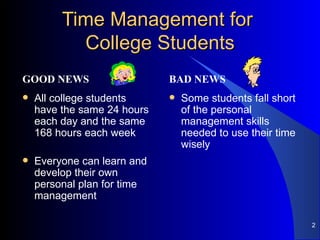
Time Management for  College Students GOOD NEWS All college students have the same 24 hours each day and the same 168 hours each week Everyone can learn and develop their own personal plan for time management BAD NEWS Some students fall short of the personal management skills needed to use their time wisely
Why use a time management plan? To provide  structure  and  balance  among all of the things you  need  and  want  to do To provide a road map to  accomplish  academic and personal  goals . To learn  new  and  different  time management skills since college is different from high school.
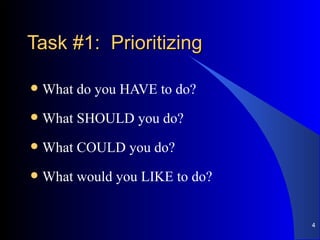
Task #1:  Prioritizing What do you HAVE to do?  What SHOULD you do?  What COULD you do?  What would you LIKE to do?
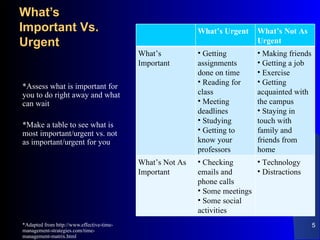
What’s Important Vs. Urgent *Assess what is important for you to do right away and what can wait *Make a table to see what is most important/urgent vs. not as important/urgent for you *Adapted from http://www.effective-time-management-strategies.com/time-management-matrix.html What’s Urgent What’s Not As Urgent What’s Important Getting assignments done on time Reading for class Meeting deadlines Studying Getting to know your professors Making friends Getting a job Exercise Getting acquainted with the campus Staying in touch with family and friends from home What’s Not As Important Checking emails and phone calls Some meetings Some social activities Technology Distractions
Task #2:  Making a Schedule Once you have prioritized what is most important/urgent for you to do, create a schedule for yourself (daily/weekly/monthly) Put the schedule somewhere you can see it every day and add new information as needed Buy a planner or calendar
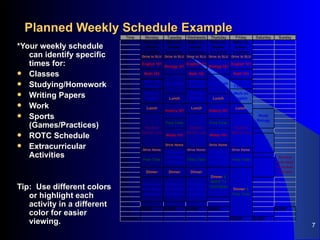
Planned Weekly Schedule Example *Your weekly schedule can identify specific times for: Classes Studying/Homework Writing Papers  Work Sports (Games/Practices) ROTC Schedule Extracurricular Activities Tip:  Use different colors or highlight  each activity in a different color  for easier viewing.
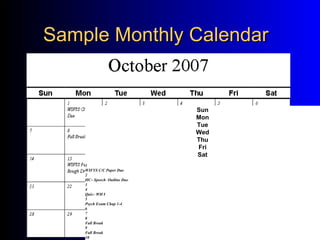
Sample Monthly Calendar Sun Mon Tue Wed Thu Fri Sat 1 WIFYS C/C Paper Due 2 HC– Speech  Outline Due 3 4 Quiz– WH I 5 Psych Exam Chap 1-4 6 7 8 Fall Break 9 Fall Break 10 11 HC– Pers Speech 12 Psych Project Due 13 14 15 WIFYS Pers. Rough Draft Due 16 17 Art Apprec  Midterm Psych Quiz 18 WH I Midterm 19 20 21 22 23 HC Quiz 24 25 26 27 28 29 30 HC– Group  Project Due 31 Sun Mon Tue Wed Thu Fri Sat 1 WIFYS C/C Paper Due 2 HC– Speech  Outline Due 3 4 Quiz– WH I 5 Psych Exam Chap 1-4 6 7 8 Fall Break 9 Fall Break 10 11 HC– Pers Speech 12 Psych Project Due 13 14 15 WIFYS Pers. Rough Draft Due 16 17 Art Apprec  Midterm Psych Quiz 18 WH I Midterm 19 20 21 22 23 HC Quiz 24 25 26 27 28 29 30 HC– Group  Project Due 31
Task #3: Avoid Procrastination! Perhaps the #1 enemy of college success Strategies: Ask yourself – Why are you putting specific things off? Do not wait until the night before to start a big project!  Start big projects early.  Break it into manageable parts.
The Keys to Your Time Management Plan Set precise and realistic goals Develop a plan for the whole semester Commit to your plan 100%! Keep in mind the times of day that you are most effective!
More Time Management Hints! Take advantage of small breaks (use half-hours or hours between classes to get work done) Participate in a study group for  reinforcement of your learning process Allow time each week to adjust your schedule for unexpected changes or for when more intense studying is required Look ahead up upcoming events so that you are prepared when they arrive
More Helpful Hints Establish a study routine to study at the same place and time each day Study as soon after class as possible Reward yourself Example: Read and study before your favorite TV show then reward yourself by watching the show stress-free
Get Help Scheduling for Big Projects/Papers Try using this URL for research paper planning: http:// www.lib.umn.edu/help/calculator
Where to Get More Help Learning Center (717) 477-1420 First Floor of Lehman Library:  http://www.ship.edu/learning/ AIM participations  will receive credit for viewing this Power Point presentation by answering the questions below and emailing your replies to  [email_address] . 1. Was this presentation useful? 2. Which part of the presentation did you find most useful? 3. Which part of the presentation was the least useful? 4. What are you going to do now based on what you have learned from this  presentation?

Time mangement

  • 1.
    Start Your Semester Right On Time Learning Center Shippensburg University
  • 2.
    Time Management for College Students GOOD NEWS All college students have the same 24 hours each day and the same 168 hours each week Everyone can learn and develop their own personal plan for time management BAD NEWS Some students fall short of the personal management skills needed to use their time wisely
  • 3.
    Why use atime management plan? To provide structure and balance among all of the things you need and want to do To provide a road map to accomplish academic and personal goals . To learn new and different time management skills since college is different from high school.
  • 4.
    Task #1: Prioritizing What do you HAVE to do? What SHOULD you do? What COULD you do? What would you LIKE to do?
  • 5.
    What’s Important Vs.Urgent *Assess what is important for you to do right away and what can wait *Make a table to see what is most important/urgent vs. not as important/urgent for you *Adapted from http://www.effective-time-management-strategies.com/time-management-matrix.html What’s Urgent What’s Not As Urgent What’s Important Getting assignments done on time Reading for class Meeting deadlines Studying Getting to know your professors Making friends Getting a job Exercise Getting acquainted with the campus Staying in touch with family and friends from home What’s Not As Important Checking emails and phone calls Some meetings Some social activities Technology Distractions
  • 6.
    Task #2: Making a Schedule Once you have prioritized what is most important/urgent for you to do, create a schedule for yourself (daily/weekly/monthly) Put the schedule somewhere you can see it every day and add new information as needed Buy a planner or calendar
  • 7.
    Planned Weekly ScheduleExample *Your weekly schedule can identify specific times for: Classes Studying/Homework Writing Papers Work Sports (Games/Practices) ROTC Schedule Extracurricular Activities Tip: Use different colors or highlight each activity in a different color for easier viewing.
  • 8.
    Sample Monthly CalendarSun Mon Tue Wed Thu Fri Sat 1 WIFYS C/C Paper Due 2 HC– Speech Outline Due 3 4 Quiz– WH I 5 Psych Exam Chap 1-4 6 7 8 Fall Break 9 Fall Break 10 11 HC– Pers Speech 12 Psych Project Due 13 14 15 WIFYS Pers. Rough Draft Due 16 17 Art Apprec Midterm Psych Quiz 18 WH I Midterm 19 20 21 22 23 HC Quiz 24 25 26 27 28 29 30 HC– Group Project Due 31 Sun Mon Tue Wed Thu Fri Sat 1 WIFYS C/C Paper Due 2 HC– Speech Outline Due 3 4 Quiz– WH I 5 Psych Exam Chap 1-4 6 7 8 Fall Break 9 Fall Break 10 11 HC– Pers Speech 12 Psych Project Due 13 14 15 WIFYS Pers. Rough Draft Due 16 17 Art Apprec Midterm Psych Quiz 18 WH I Midterm 19 20 21 22 23 HC Quiz 24 25 26 27 28 29 30 HC– Group Project Due 31
  • 9.
    Task #3: AvoidProcrastination! Perhaps the #1 enemy of college success Strategies: Ask yourself – Why are you putting specific things off? Do not wait until the night before to start a big project! Start big projects early. Break it into manageable parts.
  • 10.
    The Keys toYour Time Management Plan Set precise and realistic goals Develop a plan for the whole semester Commit to your plan 100%! Keep in mind the times of day that you are most effective!
  • 11.
    More Time ManagementHints! Take advantage of small breaks (use half-hours or hours between classes to get work done) Participate in a study group for reinforcement of your learning process Allow time each week to adjust your schedule for unexpected changes or for when more intense studying is required Look ahead up upcoming events so that you are prepared when they arrive
  • 12.
    More Helpful HintsEstablish a study routine to study at the same place and time each day Study as soon after class as possible Reward yourself Example: Read and study before your favorite TV show then reward yourself by watching the show stress-free
  • 13.
    Get Help Schedulingfor Big Projects/Papers Try using this URL for research paper planning: http:// www.lib.umn.edu/help/calculator
  • 14.
    Where to GetMore Help Learning Center (717) 477-1420 First Floor of Lehman Library: http://www.ship.edu/learning/ AIM participations will receive credit for viewing this Power Point presentation by answering the questions below and emailing your replies to [email_address] . 1. Was this presentation useful? 2. Which part of the presentation did you find most useful? 3. Which part of the presentation was the least useful? 4. What are you going to do now based on what you have learned from this presentation?