Time Management
 and Goal Setting

      UGST 1000
      FALL 2012
Personal Time Survey

Figure out how you spend your time
Can help to identify time wasters
Did you run out of hours in the week?
    Where do you need to cut back in order to not be burnt out?
Do you have some free time?
    Where can you use that time best?
Keep track of how you spend your time for a week for a
 more accurate estimate
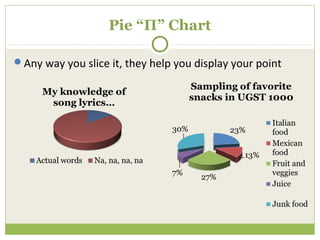
Pie “П” Chart

Any way you slice it, they help you display your point
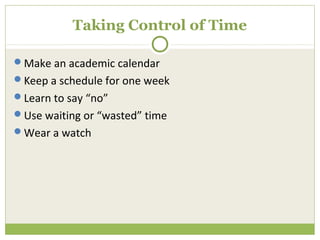
Taking Control of Time

Make an academic calendar
Keep a schedule for one week
Learn to say “no”
Use waiting or “wasted” time
Wear a watch
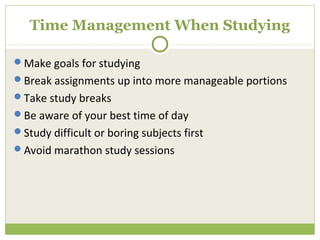
Time Management When Studying

Make goals for studying
Break assignments up into more manageable portions
Take study breaks
Be aware of your best time of day
Study difficult or boring subjects first
Avoid marathon study sessions
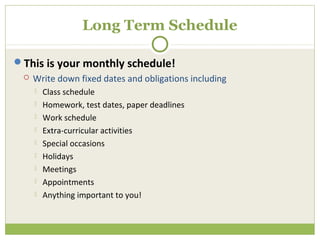
Long Term Schedule

This is your monthly schedule!
    Write down fixed dates and obligations including
        Class schedule
        Homework, test dates, paper deadlines
        Work schedule
        Extra-curricular activities
        Special occasions
        Holidays
        Meetings
        Appointments
        Anything important to you!
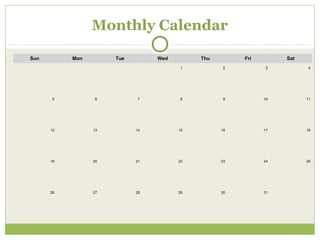
Monthly Calendar

Sun        Mon        Tue        Wed        Thu        Fri        Sat
                                       1          2          3          4


      5          6          7          8          9          10         11


      12         13         14         15         16         17         18


      19         20         21         22         23         24         25


      26         27         28         29         30         31
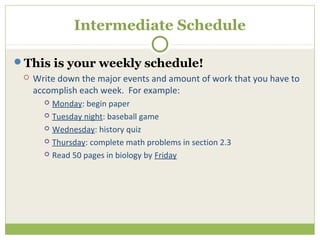
Intermediate Schedule

This is your weekly schedule!
    Write down the major events and amount of work that you have to
     accomplish each week. For example:
        Monday: begin paper
        Tuesday night: baseball game

        Wednesday: history quiz

        Thursday: complete math problems in section 2.3

        Read 50 pages in biology by Friday
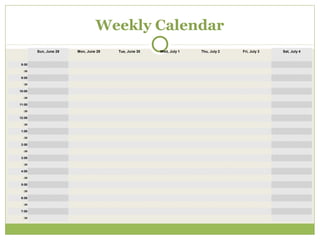
Weekly Calendar
        Sun, June 28   Mon, June 29   Tue, June 30   Wed, July 1   Thu, July 2   Fri, July 3   Sat, July 4


 8:00

  :30

 9:00

  :30

10:00

  :30

11:00

  :30

12:00

  :30

 1:00

  :30

 2:00

  :30

 3:00

  :30

 4:00

  :30

 5:00

  :30

 6:00

  :30

 7:00

  :30
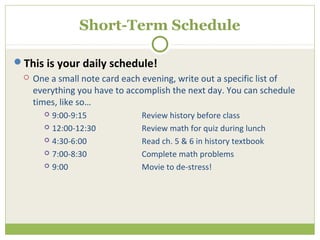
Short-Term Schedule

This is your daily schedule!
    One a small note card each evening, write out a specific list of
     everything you have to accomplish the next day. You can schedule
     times, like so…
        9:00-9:15             Review history before class
        12:00-12:30           Review math for quiz during lunch
        4:30-6:00             Read ch. 5 & 6 in history textbook
        7:00-8:30             Complete math problems
        9:00                  Movie to de-stress!
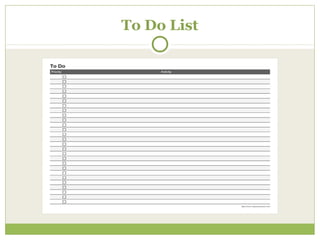
To Do List
ABC List

Write down the day’s tasks and place A, B or C according
 to priority
    “A” means most urgent
    “B” mildly urgent
    “C” not urgent
    Your ABC list may look like this:
        Read three chapters in English book for discussion tomorrow (A)
        Begin working on psychology paper due in three weeks (C)

        Call best friend before she goes to bed (B)

        Vacuum room (B)

        Complete math problems for class tomorrow (A)
Setting Goals

Setting goals can help with time management
Manage time better by figuring out what your goals are
S.M.A.R.T Goals
       SPECIFIC
       MEASUREABLE
       ACTION-ORIENTED
       REALISTIC
       TIMELY
S.M.A.R.T. Goals

SPECIFIC
        Specifics help us to focus our efforts and clearly define what we are
         going to do.
        Specific is the What, Why, and How of the SMART model.
        WHAT are you going to do? Use action words such as direct, organize,
         coordinate, develop, plan, build etc. WHY is this important to do at this
         time? HOW are you going to do it?
        Ensure that the goals you set are very specific, clear, and reachable.
MEASURABLE
        If you can't measure it, you can't manage it.
        Choose a goal with measurable progress so you can see the change
         occur.
        Establish concrete criteria for measuring progress toward the
         attainment of each goal you set.
S.M.A.R.T. Goals

 ACTION ORIENTED
        What will you do action wise to ensure your success?
        Once you’ve put a plan in action, following through with it is the most
         important and sometimes hardest part.
REALISTIC
        A goal needs to stretch you slightly so you feel you can do it and it will
         need a real commitment from you.
        Set goals that are too difficult and you set the stage for failure, but
         setting too low sends yourself the message that you aren't very capable.
        Set the bar high enough for a satisfying achievement!
TIMELY
        Set a timeframe for the goal.
        Without a time limit, there's no urgency to start taking action now.
Motivation Tips

Think about the end result
Set S.M.A.R.T. goals and write them down
Be active
Set aside time for you

Time Management

  • 1.
    Time Management andGoal Setting UGST 1000 FALL 2012
  • 2.
    Personal Time Survey Figureout how you spend your time Can help to identify time wasters Did you run out of hours in the week?  Where do you need to cut back in order to not be burnt out? Do you have some free time?  Where can you use that time best? Keep track of how you spend your time for a week for a more accurate estimate
  • 3.
    Pie “П” Chart Anyway you slice it, they help you display your point
  • 4.
    Taking Control ofTime Make an academic calendar Keep a schedule for one week Learn to say “no” Use waiting or “wasted” time Wear a watch
  • 5.
    Time Management WhenStudying Make goals for studying Break assignments up into more manageable portions Take study breaks Be aware of your best time of day Study difficult or boring subjects first Avoid marathon study sessions
  • 6.
    Long Term Schedule Thisis your monthly schedule!  Write down fixed dates and obligations including  Class schedule  Homework, test dates, paper deadlines  Work schedule  Extra-curricular activities  Special occasions  Holidays  Meetings  Appointments  Anything important to you!
  • 7.
    Monthly Calendar Sun Mon Tue Wed Thu Fri Sat 1 2 3 4 5 6 7 8 9 10 11 12 13 14 15 16 17 18 19 20 21 22 23 24 25 26 27 28 29 30 31
  • 8.
    Intermediate Schedule This isyour weekly schedule!  Write down the major events and amount of work that you have to accomplish each week. For example:  Monday: begin paper  Tuesday night: baseball game  Wednesday: history quiz  Thursday: complete math problems in section 2.3  Read 50 pages in biology by Friday
  • 9.
    Weekly Calendar Sun, June 28 Mon, June 29 Tue, June 30 Wed, July 1 Thu, July 2 Fri, July 3 Sat, July 4 8:00 :30 9:00 :30 10:00 :30 11:00 :30 12:00 :30 1:00 :30 2:00 :30 3:00 :30 4:00 :30 5:00 :30 6:00 :30 7:00 :30
  • 10.
    Short-Term Schedule This isyour daily schedule!  One a small note card each evening, write out a specific list of everything you have to accomplish the next day. You can schedule times, like so…  9:00-9:15 Review history before class  12:00-12:30 Review math for quiz during lunch  4:30-6:00 Read ch. 5 & 6 in history textbook  7:00-8:30 Complete math problems  9:00 Movie to de-stress!
  • 11.
  • 12.
    ABC List Write downthe day’s tasks and place A, B or C according to priority  “A” means most urgent  “B” mildly urgent  “C” not urgent  Your ABC list may look like this:  Read three chapters in English book for discussion tomorrow (A)  Begin working on psychology paper due in three weeks (C)  Call best friend before she goes to bed (B)  Vacuum room (B)  Complete math problems for class tomorrow (A)
  • 13.
    Setting Goals Setting goalscan help with time management Manage time better by figuring out what your goals are S.M.A.R.T Goals  SPECIFIC  MEASUREABLE  ACTION-ORIENTED  REALISTIC  TIMELY
  • 14.
    S.M.A.R.T. Goals SPECIFIC  Specifics help us to focus our efforts and clearly define what we are going to do.  Specific is the What, Why, and How of the SMART model.  WHAT are you going to do? Use action words such as direct, organize, coordinate, develop, plan, build etc. WHY is this important to do at this time? HOW are you going to do it?  Ensure that the goals you set are very specific, clear, and reachable. MEASURABLE  If you can't measure it, you can't manage it.  Choose a goal with measurable progress so you can see the change occur.  Establish concrete criteria for measuring progress toward the attainment of each goal you set.
  • 15.
    S.M.A.R.T. Goals  ACTIONORIENTED  What will you do action wise to ensure your success?  Once you’ve put a plan in action, following through with it is the most important and sometimes hardest part. REALISTIC  A goal needs to stretch you slightly so you feel you can do it and it will need a real commitment from you.  Set goals that are too difficult and you set the stage for failure, but setting too low sends yourself the message that you aren't very capable.  Set the bar high enough for a satisfying achievement! TIMELY  Set a timeframe for the goal.  Without a time limit, there's no urgency to start taking action now.
  • 16.
    Motivation Tips Think aboutthe end result Set S.M.A.R.T. goals and write them down Be active Set aside time for you