Do you have a goal???
Goals should be... Specific Getting an “A” in Math and a “B” in Accounts is much more specific than just saying that you would like to get good grades this semester Measurable You’re more likely to keep up if you can see progress toward your goal.  For example, getting an “A” on your midterm is measurable progress toward getting an “A” in the class.
Moderately difficult A goal that is too hard or too easy will decrease your motivation and won’t show you what you’re really capable of accomplishing.  Use what you’ve accomplished in the past as a guide Self-chosen You are much more likely to achieve a goal that you set for yourself than one that has been set for you
Positive Say what you do want to accomplish instead of what you don’t want to do.  “I will attend all classes,” is much better than “I won’t skip any classes.” Realistic Winning a marathon after two weeks of training is an unrealistic goal. Use what you’ve accomplished in the past to set a reasonable goal for the future.
Flexible If it looks like you can’t reach your original goal, be flexible and redraw your plan Associated with a deadline When do you plan on accomplishing this goal, in a month, day, or year?
Written down It will serve as a better reminder to keep you motivated
Where goal setting can go wrong When goal setting is disorganized For example, keep personal and academic goals separate  When goals are unrealistic For example, becoming a company CEO immediately after graduation is an unrealistic goal Goals that are ‘beyond’ your control For example, winning the lottery is definitely beyond your control
When goals are vague For example, “becoming successful” or “becoming a better student” are not clear goals to work toward. When you set too many goals At any one time you should focus on achieving only three or four goals
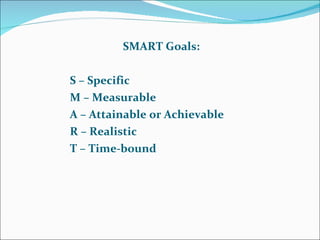
SMART Goals: S – Specific M – Measurable A – Attainable or Achievable R – Realistic T – Time-bound
SMART Goals offer:   Clarity Direction Increased motivation, involvement,   & commitment Improved chances for success So, everyone… Get SMART with the goals you are setting!
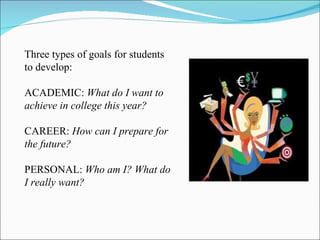
Three types of goals for students to develop:  ACADEMIC:  What do I want to achieve in college this year? CAREER:  How can I prepare for the future? PERSONAL:  Who am I? What do I really want?
GOALS: ACADEMIC How can I build on my strengths? How can I improve? What can I achieve? (attendance, percentage, course selection…)
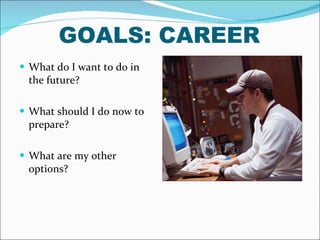
GOALS: CAREER What do I want to do in the future? What should I do now to prepare? What are my other options?
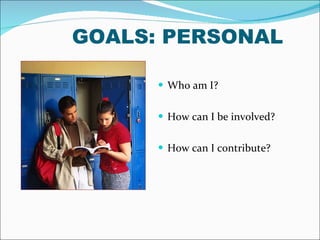
GOALS: PERSONAL Who am I? How can I be involved? How can I contribute?
Types of Procrastinators Perfectionist: wants to be perfect; needs to focus on excellence Dreamer: Have big ideas but don’t follow through; needs to set specific goals Worrier: avoids situations that cause stress/anxiety; needs to break tasks down and focus on what they do know
Crisis-Maker: Enjoy getting it done at the last minute; needs to create own motivation Overdoer: Have difficulty saying no; needs to set daily priorities and create time for self.
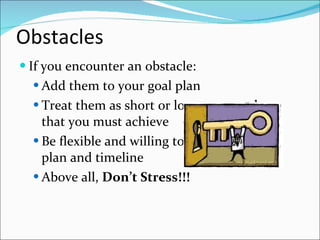
Obstacles If you encounter an obstacle: Add them to your goal plan Treat them as short or long term goals that you must achieve Be flexible and willing to change your plan and timeline Above all,  Don’t Stress!!!
Dealing with Procrastination? If your goal is long term Take small steps to complete your goal No matter what, just start Keep little reminders Tell a friend your goal, ask them to remind you Keep little notes of encouragement Reward yourself when you complete a task Buy something special for yourself Do something special for yourself Call someone who would motivate you
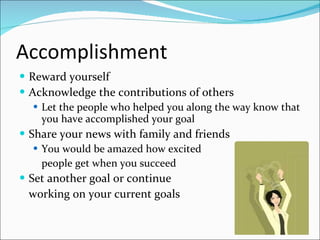
Accomplishment Reward yourself  Acknowledge the contributions of others Let the people who helped you along the way know that you have accomplished your goal Share your news with family and friends You would be amazed how excited  people get when you succeed Set another goal or continue  working on your current goals
Assignment Complete your Goal Setting by –  ---------, 2010
Goal Setting Exercise What motivates you? And Why? Money Recognition Desire to please Self Satisfaction Sense of Accomplishment Fear Physical needs Any other _____________
Visualize what you would like to be doing 5 years from now Higher Studies? Working? Family? Home? Car? How will you reach these goals?
In what general area/career do you wish to work? What will be your most important “product/deed” for which you want to be remembered? What kind of person do you want to be? What words describe your ideal lifestyle?
By: Prof. Sandeep Sharma 9310102022 9311111727 [email_address]

Goal setting

  • 1.
  • 2.
    Do you havea goal???
  • 3.
    Goals should be...Specific Getting an “A” in Math and a “B” in Accounts is much more specific than just saying that you would like to get good grades this semester Measurable You’re more likely to keep up if you can see progress toward your goal. For example, getting an “A” on your midterm is measurable progress toward getting an “A” in the class.
  • 4.
    Moderately difficult Agoal that is too hard or too easy will decrease your motivation and won’t show you what you’re really capable of accomplishing. Use what you’ve accomplished in the past as a guide Self-chosen You are much more likely to achieve a goal that you set for yourself than one that has been set for you
  • 5.
    Positive Say whatyou do want to accomplish instead of what you don’t want to do. “I will attend all classes,” is much better than “I won’t skip any classes.” Realistic Winning a marathon after two weeks of training is an unrealistic goal. Use what you’ve accomplished in the past to set a reasonable goal for the future.
  • 6.
    Flexible If itlooks like you can’t reach your original goal, be flexible and redraw your plan Associated with a deadline When do you plan on accomplishing this goal, in a month, day, or year?
  • 7.
    Written down Itwill serve as a better reminder to keep you motivated
  • 8.
    Where goal settingcan go wrong When goal setting is disorganized For example, keep personal and academic goals separate When goals are unrealistic For example, becoming a company CEO immediately after graduation is an unrealistic goal Goals that are ‘beyond’ your control For example, winning the lottery is definitely beyond your control
  • 9.
    When goals arevague For example, “becoming successful” or “becoming a better student” are not clear goals to work toward. When you set too many goals At any one time you should focus on achieving only three or four goals
  • 10.
    SMART Goals: S– Specific M – Measurable A – Attainable or Achievable R – Realistic T – Time-bound
  • 11.
    SMART Goals offer: Clarity Direction Increased motivation, involvement, & commitment Improved chances for success So, everyone… Get SMART with the goals you are setting!
  • 12.
    Three types ofgoals for students to develop: ACADEMIC: What do I want to achieve in college this year? CAREER: How can I prepare for the future? PERSONAL: Who am I? What do I really want?
  • 13.
    GOALS: ACADEMIC Howcan I build on my strengths? How can I improve? What can I achieve? (attendance, percentage, course selection…)
  • 14.
    GOALS: CAREER Whatdo I want to do in the future? What should I do now to prepare? What are my other options?
  • 15.
    GOALS: PERSONAL Whoam I? How can I be involved? How can I contribute?
  • 16.
    Types of ProcrastinatorsPerfectionist: wants to be perfect; needs to focus on excellence Dreamer: Have big ideas but don’t follow through; needs to set specific goals Worrier: avoids situations that cause stress/anxiety; needs to break tasks down and focus on what they do know
  • 17.
    Crisis-Maker: Enjoy gettingit done at the last minute; needs to create own motivation Overdoer: Have difficulty saying no; needs to set daily priorities and create time for self.
  • 18.
    Obstacles If youencounter an obstacle: Add them to your goal plan Treat them as short or long term goals that you must achieve Be flexible and willing to change your plan and timeline Above all, Don’t Stress!!!
  • 19.
    Dealing with Procrastination?If your goal is long term Take small steps to complete your goal No matter what, just start Keep little reminders Tell a friend your goal, ask them to remind you Keep little notes of encouragement Reward yourself when you complete a task Buy something special for yourself Do something special for yourself Call someone who would motivate you
  • 20.
    Accomplishment Reward yourself Acknowledge the contributions of others Let the people who helped you along the way know that you have accomplished your goal Share your news with family and friends You would be amazed how excited people get when you succeed Set another goal or continue working on your current goals
  • 21.
    Assignment Complete yourGoal Setting by – ---------, 2010
  • 22.
    Goal Setting ExerciseWhat motivates you? And Why? Money Recognition Desire to please Self Satisfaction Sense of Accomplishment Fear Physical needs Any other _____________
  • 23.
    Visualize what youwould like to be doing 5 years from now Higher Studies? Working? Family? Home? Car? How will you reach these goals?
  • 24.
    In what generalarea/career do you wish to work? What will be your most important “product/deed” for which you want to be remembered? What kind of person do you want to be? What words describe your ideal lifestyle?
  • 25.
    By: Prof. SandeepSharma 9310102022 9311111727 [email_address]

Editor's Notes

  • #14 In the area of ACADEMIC DEVELOPMENT , what do students want to achieve in school this year? In Navigation, we give students the opportunity to learn to assess their own work and then build on their strengths to improve. Students’ goals in this area may be simple – such as attending class or doing homework – or they may be more ambitious, focused on taking advanced classes or preparing for postsecondary. As we’ll discuss later, students develop and reflect on academic goals throughout the Navigation year, including in the development of their annual Academic Improvement Plans (soon to be called Academic Inventories), in their course plans (soon to be called Four Year Plans) and in their annual drafts of the OSPI-required High School & Beyond Plan.
  • #15 In the area of CAREER DEVELOPMENT , students spend significant amounts of time in Navigation each year exploring their dreams for the future and then learning about what they need to do now to prepare for the future. This is where Navigation is particularly helpful: in helping students make connections between vague and distant goals for the future (such as, I want to be an engineer) to specific goals for this year and next year that will help the student prepare (such as I need to take pre-Calculus next year and find a job shadow at an engineering firm). Advisors are aided by the Navigation lesson plans to guide students to the tools that are available at each grade level: students may be able to take interest assessments, explore career pathways, research the educational needs for different careers, or aim to enroll in the courses they need to prepare themselves for a career dream. Navigation can also help students explore alternative options: what else would they like to do? What would that alternative dream require?
  • #16 In the area of PERSONAL & SOCIAL DEVELOPMENT, students are given opportunities each year to continue to define who they are and who they are becoming. Students are also encouraged – and given support – to become contributing members of the school community, and of the larger community. They are encouraged to join activities and get engaged in the life of the school – both to participate and also because research shows that students who are engaged and involved at school are significantly less likely to drop out. Students are also encouraged to learn how they can contribute, both to the school community and to the larger communities in which they live: Navigation helps provide structure for students to embark on volunteer service projects and to make service to others a key part of who they are.