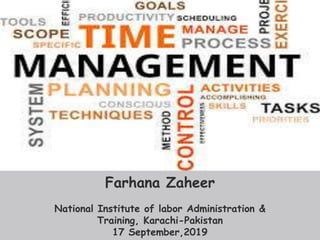
Farhana Zaheer
National Institute of labor Administration &
Training, Karachi-Pakistan
17 September,2019
Objective of Session
Guidelines for
Time
Management
Importance &
Scope of
Time
Management
Understanding
Time
Define Time…
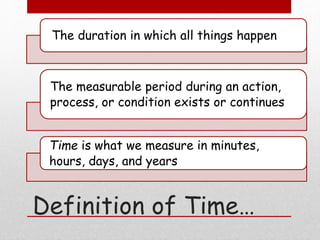
Definition of Time…
The duration in which all things happen
The measurable period during an action,
process, or condition exists or continues
Time is what we measure in minutes,
hours, days, and years
Time and Quran…
Time and Quran…
Time and Islam…
Definition of Time…
Process of
organizing &
planning how to
divide time
between specific
activities
Good time
management enables
you to work smarter
– not harder –
Self Management
Self Management
• You don’t manage time but manage
yourself, others and work
Time Management…
• Time Management is defined as the management
of time in order to make the most out of it
Ice Breaking Activity
Birthday Month order groups of all participants in 5
minutes
IMPORTANCE & SCOPE OF
TIME MANAGEMENT
Time Management
• Get organized
• Get structured
• Set short term goals
• Set long term goals
• Use a planner:
• daily schedule and “To Do” list
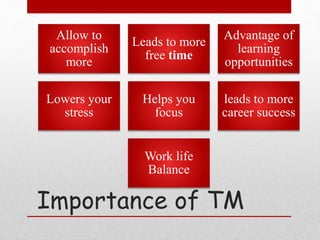
Importance of TM
Allow to
accomplish
more
Leads to more
free time
Advantage of
learning
opportunities
Lowers your
stress
Helps you
focus
leads to more
career success
Work life
Balance
Pareto analysis
• This is the idea that 80% of tasks can be completed in
20% of the disposable time, and the remaining 20% of
tasks will take up 80% of the time.
• This principle is used to sort tasks into two parts.
• According to this form of Pareto analysis it is
recommended that tasks that fall into the first category
be assigned a higher priority.
• It depend
Pareto analysis
The 80-20-rule can also be applied to increase
productivity: it is assumed that 80% of the
productivity can be achieved by doing 20% of the
tasks.
Similarly, 80% of results can be attributed to 20% of
activity.
If productivity is the aim of time management, then
these tasks should be prioritized higher.
TEA BREAK
GUIDELINES FOR TIME
MANAGEMENT
Time Consuming by..
Going to office hours
Late sitting
Checking email
Getting coffee
Volunteering
Doing research
Shopping for
groceries
Caring for family
members
Taking a nap
Exercising
Playing an instrument
Attending events
Chatting with friends
Helping a friend
Catching up!
Cultivating a
relationship
Meeting new people
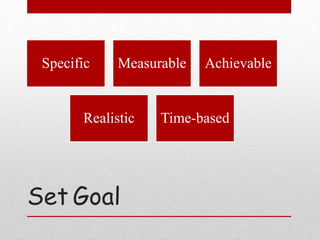
Specific Measurable Achievable
Realistic Time-based
Set Goal
Four Ds of TM
Do Delegate
Delay Delete
Name Your Time
Waster
• Person
• Place
• Thing
Steps- Managing Time
1. Set goals
2. Make a schedule
3. Revisit and revise your plan
4. Set Priorities
Avoid the offer to socialize
when you’ve scheduled
work.
Refuse at last minute,
decline but ask later in
week.
Socializing is important
when you don’t have other
things to worry about!
I have a study group
tonight. Are you free
on Thursday?
We are going for Movie
tonight. Are you free ?
Learn to say “No!”
Consider your personal
prime time
• Morning?
• Evening?
• Late night?
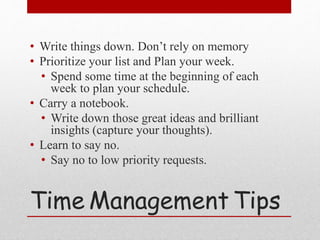
Time Management Tips
• Write things down. Don’t rely on memory
• Prioritize your list and Plan your week.
• Spend some time at the beginning of each
week to plan your schedule.
• Carry a notebook.
• Write down those great ideas and brilliant
insights (capture your thoughts).
• Learn to say no.
• Say no to low priority requests.
Activity # 01
6,400
Tell participants they have $86,400.00 to spend anyway
they wish. The only restrictions are that they cannot
bank any money and if they do not use any of the money
they lose it. We then discuss why and how they spent the
money the way they did. I then tell them that 86400 are
the number of seconds we have each day and that as
often as possible they should consider spending their
time on things that are important to them as they did
with their money.
Activity # 02
• HOW LONG IS A MINUTE?
• At the beginning of session I ask people to close their eyes for
30 seconds and after that to open it. Nobody can watch the
clock and I don’t measure the time. All I ask of participants is
to open their eyes after what they believe has been 30 seconds.
• Of course, they all open them at different times. Afterwards,
we talk about our understanding of time. Even though
everyone has an equal (24 hours a day or 30 seconds for
excercise), in fact, we experience it and use it in different
ways. Some of us experienced it as a short period, other as a
long. This always works as a good opener.
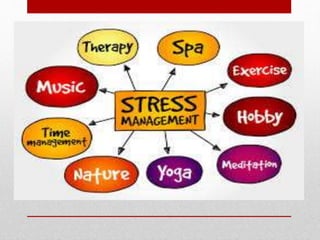
STRESS MANAGEMENT
Are you Stressed?
Feel like you are Losing It?
Signs of Stress
• Physical
• Headache
• Back Pain
• Fatigue
• Aches and Pains
• Mental
• Difficulty Concentrating
• Increased Errors
• Poor Decision Making
Relaxation
• Breathing: practice deep breathing
• Progressive muscle relaxation
• Guided Imagery
• Meditation
• Tapes, CDs etc.: Either something structured
(commercial) or soothing music
• Choose and schedule it in
Personal Stress First
Aid Kit
• What would you put in yours?
• I have in mine…
Name Your Stressor
• Person
• Place
• Thing
Conclusion
1. Time and management can make you more
productive and reduce your stress level.
2. The Three Steps- Set goals- Make a schedule Revisit
and revise your plan
3. Be tough with your time.
4. Actively avoid time wasters.
5. Learn to say “no” to distractions.
6. Employ a variety of time management strategies to
maximize your time.
7. Relax and enjoy the extra time that you’ve
discovered!
Questions?
Feedback & follow us at
Farza747@yahoo.com

Time Management 2019

  • 1.
    Farhana Zaheer National Instituteof labor Administration & Training, Karachi-Pakistan 17 September,2019
  • 2.
    Objective of Session Guidelinesfor Time Management Importance & Scope of Time Management Understanding Time
  • 3.
  • 4.
    Definition of Time… Theduration in which all things happen The measurable period during an action, process, or condition exists or continues Time is what we measure in minutes, hours, days, and years
  • 5.
  • 6.
  • 7.
  • 10.
    Definition of Time… Processof organizing & planning how to divide time between specific activities Good time management enables you to work smarter – not harder –
  • 12.
  • 13.
    Self Management • Youdon’t manage time but manage yourself, others and work
  • 14.
    Time Management… • TimeManagement is defined as the management of time in order to make the most out of it
  • 15.
    Ice Breaking Activity BirthdayMonth order groups of all participants in 5 minutes
  • 16.
    IMPORTANCE & SCOPEOF TIME MANAGEMENT
  • 17.
    Time Management • Getorganized • Get structured • Set short term goals • Set long term goals • Use a planner: • daily schedule and “To Do” list
  • 18.
    Importance of TM Allowto accomplish more Leads to more free time Advantage of learning opportunities Lowers your stress Helps you focus leads to more career success Work life Balance
  • 19.
    Pareto analysis • Thisis the idea that 80% of tasks can be completed in 20% of the disposable time, and the remaining 20% of tasks will take up 80% of the time. • This principle is used to sort tasks into two parts. • According to this form of Pareto analysis it is recommended that tasks that fall into the first category be assigned a higher priority. • It depend
  • 20.
    Pareto analysis The 80-20-rulecan also be applied to increase productivity: it is assumed that 80% of the productivity can be achieved by doing 20% of the tasks. Similarly, 80% of results can be attributed to 20% of activity. If productivity is the aim of time management, then these tasks should be prioritized higher.
  • 21.
  • 22.
  • 23.
    Time Consuming by.. Goingto office hours Late sitting Checking email Getting coffee Volunteering Doing research Shopping for groceries Caring for family members Taking a nap Exercising Playing an instrument Attending events Chatting with friends Helping a friend Catching up! Cultivating a relationship Meeting new people
  • 25.
  • 26.
    Four Ds ofTM Do Delegate Delay Delete
  • 27.
    Name Your Time Waster •Person • Place • Thing
  • 28.
    Steps- Managing Time 1.Set goals 2. Make a schedule 3. Revisit and revise your plan 4. Set Priorities
  • 29.
    Avoid the offerto socialize when you’ve scheduled work. Refuse at last minute, decline but ask later in week. Socializing is important when you don’t have other things to worry about! I have a study group tonight. Are you free on Thursday? We are going for Movie tonight. Are you free ? Learn to say “No!”
  • 30.
    Consider your personal primetime • Morning? • Evening? • Late night?
  • 31.
    Time Management Tips •Write things down. Don’t rely on memory • Prioritize your list and Plan your week. • Spend some time at the beginning of each week to plan your schedule. • Carry a notebook. • Write down those great ideas and brilliant insights (capture your thoughts). • Learn to say no. • Say no to low priority requests.
  • 32.
    Activity # 01 6,400 Tellparticipants they have $86,400.00 to spend anyway they wish. The only restrictions are that they cannot bank any money and if they do not use any of the money they lose it. We then discuss why and how they spent the money the way they did. I then tell them that 86400 are the number of seconds we have each day and that as often as possible they should consider spending their time on things that are important to them as they did with their money.
  • 33.
    Activity # 02 •HOW LONG IS A MINUTE? • At the beginning of session I ask people to close their eyes for 30 seconds and after that to open it. Nobody can watch the clock and I don’t measure the time. All I ask of participants is to open their eyes after what they believe has been 30 seconds. • Of course, they all open them at different times. Afterwards, we talk about our understanding of time. Even though everyone has an equal (24 hours a day or 30 seconds for excercise), in fact, we experience it and use it in different ways. Some of us experienced it as a short period, other as a long. This always works as a good opener.
  • 34.
  • 35.
  • 37.
    Feel like youare Losing It?
  • 38.
    Signs of Stress •Physical • Headache • Back Pain • Fatigue • Aches and Pains • Mental • Difficulty Concentrating • Increased Errors • Poor Decision Making
  • 39.
    Relaxation • Breathing: practicedeep breathing • Progressive muscle relaxation • Guided Imagery • Meditation • Tapes, CDs etc.: Either something structured (commercial) or soothing music • Choose and schedule it in
  • 41.
    Personal Stress First AidKit • What would you put in yours? • I have in mine…
  • 42.
    Name Your Stressor •Person • Place • Thing
  • 43.
    Conclusion 1. Time andmanagement can make you more productive and reduce your stress level. 2. The Three Steps- Set goals- Make a schedule Revisit and revise your plan 3. Be tough with your time. 4. Actively avoid time wasters. 5. Learn to say “no” to distractions. 6. Employ a variety of time management strategies to maximize your time. 7. Relax and enjoy the extra time that you’ve discovered!
  • 44.
  • 45.
    Feedback & followus at Farza747@yahoo.com