Presented by Diana Lynch
Writing Tutor
School of Social Work
dirose@bu.edu
Created by Barbaranne Benjamin, Ph.D.
 Not your undergraduate degree
 Undergraduate skills
 Graduate specialization
 Independent
 Time management is nothing
but common sense. I do well in
school, so I must be managing
my time effectively.
 It takes all the fun out of life!!!
 Time management? I work
better under pressure.
 No matter what I do, I won’t
have enough time!
Increases productivity.
Reduces stress.
Improves self-esteem.
Helps achieve balance in life.
Increases self-confidence
Helps you reach your goals!
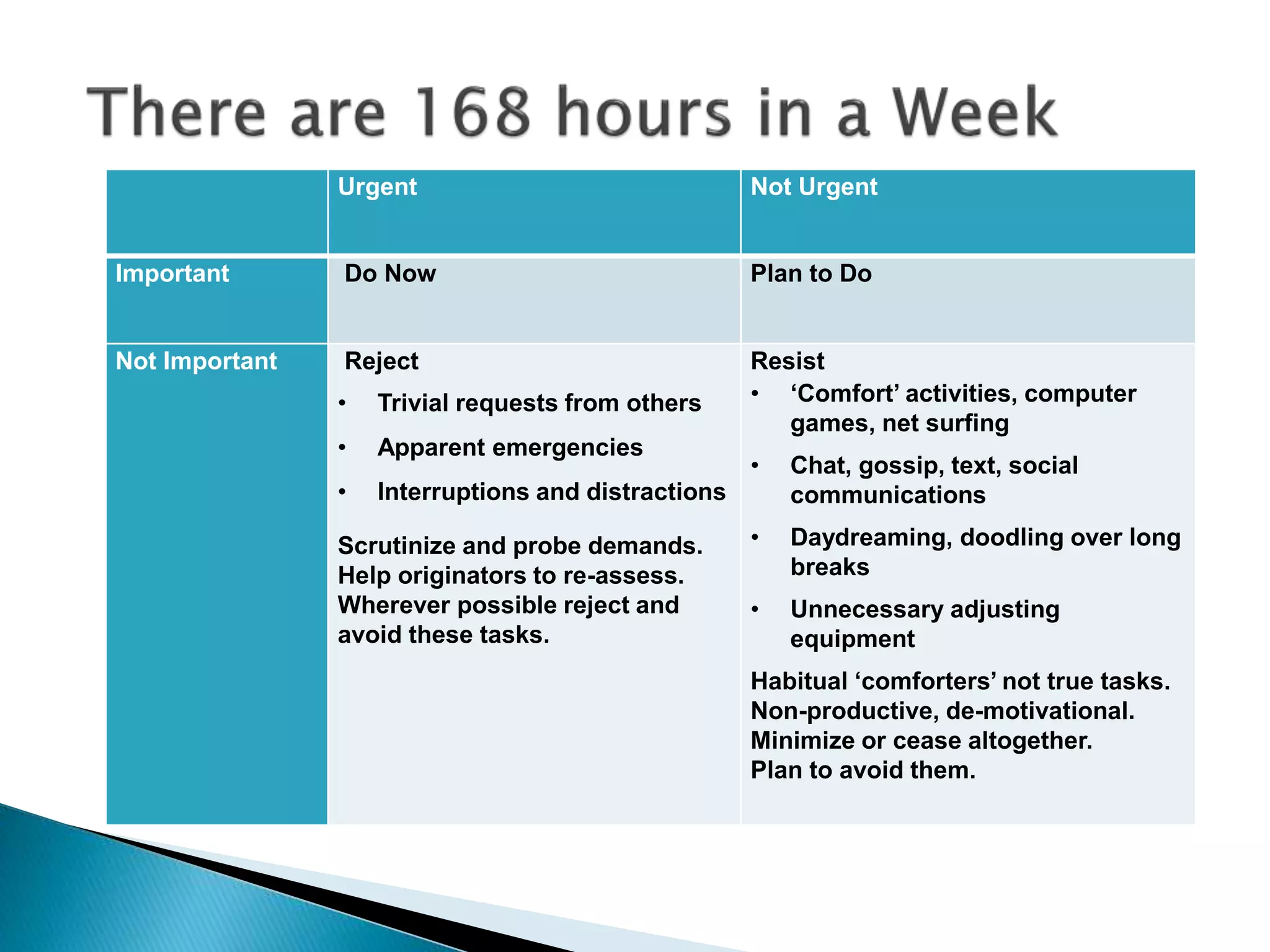
Urgent Not Urgent
Important Do Now Plan to Do
Not Important Reject
• Trivial requests from others
• Apparent emergencies
• Interruptions and distractions
Scrutinize and probe demands.
Help originators to re-assess.
Wherever possible reject and
avoid these tasks.
Resist
• ‘Comfort’ activities, computer
games, net surfing
• Chat, gossip, text, social
communications
• Daydreaming, doodling over long
breaks
• Unnecessary adjusting
equipment
Habitual ‘comforters’ not true tasks.
Non-productive, de-motivational.
Minimize or cease altogether.
Plan to avoid them.
1. Set goals
2. Set reasonable expectations
(and remember that no one’s
perfect)
3. Make a schedule
4. Revisit and revise your plan
 Knowing what is most valuable to you
gives direction to your life.
 Your energy should be oriented first
toward things that reflect the values that
are most important.
 Examine your values to help you make
time management decisions.
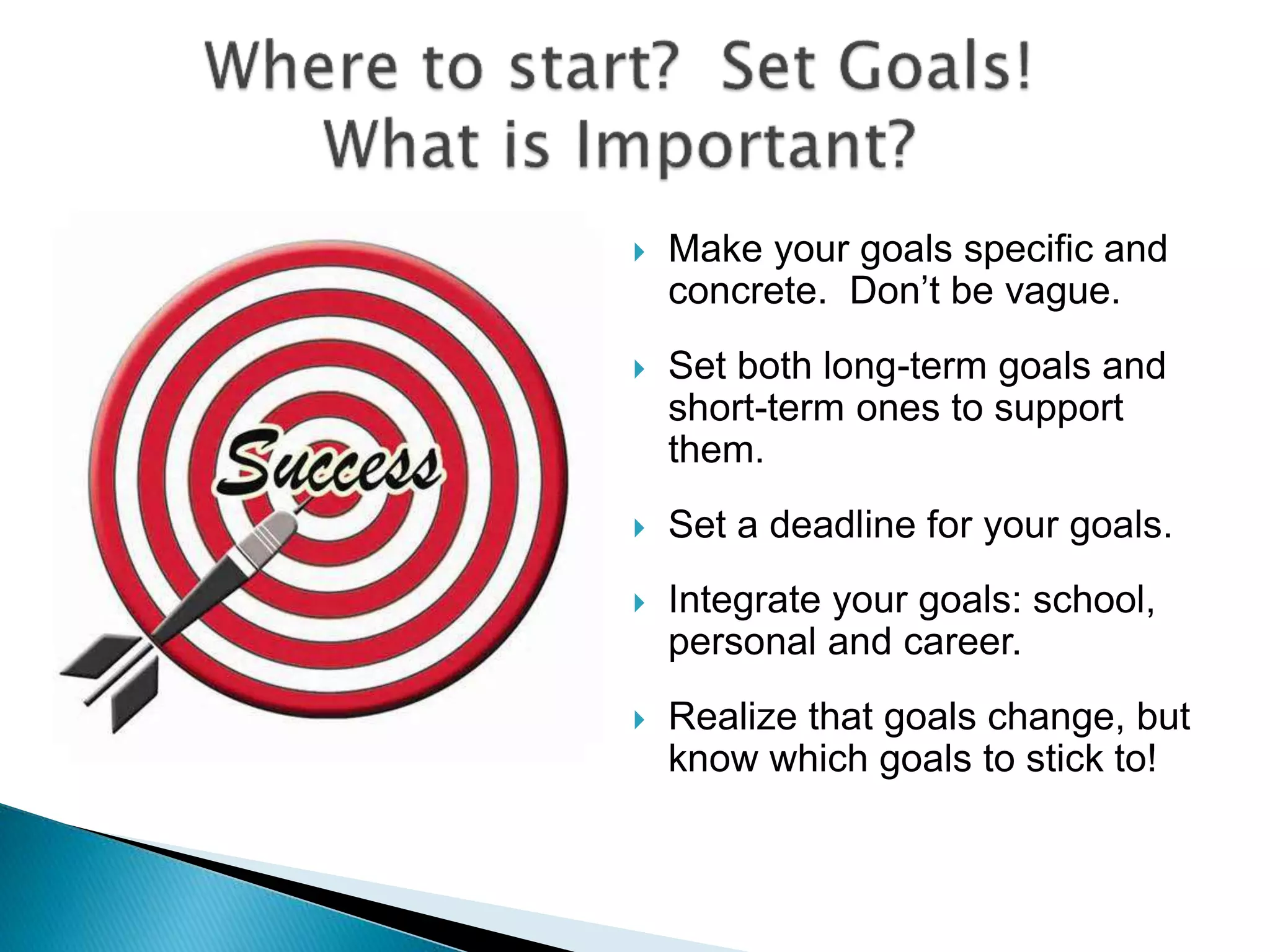
 Make your goals specific and
concrete. Don’t be vague.
 Set both long-term goals and
short-term ones to support
them.
 Set a deadline for your goals.
 Integrate your goals: school,
personal and career.
 Realize that goals change, but
know which goals to stick to!
 What’s important and what isn’t?
 What order do things need to be
done in?
 Once you know what your
priorities are, you need to plan
out a schedule for the semester,
the week and the day.
 Acknowledge the realities of
college schedules.
 Planning may seem hard at first,
but the more you do it, the
easier and more natural it gets.
Set Up Your Semester Calendar
 Block all important set time obligations.
 Block all class and lab times.
 Look at the syllabus for the class schedule.
◦ Note the weight of the activities.
◦ Highlight all exams and project due dates.
 Work backwards from exams and papers (PERT).
 Study time.
 Time for your sanity.
 Set realistic goals, there are only
24 hours in a day.
 Use spare time to review.
 Study at the same time each day:
make it a habit
 Divide study time into manageable
chunks
 Leave extra time at the end!
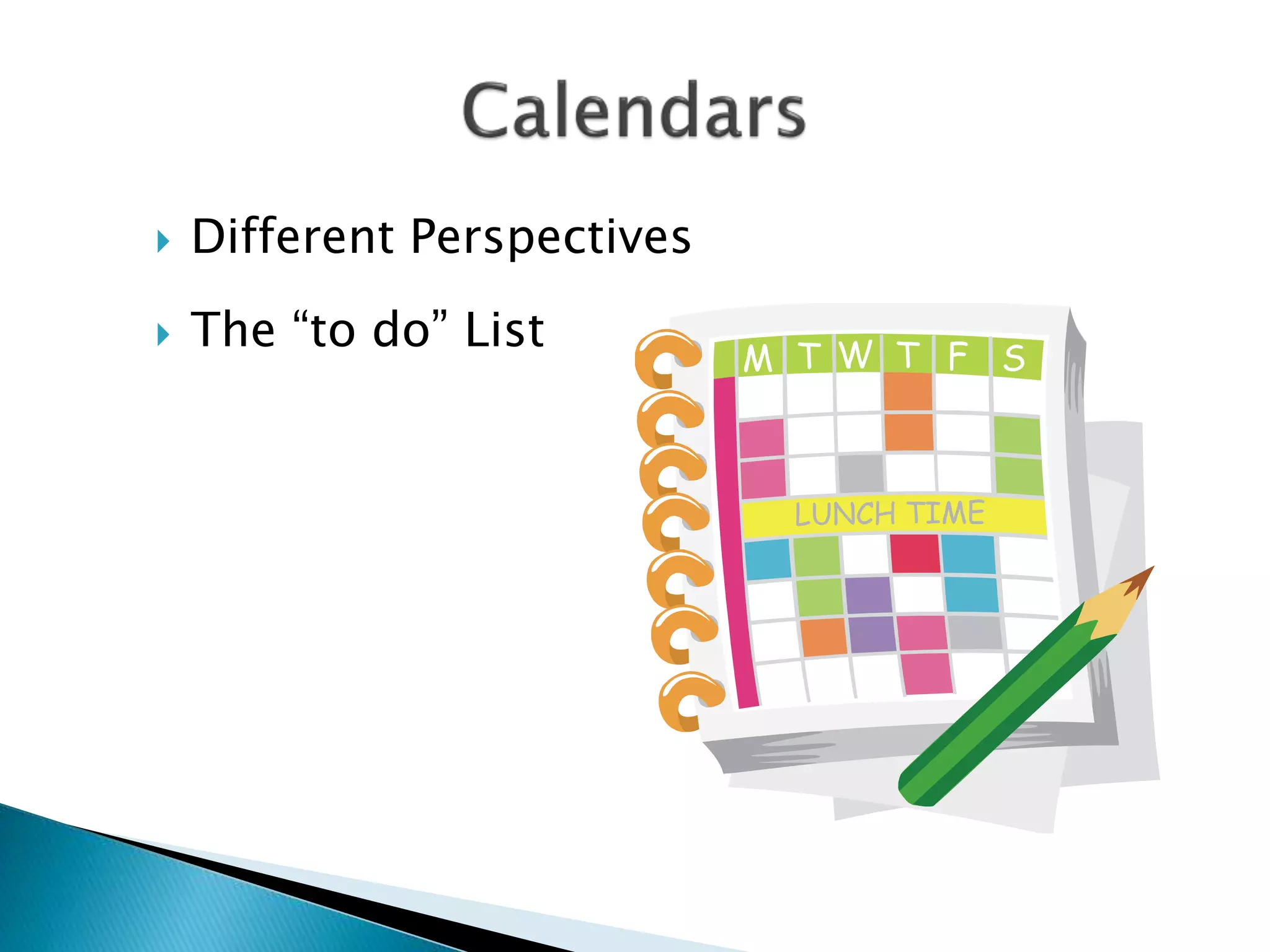
 Different Perspectives
 The “to do” List
 How are you actually using your time?
 Which tasks were you able to do? What didn’t get
done?
 Was your energy level appropriate? Your stress level?
 What changes need to be made to your weekly
schedule?
 What are persistent time wasters?
 Was procrastination an issue?
 Procrastination is my sin.
 It brings me naught but sorrow.
 I know that I should stop it.
 It fact, I will – tomorrow!
• Ignoring the task, hoping it will go away
• Underestimating how long it will take/overestimating your abilities and
resources
• Telling yourself that poor performance is okay/insisting on perfection
• Doing something else that isn’t very important
• Believing that repeated “minor” delays won’t hurt you
• Talking about rather than doing it
• Putting all your work on only one part of the task
• Becoming paralyzed when having to make choices
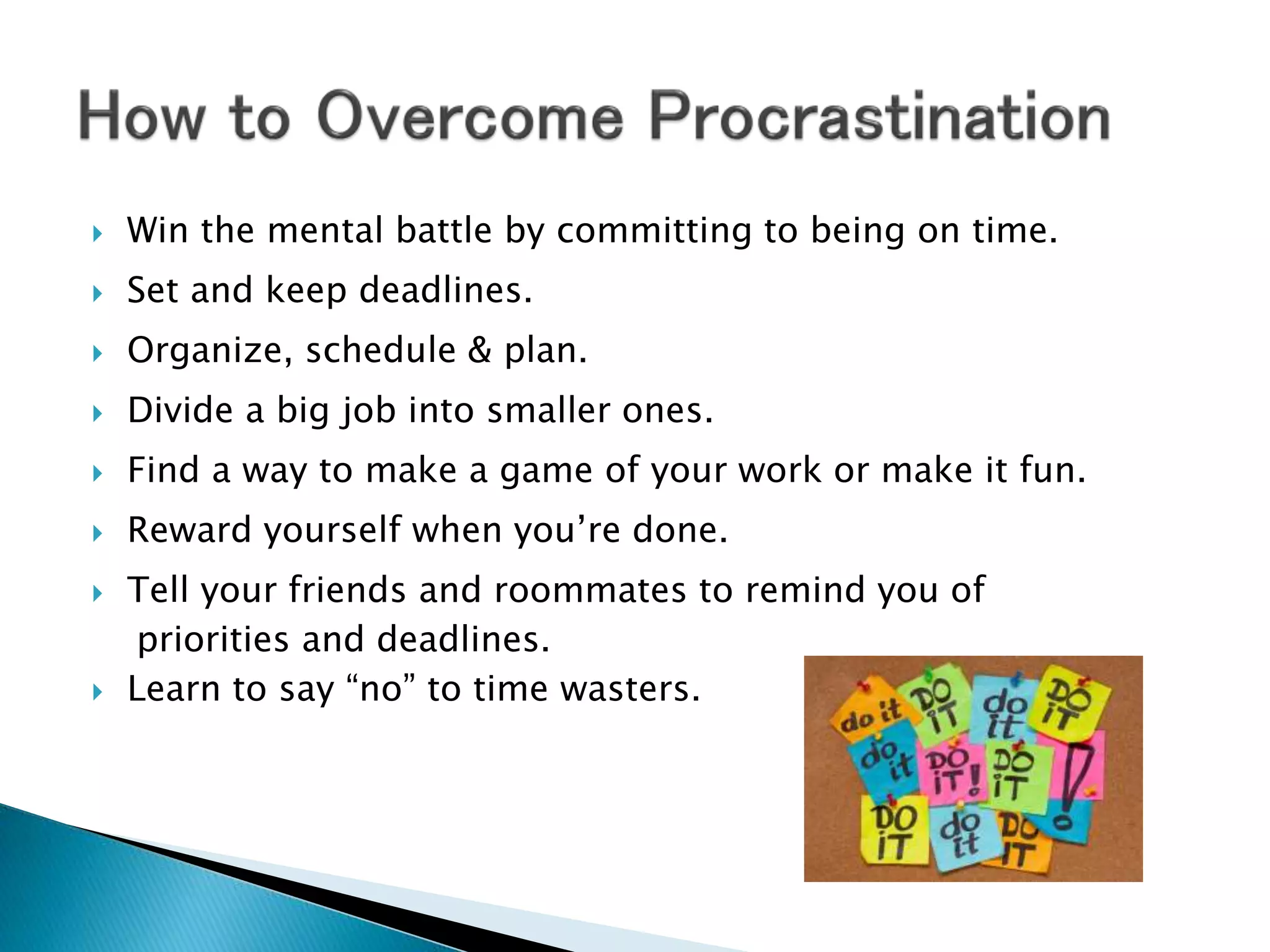
 Win the mental battle by committing to being on time.
 Set and keep deadlines.
 Organize, schedule & plan.
 Divide a big job into smaller ones.
 Find a way to make a game of your work or make it fun.
 Reward yourself when you’re done.
 Tell your friends and roommates to remind you of
priorities and deadlines.
 Learn to say “no” to time wasters.
 Learn to recognize when you’re wasting time.
 Decide what you need to do and can realistically do.
 Learn how to say “NO” when you don’t have time.
 Return calls at your convenience. The phone is a major
time killer.
 Learn to say “I can’t talk right now. I’ll get back to you.”
 Wasting time is often linked to a lack of self-discipline.
 Ask yourself, “Do I really need to do this or not?”
 Avoid the temptation to socialize when you’ve scheduled
work.
 If friends ask you to join them last minute, decline
outright, but ask if you could get together later in the
week.
 Socializing is important when you don’t have other
things to worry about!
 Study somewhere you won’t be tempted to chat, watch
movies or YouTube, or use social utilities like Facebook.
 Texts are a major distraction.
 Immediately note all changes.
◦ Exam/Paper due date revisions
◦ Meeting additions/cancellations
◦ Work schedule changes
◦ Upcoming visitors, etc., etc…
 Preview the upcoming week making any
necessary adjustments.
 Preview each day to see what might
happen…
 Time and energy management can make you more
productive and reduce your stress level.
 The Three Steps
◦ Set goals
◦ Make a schedule
◦ Revisit and revise your plan
 Be tough with your time. Actively avoid procrastination
and time wasters. Learn to say “no” to distractions.
 Employ a variety of time management strategies to
maximize your time.
 Relax and enjoy the extra time that you’ve discovered!
Time management1

Time management1

  • 1.
    Presented by DianaLynch Writing Tutor School of Social Work dirose@bu.edu Created by Barbaranne Benjamin, Ph.D.
  • 2.
     Not yourundergraduate degree  Undergraduate skills  Graduate specialization  Independent
  • 3.
     Time managementis nothing but common sense. I do well in school, so I must be managing my time effectively.  It takes all the fun out of life!!!  Time management? I work better under pressure.  No matter what I do, I won’t have enough time!
  • 5.
    Increases productivity. Reduces stress. Improvesself-esteem. Helps achieve balance in life. Increases self-confidence Helps you reach your goals!
  • 6.
    Urgent Not Urgent ImportantDo Now Plan to Do Not Important Reject • Trivial requests from others • Apparent emergencies • Interruptions and distractions Scrutinize and probe demands. Help originators to re-assess. Wherever possible reject and avoid these tasks. Resist • ‘Comfort’ activities, computer games, net surfing • Chat, gossip, text, social communications • Daydreaming, doodling over long breaks • Unnecessary adjusting equipment Habitual ‘comforters’ not true tasks. Non-productive, de-motivational. Minimize or cease altogether. Plan to avoid them.
  • 7.
    1. Set goals 2.Set reasonable expectations (and remember that no one’s perfect) 3. Make a schedule 4. Revisit and revise your plan
  • 8.
     Knowing whatis most valuable to you gives direction to your life.  Your energy should be oriented first toward things that reflect the values that are most important.  Examine your values to help you make time management decisions.
  • 9.
     Make yourgoals specific and concrete. Don’t be vague.  Set both long-term goals and short-term ones to support them.  Set a deadline for your goals.  Integrate your goals: school, personal and career.  Realize that goals change, but know which goals to stick to!
  • 10.
     What’s importantand what isn’t?  What order do things need to be done in?  Once you know what your priorities are, you need to plan out a schedule for the semester, the week and the day.  Acknowledge the realities of college schedules.  Planning may seem hard at first, but the more you do it, the easier and more natural it gets.
  • 11.
    Set Up YourSemester Calendar  Block all important set time obligations.  Block all class and lab times.  Look at the syllabus for the class schedule. ◦ Note the weight of the activities. ◦ Highlight all exams and project due dates.  Work backwards from exams and papers (PERT).  Study time.  Time for your sanity.
  • 12.
     Set realisticgoals, there are only 24 hours in a day.  Use spare time to review.  Study at the same time each day: make it a habit  Divide study time into manageable chunks  Leave extra time at the end!
  • 13.
     Different Perspectives The “to do” List
  • 18.
     How areyou actually using your time?  Which tasks were you able to do? What didn’t get done?  Was your energy level appropriate? Your stress level?  What changes need to be made to your weekly schedule?  What are persistent time wasters?  Was procrastination an issue?
  • 19.
     Procrastination ismy sin.  It brings me naught but sorrow.  I know that I should stop it.  It fact, I will – tomorrow!
  • 20.
    • Ignoring thetask, hoping it will go away • Underestimating how long it will take/overestimating your abilities and resources • Telling yourself that poor performance is okay/insisting on perfection • Doing something else that isn’t very important • Believing that repeated “minor” delays won’t hurt you • Talking about rather than doing it • Putting all your work on only one part of the task • Becoming paralyzed when having to make choices
  • 21.
     Win themental battle by committing to being on time.  Set and keep deadlines.  Organize, schedule & plan.  Divide a big job into smaller ones.  Find a way to make a game of your work or make it fun.  Reward yourself when you’re done.  Tell your friends and roommates to remind you of priorities and deadlines.  Learn to say “no” to time wasters.
  • 22.
     Learn torecognize when you’re wasting time.  Decide what you need to do and can realistically do.  Learn how to say “NO” when you don’t have time.  Return calls at your convenience. The phone is a major time killer.  Learn to say “I can’t talk right now. I’ll get back to you.”  Wasting time is often linked to a lack of self-discipline.  Ask yourself, “Do I really need to do this or not?”
  • 23.
     Avoid thetemptation to socialize when you’ve scheduled work.  If friends ask you to join them last minute, decline outright, but ask if you could get together later in the week.  Socializing is important when you don’t have other things to worry about!  Study somewhere you won’t be tempted to chat, watch movies or YouTube, or use social utilities like Facebook.  Texts are a major distraction.
  • 24.
     Immediately noteall changes. ◦ Exam/Paper due date revisions ◦ Meeting additions/cancellations ◦ Work schedule changes ◦ Upcoming visitors, etc., etc…  Preview the upcoming week making any necessary adjustments.  Preview each day to see what might happen…
  • 26.
     Time andenergy management can make you more productive and reduce your stress level.  The Three Steps ◦ Set goals ◦ Make a schedule ◦ Revisit and revise your plan  Be tough with your time. Actively avoid procrastination and time wasters. Learn to say “no” to distractions.  Employ a variety of time management strategies to maximize your time.  Relax and enjoy the extra time that you’ve discovered!