
I DON’T HAVE TIME TO
GO TO THIS WORKSHOP!
TIME MANAGEMENT
MUS WELLNESS
CRISTIN STOKES AND NEAL ANDREWS
WORKSHOP OBJECTIVES
• Discuss practical Time Management strategies.
• Integrate Health
• Disclaimer!
• There is an element of psychology and physiology in time
management.
• Find strategies that work for YOU!
• This is not a “One-size-fits-all” subject
TAKE HOME POINT!
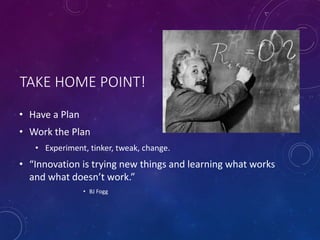
• Have a Plan
• Work the Plan
• Experiment, tinker, tweak, change.
• “Innovation is trying new things and learning what works
and what doesn’t work.”
• BJ Fogg
IDENTIFYING OBSTACLES
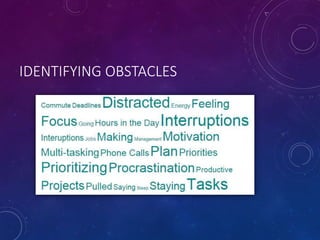
• Scheduling conflicts.
• Too many distractions during the day.
• Trying to work on multiple tasks at the same time and then not being able to
focus enough to finish any of them in a timely manner.
• Email - eats up a lot of time. Also all the day-to-day things and the
"emergencies" that pop up most days that have to be dealt with.
• How to balance the urgent and the important...I am easily distracted.
• Being tired at the end of the day and therefore having the energy and
motivation to get tasks done in the evening, after work and dinner.
• Saying yes to every event or favor.
• Prioritizing a work out in between home/work/kids schedules.
“HOW WE SPEND OUR DAYS…
• …is how we spend our lives.”
• First step in understanding Time Management is
understanding what we do with our time on a daily basis.
• Write down hour by hour your past 36 hours (begin
yesterday morning.)
ANALYZE!
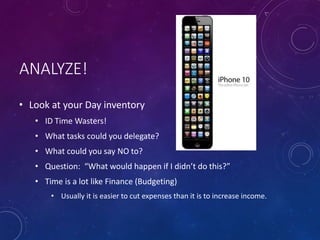
• Look at your Day inventory
• ID Time Wasters!
• What tasks could you delegate?
• What could you say NO to?
• Question: “What would happen if I didn’t do this?”
• Time is a lot like Finance (Budgeting)
• Usually it is easier to cut expenses than it is to increase income.
ORGANIZATIONAL TOOLS
• The To-Do List
• Many different approaches
• Use one that fits you
• Break big tasks into smaller, more manageable tasks.
• The Top 5
• The 6x6
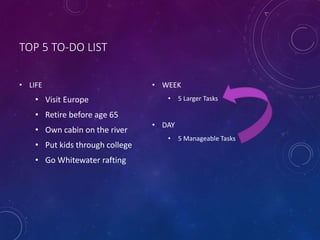
TOP 5 TO-DO LIST
• LIFE
• Visit Europe
• Retire before age 65
• Own cabin on the river
• Put kids through college
• Go Whitewater rafting
• WEEK
• 5 Larger Tasks
• DAY
• 5 Manageable Tasks
6X6 TO-DO LIST
• Good for focusing on bigger themes and projects.
• What are the most important 6 things for me to accomplish over
the next 6 weeks?
• Put it somewhere where you can see it constantly.
• Regular, “daily” To-Do list should focus on tasks pertaining to 6x6.
• Create new 6x6 every six weeks.
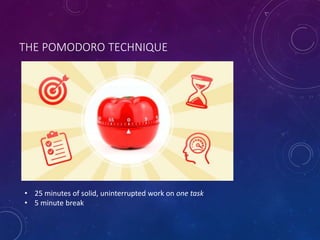
THE POMODORO TECHNIQUE
• 25 minutes of solid, uninterrupted work on one task
• 5 minute break
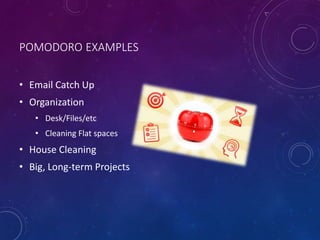
POMODORO EXAMPLES
• Email Catch Up
• Organization
• Desk/Files/etc
• Cleaning Flat spaces
• House Cleaning
• Big, Long-term Projects
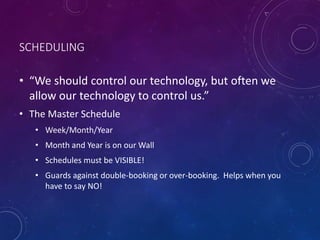
SCHEDULING
• “We should control our technology, but often we
allow our technology to control us.”
• The Master Schedule
• Week/Month/Year
• Month and Year is on our Wall
• Schedules must be VISIBLE!
• Guards against double-booking or over-booking. Helps when you
have to say NO!
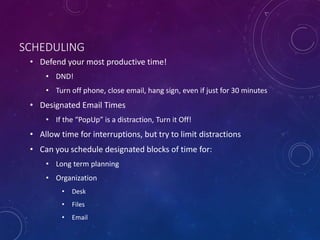
SCHEDULING
• Defend your most productive time!
• DND!
• Turn off phone, close email, hang sign, even if just for 30 minutes
• Designated Email Times
• If the “PopUp” is a distraction, Turn it Off!
• Allow time for interruptions, but try to limit distractions
• Can you schedule designated blocks of time for:
• Long term planning
• Organization
• Desk
• Files
• Email
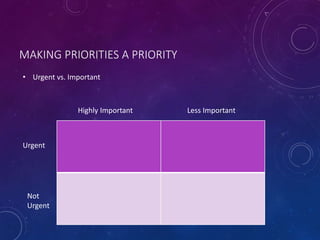
MAKING PRIORITIES A PRIORITY
• Urgent vs. Important
Urgent
Highly Important
Not
Urgent
Less Important
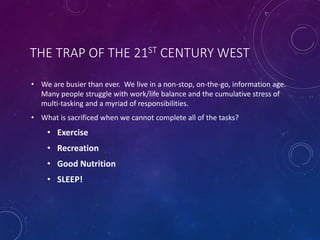
THE TRAP OF THE 21ST CENTURY WEST
• We are busier than ever. We live in a non-stop, on-the-go, information age.
Many people struggle with work/life balance and the cumulative stress of
multi-tasking and a myriad of responsibilities.
• What is sacrificed when we cannot complete all of the tasks?
• Exercise
• Recreation
• Good Nutrition
• SLEEP!
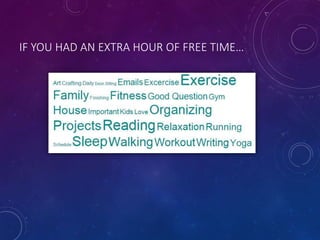
IF YOU HAD AN EXTRA HOUR OF FREE TIME…
PRIORITY HIGH: YOUR HEALTH
• “You don’t find time for your health, you make time for your health.”
• “If your health isn’t a priority now, it will be someday.”
• “You Time”
• Exercise, eating right, and sleeping go on the To-do
list, top of priority list, and written into the
schedule.
• This is a time investment
• Return on Investment?
• Happier, healthier, more productive YOU.
• (Everyone else will like you better too.)
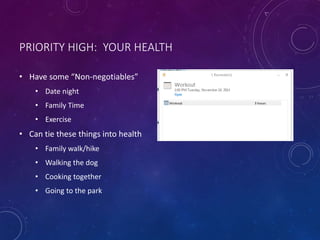
PRIORITY HIGH: YOUR HEALTH
• Have some “Non-negotiables”
• Date night
• Family Time
• Exercise
• Can tie these things into health
• Family walk/hike
• Walking the dog
• Cooking together
• Going to the park
PRIORITY HIGH: YOUR HEALTH
• Think SMALL! Small=Big
• Things with small time investment can yield big
health returns.
• Getting out of your chair for a stretch break or walk
break.
• Break for a healthy snack.
• Creating consistency.
• Not everything has to be EPIC.
• “How we spend our days is how we spend our
lives.”
CHECK US OUT ONLINE
• www.muswell.limeade.com
• www.montanamovesandmeals.com
• www.wellness.mus.edu
• wellness@montana.edu

Time Management 2015

  • 1.
    I DON’T HAVETIME TO GO TO THIS WORKSHOP! TIME MANAGEMENT MUS WELLNESS CRISTIN STOKES AND NEAL ANDREWS
  • 2.
    WORKSHOP OBJECTIVES • Discusspractical Time Management strategies. • Integrate Health • Disclaimer! • There is an element of psychology and physiology in time management. • Find strategies that work for YOU! • This is not a “One-size-fits-all” subject
  • 3.
    TAKE HOME POINT! •Have a Plan • Work the Plan • Experiment, tinker, tweak, change. • “Innovation is trying new things and learning what works and what doesn’t work.” • BJ Fogg
  • 4.
  • 5.
    IDENTIFYING OBSTACLES • Schedulingconflicts. • Too many distractions during the day. • Trying to work on multiple tasks at the same time and then not being able to focus enough to finish any of them in a timely manner. • Email - eats up a lot of time. Also all the day-to-day things and the "emergencies" that pop up most days that have to be dealt with. • How to balance the urgent and the important...I am easily distracted. • Being tired at the end of the day and therefore having the energy and motivation to get tasks done in the evening, after work and dinner. • Saying yes to every event or favor. • Prioritizing a work out in between home/work/kids schedules.
  • 6.
    “HOW WE SPENDOUR DAYS… • …is how we spend our lives.” • First step in understanding Time Management is understanding what we do with our time on a daily basis. • Write down hour by hour your past 36 hours (begin yesterday morning.)
  • 7.
    ANALYZE! • Look atyour Day inventory • ID Time Wasters! • What tasks could you delegate? • What could you say NO to? • Question: “What would happen if I didn’t do this?” • Time is a lot like Finance (Budgeting) • Usually it is easier to cut expenses than it is to increase income.
  • 8.
    ORGANIZATIONAL TOOLS • TheTo-Do List • Many different approaches • Use one that fits you • Break big tasks into smaller, more manageable tasks. • The Top 5 • The 6x6
  • 9.
    TOP 5 TO-DOLIST • LIFE • Visit Europe • Retire before age 65 • Own cabin on the river • Put kids through college • Go Whitewater rafting • WEEK • 5 Larger Tasks • DAY • 5 Manageable Tasks
  • 10.
    6X6 TO-DO LIST •Good for focusing on bigger themes and projects. • What are the most important 6 things for me to accomplish over the next 6 weeks? • Put it somewhere where you can see it constantly. • Regular, “daily” To-Do list should focus on tasks pertaining to 6x6. • Create new 6x6 every six weeks.
  • 11.
    THE POMODORO TECHNIQUE •25 minutes of solid, uninterrupted work on one task • 5 minute break
  • 12.
    POMODORO EXAMPLES • EmailCatch Up • Organization • Desk/Files/etc • Cleaning Flat spaces • House Cleaning • Big, Long-term Projects
  • 13.
    SCHEDULING • “We shouldcontrol our technology, but often we allow our technology to control us.” • The Master Schedule • Week/Month/Year • Month and Year is on our Wall • Schedules must be VISIBLE! • Guards against double-booking or over-booking. Helps when you have to say NO!
  • 14.
    SCHEDULING • Defend yourmost productive time! • DND! • Turn off phone, close email, hang sign, even if just for 30 minutes • Designated Email Times • If the “PopUp” is a distraction, Turn it Off! • Allow time for interruptions, but try to limit distractions • Can you schedule designated blocks of time for: • Long term planning • Organization • Desk • Files • Email
  • 15.
    MAKING PRIORITIES APRIORITY • Urgent vs. Important Urgent Highly Important Not Urgent Less Important
  • 16.
    THE TRAP OFTHE 21ST CENTURY WEST • We are busier than ever. We live in a non-stop, on-the-go, information age. Many people struggle with work/life balance and the cumulative stress of multi-tasking and a myriad of responsibilities. • What is sacrificed when we cannot complete all of the tasks? • Exercise • Recreation • Good Nutrition • SLEEP!
  • 17.
    IF YOU HADAN EXTRA HOUR OF FREE TIME…
  • 18.
    PRIORITY HIGH: YOURHEALTH • “You don’t find time for your health, you make time for your health.” • “If your health isn’t a priority now, it will be someday.” • “You Time” • Exercise, eating right, and sleeping go on the To-do list, top of priority list, and written into the schedule. • This is a time investment • Return on Investment? • Happier, healthier, more productive YOU. • (Everyone else will like you better too.)
  • 19.
    PRIORITY HIGH: YOURHEALTH • Have some “Non-negotiables” • Date night • Family Time • Exercise • Can tie these things into health • Family walk/hike • Walking the dog • Cooking together • Going to the park
  • 20.
    PRIORITY HIGH: YOURHEALTH • Think SMALL! Small=Big • Things with small time investment can yield big health returns. • Getting out of your chair for a stretch break or walk break. • Break for a healthy snack. • Creating consistency. • Not everything has to be EPIC. • “How we spend our days is how we spend our lives.”
  • 21.
    CHECK US OUTONLINE • www.muswell.limeade.com • www.montanamovesandmeals.com • www.wellness.mus.edu • wellness@montana.edu