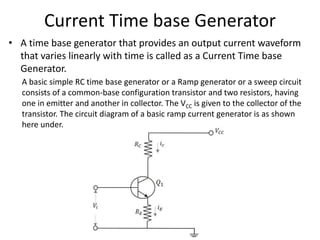
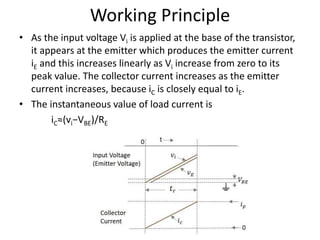
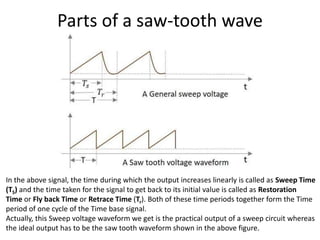
A time base generator produces a sawtooth waveform that varies linearly with time. It is used in oscilloscopes to display how signals change over time by applying the sawtooth voltage to the deflection plates. A time base generator works by using capacitors and resistors in a circuit to charge and discharge the capacitor, producing the sawtooth waveform. There are two main types: voltage time base generators that output a varying voltage, and current time base generators that output a varying current. Circuits like the bootstrap and Miller generators use feedback or additional stages to generate the waveform.

![Working Principle
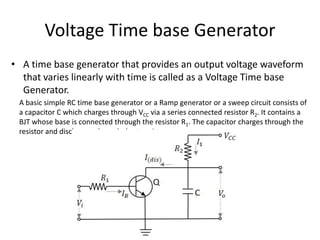
• When the transistor turns ON it provides a low
resistance path for the capacitor to discharge
quickly. When the transistor is in OFF
condition, the capacitor will charge
exponentially to the supply voltage VCC,
according to the equation
V0=VCC[1−exp(−t/RC)]](https://image.slidesharecdn.com/timebasegenerators-240330063147-65a06e67/85/Time-Base-Generators-or-Sweep-Circuits-pptx-8-320.jpg)