UNIT III
GENERATION OF HIGH VOLTAGES AND
HIGH CURRENTS
2
GENERATION OF HIGH D.C VOLTAGE
DIFFERENT METHODS TO GENERATE HIGH D,C VOLTAGE:
1. Half and full wave rectifier circuits
2. Voltage doubler circuits
3. Voltage multiplier circuits
4. Van de Graaff generator
HALF AND FULL WAVE RECTIFIER CIRCUITS
 This method can be used to produce DC voltage up to 20 kV
 For high voltages several units can be connected in series
 For the first half cycle of the given AC input voltage, capacitor is
charged to Vmax and for the next half cycle the capacitor is
dischar5ged to the load

The capacitor C is chosen such that the time constant CRl is 10 times
that of AC supply
3
VOLTAGE DOUBLER CIRCUIT
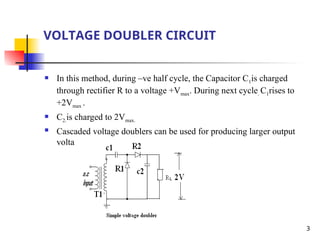
 In this method, during –ve half cycle, the Capacitor C1is charged
through rectifier R to a voltage +Vmax. During next cycle. C1rises to
+2Vmax .
 C2.is charged to 2Vmax.
 Cascaded voltage doublers can be used for producing larger output
voltage
4
CASCADED VOLTAGE
DOUBLERS
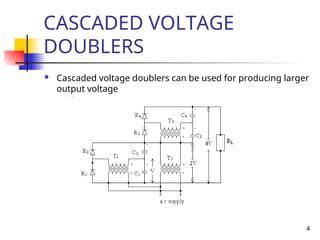
 Cascaded voltage doublers can be used for producing larger
output voltage
5
VOLTAGE MULTIPLIER CIRCUITS
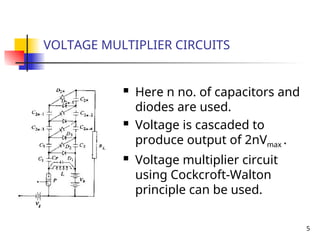
 Here n no. of capacitors and
diodes are used.
 Voltage is cascaded to
produce output of 2nVmax .
 Voltage multiplier circuit
using Cockcroft-Walton
principle can be used.
6
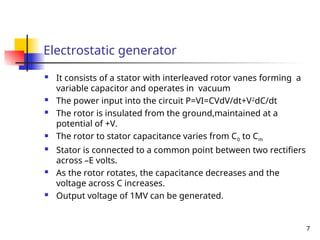
VAN DE GRAFF GENERATOR
 In electrostatic machines charged bodies are
moved in an electrostatic field
 If an insulated belt with a charge density δ moves
in an electric field between two electrodes with
separation ‘s’
 If the belt moves with a velocity v then
mechanical power require to move the belt is
P=F.v=V.I
7
Electrostatic generator
 It consists of a stator with interleaved rotor vanes forming a
variable capacitor and operates in vacuum
 The power input into the circuit P=VI=CVdV/dt+V2
dC/dt
 The rotor is insulated from the ground,maintained at a
potential of +V.
 The rotor to stator capacitance varies from C0 to Cm
 Stator is connected to a common point between two rectifiers
across –E volts.
 As the rotor rotates, the capacitance decreases and the
voltage across C increases.
 Output voltage of 1MV can be generated.
8
GENERATION OF HIGH
ALTERNETING VOLTAGES
 When test voltage requirements are less than about 300
kV,a single transformer can be used.
 Each transformer unit consists of low,high and meter
winding.
 Series connection of the several units of transformers used
to produce very high voltage.
9
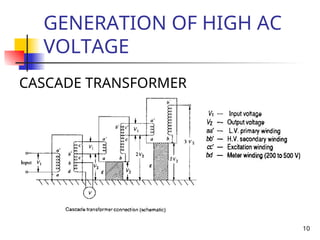
CASCADE TRANSFORMERS
 First transformer is at ground potential along with its tank.The 2nd
transformer is kept on insulators and maintained at a potential of V2.
 The high voltage winding of the 1st
unit is connected to the tank of the
2nd
unit,the low voltage winging of this unit is supplied from the
excitation winding of the 1st
transformer,which is in series with the
high voltage winding of the 1st
transformer at its high voltage end.
 The rating of the excitation winding is same as that of low voltage
winding.3rd
transformer is kept on insulator above the ground at a
potential of 2V2.output of 3 stage is 3V2.
 The rating of the low voltage winding of 230 or 400 Vcan be used to
produce 3.3 kV,6.6 kV or 11 kV.
10
GENERATION OF HIGH AC
VOLTAGE
CASCADE TRANSFORMER
11
GENERATION OF HIGH AC
VOLTAGE
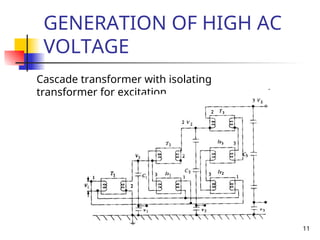
Cascade transformer with isolating
transformer for excitation
12
GENERATION OF HIGH FREQUENCY
A.C HIGH VOLTAGES
 High frequency high voltage damped oscillations are needed
which need high voltage high frequency transformer which
is a Tesla coil.
 Tesla coil is a doubly tuned resonant circuit,primary voltage
rating is 10 kV and secondary voltage rated from 500 to
1000 kV.
 The primary is fed from DC or AC supply through C1.A
spark gap G connected across the primary is triggered at V1
which induces a high self excitation in the secondary.The
windings are tuned to a frequency of 10 to 100 kHz.
13
GENERATION OF IMPULSE VOLTAGES
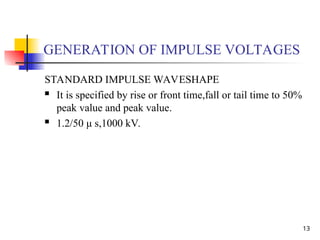
STANDARD IMPULSE WAVESHAPE
 It is specified by rise or front time,fall or tail time to 50%
peak value and peak value.
 1.2/50 μ s,1000 kV.
14
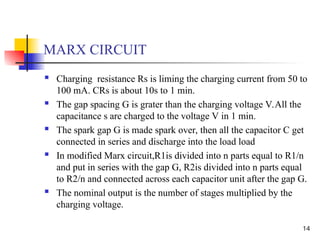
MARX CIRCUIT
 Charging resistance Rs is liming the charging current from 50 to
100 mA. CRs is about 10s to 1 min.
 The gap spacing G is grater than the charging voltage V.All the
capacitance s are charged to the voltage V in 1 min.
 The spark gap G is made spark over, then all the capacitor C get
connected in series and discharge into the load load
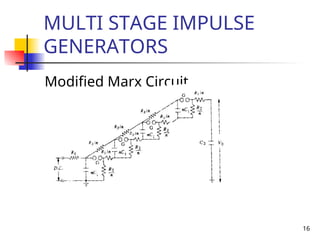
 In modified Marx circuit,R1is divided into n parts equal to R1/n
and put in series with the gap G, R2is divided into n parts equal
to R2/n and connected across each capacitor unit after the gap G.
 The nominal output is the number of stages multiplied by the
charging voltage.
15
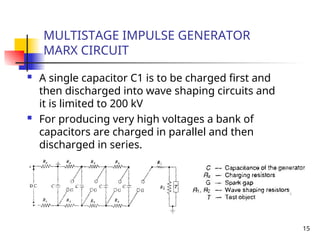
MULTISTAGE IMPULSE GENERATOR
MARX CIRCUIT
 A single capacitor C1 is to be charged first and
then discharged into wave shaping circuits and
it is limited to 200 kV
 For producing very high voltages a bank of
capacitors are charged in parallel and then
discharged in series.
16
MULTI STAGE IMPULSE
GENERATORS
Modified Marx Circuit
17
COMPONENTS OF A MULTISTAGE
IMPULSE GENERATOR
 DC Charging set
 Charging resistors
 Generator capacitors and spark gaps
 Wave shaping resistors and capacitors
 Triggering system
 Voltage dividers
18
GENERATION OF SWITCHING SURGES
 A switching surge is a short duration transient voltage produced in the
system due to a sudden opening or closing of a switch or c.b or due to an
arcing at a fault in the system.
 Impulse generator circuit is modified to give longer duration wave
shape,100/1000 μs,R1 is increased to very high value and it is parallel to
R2 in the discharge circuit.
 Power transformer excited by DC voltages giving oscillatory waves
which produces unidirectional damped oscillations.Frequency of 1to 10
kHz
 Switching surges of very high peaks and long duration can be obtained
by one circuit,In this circuit C1 charged to a low voltage d.c(20 to 25
kV) is discharged into the low voltage winding of a power
transformer.The high voltage winding is connected inparallel to a load
capacitance C2,potential divider R2,gap S and test object.
19
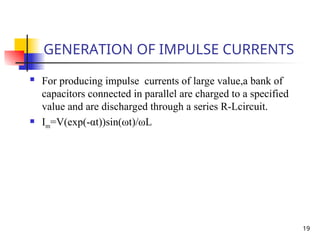
GENERATION OF IMPULSE CURRENTS
 For producing impulse currents of large value,a bank of
capacitors connected in parallel are charged to a specified
value and are discharged through a series R-Lcircuit.
 Im=V(exp(-αt))sin(ωt)/ωL
20
GENERATION OF HIGH IMPULSE
CURRENTS
 For producing large values of impulse,a no.of capacitors are
charged in parallel and discharged in parallel into the circuit.
 The essential parts of an impulse current generator are:
 (i) a.d.c. charging unit
 (ii) capacitors of high value (0.5 to 5 μF)
 (iii) an additional air cored inductor
 (iv) proper shunts and oscillograph for measurement
purposes, and
 (v) a triggering unit and spark gap for the initiation of the
current generator.
21
TRIPPING AND CONTROL OF IMPULSE
GENERATORS
 In large impulse generators, the spark gaps are
generally sphere gaps or gaps formed by
hemispherical electrodes.
 The gaps are arranged such that sparking of one
gap results in automatic sparking of other gaps as
overvoltage is impressed on the other.
 A simple method of controlled tripping consists of
making the first gap a three electrode gap and
firing it from a controlled source.
22
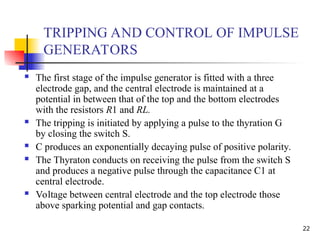
TRIPPING AND CONTROL OF IMPULSE
GENERATORS
 The first stage of the impulse generator is fitted with a three
electrode gap, and the central electrode is maintained at a
potential in between that of the top and the bottom electrodes
with the resistors R1 and RL.
 The tripping is initiated by applying a pulse to the thyration G
by closing the switch S.
 C produces an exponentially decaying pulse of positive polarity.
 The Thyraton conducts on receiving the pulse from the switch S
and produces a negative pulse through the capacitance C1 at
central electrode.
 Voltage between central electrode and the top electrode those
above sparking potential and gap contacts.
23
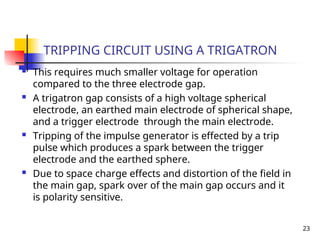
TRIPPING CIRCUIT USING A TRIGATRON
 This requires much smaller voltage for operation
compared to the three electrode gap.
 A trigatron gap consists of a high voltage spherical
electrode, an earthed main electrode of spherical shape,
and a trigger electrode through the main electrode.
 Tripping of the impulse generator is effected by a trip
pulse which produces a spark between the trigger
electrode and the earthed sphere.
 Due to space charge effects and distortion of the field in
the main gap, spark over of the main gap occurs and it
is polarity sensitive.

high voltage engineering measure UNIT III.ppt

  • 1.
    UNIT III GENERATION OFHIGH VOLTAGES AND HIGH CURRENTS
  • 2.
    2 GENERATION OF HIGHD.C VOLTAGE DIFFERENT METHODS TO GENERATE HIGH D,C VOLTAGE: 1. Half and full wave rectifier circuits 2. Voltage doubler circuits 3. Voltage multiplier circuits 4. Van de Graaff generator HALF AND FULL WAVE RECTIFIER CIRCUITS  This method can be used to produce DC voltage up to 20 kV  For high voltages several units can be connected in series  For the first half cycle of the given AC input voltage, capacitor is charged to Vmax and for the next half cycle the capacitor is dischar5ged to the load  The capacitor C is chosen such that the time constant CRl is 10 times that of AC supply
  • 3.
    3 VOLTAGE DOUBLER CIRCUIT In this method, during –ve half cycle, the Capacitor C1is charged through rectifier R to a voltage +Vmax. During next cycle. C1rises to +2Vmax .  C2.is charged to 2Vmax.  Cascaded voltage doublers can be used for producing larger output voltage
  • 4.
    4 CASCADED VOLTAGE DOUBLERS  Cascadedvoltage doublers can be used for producing larger output voltage
  • 5.
    5 VOLTAGE MULTIPLIER CIRCUITS Here n no. of capacitors and diodes are used.  Voltage is cascaded to produce output of 2nVmax .  Voltage multiplier circuit using Cockcroft-Walton principle can be used.
  • 6.
    6 VAN DE GRAFFGENERATOR  In electrostatic machines charged bodies are moved in an electrostatic field  If an insulated belt with a charge density δ moves in an electric field between two electrodes with separation ‘s’  If the belt moves with a velocity v then mechanical power require to move the belt is P=F.v=V.I
  • 7.
    7 Electrostatic generator  Itconsists of a stator with interleaved rotor vanes forming a variable capacitor and operates in vacuum  The power input into the circuit P=VI=CVdV/dt+V2 dC/dt  The rotor is insulated from the ground,maintained at a potential of +V.  The rotor to stator capacitance varies from C0 to Cm  Stator is connected to a common point between two rectifiers across –E volts.  As the rotor rotates, the capacitance decreases and the voltage across C increases.  Output voltage of 1MV can be generated.
  • 8.
    8 GENERATION OF HIGH ALTERNETINGVOLTAGES  When test voltage requirements are less than about 300 kV,a single transformer can be used.  Each transformer unit consists of low,high and meter winding.  Series connection of the several units of transformers used to produce very high voltage.
  • 9.
    9 CASCADE TRANSFORMERS  Firsttransformer is at ground potential along with its tank.The 2nd transformer is kept on insulators and maintained at a potential of V2.  The high voltage winding of the 1st unit is connected to the tank of the 2nd unit,the low voltage winging of this unit is supplied from the excitation winding of the 1st transformer,which is in series with the high voltage winding of the 1st transformer at its high voltage end.  The rating of the excitation winding is same as that of low voltage winding.3rd transformer is kept on insulator above the ground at a potential of 2V2.output of 3 stage is 3V2.  The rating of the low voltage winding of 230 or 400 Vcan be used to produce 3.3 kV,6.6 kV or 11 kV.
  • 10.
    10 GENERATION OF HIGHAC VOLTAGE CASCADE TRANSFORMER
  • 11.
    11 GENERATION OF HIGHAC VOLTAGE Cascade transformer with isolating transformer for excitation
  • 12.
    12 GENERATION OF HIGHFREQUENCY A.C HIGH VOLTAGES  High frequency high voltage damped oscillations are needed which need high voltage high frequency transformer which is a Tesla coil.  Tesla coil is a doubly tuned resonant circuit,primary voltage rating is 10 kV and secondary voltage rated from 500 to 1000 kV.  The primary is fed from DC or AC supply through C1.A spark gap G connected across the primary is triggered at V1 which induces a high self excitation in the secondary.The windings are tuned to a frequency of 10 to 100 kHz.
  • 13.
    13 GENERATION OF IMPULSEVOLTAGES STANDARD IMPULSE WAVESHAPE  It is specified by rise or front time,fall or tail time to 50% peak value and peak value.  1.2/50 μ s,1000 kV.
  • 14.
    14 MARX CIRCUIT  Chargingresistance Rs is liming the charging current from 50 to 100 mA. CRs is about 10s to 1 min.  The gap spacing G is grater than the charging voltage V.All the capacitance s are charged to the voltage V in 1 min.  The spark gap G is made spark over, then all the capacitor C get connected in series and discharge into the load load  In modified Marx circuit,R1is divided into n parts equal to R1/n and put in series with the gap G, R2is divided into n parts equal to R2/n and connected across each capacitor unit after the gap G.  The nominal output is the number of stages multiplied by the charging voltage.
  • 15.
    15 MULTISTAGE IMPULSE GENERATOR MARXCIRCUIT  A single capacitor C1 is to be charged first and then discharged into wave shaping circuits and it is limited to 200 kV  For producing very high voltages a bank of capacitors are charged in parallel and then discharged in series.
  • 16.
  • 17.
    17 COMPONENTS OF AMULTISTAGE IMPULSE GENERATOR  DC Charging set  Charging resistors  Generator capacitors and spark gaps  Wave shaping resistors and capacitors  Triggering system  Voltage dividers
  • 18.
    18 GENERATION OF SWITCHINGSURGES  A switching surge is a short duration transient voltage produced in the system due to a sudden opening or closing of a switch or c.b or due to an arcing at a fault in the system.  Impulse generator circuit is modified to give longer duration wave shape,100/1000 μs,R1 is increased to very high value and it is parallel to R2 in the discharge circuit.  Power transformer excited by DC voltages giving oscillatory waves which produces unidirectional damped oscillations.Frequency of 1to 10 kHz  Switching surges of very high peaks and long duration can be obtained by one circuit,In this circuit C1 charged to a low voltage d.c(20 to 25 kV) is discharged into the low voltage winding of a power transformer.The high voltage winding is connected inparallel to a load capacitance C2,potential divider R2,gap S and test object.
  • 19.
    19 GENERATION OF IMPULSECURRENTS  For producing impulse currents of large value,a bank of capacitors connected in parallel are charged to a specified value and are discharged through a series R-Lcircuit.  Im=V(exp(-αt))sin(ωt)/ωL
  • 20.
    20 GENERATION OF HIGHIMPULSE CURRENTS  For producing large values of impulse,a no.of capacitors are charged in parallel and discharged in parallel into the circuit.  The essential parts of an impulse current generator are:  (i) a.d.c. charging unit  (ii) capacitors of high value (0.5 to 5 μF)  (iii) an additional air cored inductor  (iv) proper shunts and oscillograph for measurement purposes, and  (v) a triggering unit and spark gap for the initiation of the current generator.
  • 21.
    21 TRIPPING AND CONTROLOF IMPULSE GENERATORS  In large impulse generators, the spark gaps are generally sphere gaps or gaps formed by hemispherical electrodes.  The gaps are arranged such that sparking of one gap results in automatic sparking of other gaps as overvoltage is impressed on the other.  A simple method of controlled tripping consists of making the first gap a three electrode gap and firing it from a controlled source.
  • 22.
    22 TRIPPING AND CONTROLOF IMPULSE GENERATORS  The first stage of the impulse generator is fitted with a three electrode gap, and the central electrode is maintained at a potential in between that of the top and the bottom electrodes with the resistors R1 and RL.  The tripping is initiated by applying a pulse to the thyration G by closing the switch S.  C produces an exponentially decaying pulse of positive polarity.  The Thyraton conducts on receiving the pulse from the switch S and produces a negative pulse through the capacitance C1 at central electrode.  Voltage between central electrode and the top electrode those above sparking potential and gap contacts.
  • 23.
    23 TRIPPING CIRCUIT USINGA TRIGATRON  This requires much smaller voltage for operation compared to the three electrode gap.  A trigatron gap consists of a high voltage spherical electrode, an earthed main electrode of spherical shape, and a trigger electrode through the main electrode.  Tripping of the impulse generator is effected by a trip pulse which produces a spark between the trigger electrode and the earthed sphere.  Due to space charge effects and distortion of the field in the main gap, spark over of the main gap occurs and it is polarity sensitive.