BUILDING CONSTRUCTION & MATERIALS – II
GROUP 3
TOPIC:
STRUCTURAL PROPERTIES OF TIMBER
GROUP MEMBERS:
ZAINAB MUZAFFAR FARIYA RIYAZ SAQIB NAZIR
LABEEB QASHU AZRA FATIMA UBAID UR REHMAN
TIMBER STRUCTURES
INTRODUCTION
 Any wood used for the construction purposes is called as
timber.
 Lumbar is the wood material roughly sawn and cut into
length.
 Timber might be obtained from different kinds of trees
all around the world.
 Selection of timber in different parts of the building may
depend on different factors such as,
• Durability .
• Finish.
• Availability.
HARDWOOD SOFTWOOD
• Hardwood producing trees are
generally flowering trees, have
broad leaves and typically
deciduous,(shedding and
regrowing leaves annually).
• Cellular structure is complex. The
longitudinal cells of hardwood are
of two types
1) small cavities –provide strength
2)large cavities-conduct food
Wood grain pattern increases
density and workability.
• Softwood producing trees do not
bear flowers and have a single
main stem and are evergreen.
• All longitudinal cells are of
same type and almost the same
size,these provide strength to the
tree
Types of timber
HARDWOOD
• Hardwoods are
commonly used for
finishing floors.Due to
interesting grain
structure.They are used
for wall
paneling,cabinets,
furniture.
• More expensive
SOFTWOOD
• Softwood trees mature
faster,hence because of
the relative abundance
are commonly used for
structural framing.
(floors,ceilings,joists,raf
ters etc
• Less expensive.
HARDWOOD
• Transverse cells called
rays (perpendicular to
the longitudnal cells)
provide transverse
strength.
• Ray cells are more
prominent,due to which
hardwoods show a
more interesting grain
structure.
SOFTWOOD
• Transverse cells called
rays provide transverse
strength
• Ray cells are not more
prominnent,thus show
less interesting grain
structure.
ELEMENTS OF A TIMBER FRAME
TRUSS
• A framework, typically consisting of rafters, posts, and
struts, supporting a roof, bridge, or other structure.
Types of trusses
1.Closed truss
2.Open truss
ELEMENTS OF TRUSS
ELEMENTS OF TRUSS
CLOSED TRUSS
1. KING POST TRUSS
• For spans
greater than 5
m and less
than 9 m.
• Framework
consisting of
two principal
rafters, one
tie beam, two
struts and a
king post.
Joints
Joint at the feet of king post
Gibs , Cotters and Three way strap
Joints
Joint at purlin or at head of Joint at the head of king post Strut point.
2.QUEEN POST TRUSS
• For spans greater
than 9 m and less
than 14 m
• Framework
consisting of two
principal rafters,
two queen posts,
one straining
beam , two
inclined struts
and a straining
sill.
Detail Of Joints
Joint at the feet of queen post Joint at the head of queen post
OPEN TRUSS
1.HAMMER BEAM TRUSS
• Constructed
by omitting
the middle
part of tie
beam.
• Spans over
20 m .
2.Scissor Truss
• Scissors trusses are
used almost entirely in
building construction to
support a pitched roof,
where a sloping or
raised ceiling surface is
desired.
• It is a kind of truss in
which the bottom
chord members cross
each other, connecting
to the angled top
chords at a point
intermediate on the
top chords' length,
creating an appearance
similar to an opened
pair of scissors.
CRUCK FRAME
A CRUCK FRAME IS A CURVED TIMBER MEMBER, ONE OF A
PAIR, CURVED INWARDS, WHICH SUPPORTS THE ROOF OF
A BUILDING
CRUCK TIMBER FRAMES
.
TYPES OF
CRUCK FRAMES:
1. FULL CRUCK OR
TRUE CRUCK
2. UPPER CRUCK
3. JOINTED CRUCK
4. BASE CRUCK
5. RAISED CRUCK
.
* THE BLADES, STRAIGHT OR CURVED, EXTEND FROM THE FOUNDATION NEAR
THE GROUND TO THE RIDGE.
* A FULL CRUCK DOES NOT NEED A TIE BEAM & MAY BE CALLED A ‘FULL CRUCK’,
& IF A TIE BEAM IS USED, THEN ITS CALLED ‘ FULL CRUCK -CLOSED’
1.
TRUE CRUCK OR FULL CRUCK:
2.
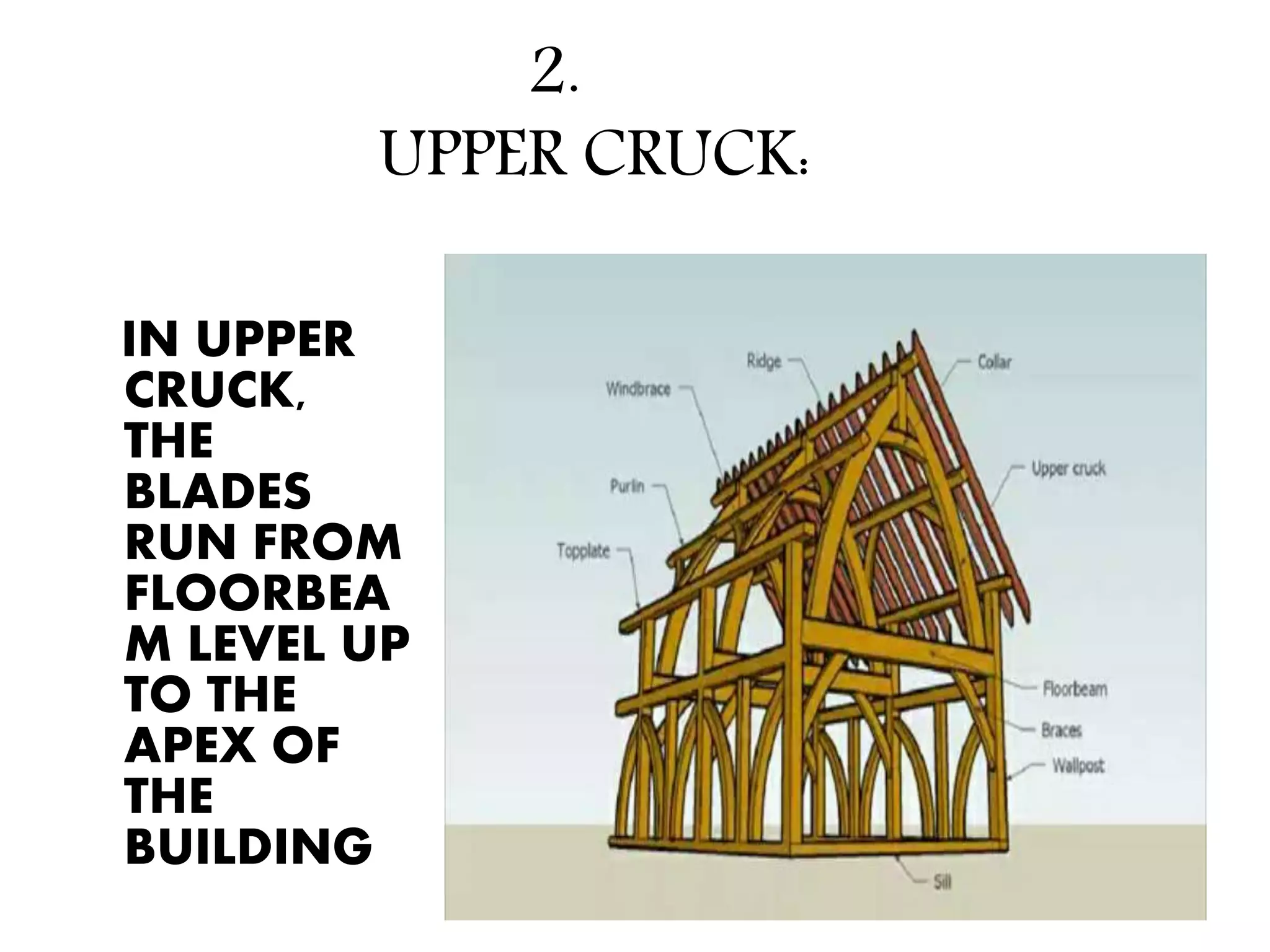
UPPER CRUCK:
IN UPPER
CRUCK,
THE
BLADES
RUN FROM
FLOORBEA
M LEVEL UP
TO THE
APEX OF
THE
BUILDING
3.
JOINTED CRUCK:
• TWO MEMBERS
ARE JOINED TO
FORM A CRUCK.
HERE, A POST
RUNS UP TO
TOPPLATE LEVEL
WHERE IT
FLARES OUT
INTO THE ROOF
ANGLE. THERE,
IT IS JOINED
WITH A
STRAIGHT
PRINCIPLE
RAFTER.
4.
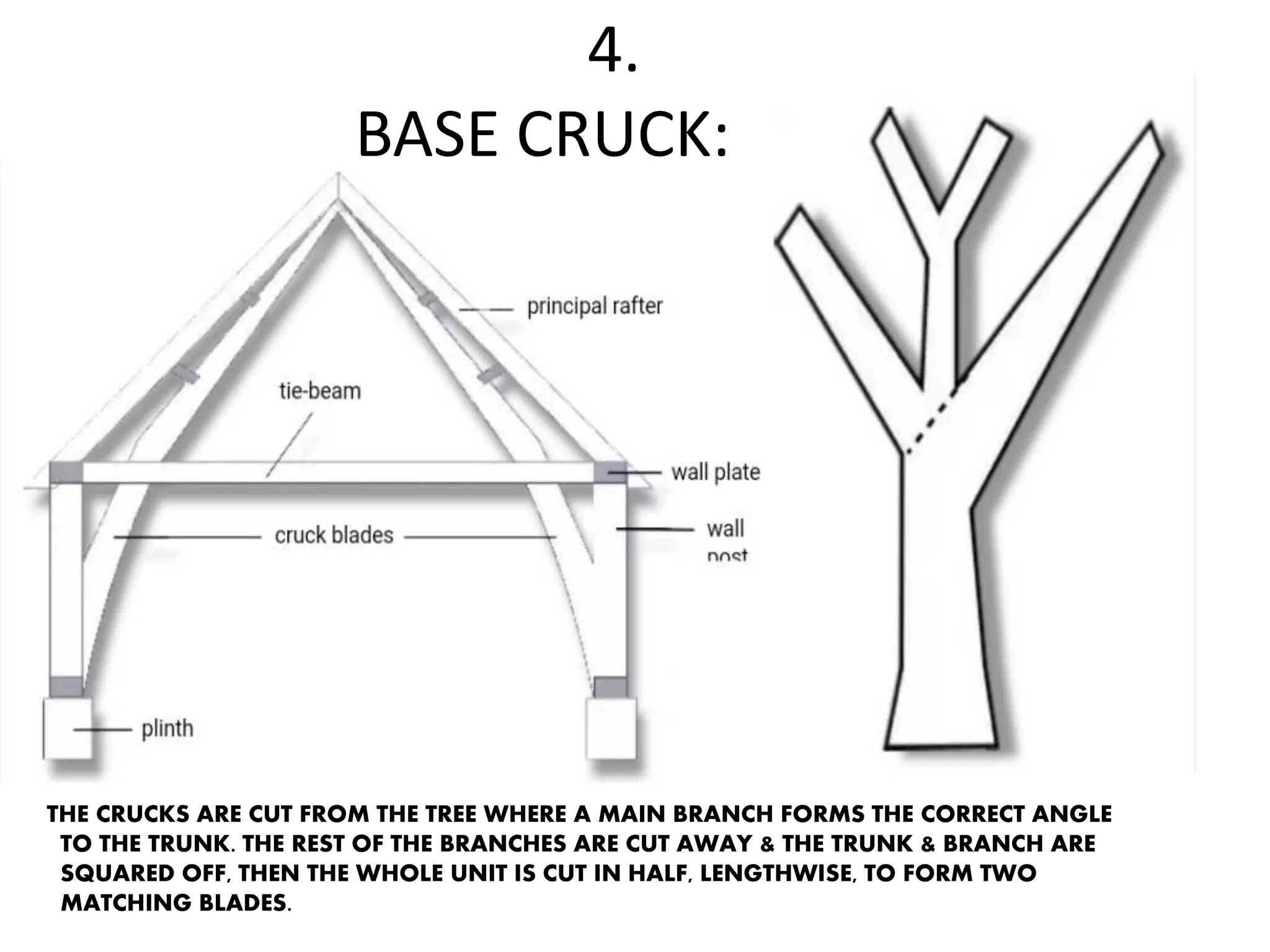
BASE CRUCK:
THE CRUCKS ARE CUT FROM THE TREE WHERE A MAIN BRANCH FORMS THE CORRECT ANGLE
TO THE TRUNK. THE REST OF THE BRANCHES ARE CUT AWAY & THE TRUNK & BRANCH ARE
SQUARED OFF, THEN THE WHOLE UNIT IS CUT IN HALF, LENGTHWISE, TO FORM TWO
MATCHING BLADES.
5.
RAISED CRUCK:
THE BLADES LAND ON MASONRY WALL & EXTEND TO RIDGE
Joints in timber structures
1. Butt joint
•It is the simplest joint.
•It is the weakest joint
and relies in some form
of reinforcement or glue.
Butt joint
2.Mortise and tenon
•It has been used for centuries by
woodworkers because of its high
strength.
•It is usually used when two
members are at held at 90
degrees or slightly less than 90
(strongest when at 90 degrees).
3.LAP JOINT
•It is made by halving the the
thickness of members at the
joint and fitting them together.
4.Dowel joint.
Dowels are rounded pins used to strengthen a
joint.
Dowel joint
5.Finger joint.
Multiple grooves are cut from plank leaving multiple protruding peaks or
fingers which interlock.
6.Birdle joint.
•It is similar to tenon and mortice joint but the difference is that the
tenons and mortice are cut to full width of tenon member.
•Mostly used to fix rails with stiles.
7.Splice joint or scarf joint
It is used to join two members end to end.
8.Bird’s mouth joint.
• It is generally used to connect roof rafter to top plate of a
supporting wall
• The notch in the rafter has the shape odf birds mouth.
9.Tongue and groove joint
•It joins two members end to end.
•The tongue projects a little less than the depth of groove.
Hammer and beam truss details
dowels
tenons
mortise
Post and principle rafter details
rafter
post
mortise
beam
Lower strut to king post
dowels
King post
strut
Tie beam
Four beams to a post
Dhajji dewari
.
introduction
DHAJJI DEWARI IS A TIMBER FRAME WITH STONE & EARTH INFILL,
TYPICALLY USED IN THE MOUNTAIN REGIONS OF SOUTH ASIA. SIMILAR
CONSTRUCTION IS USED AROUND THE WORLD, UNDER DIFFERENT
NAMES. HIMIS IS A TURKISH VARIATION OF THIS TECHNIQUE, IN
PORTUGAL, BUILDERS HAVE USED GAIOLA POMBALINA & ITALY USES
CASA BARACCATA TIMBER FRAME.
DHAJJI DEWARI {PERSIAN FOR “ PATCH QUILT WALL”}IS A
TRADITIONAL BUILDING TYPE FOUND IN THE WESTERN HIMALAYAS.
SUCH HOUSES ARE FOUND IN BOTH THE PAKISTANI & INDIAN SIDES OF
KASHMIR. THIS FORM OF CONSTRUCTION IS ALSO REFERRED TO IN THE
INDIAN STANDARD CODES AS BRICK NOGGED TIMBER FRAME
CONSTRUCTION.
EXAMPLES
TERMINOLOGY
JOINTS
JOINERY
.
BRACING PATTERNS
DHAJJI BUILDING IN DETAIL
DHAJJI BUILDINGS ARE TYPICALLY ONE TO FOUR STORIES TALL & THE ROOF MAY
BE A TIMBER OR MUD ROOF OR A PITCHED ROOF WITH METAL SHEETING. THE
FLOORS OF THESE HOUSES ARE MADE WITH TIMBER BEAMS THAT SPAN BETWEEN
WALLS. TIMBER FLOOR BOARDS, WHICH SPAN OVER THE FLOOR BEAMS WOULD
TRADITIONALLY BE OVERLAID BY A LAYER OF CLAY OR MUD.
PLA
PLAN OF A DHAJJI BUILDING
DFF
• FGGG
SECTION OF A DHAJJI BUILDING
EXPLODED MODEL OF A DHAJJI BUILDING
MODEL OF A DHAJJI BUILDING
TIMBER FRAMES FOR DHAJJI BUILDINGS
JOINTS
JOINING DETAILS AT THE CORNER
DPC IS NOT PROVIDED.
Timber ground beam
(or sill beam) raised
above the ground to
protect the timber
frame from rotting
.
JOINERY DETAILS AT THE TOP
FOUNDATION
• HSGBHGHIH
Strip footing made from stone with concrete Foundation below plinth beam
capping and embedded steel reinforcement
Bolts in the foundation to tie-up plinth timber Base plate corner detail & Bolt anchor
holes
INFILL
WALL/BRACE READY TO RECEIVE INFILL WALL/BRACE RECEIVING THE INFILL
INTERNAL VIEW OF THE
WALL/BRACE AFTER
RECEIVING THE INFILL
IMPORTANT FACTORS TO BE CONSIDERED
WHILE DESIGNING DAJJI BUILDINGS
1. PROPORTIONS 2. SHAPE
3. PLANNING 4. BALANCE
5. EXTERNAL WALLS 6. SHOP WINDOW FRONT
1. HIPPED ROOFS ARE STRONGER
THAN PITCHED ROOFS BECAUSE
THEY DON’T FALL OVER.
2. IF A PITCHED ROOF IS USED,
IT MUST BE BRACED INSIDE
3. MORE STOREYED BUILDINGS ARE CONSTRUCTED, BUT
TWO STOREYED BUILDINGS HAVE THE BEST STABILITY
4. THE LENGTH OF THE WALL MUST NOT EXCEED 15 FEET.
IF THE WALL IS LONGER, IT HAS TO BE BRACED IN
BETWEEN, EITHER BY A BUTTRESS WALL OR A BEAM WELL
CONNECTED TO ANOTHER WALL IN THE SAME DIRECTION
OPENINGS
1. WINDOWS & DOORS MUST BE MINIMISED AS THEY ARE THE WEAK POINTS
2. SMALLER OPENINGS ARE BETTER THAN BIG ONES
3. AVOID PLACING ALL THE WINDOWS ON THE SAME SIDE
4. KEEP WINDOWS & DOORS ATLEAST 2 FEET FROM THE CORNERS
5. VERANDAS SHOULD NOT BE
DEEPER THAN 1/3 OF THE
DEPTH OF THE BUILDING
6. VERANDAS PLACED IN THE
MIDDLE OF THE BUILDING
ARE BETTER
EARTHQUAKE RESISTANCE
SIMILAR CONSTRUCTION
TECHNIQUES AROUND THE
WORLD:
HIMIS – TURKEY
GAIOLA POMBALINA - PORTUGAL
CASA BARACCATA – ITALY
AND MORE……
HIMIS [TURKEY]
EXAMPLES OF HIMIS THROUGHOUT TURKEY
.
BUILDINGS IN TURKEY MADE BY HIMIS TECHNIQUE
GAIOLA POMBALINA [PORTUGAL]
BUILDINGS IN PORTUGAL MADE BY GAIOLA POMBALINA TECHNIQUE
CASA BARACCATA [ITALY]
.
FRAME & EXAMPLE OF A STRUCTURE MADE
WITH CASA BARACCATA TECHNIQUE
Some more
examples of
similar types of
construction
• .
Similar types of construction from
Nicosia, Cyprus
Similar types of construction from
Port au prince, Haiti
Similar types of construction from
Venezuela
Similar types of construction from
Punjab, India
Similar types of construction from
France
Similar types of construction from
South America
LOG CONSTRUCTION
• It is the method of construction of a structure by
stacking up logs on one another horizontally.
• Logs are placed in place with the help of tongue and
groove joint.
• Logs are interlocked at corners with the help of
notching
Log profiles
1. Double round
•It gives round look on interior as well as exterior.
Double round profile with double
tongue and groove joint
Single tongue and groove
joint
2. D profile
•Flat interior walls and
round appearance on the
exterior.
Tongue and groove joint
between logsD profile
3. Square or rectangular
•Logs produce flat interior and exterior walls.
Single tongue and groove joint
Double tongue and groove joint
4. Swedish cope
•A concave notch is made at the bottom of log so that it sits over the log lying
below it.
Swedish cope profile Logs stacked over one another
5. Bevelled or shiplap
Corner details
1. Butt and pass corner
•One log is intercepted by
the other coming at 90
degrees.
•Logs exceed corners
alternatively.
Corner detail
2.Dovetail corner
•Logs at corners are held
together with the help of
dovetail profile.
•This type of corner resists
sliding movements because of
firm interlockinf pattern
•It is aesthetically more
pleasing
3. saddle notch corner
•One log sits on the saddle shaped notch of other ,allowing
every log to exceed the corner
Saddle shaped notch
Corner detail
4. Corner post
•Every log meeting at corner is
attached to a log post
•Thus giving us a vertical
member at corner.
PROS & CONS OF TIMBER STRUCTURE
Wood is an organic, Hygroscopic and
Anisotropic Material. It has good thermal,
acoustic, electrical, mechanical, aesthetic
properties .These Properties are very
suitable to use it as a building material
Advantages
• Thermal Properties:-
Wood is 400 times better as a thermal insulator than steel and 14 times
better than concrete.
Wood also has significant thermal properties, retaining heat from the day
and releasing at night.
• Acoustic Properties:-
Sound isolation is based on the mass of the surface. Wood, as alight
material, is not perfect for sound isolation, but it is ideal for sound
absorption. Wood prevents echo and noise by absorbing sound. For this
reason it is used in concert hall
• Electrical Properties:-
Resistance to electrical current of a compeletely dry wood is equal to that
of phenol formaldehyde. An oven dried wood is very good electrical
insulator.
.• Mechanical Properties:-
Tensile strength of wood = 0.6/cm3
Specific Gravity of wood = 100 N/mm2
Tensile strength of steel = 7.89/cm3
Specific Gravity of steel = 500 N/mm2
• Aesthetic Properties:-
Wood is a decorative material when considered as an
aesthetic material. Each tree has it own color, design and
smell the design of the tree does not change according to the
way it sliced.
.
• Building Time:-
Bricks and block frame buildings take longer to construct
because of the time it’s takes to built walls, plaster them,
throw the concrete floors, and for the mortar, plater and
concrete to dry properly.
• Timber frame homes can be built in freezing
temperatures
• More flexible design:-
Timber frames can be crafted into almost any shape and are
perfect for an pen plan style home.
• Timber is green and eco-friendly:-
Most forested trees are re-planted after they are felled and
this makes them a good option.
Disadvantages
• Shrinkage and swelling of wood:-
Wood is a hygroscopic material. This means that it will absorb
surrounding condensable vapors and loses moisture to air
below the fixer saturation point.
• Deterioration of wood:-
The agent causing the deterioration and destruction of wood
fall into two categories: Biotic( biological) and Abiotic(non-
biological)
Biotic agents include decay and mold fungi, bacteria and
insects.
Abiotic agents include sun, wind, certain chemicals and fire.
.
• Susceptible to damp conditions;-
Where a timber frame home has been poorly built in an area
where wet conditions dominate, damp problems can occur.
When exposed to constant or long term dampness wood will
eventually rot.

Timber structures

  • 1.
    BUILDING CONSTRUCTION &MATERIALS – II GROUP 3 TOPIC: STRUCTURAL PROPERTIES OF TIMBER GROUP MEMBERS: ZAINAB MUZAFFAR FARIYA RIYAZ SAQIB NAZIR LABEEB QASHU AZRA FATIMA UBAID UR REHMAN
  • 2.
  • 3.
    INTRODUCTION  Any woodused for the construction purposes is called as timber.  Lumbar is the wood material roughly sawn and cut into length.  Timber might be obtained from different kinds of trees all around the world.  Selection of timber in different parts of the building may depend on different factors such as, • Durability . • Finish. • Availability.
  • 4.
    HARDWOOD SOFTWOOD • Hardwoodproducing trees are generally flowering trees, have broad leaves and typically deciduous,(shedding and regrowing leaves annually). • Cellular structure is complex. The longitudinal cells of hardwood are of two types 1) small cavities –provide strength 2)large cavities-conduct food Wood grain pattern increases density and workability. • Softwood producing trees do not bear flowers and have a single main stem and are evergreen. • All longitudinal cells are of same type and almost the same size,these provide strength to the tree Types of timber
  • 6.
    HARDWOOD • Hardwoods are commonlyused for finishing floors.Due to interesting grain structure.They are used for wall paneling,cabinets, furniture. • More expensive SOFTWOOD • Softwood trees mature faster,hence because of the relative abundance are commonly used for structural framing. (floors,ceilings,joists,raf ters etc • Less expensive.
  • 7.
    HARDWOOD • Transverse cellscalled rays (perpendicular to the longitudnal cells) provide transverse strength. • Ray cells are more prominent,due to which hardwoods show a more interesting grain structure. SOFTWOOD • Transverse cells called rays provide transverse strength • Ray cells are not more prominnent,thus show less interesting grain structure.
  • 11.
    ELEMENTS OF ATIMBER FRAME
  • 12.
    TRUSS • A framework,typically consisting of rafters, posts, and struts, supporting a roof, bridge, or other structure. Types of trusses 1.Closed truss 2.Open truss
  • 13.
  • 14.
  • 15.
    CLOSED TRUSS 1. KINGPOST TRUSS • For spans greater than 5 m and less than 9 m. • Framework consisting of two principal rafters, one tie beam, two struts and a king post.
  • 16.
    Joints Joint at thefeet of king post Gibs , Cotters and Three way strap
  • 17.
    Joints Joint at purlinor at head of Joint at the head of king post Strut point.
  • 18.
    2.QUEEN POST TRUSS •For spans greater than 9 m and less than 14 m • Framework consisting of two principal rafters, two queen posts, one straining beam , two inclined struts and a straining sill.
  • 19.
    Detail Of Joints Jointat the feet of queen post Joint at the head of queen post
  • 20.
    OPEN TRUSS 1.HAMMER BEAMTRUSS • Constructed by omitting the middle part of tie beam. • Spans over 20 m .
  • 21.
    2.Scissor Truss • Scissorstrusses are used almost entirely in building construction to support a pitched roof, where a sloping or raised ceiling surface is desired. • It is a kind of truss in which the bottom chord members cross each other, connecting to the angled top chords at a point intermediate on the top chords' length, creating an appearance similar to an opened pair of scissors.
  • 32.
    CRUCK FRAME A CRUCKFRAME IS A CURVED TIMBER MEMBER, ONE OF A PAIR, CURVED INWARDS, WHICH SUPPORTS THE ROOF OF A BUILDING
  • 33.
  • 34.
    TYPES OF CRUCK FRAMES: 1.FULL CRUCK OR TRUE CRUCK 2. UPPER CRUCK 3. JOINTED CRUCK 4. BASE CRUCK 5. RAISED CRUCK
  • 35.
    . * THE BLADES,STRAIGHT OR CURVED, EXTEND FROM THE FOUNDATION NEAR THE GROUND TO THE RIDGE. * A FULL CRUCK DOES NOT NEED A TIE BEAM & MAY BE CALLED A ‘FULL CRUCK’, & IF A TIE BEAM IS USED, THEN ITS CALLED ‘ FULL CRUCK -CLOSED’ 1. TRUE CRUCK OR FULL CRUCK:
  • 37.
    2. UPPER CRUCK: IN UPPER CRUCK, THE BLADES RUNFROM FLOORBEA M LEVEL UP TO THE APEX OF THE BUILDING
  • 38.
    3. JOINTED CRUCK: • TWOMEMBERS ARE JOINED TO FORM A CRUCK. HERE, A POST RUNS UP TO TOPPLATE LEVEL WHERE IT FLARES OUT INTO THE ROOF ANGLE. THERE, IT IS JOINED WITH A STRAIGHT PRINCIPLE RAFTER.
  • 39.
    4. BASE CRUCK: THE CRUCKSARE CUT FROM THE TREE WHERE A MAIN BRANCH FORMS THE CORRECT ANGLE TO THE TRUNK. THE REST OF THE BRANCHES ARE CUT AWAY & THE TRUNK & BRANCH ARE SQUARED OFF, THEN THE WHOLE UNIT IS CUT IN HALF, LENGTHWISE, TO FORM TWO MATCHING BLADES.
  • 40.
    5. RAISED CRUCK: THE BLADESLAND ON MASONRY WALL & EXTEND TO RIDGE
  • 41.
    Joints in timberstructures 1. Butt joint •It is the simplest joint. •It is the weakest joint and relies in some form of reinforcement or glue. Butt joint
  • 42.
    2.Mortise and tenon •Ithas been used for centuries by woodworkers because of its high strength. •It is usually used when two members are at held at 90 degrees or slightly less than 90 (strongest when at 90 degrees).
  • 43.
    3.LAP JOINT •It ismade by halving the the thickness of members at the joint and fitting them together.
  • 44.
    4.Dowel joint. Dowels arerounded pins used to strengthen a joint. Dowel joint
  • 45.
    5.Finger joint. Multiple groovesare cut from plank leaving multiple protruding peaks or fingers which interlock.
  • 46.
    6.Birdle joint. •It issimilar to tenon and mortice joint but the difference is that the tenons and mortice are cut to full width of tenon member. •Mostly used to fix rails with stiles.
  • 47.
    7.Splice joint orscarf joint It is used to join two members end to end.
  • 48.
    8.Bird’s mouth joint. •It is generally used to connect roof rafter to top plate of a supporting wall • The notch in the rafter has the shape odf birds mouth.
  • 49.
    9.Tongue and groovejoint •It joins two members end to end. •The tongue projects a little less than the depth of groove.
  • 50.
    Hammer and beamtruss details dowels tenons mortise
  • 51.
    Post and principlerafter details rafter post mortise beam
  • 52.
    Lower strut toking post dowels King post strut Tie beam
  • 53.
  • 54.
  • 55.
    introduction DHAJJI DEWARI ISA TIMBER FRAME WITH STONE & EARTH INFILL, TYPICALLY USED IN THE MOUNTAIN REGIONS OF SOUTH ASIA. SIMILAR CONSTRUCTION IS USED AROUND THE WORLD, UNDER DIFFERENT NAMES. HIMIS IS A TURKISH VARIATION OF THIS TECHNIQUE, IN PORTUGAL, BUILDERS HAVE USED GAIOLA POMBALINA & ITALY USES CASA BARACCATA TIMBER FRAME. DHAJJI DEWARI {PERSIAN FOR “ PATCH QUILT WALL”}IS A TRADITIONAL BUILDING TYPE FOUND IN THE WESTERN HIMALAYAS. SUCH HOUSES ARE FOUND IN BOTH THE PAKISTANI & INDIAN SIDES OF KASHMIR. THIS FORM OF CONSTRUCTION IS ALSO REFERRED TO IN THE INDIAN STANDARD CODES AS BRICK NOGGED TIMBER FRAME CONSTRUCTION.
  • 56.
  • 57.
  • 59.
  • 61.
  • 62.
  • 63.
  • 64.
    DHAJJI BUILDING INDETAIL DHAJJI BUILDINGS ARE TYPICALLY ONE TO FOUR STORIES TALL & THE ROOF MAY BE A TIMBER OR MUD ROOF OR A PITCHED ROOF WITH METAL SHEETING. THE FLOORS OF THESE HOUSES ARE MADE WITH TIMBER BEAMS THAT SPAN BETWEEN WALLS. TIMBER FLOOR BOARDS, WHICH SPAN OVER THE FLOOR BEAMS WOULD TRADITIONALLY BE OVERLAID BY A LAYER OF CLAY OR MUD. PLA PLAN OF A DHAJJI BUILDING
  • 65.
  • 66.
    SECTION OF ADHAJJI BUILDING
  • 67.
    EXPLODED MODEL OFA DHAJJI BUILDING
  • 68.
    MODEL OF ADHAJJI BUILDING TIMBER FRAMES FOR DHAJJI BUILDINGS
  • 69.
    JOINTS JOINING DETAILS ATTHE CORNER DPC IS NOT PROVIDED. Timber ground beam (or sill beam) raised above the ground to protect the timber frame from rotting
  • 70.
  • 71.
    FOUNDATION • HSGBHGHIH Strip footingmade from stone with concrete Foundation below plinth beam capping and embedded steel reinforcement Bolts in the foundation to tie-up plinth timber Base plate corner detail & Bolt anchor holes
  • 72.
    INFILL WALL/BRACE READY TORECEIVE INFILL WALL/BRACE RECEIVING THE INFILL INTERNAL VIEW OF THE WALL/BRACE AFTER RECEIVING THE INFILL
  • 73.
    IMPORTANT FACTORS TOBE CONSIDERED WHILE DESIGNING DAJJI BUILDINGS 1. PROPORTIONS 2. SHAPE
  • 74.
    3. PLANNING 4.BALANCE 5. EXTERNAL WALLS 6. SHOP WINDOW FRONT
  • 75.
    1. HIPPED ROOFSARE STRONGER THAN PITCHED ROOFS BECAUSE THEY DON’T FALL OVER. 2. IF A PITCHED ROOF IS USED, IT MUST BE BRACED INSIDE
  • 76.
    3. MORE STOREYEDBUILDINGS ARE CONSTRUCTED, BUT TWO STOREYED BUILDINGS HAVE THE BEST STABILITY
  • 77.
    4. THE LENGTHOF THE WALL MUST NOT EXCEED 15 FEET. IF THE WALL IS LONGER, IT HAS TO BE BRACED IN BETWEEN, EITHER BY A BUTTRESS WALL OR A BEAM WELL CONNECTED TO ANOTHER WALL IN THE SAME DIRECTION
  • 78.
    OPENINGS 1. WINDOWS &DOORS MUST BE MINIMISED AS THEY ARE THE WEAK POINTS 2. SMALLER OPENINGS ARE BETTER THAN BIG ONES 3. AVOID PLACING ALL THE WINDOWS ON THE SAME SIDE 4. KEEP WINDOWS & DOORS ATLEAST 2 FEET FROM THE CORNERS
  • 79.
    5. VERANDAS SHOULDNOT BE DEEPER THAN 1/3 OF THE DEPTH OF THE BUILDING 6. VERANDAS PLACED IN THE MIDDLE OF THE BUILDING ARE BETTER
  • 80.
  • 81.
    SIMILAR CONSTRUCTION TECHNIQUES AROUNDTHE WORLD: HIMIS – TURKEY GAIOLA POMBALINA - PORTUGAL CASA BARACCATA – ITALY AND MORE……
  • 82.
    HIMIS [TURKEY] EXAMPLES OFHIMIS THROUGHOUT TURKEY
  • 83.
    . BUILDINGS IN TURKEYMADE BY HIMIS TECHNIQUE
  • 84.
    GAIOLA POMBALINA [PORTUGAL] BUILDINGSIN PORTUGAL MADE BY GAIOLA POMBALINA TECHNIQUE
  • 85.
  • 86.
    . FRAME & EXAMPLEOF A STRUCTURE MADE WITH CASA BARACCATA TECHNIQUE
  • 87.
    Some more examples of similartypes of construction • .
  • 88.
    Similar types ofconstruction from Nicosia, Cyprus
  • 89.
    Similar types ofconstruction from Port au prince, Haiti
  • 90.
    Similar types ofconstruction from Venezuela
  • 91.
    Similar types ofconstruction from Punjab, India
  • 92.
    Similar types ofconstruction from France
  • 93.
    Similar types ofconstruction from South America
  • 94.
    LOG CONSTRUCTION • Itis the method of construction of a structure by stacking up logs on one another horizontally. • Logs are placed in place with the help of tongue and groove joint. • Logs are interlocked at corners with the help of notching
  • 95.
  • 96.
    1. Double round •Itgives round look on interior as well as exterior. Double round profile with double tongue and groove joint Single tongue and groove joint
  • 97.
    2. D profile •Flatinterior walls and round appearance on the exterior. Tongue and groove joint between logsD profile
  • 98.
    3. Square orrectangular •Logs produce flat interior and exterior walls. Single tongue and groove joint Double tongue and groove joint
  • 99.
    4. Swedish cope •Aconcave notch is made at the bottom of log so that it sits over the log lying below it. Swedish cope profile Logs stacked over one another
  • 100.
  • 101.
    Corner details 1. Buttand pass corner •One log is intercepted by the other coming at 90 degrees. •Logs exceed corners alternatively. Corner detail
  • 102.
    2.Dovetail corner •Logs atcorners are held together with the help of dovetail profile. •This type of corner resists sliding movements because of firm interlockinf pattern •It is aesthetically more pleasing
  • 103.
    3. saddle notchcorner •One log sits on the saddle shaped notch of other ,allowing every log to exceed the corner Saddle shaped notch Corner detail
  • 104.
    4. Corner post •Everylog meeting at corner is attached to a log post •Thus giving us a vertical member at corner.
  • 105.
    PROS & CONSOF TIMBER STRUCTURE Wood is an organic, Hygroscopic and Anisotropic Material. It has good thermal, acoustic, electrical, mechanical, aesthetic properties .These Properties are very suitable to use it as a building material
  • 106.
    Advantages • Thermal Properties:- Woodis 400 times better as a thermal insulator than steel and 14 times better than concrete. Wood also has significant thermal properties, retaining heat from the day and releasing at night. • Acoustic Properties:- Sound isolation is based on the mass of the surface. Wood, as alight material, is not perfect for sound isolation, but it is ideal for sound absorption. Wood prevents echo and noise by absorbing sound. For this reason it is used in concert hall • Electrical Properties:- Resistance to electrical current of a compeletely dry wood is equal to that of phenol formaldehyde. An oven dried wood is very good electrical insulator.
  • 107.
    .• Mechanical Properties:- Tensilestrength of wood = 0.6/cm3 Specific Gravity of wood = 100 N/mm2 Tensile strength of steel = 7.89/cm3 Specific Gravity of steel = 500 N/mm2 • Aesthetic Properties:- Wood is a decorative material when considered as an aesthetic material. Each tree has it own color, design and smell the design of the tree does not change according to the way it sliced.
  • 108.
    . • Building Time:- Bricksand block frame buildings take longer to construct because of the time it’s takes to built walls, plaster them, throw the concrete floors, and for the mortar, plater and concrete to dry properly. • Timber frame homes can be built in freezing temperatures • More flexible design:- Timber frames can be crafted into almost any shape and are perfect for an pen plan style home. • Timber is green and eco-friendly:- Most forested trees are re-planted after they are felled and this makes them a good option.
  • 109.
    Disadvantages • Shrinkage andswelling of wood:- Wood is a hygroscopic material. This means that it will absorb surrounding condensable vapors and loses moisture to air below the fixer saturation point. • Deterioration of wood:- The agent causing the deterioration and destruction of wood fall into two categories: Biotic( biological) and Abiotic(non- biological) Biotic agents include decay and mold fungi, bacteria and insects. Abiotic agents include sun, wind, certain chemicals and fire.
  • 110.
    . • Susceptible todamp conditions;- Where a timber frame home has been poorly built in an area where wet conditions dominate, damp problems can occur. When exposed to constant or long term dampness wood will eventually rot.