ALTERNATE ROOFING MATERIALS
TO R.C.C
• Stone slab roofing
• Jack arch roofing
• Madras roofing
• Deck roofing
● Alternate building materials are those which can
be used economically by replacing the
conventional building materials.
● These materials are historically appropriate,cost
effective,easy to install,and functional in wildland
fire environments.
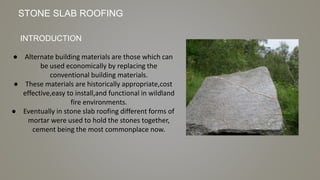
● Eventually in stone slab roofing different forms of
mortar were used to hold the stones together,
cement being the most commonplace now.
INTRODUCTION
STONE SLAB ROOFING
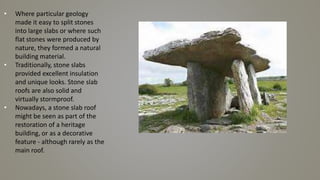
• Where particular geology
made it easy to split stones
into large slabs or where such
flat stones were produced by
nature, they formed a natural
building material.
• Traditionally, stone slabs
provided excellent insulation
and unique looks. Stone slab
roofs are also solid and
virtually stormproof.
• Nowadays, a stone slab roof
might be seen as part of the
restoration of a heritage
building, or as a decorative
feature - although rarely as the
main roof.
Stone roofs
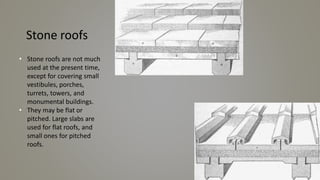
• Stone roofs are not much
used at the present time,
except for covering small
vestibules, porches,
turrets, towers, and
monumental buildings.
• They may be flat or
pitched. Large slabs are
used for flat roofs, and
small ones for pitched
roofs.
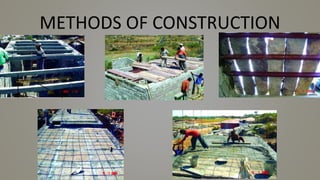
Methods of Construction: CONTEMPORARY METHOD
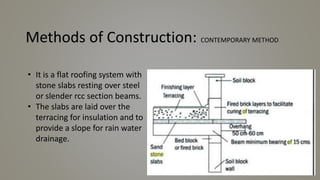
• It is a flat roofing system with
stone slabs resting over steel
or slender rcc section beams.
• The slabs are laid over the
terracing for insulation and to
provide a slope for rain water
drainage.
METHODS OF CONSTRUCTION :
TRADITIONAL METHOD
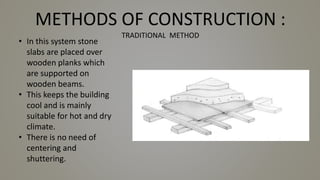
• In this system stone
slabs are placed over
wooden planks which
are supported on
wooden beams.
• This keeps the building
cool and is mainly
suitable for hot and dry
climate.
• There is no need of
centering and
shuttering.
METHODS OF CONSTRUCTION
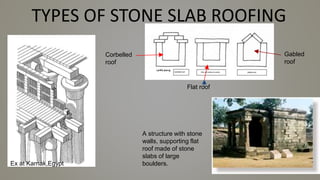
TYPES OF STONE SLAB ROOFING
Ex at Karnak,Egypt
A structure with stone
walls, supporting flat
roof made of stone
slabs of large
boulders.
Corbelled
roof
Flat roof
Gabled
roof
Advantages and Disadvantages
• Good insulation
• Beautiful appearance
• They are solid and also storm proof
• Water proof roofing
• Durability
• Very heavy
• Labour incentive
• An obsolete cladding material
• Not suitable to withstand loading from
furniture, etc of modern residential buildings.
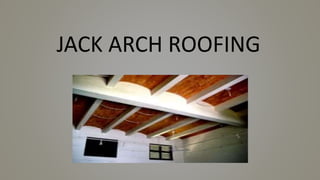
JACK ARCH ROOFING
INTRODUCTION
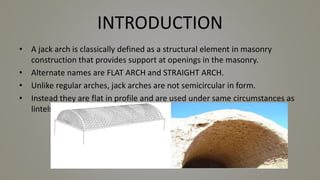
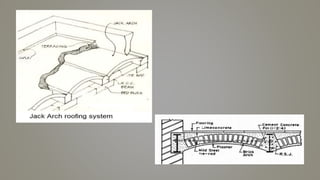
• A jack arch is classically defined as a structural element in masonry
construction that provides support at openings in the masonry.
• Alternate names are FLAT ARCH and STRAIGHT ARCH.
• Unlike regular arches, jack arches are not semicircular in form.
• Instead they are flat in profile and are used under same circumstances as
lintels.
MATERIALS
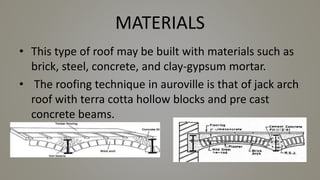
• This type of roof may be built with materials such as
brick, steel, concrete, and clay-gypsum mortar.
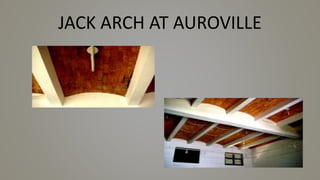
• The roofing technique in auroville is that of jack arch
roof with terra cotta hollow blocks and pre cast
concrete beams.
ADVANTAGES
• It can be constructed from relatively small pieces of
material that can be handled by individuals .
• Arches are typically sawn from an appropriately sized
fired clay lintel.
• There is considerable scope for in corporation of
decorative patterns and elements into jack arches.
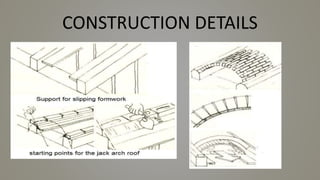
CONSTRUCTION DETAILS
JACK ARCH AT AUROVILLE
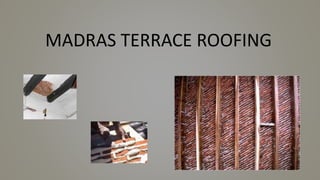
MADRAS TERRACE ROOFING
INTRODUCTION
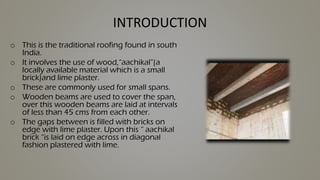
o This is the traditional roofing found in south
India.
o It involves the use of wood,“aachikal”(a
locally available material which is a small
brick)and lime plaster.
o These are commonly used for small spans.
o Wooden beams are used to cover the span,
over this wooden beams are laid at intervals
of less than 45 cms from each other.
o The gaps between is filled with bricks on
edge with lime plaster. Upon this “ aachikal
brick “is laid on edge across in diagonal
fashion plastered with lime.
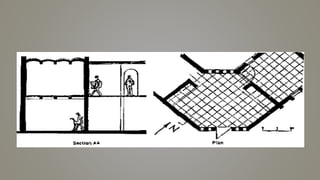
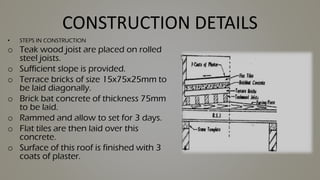
CONSTRUCTION DETAILS
• STEPS IN CONSTRUCTION
o Teak wood joist are placed on rolled
steel joists.
o Sufficient slope is provided.
o Terrace bricks of size 15x75x25mm to
be laid diagonally.
o Brick bat concrete of thickness 75mm
to be laid.
o Rammed and allow to set for 3 days.
o Flat tiles are then laid over this
concrete.
o Surface of this roof is finished with 3
coats of plaster.
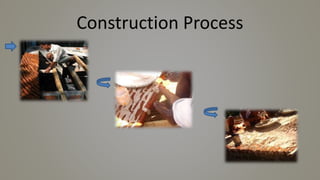
Construction Process
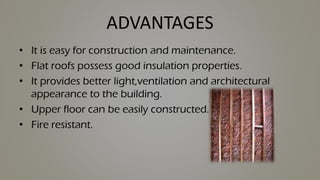
ADVANTAGES
• It is easy for construction and maintenance.
• Flat roofs possess good insulation properties.
• It provides better light,ventilation and architectural
appearance to the building.
• Upper floor can be easily constructed.
• Fire resistant.
DISADVANTAGES
• Madras roofs are not suitable for long span ,with out the
introduction of columns and beams.
• Initial cost is less than a pitched roof
• Not suitable for places of heavy snowfall.
• Construction speed is slower than pitched roof
DECK ROOFING
DECK ROOFING
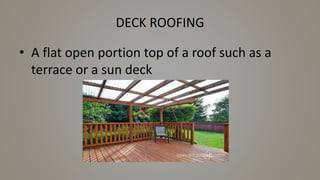
• A flat open portion top of a roof such as a
terrace or a sun deck
TYPES OF DECK ROOFING
• Depending upon materials used there are four
types of deck roofing.
1.Steel deck roofing.
2.Wood deck roofing.
3.Concrete deck roofing.
4.Cement deck roofing.
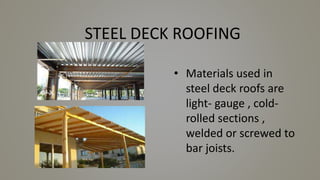
STEEL DECK ROOFING
• Materials used in
steel deck roofs are
light- gauge , cold-
rolled sections ,
welded or screwed to
bar joists.
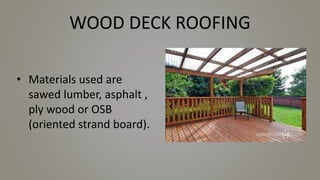
WOOD DECK ROOFING
• Materials used are
sawed lumber, asphalt ,
ply wood or OSB
(oriented strand board).
CONCRETE DECK ROOFING
• There are four types of concrete deck roofs
1.Structural concrete deck.
2.Structural composite concrete deck.
3.Precast concrete deck.
4.Lightweight insulating concrete deck.
• Concrete roof decks are commonly topside insulated
using adhered insulation panels or cast-in-place
lightweight insulating panels.
USES
• The primary use of steel roof is to support
vertical loads and the weather resisting
system , such as insulation , roofing and
waterproofing materials.
• Deck roofing can be used in garden
landscaping , to extend living areas of houses.
Source
● http://www.ruralhousingnetwork.in/technology/56adb59c336c497dc92b53d6
● https://www.google.co.in
Thank you!

Alternate roofing

  • 1.
  • 2.
    • Stone slabroofing • Jack arch roofing • Madras roofing • Deck roofing
  • 3.
    ● Alternate buildingmaterials are those which can be used economically by replacing the conventional building materials. ● These materials are historically appropriate,cost effective,easy to install,and functional in wildland fire environments. ● Eventually in stone slab roofing different forms of mortar were used to hold the stones together, cement being the most commonplace now. INTRODUCTION STONE SLAB ROOFING
  • 4.
    • Where particulargeology made it easy to split stones into large slabs or where such flat stones were produced by nature, they formed a natural building material. • Traditionally, stone slabs provided excellent insulation and unique looks. Stone slab roofs are also solid and virtually stormproof. • Nowadays, a stone slab roof might be seen as part of the restoration of a heritage building, or as a decorative feature - although rarely as the main roof.
  • 5.
    Stone roofs • Stoneroofs are not much used at the present time, except for covering small vestibules, porches, turrets, towers, and monumental buildings. • They may be flat or pitched. Large slabs are used for flat roofs, and small ones for pitched roofs.
  • 6.
    Methods of Construction:CONTEMPORARY METHOD • It is a flat roofing system with stone slabs resting over steel or slender rcc section beams. • The slabs are laid over the terracing for insulation and to provide a slope for rain water drainage.
  • 7.
    METHODS OF CONSTRUCTION: TRADITIONAL METHOD • In this system stone slabs are placed over wooden planks which are supported on wooden beams. • This keeps the building cool and is mainly suitable for hot and dry climate. • There is no need of centering and shuttering.
  • 8.
  • 9.
    TYPES OF STONESLAB ROOFING Ex at Karnak,Egypt A structure with stone walls, supporting flat roof made of stone slabs of large boulders. Corbelled roof Flat roof Gabled roof
  • 10.
    Advantages and Disadvantages •Good insulation • Beautiful appearance • They are solid and also storm proof • Water proof roofing • Durability • Very heavy • Labour incentive • An obsolete cladding material • Not suitable to withstand loading from furniture, etc of modern residential buildings.
  • 11.
  • 12.
    INTRODUCTION • A jackarch is classically defined as a structural element in masonry construction that provides support at openings in the masonry. • Alternate names are FLAT ARCH and STRAIGHT ARCH. • Unlike regular arches, jack arches are not semicircular in form. • Instead they are flat in profile and are used under same circumstances as lintels.
  • 13.
    MATERIALS • This typeof roof may be built with materials such as brick, steel, concrete, and clay-gypsum mortar. • The roofing technique in auroville is that of jack arch roof with terra cotta hollow blocks and pre cast concrete beams.
  • 14.
    ADVANTAGES • It canbe constructed from relatively small pieces of material that can be handled by individuals . • Arches are typically sawn from an appropriately sized fired clay lintel. • There is considerable scope for in corporation of decorative patterns and elements into jack arches.
  • 15.
  • 17.
    JACK ARCH ATAUROVILLE
  • 19.
  • 20.
    INTRODUCTION o This isthe traditional roofing found in south India. o It involves the use of wood,“aachikal”(a locally available material which is a small brick)and lime plaster. o These are commonly used for small spans. o Wooden beams are used to cover the span, over this wooden beams are laid at intervals of less than 45 cms from each other. o The gaps between is filled with bricks on edge with lime plaster. Upon this “ aachikal brick “is laid on edge across in diagonal fashion plastered with lime.
  • 21.
    CONSTRUCTION DETAILS • STEPSIN CONSTRUCTION o Teak wood joist are placed on rolled steel joists. o Sufficient slope is provided. o Terrace bricks of size 15x75x25mm to be laid diagonally. o Brick bat concrete of thickness 75mm to be laid. o Rammed and allow to set for 3 days. o Flat tiles are then laid over this concrete. o Surface of this roof is finished with 3 coats of plaster.
  • 22.
  • 23.
    ADVANTAGES • It iseasy for construction and maintenance. • Flat roofs possess good insulation properties. • It provides better light,ventilation and architectural appearance to the building. • Upper floor can be easily constructed. • Fire resistant.
  • 24.
    DISADVANTAGES • Madras roofsare not suitable for long span ,with out the introduction of columns and beams. • Initial cost is less than a pitched roof • Not suitable for places of heavy snowfall. • Construction speed is slower than pitched roof
  • 25.
  • 26.
    DECK ROOFING • Aflat open portion top of a roof such as a terrace or a sun deck
  • 27.
    TYPES OF DECKROOFING • Depending upon materials used there are four types of deck roofing. 1.Steel deck roofing. 2.Wood deck roofing. 3.Concrete deck roofing. 4.Cement deck roofing.
  • 28.
    STEEL DECK ROOFING •Materials used in steel deck roofs are light- gauge , cold- rolled sections , welded or screwed to bar joists.
  • 29.
    WOOD DECK ROOFING •Materials used are sawed lumber, asphalt , ply wood or OSB (oriented strand board).
  • 30.
    CONCRETE DECK ROOFING •There are four types of concrete deck roofs 1.Structural concrete deck. 2.Structural composite concrete deck. 3.Precast concrete deck. 4.Lightweight insulating concrete deck. • Concrete roof decks are commonly topside insulated using adhered insulation panels or cast-in-place lightweight insulating panels.
  • 31.
    USES • The primaryuse of steel roof is to support vertical loads and the weather resisting system , such as insulation , roofing and waterproofing materials. • Deck roofing can be used in garden landscaping , to extend living areas of houses.
  • 32.
  • 33.

Editor's Notes

  • #3 Stone Slabs are similar in appearance to regular stone, but smoother, and the texture is made up of much larger bricks.
  • #4  Eventually, different forms of mortar were used to hold the stones together, cement being the most commonplace now.
  • #9 Precast Joints and panels: Precast RCC Slabs over precast joists. This process is a suggested modification to the traditional wooden framework-cum-flooring or stone joists and slab flooring. It is more economical than normal RCC slab. The RCC precast panels are easy to cast at the site and can be easily placed on the precast joists joining with cement mortar of proportion 1:4. After casting the beams and slabs, the precast beams are anchored with the roof band at equal distances as per the design. Thereafter, precasts labs are placed and inter linked through wires. Nominal steel (6-8 mm dia) issued for thermal reinforcement on the slab surface. Concreting is done with 50 mm thickness and is cured for 14 days. Installing Precastslabs on beams Placing of Thermal reinforcement of 6 to 8 mm dia M S steel over precast slab. Casting 50 mm thick wearing coat of Cement concrete 1:2:4
  • #10  Karnak, Egypt), in which the central range of columns, higher than those on either side, permitted clerestories to be built of pierced stone slabs.. The structure still reminds us of a wooden prototype with stone walls, supporting a slanting roof made of large boulders of stone slabs. Corbelled roof , flat roof and gabled roof roof made
  • #11 Obsolete: no longer produced or used.