Wood Substitutes
Siddharth Meloth
14020243033
MBA - E&E (2014-2016)
Semester- 2nd
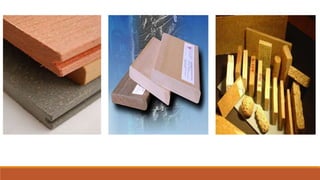
 Wood substitutes are building products that are not graded as lumber
 Composite substitutes contain wood fibre's and a mixture of plastic
(Wood-plastic composites-WPC) or cement, glue and assorted other
materials.
 Structural substitutes, also known as engineered wood, consist of
thin, overlapping strips of lumber laminated together under hydraulic
pressure.
 Majority of wood substitutes contain wood by products, other
substitutes may contain no wood whatsoever.
Introduction
Deforestation
 It has been estimated that about half of the Earth's mature tropical forests—
between 7.5 million and 8 million km2 have now been destroyed.
 By 2030 there will only be 10% of forest cover will be remaining if the current
rate of deforestation is not reduced.
 It has been estimated that we are losing 137 plant, animal and insect species
every single day due to rainforest deforestation.
 Deforestation is a major contributor to global warming.
 Damage to forests and other aspects of nature could halve living standards for
the world's poor and reduce global GDP by about 7% by 2050.
Advantages of wood substitutes
 Environmental benefits: Utilization of industrial waste, avoid deforestation,
reduction of environmental pollution.
 Stronger than wood
 Weather resistant, durable
 Corrosion-resistant
 Termite fungus, rot, rodent-resistant
 Fire retardant, self-extinguishing nature
 Cost-effective than teakwood, GRP, PC products and maintenance-free
 Use in variety of applications: doors, ceilings, flooring, partition, furniture
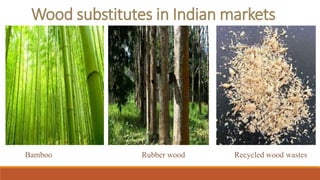
Wood substitutes in Indian markets
Bamboo Rubber wood Recycled wood wastes
 India is the second richest country in the world in terms of Bamboo genetic resources,
after China with about 13.96 million Hectares.
More than 50% of the principal genera of Bamboo are found in Eastern India.
 Results indicate that the maximum number of green sound bamboos is found in
Arunachal Pradesh (2666 million T), followed by Assam (2046 million T), Manipur (2035
million T) and Mizoram (1953 million T).
 It is estimated that the quantity of Indian imports of Bamboo Poles in 2012 was
approximately 6.1 Million kg, valued at US$ 5.62 Million.
The National Mission on Bamboo Technology and Trade Development under Ministry of
Agriculture looks after the bamboo plantation and industry in India.
Bamboo
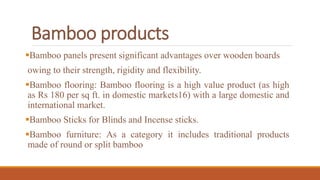
Bamboo products
Bamboo panels present significant advantages over wooden boards
owing to their strength, rigidity and flexibility.
Bamboo flooring: Bamboo flooring is a high value product (as high
as Rs 180 per sq ft. in domestic markets16) with a large domestic and
international market.
Bamboo Sticks for Blinds and Incense sticks.
Bamboo furniture: As a category it includes traditional products
made of round or split bamboo
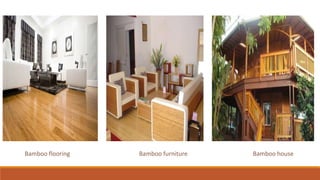
Bamboo flooring Bamboo furniture Bamboo house
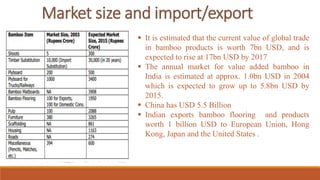
Market size and import/export
 It is estimated that the current value of global trade
in bamboo products is worth 7bn USD, and is
expected to rise at 17bn USD by 2017
 The annual market for value added bamboo in
India is estimated at approx. 1.0bn USD in 2004
which is expected to grow up to 5.8bn USD by
2015.
 China has USD 5.5 Billion
 Indian exports bamboo flooring and products
worth 1 billion USD to European Union, Hong
Kong, Japan and the United States .
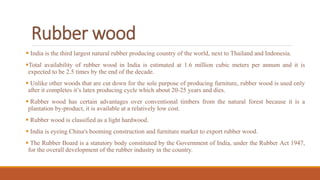
Rubber wood
 India is the third largest natural rubber producing country of the world, next to Thailand and Indonesia.
Total availability of rubber wood in India is estimated at 1.6 million cubic meters per annum and it is
expected to be 2.5 times by the end of the decade.
 Unlike other woods that are cut down for the sole purpose of producing furniture, rubber wood is used only
after it completes it’s latex producing cycle which about 20-25 years and dies.
 Rubber wood has certain advantages over conventional timbers from the natural forest because it is a
plantation by-product, it is available at a relatively low cost.
 Rubber wood is classified as a light hardwood.
 India is eyeing China's booming construction and furniture market to export rubber wood.
 The Rubber Board is a statutory body constituted by the Government of India, under the Rubber Act 1947,
for the overall development of the rubber industry in the country.
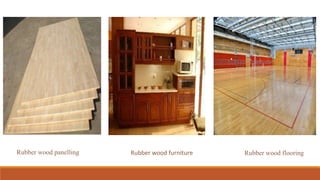
Rubber wood products
 Furniture and furniture parts
 Parquet
 Panelling
 Wood-based panels (particleboard, cement and gypsum-bonded panels)
 Medium-density fibreboard (MDF)
 Kitchen and novelty items
 Sawn timber for general utility and fuel
Rubber wood furniture Rubber wood flooringRubber wood panelling
Market size and import/export
 Malaysia is the largest exporter of rubber wood with an overall production
capacity of 1.16 million m3 per annum.
Thailand is the second largest exporter of rubber wood 1 million cubic metres of
rubber wood.
Japan, United States & China are the largest importer of rubber wood.
India is now looking to add China to its export market in addition to the United
States, Japan, Singapore, United Kingdom and the Middle East.
The Rubber Board of India participated in International exhibition on furniture
world and wood working machinery, China 2003 to finalise the deals.
Recycled plastic
In addition to being made from recycled content, HDPE plastic lumber is a truly
recyclable material that can be used over and over again.
Its resistance to decay and ability to withstand severe weather ensures a lifetime
of use, without sacrificing the look of the product.
 Since plastic is susceptible to expansion and contraction from variable
temperatures, HDPE, EPS Solutions are mixed to it during manufacturing to
increase durability and decrease expansion and contraction.
 Since the minerals are not an organic material EPS Solutions’ recycled plastic
lumber remains impervious to rot, mold, mildew, insects, water and other decay.
Characteristics
Extremely non-corrosive plastic
Prohibits water penetration
Increased strength
Decreased thermal expansion
Coloured all the way through (minimal fading)
Ease of use with standard woodworking tools
No decay from microscopic organisms
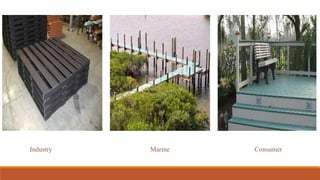
Industry Marine Consumer
Thank you

Wood substitutes

  • 1.
  • 2.
     Wood substitutesare building products that are not graded as lumber  Composite substitutes contain wood fibre's and a mixture of plastic (Wood-plastic composites-WPC) or cement, glue and assorted other materials.  Structural substitutes, also known as engineered wood, consist of thin, overlapping strips of lumber laminated together under hydraulic pressure.  Majority of wood substitutes contain wood by products, other substitutes may contain no wood whatsoever. Introduction
  • 4.
    Deforestation  It hasbeen estimated that about half of the Earth's mature tropical forests— between 7.5 million and 8 million km2 have now been destroyed.  By 2030 there will only be 10% of forest cover will be remaining if the current rate of deforestation is not reduced.  It has been estimated that we are losing 137 plant, animal and insect species every single day due to rainforest deforestation.  Deforestation is a major contributor to global warming.  Damage to forests and other aspects of nature could halve living standards for the world's poor and reduce global GDP by about 7% by 2050.
  • 5.
    Advantages of woodsubstitutes  Environmental benefits: Utilization of industrial waste, avoid deforestation, reduction of environmental pollution.  Stronger than wood  Weather resistant, durable  Corrosion-resistant  Termite fungus, rot, rodent-resistant  Fire retardant, self-extinguishing nature  Cost-effective than teakwood, GRP, PC products and maintenance-free  Use in variety of applications: doors, ceilings, flooring, partition, furniture
  • 6.
    Wood substitutes inIndian markets Bamboo Rubber wood Recycled wood wastes
  • 7.
     India isthe second richest country in the world in terms of Bamboo genetic resources, after China with about 13.96 million Hectares. More than 50% of the principal genera of Bamboo are found in Eastern India.  Results indicate that the maximum number of green sound bamboos is found in Arunachal Pradesh (2666 million T), followed by Assam (2046 million T), Manipur (2035 million T) and Mizoram (1953 million T).  It is estimated that the quantity of Indian imports of Bamboo Poles in 2012 was approximately 6.1 Million kg, valued at US$ 5.62 Million. The National Mission on Bamboo Technology and Trade Development under Ministry of Agriculture looks after the bamboo plantation and industry in India. Bamboo
  • 8.
    Bamboo products Bamboo panelspresent significant advantages over wooden boards owing to their strength, rigidity and flexibility. Bamboo flooring: Bamboo flooring is a high value product (as high as Rs 180 per sq ft. in domestic markets16) with a large domestic and international market. Bamboo Sticks for Blinds and Incense sticks. Bamboo furniture: As a category it includes traditional products made of round or split bamboo
  • 9.
    Bamboo flooring Bamboofurniture Bamboo house
  • 10.
    Market size andimport/export  It is estimated that the current value of global trade in bamboo products is worth 7bn USD, and is expected to rise at 17bn USD by 2017  The annual market for value added bamboo in India is estimated at approx. 1.0bn USD in 2004 which is expected to grow up to 5.8bn USD by 2015.  China has USD 5.5 Billion  Indian exports bamboo flooring and products worth 1 billion USD to European Union, Hong Kong, Japan and the United States .
  • 11.
    Rubber wood  Indiais the third largest natural rubber producing country of the world, next to Thailand and Indonesia. Total availability of rubber wood in India is estimated at 1.6 million cubic meters per annum and it is expected to be 2.5 times by the end of the decade.  Unlike other woods that are cut down for the sole purpose of producing furniture, rubber wood is used only after it completes it’s latex producing cycle which about 20-25 years and dies.  Rubber wood has certain advantages over conventional timbers from the natural forest because it is a plantation by-product, it is available at a relatively low cost.  Rubber wood is classified as a light hardwood.  India is eyeing China's booming construction and furniture market to export rubber wood.  The Rubber Board is a statutory body constituted by the Government of India, under the Rubber Act 1947, for the overall development of the rubber industry in the country.
  • 12.
    Rubber wood products Furniture and furniture parts  Parquet  Panelling  Wood-based panels (particleboard, cement and gypsum-bonded panels)  Medium-density fibreboard (MDF)  Kitchen and novelty items  Sawn timber for general utility and fuel
  • 13.
    Rubber wood furnitureRubber wood flooringRubber wood panelling
  • 14.
    Market size andimport/export  Malaysia is the largest exporter of rubber wood with an overall production capacity of 1.16 million m3 per annum. Thailand is the second largest exporter of rubber wood 1 million cubic metres of rubber wood. Japan, United States & China are the largest importer of rubber wood. India is now looking to add China to its export market in addition to the United States, Japan, Singapore, United Kingdom and the Middle East. The Rubber Board of India participated in International exhibition on furniture world and wood working machinery, China 2003 to finalise the deals.
  • 15.
    Recycled plastic In additionto being made from recycled content, HDPE plastic lumber is a truly recyclable material that can be used over and over again. Its resistance to decay and ability to withstand severe weather ensures a lifetime of use, without sacrificing the look of the product.  Since plastic is susceptible to expansion and contraction from variable temperatures, HDPE, EPS Solutions are mixed to it during manufacturing to increase durability and decrease expansion and contraction.  Since the minerals are not an organic material EPS Solutions’ recycled plastic lumber remains impervious to rot, mold, mildew, insects, water and other decay.
  • 16.
    Characteristics Extremely non-corrosive plastic Prohibitswater penetration Increased strength Decreased thermal expansion Coloured all the way through (minimal fading) Ease of use with standard woodworking tools No decay from microscopic organisms
  • 17.
  • 18.

Editor's Notes

  • #8 COMTRADE data, accessed from the INBAR Bamboo and Rattan Trade Database on July 19 2013.