PRESENTATION ON
Targeting Induced Local Lesions In Genomes
MBB -602
Siddhartha Swarup Jena
RAD/10-30
Ph.D Mol.Bio & Biotech
 
PRESENTATION ON
Genome
TILLInGMBB -602
Siddhartha Swarup Jena
RAD/10-30
Ph.D Mol.Bio & Biotech
OUTLINE
1. Introduction
2. Principle
3. Steps
4. Applications
5. Merits
6. Demerits
7. Eco-TILLING
8. Conclusion
Important breakthrough in genetics: ‘mutations can
be induced’.
Alkylating agents yield predominantly point
mutations.
The resulting altered and truncated protein
products help to precisely map gene and
protein function.
INTRODUCTION
In plants, the two most common methods for producing
reduction-of-function mutations are
Antisense RNA suppression and
Insertional mutagenesis .
Demerits:
Antisense RNA suppression requires considerable
effort for any given target gene before knowing
whether it will work,
Insertional mutagenesis occurs at a low frequency per
genome.
Hamilton et al., 1995; Speulman et al., 1999
Introduction cont..
A new reverse genetic strategy that combines
High density of point mutations provided by
traditional chemical mutagenesis with
Rapid mutational screening to discover induced
lesions
TILLING
(Targeting Induced
Local Lesions IN Genomes)
(Mc Callum et al., 2000).
Introduction cont..
TILLING
TILLING (Targetting Induced Local Lesions In
Genomes) is a general reverse genetic strategy that
works with a mismatch-specific endonuclease to
detect induced or natural DNA polymorphisms in
genes of interest.
It combines chemical or physical mutagenesis and
PCR based screening to identify mutation in one or
more target gene.
Non transgenic gene modification technique
TILLING - History
Developed by Colbert et. al. 2001.
(Fred Hutchinson Cancer Research Center, Seattle ,
Washington)
American scientists ‘Comai’ & ‘Henikoff’ (2003) have
initiated first TILLING project in Arabidopsis.
They developed ‘Arabidopsis TILLING library’
PRINCIPLE OF TILLING
Make EMS-mutagenized population
Target gene of interest with PCR primers
Search for rare mutants among many individuals.
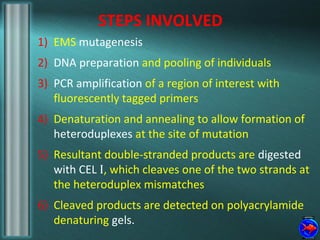
STEPS INVOLVED
1) EMS mutagenesis
2) DNA preparation and pooling of individuals
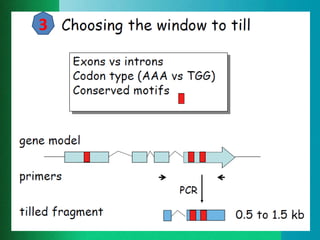
3) PCR amplification of a region of interest with
fluorescently tagged primers
4) Denaturation and annealing to allow formation of
heteroduplexes at the site of mutation
5) Resultant double-stranded products are digested
with CEL I, which cleaves one of the two strands at
the heteroduplex mismatches
6) Cleaved products are detected on polyacrylamide
denaturing gels.
Step - 1
Seeds of selected species are mutagenized by
treatment with EMS to induce point mutation
throughout the genome.
A founder population is grown from mutagenized
seeds i.e. M1 generation
Resulting M1 plants are self-fertilized to produce
M2 generation.
The M2 generation of individuals are used to
prepare DNA samples for mutational screening.
Lightner and Caspar, 1998
Why EMS ?
Alkylating agent, EMS (Ethyl Methane Sulfonate)
yields predominantly point mutations.
High mutational density
Stable mutagenesis
Step - 2
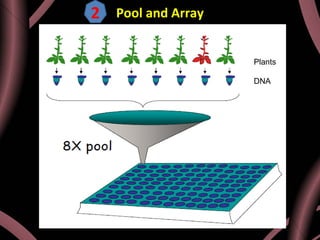
The DNA samples are pooled eight fold to
maximize screening efficiency (or to increase
throughput).
In order to check many samples for a possible
mutation, samples must be pooled.
Arrayed on 96-well microtiter plates
Pool and Array
Plants
DNA
2
Step - 3
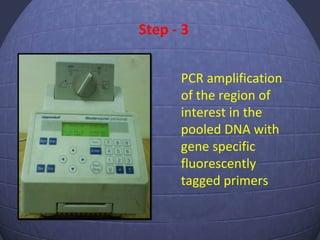
PCR amplification
of the region of
interest in the
pooled DNA with
gene specific
fluorescently
tagged primers
3
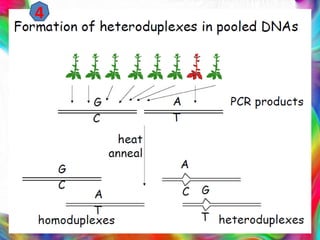
Step - 4
The amplification products are denatured and
allowed to reanneal, generally by heating and
cooling.
As a result, a mutant strand will often reanneal with
a wild-type strand, creating heteroduplexes at the site
of the mutation or polymorphism.
4
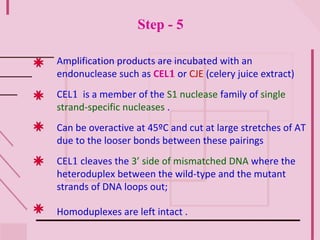
Step - 5
Amplification products are incubated with an
endonuclease such as CEL1 or CJE (celery juice extract)
CEL1 is a member of the S1 nuclease family of single
strand-specific nucleases .
Can be overactive at 45ºC and cut at large stretches of AT
due to the looser bonds between these pairings
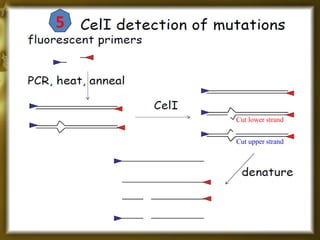
CEL1 cleaves the 3’ side of mismatched DNA where the
heteroduplex between the wild-type and the mutant
strands of DNA loops out;
Homoduplexes are left intact .
Cut lower strand
Cut upper strand
5
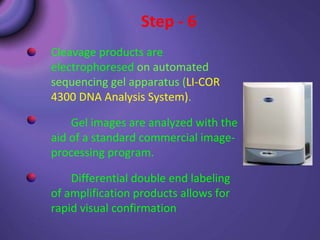
Step - 6
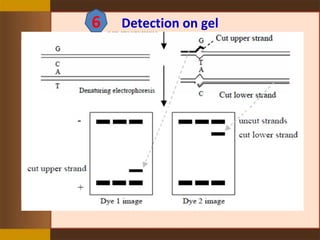
Cleavage products are
electrophoresed on automated
sequencing gel apparatus (LI-COR
4300 DNA Analysis System).
Gel images are analyzed with the
aid of a standard commercial image-
processing program.
Differential double end labeling
of amplification products allows for
rapid visual confirmation
Cont.
The first paper describing TILLING used dHPLC to identify
mutations (McCallum et al., 2000a).
The method was made more high throughput by using the
restriction enzyme Cel 1 combined with the LICOR gel based
system to identify mutations (Colbert et al.,2001).
Advantages to the LICOR system are
- Separation of large fragments (~ 2kb),
- High sample throughput (96 samples loaded on paper
combs),
- Freeware to identify the mutations
Detection on gel6
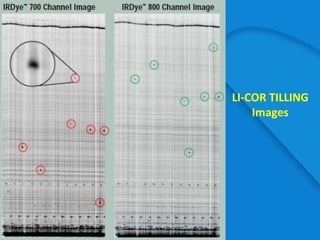
LI-COR TILLING
Images
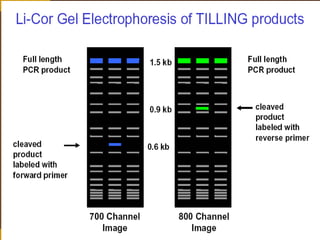
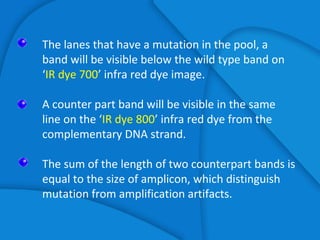
The lanes that have a mutation in the pool, a
band will be visible below the wild type band on
‘IR dye 700’ infra red dye image.
A counter part band will be visible in the same
line on the ‘IR dye 800’ infra red dye from the
complementary DNA strand.
The sum of the length of two counterpart bands is
equal to the size of amplicon, which distinguish
mutation from amplification artifacts.
After detection of a mutation in a pool,
the individual DNA samples in the pool
are screened again to find out which of
the eight pooled samples from the
crossed population has the mutation.
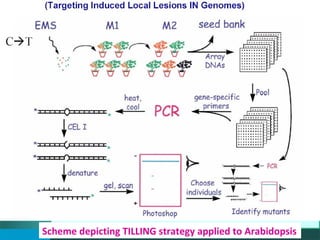
Scheme depicting TILLING strategy applied to Arabidopsis
APPLICATIONS OF TILLING
Major areas of application are
1.Functional Genomics
2.Genetic Engineering
3.Evaluation of genetic diversity of natural
populations
1. Functional genomics
The study of functions of all specific gene sequences
and their expression in time and space in organism
The identification of numerous mutations in target
region of genome.
Construction of TILLING library is useful for scientists
to search for mutations in gene of interest.
TILLING offers a way to investigate target GOI in any
crop of interest without first having knowledge of
gene product
2. Genetic Engineering
Agricultural interest in producing phenotypic
variants without introducing foreign DNA of any type
into a plant’s genome.
T-DNA/Transposon insertions are used to obtain
specific gene knockouts but practically limited to
some crops only.
TILLING is in front of transgene, as consists of
identification of numerous mutation within a
targeted region of whole genome.
3. Genetic Diversity
Alternative to wild relatives, TILLING is used to
introduce useful genetic variation of elite
germplasm
Also applicable in a population which has several
pre-existing polymorphism for developing SNPs
TILLING projects in different species
Arabidopsis is the obvious choice for the prototypic
implementation of high throughput TILLING.
In 2001, Arabidopsis TILLING Project (ATP) started at
University of Washington and the Henikoff
Laboratory.
The greatest utility of TILLING might be for crop and
other model plants such as Rice and Medicago
truncatula
TILLING project of maize & rice – Till et al.,FHCRC
Seattle, Washington
( http:// genome.purdue.edu/maize tilling)
Many TILLING projects are ongoing in diverse plant species
such as Brassica oleracea, lotus, barley , wheat etc.
Barley TILLING project at the University of Bologna- ITALY.
Slade and colleagues mutagenized (allohexaploid and
allotetraploid) wheat strains with EMS and identified 246
alleles of the waxy genes in 1920 individuals.
Some animal species such as rat and zebrafish.
Cont.
ICRISAT –
Chickpea genomics (drought tolerance),
millets.
R.K Varshney
NRCPB & IARI, New Delhi –
Chick pea (drought tolerance)
Univ. of Hyd – Andhra Pradesh – Tomato
TILLING RESEARCH – INDIAN SCENARIO
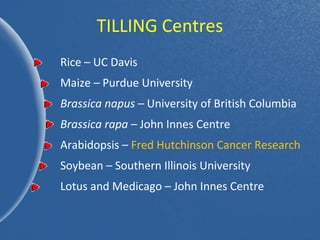
TILLING Centres
Rice – UC Davis
Maize – Purdue University
Brassica napus – University of British Columbia
Brassica rapa – John Innes Centre
Arabidopsis – Fred Hutchinson Cancer Research
Soybean – Southern Illinois University
Lotus and Medicago – John Innes Centre
TILLING Informatics
CODDLE, is a web-based software for submitting a genomic
sequence and for obtaining an exon-intron model for the
gene of interest using public sequence databanks.
CODDLE (http://www.proweb.org/input) allows researchers
to specifically design PCR primers .
SIFT : (Sorting Intolerant From Tolerant)
PARSESNP – Project Aligned Related Sequences and
evaluate SNP’s.
MERITS of TILLING
It is independent of genome size, reproductive system or
generation time.
High throughput & data analysis can also be automated.
Valuable for essential genes, where sublethal alleles are
required for phenotypic analysis.
TILLING is suitable for any organism that can be heavily
mutagenized, even those that lack genetic tools.
Organisms that do not have efficient transformation
systems – TILLING is the only practical choice
Merits cont.
Overcomes disadvantage of knockout gene therapy for
a specific gene, as eliminates the need for removal of
gene from gene pool to detect its function.
TILLING can introduce genetic variation in an elite
germplasm without need to acquire variation & thus
avoiding introduction of agriculturally undesirable
traits.
Also overcomes problems of transgenic approach as it is
independent of transgene efficiency and regeneration
of plant.
Merits cont.
The likelihood of recovering a deleterious mutation can
be calculated in advance.
Highly sensitive and cost effective
Detect SNP over thousands of samples.
Producing phenotypic variants without
introducing foreign DNA of any type into a plant’s
genome
Has the advantage of exemption from regulatory
approval requirements which is strictly obliged for
transgenic crops when commercially suitable
variations are discovered.
Merits cont.
Rapid and low-cost discovery of induced point mutations
in populations of chemically mutagenized individuals from
diverse organisms.
No requirement of transgenic / sophisticated tissue
culture methodology.
Most steps of TILLING are suitable for automation.
The choice of PCR amplicon can be automated (for
high-throughput) and
Streamlined for interactive use (by users requesting
genes for TILLING).
DEMERITS
Rate of induction of mutation is low
Requires skillful labours
Depends on primer designing
Mutagenized organism must be kept alive long
enough to screen mutant population in
vegetatively propagated plant species.
Starting with a homozygous population is desirable
EcoTILLING
It is a method that uses TILLING techniques to look for
natural mutations in individuals, usually for population
genetics analysis.
EcoTILLING can be performed more inexpensive than full
sequencing, the method currently used for most single
nucleotide polymorphism (SNP) discovery.
But differs from TILLING in that natural polymorphisms
are detected rather than polymorphisms induced
through chemical mutagenesis
EcoTILLING Applications
Mapping- Detection of polymorphisms that can
be used as genetic markers
Association analysis- Correlating natural
polymorphisms with phenotypic traits
Mutational profiling- Characterizing the amount
of genetic variation in a species
Biodiversity- Determining the evolutionary
history of natural populations
Conclusion
TILLING is a cheap and fast natural
polymorphism discovery and genotyping
method.
Has advantages for determining the spectrum
of variation and for genetic mapping based on
linkage association analysis.
….Thank You
Queries?
QUERIES….

Tilling @ sid

  • 2.
    PRESENTATION ON Targeting InducedLocal Lesions In Genomes MBB -602 Siddhartha Swarup Jena RAD/10-30 Ph.D Mol.Bio & Biotech   PRESENTATION ON Genome TILLInGMBB -602 Siddhartha Swarup Jena RAD/10-30 Ph.D Mol.Bio & Biotech
  • 3.
    OUTLINE 1. Introduction 2. Principle 3.Steps 4. Applications 5. Merits 6. Demerits 7. Eco-TILLING 8. Conclusion
  • 4.
    Important breakthrough ingenetics: ‘mutations can be induced’. Alkylating agents yield predominantly point mutations. The resulting altered and truncated protein products help to precisely map gene and protein function. INTRODUCTION
  • 5.
    In plants, thetwo most common methods for producing reduction-of-function mutations are Antisense RNA suppression and Insertional mutagenesis . Demerits: Antisense RNA suppression requires considerable effort for any given target gene before knowing whether it will work, Insertional mutagenesis occurs at a low frequency per genome. Hamilton et al., 1995; Speulman et al., 1999 Introduction cont..
  • 6.
    A new reversegenetic strategy that combines High density of point mutations provided by traditional chemical mutagenesis with Rapid mutational screening to discover induced lesions TILLING (Targeting Induced Local Lesions IN Genomes) (Mc Callum et al., 2000). Introduction cont..
  • 7.
    TILLING TILLING (Targetting InducedLocal Lesions In Genomes) is a general reverse genetic strategy that works with a mismatch-specific endonuclease to detect induced or natural DNA polymorphisms in genes of interest. It combines chemical or physical mutagenesis and PCR based screening to identify mutation in one or more target gene. Non transgenic gene modification technique
  • 8.
    TILLING - History Developedby Colbert et. al. 2001. (Fred Hutchinson Cancer Research Center, Seattle , Washington) American scientists ‘Comai’ & ‘Henikoff’ (2003) have initiated first TILLING project in Arabidopsis. They developed ‘Arabidopsis TILLING library’
  • 9.
    PRINCIPLE OF TILLING MakeEMS-mutagenized population Target gene of interest with PCR primers Search for rare mutants among many individuals.
  • 10.
    STEPS INVOLVED 1) EMSmutagenesis 2) DNA preparation and pooling of individuals 3) PCR amplification of a region of interest with fluorescently tagged primers 4) Denaturation and annealing to allow formation of heteroduplexes at the site of mutation 5) Resultant double-stranded products are digested with CEL I, which cleaves one of the two strands at the heteroduplex mismatches 6) Cleaved products are detected on polyacrylamide denaturing gels.
  • 11.
    Step - 1 Seedsof selected species are mutagenized by treatment with EMS to induce point mutation throughout the genome. A founder population is grown from mutagenized seeds i.e. M1 generation Resulting M1 plants are self-fertilized to produce M2 generation. The M2 generation of individuals are used to prepare DNA samples for mutational screening. Lightner and Caspar, 1998
  • 12.
    Why EMS ? Alkylatingagent, EMS (Ethyl Methane Sulfonate) yields predominantly point mutations. High mutational density Stable mutagenesis
  • 13.
    Step - 2 TheDNA samples are pooled eight fold to maximize screening efficiency (or to increase throughput). In order to check many samples for a possible mutation, samples must be pooled. Arrayed on 96-well microtiter plates
  • 14.
  • 15.
    Step - 3 PCRamplification of the region of interest in the pooled DNA with gene specific fluorescently tagged primers
  • 16.
  • 17.
    Step - 4 Theamplification products are denatured and allowed to reanneal, generally by heating and cooling. As a result, a mutant strand will often reanneal with a wild-type strand, creating heteroduplexes at the site of the mutation or polymorphism.
  • 18.
  • 19.
    Step - 5 Amplificationproducts are incubated with an endonuclease such as CEL1 or CJE (celery juice extract) CEL1 is a member of the S1 nuclease family of single strand-specific nucleases . Can be overactive at 45ºC and cut at large stretches of AT due to the looser bonds between these pairings CEL1 cleaves the 3’ side of mismatched DNA where the heteroduplex between the wild-type and the mutant strands of DNA loops out; Homoduplexes are left intact .
  • 20.
    Cut lower strand Cutupper strand 5
  • 21.
    Step - 6 Cleavageproducts are electrophoresed on automated sequencing gel apparatus (LI-COR 4300 DNA Analysis System). Gel images are analyzed with the aid of a standard commercial image- processing program. Differential double end labeling of amplification products allows for rapid visual confirmation
  • 22.
    Cont. The first paperdescribing TILLING used dHPLC to identify mutations (McCallum et al., 2000a). The method was made more high throughput by using the restriction enzyme Cel 1 combined with the LICOR gel based system to identify mutations (Colbert et al.,2001). Advantages to the LICOR system are - Separation of large fragments (~ 2kb), - High sample throughput (96 samples loaded on paper combs), - Freeware to identify the mutations
  • 23.
  • 25.
  • 26.
    The lanes thathave a mutation in the pool, a band will be visible below the wild type band on ‘IR dye 700’ infra red dye image. A counter part band will be visible in the same line on the ‘IR dye 800’ infra red dye from the complementary DNA strand. The sum of the length of two counterpart bands is equal to the size of amplicon, which distinguish mutation from amplification artifacts.
  • 27.
    After detection ofa mutation in a pool, the individual DNA samples in the pool are screened again to find out which of the eight pooled samples from the crossed population has the mutation.
  • 28.
    Scheme depicting TILLINGstrategy applied to Arabidopsis
  • 29.
    APPLICATIONS OF TILLING Majorareas of application are 1.Functional Genomics 2.Genetic Engineering 3.Evaluation of genetic diversity of natural populations
  • 30.
    1. Functional genomics Thestudy of functions of all specific gene sequences and their expression in time and space in organism The identification of numerous mutations in target region of genome. Construction of TILLING library is useful for scientists to search for mutations in gene of interest. TILLING offers a way to investigate target GOI in any crop of interest without first having knowledge of gene product
  • 31.
    2. Genetic Engineering Agriculturalinterest in producing phenotypic variants without introducing foreign DNA of any type into a plant’s genome. T-DNA/Transposon insertions are used to obtain specific gene knockouts but practically limited to some crops only. TILLING is in front of transgene, as consists of identification of numerous mutation within a targeted region of whole genome.
  • 32.
    3. Genetic Diversity Alternativeto wild relatives, TILLING is used to introduce useful genetic variation of elite germplasm Also applicable in a population which has several pre-existing polymorphism for developing SNPs
  • 33.
    TILLING projects indifferent species Arabidopsis is the obvious choice for the prototypic implementation of high throughput TILLING. In 2001, Arabidopsis TILLING Project (ATP) started at University of Washington and the Henikoff Laboratory. The greatest utility of TILLING might be for crop and other model plants such as Rice and Medicago truncatula TILLING project of maize & rice – Till et al.,FHCRC Seattle, Washington ( http:// genome.purdue.edu/maize tilling)
  • 34.
    Many TILLING projectsare ongoing in diverse plant species such as Brassica oleracea, lotus, barley , wheat etc. Barley TILLING project at the University of Bologna- ITALY. Slade and colleagues mutagenized (allohexaploid and allotetraploid) wheat strains with EMS and identified 246 alleles of the waxy genes in 1920 individuals. Some animal species such as rat and zebrafish. Cont.
  • 35.
    ICRISAT – Chickpea genomics(drought tolerance), millets. R.K Varshney NRCPB & IARI, New Delhi – Chick pea (drought tolerance) Univ. of Hyd – Andhra Pradesh – Tomato TILLING RESEARCH – INDIAN SCENARIO
  • 36.
    TILLING Centres Rice –UC Davis Maize – Purdue University Brassica napus – University of British Columbia Brassica rapa – John Innes Centre Arabidopsis – Fred Hutchinson Cancer Research Soybean – Southern Illinois University Lotus and Medicago – John Innes Centre
  • 37.
    TILLING Informatics CODDLE, isa web-based software for submitting a genomic sequence and for obtaining an exon-intron model for the gene of interest using public sequence databanks. CODDLE (http://www.proweb.org/input) allows researchers to specifically design PCR primers . SIFT : (Sorting Intolerant From Tolerant) PARSESNP – Project Aligned Related Sequences and evaluate SNP’s.
  • 38.
    MERITS of TILLING Itis independent of genome size, reproductive system or generation time. High throughput & data analysis can also be automated. Valuable for essential genes, where sublethal alleles are required for phenotypic analysis. TILLING is suitable for any organism that can be heavily mutagenized, even those that lack genetic tools. Organisms that do not have efficient transformation systems – TILLING is the only practical choice
  • 39.
    Merits cont. Overcomes disadvantageof knockout gene therapy for a specific gene, as eliminates the need for removal of gene from gene pool to detect its function. TILLING can introduce genetic variation in an elite germplasm without need to acquire variation & thus avoiding introduction of agriculturally undesirable traits. Also overcomes problems of transgenic approach as it is independent of transgene efficiency and regeneration of plant.
  • 40.
    Merits cont. The likelihoodof recovering a deleterious mutation can be calculated in advance. Highly sensitive and cost effective Detect SNP over thousands of samples. Producing phenotypic variants without introducing foreign DNA of any type into a plant’s genome Has the advantage of exemption from regulatory approval requirements which is strictly obliged for transgenic crops when commercially suitable variations are discovered.
  • 41.
    Merits cont. Rapid andlow-cost discovery of induced point mutations in populations of chemically mutagenized individuals from diverse organisms. No requirement of transgenic / sophisticated tissue culture methodology. Most steps of TILLING are suitable for automation. The choice of PCR amplicon can be automated (for high-throughput) and Streamlined for interactive use (by users requesting genes for TILLING).
  • 42.
    DEMERITS Rate of inductionof mutation is low Requires skillful labours Depends on primer designing Mutagenized organism must be kept alive long enough to screen mutant population in vegetatively propagated plant species. Starting with a homozygous population is desirable
  • 43.
    EcoTILLING It is amethod that uses TILLING techniques to look for natural mutations in individuals, usually for population genetics analysis. EcoTILLING can be performed more inexpensive than full sequencing, the method currently used for most single nucleotide polymorphism (SNP) discovery. But differs from TILLING in that natural polymorphisms are detected rather than polymorphisms induced through chemical mutagenesis
  • 44.
    EcoTILLING Applications Mapping- Detectionof polymorphisms that can be used as genetic markers Association analysis- Correlating natural polymorphisms with phenotypic traits Mutational profiling- Characterizing the amount of genetic variation in a species Biodiversity- Determining the evolutionary history of natural populations
  • 45.
    Conclusion TILLING is acheap and fast natural polymorphism discovery and genotyping method. Has advantages for determining the spectrum of variation and for genetic mapping based on linkage association analysis.
  • 46.
  • 47.