TILLING
Targeting Induced Local Lesions
in Genome
What is Tilling
 Tilling is a non Transgenic method that helps
to identify mutations in a specific gene.
 First time this technique was developed in
Arabidopsis thaliana.
 This technique works with good results even
a population contains pre existing mutations
Why Tilling
 Availability of large scale sequences of most organism
 Type of Reverse Genetics
 Simple to Implement because it does not require advance
genetic tools.
 Helps to identify induced and natural variants in germplasm and
mutant collections for almost any crop species.
 Tilling has a potential to identify a large series of mutations
ranging from knockouts to subtle missense mutations
 Helps in discovering and cataloguing new polymorphisms
What is Mutation
 To produce change in DNA sequence
 Important breakthrough ----induction of
mutations
 Mutation causes change in genes and
phenotypes
 Forward genetics----to----Reverse Genetics
 Allowed to study higher organsim where
mutation is possible
Chemical Mutagen
 Alkylating agents
 yield predominantly point mutations,
 Resulting in altered and truncated protein
products
 Help to precisely map gene and protein
function
Chemical Mutagen----EMS
 EMS---Ethyl Methyl Sulfonate
 most commonly used chemical mutagen in
plants
 causes a high frequency of nucleotide
substitutions in a variety of organisms
 EMS alkylates guanine bases and leads to
mispairing
 alkylated G pairs with T instead of C,
resulting in primarily G/C to A/T transitions
Methodology
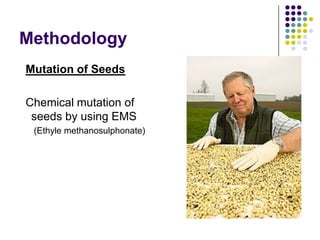
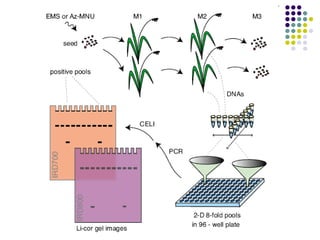
Mutation of Seeds
Chemical mutation of
seeds by using EMS
(Ethyle methanosulphonate)
Raising of M1 Population
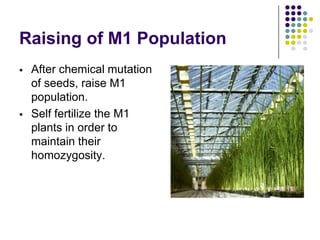
 After chemical mutation
of seeds, raise M1
population.
 Self fertilize the M1
plants in order to
maintain their
homozygosity.
Raising of M2 Population and
collection of DNA samples
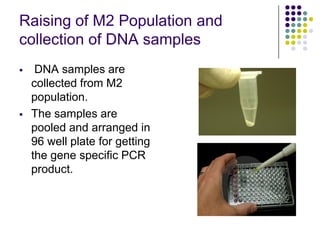
 DNA samples are
collected from M2
population.
 The samples are
pooled and arranged in
96 well plate for getting
the gene specific PCR
product.
Getting of PCR amplified product
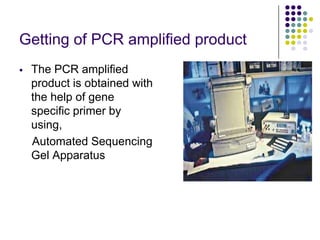
 The PCR amplified
product is obtained with
the help of gene
specific primer by
using,
Automated Sequencing
Gel Apparatus
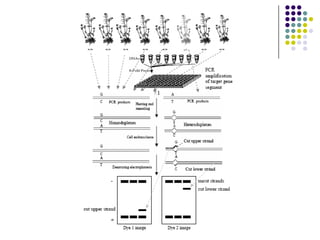
Denaturation and annealing of PCR
product
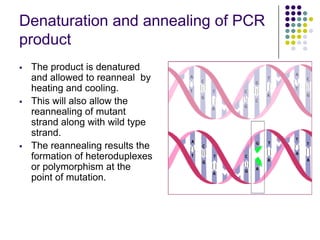
 The product is denatured
and allowed to reanneal by
heating and cooling.
 This will also allow the
reannealing of mutant
strand along with wild type
strand.
 The reannealing results the
formation of heteroduplexes
or polymorphism at the
point of mutation.
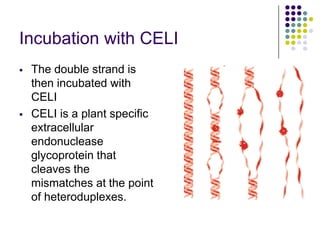
Incubation with CELI
 The double strand is
then incubated with
CELI
 CELI is a plant specific
extracellular
endonuclease
glycoprotein that
cleaves the
mismatches at the point
of heteroduplexes.
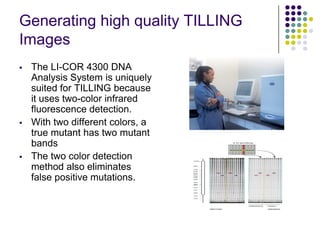
Generating high quality TILLING
Images
 The LI-COR 4300 DNA
Analysis System is uniquely
suited for TILLING because
it uses two-color infrared
fluorescence detection.
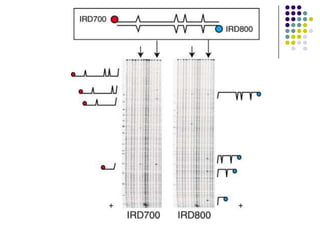
 With two different colors, a
true mutant has two mutant
bands
 The two color detection
method also eliminates
false positive mutations.
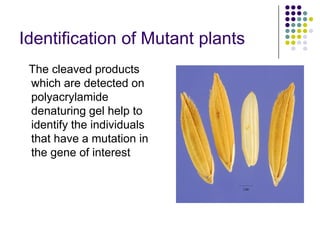
Identification of Mutant plants
The cleaved products
which are detected on
polyacrylamide
denaturing gel help to
identify the individuals
that have a mutation in
the gene of interest
TILLING in Major Crops
Now a days TILLING is
applied in Wheat,
Maize, Rice, Brassica
and Arabidopsis etc

TILLING.pdf

  • 1.
  • 2.
    What is Tilling Tilling is a non Transgenic method that helps to identify mutations in a specific gene.  First time this technique was developed in Arabidopsis thaliana.  This technique works with good results even a population contains pre existing mutations
  • 3.
    Why Tilling  Availabilityof large scale sequences of most organism  Type of Reverse Genetics  Simple to Implement because it does not require advance genetic tools.  Helps to identify induced and natural variants in germplasm and mutant collections for almost any crop species.  Tilling has a potential to identify a large series of mutations ranging from knockouts to subtle missense mutations  Helps in discovering and cataloguing new polymorphisms
  • 4.
    What is Mutation To produce change in DNA sequence  Important breakthrough ----induction of mutations  Mutation causes change in genes and phenotypes  Forward genetics----to----Reverse Genetics  Allowed to study higher organsim where mutation is possible
  • 5.
    Chemical Mutagen  Alkylatingagents  yield predominantly point mutations,  Resulting in altered and truncated protein products  Help to precisely map gene and protein function
  • 6.
    Chemical Mutagen----EMS  EMS---EthylMethyl Sulfonate  most commonly used chemical mutagen in plants  causes a high frequency of nucleotide substitutions in a variety of organisms  EMS alkylates guanine bases and leads to mispairing  alkylated G pairs with T instead of C, resulting in primarily G/C to A/T transitions
  • 7.
    Methodology Mutation of Seeds Chemicalmutation of seeds by using EMS (Ethyle methanosulphonate)
  • 8.
    Raising of M1Population  After chemical mutation of seeds, raise M1 population.  Self fertilize the M1 plants in order to maintain their homozygosity.
  • 9.
    Raising of M2Population and collection of DNA samples  DNA samples are collected from M2 population.  The samples are pooled and arranged in 96 well plate for getting the gene specific PCR product.
  • 10.
    Getting of PCRamplified product  The PCR amplified product is obtained with the help of gene specific primer by using, Automated Sequencing Gel Apparatus
  • 11.
    Denaturation and annealingof PCR product  The product is denatured and allowed to reanneal by heating and cooling.  This will also allow the reannealing of mutant strand along with wild type strand.  The reannealing results the formation of heteroduplexes or polymorphism at the point of mutation.
  • 12.
    Incubation with CELI The double strand is then incubated with CELI  CELI is a plant specific extracellular endonuclease glycoprotein that cleaves the mismatches at the point of heteroduplexes.
  • 13.
    Generating high qualityTILLING Images  The LI-COR 4300 DNA Analysis System is uniquely suited for TILLING because it uses two-color infrared fluorescence detection.  With two different colors, a true mutant has two mutant bands  The two color detection method also eliminates false positive mutations.
  • 15.
    Identification of Mutantplants The cleaved products which are detected on polyacrylamide denaturing gel help to identify the individuals that have a mutation in the gene of interest
  • 18.
    TILLING in MajorCrops Now a days TILLING is applied in Wheat, Maize, Rice, Brassica and Arabidopsis etc