
TICKS
Ticks 101
 There are about 200
species of ticks in the
United States and about
850 species globally. Soft
ticks infest birds and
mammals other than
humans, while hard ticks
are the most important
species with regard to
human attacks.
Ticks 101
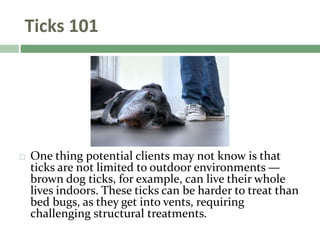
 One thing potential clients may not know is that
ticks are not limited to outdoor environments —
brown dog ticks, for example, can live their whole
lives indoors. These ticks can be harder to treat than
bed bugs, as they get into vents, requiring
challenging structural treatments.
Ticks 101
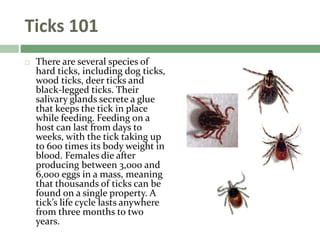
 There are several species of
hard ticks, including dog ticks,
wood ticks, deer ticks and
black-legged ticks. Their
salivary glands secrete a glue
that keeps the tick in place
while feeding. Feeding on a
host can last from days to
weeks, with the tick taking up
to 600 times its body weight in
blood. Females die after
producing between 3,000 and
6,000 eggs in a mass, meaning
that thousands of ticks can be
found on a single property. A
tick’s life cycle lasts anywhere
from three months to two
years.
Preparation
 It is important to let clients
know that you will be
providing a suppression
service, not an elimination
service. While it’s possible to
reduce the amount of ticks
on a property through
habitat modification, deer
control and exclusion
services, even the most
thorough technician
implementing the most
comprehensive pest control
program won’t be able to
eradicate them.
Preparation
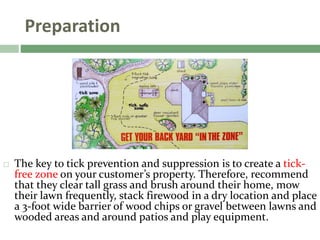
 The key to tick prevention and suppression is to create a tick-
free zone on your customer’s property. Therefore, recommend
that they clear tall grass and brush around their home, mow
their lawn frequently, stack firewood in a dry location and place
a 3-foot wide barrier of wood chips or gravel between lawns and
wooded areas and around patios and play equipment.
Preparation
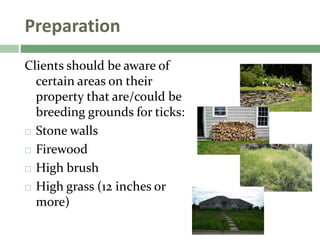
Clients should be aware of
certain areas on their
property that are/could be
breeding grounds for ticks:
 Stone walls
 Firewood
 High brush
 High grass (12 inches or
more)
Preparation
Before beginning any treatments all technicians should familiarize
themselves with the property they are servicing. They should know
for example:
 If a client’s neighbors are raising honeybees.
 That the treatments droplets on foliage can potentially act like
magnifying glasses in high heat, thus “burning” the flowers.
 The treatments are toxic to fish.
Treatment
 The best approach to controlling
backyard tick populations is to target
the lawn and woodland edge,
including walking trails frequented by
family members. It’s important to note
that most ticks are found in wooded
areas and in the transition area
between woodlands and open space. A
powerful solution includes the use of a
residual spray and a granular
insecticide, in order to achieve both
quick knockdown and long-term
control.
Treatment
Treating the transition area
between woodlands and open
space for ticks would require
spraying 10 feet into the grass
and 20 feet into the shrubby
area with a pyrethroid, ensuring
that the product is forced into
the grass thatch, litter and
mulch under the shrubs.
Applying product higher than
3–4 feet up is not necessary,
since this is the area that ticks
are hatching from and moving
around in.
Treatment
 Indoors (if necessary) : treat baseboards,
carpeted areas, and rugs with an EC plus an
IGR(Precor). Be sure to check label on the EC to
make sure you can do a open surface treatment
on carpets. Treat all carpets/rugs with a fan spray
with a 30 percent over lay.
Questions?
SOURCES
 http://www.npmapestworld.org/
 http://www.pctonline.com/

Ticks

  • 1.
  • 2.
    Ticks 101  Thereare about 200 species of ticks in the United States and about 850 species globally. Soft ticks infest birds and mammals other than humans, while hard ticks are the most important species with regard to human attacks.
  • 3.
    Ticks 101  Onething potential clients may not know is that ticks are not limited to outdoor environments — brown dog ticks, for example, can live their whole lives indoors. These ticks can be harder to treat than bed bugs, as they get into vents, requiring challenging structural treatments.
  • 4.
    Ticks 101  Thereare several species of hard ticks, including dog ticks, wood ticks, deer ticks and black-legged ticks. Their salivary glands secrete a glue that keeps the tick in place while feeding. Feeding on a host can last from days to weeks, with the tick taking up to 600 times its body weight in blood. Females die after producing between 3,000 and 6,000 eggs in a mass, meaning that thousands of ticks can be found on a single property. A tick’s life cycle lasts anywhere from three months to two years.
  • 5.
    Preparation  It isimportant to let clients know that you will be providing a suppression service, not an elimination service. While it’s possible to reduce the amount of ticks on a property through habitat modification, deer control and exclusion services, even the most thorough technician implementing the most comprehensive pest control program won’t be able to eradicate them.
  • 6.
    Preparation  The keyto tick prevention and suppression is to create a tick- free zone on your customer’s property. Therefore, recommend that they clear tall grass and brush around their home, mow their lawn frequently, stack firewood in a dry location and place a 3-foot wide barrier of wood chips or gravel between lawns and wooded areas and around patios and play equipment.
  • 7.
    Preparation Clients should beaware of certain areas on their property that are/could be breeding grounds for ticks:  Stone walls  Firewood  High brush  High grass (12 inches or more)
  • 8.
    Preparation Before beginning anytreatments all technicians should familiarize themselves with the property they are servicing. They should know for example:  If a client’s neighbors are raising honeybees.  That the treatments droplets on foliage can potentially act like magnifying glasses in high heat, thus “burning” the flowers.  The treatments are toxic to fish.
  • 9.
    Treatment  The bestapproach to controlling backyard tick populations is to target the lawn and woodland edge, including walking trails frequented by family members. It’s important to note that most ticks are found in wooded areas and in the transition area between woodlands and open space. A powerful solution includes the use of a residual spray and a granular insecticide, in order to achieve both quick knockdown and long-term control.
  • 10.
    Treatment Treating the transitionarea between woodlands and open space for ticks would require spraying 10 feet into the grass and 20 feet into the shrubby area with a pyrethroid, ensuring that the product is forced into the grass thatch, litter and mulch under the shrubs. Applying product higher than 3–4 feet up is not necessary, since this is the area that ticks are hatching from and moving around in.
  • 11.
    Treatment  Indoors (ifnecessary) : treat baseboards, carpeted areas, and rugs with an EC plus an IGR(Precor). Be sure to check label on the EC to make sure you can do a open surface treatment on carpets. Treat all carpets/rugs with a fan spray with a 30 percent over lay.
  • 12.
  • 13.