2015-16
Presentation by,
Guru P. N.
Ph. D. 015/39
Dept. of Agril. Entomology,
PGI, MPKV, Rahuri.
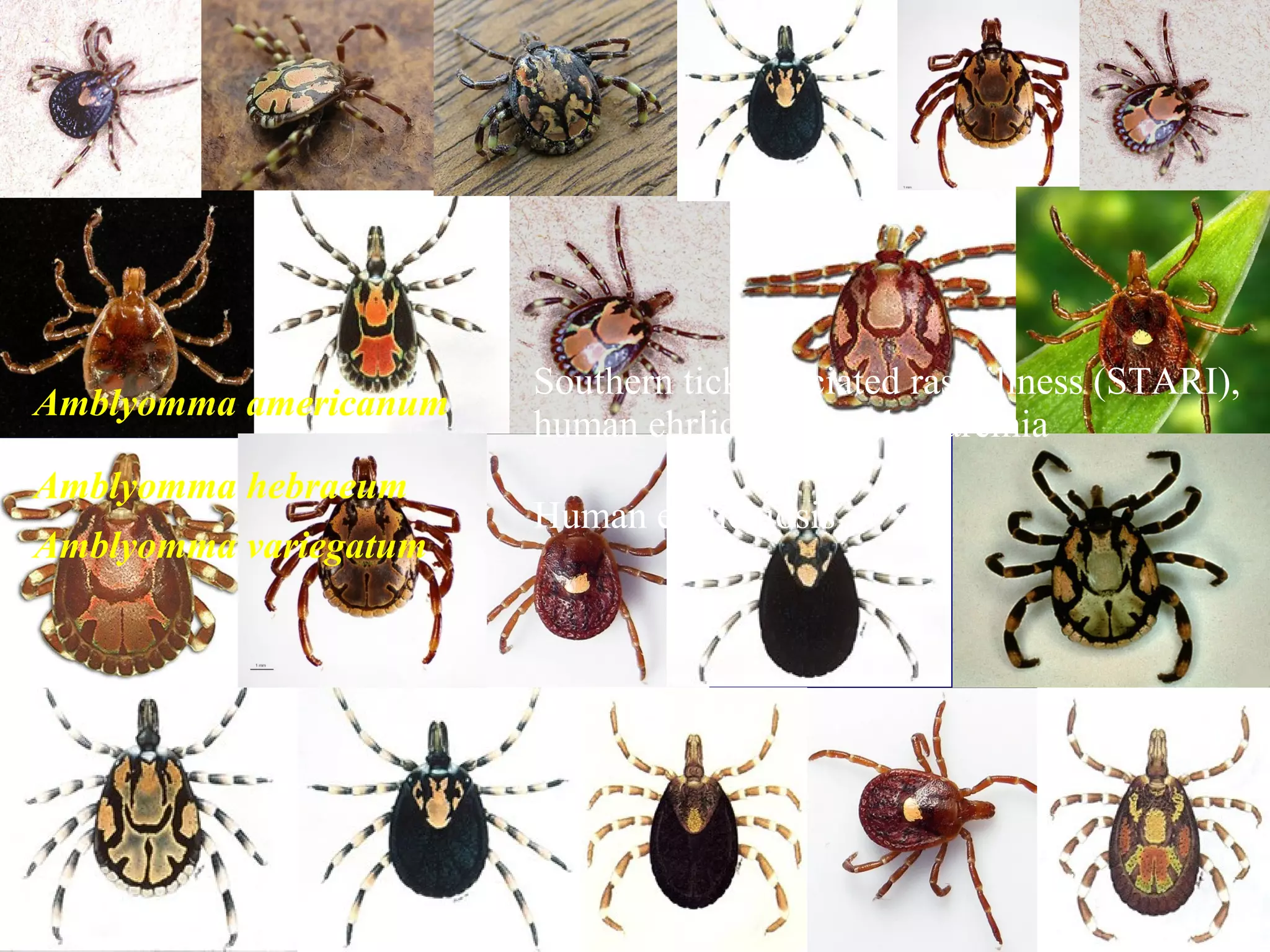
Amblyomma americanum
Southern tickassociated rash illness (STARI),
human ehrlichiosis and tularemia
Amblyomma hebraeum
Human ehrlichiosis
Amblyomma variegatum
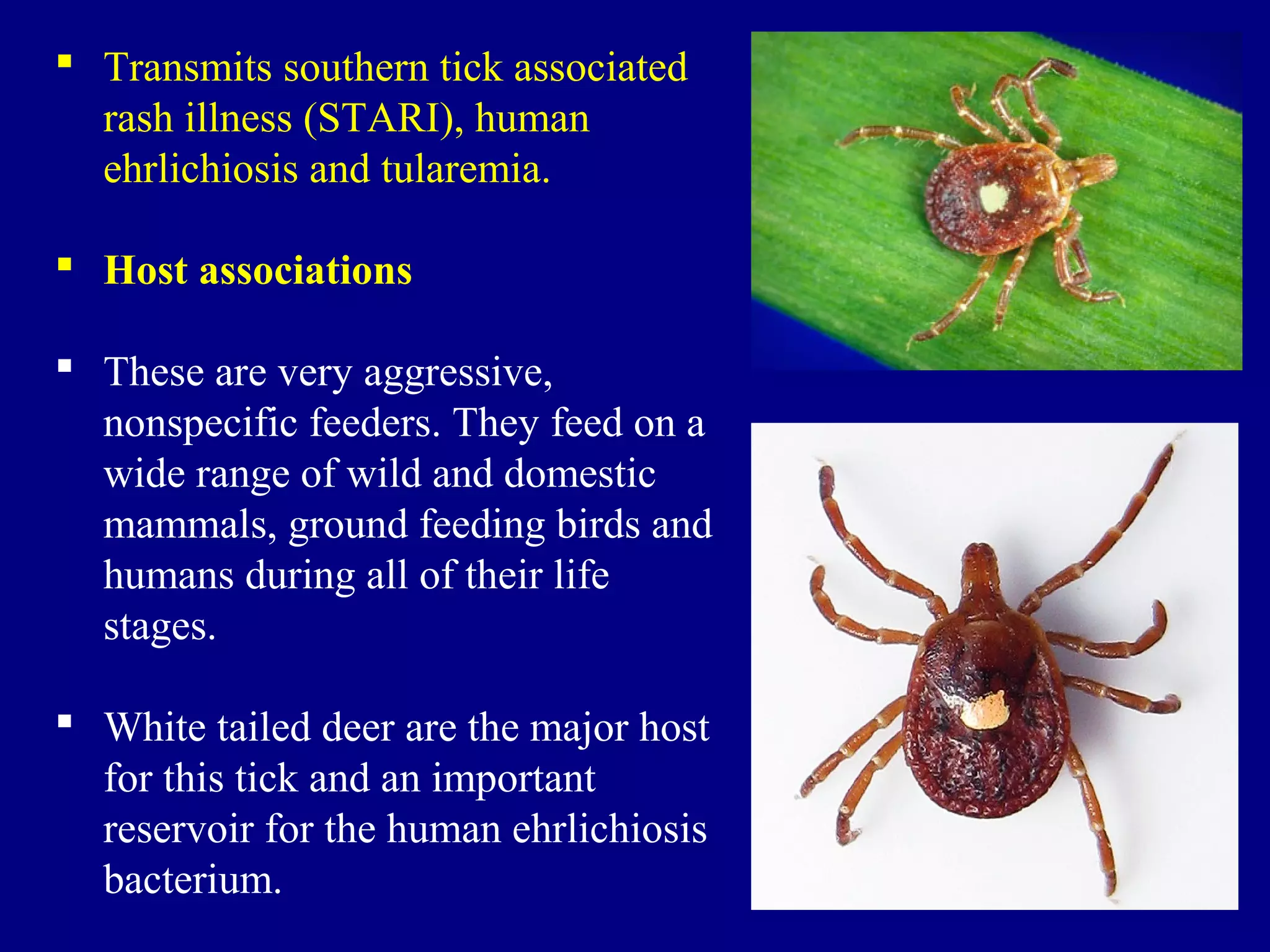
Lone star tick
(Amblyomma americanum)
Females have scutum with distinct white spot.
Males have inverted horseshoe markings at the
rounded posterior edge of the scutum.
3 host tick
Their bite may cause locally intense irritation
Massive infestations on animals may result in
severe blood loss and debilitation.
A toxin introduced during feeding can cause
tick paralysis.
 Transmits southern tick associated
rash illness (STARI), human
ehrlichiosis and tularemia.
 Host associations
 These are very aggressive,
nonspecific feeders. They feed on a
wide range of wild and domestic
mammals, ground feeding birds and
humans during all of their life
stages.
 White tailed deer are the major host
for this tick and an important
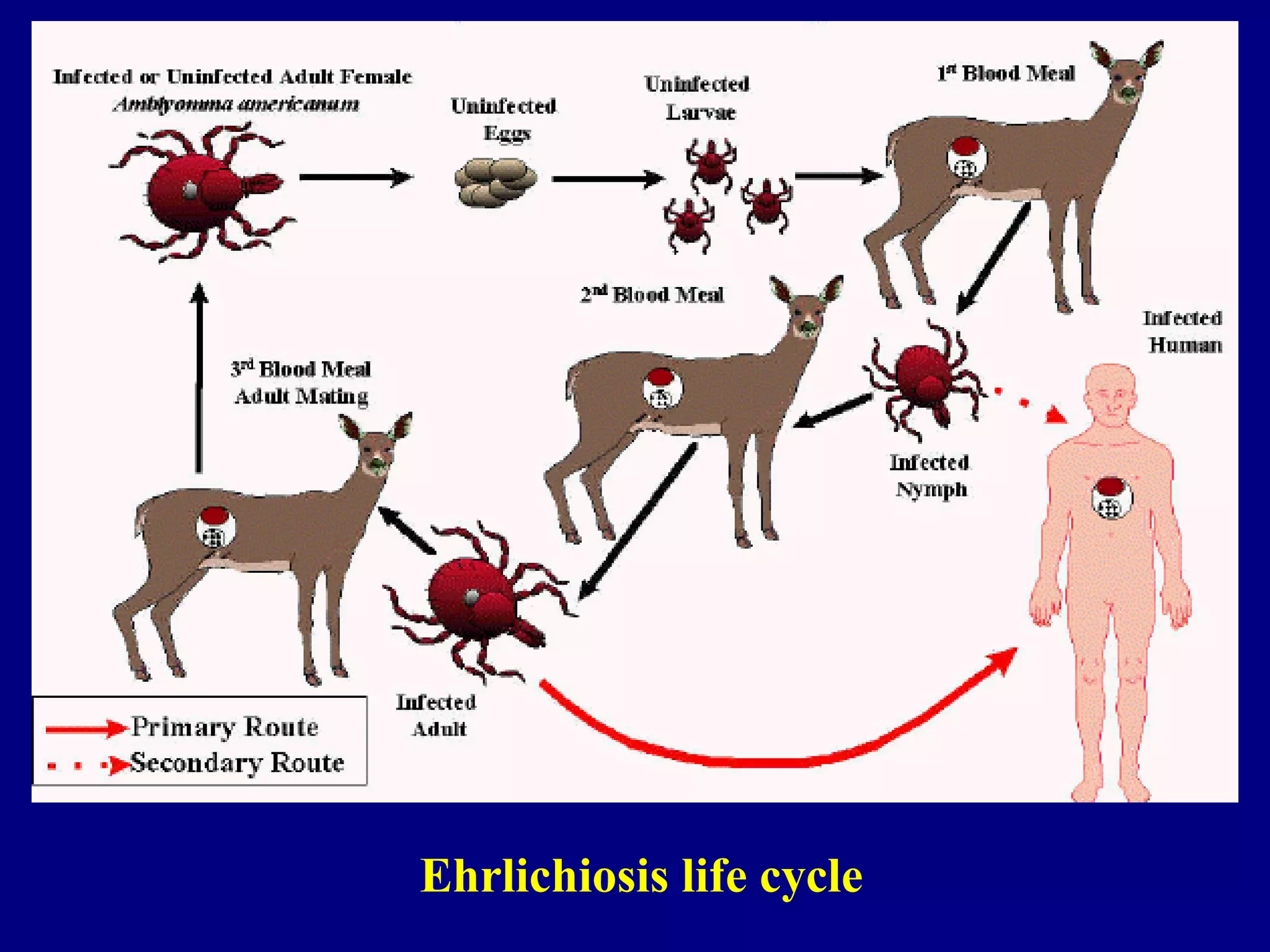
reservoir for the human ehrlichiosis
bacterium.
Ehrlichiosis
Caused by Ehrlichia
chaffeensis
Ehrlichia are bacteria
related to Rickettsiae
Rash is more common.
Ehrlichiosis life cycle
Tularemia
Caused by : intracellular bacterium Francisella tularensis
Ulceration
Ticks involved include Amblyomma, Dermacentor, Haemaphysalis,
and Ixodes.
Rodents, rabbits, and hares often serve as reservoir hosts
The Centers for Disease Control and Prevention (CDC) regard F.
tularensis as a viable biological warfare agent
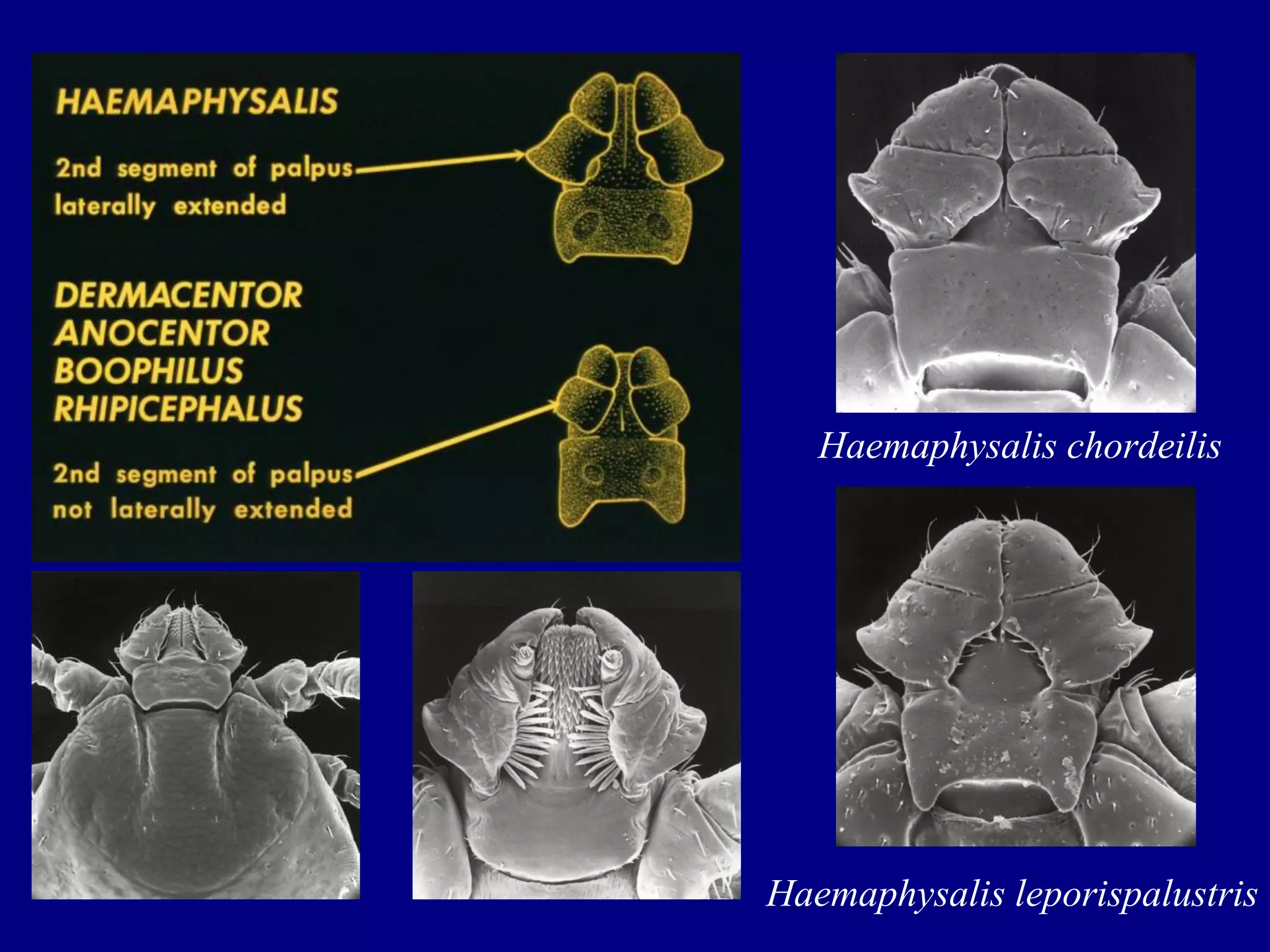
Haemaphysalis chordeilis
Haemaphysalis leporispalustris
Ixodes species ticks are inornate, do not possess eyes and with an
anal groove surrounding the anus anteriorly.
 European castor bean tick, Ixodes ricinus (L.),
 Blacklegged tick (Ixodes scapularis): anaplasmosis, Lyme
disease and Rocky Mountain spotted fever to humans.
Black legged tick
(Ixodes scapularis)
 Adult females are 3 to 4 mm long and adult males 2 to3 mm long.
It has an anal groove in front of its anus.
 2 years to complete their life cycle and are found predominately
in deciduous forest.
 Both nymph and adult stages transmit diseases such as Lyme
disease, Babesiosis, and Anaplasmosis
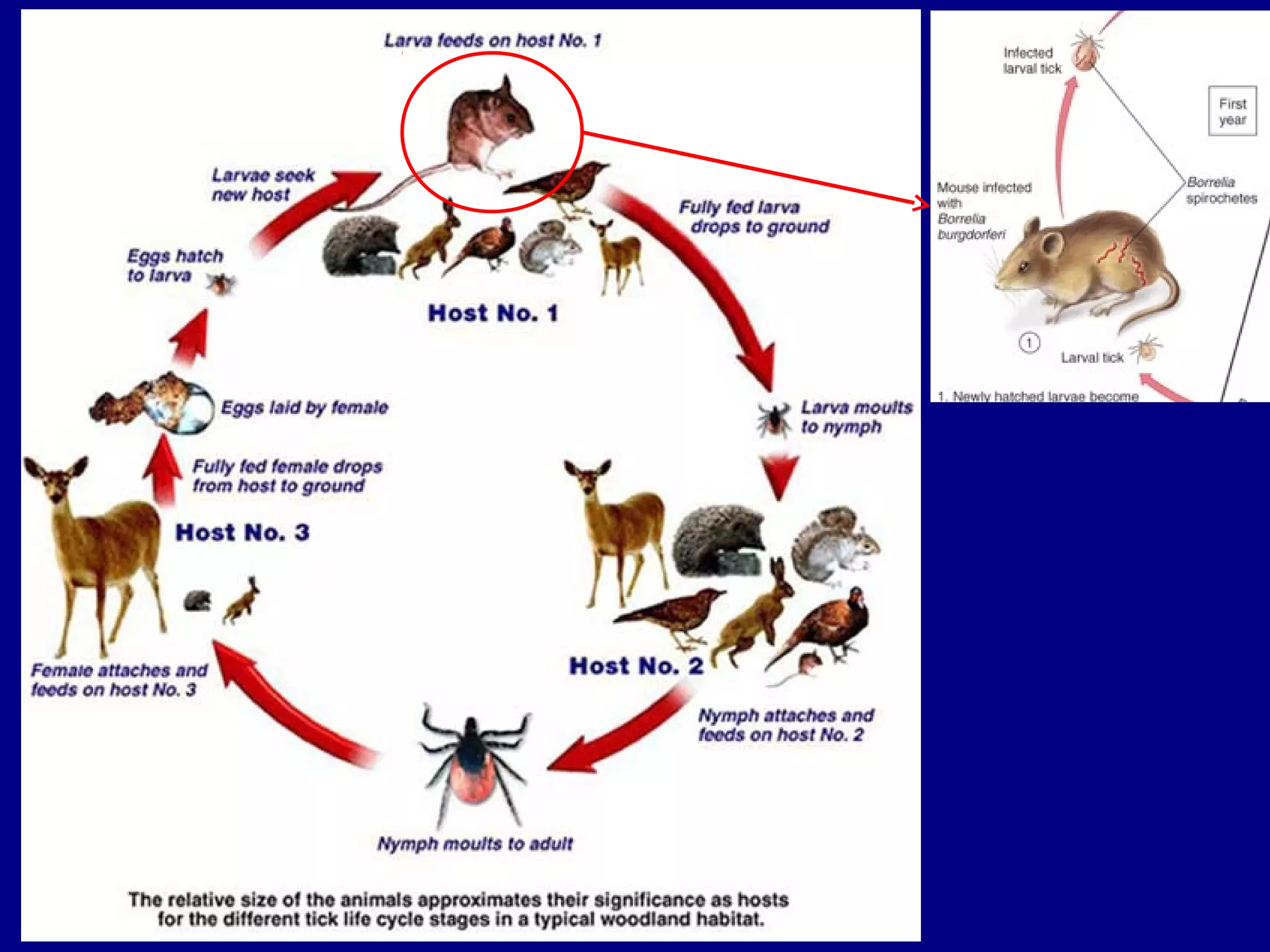
 3 host tick
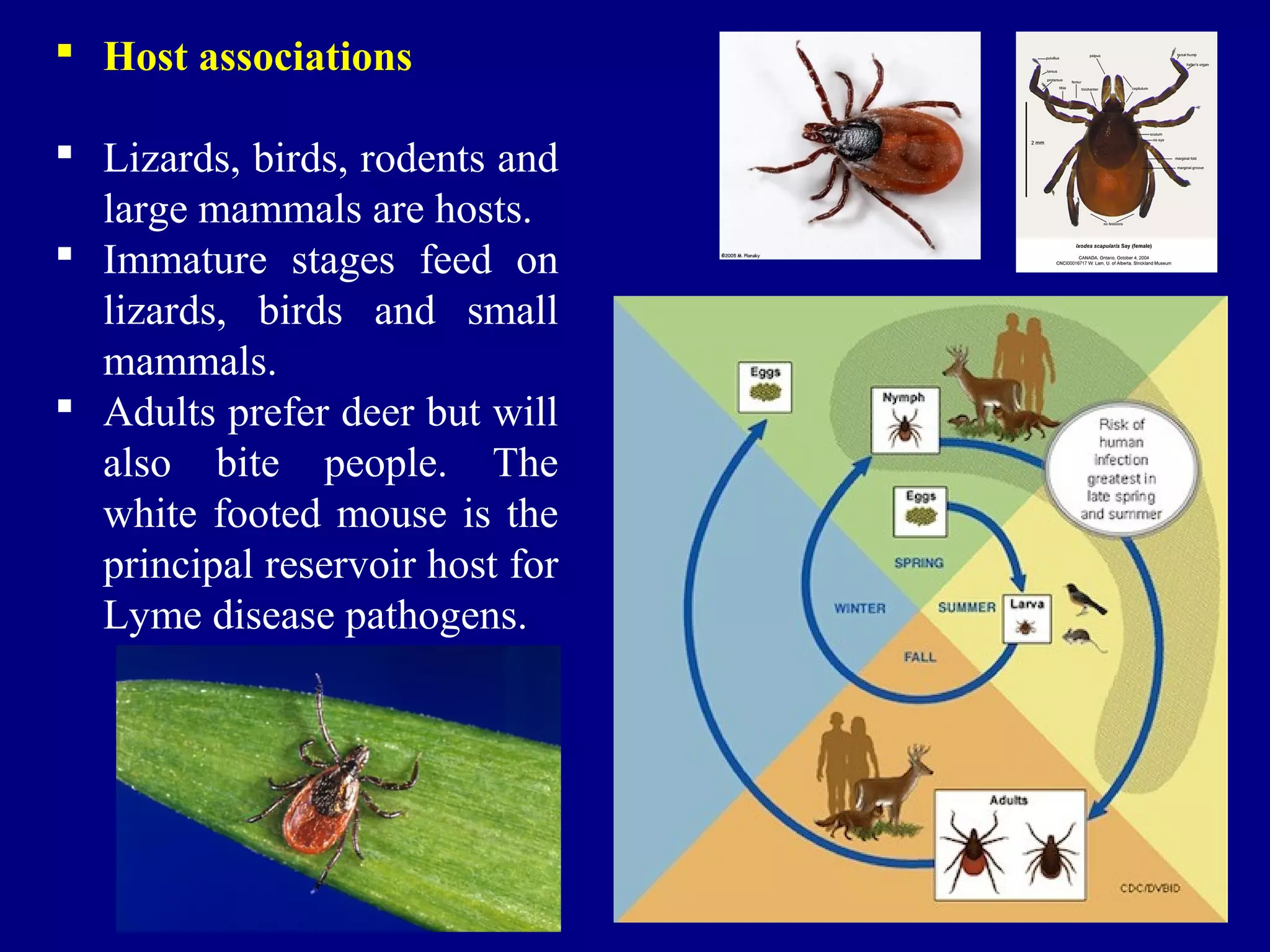
 Host associations
 Lizards, birds, rodents and
large mammals are hosts.
 Immature stages feed on
lizards, birds and small
mammals.
 Adults prefer deer but will
also bite people. The
white footed mouse is the
principal reservoir host for
Lyme disease pathogens.
Lyme disease
Also known as Lyme borreliosis: bacteria (Borrelia)
Erythema migrans
The disease does not appear to be transmissible between people, by other
animals, or through food.
It is estimated to affect 300,000 people a year in the United States and 65,000
people a year in Europe.
Chronic Lyme disease
Early localized infection
Disseminated infection
National Institute of Allergies & Infectious Diseases, Lyme disease is the most
common tickborne infectious disease in the USA
Vectors: Blacklegged tick (Ixodes scapularis),
 Western blacklegged tick (Ixodes pacificus) and
 Sheep tick (Ixodes ricinus)
 Within the tick midgut, the Borrelia's outer surface protein A (OspA) binds
to the tick receptor for OspA, known as TROSPA. When the tick feeds, the
Borrelia downregulates OspA and upregulates OspC, another surface
protein. After the bacteria migrate from the midgut to the salivary glands,
OspC binds to Salp15, a tick salivary protein that appears to have
immunosuppressive effects that enhance infection.[46] Successful infection
of the mammalian host depends on bacterial expression of OspC.
 Ticks that transmit B. burgdorferi to humans can also carry and transmit
several other parasites, such as Theileria microti and Anaplasma
phagocytophilum, which cause the diseases babesiosis and human
granulocytic anaplasmosis (HGA), respectively.
 Borrelia burgdorferi has a unique feature not present in any other known
organism it can exist without iron. All other life requires iron to make
proteins and enzymes.
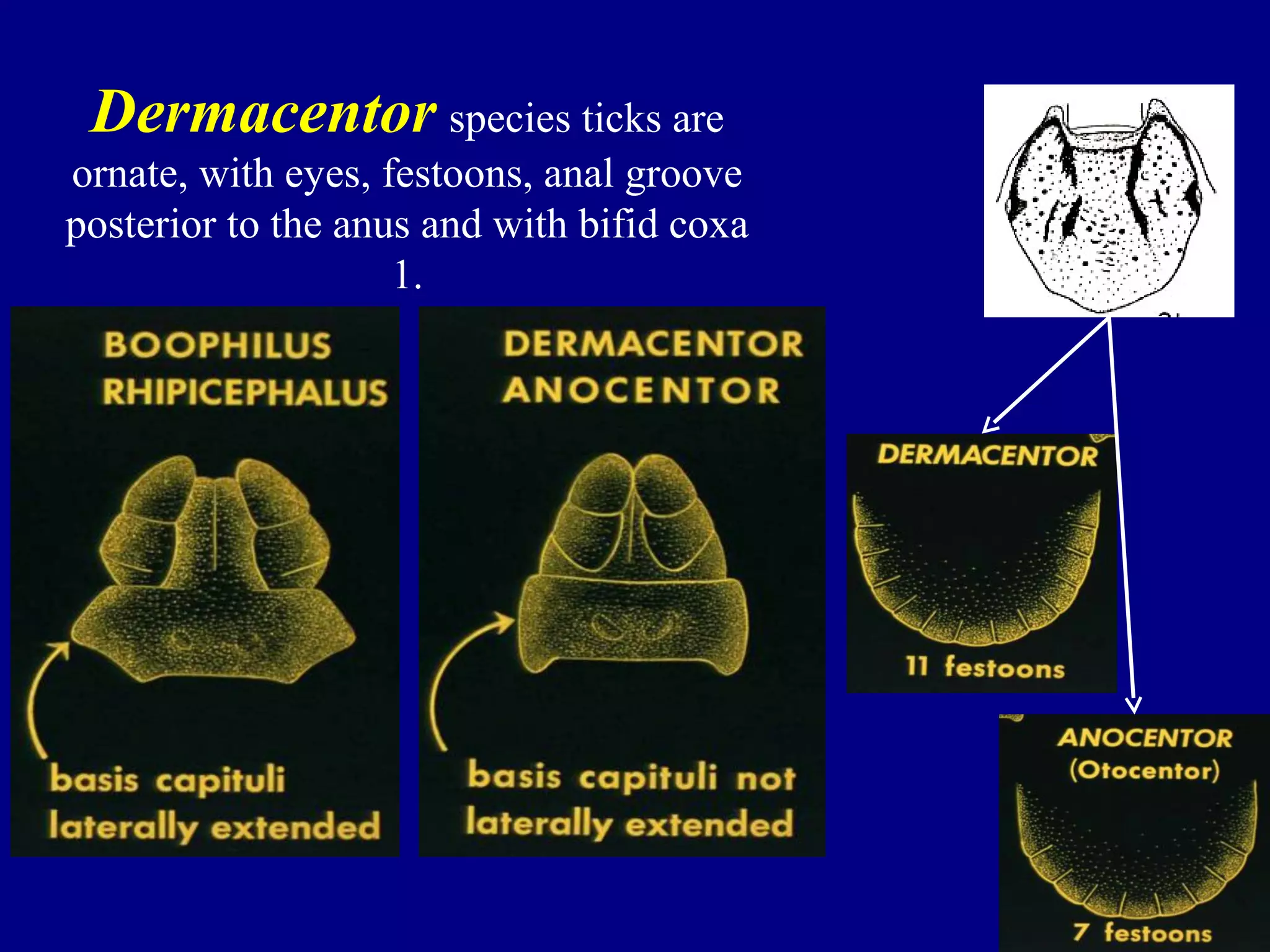
Dermacentor species ticks are
ornate, with eyes, festoons, anal groove
posterior to the anus and with bifid coxa
1.
Wood Ticks (Dermacentor species)
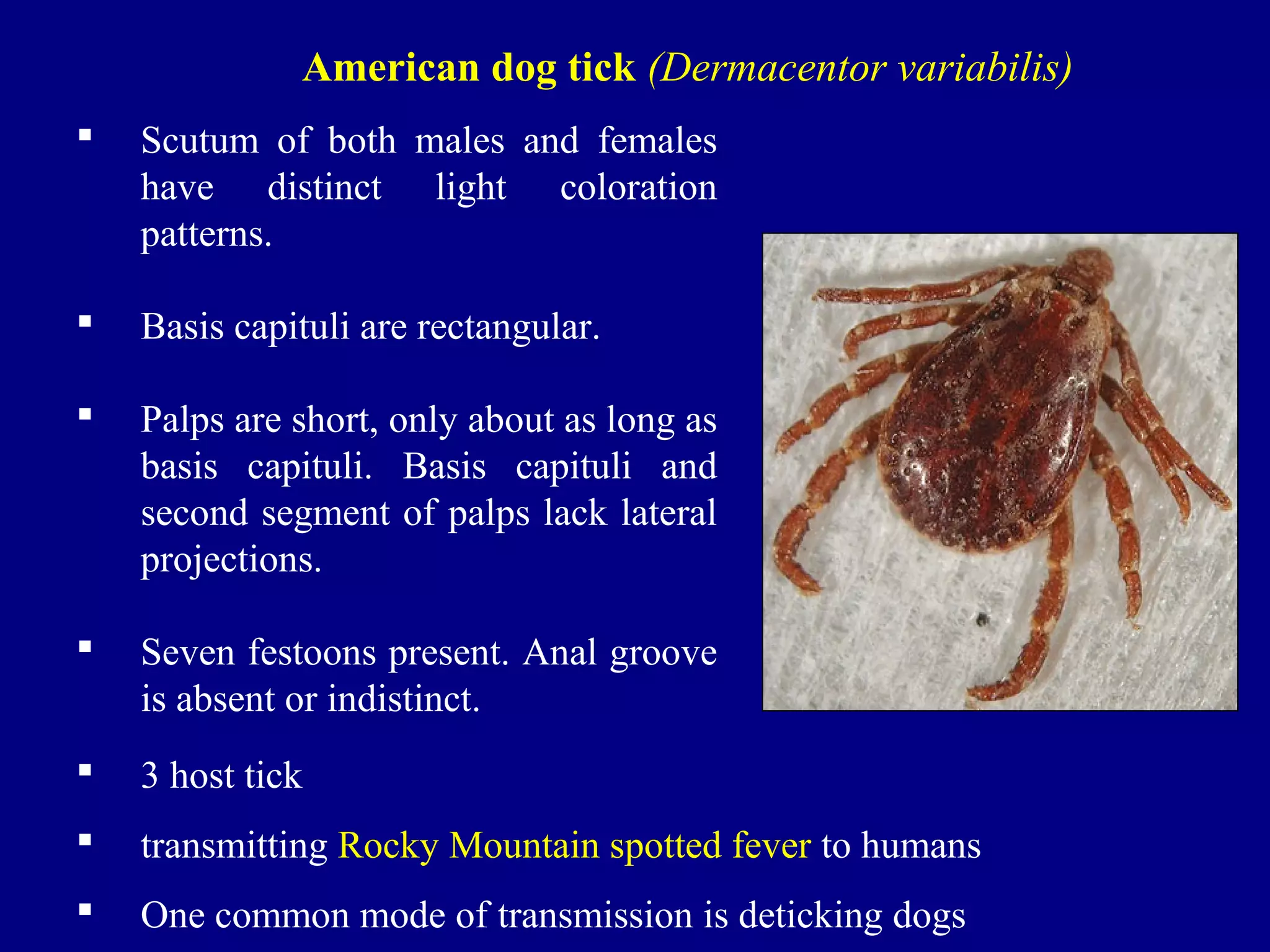
American dog tick, Dermacentor variabilis (Say)
Rocky Mountain wood tick, Dermacentor andersoni Stiles
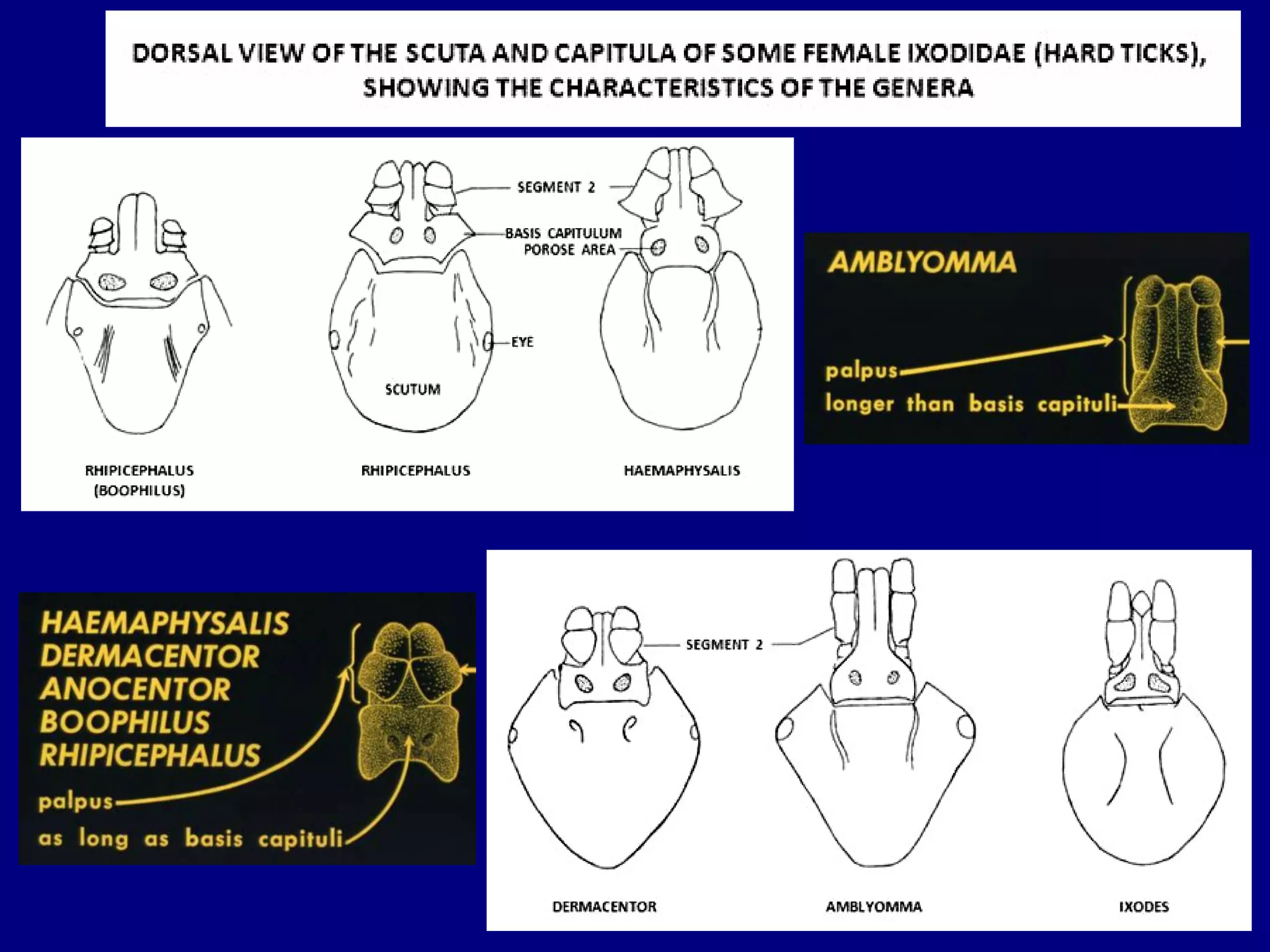
 Scutum of both males and females
have distinct light coloration
patterns.
 Basis capituli are rectangular.
 Palps are short, only about as long as
basis capituli. Basis capituli and
second segment of palps lack lateral
projections.
 Seven festoons present. Anal groove
is absent or indistinct.
American dog tick (Dermacentor variabilis)
 3 host tick
 transmitting Rocky Mountain spotted fever to humans
 One common mode of transmission is deticking dogs
Host associations
Dogs and medium sized mammals are the
preferred hosts
Although this tick feeds readily on other
common mammals, such as opossums,
raccoons, skunks, foxes, coyotes, bobcats,
squirrels, cattle, sheep, horses, and humans.
Larvae and nymphs feed primarily on
small mammals, especially rodents.
Adults prefer dogs but also
bite humans.
Rocky Mountain spotted fever
Blue disease is the most lethal and most frequently reported rickettsial
illness.
Rickettsia rickettsii, a species of bacterium
Transovarial transmission.
Vectors:
Dermacentor variabilis,
Dermacentor andersoni,
Rhipicephalus sanguineus, and
Amblyomma cajennense
“black measles”: 1896 in the Snake River Valley of Idaho
This tick has very prominent eyes and an anal groove posterior to the
anus with a median groove posterior to that. (commonest)
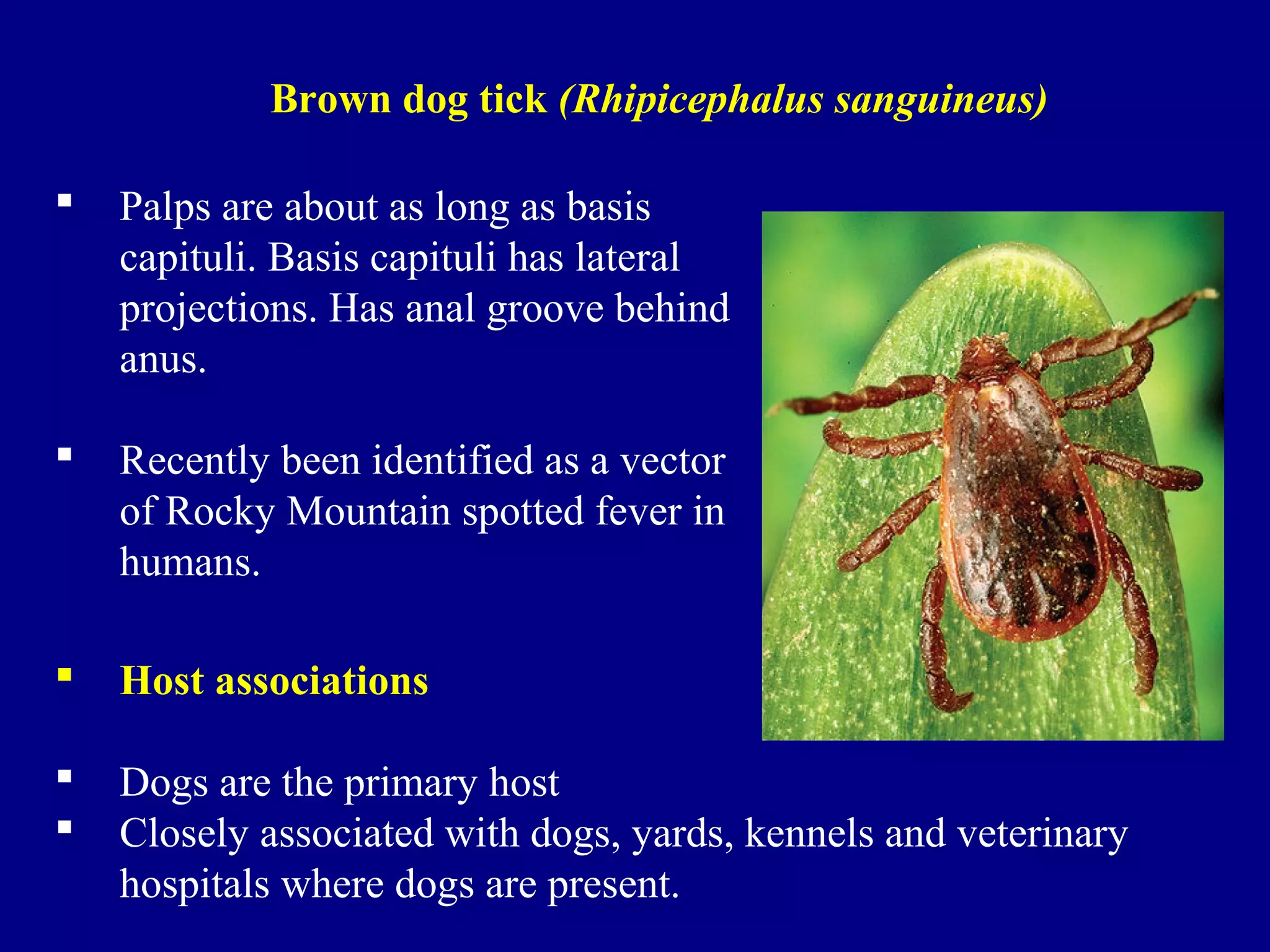
Brown dog tick (Rhipicephalus sanguineus) : vector of Rocky
Mountain spotted fever in humans
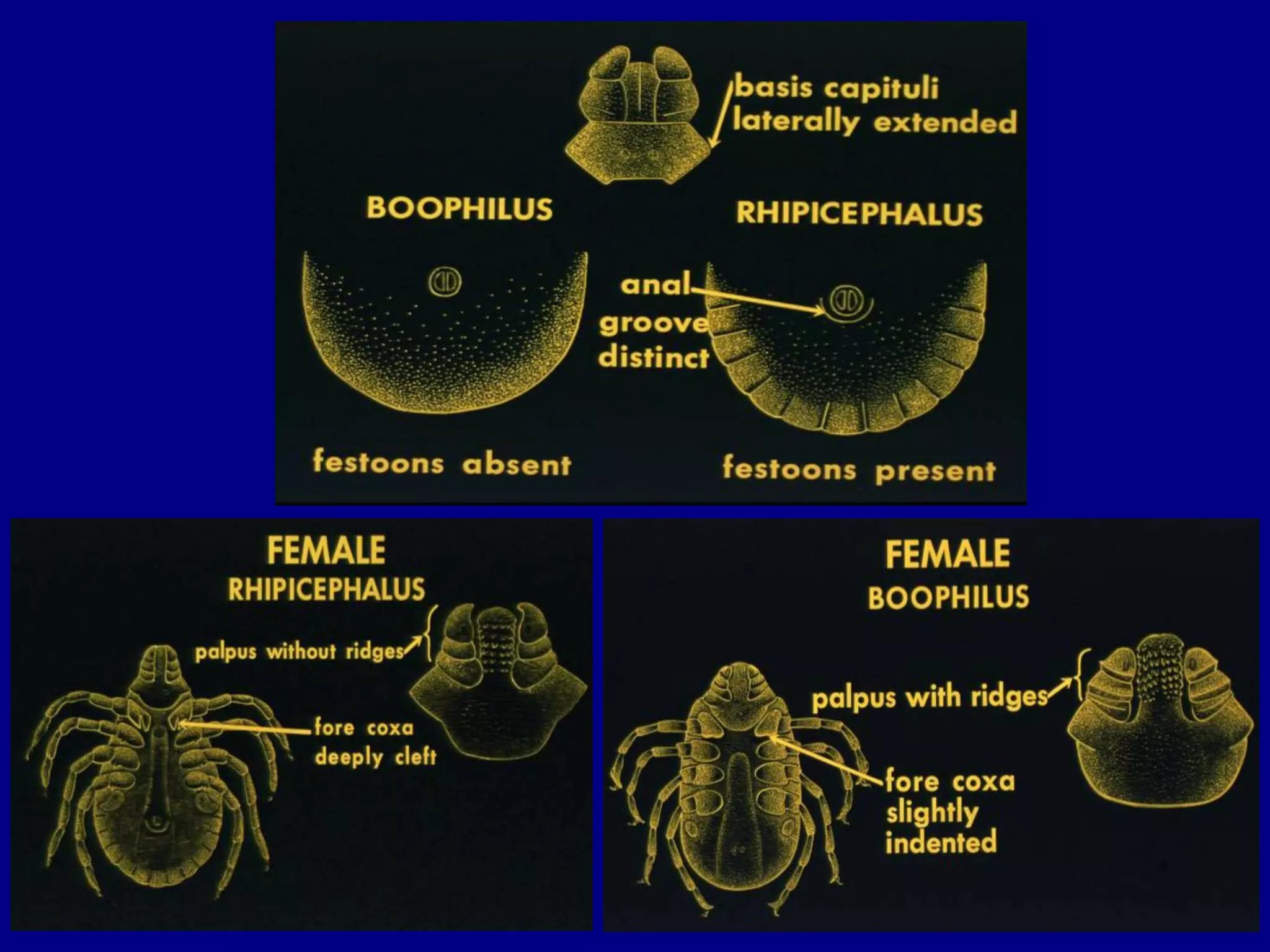
 Palps are about as long as basis
capituli. Basis capituli has lateral
projections. Has anal groove behind
anus.
 Recently been identified as a vector
of Rocky Mountain spotted fever in
humans.
 Host associations
 Dogs are the primary host
 Closely associated with dogs, yards, kennels and veterinary
hospitals where dogs are present.
Brown dog tick (Rhipicephalus sanguineus)
Relapsing
fever tick Ornithodoros turicata Relapsing fever
Bat tick Ornithodoros kelleyi
No transmission
reported yet
Fowl Tick Argas persicus
Avian
spherochetosis
Pigeon tick Argas reflexus
Spinose ear
tick
Otobius megnini Otoacariasis
Thank
you

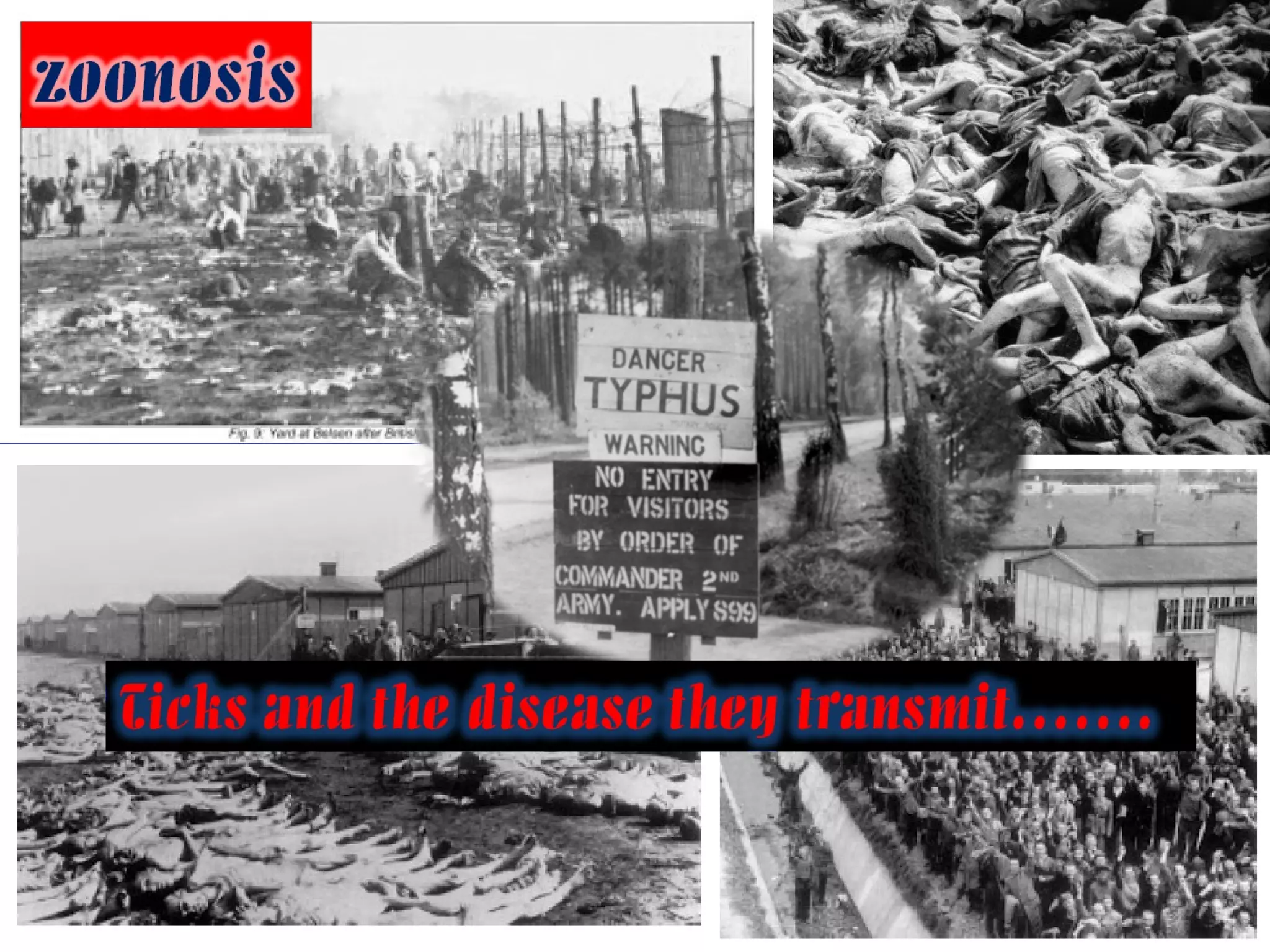
Important ticks and their classification

  • 1.
    2015-16 Presentation by, Guru P.N. Ph. D. 015/39 Dept. of Agril. Entomology, PGI, MPKV, Rahuri.
  • 4.
    Amblyomma americanum Southern tickassociatedrash illness (STARI), human ehrlichiosis and tularemia Amblyomma hebraeum Human ehrlichiosis Amblyomma variegatum
  • 5.
    Lone star tick (Amblyommaamericanum) Females have scutum with distinct white spot. Males have inverted horseshoe markings at the rounded posterior edge of the scutum. 3 host tick Their bite may cause locally intense irritation Massive infestations on animals may result in severe blood loss and debilitation. A toxin introduced during feeding can cause tick paralysis.
  • 6.
     Transmits southerntick associated rash illness (STARI), human ehrlichiosis and tularemia.  Host associations  These are very aggressive, nonspecific feeders. They feed on a wide range of wild and domestic mammals, ground feeding birds and humans during all of their life stages.  White tailed deer are the major host for this tick and an important reservoir for the human ehrlichiosis bacterium.
  • 7.
    Ehrlichiosis Caused by Ehrlichia chaffeensis Ehrlichiaare bacteria related to Rickettsiae Rash is more common.
  • 8.
  • 9.
    Tularemia Caused by :intracellular bacterium Francisella tularensis Ulceration Ticks involved include Amblyomma, Dermacentor, Haemaphysalis, and Ixodes. Rodents, rabbits, and hares often serve as reservoir hosts The Centers for Disease Control and Prevention (CDC) regard F. tularensis as a viable biological warfare agent
  • 10.
  • 11.
    Ixodes species ticksare inornate, do not possess eyes and with an anal groove surrounding the anus anteriorly.  European castor bean tick, Ixodes ricinus (L.),  Blacklegged tick (Ixodes scapularis): anaplasmosis, Lyme disease and Rocky Mountain spotted fever to humans.
  • 12.
    Black legged tick (Ixodesscapularis)  Adult females are 3 to 4 mm long and adult males 2 to3 mm long. It has an anal groove in front of its anus.  2 years to complete their life cycle and are found predominately in deciduous forest.  Both nymph and adult stages transmit diseases such as Lyme disease, Babesiosis, and Anaplasmosis  3 host tick
  • 13.
     Host associations Lizards, birds, rodents and large mammals are hosts.  Immature stages feed on lizards, birds and small mammals.  Adults prefer deer but will also bite people. The white footed mouse is the principal reservoir host for Lyme disease pathogens.
  • 15.
    Lyme disease Also knownas Lyme borreliosis: bacteria (Borrelia) Erythema migrans The disease does not appear to be transmissible between people, by other animals, or through food. It is estimated to affect 300,000 people a year in the United States and 65,000 people a year in Europe. Chronic Lyme disease Early localized infection Disseminated infection National Institute of Allergies & Infectious Diseases, Lyme disease is the most common tickborne infectious disease in the USA Vectors: Blacklegged tick (Ixodes scapularis),  Western blacklegged tick (Ixodes pacificus) and  Sheep tick (Ixodes ricinus)
  • 17.
     Within thetick midgut, the Borrelia's outer surface protein A (OspA) binds to the tick receptor for OspA, known as TROSPA. When the tick feeds, the Borrelia downregulates OspA and upregulates OspC, another surface protein. After the bacteria migrate from the midgut to the salivary glands, OspC binds to Salp15, a tick salivary protein that appears to have immunosuppressive effects that enhance infection.[46] Successful infection of the mammalian host depends on bacterial expression of OspC.  Ticks that transmit B. burgdorferi to humans can also carry and transmit several other parasites, such as Theileria microti and Anaplasma phagocytophilum, which cause the diseases babesiosis and human granulocytic anaplasmosis (HGA), respectively.  Borrelia burgdorferi has a unique feature not present in any other known organism it can exist without iron. All other life requires iron to make proteins and enzymes.
  • 18.
    Dermacentor species ticksare ornate, with eyes, festoons, anal groove posterior to the anus and with bifid coxa 1.
  • 19.
    Wood Ticks (Dermacentorspecies) American dog tick, Dermacentor variabilis (Say) Rocky Mountain wood tick, Dermacentor andersoni Stiles
  • 20.
     Scutum ofboth males and females have distinct light coloration patterns.  Basis capituli are rectangular.  Palps are short, only about as long as basis capituli. Basis capituli and second segment of palps lack lateral projections.  Seven festoons present. Anal groove is absent or indistinct. American dog tick (Dermacentor variabilis)  3 host tick  transmitting Rocky Mountain spotted fever to humans  One common mode of transmission is deticking dogs
  • 21.
    Host associations Dogs andmedium sized mammals are the preferred hosts Although this tick feeds readily on other common mammals, such as opossums, raccoons, skunks, foxes, coyotes, bobcats, squirrels, cattle, sheep, horses, and humans. Larvae and nymphs feed primarily on small mammals, especially rodents. Adults prefer dogs but also bite humans.
  • 22.
    Rocky Mountain spottedfever Blue disease is the most lethal and most frequently reported rickettsial illness. Rickettsia rickettsii, a species of bacterium Transovarial transmission. Vectors: Dermacentor variabilis, Dermacentor andersoni, Rhipicephalus sanguineus, and Amblyomma cajennense “black measles”: 1896 in the Snake River Valley of Idaho
  • 24.
    This tick hasvery prominent eyes and an anal groove posterior to the anus with a median groove posterior to that. (commonest) Brown dog tick (Rhipicephalus sanguineus) : vector of Rocky Mountain spotted fever in humans
  • 25.
     Palps areabout as long as basis capituli. Basis capituli has lateral projections. Has anal groove behind anus.  Recently been identified as a vector of Rocky Mountain spotted fever in humans.  Host associations  Dogs are the primary host  Closely associated with dogs, yards, kennels and veterinary hospitals where dogs are present. Brown dog tick (Rhipicephalus sanguineus)
  • 27.
    Relapsing fever tick Ornithodorosturicata Relapsing fever Bat tick Ornithodoros kelleyi No transmission reported yet Fowl Tick Argas persicus Avian spherochetosis Pigeon tick Argas reflexus Spinose ear tick Otobius megnini Otoacariasis
  • 28.