Principles
of
Pest
Control
EMW3

1
Definition of a Pest

EMW3

2
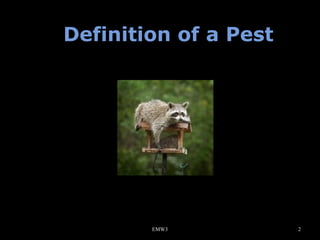
Definition of a Pest
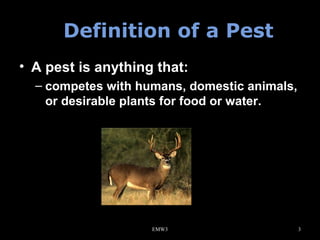
• A pest is anything that:
– competes with humans, domestic animals,
or desirable plants for food or water.

EMW3

3
Definition of a Pest
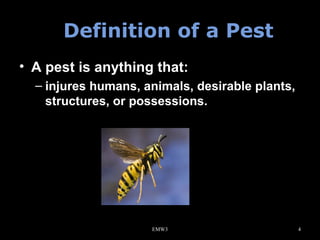
• A pest is anything that:
– injures humans, animals, desirable plants,
structures, or possessions.

EMW3

4
Definition of a Pest
• A pest is anything that:
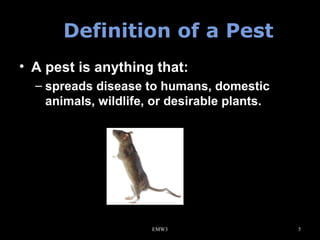
– spreads disease to humans, domestic
animals, wildlife, or desirable plants.

EMW3

5
Definition of a Pest
• A pest is anything that:
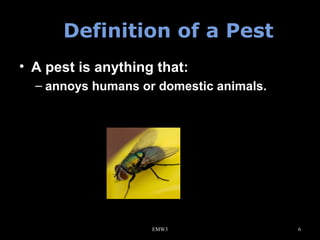
– annoys humans or domestic animals.

EMW3

6
Types of Pests
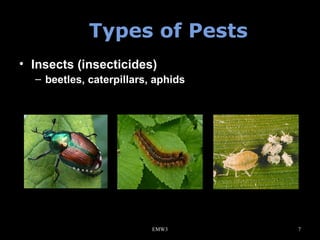
• Insects (insecticides)
– beetles, caterpillars, aphids

EMW3

7
Types of Pests
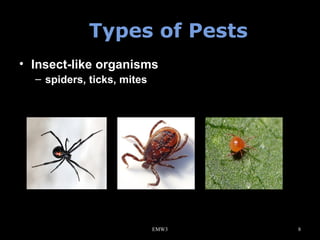
• Insect-like organisms
– spiders, ticks, mites

EMW3

8
Types of Pests
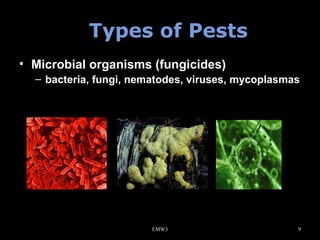
• Microbial organisms (fungicides)
– bacteria, fungi, nematodes, viruses, mycoplasmas

EMW3

9
Types of Pests
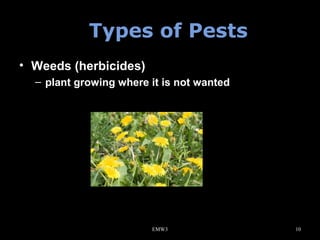
• Weeds (herbicides)
– plant growing where it is not wanted

EMW3

10
Types of Pests
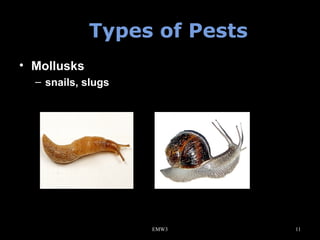
• Mollusks
– snails, slugs

EMW3

11
Types of Pests
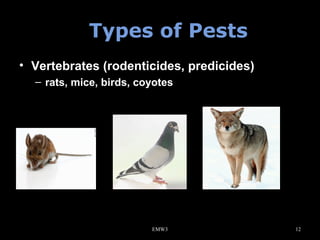
• Vertebrates (rodenticides, predicides)
– rats, mice, birds, coyotes

EMW3

12
Pest Control is…….

• To control a pest only
when it is causing or is
expected to cause
more harm than is
reasonable to accept.
EMW3

13
Pest Control is…….

• To use a control
strategy that will
reduce the pest
numbers to an
acceptable level.
EMW3

14
Pest Control is…….

• To cause as little harm
as possible to
everything except the
pest.
EMW3

15
Pest Control Goals
• Prevention
• Suppression
• Eradication
EMW3

16
Threshold Levels……
• Are the levels of pest
populations at which pest
control action needs to be
taken to prevent the pest
from causing unacceptable
injury or harm.
EMW3

17
Avoiding Harmful Effects

• Choose the pest control
method that will best
control the pest with the
least harmful effect to the
environment.
EMW3

18
Integrated Pest
Management (IPM) is…

• the combining of
appropriate pest control
tactics into a single plan
to reduce pests and their
damage to an acceptable
level.
EMW3

19
Integrated Pest
Management (IPM)
• To solve pest problems using
IPM:
– Identify the pest
– Is control needed?
– What controls are available?
– Evaluate the risks and benefits
EMW3

20
Integrated Pest
Management (IPM) is
• To solve pest problems (con't):
– choose a control strategy that will be
most effective and cause the least harm
to people and the environment
– use each tactic in the strategy correctly
– observe Local, State, and Federal laws.

EMW3

21
Integrated Pest
Management (IPM) is
• Natural Controls
– climate
– natural enemies
– natural barriers
– food and water supply
– shelter

EMW3

22
Integrated Pest
Management (IPM) is
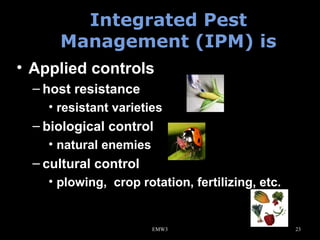
• Applied controls
– host resistance
• resistant varieties

– biological control
• natural enemies

– cultural control
• plowing, crop rotation, fertilizing, etc.

EMW3

23
Integrated Pest
Management (IPM) is
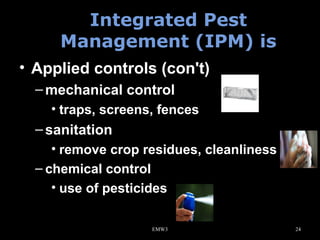
• Applied controls (con't)
– mechanical control
• traps, screens, fences

– sanitation
• remove crop residues, cleanliness
– chemical control
• use of pesticides
EMW3

24
IPM Monitoring

(questions to ask)

• What kinds of pests are present?
• Are the numbers great enough to
warrant control?
• Have the control efforts successfully
reduced the number of pests?
EMW3

25
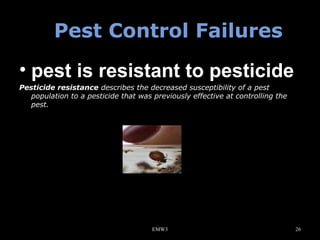
Pest Control Failures
• pest is resistant to pesticide
Pesticide resistance describes the decreased susceptibility of a pest 
population to a pesticide that was previously effective at controlling the 
pest. 

EMW3

26
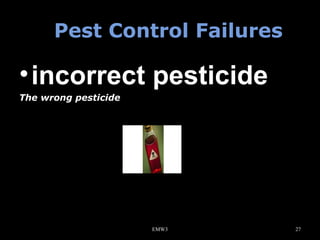
Pest Control Failures

• incorrect pesticide
The wrong pesticide

EMW3

27
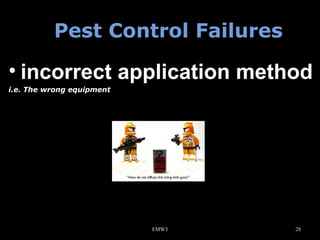
Pest Control Failures

• incorrect application method
i.e. The wrong equipment

EMW3

28
Pest Control Failures

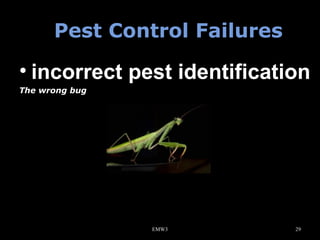
• incorrect pest identification
The wrong bug

EMW3

29
Pest Control Failures

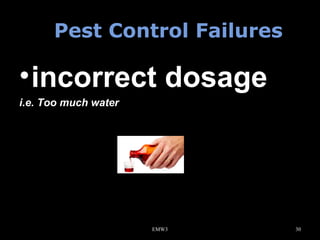
• incorrect dosage
i.e. Too much water

EMW3

30
Key Points
• A PEST is anything that competes, injures, spreads
disease, or annoys humans, domestic animals, or
desirable plants.
• Pest Control is to control a pest only when it is
causing or is expected to cause more harm than
is reasonable to acceptable.
• Integrated Pest Management (IPM) is the
combining of appropriate pest control tactics into
a single plan to reduce pests and their damage to
an acceptable level.
Acknowledgments: Thanks to the University of Wyoming extension.
I reworked this PPT using the information from University of Wyoming extension.

EMW3

31

Principles of-pest-control

  • 1.
  • 2.
    Definition of aPest EMW3 2
  • 3.
    Definition of aPest • A pest is anything that: – competes with humans, domestic animals, or desirable plants for food or water. EMW3 3
  • 4.
    Definition of aPest • A pest is anything that: – injures humans, animals, desirable plants, structures, or possessions. EMW3 4
  • 5.
    Definition of aPest • A pest is anything that: – spreads disease to humans, domestic animals, wildlife, or desirable plants. EMW3 5
  • 6.
    Definition of aPest • A pest is anything that: – annoys humans or domestic animals. EMW3 6
  • 7.
    Types of Pests •Insects (insecticides) – beetles, caterpillars, aphids EMW3 7
  • 8.
    Types of Pests •Insect-like organisms – spiders, ticks, mites EMW3 8
  • 9.
    Types of Pests •Microbial organisms (fungicides) – bacteria, fungi, nematodes, viruses, mycoplasmas EMW3 9
  • 10.
    Types of Pests •Weeds (herbicides) – plant growing where it is not wanted EMW3 10
  • 11.
    Types of Pests •Mollusks – snails, slugs EMW3 11
  • 12.
    Types of Pests •Vertebrates (rodenticides, predicides) – rats, mice, birds, coyotes EMW3 12
  • 13.
    Pest Control is……. •To control a pest only when it is causing or is expected to cause more harm than is reasonable to accept. EMW3 13
  • 14.
    Pest Control is……. •To use a control strategy that will reduce the pest numbers to an acceptable level. EMW3 14
  • 15.
    Pest Control is……. •To cause as little harm as possible to everything except the pest. EMW3 15
  • 16.
    Pest Control Goals •Prevention • Suppression • Eradication EMW3 16
  • 17.
    Threshold Levels…… • Arethe levels of pest populations at which pest control action needs to be taken to prevent the pest from causing unacceptable injury or harm. EMW3 17
  • 18.
    Avoiding Harmful Effects •Choose the pest control method that will best control the pest with the least harmful effect to the environment. EMW3 18
  • 19.
    Integrated Pest Management (IPM)is… • the combining of appropriate pest control tactics into a single plan to reduce pests and their damage to an acceptable level. EMW3 19
  • 20.
    Integrated Pest Management (IPM) •To solve pest problems using IPM: – Identify the pest – Is control needed? – What controls are available? – Evaluate the risks and benefits EMW3 20
  • 21.
    Integrated Pest Management (IPM)is • To solve pest problems (con't): – choose a control strategy that will be most effective and cause the least harm to people and the environment – use each tactic in the strategy correctly – observe Local, State, and Federal laws. EMW3 21
  • 22.
    Integrated Pest Management (IPM)is • Natural Controls – climate – natural enemies – natural barriers – food and water supply – shelter EMW3 22
  • 23.
    Integrated Pest Management (IPM)is • Applied controls – host resistance • resistant varieties – biological control • natural enemies – cultural control • plowing, crop rotation, fertilizing, etc. EMW3 23
  • 24.
    Integrated Pest Management (IPM)is • Applied controls (con't) – mechanical control • traps, screens, fences – sanitation • remove crop residues, cleanliness – chemical control • use of pesticides EMW3 24
  • 25.
    IPM Monitoring (questions toask) • What kinds of pests are present? • Are the numbers great enough to warrant control? • Have the control efforts successfully reduced the number of pests? EMW3 25
  • 26.
    Pest Control Failures •pest is resistant to pesticide Pesticide resistance describes the decreased susceptibility of a pest  population to a pesticide that was previously effective at controlling the  pest.  EMW3 26
  • 27.
    Pest Control Failures •incorrect pesticide The wrong pesticide EMW3 27
  • 28.
    Pest Control Failures •incorrect application method i.e. The wrong equipment EMW3 28
  • 29.
    Pest Control Failures •incorrect pest identification The wrong bug EMW3 29
  • 30.
    Pest Control Failures •incorrect dosage i.e. Too much water EMW3 30
  • 31.
    Key Points • APEST is anything that competes, injures, spreads disease, or annoys humans, domestic animals, or desirable plants. • Pest Control is to control a pest only when it is causing or is expected to cause more harm than is reasonable to acceptable. • Integrated Pest Management (IPM) is the combining of appropriate pest control tactics into a single plan to reduce pests and their damage to an acceptable level. Acknowledgments: Thanks to the University of Wyoming extension. I reworked this PPT using the information from University of Wyoming extension. EMW3 31