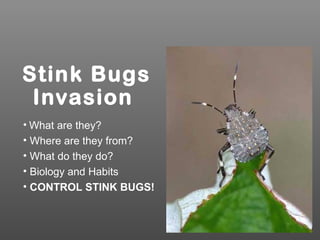
Stink Bugs
Invasion
• What are they?
• Where are they from?
• What do they do?
• Biology and Habits
• CONTROL STINK BUGS!
Identifying
the
Brown
Marmorated
Stink Bug
red eyes
& ocelli
black and
white
banding
white
banding
Image courtesy of David J. Shetlar, The Ohio State University
Look for these
unique identifying
features…
Ventral side:
(abdominal)
• Adults - 5/8” (14 -17mm)
• Light colored
• May have black or
gray markings
• Legs: brown with faint
white bands
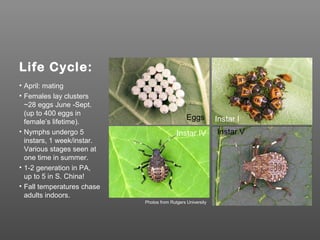
Life Cycle:
Photos from Rutgers University
• April: mating
• Females lay clusters
~28 eggs June -Sept.
(up to 400 eggs in
female’s lifetime).
• Nymphs undergo 5
instars, 1 week/instar.
Various stages seen at
one time in summer.
• 1-2 generation in PA,
up to 5 in S. China!
• Fall temperatures chase
adults indoors.
Eggs Instar I
Instar IV Instar V
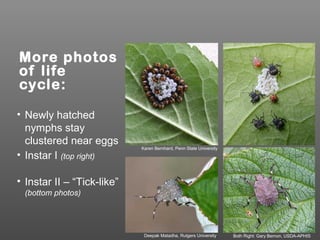
More photos
of life
cycle:
• Newly hatched
nymphs stay
clustered near eggs
• Instar I (top right)
• Instar II – “Tick-like”
(bottom photos)
Karen Bernhard, Penn State University
Both Right: Gary Bernon, USDA-APHISDeepak Matadha, Rutgers University
Population
EXPLOSION:
• Entered the U.S. in
Allentown, PA area in
early 1990’s from
Japan or China
• Today infesting over
half of Pennsylvania
Population
EXPLOSION:
• 20012001 – 5 more counties in– 5 more counties in
E. PA & 2 counties in NJE. PA & 2 counties in NJ
• 20032003 – MD, SC & MN– MD, SC & MN
• 20042004 – WV, VA & OR– WV, VA & OR
• 20052005 – DE & CA– DE & CA
• 20072007 – OH– OH
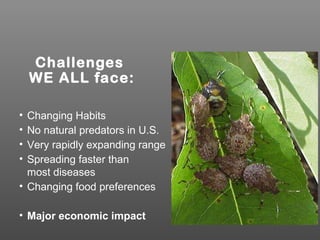
Challenges
WE ALL face:
• Changing Habits
• No natural predators in U.S.
• Very rapidly expanding range
• Spreading faster than
most diseases
• Changing food preferences
• Major economic impact
Plant Damage in U.S. so far…
Fruits
• Asian Pear, Peach, Apple, Raspberry, Grape, Apricot
• Damage appearing in orchards and backyard gardens
Deepak Matadha, Rutgers University
Veggies
• String beans, onions
• The list is growing as their numbers grow…
Deepak Matadha, Rutgers University
Plant Damage in U.S. so far…
• Ornamentals
• Buddleia
• Honeysuckle
• Paulownia
Shade trees
• Norway Maple
• Catalpa
• Crabapple
Plant Damage in U.S. so far…
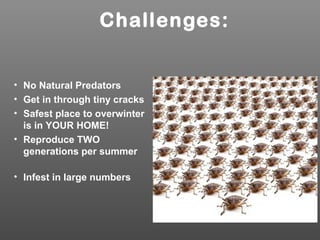
Challenges:
• No Natural Predators
• Get in through tiny cracks
• Safest place to overwinter
is in YOUR HOME!
• Reproduce TWO
generations per summer
• Infest in large numbers
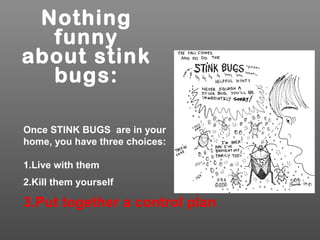
Nothing
funny
about stink
bugs:
Once STINK BUGS are in your
home, you have three choices:
1.Live with them
2.Kill them yourself
3.Put together a control plan
You can
put up barriers
•screens
•caulking
•screen house
vents & eaves
You can reduce and
eliminate attractants
•Tomato plants and
fruit-bearing ornamentals
•Trim foliage back from house
•Remove veggie
garden EARLY
Installing
light traps
can help
keep stink
bugs away
from your
family living
area
Treating
cracks and
crevices can
help on the
inside and
outside of
your home
Carefully
timed exterior
treatment
Late Summer!!!!
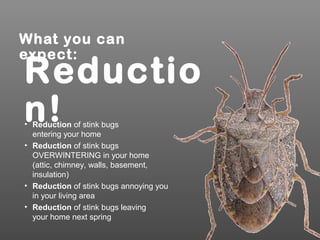
What you can
expect:
• Reduction of stink bugs
entering your home
• Reduction of stink bugs
OVERWINTERING in your home
(attic, chimney, walls, basement,
insulation)
• Reduction of stink bugs annoying you
in your living area
• Reduction of stink bugs leaving
your home next spring
Reductio
n!
 Questions?

Pointe stink bugs

  • 1.
    Stink Bugs Invasion • Whatare they? • Where are they from? • What do they do? • Biology and Habits • CONTROL STINK BUGS!
  • 2.
    Identifying the Brown Marmorated Stink Bug red eyes &ocelli black and white banding white banding Image courtesy of David J. Shetlar, The Ohio State University Look for these unique identifying features…
  • 3.
    Ventral side: (abdominal) • Adults- 5/8” (14 -17mm) • Light colored • May have black or gray markings • Legs: brown with faint white bands
  • 4.
    Life Cycle: Photos fromRutgers University • April: mating • Females lay clusters ~28 eggs June -Sept. (up to 400 eggs in female’s lifetime). • Nymphs undergo 5 instars, 1 week/instar. Various stages seen at one time in summer. • 1-2 generation in PA, up to 5 in S. China! • Fall temperatures chase adults indoors. Eggs Instar I Instar IV Instar V
  • 5.
    More photos of life cycle: •Newly hatched nymphs stay clustered near eggs • Instar I (top right) • Instar II – “Tick-like” (bottom photos) Karen Bernhard, Penn State University Both Right: Gary Bernon, USDA-APHISDeepak Matadha, Rutgers University
  • 6.
    Population EXPLOSION: • Entered theU.S. in Allentown, PA area in early 1990’s from Japan or China • Today infesting over half of Pennsylvania
  • 7.
    Population EXPLOSION: • 20012001 –5 more counties in– 5 more counties in E. PA & 2 counties in NJE. PA & 2 counties in NJ • 20032003 – MD, SC & MN– MD, SC & MN • 20042004 – WV, VA & OR– WV, VA & OR • 20052005 – DE & CA– DE & CA • 20072007 – OH– OH
  • 8.
    Challenges WE ALL face: •Changing Habits • No natural predators in U.S. • Very rapidly expanding range • Spreading faster than most diseases • Changing food preferences • Major economic impact
  • 9.
    Plant Damage inU.S. so far… Fruits • Asian Pear, Peach, Apple, Raspberry, Grape, Apricot • Damage appearing in orchards and backyard gardens Deepak Matadha, Rutgers University
  • 10.
    Veggies • String beans,onions • The list is growing as their numbers grow… Deepak Matadha, Rutgers University Plant Damage in U.S. so far…
  • 11.
    • Ornamentals • Buddleia •Honeysuckle • Paulownia Shade trees • Norway Maple • Catalpa • Crabapple Plant Damage in U.S. so far…
  • 12.
    Challenges: • No NaturalPredators • Get in through tiny cracks • Safest place to overwinter is in YOUR HOME! • Reproduce TWO generations per summer • Infest in large numbers
  • 13.
    Nothing funny about stink bugs: Once STINKBUGS are in your home, you have three choices: 1.Live with them 2.Kill them yourself 3.Put together a control plan
  • 14.
    You can put upbarriers •screens •caulking •screen house vents & eaves
  • 15.
    You can reduceand eliminate attractants •Tomato plants and fruit-bearing ornamentals •Trim foliage back from house •Remove veggie garden EARLY
  • 16.
    Installing light traps can help keepstink bugs away from your family living area
  • 17.
    Treating cracks and crevices can helpon the inside and outside of your home
  • 18.
  • 19.
    What you can expect: •Reduction of stink bugs entering your home • Reduction of stink bugs OVERWINTERING in your home (attic, chimney, walls, basement, insulation) • Reduction of stink bugs annoying you in your living area • Reduction of stink bugs leaving your home next spring Reductio n!
  • 20.