Clinical case
   55 yo male presented with weaknessx3 wks,
    insideous onset, progressive, easy fatigability, weight
    loss. No cough, SOB, CP, abdominal pain.
   ROS negative
   PE: Thin, lean, oral mucosa black pigmentation.
   Labs: Leukopenia, PPD+, dec cortisol, increase
    ACTH, CXR norm
    Final diagnosis: TB adrenalitisPrimary adrenal
    insufficiency.
Ahad Lodhi, M.D.
  07/21/2010
The Adrenal Glands
Adrenal Cross Section
Adrenal Zonation and Vasculature
                         -blood flow

                         -steroid gradient
Overview: Hypothalamic-Pituitary-Adrenal (HPA)
Axis
Activity of the Hypothalamic-Pituitary-Adrenal Axis under Normal Conditions (Panel A), during an
Appropriate Response to Stress (Panel B), and during an Inappropriate Response to Critical Illness (Panel
                                                   C)


              Cooper M and Stewart P. N Engl J Med 2003;348:727-734
Definition
   A disease state caused by insufficient circulating
    glucocorticoid and/or mineralocorticoid hormones.
   May be caused by abnormalities at any level of the
    hypothalamic-pituitary-adrenal axis.
    TYPES
       Primary
       Secondary
       Tertiary
EPIDEMIOLOGY
   Prevalence: 12 per 100,000 persons
   Incidence: 0.5 per 100,000 persons
   Age: may occur at any age, with peak incidence in the
    fourth decade
   Sex:
    Autoimmune causes: female predominance
    Non-autoimmune causes: equal sex distribution
Risk Factors
1.Genetic:
 Isolated autoimmune adrenal insufficiency
 Congenital abnormalities of cortisol synthesis
 Autoimmune PGS 1:
        hypoparathyroidism, adrenal insufficiency, and chronic mucocutaneous candidiasis
 PGS 2:
       >2 adrenal insufficiency, chronic lymphocytic thyroiditis, premature ovarian failure, type 1
   diabetes mellitus, Graves’ disease, hypo-hyperthyroidism

2. Medications:
       Rifampin, Phenytoin, Ketoconazole, etomidate, magesterol and opiates .
3. Rapid withdrawal of glucocorticoids after long-term steroid therapy
4. Anticoagulants
5. Hypercoagulable states (adrenal infarction)
6. Severe sepsis (e.g., meningococcus)
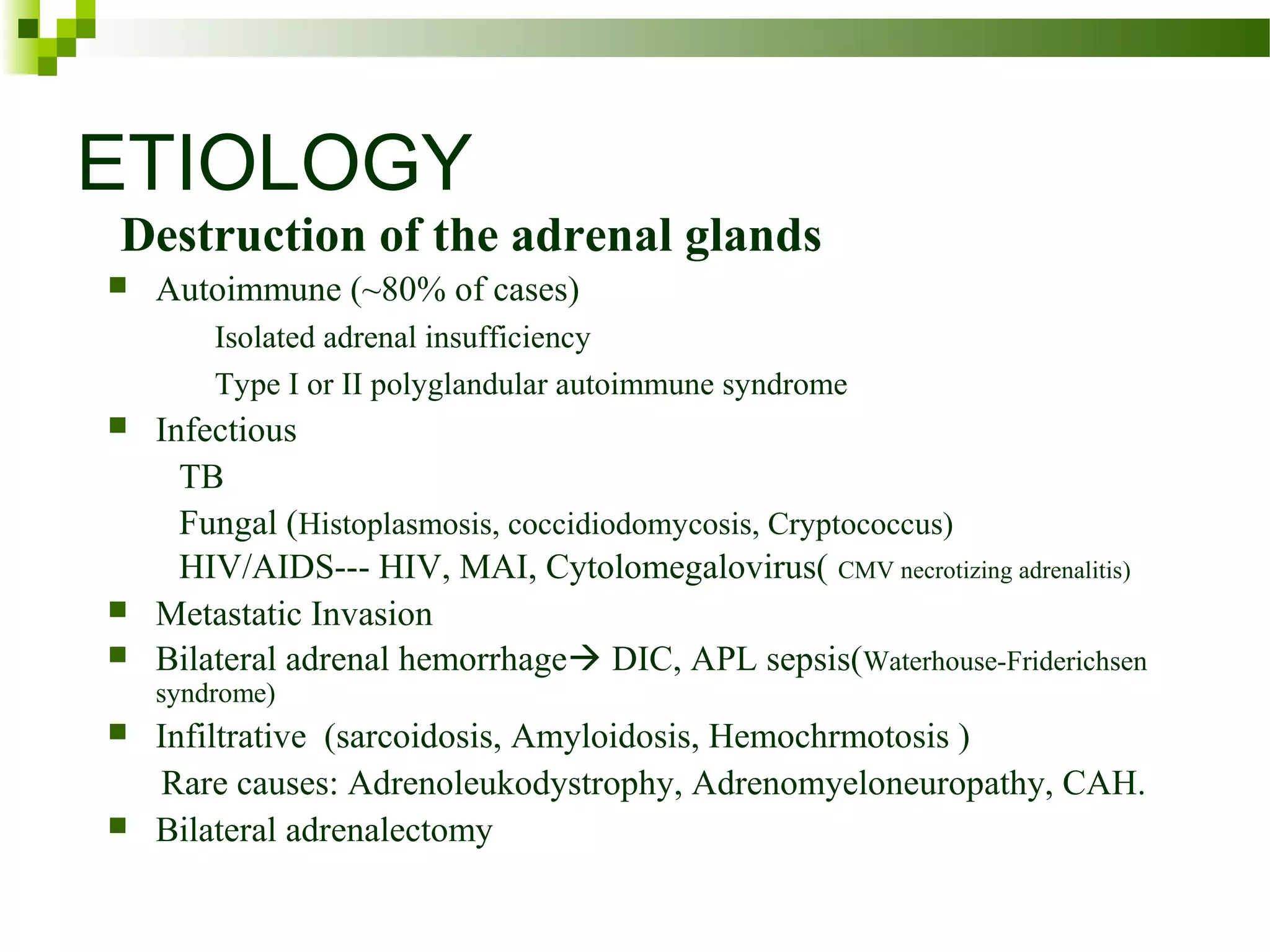
ETIOLOGY
Destruction of the adrenal glands
   Autoimmune (~80% of cases)
        Isolated adrenal insufficiency
        Type I or II polyglandular autoimmune syndrome
   Infectious
      TB
      Fungal (Histoplasmosis, coccidiodomycosis, Cryptococcus)
      HIV/AIDS--- HIV, MAI, Cytolomegalovirus( CMV necrotizing adrenalitis)
   Metastatic Invasion
   Bilateral adrenal hemorrhage DIC, APL sepsis(Waterhouse-Friderichsen
    syndrome)
   Infiltrative (sarcoidosis, Amyloidosis, Hemochrmotosis )
    Rare causes: Adrenoleukodystrophy, Adrenomyeloneuropathy, CAH.
   Bilateral adrenalectomy
Histoplasmosis:
Large bilateral
adrenal masses (a
rrows) patchy& per
ipheral enhancem
ent, central hypod
ensities, septation
s.
SECONDARY AI
   Hypopituitarism
   Head injury
   Postpartum hemorrhage – Sheehan syndrome
   Craniopharyngiomas, Pituitary radiation
   Pituitary surgery
   Acute interruption of prolonged corticosteroids
   Pituitary infiltrative disease – tuberculosis, sarcoidosis, Wegener's.
   Exogenous glucocorticoid administration
   Lymphocytic hypophysitis
Clinical Manifestations
Unexplained hypotension, weight loss, fatigue.
Primary and Sec AI
   Fatigue, weakness, anorexia, weight loss
   N/V/D, dizziness, orthostatic hypotension
   Hyponatremia, hypoglycemia, Eosinophilia
Primary AI and associated conditions.
   Hyperpigmentation, hyperkalemia, salt craving
   Vitiligo, autoimmue thyroid disease
Secondary AI & associated conditions:
   Pale skin, marked anemia
   Amenorrhea, scant pubic and axillary hairs, small testicles.
   Secondary hypothyroidism, delayed puberty
   Headache, visual symptoms, diabetes insipidus
Addison’s Disease: effect of MSH activity
Hyperpigmentation
DIAGNOSTIC APPROACH
      The diagnostic approach to adrenal insufficiency has 3
    stages.
       Demonstration of an inappropriately low cortisol level
       Determination of the level of adrenal dysfunction
    (primary vs secondary)
       Identification of the specific cause of adrenal
    insufficiency
Screening


1. Morning cortisol level 8am-9am
   >18 μg/dl excludes adrenal insufficiency.
   < 3 μg/dl is highly suggestive of adrenal insufficiency
   Indeterminate value: 3–18 μg/dl
2. ACTH level:
    ≥ 22 pmol/L (100 pg/mL) primary adrenal insufficiency.
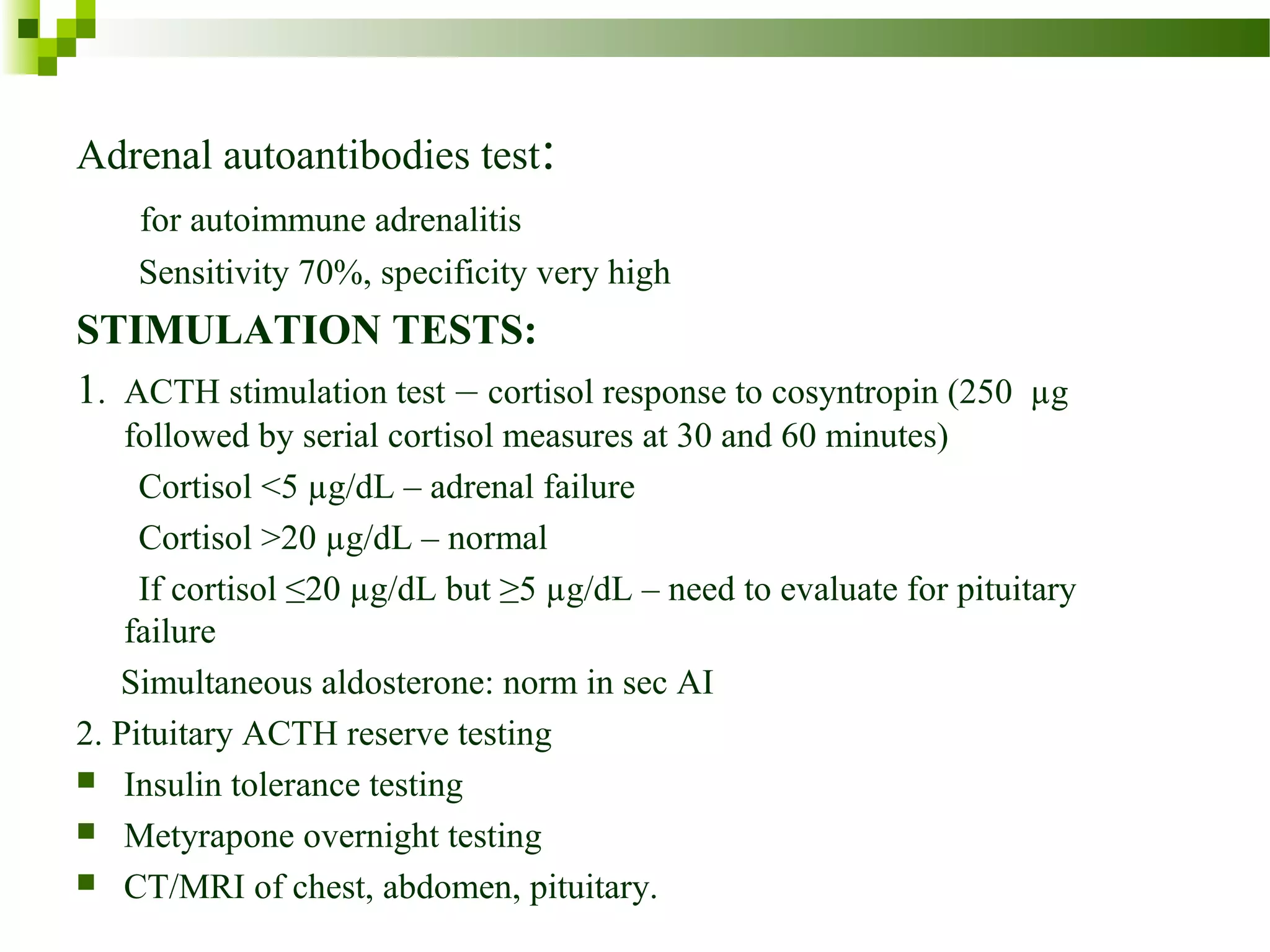
Adrenal autoantibodies test:
    for autoimmune adrenalitis
    Sensitivity 70%, specificity very high
STIMULATION TESTS:
1. ACTH stimulation test – cortisol response to cosyntropin (250 µg
    followed by serial cortisol measures at 30 and 60 minutes)
     Cortisol <5 µg/dL – adrenal failure
     Cortisol >20 µg/dL – normal
     If cortisol ≤20 µg/dL but ≥5 µg/dL – need to evaluate for pituitary
    failure
   Simultaneous aldosterone: norm in sec AI
2. Pituitary ACTH reserve testing
 Insulin tolerance testing
 Metyrapone overnight testing
 CT/MRI of chest, abdomen, pituitary.
Relative adrenal insufficiency
   Critical care and Resuscitation: Journal of the Australian Critical
    Care Medicine,2006 Dec;8(4):371-5
         - In septic shock
         - Increment of < 250 nmol/L(9 µg/dL) in total serum cortisol
    level after administration of 250 microg corticotropin
         - RAI associated with increased risk of death

         - There is strong, but not overwhelming, evidence that
    administration of low doses of hydrocortisone to patients with
    septic shock, especially those with RAI, improves survival .
American Journal of Respiratory and Critical Care Medicine,
  2006 Dec 15

   In sepsis, adrenal insufficiency is likely when
         - Baseline cortisol levels <10 µg/dL

   Unlikely when
        - Cosyntropin-stimulated cortisol level > 44 µg/dL
Diagnostic approach
Other tests

CBC:
        anemia, moderate neutropenia, eosinophilia, relative
        lymphocytosis

BMP:
        hyponatremia (90%), hyperkalemia(65%), hypoglycemia

       TSH, CXR
        plasma very long chain fatty acids
        S/ DHEA levels
        Plasma renin activity
D/D
 Occult cancer
 Hemochromatosis
 Anorexia nervosa
 AIDS
 Multiple sclerosis
Treatment of chronic AI
Mild cases hydrocortisone alone
Moderate to SevereReplacement of corticosteroids and mineralocorticoid
Hydrocortisone----Drug of choice, 15-25 mg PO BID or
Prednisone: 2-3 mg am, 1-2 mg pm
FU response: normal WBC diff count with proper dose,
Some patients need Florinef 0.05-0.3 qday or QOD---elevated PRA indicates
   need for higher dose.
DHEA 50 mg PO qday: to some womenimprove sense of well being, mood
   and sexuality

Treat infections immediately and vigorously
Increase dose of steroid in times of stress.
Medical alert bracelet ….adrenal insuffiency ---takes hydrocortisone
.
Treatment :Acute Adrenal crisis
    Glucocorticoid replacement
1. Hydrocortisone 100 mg iv every 6 hr. for 24 hr.
2. Hydrocortisone 50 mg every 6 hr. when stable
3. Maintenance therapy (10 mg 3 times/days) by day 4 or 5
4. Increase dose to 200-400 mg/day if complication occurs
5. Vasopressors may be needed.

    General and supportive measures
1. Correct volume depletion, dehydration, hypoglycemia with iv
    saline and glucose
2. Correct infection and other precipitating causes
Prognosis & Response to
therapy
Life expectancy is usually normal with good compliance.
It is important to make sure that pt is taking medications
    regularly and knowledgeable about his condition.

BP without orthostatic hypotension, normal lytes, PRA
  <5ng/ml/h
Cushing syndrome: overtreatment
Persistent fatigue consider epinephrine deficiency, suboptimal
  dosing, electrolyte problem.
PEARLS
   Mineralocorticoid deficiency is present only in primary adrenal
    insufficiency and accounts for hyponatremia, hyperkalemia, and salt
    craving.
   In general, a random afternoon or evening serum cortisol level is not useful
    for evaluation of adrenal insufficiency.
   A markedly elevated ACTH level in the context of a low cortisol level is
    useful to confirm suspected primary adrenal insufficiency.
   ACTH samples must be drawn in EDTA tubes, placed on ice, and
    processed immediately for reliable results.
   ACTH stimulation testing is not useful in the evaluation of patients who
    have recently undergone pituitary surgery.
   Adrenal insufficiency is highly prevalent (~30%) in patients with AIDS
    who present with hyponatremia and hypovolemia.
   Pregnant women with adrenal insufficiency generally do not need
    increases in glucocorticoid or mineralocorticoid doses until labor and
    delivery, when stress doses are required.
   Prior Steroid use: at least 20mg of prednisone or its equivalent for 5 days
    in last 12 months. Topical steroids applied over large surface area, using
    occlusive dressing, high potency. inhaled steroid >0.8 mg/d for long
    duration
Thank you
For your attention

Adrenal insufficiency

  • 1.
    Clinical case  55 yo male presented with weaknessx3 wks, insideous onset, progressive, easy fatigability, weight loss. No cough, SOB, CP, abdominal pain.  ROS negative  PE: Thin, lean, oral mucosa black pigmentation.  Labs: Leukopenia, PPD+, dec cortisol, increase ACTH, CXR norm  Final diagnosis: TB adrenalitisPrimary adrenal insufficiency.
  • 2.
  • 3.
  • 4.
  • 5.
    Adrenal Zonation andVasculature -blood flow -steroid gradient
  • 6.
  • 7.
    Activity of theHypothalamic-Pituitary-Adrenal Axis under Normal Conditions (Panel A), during an Appropriate Response to Stress (Panel B), and during an Inappropriate Response to Critical Illness (Panel C) Cooper M and Stewart P. N Engl J Med 2003;348:727-734
  • 8.
    Definition  A disease state caused by insufficient circulating glucocorticoid and/or mineralocorticoid hormones.  May be caused by abnormalities at any level of the hypothalamic-pituitary-adrenal axis. TYPES Primary Secondary Tertiary
  • 9.
    EPIDEMIOLOGY  Prevalence: 12 per 100,000 persons  Incidence: 0.5 per 100,000 persons  Age: may occur at any age, with peak incidence in the fourth decade  Sex: Autoimmune causes: female predominance Non-autoimmune causes: equal sex distribution
  • 10.
    Risk Factors 1.Genetic: Isolatedautoimmune adrenal insufficiency Congenital abnormalities of cortisol synthesis Autoimmune PGS 1: hypoparathyroidism, adrenal insufficiency, and chronic mucocutaneous candidiasis PGS 2: >2 adrenal insufficiency, chronic lymphocytic thyroiditis, premature ovarian failure, type 1 diabetes mellitus, Graves’ disease, hypo-hyperthyroidism 2. Medications: Rifampin, Phenytoin, Ketoconazole, etomidate, magesterol and opiates . 3. Rapid withdrawal of glucocorticoids after long-term steroid therapy 4. Anticoagulants 5. Hypercoagulable states (adrenal infarction) 6. Severe sepsis (e.g., meningococcus)
  • 11.
    ETIOLOGY Destruction of theadrenal glands  Autoimmune (~80% of cases) Isolated adrenal insufficiency Type I or II polyglandular autoimmune syndrome  Infectious TB Fungal (Histoplasmosis, coccidiodomycosis, Cryptococcus) HIV/AIDS--- HIV, MAI, Cytolomegalovirus( CMV necrotizing adrenalitis)  Metastatic Invasion  Bilateral adrenal hemorrhage DIC, APL sepsis(Waterhouse-Friderichsen syndrome)  Infiltrative (sarcoidosis, Amyloidosis, Hemochrmotosis ) Rare causes: Adrenoleukodystrophy, Adrenomyeloneuropathy, CAH.  Bilateral adrenalectomy
  • 12.
    Histoplasmosis: Large bilateral adrenal masses(a rrows) patchy& per ipheral enhancem ent, central hypod ensities, septation s.
  • 13.
    SECONDARY AI  Hypopituitarism  Head injury  Postpartum hemorrhage – Sheehan syndrome  Craniopharyngiomas, Pituitary radiation  Pituitary surgery  Acute interruption of prolonged corticosteroids  Pituitary infiltrative disease – tuberculosis, sarcoidosis, Wegener's.  Exogenous glucocorticoid administration  Lymphocytic hypophysitis
  • 14.
    Clinical Manifestations Unexplained hypotension,weight loss, fatigue. Primary and Sec AI  Fatigue, weakness, anorexia, weight loss  N/V/D, dizziness, orthostatic hypotension  Hyponatremia, hypoglycemia, Eosinophilia Primary AI and associated conditions.  Hyperpigmentation, hyperkalemia, salt craving  Vitiligo, autoimmue thyroid disease Secondary AI & associated conditions:  Pale skin, marked anemia  Amenorrhea, scant pubic and axillary hairs, small testicles.  Secondary hypothyroidism, delayed puberty  Headache, visual symptoms, diabetes insipidus
  • 15.
  • 16.
  • 17.
    DIAGNOSTIC APPROACH The diagnostic approach to adrenal insufficiency has 3 stages.  Demonstration of an inappropriately low cortisol level  Determination of the level of adrenal dysfunction (primary vs secondary)  Identification of the specific cause of adrenal insufficiency
  • 18.
    Screening 1. Morning cortisollevel 8am-9am >18 μg/dl excludes adrenal insufficiency. < 3 μg/dl is highly suggestive of adrenal insufficiency Indeterminate value: 3–18 μg/dl 2. ACTH level: ≥ 22 pmol/L (100 pg/mL) primary adrenal insufficiency.
  • 19.
    Adrenal autoantibodies test: for autoimmune adrenalitis Sensitivity 70%, specificity very high STIMULATION TESTS: 1. ACTH stimulation test – cortisol response to cosyntropin (250 µg followed by serial cortisol measures at 30 and 60 minutes) Cortisol <5 µg/dL – adrenal failure Cortisol >20 µg/dL – normal If cortisol ≤20 µg/dL but ≥5 µg/dL – need to evaluate for pituitary failure Simultaneous aldosterone: norm in sec AI 2. Pituitary ACTH reserve testing  Insulin tolerance testing  Metyrapone overnight testing  CT/MRI of chest, abdomen, pituitary.
  • 20.
    Relative adrenal insufficiency  Critical care and Resuscitation: Journal of the Australian Critical Care Medicine,2006 Dec;8(4):371-5 - In septic shock - Increment of < 250 nmol/L(9 µg/dL) in total serum cortisol level after administration of 250 microg corticotropin - RAI associated with increased risk of death - There is strong, but not overwhelming, evidence that administration of low doses of hydrocortisone to patients with septic shock, especially those with RAI, improves survival .
  • 21.
    American Journal ofRespiratory and Critical Care Medicine, 2006 Dec 15  In sepsis, adrenal insufficiency is likely when - Baseline cortisol levels <10 µg/dL  Unlikely when - Cosyntropin-stimulated cortisol level > 44 µg/dL
  • 22.
  • 23.
    Other tests CBC: anemia, moderate neutropenia, eosinophilia, relative lymphocytosis BMP: hyponatremia (90%), hyperkalemia(65%), hypoglycemia TSH, CXR plasma very long chain fatty acids S/ DHEA levels Plasma renin activity
  • 24.
    D/D  Occult cancer Hemochromatosis  Anorexia nervosa  AIDS  Multiple sclerosis
  • 25.
    Treatment of chronicAI Mild cases hydrocortisone alone Moderate to SevereReplacement of corticosteroids and mineralocorticoid Hydrocortisone----Drug of choice, 15-25 mg PO BID or Prednisone: 2-3 mg am, 1-2 mg pm FU response: normal WBC diff count with proper dose, Some patients need Florinef 0.05-0.3 qday or QOD---elevated PRA indicates need for higher dose. DHEA 50 mg PO qday: to some womenimprove sense of well being, mood and sexuality Treat infections immediately and vigorously Increase dose of steroid in times of stress. Medical alert bracelet ….adrenal insuffiency ---takes hydrocortisone .
  • 26.
    Treatment :Acute Adrenalcrisis Glucocorticoid replacement 1. Hydrocortisone 100 mg iv every 6 hr. for 24 hr. 2. Hydrocortisone 50 mg every 6 hr. when stable 3. Maintenance therapy (10 mg 3 times/days) by day 4 or 5 4. Increase dose to 200-400 mg/day if complication occurs 5. Vasopressors may be needed. General and supportive measures 1. Correct volume depletion, dehydration, hypoglycemia with iv saline and glucose 2. Correct infection and other precipitating causes
  • 27.
    Prognosis & Responseto therapy Life expectancy is usually normal with good compliance. It is important to make sure that pt is taking medications regularly and knowledgeable about his condition. BP without orthostatic hypotension, normal lytes, PRA <5ng/ml/h Cushing syndrome: overtreatment Persistent fatigue consider epinephrine deficiency, suboptimal dosing, electrolyte problem.
  • 28.
    PEARLS  Mineralocorticoid deficiency is present only in primary adrenal insufficiency and accounts for hyponatremia, hyperkalemia, and salt craving.  In general, a random afternoon or evening serum cortisol level is not useful for evaluation of adrenal insufficiency.  A markedly elevated ACTH level in the context of a low cortisol level is useful to confirm suspected primary adrenal insufficiency.  ACTH samples must be drawn in EDTA tubes, placed on ice, and processed immediately for reliable results.
  • 29.
    ACTH stimulation testing is not useful in the evaluation of patients who have recently undergone pituitary surgery.  Adrenal insufficiency is highly prevalent (~30%) in patients with AIDS who present with hyponatremia and hypovolemia.  Pregnant women with adrenal insufficiency generally do not need increases in glucocorticoid or mineralocorticoid doses until labor and delivery, when stress doses are required.  Prior Steroid use: at least 20mg of prednisone or its equivalent for 5 days in last 12 months. Topical steroids applied over large surface area, using occlusive dressing, high potency. inhaled steroid >0.8 mg/d for long duration
  • 30.

Editor's Notes

  • #4 Each: 3-6 grams; up to ~50% bigger in times of stress, 5 x 2.5 x 0.6 cm, anteromedial to upper poles of kidneys.
  • #5 Capsule, cortex, medulla
  • #6 Traversed cortex first through capillary sinusoids
  • #8 Figure 1. Activity of the Hypothalamic-Pituitary-Adrenal Axis under Normal Conditions (Panel A), during an Appropriate Response to Stress (Panel B), and during an Inappropriate Response to Critical Illness (Panel C). A plus sign indicates a stimulatory effect, and a minus sign an inhibitory effect.