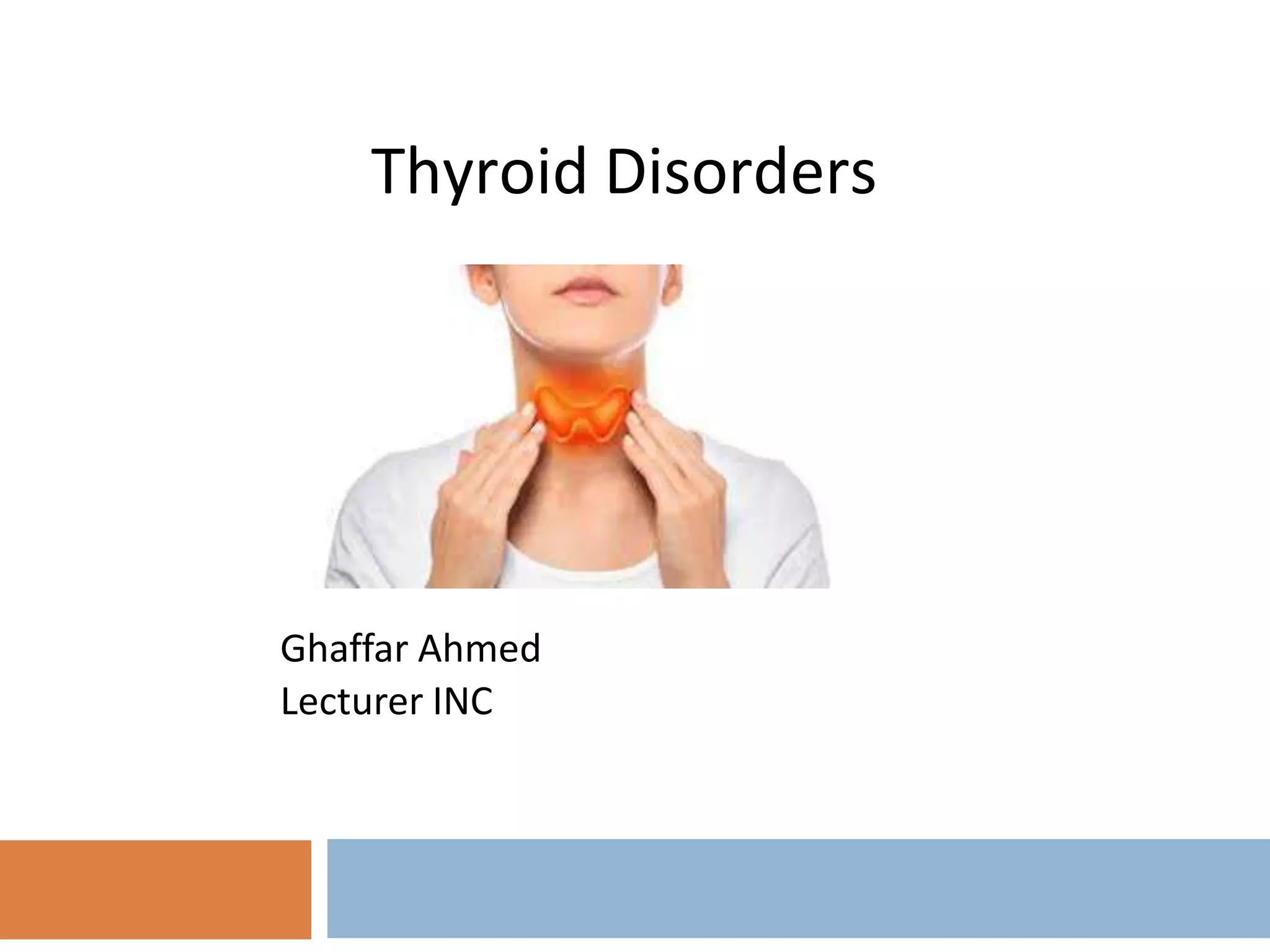
Thyroid Disorders
Ghaffar Ahmed
Lecturer INC
INTRODUCTION
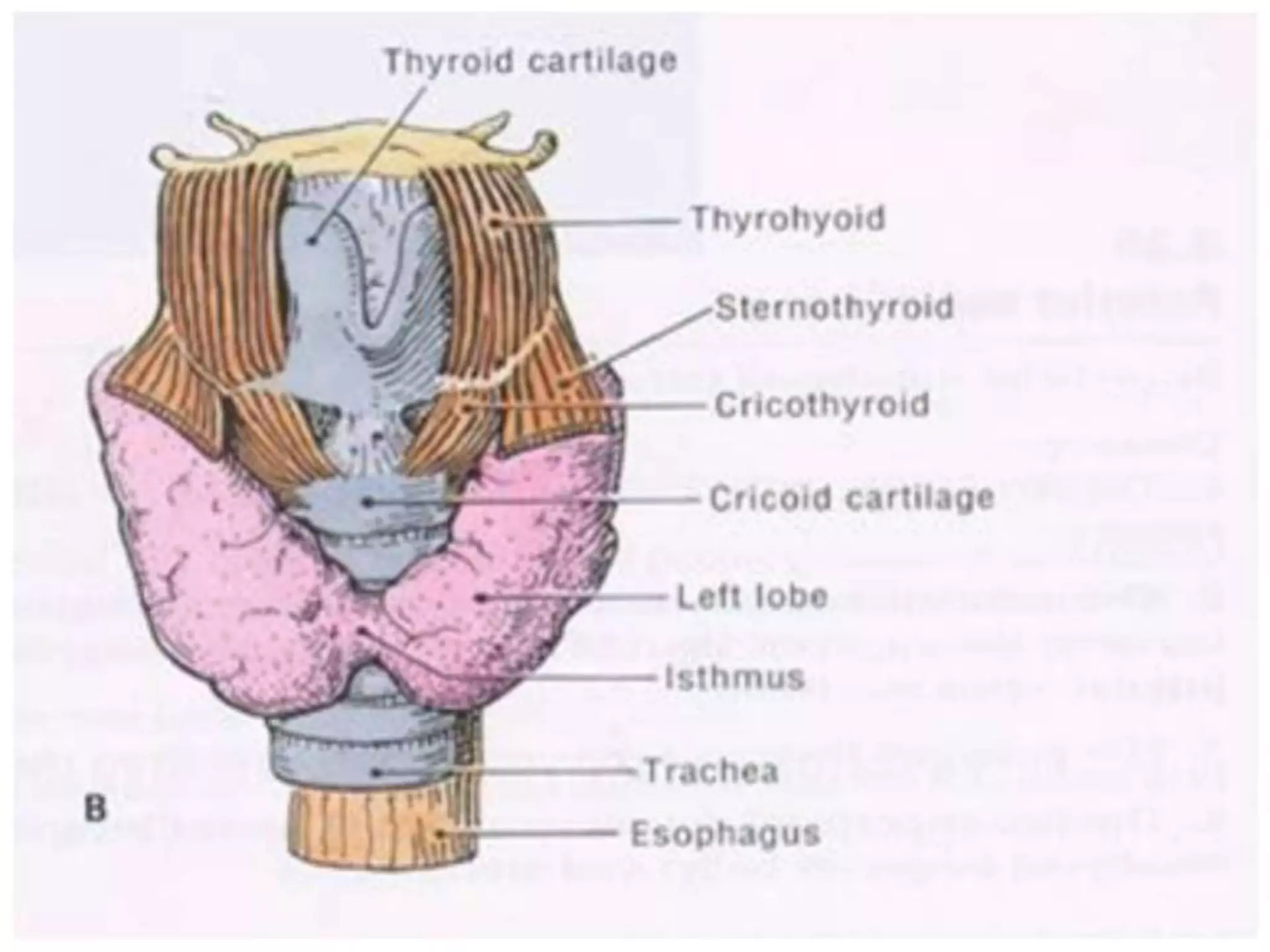
 Largest endocrine gland.
 Located inferior to cricoid cartilage.
 Butterfly shaped organ comprising of two
lobes
- lobus dexter(right)
- lobus sinister(left)
 Weighs 18-60gms in adults.
 Histologically it is made up of follicular and
parafollicular cells.
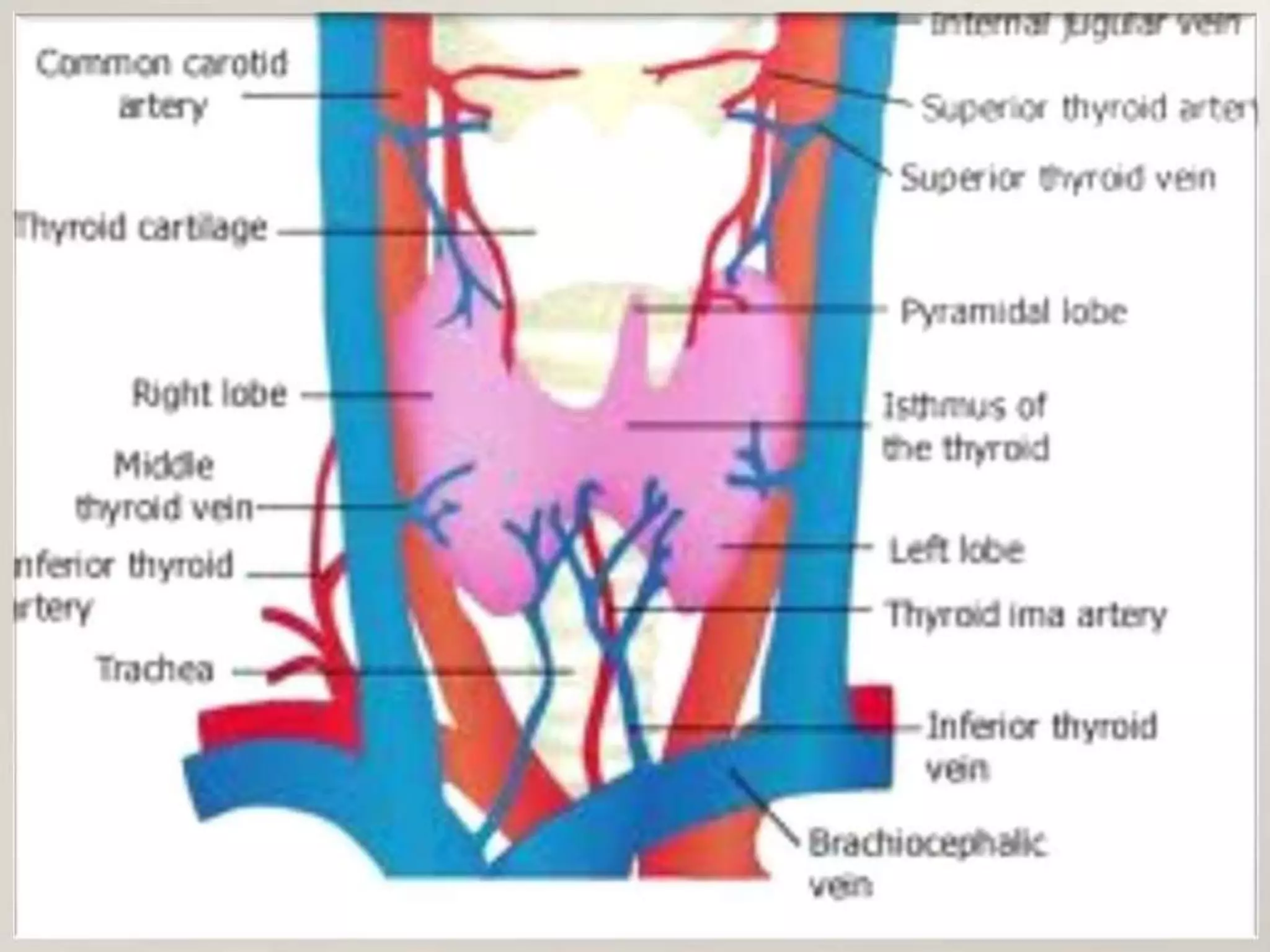
 Blood supply
Arterial supply - superior thyroid artery
- inferior thyroid artery
Venous supply - superior thyroid vein
- inferior thyroid vein
 Nerve supply
- Superior laryngeal nerve
- Recurrent laryngeal nerve
 Lymphatic drainage
- Lateral deep cervical lymph node
- Pretracheal/para tracheal lymph nodes
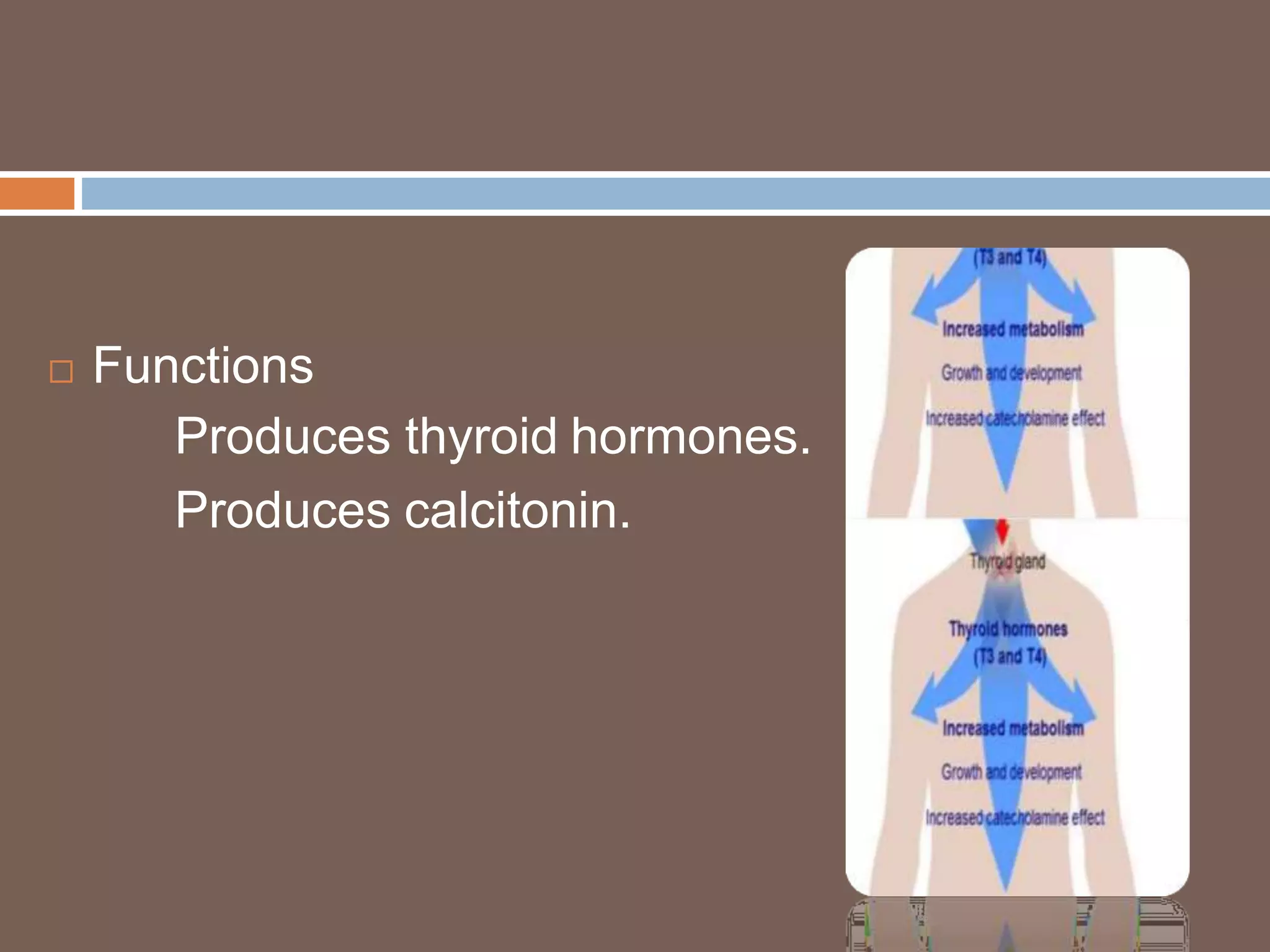
 Functions
Produces thyroid hormones.
Produces calcitonin.
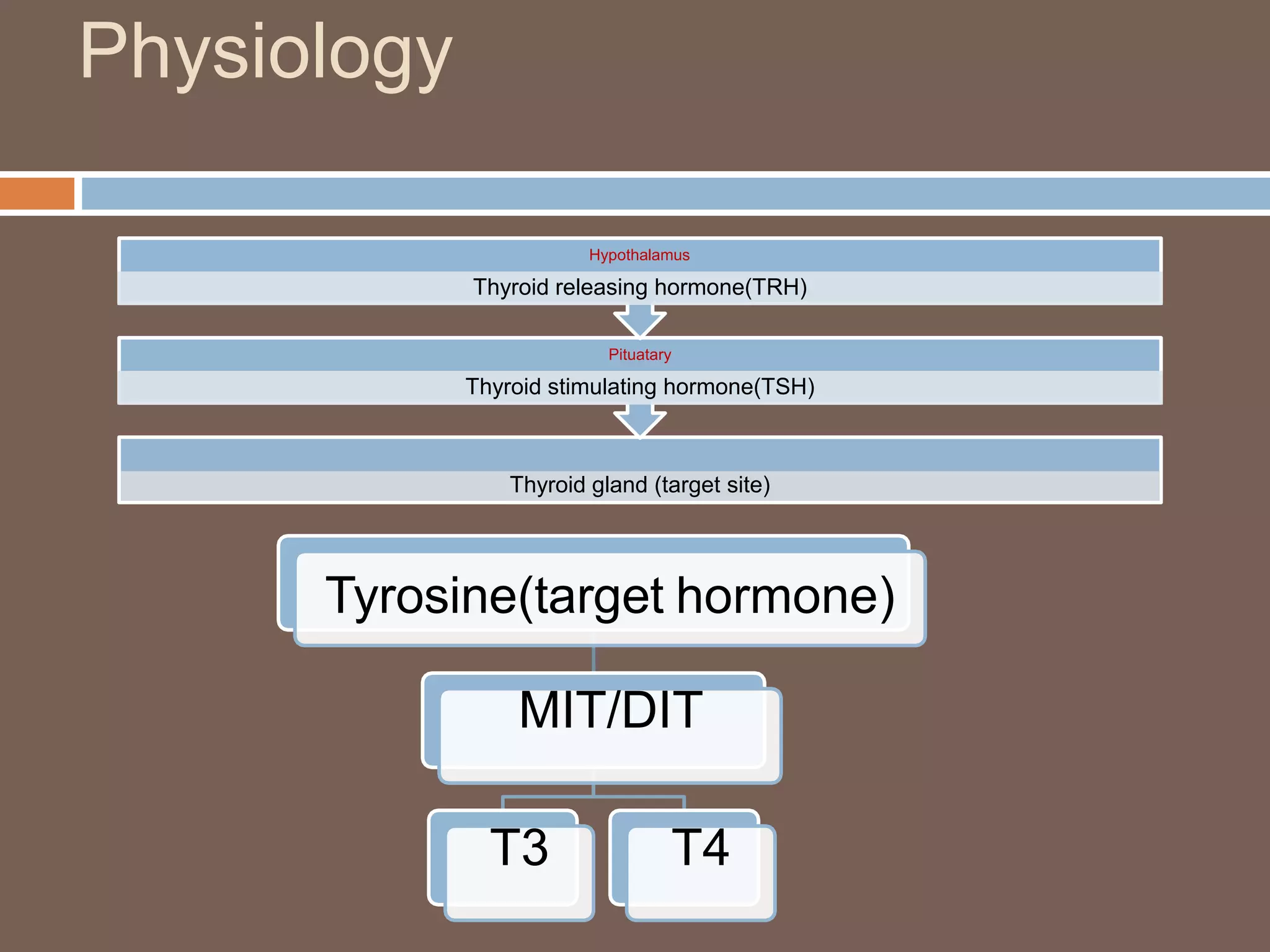
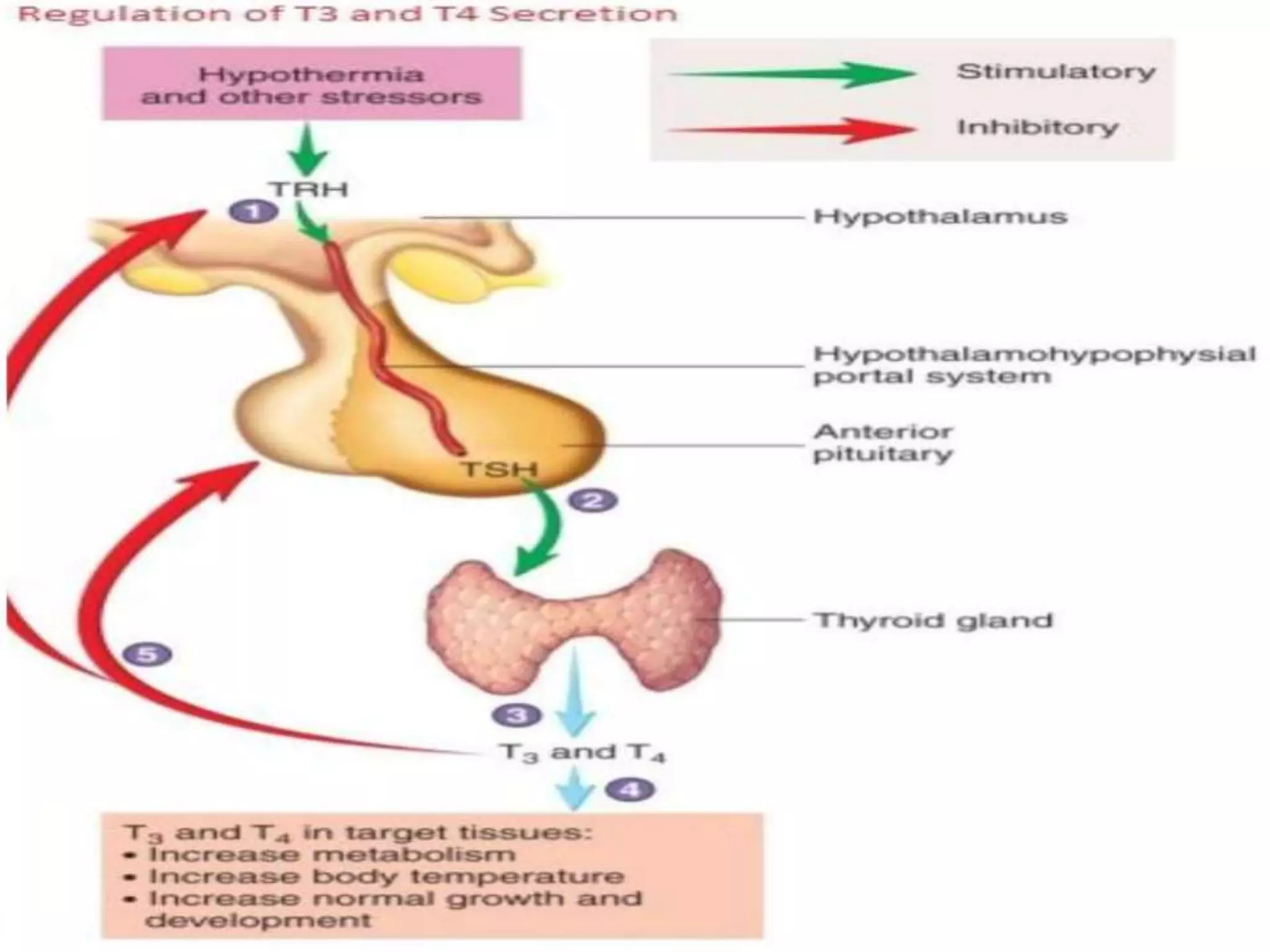
Physiology
Thyroid gland (target site)
Pituatary
Thyroid stimulating hormone(TSH)
Hypothalamus
Thyroid releasing hormone(TRH)
Tyrosine(target hormone)
MIT/DIT
T3 T4
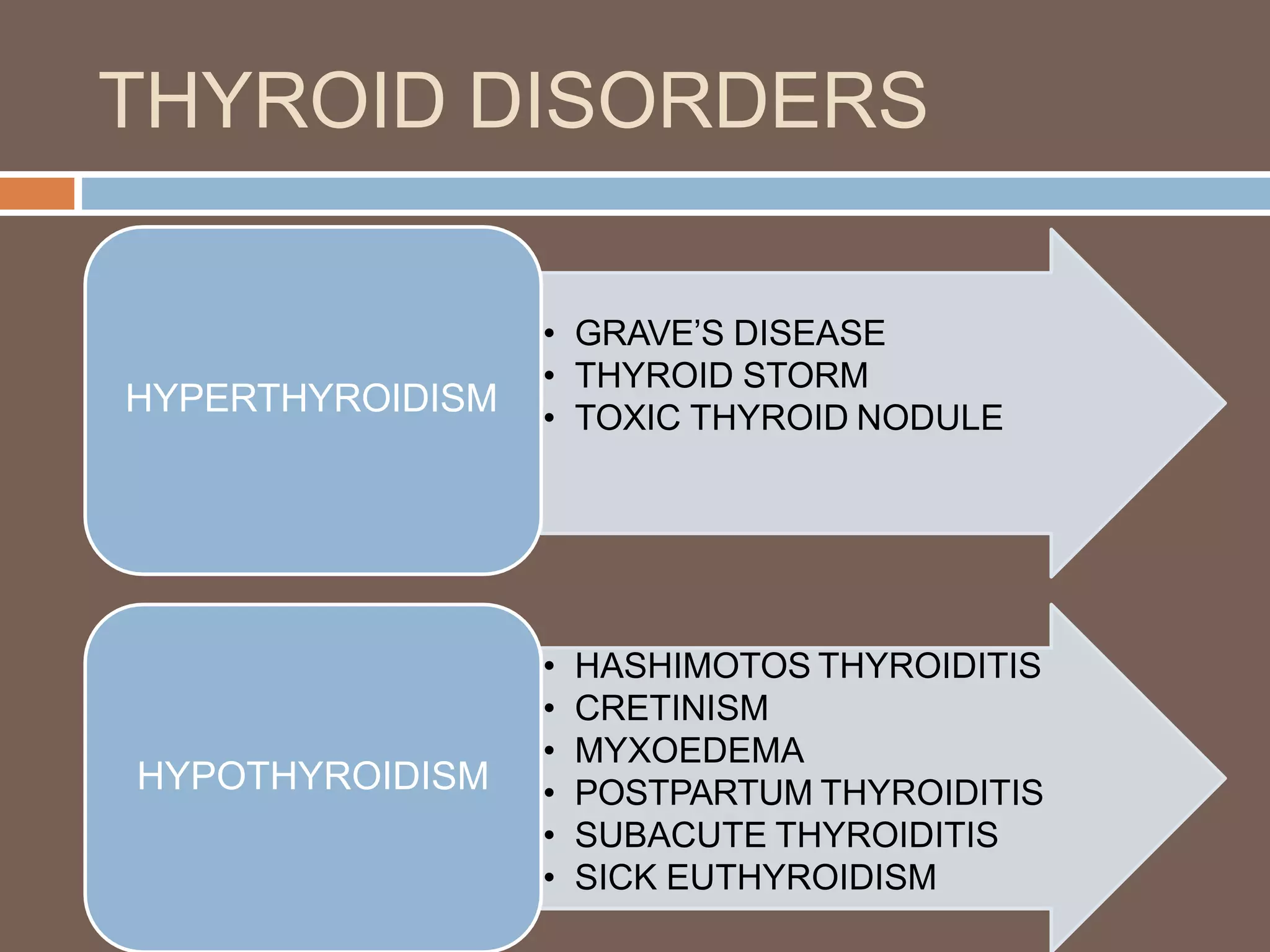
THYROID DISORDERS
• GRAVE’S DISEASE
• THYROID STORM
• TOXIC THYROID NODULE
HYPERTHYROIDISM
• HASHIMOTOS THYROIDITIS
• CRETINISM
• MYXOEDEMA
• POSTPARTUM THYROIDITIS
• SUBACUTE THYROIDITIS
• SICK EUTHYROIDISM
HYPOTHYROIDISM
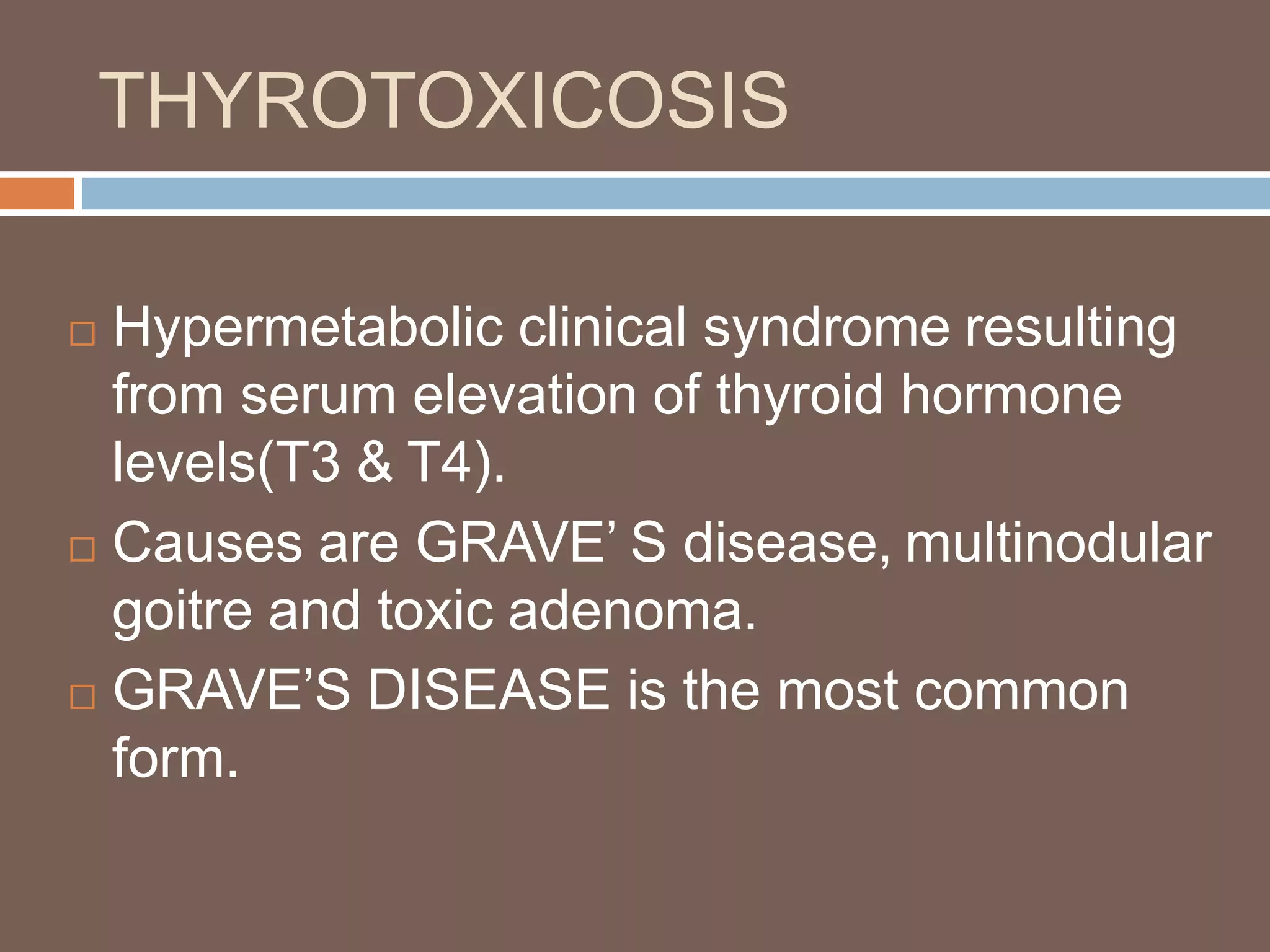
THYROTOXICOSIS
 Hypermetabolic clinical syndrome resulting
from serum elevation of thyroid hormone
levels(T3 & T4).
 Causes are GRAVE’ S disease, multinodular
goitre and toxic adenoma.
 GRAVE’S DISEASE is the most common
form.
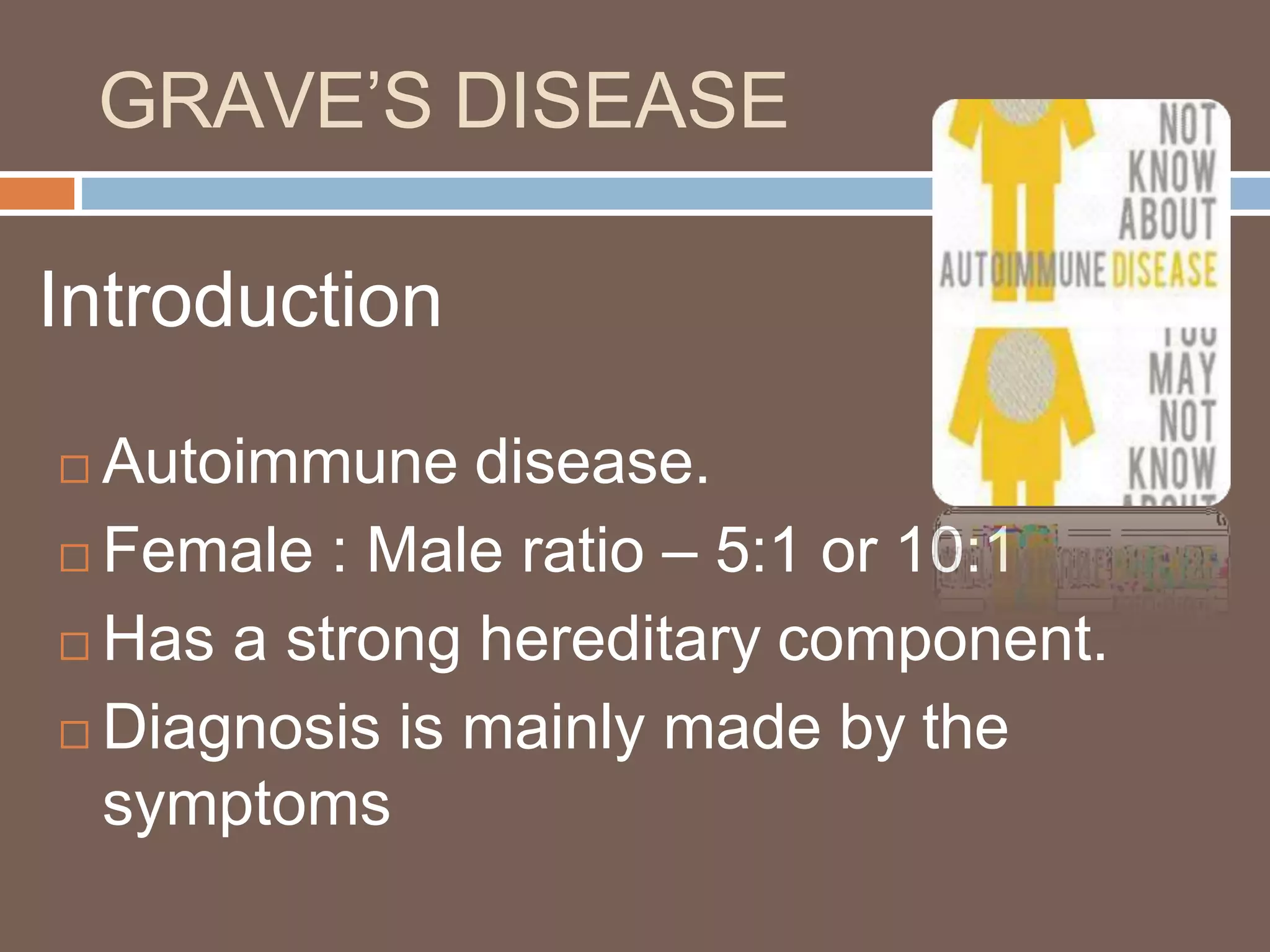
GRAVE’S DISEASE
Introduction
 Autoimmune disease.
 Female : Male ratio – 5:1 or 10:1
 Has a strong hereditary component.
 Diagnosis is mainly made by the
symptoms
Signs and symptoms
 Skin is warm and moist, palms are warm,moist
and hyperemic and Plummer’s nails are seen.
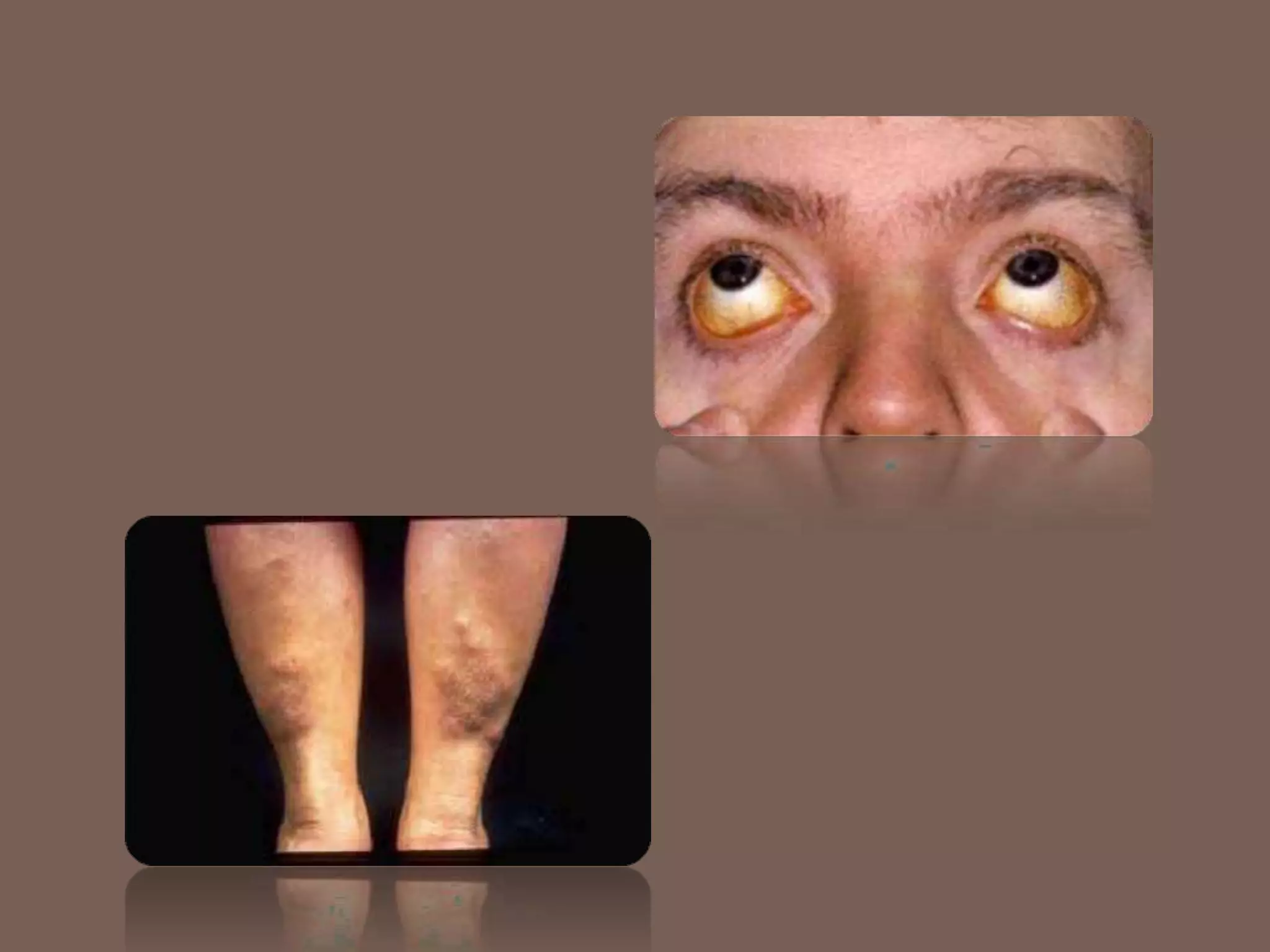
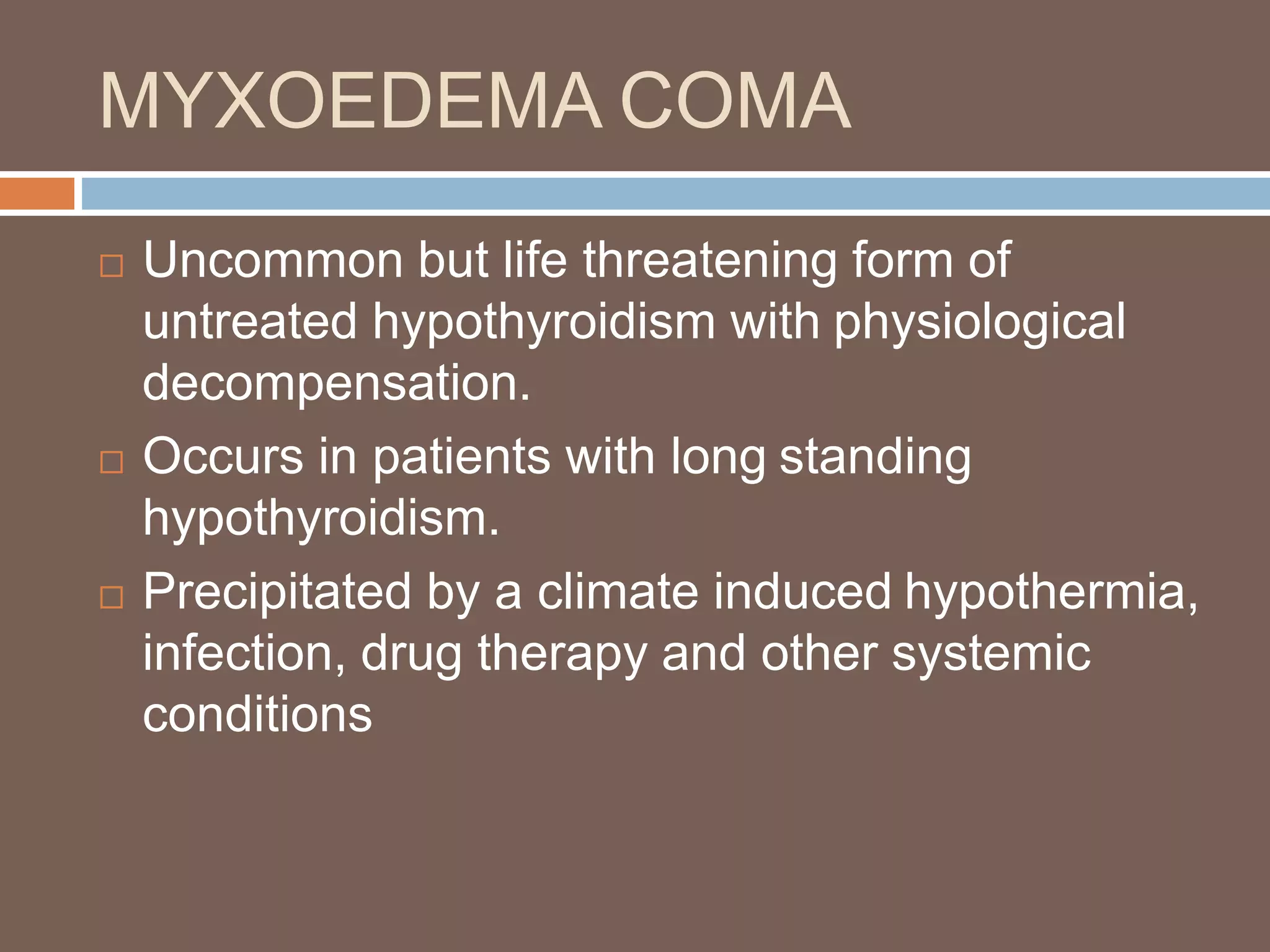
 Pretibial myxedema.
 Alopecia and vitiligo.
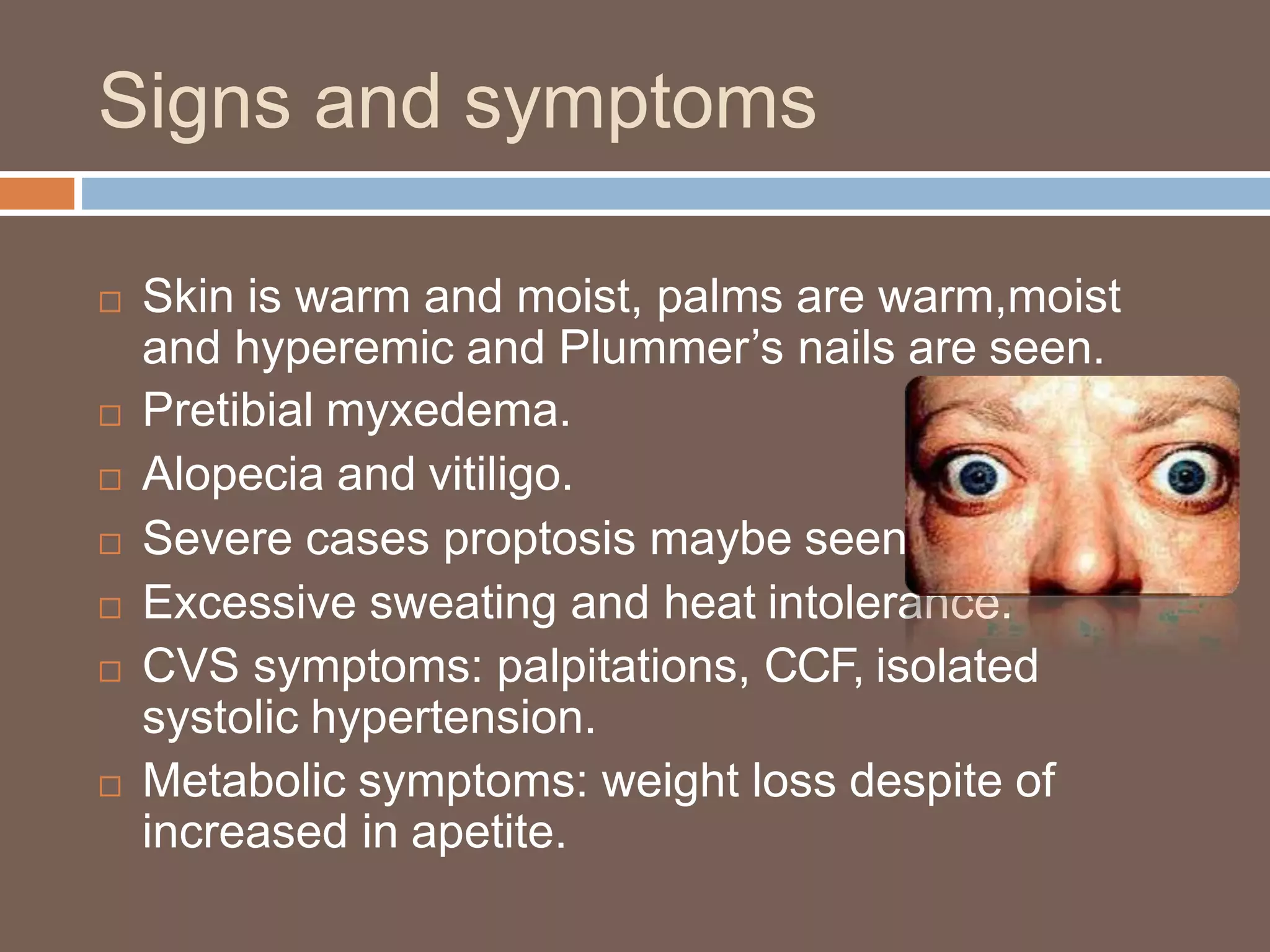
 Severe cases proptosis maybe seen.
 Excessive sweating and heat intolerance.
 CVS symptoms: palpitations, CCF, isolated
systolic hypertension.
 Metabolic symptoms: weight loss despite of
increased in apetite.
 GIT symptoms: hyperdefecation.
 Exacerbate bronchial asthma.
 CNS symptoms: nervousness, irritability,
tremor, insomnia, proximal muscle weakness.
 In females: amenorrhea/ oligomenorrhea.
 In males: impotence and loss of libido.
Eye signs
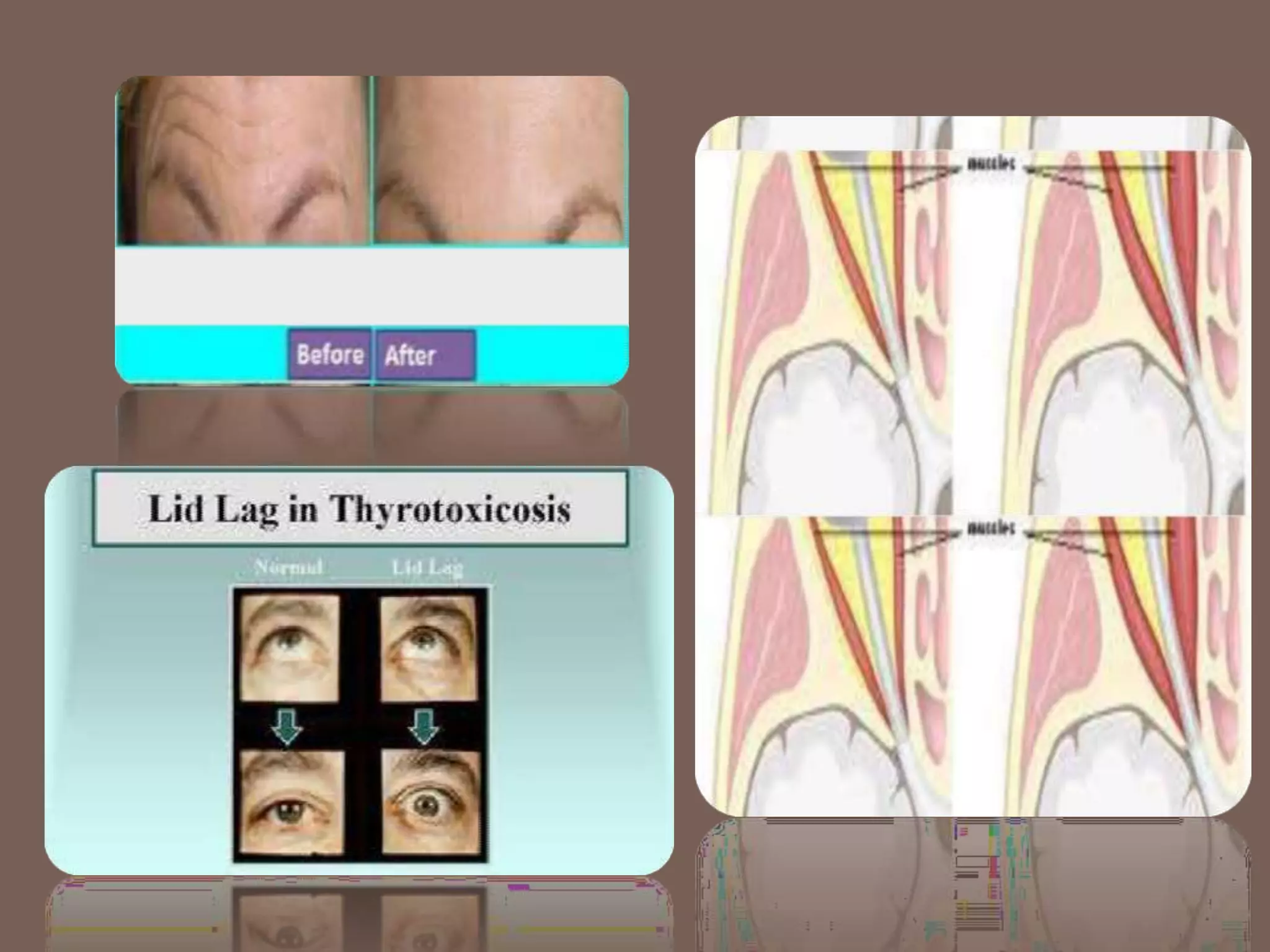
 VON GRAEFE’S SIGN – Lid lag.
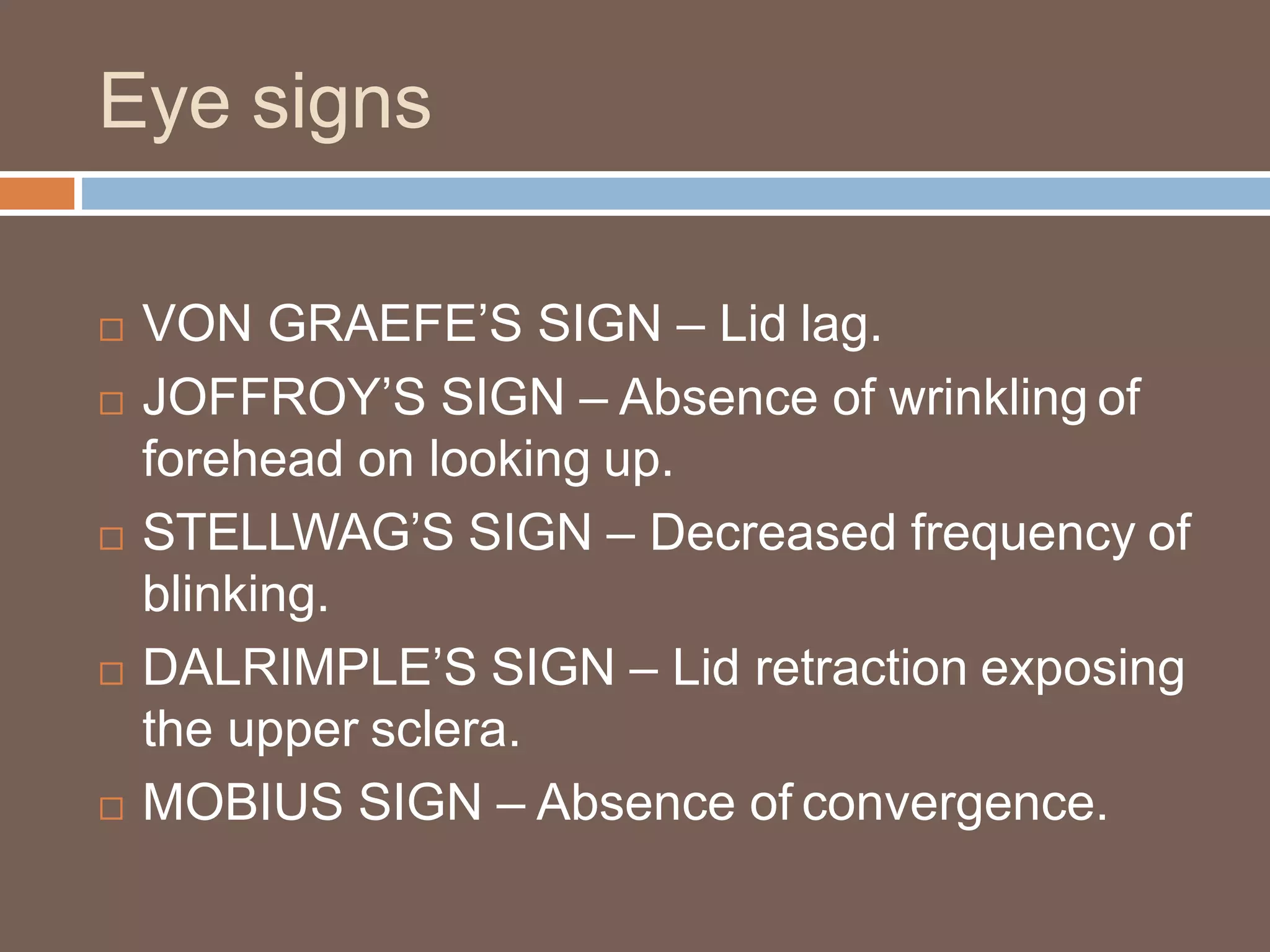
 JOFFROY’S SIGN – Absence of wrinkling of
forehead on looking up.
 STELLWAG’S SIGN – Decreased frequency of
blinking.
 DALRIMPLE’S SIGN – Lid retraction exposing
the upper sclera.
 MOBIUS SIGN – Absence of convergence.
Investigations
 T3 & T4 levels.
 Thyroid uptake of radio iodine.
 Presence of antibodies: TSH receptor antibody
Antimicrosomal antibody
 CT orbits thyroid scans.
Management
 Immediate control: Propranolol 40mg/6hr orally.
 Long term control:
Anti thyroid drugs – Carbimazole 15mg tid
initially and then reducing it to 5mg tid for
12-18 months.
Radio iodine ablation – Postmenopausal women
and elderly men.
In recurrence following surgery.
Given to fertile women conception postponed to
1
year.
Surgery – Presence of large goitre.
Poor drug compliance.
 Exopthalmos: Corticosteroids.
Tarsorrhaphy.
Orbital decompression.
 Cardiac arrythmias: ß- blockers.
In euthyroid state,
cardioversion is done.
MULTINODULAR GOITRE
 Excess production of thyroid
hormones from functionally
autonomous thyroid nodules which
do not require the stimulation from
TSH.
 Second common cause.
 Occurs in individual over 60 years of
age and females are mostly affected.
Symptoms
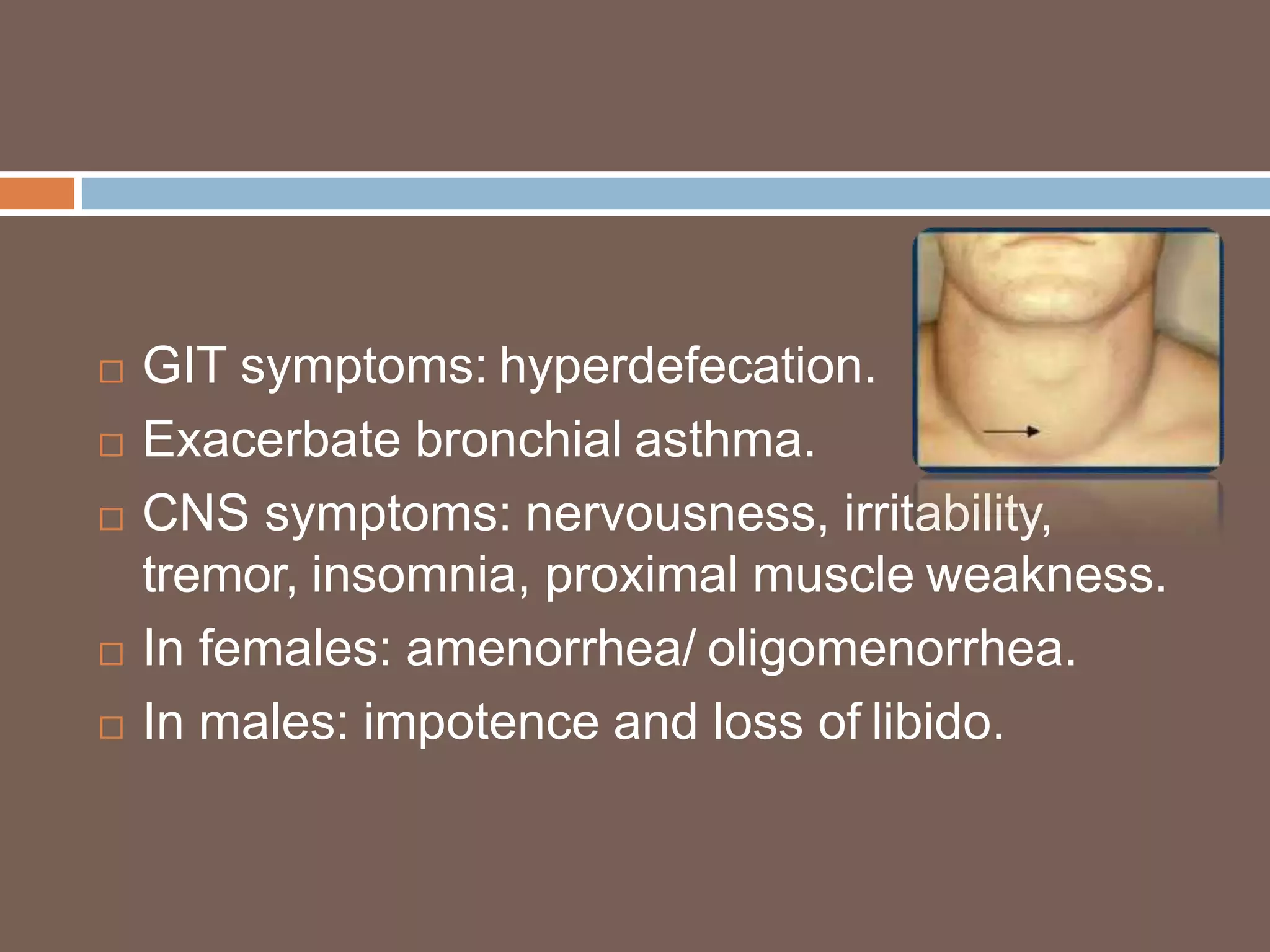
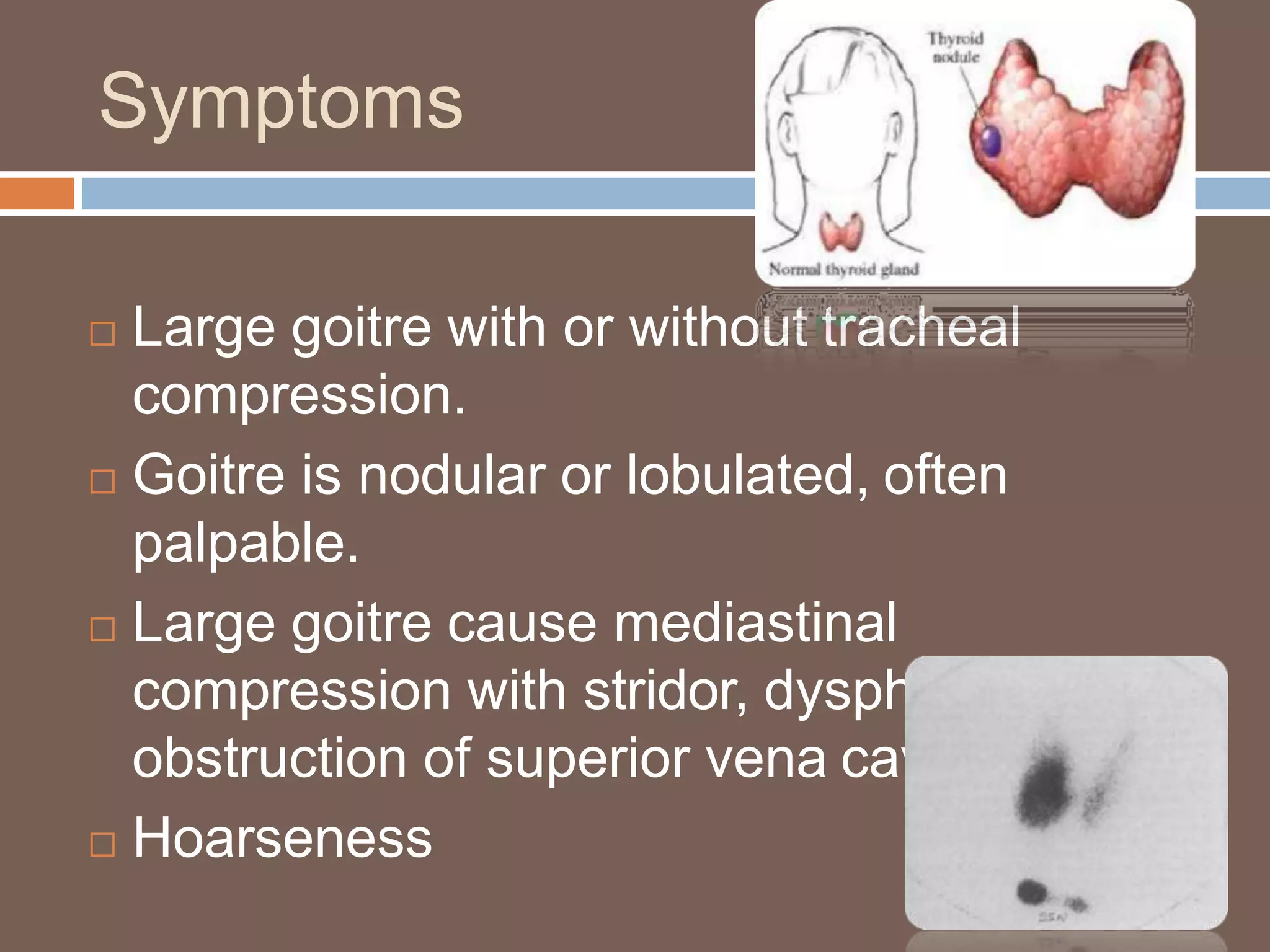
 Large goitre with or without tracheal
compression.
 Goitre is nodular or lobulated, often
palpable.
 Large goitre cause mediastinal
compression with stridor, dysphagia and
obstruction of superior vena cava.
 Hoarseness
Management
 Small goitre : No treatment.
Annual review.
 Large goitres : Partial thyroidectomy.
131
Radioactive iodine I
 Recurrence is common after 10-20 years.
THYROID STORM
 Rare but life threatening sudden severe
exarcerbation of hyperthyroidism.
 Causes: Precipitated by stress or infection with
either unrecognized thyrotoxicosis or
inadequately treated thyrotoxicosis. Following
subtotal thyroidectomy/radio active iodine.
Trauma.
Pregnancy.
Emotional stress.
Signs
 Elevation of temperature.
 Increase in heart rate.
 Irritable.
 Delirius/comatose.
 Hypotension.
 Vomiting.
 Diarrhoea.
Management
 Treatment started immediately with
Propranolol 80mg/6hrs orally(dose of 1-5mg/6hrs
given IV).
Potassium iodide 60mg daily orally/ sodium
iopodate 500mg daily orally.
Carbimazole 60-120mg daily
Dexamethasone 2mg/6hrs IV.
Fluid replacement.
Antibiotics.
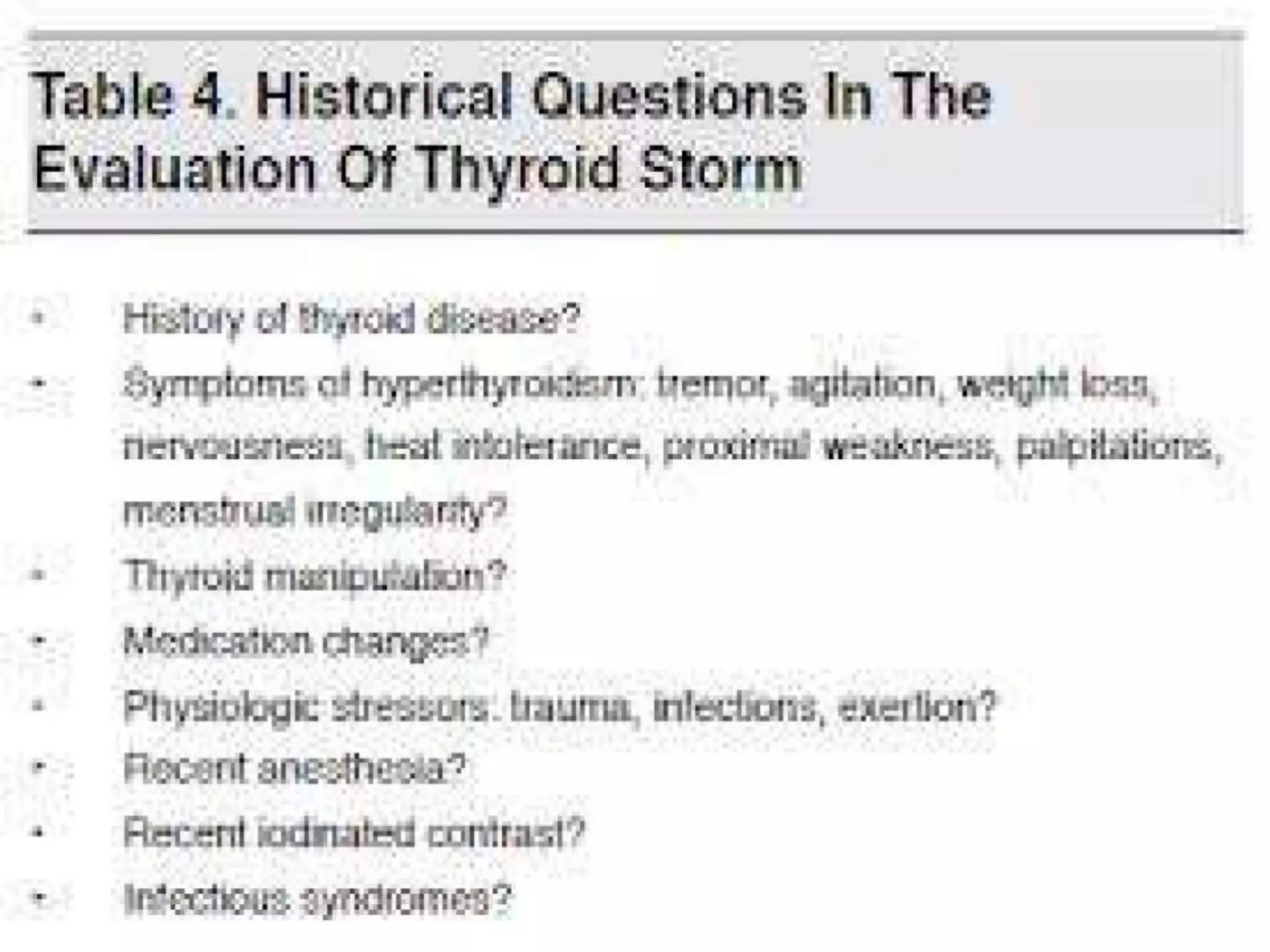
Emergency management in dental
office
 Terminate all treatment.
 Have someone summon medical assistance.
 Administer oxygen.
 Monitar all vital signs.
 Initiate basic life support if necessary.
 Start IV line with drip of crystalloid
solution(150mL/hr).
 Transport patient to emergency care facility.
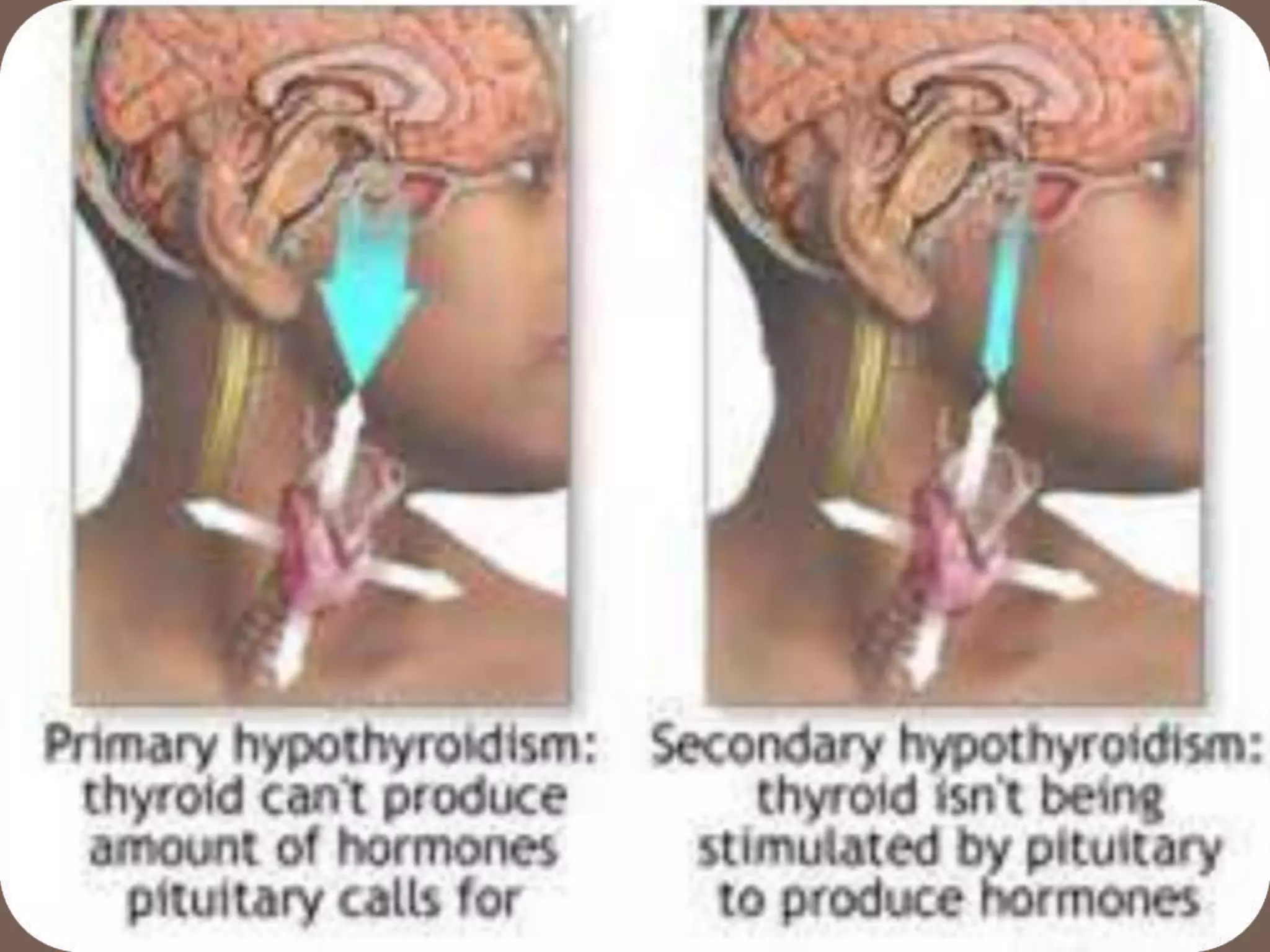
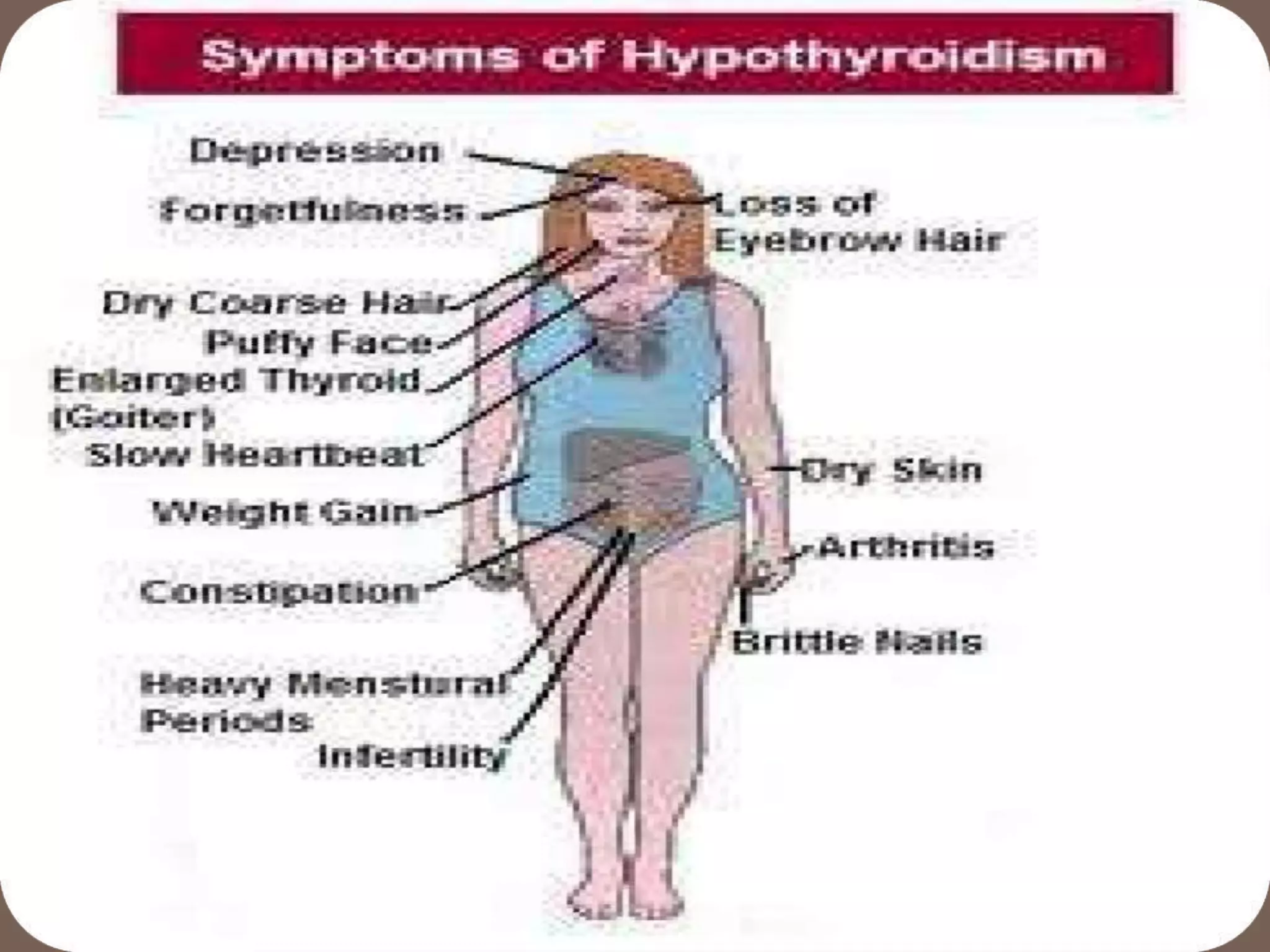
HYPOTHYROIDISM
 Insufficiency synthesis of thyroid hormones.
 Female : Male ratio is 6 : 1.
 Causes : Hashimoto’s thyroiditis
Thyroid failure following radio iodine.
surgical treatment of thyrotoxicosis.
Drugs like carbimazole, amiodarone.
Iodine deficiency.
HASHIMOTO’S THYROIDITIS
 Primary condition of
hypothyroidism
 Autoimmune.
 Described by Hakaru Hashimoto
Signs and symptoms
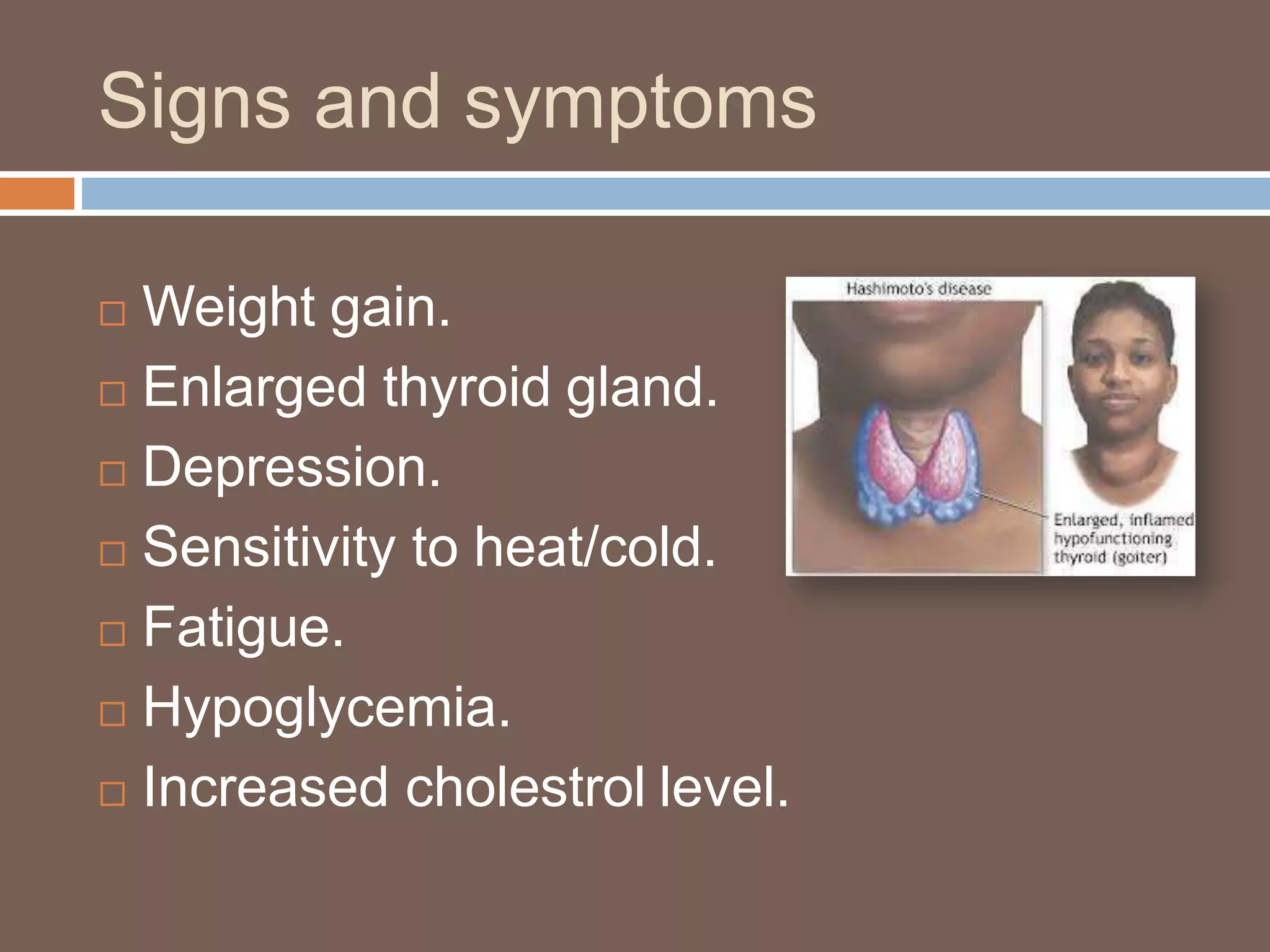
 Weight gain.
 Enlarged thyroid gland.
 Depression.
 Sensitivity to heat/cold.
 Fatigue.
 Hypoglycemia.
 Increased cholestrol level.
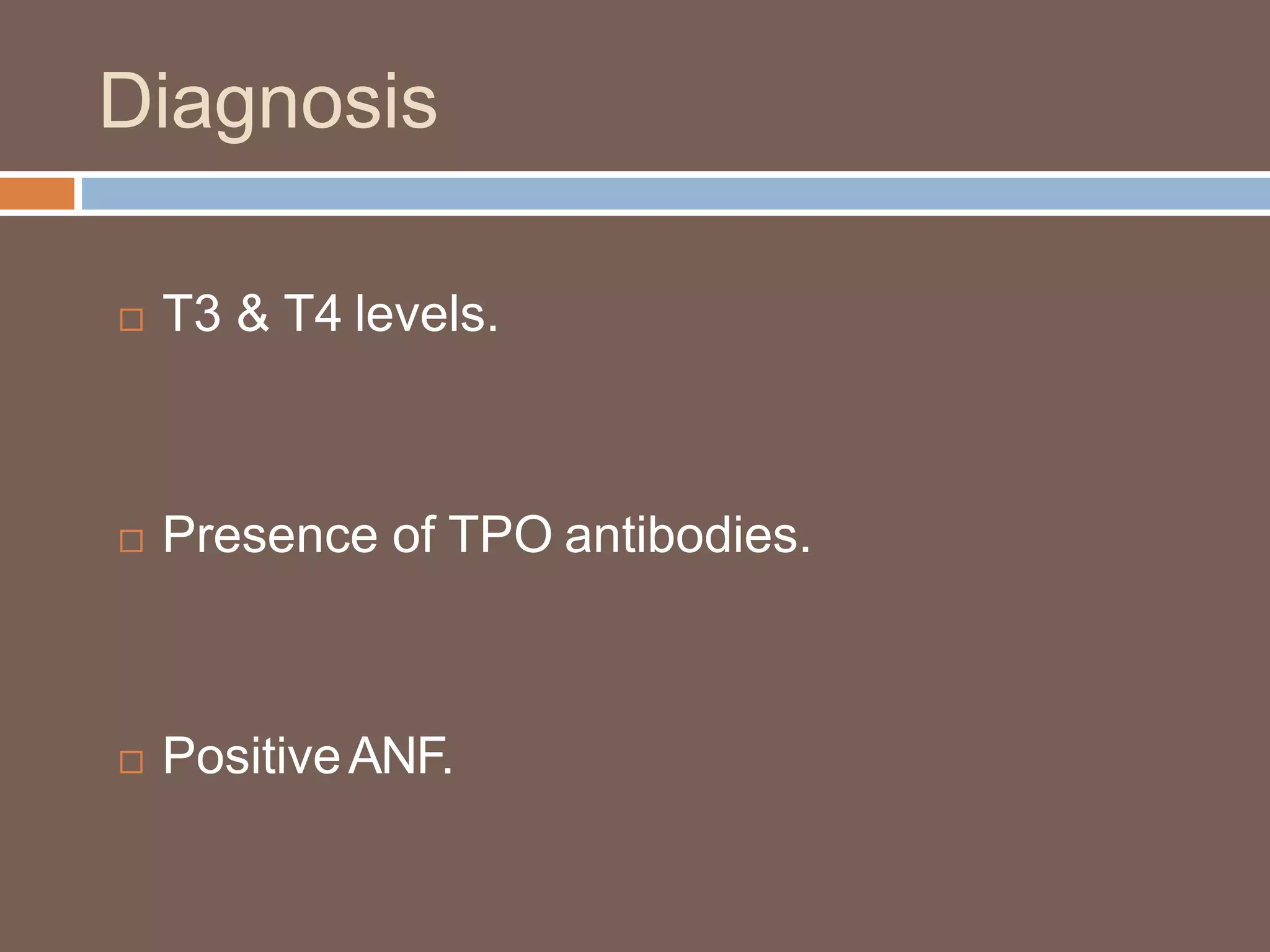
Diagnosis
 T3 & T4 levels.
 Presence of TPO antibodies.
 PositiveANF.
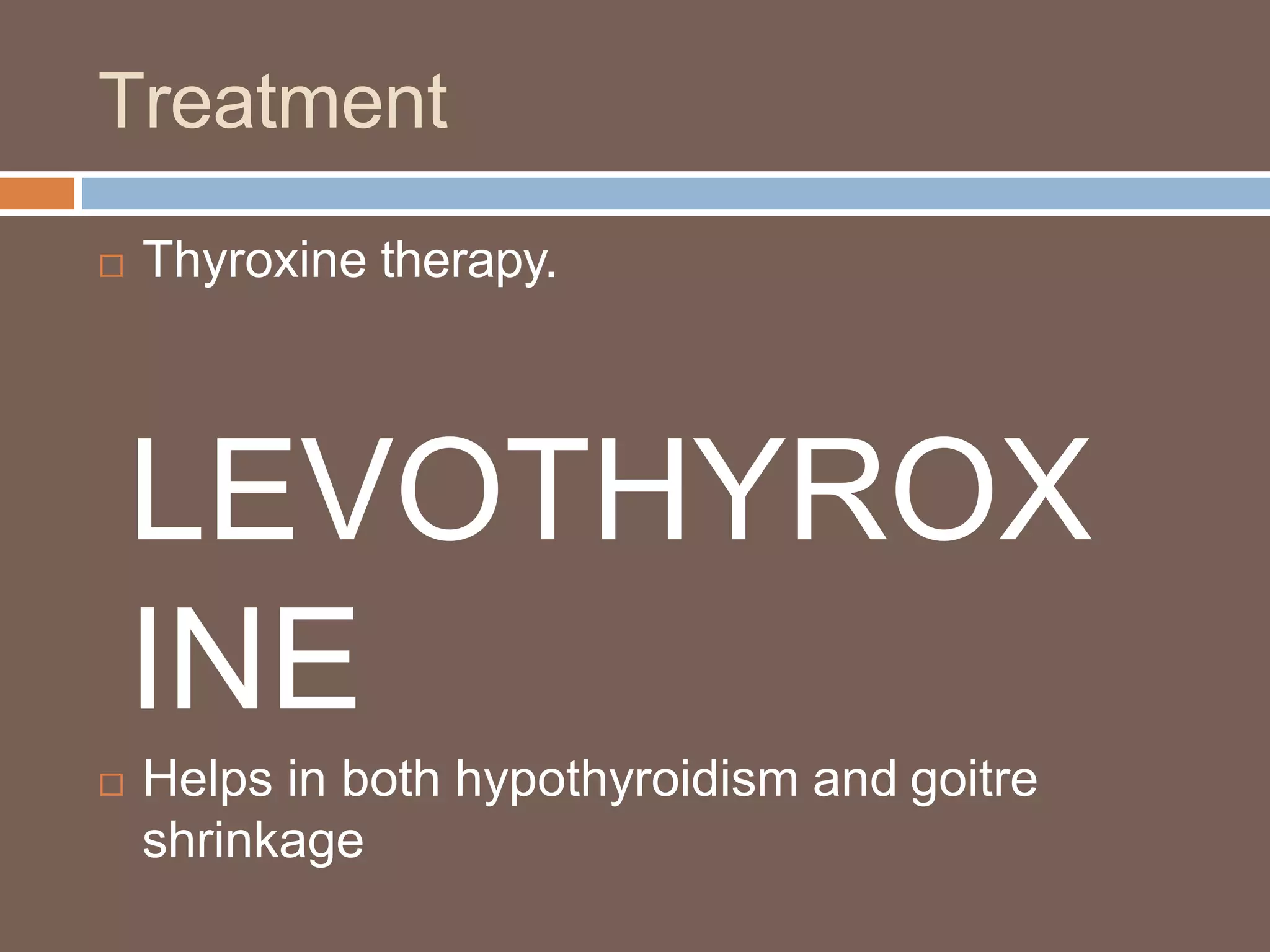
Treatment
 Thyroxine therapy.
LEVOTHYROX
INE
 Helps in both hypothyroidism and goitre
shrinkage
CRETINISM
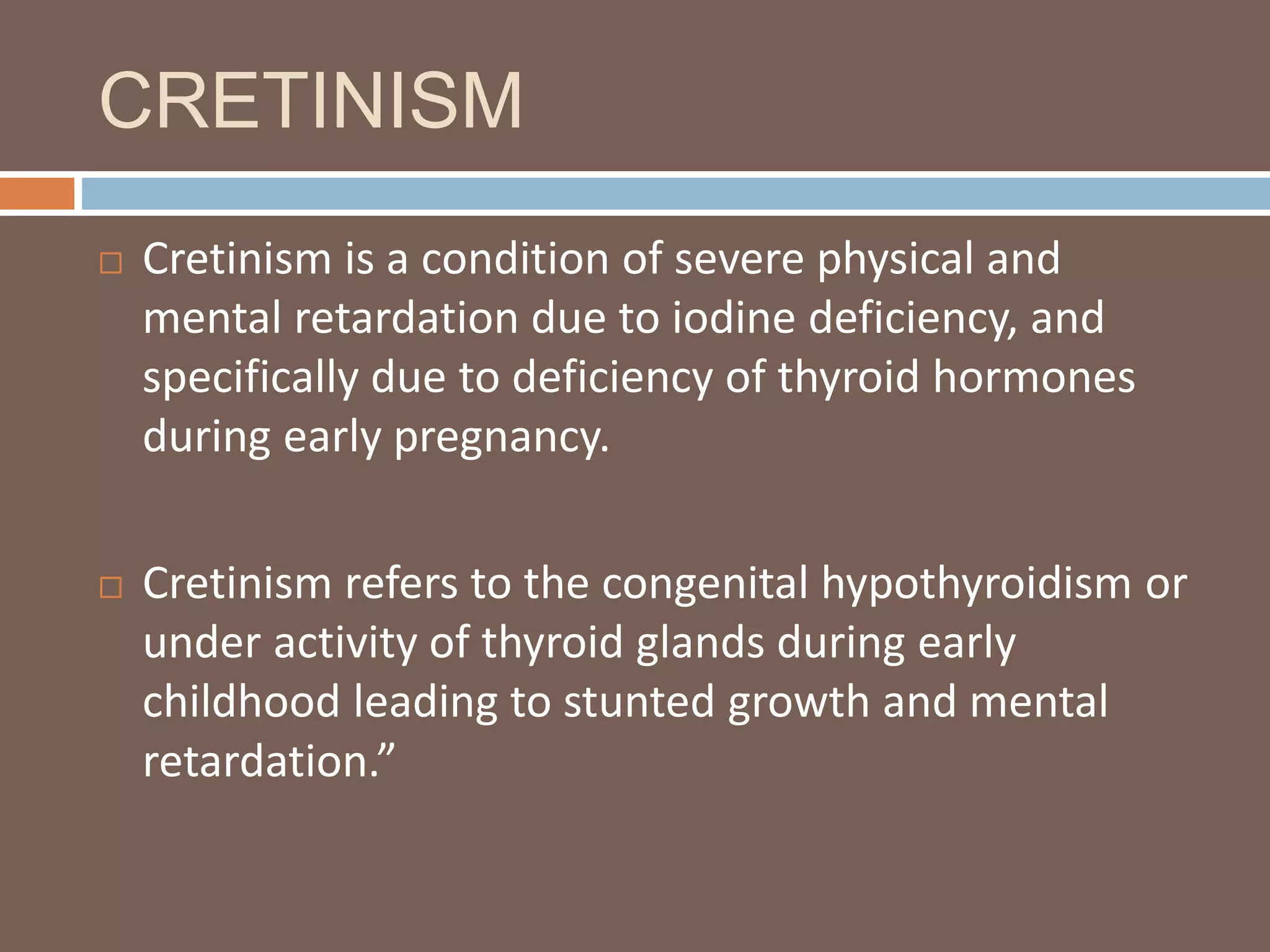
 Cretinism is a condition of severe physical and
mental retardation due to iodine deficiency, and
specifically due to deficiency of thyroid hormones
during early pregnancy.
 Cretinism refers to the congenital hypothyroidism or
under activity of thyroid glands during early
childhood leading to stunted growth and mental
retardation.”
Cretinism Causes
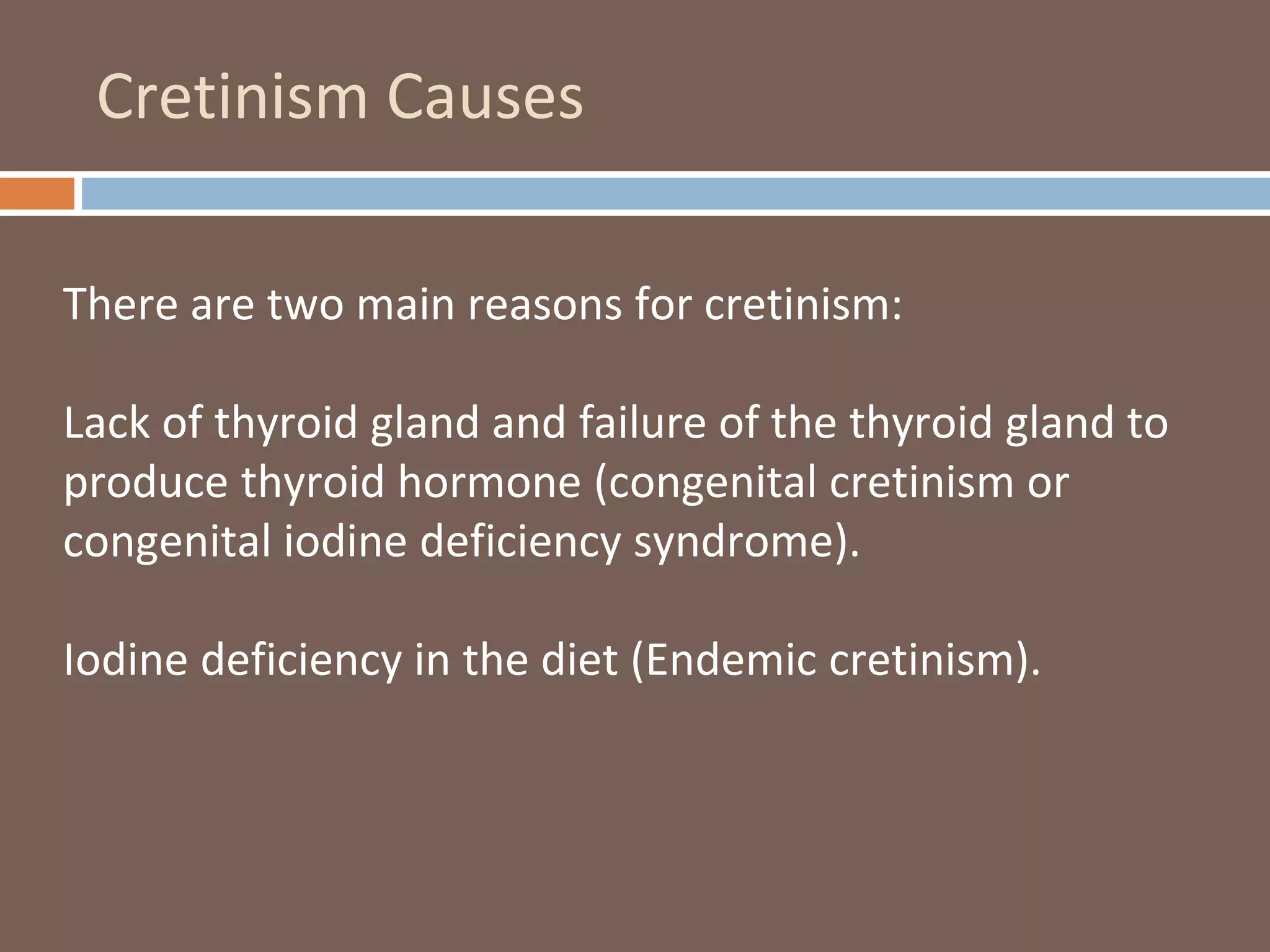
There are two main reasons for cretinism:
Lack of thyroid gland and failure of the thyroid gland to
produce thyroid hormone (congenital cretinism or
congenital iodine deficiency syndrome).
Iodine deficiency in the diet (Endemic cretinism).
Signs and symptoms
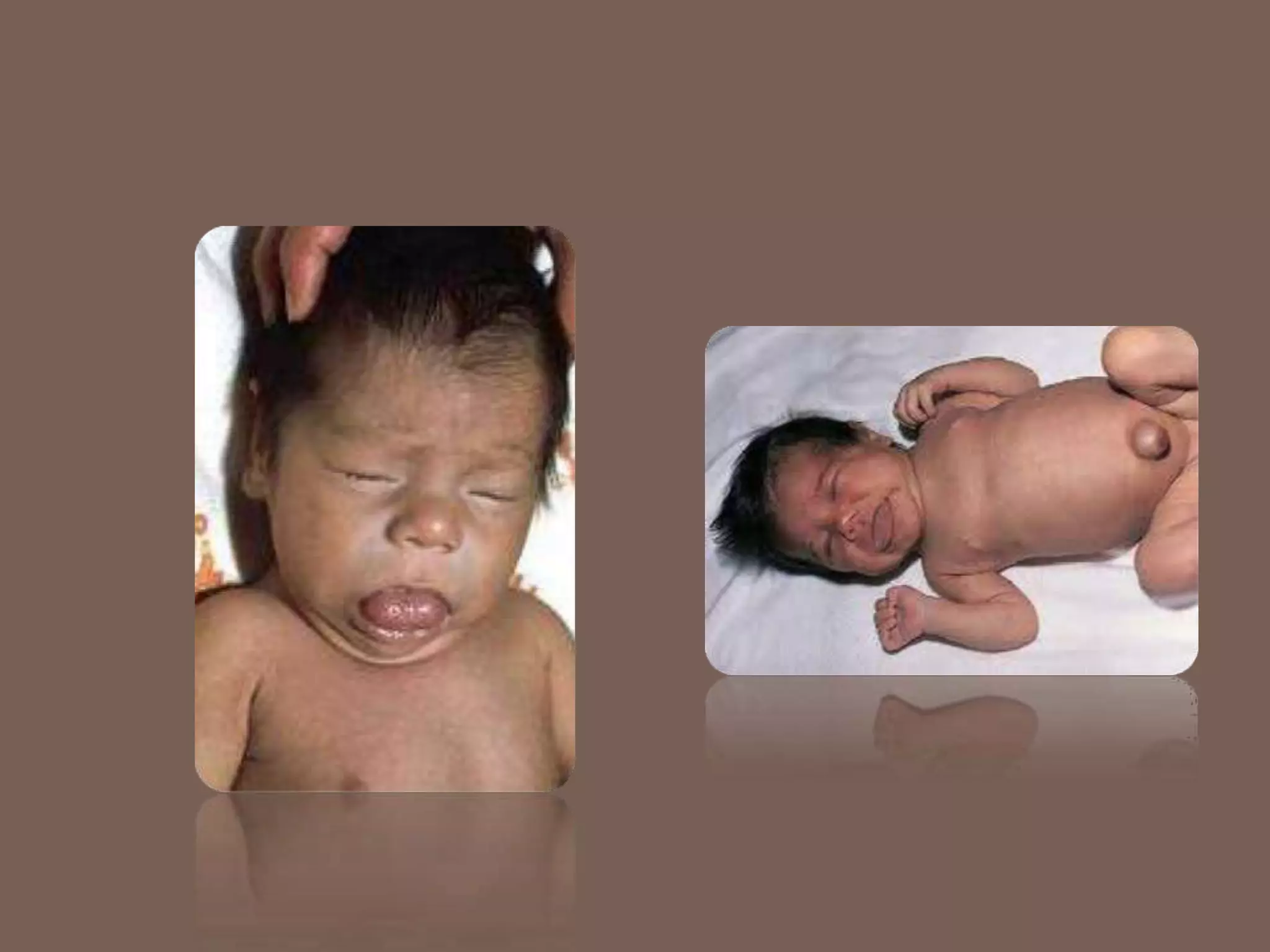
 Dry, cool, mottled skin, hoarse cry, broad flat
nose, puffy face.
 Protruberant abdomen, umblical hernia,
hypotonia.
 Large posterior fontanelle.
 Lethargy, delayed stooling, poor
feeding/sucking.
 Cold to touch.
 Delayed dentition.
 Mental retardation.
Management
 Investigation : Cord blood T4, TSH.
Serum T4, TSH
RAIU
X-ray of knee, foot and skull.
 Treatment
Medication : levothyroxine (initial dose of 10-
15mcg/kg/dl).
Diet : iodine rich foods.
Follow up.
MYXOEDEMA
It is a condition in which there is insufficiency of
thyroid hormone. It is medically referred to as
severely advanced hypothyroidism. The symptoms
include swelling and thickening of the skin, mainly in
the lower part of the legs.
 Common in women.
 Myxedema is a result of undiagnosed or untreated
severe hypothyroidism.
 Stops taking thyroid medication.
 Deposits of chains of sugar molecules in skin
 Hashimoto’s thyroiditis.
MYXOEDEMA COMA
 Uncommon but life threatening form of
untreated hypothyroidism with physiological
decompensation.
 Occurs in patients with long standing
hypothyroidism.
 Precipitated by a climate induced hypothermia,
infection, drug therapy and other systemic
conditions
Symptoms
 Lethargy.
 Stupor.
 Delirium.
 Hypotension.
 Convulsions.
 Hypoglycemia.
 Hyponatremia.
 Hypoventillation.
 Coma.
Investigations
 Free T4 and TSH
 T3 & T4 levels are decreased and TSH
are elevated or normal.
 Serum electrolyte and serum osmolality.
 Serum creatinine.
 Serum glucose.
 Differential blood count.
 Pan culture for sepsis.
Treatment
 Hyperventilation if respiratory acidosis is
significant.
 Immediate IV levothyroxine given
 Loading dose of 500 - 800mcg followed by 50
– 100mcg daily.
 Hydrocortisone 5 – 10mg/hr.
 Treatment of associated infection.
 Correction of hyponatremia with saline.
 Correction of hypoglycemia with IV dextrose.
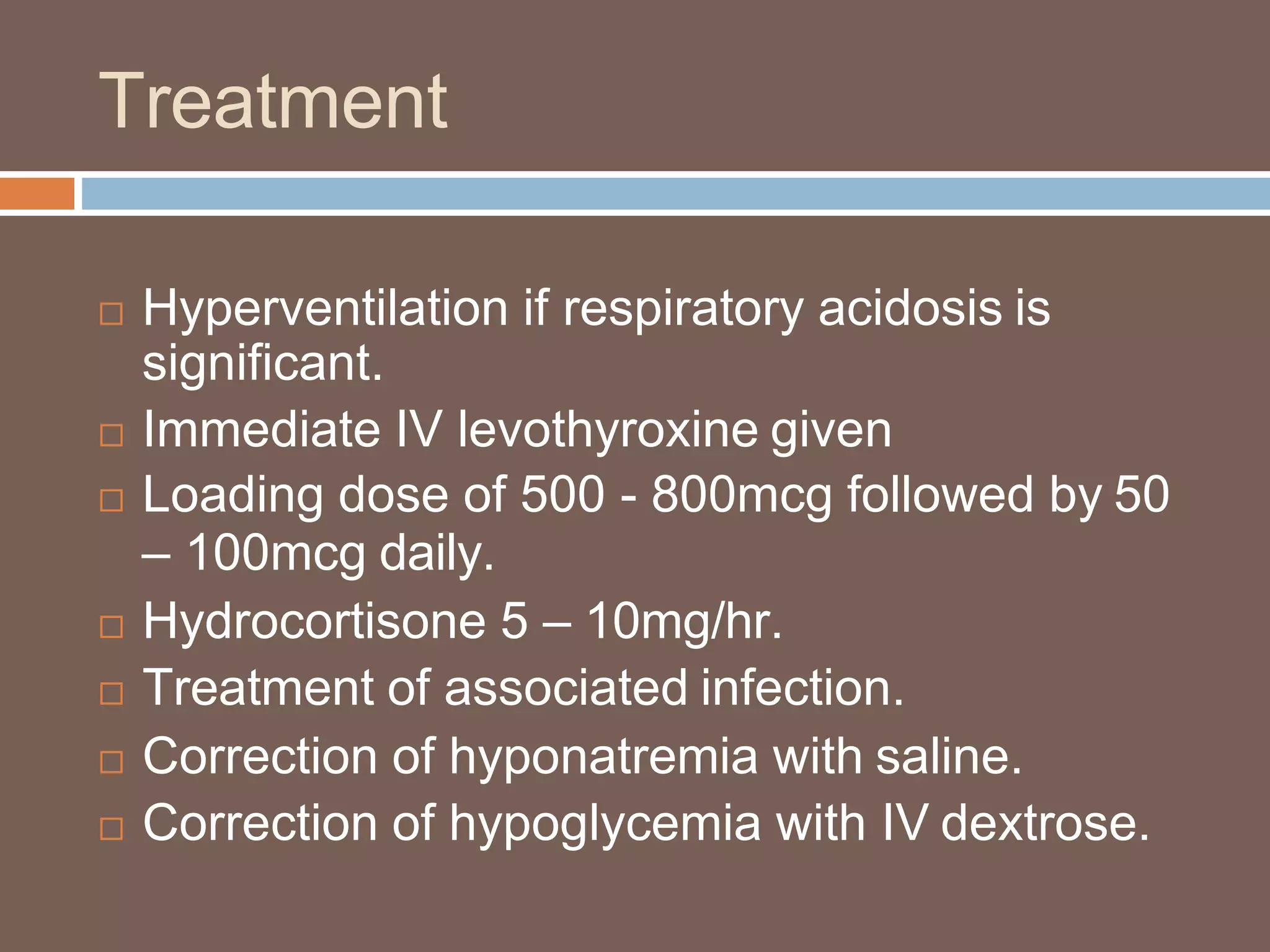
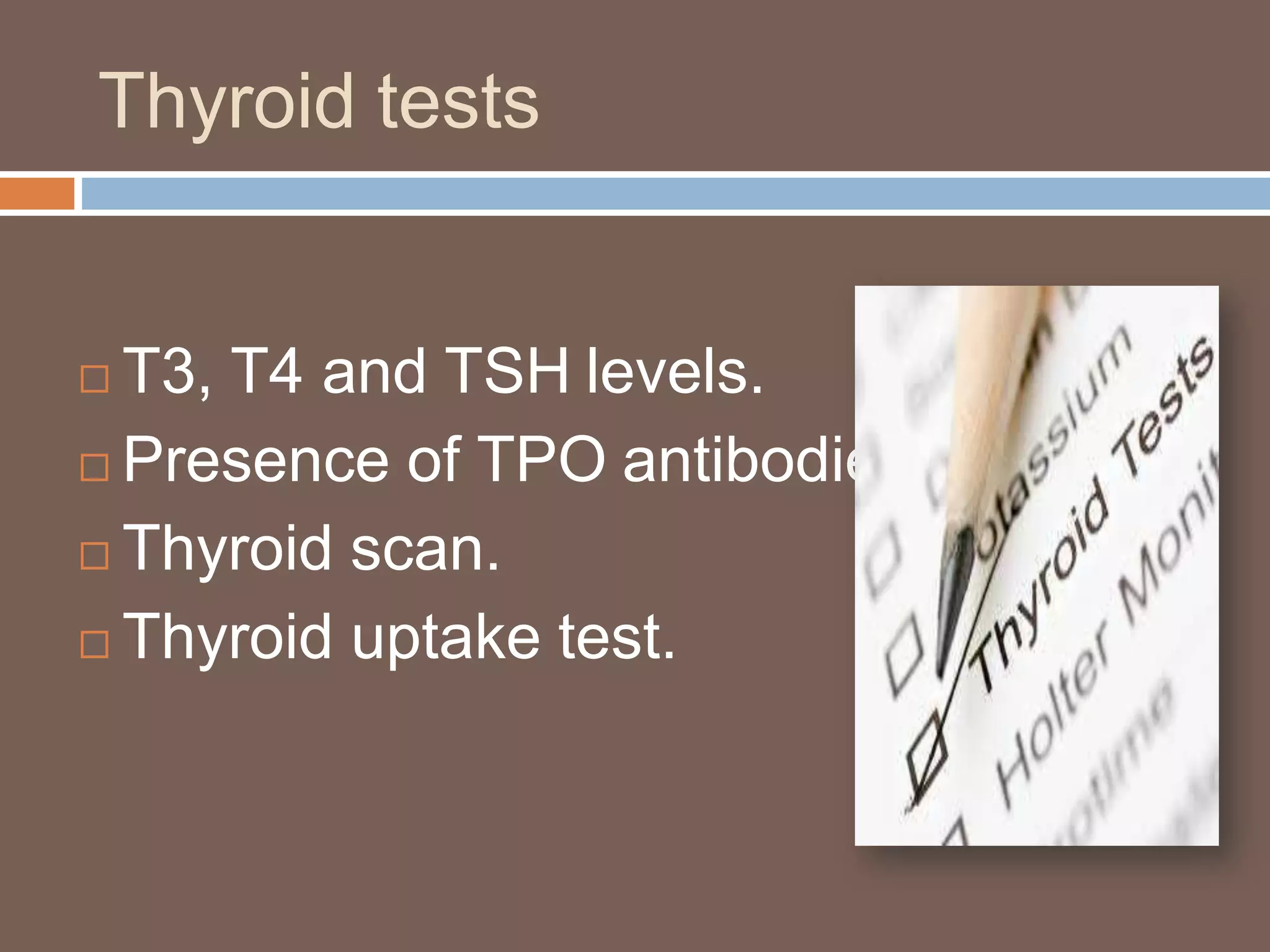
Thyroid tests
 T3, T4 and TSH levels.
 Presence of TPO antibodies.
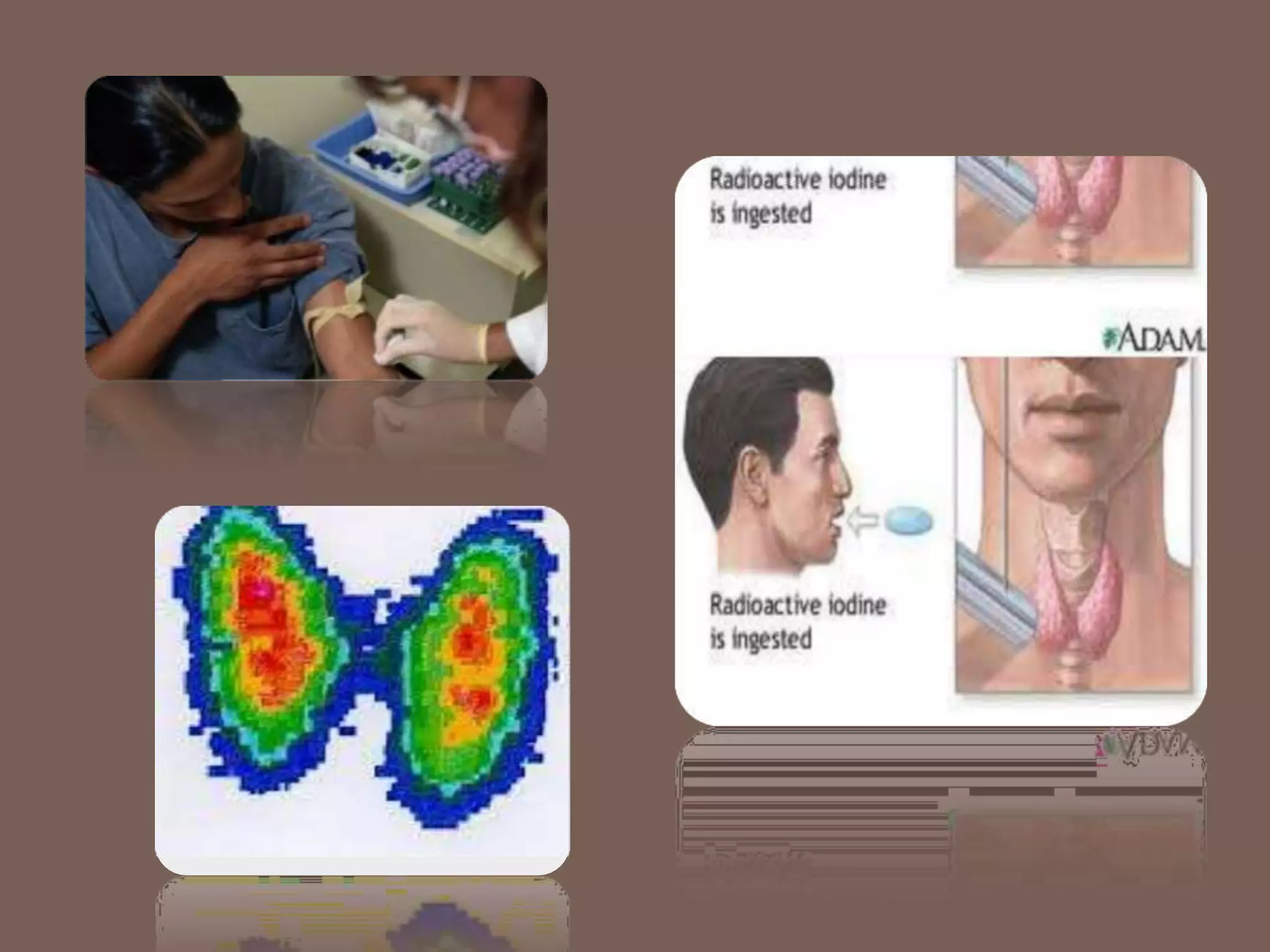
 Thyroid scan.
 Thyroid uptake test.
Thyroidectomy
 Surgical removal of all or a part of the gland.
 Indications: Thyroid carcinoma.
Hyperthyroidism.
Very enlarged thyroid.
Symptomatic obstruction.
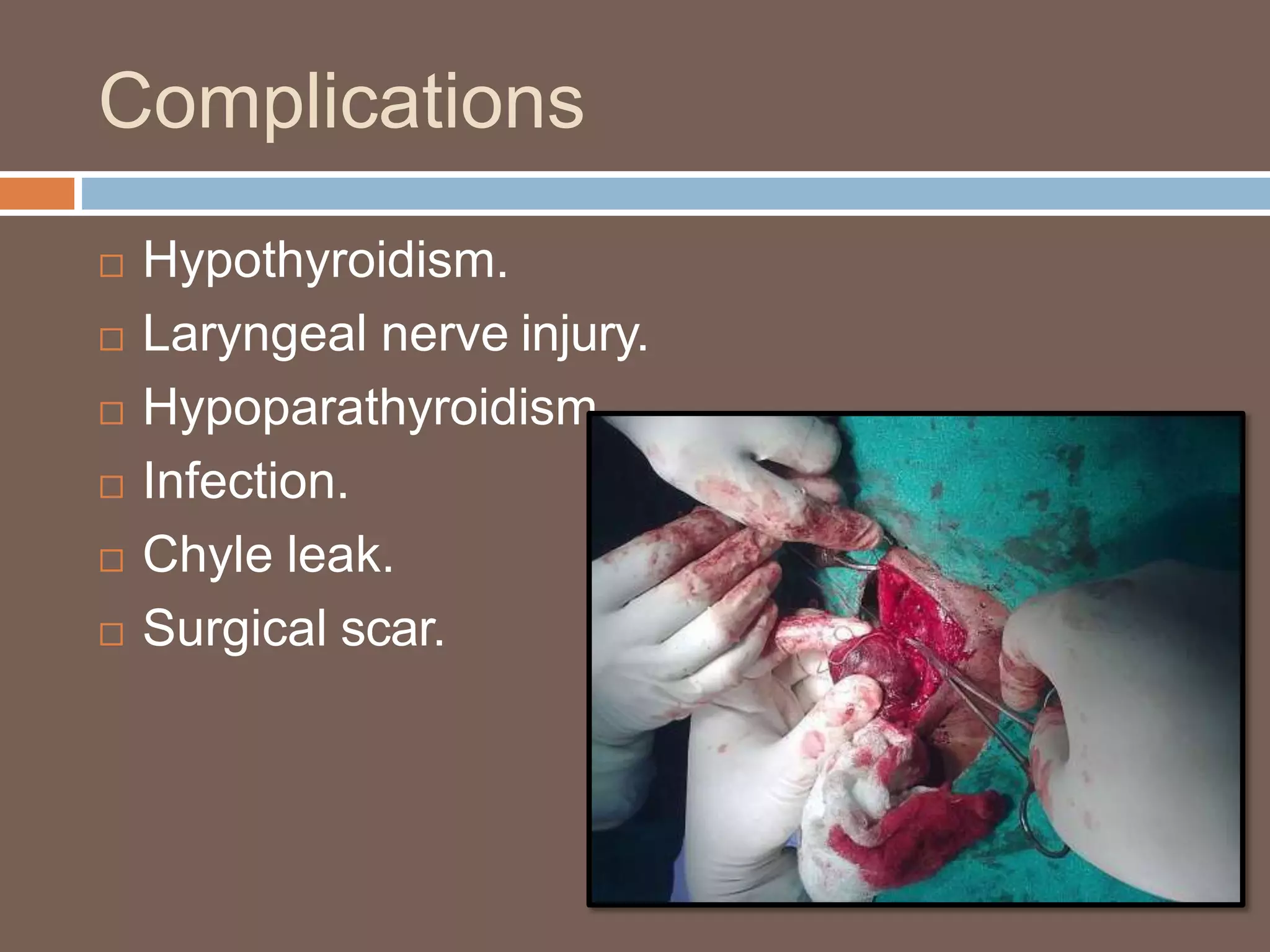
Complications
 Hypothyroidism.
 Laryngeal nerve injury.
 Hypoparathyroidism.
 Infection.
 Chyle leak.
 Surgical scar.
Conclusion
A self assessment of thyroid gland is
necessary for earliar detection of thyroid
disorders.
THANKYOU

Thyroid disorders.pptx

  • 1.
  • 2.
    INTRODUCTION  Largest endocrinegland.  Located inferior to cricoid cartilage.  Butterfly shaped organ comprising of two lobes - lobus dexter(right) - lobus sinister(left)  Weighs 18-60gms in adults.  Histologically it is made up of follicular and parafollicular cells.
  • 3.
     Blood supply Arterialsupply - superior thyroid artery - inferior thyroid artery Venous supply - superior thyroid vein - inferior thyroid vein  Nerve supply - Superior laryngeal nerve - Recurrent laryngeal nerve  Lymphatic drainage - Lateral deep cervical lymph node - Pretracheal/para tracheal lymph nodes
  • 7.
     Functions Produces thyroidhormones. Produces calcitonin.
  • 8.
    Physiology Thyroid gland (targetsite) Pituatary Thyroid stimulating hormone(TSH) Hypothalamus Thyroid releasing hormone(TRH) Tyrosine(target hormone) MIT/DIT T3 T4
  • 10.
    THYROID DISORDERS • GRAVE’SDISEASE • THYROID STORM • TOXIC THYROID NODULE HYPERTHYROIDISM • HASHIMOTOS THYROIDITIS • CRETINISM • MYXOEDEMA • POSTPARTUM THYROIDITIS • SUBACUTE THYROIDITIS • SICK EUTHYROIDISM HYPOTHYROIDISM
  • 11.
    THYROTOXICOSIS  Hypermetabolic clinicalsyndrome resulting from serum elevation of thyroid hormone levels(T3 & T4).  Causes are GRAVE’ S disease, multinodular goitre and toxic adenoma.  GRAVE’S DISEASE is the most common form.
  • 12.
    GRAVE’S DISEASE Introduction  Autoimmunedisease.  Female : Male ratio – 5:1 or 10:1  Has a strong hereditary component.  Diagnosis is mainly made by the symptoms
  • 13.
    Signs and symptoms Skin is warm and moist, palms are warm,moist and hyperemic and Plummer’s nails are seen.  Pretibial myxedema.  Alopecia and vitiligo.  Severe cases proptosis maybe seen.  Excessive sweating and heat intolerance.  CVS symptoms: palpitations, CCF, isolated systolic hypertension.  Metabolic symptoms: weight loss despite of increased in apetite.
  • 14.
     GIT symptoms:hyperdefecation.  Exacerbate bronchial asthma.  CNS symptoms: nervousness, irritability, tremor, insomnia, proximal muscle weakness.  In females: amenorrhea/ oligomenorrhea.  In males: impotence and loss of libido.
  • 15.
    Eye signs  VONGRAEFE’S SIGN – Lid lag.  JOFFROY’S SIGN – Absence of wrinkling of forehead on looking up.  STELLWAG’S SIGN – Decreased frequency of blinking.  DALRIMPLE’S SIGN – Lid retraction exposing the upper sclera.  MOBIUS SIGN – Absence of convergence.
  • 17.
    Investigations  T3 &T4 levels.  Thyroid uptake of radio iodine.  Presence of antibodies: TSH receptor antibody Antimicrosomal antibody  CT orbits thyroid scans.
  • 18.
    Management  Immediate control:Propranolol 40mg/6hr orally.  Long term control: Anti thyroid drugs – Carbimazole 15mg tid initially and then reducing it to 5mg tid for 12-18 months. Radio iodine ablation – Postmenopausal women and elderly men. In recurrence following surgery. Given to fertile women conception postponed to 1 year. Surgery – Presence of large goitre. Poor drug compliance.
  • 19.
     Exopthalmos: Corticosteroids. Tarsorrhaphy. Orbitaldecompression.  Cardiac arrythmias: ß- blockers. In euthyroid state, cardioversion is done.
  • 20.
    MULTINODULAR GOITRE  Excessproduction of thyroid hormones from functionally autonomous thyroid nodules which do not require the stimulation from TSH.  Second common cause.  Occurs in individual over 60 years of age and females are mostly affected.
  • 21.
    Symptoms  Large goitrewith or without tracheal compression.  Goitre is nodular or lobulated, often palpable.  Large goitre cause mediastinal compression with stridor, dysphagia and obstruction of superior vena cava.  Hoarseness
  • 22.
    Management  Small goitre: No treatment. Annual review.  Large goitres : Partial thyroidectomy. 131 Radioactive iodine I  Recurrence is common after 10-20 years.
  • 23.
    THYROID STORM  Rarebut life threatening sudden severe exarcerbation of hyperthyroidism.  Causes: Precipitated by stress or infection with either unrecognized thyrotoxicosis or inadequately treated thyrotoxicosis. Following subtotal thyroidectomy/radio active iodine. Trauma. Pregnancy. Emotional stress.
  • 25.
    Signs  Elevation oftemperature.  Increase in heart rate.  Irritable.  Delirius/comatose.  Hypotension.  Vomiting.  Diarrhoea.
  • 26.
    Management  Treatment startedimmediately with Propranolol 80mg/6hrs orally(dose of 1-5mg/6hrs given IV). Potassium iodide 60mg daily orally/ sodium iopodate 500mg daily orally. Carbimazole 60-120mg daily Dexamethasone 2mg/6hrs IV. Fluid replacement. Antibiotics.
  • 27.
    Emergency management indental office  Terminate all treatment.  Have someone summon medical assistance.  Administer oxygen.  Monitar all vital signs.  Initiate basic life support if necessary.  Start IV line with drip of crystalloid solution(150mL/hr).  Transport patient to emergency care facility.
  • 28.
    HYPOTHYROIDISM  Insufficiency synthesisof thyroid hormones.  Female : Male ratio is 6 : 1.  Causes : Hashimoto’s thyroiditis Thyroid failure following radio iodine. surgical treatment of thyrotoxicosis. Drugs like carbimazole, amiodarone. Iodine deficiency.
  • 31.
    HASHIMOTO’S THYROIDITIS  Primarycondition of hypothyroidism  Autoimmune.  Described by Hakaru Hashimoto
  • 32.
    Signs and symptoms Weight gain.  Enlarged thyroid gland.  Depression.  Sensitivity to heat/cold.  Fatigue.  Hypoglycemia.  Increased cholestrol level.
  • 33.
    Diagnosis  T3 &T4 levels.  Presence of TPO antibodies.  PositiveANF.
  • 34.
    Treatment  Thyroxine therapy. LEVOTHYROX INE Helps in both hypothyroidism and goitre shrinkage
  • 35.
    CRETINISM  Cretinism isa condition of severe physical and mental retardation due to iodine deficiency, and specifically due to deficiency of thyroid hormones during early pregnancy.  Cretinism refers to the congenital hypothyroidism or under activity of thyroid glands during early childhood leading to stunted growth and mental retardation.”
  • 36.
    Cretinism Causes There aretwo main reasons for cretinism: Lack of thyroid gland and failure of the thyroid gland to produce thyroid hormone (congenital cretinism or congenital iodine deficiency syndrome). Iodine deficiency in the diet (Endemic cretinism).
  • 37.
    Signs and symptoms Dry, cool, mottled skin, hoarse cry, broad flat nose, puffy face.  Protruberant abdomen, umblical hernia, hypotonia.  Large posterior fontanelle.  Lethargy, delayed stooling, poor feeding/sucking.  Cold to touch.  Delayed dentition.  Mental retardation.
  • 39.
    Management  Investigation :Cord blood T4, TSH. Serum T4, TSH RAIU X-ray of knee, foot and skull.  Treatment Medication : levothyroxine (initial dose of 10- 15mcg/kg/dl). Diet : iodine rich foods. Follow up.
  • 40.
    MYXOEDEMA It is acondition in which there is insufficiency of thyroid hormone. It is medically referred to as severely advanced hypothyroidism. The symptoms include swelling and thickening of the skin, mainly in the lower part of the legs.  Common in women.  Myxedema is a result of undiagnosed or untreated severe hypothyroidism.  Stops taking thyroid medication.  Deposits of chains of sugar molecules in skin  Hashimoto’s thyroiditis.
  • 42.
    MYXOEDEMA COMA  Uncommonbut life threatening form of untreated hypothyroidism with physiological decompensation.  Occurs in patients with long standing hypothyroidism.  Precipitated by a climate induced hypothermia, infection, drug therapy and other systemic conditions
  • 43.
    Symptoms  Lethargy.  Stupor. Delirium.  Hypotension.  Convulsions.  Hypoglycemia.  Hyponatremia.  Hypoventillation.  Coma.
  • 44.
    Investigations  Free T4and TSH  T3 & T4 levels are decreased and TSH are elevated or normal.  Serum electrolyte and serum osmolality.  Serum creatinine.  Serum glucose.  Differential blood count.  Pan culture for sepsis.
  • 45.
    Treatment  Hyperventilation ifrespiratory acidosis is significant.  Immediate IV levothyroxine given  Loading dose of 500 - 800mcg followed by 50 – 100mcg daily.  Hydrocortisone 5 – 10mg/hr.  Treatment of associated infection.  Correction of hyponatremia with saline.  Correction of hypoglycemia with IV dextrose.
  • 46.
    Thyroid tests  T3,T4 and TSH levels.  Presence of TPO antibodies.  Thyroid scan.  Thyroid uptake test.
  • 48.
    Thyroidectomy  Surgical removalof all or a part of the gland.  Indications: Thyroid carcinoma. Hyperthyroidism. Very enlarged thyroid. Symptomatic obstruction.
  • 49.
    Complications  Hypothyroidism.  Laryngealnerve injury.  Hypoparathyroidism.  Infection.  Chyle leak.  Surgical scar.
  • 50.
    Conclusion A self assessmentof thyroid gland is necessary for earliar detection of thyroid disorders.
  • 51.