Dr Asif Hussain
Dept. of Pharmacology
JNMC ,A.M.U , Aligarh
The thyroid gland secretes 2 types of hormones
1- Follicular cells of thyroid gland secrete Iodine
containing amino acids (are important for growth,
development and metabolism) and these are:
Triodothyronine, (T3)
Tetraiodothyronine, (T4)
2- Calcitonin is important in the regulation of calcium
level it is secreted by parafollicular cells of thyroid.
The iodine is necessary for the synthesis of T3 & T4 is
derived from food or iodine supplement.
Iodine uptake is an active process. Once taken up by the
thyroid gland, iodine undergoes a series of enzymatic
reactions that convert it into active hormone.
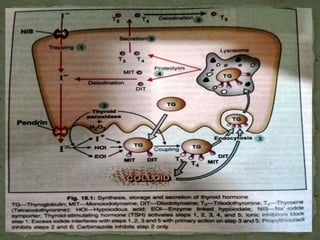
1st step : Transport of the iodine into the gland by intrinsic
follicle cell basement membrane protein called sodium
iodine symporter(NIS).
2nd step: Iodine trapped by follicle cell is carried across
apical membrane by another transporter ‘Pendrin’ .
Iodide is oxidized by thyroid peroxidase to iodinium or
hypoiodous acid (HOI) , or enzyme linked hypoiodate
(E-OI) with the help of H2O2.
3rd step: Iodination of tyrosine residues within the
thyroglobulin molecule to form monoiodotyrosine (MIT)
& diodotyrosine (DIT) this process is called iodide
organifaction.
4th step: Two molecules of DIT combine within the
thyroglobulinto form L-thyroxine (T4)
One molecule of MIT & one molecule of DIT
combine to form T3.
5th step:
T4, T3, MIT & DIT are released form thyroglobulin
by exocytosis & proteolysis of thyroglobulin.
The DIT & MIT are deiodinated within the gland &
the iodine is reutilized. This process of proteolysis is
blocked by high levels of intrathyroidal iodide.
The ratio of T4 to T3 within the thyroglobulin is 5:1
so that most of the hormone released is thyroxine.
Most of circulating T3 in the blood is derived from
peripheral metabolism of thyroxine.
Thyroid hormones are avidly bound to plasma
proteins.
Only 0.03-0.08% of T4 and 0.2-0.5% of T3 are in
free form.
Binding occurs to 3 plasma proteins in following
decreasing order
Thyroxine binding globulin(TBG)
Thyroxine binding prealbumin(Transthyretin)
Albumin
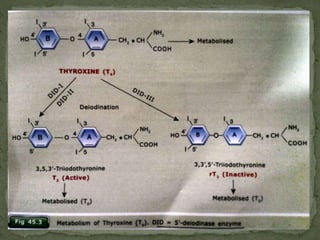
Primary pathway of peripheral metabolism is deiodination.
Deiodination of T4 may occur by removal of iodine from
the outer ring producing 3,5,3’ triiodothyronine (T3).
Alternatively deiodination of the inner ring produces 3,3’,5’
triiodothyronine (reverse T3or rT3) which is inactive.
Drugs such as ipodate, beta-blockers & corticosteroids and
severe illness or starvation inhibit the 5-deiodinase
necessary for the conversion of T4 to T3 resulting in low T3
& high rT3.
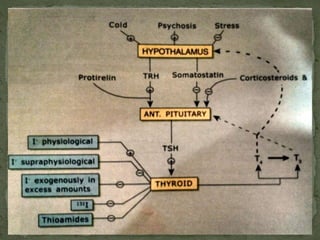
Hypothalamic cells secrete thyrotropin releasing hormone
(TRH) into the capillaries of the pituitary portal system. TRH
stimulates the synthesis & release of thyroid stimulating
hormone (TSH). TSH stimulates an adenylyl cyclase-mediated
mechanism in the thyroid gland to increase the synthesis&
release of T4 & T3
T4 & T3 act in a negative feedback fashion (mechanism) to
block the action of TRH on the pituitary gland & on the
hypothalamus to inhibit the synthesis & release of TRH.
The thyroid gland also regulates its uptake of iodide &
thyroid hormone synthesis by intrathyroidal
mechanism that are independent of TSH.
These mechanisms primarily related to the level of
iodine in the blood.
High concentration of iodide inhibits iodide
organification, and effect that is useful in the
treatment of thyroiddisease.
Inadequate iodine intake results in diffuse
enlargement of the thyroid (Goitre).
T3 is 10 times more potent than T4 and since T4 is
converted to T3 in target cells( theliver & kidneys),
most of the effect of circulating T4 is probably due to
T3.
Thyroid hormone binds to receptors in the nucleus that
control the expression of genes responsible for many
metabolic processes.
These receptors when activated by T3 bind to DNA
response elements & control synthesis of mRNA which
codes for specific proteins that mediate the action of
thyroid hormones.
The proteins synthesized differ depending on the
tissue involved. These proteins include Na+/K+
ATPase, specific contractile protein in smooth
muscles & the heart, enzymesinvolved in lipid
metabolism, important developmental components in
the brain . etc.
Includes normal growth & development of the nervous,
skeletal & reproductive systems .
Controls metabolism of fat, CHO, proteins & also
metabolism of drugs.
Thyroid deprivation in early life results in irreversible
mental retardation & dwarfism (congenital cretinism),
thyroid hyperactivity results in thyrotoxicosis.
Decrease in thyroid activity results in hypothyroidism
(myxedema).
All of the naturally occurring T4 & T3 exist in Levo
form (L-isomers), the Dextro form of Thyroxine has
only 4% of the biological activity of the L-isomer.
Thyroxine is well absorbed from the duodenum &
ileum when taken orally; oral bioavailability of L-
Thyroxine is about 80% absorbed while T3 is almost
completely absorbed. T4 & T3 can also be given
intravenously.
These are synthetic compounds.
1. Levothyroxine (T4).
2. Liothyronine (T3 ).
These synthetic compounds are identical to the
natural hormones.
Absorption:
75-80% of drug is absorbed orally
Absorption is reduced by
food,
alumunium containing antacids
Cholestyramine
Calcium carbonate
Proton pump inhibitor
Should be taken on empty stomach
Metabolized mainly in liver
Hepatic CYP3A4 induction reduces the plasma
concentration of the drug.
eg phenytoin, carbamazepine, rifampicin
Excreted partially in bile and in urine.
Due to it’s strong binding with plasma protein it
protects the drug from metabolism and excretion and
increases its t1⁄2
Due to longer t1⁄2 (7 days) it takes longer time for
clinical effects
Thyroid hormone replacement therapy in hypothyroid
state, to replenish thyroid hormone lost due to illness
eg .
Autoimmune thyroiditis
Suppression of TSH after thyroidectomy
radioiodine ablation in thyroid carcinoma.
initially 50-100 µg administered orally increased 25-
50 µg at 2weeks interval until the patient doesn’t
complain of ADR or until the serum TSH levels
become normal.
Liothyronine (T3 ) has faster onset but shorter duration
of action.
It is costlier than levothyroxine
Used only in acute emergencies
eg
myxedema coma (100 µg is given I.V followed by 25 µg
every 6 hrly I.V daily
Short term suppression of TSH in patients undergoing surgery
of thyroid cancer
5’- deiodinase defeciency
These are drugs used to lower the functional capacity
of the hyperactive thyroid gland.
Thyrotoxicosis is due to excessive secretion of thyroid
hormones. Graves’ disease( Autoimmune disorder )
and toxic nodular goiter are two main causes.
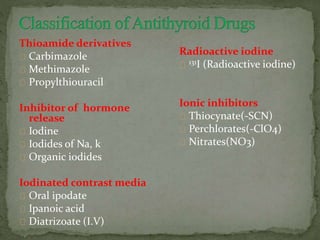
Thioamide derivatives
Carbimazole
Methimazole
Propylthiouracil
Inhibitor of hormone
release
Iodine
Iodides of Na, k
Organic iodides
Iodinated contrast media
Oral ipodate
Ipanoic acid
Diatrizoate (I.V)
Radioactive iodine
131I (Radioactive iodine)
Ionic inhibitors
Thiocynate(-SCN)
Perchlorates(-ClO4)
Nitrates(NO3)
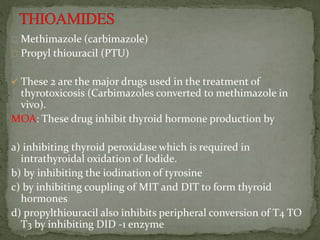
Methimazole (carbimazole)
Propyl thiouracil (PTU)
 These 2 are the major drugs used in the treatment of
thyrotoxicosis (Carbimazoles converted to methimazole in
vivo).
MOA: These drug inhibit thyroid hormone production by
a) inhibiting thyroid peroxidase which is required in
intrathyroidal oxidation of Iodide.
b) by inhibiting the iodination of tyrosine
c) by inhibiting coupling of MIT and DIT to form thyroid
hormones
d) propylthiouracil also inhibits peripheral conversion of T4 TO
T3 by inhibiting DID -1 enzyme
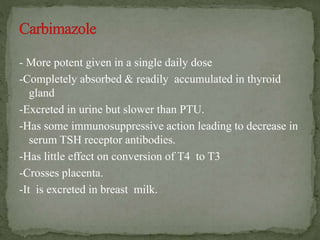
- More potent given in a single daily dose
-Completely absorbed & readily accumulated in thyroid
gland
-Excreted in urine but slower than PTU.
-Has some immunosuppressive action leading to decrease in
serum TSH receptor antibodies.
-Has little effect on conversion of T4 to T3
-Crosses placenta.
-It is excreted in breast milk.
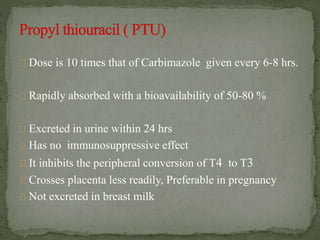
Dose is 10 times that of Carbimazole given every 6-8 hrs.
Rapidly absorbed with a bioavailability of 50-80 %
Excreted in urine within 24 hrs
Has no immunosuppressive effect
It inhibits the peripheral conversion of T4 to T3
Crosses placenta less readily, Preferable in pregnancy
Not excreted in breast milk
These drugs controls thyrotoxicosis in both graves disease
and toxic nodular goiter.
Clinical improvement starts after 1-2 weeks
Propylthiouracil : 50-150mg TDS followed by 25-50 mg
BD-TDS for maintenance
Carbimazole: 5-15 mg TDS initially
Maintenance dose is 2.5-10mg daily in 1-2 divided doses
Occur in 3-12% of treated patients.
Most reactions occur early. The most common adverse
effect is maculopapular pruritic rash, sometimes
accompanied by fever.
RARE ADVERSE EFFECTS INCLUDE:
Urticarial rash.
Vasculitis.
Hepatic failure
Arthralgia.
A lupus like reaction
Cholestatic jaundice.
Lymphadenopathy.
Hyperprothrombinemia, aplastic anemia
Agranutocytosis
Iodide salts inhibit organification (iodination of tyrosine)
and thyroid hormone release.
These salts also decrease the size & vascularity of the
hyperplastic thyroid gland.
Since iodide salts inhibit the release as well as the
synthesis of the hormone, their onset of action occurs
rapidly within 2-7 days.
This effect is transient because the thyroid gland
escapes from iodide block after several weeks of
treatment.
Iodide salts are used in thyroid storm(severe
thyrotoxicosis) & to prepare the patient for surgical
resections of the hyperactive thyroid.
The usual forms of this drug are lugol's solution(iodine &
potassium iodide) and saturated solution of potassium
iodide.
Lugols solution: 5% iodine in 10% KI solution : 5-
10drops/day
Iodide salts (sod/pot) 100-300 mg/day
Acute adverse effects
occurs in individuals who
are sensitive to iodine.
Manifestations are
Swelling of lips,eyelids,
Angioedema of larynx
Fever
Joint pain
Petechial hemorrhage
Chronic overdose (iodism)
Inflammation of mucous
membrane
Salivation
Sneezing
Swelling of eyelids
G.i disturbance
It suppresses the conversion of T4 to T3 via 5’ deiodinase
in the liver, kidney and other peripheral tissues.
Ipodate has proved very useful in rapidly reducing T3
concentration in thyrotoxicosis (in thyroid storm)
Radioactive iodine is administered as sodium salt of 131I
dissolved in water and taken orally.
131I emits x ray as well as β particles
131I is concentrated by thyroid, incorporated in colloid- emits
radiation from within the follicles.
β particles penetrates around 0.5-2 mm of tissue
Thyroid follicular cells are affected within undergoes pyknosis
and necrosis followed by fibrosis when a large dose is given.
Most common indication is hyperthyroidism due to
Graves’ disease or Toxic nodular goitre.
Avg therapeutic dose is 3-6 milli curie
Response is slow , it starts after 2 weeks and gradually
increases reaching peak at 3 month.
Certain monovalent anions inhibit iodide trapping by NIS
into thyroid because of similar hydrates ionic size.
T4 ,T3 synthesized is inhibited.
They are very toxic so they are not used.
eg: Thiocyanates, Perchlorates
Propranolol is used to rapidly alleviate manifestations
of thyrotoxicosis that are due to sympathetic
overactivity
eg: Palpitation, tremor, nervousness and sweating,
In addition they reduce peripheral conversion of T4 to
T3
β-blockers are used in hyperthyroidism in following
situations:
a) while awaitng response to
propylthiouracil/carbimazole
b) along with iodide for preoperative preparation before
subtotal thyroidectomy
c) thyrotoxic crisis
Propranolol 1-2mg slow I.V may be followed by 40-
80 mg oral every 6 hrly.
Thyroid & antithyroid drugs

Thyroid & antithyroid drugs

  • 1.
    Dr Asif Hussain Dept.of Pharmacology JNMC ,A.M.U , Aligarh
  • 2.
    The thyroid glandsecretes 2 types of hormones 1- Follicular cells of thyroid gland secrete Iodine containing amino acids (are important for growth, development and metabolism) and these are: Triodothyronine, (T3) Tetraiodothyronine, (T4) 2- Calcitonin is important in the regulation of calcium level it is secreted by parafollicular cells of thyroid.
  • 3.
    The iodine isnecessary for the synthesis of T3 & T4 is derived from food or iodine supplement. Iodine uptake is an active process. Once taken up by the thyroid gland, iodine undergoes a series of enzymatic reactions that convert it into active hormone.
  • 4.
    1st step :Transport of the iodine into the gland by intrinsic follicle cell basement membrane protein called sodium iodine symporter(NIS). 2nd step: Iodine trapped by follicle cell is carried across apical membrane by another transporter ‘Pendrin’ . Iodide is oxidized by thyroid peroxidase to iodinium or hypoiodous acid (HOI) , or enzyme linked hypoiodate (E-OI) with the help of H2O2. 3rd step: Iodination of tyrosine residues within the thyroglobulin molecule to form monoiodotyrosine (MIT) & diodotyrosine (DIT) this process is called iodide organifaction.
  • 5.
    4th step: Twomolecules of DIT combine within the thyroglobulinto form L-thyroxine (T4) One molecule of MIT & one molecule of DIT combine to form T3. 5th step: T4, T3, MIT & DIT are released form thyroglobulin by exocytosis & proteolysis of thyroglobulin. The DIT & MIT are deiodinated within the gland & the iodine is reutilized. This process of proteolysis is blocked by high levels of intrathyroidal iodide.
  • 7.
    The ratio ofT4 to T3 within the thyroglobulin is 5:1 so that most of the hormone released is thyroxine. Most of circulating T3 in the blood is derived from peripheral metabolism of thyroxine.
  • 8.
    Thyroid hormones areavidly bound to plasma proteins. Only 0.03-0.08% of T4 and 0.2-0.5% of T3 are in free form. Binding occurs to 3 plasma proteins in following decreasing order Thyroxine binding globulin(TBG) Thyroxine binding prealbumin(Transthyretin) Albumin
  • 9.
    Primary pathway ofperipheral metabolism is deiodination. Deiodination of T4 may occur by removal of iodine from the outer ring producing 3,5,3’ triiodothyronine (T3). Alternatively deiodination of the inner ring produces 3,3’,5’ triiodothyronine (reverse T3or rT3) which is inactive. Drugs such as ipodate, beta-blockers & corticosteroids and severe illness or starvation inhibit the 5-deiodinase necessary for the conversion of T4 to T3 resulting in low T3 & high rT3.
  • 11.
    Hypothalamic cells secretethyrotropin releasing hormone (TRH) into the capillaries of the pituitary portal system. TRH stimulates the synthesis & release of thyroid stimulating hormone (TSH). TSH stimulates an adenylyl cyclase-mediated mechanism in the thyroid gland to increase the synthesis& release of T4 & T3 T4 & T3 act in a negative feedback fashion (mechanism) to block the action of TRH on the pituitary gland & on the hypothalamus to inhibit the synthesis & release of TRH.
  • 12.
    The thyroid glandalso regulates its uptake of iodide & thyroid hormone synthesis by intrathyroidal mechanism that are independent of TSH. These mechanisms primarily related to the level of iodine in the blood. High concentration of iodide inhibits iodide organification, and effect that is useful in the treatment of thyroiddisease. Inadequate iodine intake results in diffuse enlargement of the thyroid (Goitre).
  • 14.
    T3 is 10times more potent than T4 and since T4 is converted to T3 in target cells( theliver & kidneys), most of the effect of circulating T4 is probably due to T3. Thyroid hormone binds to receptors in the nucleus that control the expression of genes responsible for many metabolic processes. These receptors when activated by T3 bind to DNA response elements & control synthesis of mRNA which codes for specific proteins that mediate the action of thyroid hormones.
  • 15.
    The proteins synthesizeddiffer depending on the tissue involved. These proteins include Na+/K+ ATPase, specific contractile protein in smooth muscles & the heart, enzymesinvolved in lipid metabolism, important developmental components in the brain . etc.
  • 16.
    Includes normal growth& development of the nervous, skeletal & reproductive systems . Controls metabolism of fat, CHO, proteins & also metabolism of drugs. Thyroid deprivation in early life results in irreversible mental retardation & dwarfism (congenital cretinism), thyroid hyperactivity results in thyrotoxicosis. Decrease in thyroid activity results in hypothyroidism (myxedema).
  • 17.
    All of thenaturally occurring T4 & T3 exist in Levo form (L-isomers), the Dextro form of Thyroxine has only 4% of the biological activity of the L-isomer. Thyroxine is well absorbed from the duodenum & ileum when taken orally; oral bioavailability of L- Thyroxine is about 80% absorbed while T3 is almost completely absorbed. T4 & T3 can also be given intravenously.
  • 18.
    These are syntheticcompounds. 1. Levothyroxine (T4). 2. Liothyronine (T3 ). These synthetic compounds are identical to the natural hormones.
  • 19.
    Absorption: 75-80% of drugis absorbed orally Absorption is reduced by food, alumunium containing antacids Cholestyramine Calcium carbonate Proton pump inhibitor Should be taken on empty stomach
  • 20.
    Metabolized mainly inliver Hepatic CYP3A4 induction reduces the plasma concentration of the drug. eg phenytoin, carbamazepine, rifampicin
  • 21.
    Excreted partially inbile and in urine. Due to it’s strong binding with plasma protein it protects the drug from metabolism and excretion and increases its t1⁄2 Due to longer t1⁄2 (7 days) it takes longer time for clinical effects
  • 22.
    Thyroid hormone replacementtherapy in hypothyroid state, to replenish thyroid hormone lost due to illness eg . Autoimmune thyroiditis Suppression of TSH after thyroidectomy radioiodine ablation in thyroid carcinoma. initially 50-100 µg administered orally increased 25- 50 µg at 2weeks interval until the patient doesn’t complain of ADR or until the serum TSH levels become normal.
  • 23.
    Liothyronine (T3 )has faster onset but shorter duration of action. It is costlier than levothyroxine Used only in acute emergencies eg myxedema coma (100 µg is given I.V followed by 25 µg every 6 hrly I.V daily Short term suppression of TSH in patients undergoing surgery of thyroid cancer 5’- deiodinase defeciency
  • 24.
    These are drugsused to lower the functional capacity of the hyperactive thyroid gland. Thyrotoxicosis is due to excessive secretion of thyroid hormones. Graves’ disease( Autoimmune disorder ) and toxic nodular goiter are two main causes.
  • 25.
    Thioamide derivatives Carbimazole Methimazole Propylthiouracil Inhibitor ofhormone release Iodine Iodides of Na, k Organic iodides Iodinated contrast media Oral ipodate Ipanoic acid Diatrizoate (I.V) Radioactive iodine 131I (Radioactive iodine) Ionic inhibitors Thiocynate(-SCN) Perchlorates(-ClO4) Nitrates(NO3)
  • 26.
    Methimazole (carbimazole) Propyl thiouracil(PTU)  These 2 are the major drugs used in the treatment of thyrotoxicosis (Carbimazoles converted to methimazole in vivo). MOA: These drug inhibit thyroid hormone production by a) inhibiting thyroid peroxidase which is required in intrathyroidal oxidation of Iodide. b) by inhibiting the iodination of tyrosine c) by inhibiting coupling of MIT and DIT to form thyroid hormones d) propylthiouracil also inhibits peripheral conversion of T4 TO T3 by inhibiting DID -1 enzyme
  • 27.
    - More potentgiven in a single daily dose -Completely absorbed & readily accumulated in thyroid gland -Excreted in urine but slower than PTU. -Has some immunosuppressive action leading to decrease in serum TSH receptor antibodies. -Has little effect on conversion of T4 to T3 -Crosses placenta. -It is excreted in breast milk.
  • 28.
    Dose is 10times that of Carbimazole given every 6-8 hrs. Rapidly absorbed with a bioavailability of 50-80 % Excreted in urine within 24 hrs Has no immunosuppressive effect It inhibits the peripheral conversion of T4 to T3 Crosses placenta less readily, Preferable in pregnancy Not excreted in breast milk
  • 29.
    These drugs controlsthyrotoxicosis in both graves disease and toxic nodular goiter. Clinical improvement starts after 1-2 weeks Propylthiouracil : 50-150mg TDS followed by 25-50 mg BD-TDS for maintenance Carbimazole: 5-15 mg TDS initially Maintenance dose is 2.5-10mg daily in 1-2 divided doses
  • 30.
    Occur in 3-12%of treated patients. Most reactions occur early. The most common adverse effect is maculopapular pruritic rash, sometimes accompanied by fever. RARE ADVERSE EFFECTS INCLUDE: Urticarial rash. Vasculitis. Hepatic failure Arthralgia. A lupus like reaction Cholestatic jaundice. Lymphadenopathy. Hyperprothrombinemia, aplastic anemia Agranutocytosis
  • 31.
    Iodide salts inhibitorganification (iodination of tyrosine) and thyroid hormone release. These salts also decrease the size & vascularity of the hyperplastic thyroid gland. Since iodide salts inhibit the release as well as the synthesis of the hormone, their onset of action occurs rapidly within 2-7 days. This effect is transient because the thyroid gland escapes from iodide block after several weeks of treatment.
  • 32.
    Iodide salts areused in thyroid storm(severe thyrotoxicosis) & to prepare the patient for surgical resections of the hyperactive thyroid. The usual forms of this drug are lugol's solution(iodine & potassium iodide) and saturated solution of potassium iodide. Lugols solution: 5% iodine in 10% KI solution : 5- 10drops/day Iodide salts (sod/pot) 100-300 mg/day
  • 33.
    Acute adverse effects occursin individuals who are sensitive to iodine. Manifestations are Swelling of lips,eyelids, Angioedema of larynx Fever Joint pain Petechial hemorrhage Chronic overdose (iodism) Inflammation of mucous membrane Salivation Sneezing Swelling of eyelids G.i disturbance
  • 34.
    It suppresses theconversion of T4 to T3 via 5’ deiodinase in the liver, kidney and other peripheral tissues. Ipodate has proved very useful in rapidly reducing T3 concentration in thyrotoxicosis (in thyroid storm)
  • 35.
    Radioactive iodine isadministered as sodium salt of 131I dissolved in water and taken orally. 131I emits x ray as well as β particles 131I is concentrated by thyroid, incorporated in colloid- emits radiation from within the follicles. β particles penetrates around 0.5-2 mm of tissue Thyroid follicular cells are affected within undergoes pyknosis and necrosis followed by fibrosis when a large dose is given.
  • 36.
    Most common indicationis hyperthyroidism due to Graves’ disease or Toxic nodular goitre. Avg therapeutic dose is 3-6 milli curie Response is slow , it starts after 2 weeks and gradually increases reaching peak at 3 month.
  • 37.
    Certain monovalent anionsinhibit iodide trapping by NIS into thyroid because of similar hydrates ionic size. T4 ,T3 synthesized is inhibited. They are very toxic so they are not used. eg: Thiocyanates, Perchlorates
  • 38.
    Propranolol is usedto rapidly alleviate manifestations of thyrotoxicosis that are due to sympathetic overactivity eg: Palpitation, tremor, nervousness and sweating, In addition they reduce peripheral conversion of T4 to T3
  • 39.
    β-blockers are usedin hyperthyroidism in following situations: a) while awaitng response to propylthiouracil/carbimazole b) along with iodide for preoperative preparation before subtotal thyroidectomy c) thyrotoxic crisis Propranolol 1-2mg slow I.V may be followed by 40- 80 mg oral every 6 hrly.