www.medscape.com; http://ae.medseek.com/
Evaluating Hoarseness: Keeping Your Patient's Voice Healthy - June 1998 - American
Academy of Family Physicians; http://www.aafp.org/afp/980600ap/rosen.html
 Member of the Endocrine System
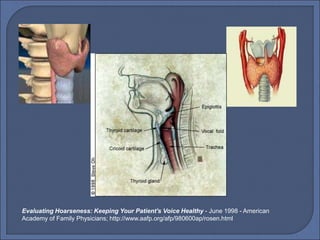
• Secretes thyroid hormones, thyroxine and calcitonin,
which regulate metabolism and growth.
• Located in neck adjacent to the 5th cervical vertebra
(C5).
• Composed of epithelial cells which specialize in the
absorption of iodine and, of course, secretion of thyroid
hormones.
• Follicles surround a protein core, the colloid, where
thyroglobulin, a substrate in thyroid hormone synthesis,
and thyroid hormones are stored.
Thyroid hormones are synthesized by iodination
of tyrosine residues on thyroglobulin within the
lumen of the thyroid follicle.
The thyroglobulin is endocytosed and thyroxin
(T4) and triiodothyronine (T3) are secreted.
Synthesis and secretion of T3 and T4 are
regulated by thyroid-stimulating hormone (TSH;
thyrotrophin) and influenced by plasma iodide.
There is a large pool of T4 in the body; it has a low
turnover rate and is found mainly in the
circulation.
There is a small pool of T3 in the body; it has a fast
turnover rate and is found mainly intracellular.
The oxidation of iodide and its
incorporation into thyroglobulin (termed
the organification of iodide) is catalysed by
thyroperoxidase TPO, an enzyme situated at
the inner surface of the cell at the interface
with the colloid. The reaction requires the
presence of hydrogen peroxide (H2O2) as an
oxidising agent
 Tyrosine residues are iodinated first at position 3 on the
ring, forming monoiodotyrosine (MIT) and then, in some
molecules, on position 5 as well, forming di-iodotyrosine
(DIT). While still incorporated into thyroglobulin, these
molecules are then coupled in pairs, either MIT with DIT
to form T3, or two DIT molecules to form T4.
 The mechanism for coupling is believed to involve a
peroxidase system similar to that involved in iodination.
About one-fifth of the tyrosine residues in thyroglobulin are
iodinated in this way.
 The thyroglobulin molecule is taken up into the follicle cell
by endocytosis.
 The endocytotic vesicles then fuse with lysosomes, and
proteolytic enzymes act on thyroglobulin, releasing T4 and
T3 to be secreted into the plasma.
 The surplus MIT and DIT, which are released at the same
time, are scavenged by the cell, where the iodide is removed
enzymatically and reused.
Stimulate metabolism generally causing
- increased oxygen consumption
-increased metabolic rate
-Influence growth and development.
Within cells, the T4 is converted to T3, which
interacts with a nuclear receptor; the receptor
represses basal transcription when not bound to
T3, and activates transcription when bound.
 ↓Metabolic rate 
 Detected by hypothalamus 
 Stimulates anterior pituitary 
 Secretes TSH 
 Blood stream  target organ  thyroid
 Stimulate Thyroid to secrete T3/T4 
 Blood stream  target organs  adrenal medulla

 Secretes Epinephrine & Norepinephrine 
 ↑Metabolic rate
Regulation:
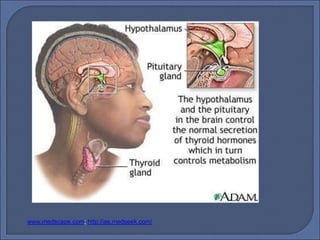
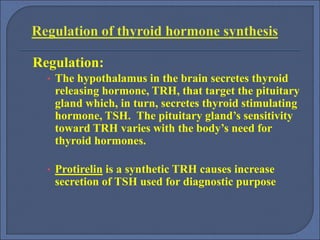
• The hypothalamus in the brain secretes thyroid
releasing hormone, TRH, that target the pituitary
gland which, in turn, secretes thyroid stimulating
hormone, TSH. The pituitary gland’s sensitivity
toward TRH varies with the body’s need for
thyroid hormones.
• Protirelin is a synthetic TRH causes increase
secretion of TSH used for diagnostic purpose
TSH is absorbed into the thyroid,
stimulating the thyroid to absorb iodine
and synthesize hormones.
Thyroid hormones provide negative
feedback for TSH production via a
“homeostatic feedback loop.”
Regulation
of
thyroid
hormone
synthesis
1. TH serves as a nuclear transcription factor, regulating
gene expression in targeted cells to increase metabolism.
1. Increase size and number of mitochondria in the cell.
2. Synthesizes cytochromes which feed into the electron
transfer chain of cellular respiration, stimulating
metabolism through increasing ATP production.
3. Increase ATPase concentration, the enzyme which
cleaves a phosphate group from ATP forming ADP and
inorganic phosphate.
4. Increased K+
and Na+
concentrations in the cell.
2. Increase the body’s basal metabolic rate, BMR, to maintain
electrochemical gradient in cell.
3. Stimulate carbohydrate metabolism and lipolysis
4. Affects protein synthesis.
5. Increase the body’s sensitivity to catecholamine, i.e.
adrenaline
Hyperthyroidism (thyrotoxicosis), either diffuse
toxic goiter or toxic nodular goiter
Hypothyroidism; in adults this causes myxoedema,
in infants, cretinism
Simple non-toxic goiter, caused by dietary iodine
deficiency, usually with normal thyroid function
cretinism
simple goiter
Insufficient amount of thyroid hormone
synthesized causing lethargy and weight gain,
among other symptoms.
Primary hypothyroidism is typically caused by
Hashimoto’s Disease, an auto-immune disorder in
which the thyroid is destroyed by antibodies.
Impaired hypothalamus and pituitary function,
typically due to a tumor, can inhibit the secretion
of THS, causing secondary hypothyroidism.
A diet insufficient in iodine causes hypothyroidism
as well.
Enlarged thyroid, symptom of hypothyroidism.
Goiters form for different reasons depending on the cause of
hypothyroidism
Hashimoto’s disease, also known as chronic lymphocytic
thyroiditis, causes goiters due to the accumulation of
lymphocytes.
The decreased amount of thyroid hormones in the body,
due to Hashimoto’s or other thyroid disorders including
infection, signals the increased production of TSH which
accumulates in the thyroid causing a characteristic
goiter.
Goiters form due to an insufficient amount of ingested
iodine and serve to increase the surface area of the
thyroid and aid in its absorption of iodine.
Thyroxine is the standard replacement therapy for
hypothyroidism. Thyroxine has all the actions of
endogenous thyroxine; it is given orally.
Liothyronine (T3) is the treatment of choice for
myxoedema coma. Liothyronine has all the actions of
endogenous triiodothyronine; it is given intravenously
1. Hormone replacement therapy
2. Administered orally with a bioavailability
ranging from 48%-80%.
1. Levothyroxine—Synthetic T4
2. Liothyronine—Synthetic T3
3. Liotrix—Combination of synthetic T4 and T3
4. Natural Thyroid Hormones—Thyroid hormones
derived from pigs, contains T4 and T3
1. Armour Thyroid
Dosage specific to individual and is determined by their
TSH serum levels. Typically 1.5μg T4 per kg body weight.
Because thyroid hormones serve to increase
heart rate, T4, the inactive form, is typically
administered to older patients who have an
increased risk for heart attack on account of
their age. Synthetic T3 is reserved for younger
patients, who do not have a history of heart
problems and individuals non-responsive to T4
treatment.
Dosage for individuals suffering from secondary
hypothyroidism determined by the amount of free
T4 and T3 circulating in their system.
Administering too high of a dosage leads to
hyperthyroid symptoms
The over production of thyroid hormones.
Symptoms include fatigue, weight lose, rapid heart
beat, anxiety, swollen eyes, and sensitivity to hot
temperatures.
Causes:
Grave’s disease, and autoimmune disorder in which
antibodies serve as agonists to the THS receptors on the
thyroid’s surface, causing thyroid growth and activation
of hormone synthesis and secretion.
Thyroid tumors which cause the uncontrolled synthesis
and secretion of thyroid hormones.
Thyroiditis, inflammation of the thyroid typically caused
by infection.
Treatment of Hyperthyroidism
•Drugs
•thioureylenes
•iodides
•radioactive iodine
•beta adrenoceptor blocking
agents
•'Lugol's iodine
Surgical
Subtotal
Thyroidectomy
1-Anti-thyroid drugs—Thioureylenes
Inhibits thyroid hormone synthesis by irreversibly
binding to TPO inhibiting its ability to break down
iodine (I2→I-
) and covalently attach it to the tyrosine
residue of thyroglobulin.
Three thioureylenes available:
Propylthiouracil
Methimazole
Carbamizole─Degraded to methimazole in the body.
Best indicated for children ,adolescents ,young adults
and pregnant women.
 Methimazole 5mg; Propylthiouracil (PTU)
50mg; Carbimazole 5mg, 20mg
MOA:
• contain a sulfhydryl group and a
thiourea moiety within a heterocyclic
structure
• inhibit synthesis by acting against
iodide organification (both)
• coupling of iodotyrosines (both)
• blocks conversion of T4 to T3 (PTU)
Carbimazole (or propylthiouracil)
1-Hyperthyroidism (diffuse toxic goitre), at least 1
year of treatment being necessary; recurrence
occurs eventually in over half the patients but can
be managed by a repeat course of treatment.
2-Propylthiouracil can be used in patients who
suffer sensitivity reactions to carbimazole.
3-Preliminary to surgery for toxic goitre.
4-Part of the treatment of thyroid storm (very severe
hyperthyroidism); propylthiouracil is preferred
because of its action in decreasing the conversion
of T4 to T3 in the tissues
 β-blockers are effective in treatment of
thyrotoxicosis to treat symptoms
 Propranolol is the most widely studied and used.
As first-line treatment for hyperthyroidism;
recurrence is rare provided the dose is adequate.
For treatment of relapse of hyperthyroidism after
carbimazole therapy or surgery.
Radioiodine, given orally, is selectively taken up by
thyroid and damages cells; it emits short-range β
radiation, which affects only thyroid follicle cells
of.
Hypothyroidism will eventually occur. Woman in
pregnancy or lactation is forbidden
131I cytotoxic action is restricted to the cells
of the thyroid follicles, resulting in
significant destruction of the tissue. 131I has
a half-life of 8 days, so by 2 months its
radioactivity has effectively disappeared. It
is given as one single dose, but its cytotoxic
effect on the gland is delayed for 1-2 months
and does not reach its maximum for a
further 2 months.
Iodine dissolved in aqueous potassium iodide
('Lugol's iodine') is used short-term to control
thyrotoxicosis preoperatively. It reduces the
vascularity of the gland.
Iodine, given orally in high doses, transiently
reduces thyroid hormone secretion and decreases
vascularity of the gland.

thyrid_and_antithyroid_drugs.ppt

  • 3.
  • 4.
    Evaluating Hoarseness: KeepingYour Patient's Voice Healthy - June 1998 - American Academy of Family Physicians; http://www.aafp.org/afp/980600ap/rosen.html
  • 5.
     Member ofthe Endocrine System • Secretes thyroid hormones, thyroxine and calcitonin, which regulate metabolism and growth. • Located in neck adjacent to the 5th cervical vertebra (C5). • Composed of epithelial cells which specialize in the absorption of iodine and, of course, secretion of thyroid hormones. • Follicles surround a protein core, the colloid, where thyroglobulin, a substrate in thyroid hormone synthesis, and thyroid hormones are stored.
  • 6.
    Thyroid hormones aresynthesized by iodination of tyrosine residues on thyroglobulin within the lumen of the thyroid follicle. The thyroglobulin is endocytosed and thyroxin (T4) and triiodothyronine (T3) are secreted. Synthesis and secretion of T3 and T4 are regulated by thyroid-stimulating hormone (TSH; thyrotrophin) and influenced by plasma iodide.
  • 7.
    There is alarge pool of T4 in the body; it has a low turnover rate and is found mainly in the circulation. There is a small pool of T3 in the body; it has a fast turnover rate and is found mainly intracellular.
  • 8.
    The oxidation ofiodide and its incorporation into thyroglobulin (termed the organification of iodide) is catalysed by thyroperoxidase TPO, an enzyme situated at the inner surface of the cell at the interface with the colloid. The reaction requires the presence of hydrogen peroxide (H2O2) as an oxidising agent
  • 9.
     Tyrosine residuesare iodinated first at position 3 on the ring, forming monoiodotyrosine (MIT) and then, in some molecules, on position 5 as well, forming di-iodotyrosine (DIT). While still incorporated into thyroglobulin, these molecules are then coupled in pairs, either MIT with DIT to form T3, or two DIT molecules to form T4.  The mechanism for coupling is believed to involve a peroxidase system similar to that involved in iodination. About one-fifth of the tyrosine residues in thyroglobulin are iodinated in this way.
  • 10.
     The thyroglobulinmolecule is taken up into the follicle cell by endocytosis.  The endocytotic vesicles then fuse with lysosomes, and proteolytic enzymes act on thyroglobulin, releasing T4 and T3 to be secreted into the plasma.  The surplus MIT and DIT, which are released at the same time, are scavenged by the cell, where the iodide is removed enzymatically and reused.
  • 12.
    Stimulate metabolism generallycausing - increased oxygen consumption -increased metabolic rate -Influence growth and development. Within cells, the T4 is converted to T3, which interacts with a nuclear receptor; the receptor represses basal transcription when not bound to T3, and activates transcription when bound.
  • 13.
     ↓Metabolic rate  Detected by hypothalamus   Stimulates anterior pituitary   Secretes TSH   Blood stream  target organ  thyroid  Stimulate Thyroid to secrete T3/T4   Blood stream  target organs  adrenal medulla   Secretes Epinephrine & Norepinephrine   ↑Metabolic rate
  • 14.
    Regulation: • The hypothalamusin the brain secretes thyroid releasing hormone, TRH, that target the pituitary gland which, in turn, secretes thyroid stimulating hormone, TSH. The pituitary gland’s sensitivity toward TRH varies with the body’s need for thyroid hormones. • Protirelin is a synthetic TRH causes increase secretion of TSH used for diagnostic purpose
  • 15.
    TSH is absorbedinto the thyroid, stimulating the thyroid to absorb iodine and synthesize hormones. Thyroid hormones provide negative feedback for TSH production via a “homeostatic feedback loop.”
  • 16.
  • 18.
    1. TH servesas a nuclear transcription factor, regulating gene expression in targeted cells to increase metabolism. 1. Increase size and number of mitochondria in the cell. 2. Synthesizes cytochromes which feed into the electron transfer chain of cellular respiration, stimulating metabolism through increasing ATP production. 3. Increase ATPase concentration, the enzyme which cleaves a phosphate group from ATP forming ADP and inorganic phosphate. 4. Increased K+ and Na+ concentrations in the cell. 2. Increase the body’s basal metabolic rate, BMR, to maintain electrochemical gradient in cell. 3. Stimulate carbohydrate metabolism and lipolysis 4. Affects protein synthesis. 5. Increase the body’s sensitivity to catecholamine, i.e. adrenaline
  • 19.
    Hyperthyroidism (thyrotoxicosis), eitherdiffuse toxic goiter or toxic nodular goiter Hypothyroidism; in adults this causes myxoedema, in infants, cretinism Simple non-toxic goiter, caused by dietary iodine deficiency, usually with normal thyroid function
  • 20.
  • 23.
    Insufficient amount ofthyroid hormone synthesized causing lethargy and weight gain, among other symptoms. Primary hypothyroidism is typically caused by Hashimoto’s Disease, an auto-immune disorder in which the thyroid is destroyed by antibodies. Impaired hypothalamus and pituitary function, typically due to a tumor, can inhibit the secretion of THS, causing secondary hypothyroidism. A diet insufficient in iodine causes hypothyroidism as well.
  • 24.
    Enlarged thyroid, symptomof hypothyroidism. Goiters form for different reasons depending on the cause of hypothyroidism Hashimoto’s disease, also known as chronic lymphocytic thyroiditis, causes goiters due to the accumulation of lymphocytes. The decreased amount of thyroid hormones in the body, due to Hashimoto’s or other thyroid disorders including infection, signals the increased production of TSH which accumulates in the thyroid causing a characteristic goiter. Goiters form due to an insufficient amount of ingested iodine and serve to increase the surface area of the thyroid and aid in its absorption of iodine.
  • 25.
    Thyroxine is thestandard replacement therapy for hypothyroidism. Thyroxine has all the actions of endogenous thyroxine; it is given orally. Liothyronine (T3) is the treatment of choice for myxoedema coma. Liothyronine has all the actions of endogenous triiodothyronine; it is given intravenously
  • 26.
    1. Hormone replacementtherapy 2. Administered orally with a bioavailability ranging from 48%-80%. 1. Levothyroxine—Synthetic T4 2. Liothyronine—Synthetic T3 3. Liotrix—Combination of synthetic T4 and T3 4. Natural Thyroid Hormones—Thyroid hormones derived from pigs, contains T4 and T3 1. Armour Thyroid Dosage specific to individual and is determined by their TSH serum levels. Typically 1.5μg T4 per kg body weight.
  • 27.
    Because thyroid hormonesserve to increase heart rate, T4, the inactive form, is typically administered to older patients who have an increased risk for heart attack on account of their age. Synthetic T3 is reserved for younger patients, who do not have a history of heart problems and individuals non-responsive to T4 treatment. Dosage for individuals suffering from secondary hypothyroidism determined by the amount of free T4 and T3 circulating in their system. Administering too high of a dosage leads to hyperthyroid symptoms
  • 28.
    The over productionof thyroid hormones. Symptoms include fatigue, weight lose, rapid heart beat, anxiety, swollen eyes, and sensitivity to hot temperatures. Causes: Grave’s disease, and autoimmune disorder in which antibodies serve as agonists to the THS receptors on the thyroid’s surface, causing thyroid growth and activation of hormone synthesis and secretion. Thyroid tumors which cause the uncontrolled synthesis and secretion of thyroid hormones. Thyroiditis, inflammation of the thyroid typically caused by infection.
  • 29.
    Treatment of Hyperthyroidism •Drugs •thioureylenes •iodides •radioactiveiodine •beta adrenoceptor blocking agents •'Lugol's iodine Surgical Subtotal Thyroidectomy
  • 30.
    1-Anti-thyroid drugs—Thioureylenes Inhibits thyroidhormone synthesis by irreversibly binding to TPO inhibiting its ability to break down iodine (I2→I- ) and covalently attach it to the tyrosine residue of thyroglobulin. Three thioureylenes available: Propylthiouracil Methimazole Carbamizole─Degraded to methimazole in the body. Best indicated for children ,adolescents ,young adults and pregnant women.
  • 31.
     Methimazole 5mg;Propylthiouracil (PTU) 50mg; Carbimazole 5mg, 20mg MOA: • contain a sulfhydryl group and a thiourea moiety within a heterocyclic structure • inhibit synthesis by acting against iodide organification (both) • coupling of iodotyrosines (both) • blocks conversion of T4 to T3 (PTU)
  • 32.
    Carbimazole (or propylthiouracil) 1-Hyperthyroidism(diffuse toxic goitre), at least 1 year of treatment being necessary; recurrence occurs eventually in over half the patients but can be managed by a repeat course of treatment. 2-Propylthiouracil can be used in patients who suffer sensitivity reactions to carbimazole. 3-Preliminary to surgery for toxic goitre. 4-Part of the treatment of thyroid storm (very severe hyperthyroidism); propylthiouracil is preferred because of its action in decreasing the conversion of T4 to T3 in the tissues
  • 33.
     β-blockers areeffective in treatment of thyrotoxicosis to treat symptoms  Propranolol is the most widely studied and used.
  • 34.
    As first-line treatmentfor hyperthyroidism; recurrence is rare provided the dose is adequate. For treatment of relapse of hyperthyroidism after carbimazole therapy or surgery. Radioiodine, given orally, is selectively taken up by thyroid and damages cells; it emits short-range β radiation, which affects only thyroid follicle cells of. Hypothyroidism will eventually occur. Woman in pregnancy or lactation is forbidden
  • 35.
    131I cytotoxic actionis restricted to the cells of the thyroid follicles, resulting in significant destruction of the tissue. 131I has a half-life of 8 days, so by 2 months its radioactivity has effectively disappeared. It is given as one single dose, but its cytotoxic effect on the gland is delayed for 1-2 months and does not reach its maximum for a further 2 months.
  • 36.
    Iodine dissolved inaqueous potassium iodide ('Lugol's iodine') is used short-term to control thyrotoxicosis preoperatively. It reduces the vascularity of the gland. Iodine, given orally in high doses, transiently reduces thyroid hormone secretion and decreases vascularity of the gland.