Thrombotic Diseases
Somu.Venkatesh
Roll 118
Thrombotic disorders
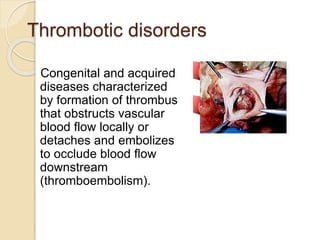
Congenital and acquired
diseases characterized
by formation of thrombus
that obstructs vascular
blood flow locally or
detaches and embolizes
to occlude blood flow
downstream
(thromboembolism).
Classification:
1. Familial – physiological
2. Non-familial (acquired) – physiological or
pathological
Acquired
Prothrombotic
Stimulus
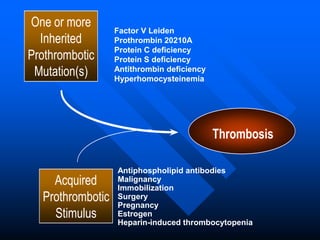
One or more
Inherited
Prothrombotic
Mutation(s)
Thrombosis
Acquired
Prothrombotic
Stimulus
One or more
Inherited
Prothrombotic
Mutation(s)
Thrombosis
Factor V Leiden
Prothrombin 20210A
Protein C deficiency
Protein S deficiency
Antithrombin deficiency
Hyperhomocysteinemia
Antiphospholipid antibodies
Malignancy
Immobilization
Surgery
Pregnancy
Estrogen
Heparin-induced thrombocytopenia
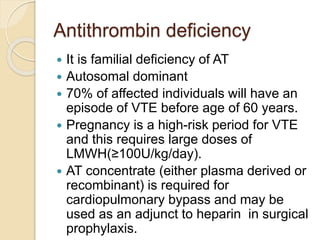
Antithrombin deficiency
 It is familial deficiency of AT
 Autosomal dominant
 70% of affected individuals will have an
episode of VTE before age of 60 years.
 Pregnancy is a high-risk period for VTE
and this requires large doses of
LMWH(≥100U/kg/day).
 AT concentrate (either plasma derived or
recombinant) is required for
cardiopulmonary bypass and may be
used as an adjunct to heparin in surgical
prophylaxis.
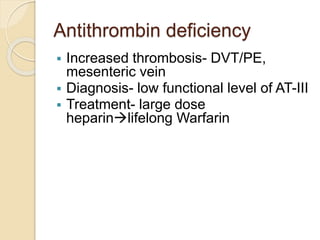
Antithrombin deficiency
 Increased thrombosis- DVT/PE,
mesenteric vein
 Diagnosis- low functional level of AT-III
 Treatment- large dose
heparinlifelong Warfarin
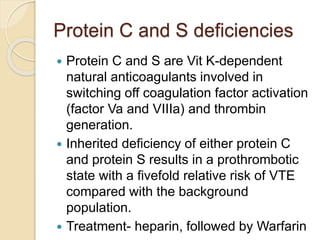
Protein C and S deficiencies
 Protein C and S are Vit K-dependent
natural anticoagulants involved in
switching off coagulation factor activation
(factor Va and VIIIa) and thrombin
generation.
 Inherited deficiency of either protein C
and protein S results in a prothrombotic
state with a fivefold relative risk of VTE
compared with the background
population.
 Treatment- heparin, followed by Warfarin
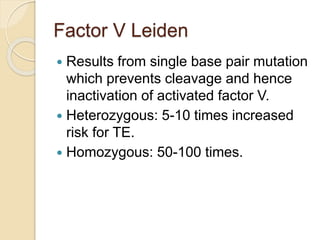
Factor V Leiden
 Results from single base pair mutation
which prevents cleavage and hence
inactivation of activated factor V.
 Heterozygous: 5-10 times increased
risk for TE.
 Homozygous: 50-100 times.
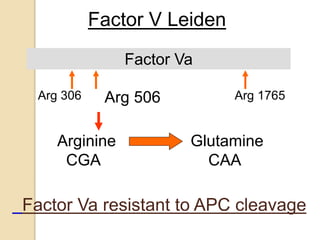
Factor Va
Arg 306 Arg 506 Arg 1765
Arginine
CGA
Glutamine
CAA
Factor Va resistant to APC cleavage
Factor V Leiden
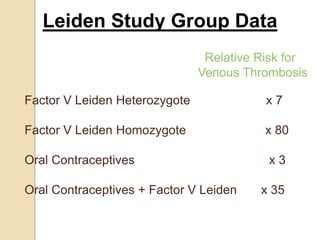
Relative Risk for
Venous Thrombosis
Factor V Leiden Heterozygote x 7
Factor V Leiden Homozygote x 80
Oral Contraceptives x 3
Oral Contraceptives + Factor V Leiden x 35
Leiden Study Group Data
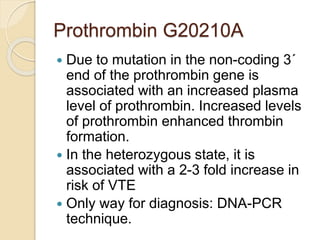
Prothrombin G20210A
 Due to mutation in the non-coding 3´
end of the prothrombin gene is
associated with an increased plasma
level of prothrombin. Increased levels
of prothrombin enhanced thrombin
formation.
 In the heterozygous state, it is
associated with a 2-3 fold increase in
risk of VTE
 Only way for diagnosis: DNA-PCR
technique.
Antiphospholipid
Syndrome(APS)
 Syndrome characterized by venous
and/or arterial thrombosis,
thrombocytopenia, or recurrent fetal
loss; associated with antibodies to
phospho-lipid-protein Complexes.
 May present in isolation (primary APS)
or in associated conditions like
Conditions associated with
secondary APS
 Systemic lupus erythematosus
 Rheumatoid arthritis
 Systemic sclerosis
 Behcet’s syndrome
 Temporal arteritis
 Sjögren’s syndrome
Antiphospholipid Syndrome
 Antiphospholipid antibodies are
heterogenous and typically are directed
against proteins which bind to
phospholipids.
Targets for antiphospholipid antibodies
 ß2-glycoprotein 1
 Protein C
 Annexin V
 Prothrombin (may result in haemorrhagic
presentation)
Clinical features
 Adverse pregnancy ourcome
Recurrent 1st trimester abortion (≥3)
Unexplained death of morphologically
normal fetus after 10 wks of gestation
Severe early pre-eclampsia
 Venous thromboembolism
 Arterial thromboembolism
 Livedo reticularis, catastrophic APS,
transverse myelitis, skin necrosis,
chorea
Investigation
 Anticardiolipin antibody test
 Lupus anticoagulant test
Management
 Arterial thrombosis, typically stroke,
associated with APS should be treated
with warfarin, as opposed to aspirin.
 APS-associated VTE is one of the
situation in which the predicted
recurrence rate is high enough to
indicate long-term anticoagulation after a
first event.
 In women with APS, it is likely that
intervention with heparin and possibly
aspirin increases the chance of
successful pregnancy outcome.
Disseminated Intravascular
Coagulation
Disseminated Intravascular Coagulation
It is an acquired condition in which normal physiology of
coagulation is disturbed leading to widespread intravascular
coagulation process associated with injury to
microvasculature which results in organ dysfunction,
capillary leak & shock.
Occurs due to simultaneous action of the following 4
mechanisms
Increased thrombin generation
Suppressed physiological anticoagulant pathways
Activation & subsequent impairment of fibrinolysis
Activation of inflammatory pathways
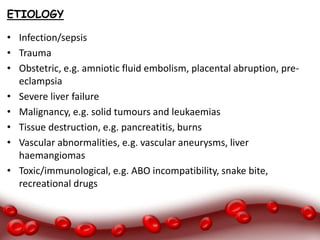
ETIOLOGY
• Infection/sepsis
• Trauma
• Obstetric, e.g. amniotic fluid embolism, placental abruption, pre-
eclampsia
• Severe liver failure
• Malignancy, e.g. solid tumours and leukaemias
• Tissue destruction, e.g. pancreatitis, burns
• Vascular abnormalities, e.g. vascular aneurysms, liver
haemangiomas
• Toxic/immunological, e.g. ABO incompatibility, snake bite,
recreational drugs
Disseminated Intravascular Coagulation
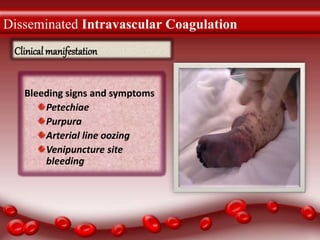
Bleeding signs and symptoms
Petechiae
Purpura
Arterial line oozing
Venipuncture site
bleeding
Clinical manifestation
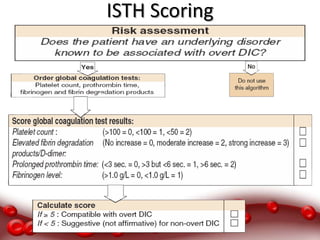
ISTH Scoring
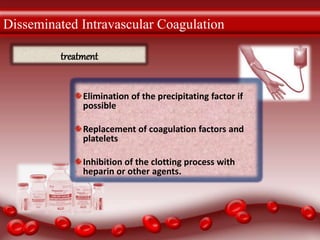
treatment
Disseminated Intravascular Coagulation
Elimination of the precipitating factor if
possible
Replacement of coagulation factors and
platelets
Inhibition of the clotting process with
heparin or other agents.
Thrombotic Thrombocytopenic Purpura
 Rare
 Enzyme ADAMTS13, responsible for cleaving
large multimers of vWF into normal functional
units and its deficiency due to antibodies
binding to it and results in large vWF
multimers which cross-link platelets.
 Causes extensive microscopic thrombosis,
with platelet consumption
 Microthromboses cause end- organ
dysfunction
 Hemolysis is due to shear stress,
producing schistocytes
Cause
 Idiopathic- autoimmune,
severely decreased ADAMTS13 activity
 Secondary- associated with
 Cancer
 BMT
 Pregnancy
 HIV-1 infection
 Drugs- Quinine, Clopidogrel, cyclosporine, Tacrolimus,
Mitomycin-C, Interferon
 Hereditary- Upshaw-Schulman syndrome
Clinical presentation-
 pentad
 Thrombocytopenia
 Microangiopathic haemolytic anaemia
 Neurological sequelae
 Fever
 Renal impairement
Management
 Diagnosis
 clinical,
 thrombocytopenia,
 normal PT/aPTT
 Treatment
 Plasmapheresis, with supportive treatment
 Refractory- steroids, aspirin, cyclophosphamide,
rituximab
 Splenectomy
Thank you

Thrombotic disorders

  • 1.
  • 2.
    Thrombotic disorders Congenital andacquired diseases characterized by formation of thrombus that obstructs vascular blood flow locally or detaches and embolizes to occlude blood flow downstream (thromboembolism).
  • 4.
    Classification: 1. Familial –physiological 2. Non-familial (acquired) – physiological or pathological
  • 5.
    Acquired Prothrombotic Stimulus One or more Inherited Prothrombotic Mutation(s) Thrombosis Acquired Prothrombotic Stimulus Oneor more Inherited Prothrombotic Mutation(s) Thrombosis Factor V Leiden Prothrombin 20210A Protein C deficiency Protein S deficiency Antithrombin deficiency Hyperhomocysteinemia Antiphospholipid antibodies Malignancy Immobilization Surgery Pregnancy Estrogen Heparin-induced thrombocytopenia
  • 6.
    Antithrombin deficiency  Itis familial deficiency of AT  Autosomal dominant  70% of affected individuals will have an episode of VTE before age of 60 years.  Pregnancy is a high-risk period for VTE and this requires large doses of LMWH(≥100U/kg/day).  AT concentrate (either plasma derived or recombinant) is required for cardiopulmonary bypass and may be used as an adjunct to heparin in surgical prophylaxis.
  • 7.
    Antithrombin deficiency  Increasedthrombosis- DVT/PE, mesenteric vein  Diagnosis- low functional level of AT-III  Treatment- large dose heparinlifelong Warfarin
  • 8.
    Protein C andS deficiencies  Protein C and S are Vit K-dependent natural anticoagulants involved in switching off coagulation factor activation (factor Va and VIIIa) and thrombin generation.  Inherited deficiency of either protein C and protein S results in a prothrombotic state with a fivefold relative risk of VTE compared with the background population.  Treatment- heparin, followed by Warfarin
  • 9.
    Factor V Leiden Results from single base pair mutation which prevents cleavage and hence inactivation of activated factor V.  Heterozygous: 5-10 times increased risk for TE.  Homozygous: 50-100 times.
  • 10.
    Factor Va Arg 306Arg 506 Arg 1765 Arginine CGA Glutamine CAA Factor Va resistant to APC cleavage Factor V Leiden
  • 11.
    Relative Risk for VenousThrombosis Factor V Leiden Heterozygote x 7 Factor V Leiden Homozygote x 80 Oral Contraceptives x 3 Oral Contraceptives + Factor V Leiden x 35 Leiden Study Group Data
  • 12.
    Prothrombin G20210A  Dueto mutation in the non-coding 3´ end of the prothrombin gene is associated with an increased plasma level of prothrombin. Increased levels of prothrombin enhanced thrombin formation.  In the heterozygous state, it is associated with a 2-3 fold increase in risk of VTE  Only way for diagnosis: DNA-PCR technique.
  • 13.
    Antiphospholipid Syndrome(APS)  Syndrome characterizedby venous and/or arterial thrombosis, thrombocytopenia, or recurrent fetal loss; associated with antibodies to phospho-lipid-protein Complexes.  May present in isolation (primary APS) or in associated conditions like
  • 14.
    Conditions associated with secondaryAPS  Systemic lupus erythematosus  Rheumatoid arthritis  Systemic sclerosis  Behcet’s syndrome  Temporal arteritis  Sjögren’s syndrome
  • 15.
    Antiphospholipid Syndrome  Antiphospholipidantibodies are heterogenous and typically are directed against proteins which bind to phospholipids. Targets for antiphospholipid antibodies  ß2-glycoprotein 1  Protein C  Annexin V  Prothrombin (may result in haemorrhagic presentation)
  • 16.
    Clinical features  Adversepregnancy ourcome Recurrent 1st trimester abortion (≥3) Unexplained death of morphologically normal fetus after 10 wks of gestation Severe early pre-eclampsia  Venous thromboembolism  Arterial thromboembolism  Livedo reticularis, catastrophic APS, transverse myelitis, skin necrosis, chorea
  • 17.
    Investigation  Anticardiolipin antibodytest  Lupus anticoagulant test
  • 18.
    Management  Arterial thrombosis,typically stroke, associated with APS should be treated with warfarin, as opposed to aspirin.  APS-associated VTE is one of the situation in which the predicted recurrence rate is high enough to indicate long-term anticoagulation after a first event.  In women with APS, it is likely that intervention with heparin and possibly aspirin increases the chance of successful pregnancy outcome.
  • 19.
  • 20.
    Disseminated Intravascular Coagulation Itis an acquired condition in which normal physiology of coagulation is disturbed leading to widespread intravascular coagulation process associated with injury to microvasculature which results in organ dysfunction, capillary leak & shock. Occurs due to simultaneous action of the following 4 mechanisms Increased thrombin generation Suppressed physiological anticoagulant pathways Activation & subsequent impairment of fibrinolysis Activation of inflammatory pathways
  • 21.
    ETIOLOGY • Infection/sepsis • Trauma •Obstetric, e.g. amniotic fluid embolism, placental abruption, pre- eclampsia • Severe liver failure • Malignancy, e.g. solid tumours and leukaemias • Tissue destruction, e.g. pancreatitis, burns • Vascular abnormalities, e.g. vascular aneurysms, liver haemangiomas • Toxic/immunological, e.g. ABO incompatibility, snake bite, recreational drugs
  • 22.
    Disseminated Intravascular Coagulation Bleedingsigns and symptoms Petechiae Purpura Arterial line oozing Venipuncture site bleeding Clinical manifestation
  • 23.
  • 24.
    treatment Disseminated Intravascular Coagulation Eliminationof the precipitating factor if possible Replacement of coagulation factors and platelets Inhibition of the clotting process with heparin or other agents.
  • 25.
    Thrombotic Thrombocytopenic Purpura Rare  Enzyme ADAMTS13, responsible for cleaving large multimers of vWF into normal functional units and its deficiency due to antibodies binding to it and results in large vWF multimers which cross-link platelets.  Causes extensive microscopic thrombosis, with platelet consumption  Microthromboses cause end- organ dysfunction  Hemolysis is due to shear stress, producing schistocytes
  • 26.
    Cause  Idiopathic- autoimmune, severelydecreased ADAMTS13 activity  Secondary- associated with  Cancer  BMT  Pregnancy  HIV-1 infection  Drugs- Quinine, Clopidogrel, cyclosporine, Tacrolimus, Mitomycin-C, Interferon  Hereditary- Upshaw-Schulman syndrome
  • 27.
    Clinical presentation-  pentad Thrombocytopenia  Microangiopathic haemolytic anaemia  Neurological sequelae  Fever  Renal impairement
  • 28.
    Management  Diagnosis  clinical, thrombocytopenia,  normal PT/aPTT  Treatment  Plasmapheresis, with supportive treatment  Refractory- steroids, aspirin, cyclophosphamide, rituximab  Splenectomy
  • 29.