hemo=blood stasis=stable prevention of blood loss
Steps of hemostasis:
1. Vasoconstriction(TXA2,LOCAL MYOGENIC SPASM,NERVOUS REFLEX)
2. Temporary platelet plug(primary hemostasis)
3. Coagulation(secondry hemostasis)
4. Fibrinolysis(dissolves the clot,restores function)
5. Regeneration(repair)
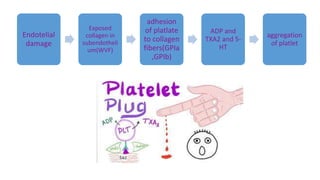
Endotelial
damage
Exposed
collagen in
subendotheli
um(WVF)
adhesion
of platlate
to collagen
fibers(GPIa
,GPIb)
ADP and
TXA2 and 5-
HT
aggregation
of platlet
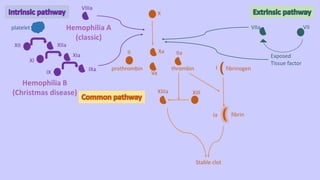
Exposed
Tissue factor
VIIVIIa
X
Xa
Va
II IIa
prothrombin thrombin I
Ia
fibrinogen
fibrin
XIIIXIIIa
Stable clot
platelet
XII
XI
IX
XIIa
XIa
IXa
VIIIa
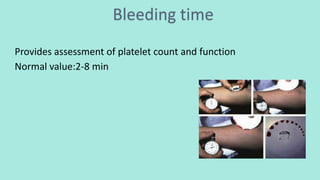
Provides assessment of platelet count and function
Normal value:2-8 min
Bleeding time
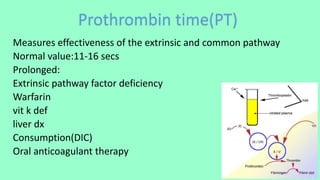
Measures effectiveness of the extrinsic and common pathway
Normal value:11-16 secs
Prolonged:
Extrinsic pathway factor deficiency
Warfarin
vit k def
liver dx
Consumption(DIC)
Oral anticoagulant therapy
Prothrombin time(PT)
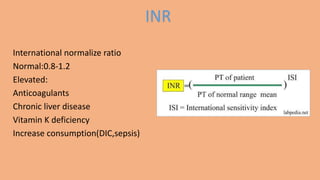
International normalize ratio
Normal:0.8-1.2
Elevated:
Anticoagulants
Chronic liver disease
Vitamin K deficiency
Increase consumption(DIC,sepsis)
INR
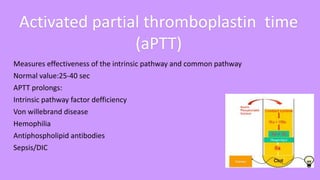
Measures effectiveness of the intrinsic pathway and common pathway
Normal value:25-40 sec
APTT prolongs:
Intrinsic pathway factor defficiency
Von willebrand disease
Hemophilia
Antiphospholipid antibodies
Sepsis/DIC
Activated partial thromboplastin time
(aPTT)
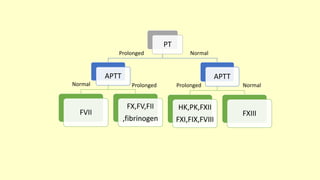
PT
APTT
FVII
FX,FV,FII
,fibrinogen
APTT
HK,PK,FXII
FXI,FIX,FVIII
FXIII
Prolonged
Prolonged
Prolonged Normal
Normal
Normal
Time for thrombin to convert fibrinogen to fibrin
A measure of fibrinolytic pathway
Normal pathway:9-13 secs
TT prolongs:
Hypo afibrinogeneamia
Dysfibrinogenaemia
Non functionated heparin
Chronic liver dx
Thrombin time
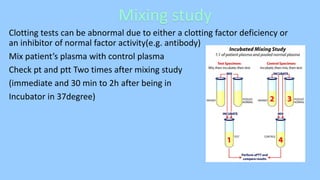
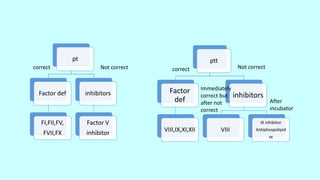
Clotting tests can be abnormal due to either a clotting factor deficiency or
an inhibitor of normal factor activity(e.g. antibody)
Mix patient’s plasma with control plasma
Check pt and ptt Two times after mixing study
(immediate and 30 min to 2h after being in
Incubator in 37degree)
Mixing study
pt
inhibitors
Factor V
inhibitor
Factor def
FI,FII,FV,
FVII,FX
ptt
inhibitors
IX inhibitor
Antiphospolipid
sx
VIII
Factor
def
VIII,IX,XI,XII
correct Not correctNot correct correct
Immediately
correct but
after not
correct
After
incubator
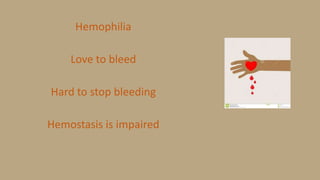
Hemophilia
Love to bleed
Hard to stop bleeding
Hemostasis is impaired
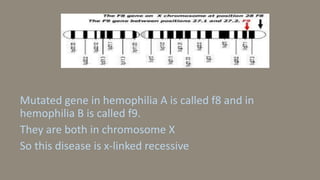
Mutated gene in hemophilia A is called f8 and in
hemophilia B is called f9.
They are both in chromosome X
So this disease is x-linked recessive
• Inherited hemorrhagic disorder caused by deficiency of factor VIII
or factor IX.
• X linked recessive inheritance hence affect males exclusively.
• Incidence in hemophilia A is 1 in 5000 male alive births.
• Incidence in hemophilia B is 1 in 30000 male alive births.
• Female who carry a single mutated gene, are generally
asymptomatic.
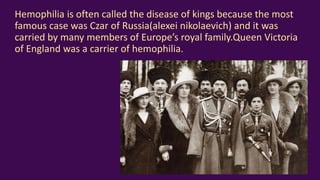
Hemophilia is often called the disease of kings because the most
famous case was Czar of Russia(alexei nikolaevich) and it was
carried by many members of Europe’s royal family.Queen Victoria
of England was a carrier of hemophilia.
Hemophilia B also known as Christmas disease because
The first patient having this condition was named Steven
Christmas.
Signs and symptoms of hemophilia A and B are nearly clinically
identical.
Severity of symptoms depends on severity of mutation which
determined the activity of the factors.
Signs and symptoms
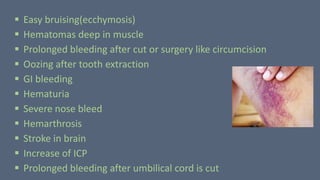
 Easy bruising(ecchymosis)
 Hematomas deep in muscle
 Prolonged bleeding after cut or surgery like circumcision
 Oozing after tooth extraction
 GI bleeding
 Hematuria
 Severe nose bleed
 Hemarthrosis
 Stroke in brain
 Increase of ICP
 Prolonged bleeding after umbilical cord is cut
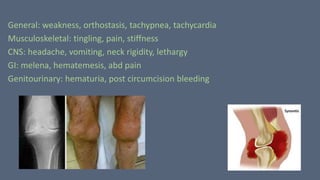
General: weakness, orthostasis, tachypnea, tachycardia
Musculoskeletal: tingling, pain, stiffness
CNS: headache, vomiting, neck rigidity, lethargy
GI: melena, hematemesis, abd pain
Genitourinary: hematuria, post circumcision bleeding
• Lab tests
Platelet (normal)
Prothrombin time (normal)
Tests Extrinsic and Common pathway(VII,X,V,II,I)
Partial thromboplastic time (increase)
Tests Intrinsic and Common pathway(XII,XI,IX,VIII,X,V,II,I)
Factor assay
• Confirmation
Tests for specific factor activities and mutation testing.
Diagnosis
Treatment of hemophilia may involve the following:
management of hemostasis
Management of bleeding episodes
Use factor replacement products and adjuvant medication
Treatment of patient with factor inhibitors
Treatment and rehabilitation of patient with hemophilia synovitis
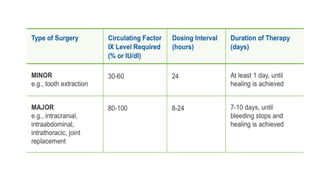
Injections of missing or non functioning clotting factor.
high purity factors(factor concentration)
Recombinant human factors
FFP
cryoprecipitate just for hemophilia A
Desmopressin(DDAVP) can be helpful for Hemophilia A.
Desmopressin stimulate VWF which stabilized factor VIII.
Treatment
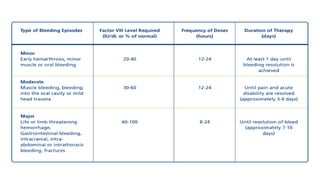
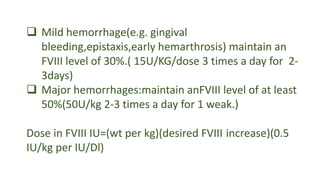
 Mild hemorrhage(e.g. gingival
bleeding,epistaxis,early hemarthrosis) maintain an
FVIII level of 30%.( 15U/KG/dose 3 times a day for 2-
3days)
 Major hemorrhages:maintain anFVIII level of at least
50%(50U/kg 2-3 times a day for 1 weak.)
Dose in FVIII IU=(wt per kg)(desired FVIII increase)(0.5
IU/kg per IU/Dl)
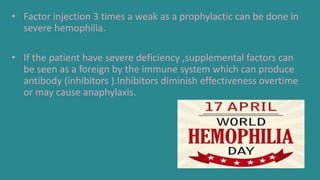
• Factor injection 3 times a weak as a prophylactic can be done in
severe hemophilia.
• If the patient have severe deficiency ,supplemental factors can
be seen as a foreign by the immune system which can produce
antibody (inhibitors ).Inhibitors diminish effectiveness overtime
or may cause anaphylaxis.
Hemophilia

Hemophilia

  • 2.
    hemo=blood stasis=stable preventionof blood loss Steps of hemostasis: 1. Vasoconstriction(TXA2,LOCAL MYOGENIC SPASM,NERVOUS REFLEX) 2. Temporary platelet plug(primary hemostasis) 3. Coagulation(secondry hemostasis) 4. Fibrinolysis(dissolves the clot,restores function) 5. Regeneration(repair)
  • 3.
    Endotelial damage Exposed collagen in subendotheli um(WVF) adhesion of platlate tocollagen fibers(GPIa ,GPIb) ADP and TXA2 and 5- HT aggregation of platlet
  • 5.
    Exposed Tissue factor VIIVIIa X Xa Va II IIa prothrombinthrombin I Ia fibrinogen fibrin XIIIXIIIa Stable clot platelet XII XI IX XIIa XIa IXa VIIIa
  • 6.
    Provides assessment ofplatelet count and function Normal value:2-8 min Bleeding time
  • 7.
    Measures effectiveness ofthe extrinsic and common pathway Normal value:11-16 secs Prolonged: Extrinsic pathway factor deficiency Warfarin vit k def liver dx Consumption(DIC) Oral anticoagulant therapy Prothrombin time(PT)
  • 8.
    International normalize ratio Normal:0.8-1.2 Elevated: Anticoagulants Chronicliver disease Vitamin K deficiency Increase consumption(DIC,sepsis) INR
  • 9.
    Measures effectiveness ofthe intrinsic pathway and common pathway Normal value:25-40 sec APTT prolongs: Intrinsic pathway factor defficiency Von willebrand disease Hemophilia Antiphospholipid antibodies Sepsis/DIC Activated partial thromboplastin time (aPTT)
  • 10.
  • 11.
    Time for thrombinto convert fibrinogen to fibrin A measure of fibrinolytic pathway Normal pathway:9-13 secs TT prolongs: Hypo afibrinogeneamia Dysfibrinogenaemia Non functionated heparin Chronic liver dx Thrombin time
  • 12.
    Clotting tests canbe abnormal due to either a clotting factor deficiency or an inhibitor of normal factor activity(e.g. antibody) Mix patient’s plasma with control plasma Check pt and ptt Two times after mixing study (immediate and 30 min to 2h after being in Incubator in 37degree) Mixing study
  • 13.
    pt inhibitors Factor V inhibitor Factor def FI,FII,FV, FVII,FX ptt inhibitors IXinhibitor Antiphospolipid sx VIII Factor def VIII,IX,XI,XII correct Not correctNot correct correct Immediately correct but after not correct After incubator
  • 14.
    Hemophilia Love to bleed Hardto stop bleeding Hemostasis is impaired
  • 15.
    Mutated gene inhemophilia A is called f8 and in hemophilia B is called f9. They are both in chromosome X So this disease is x-linked recessive
  • 16.
    • Inherited hemorrhagicdisorder caused by deficiency of factor VIII or factor IX. • X linked recessive inheritance hence affect males exclusively. • Incidence in hemophilia A is 1 in 5000 male alive births. • Incidence in hemophilia B is 1 in 30000 male alive births. • Female who carry a single mutated gene, are generally asymptomatic.
  • 17.
    Hemophilia is oftencalled the disease of kings because the most famous case was Czar of Russia(alexei nikolaevich) and it was carried by many members of Europe’s royal family.Queen Victoria of England was a carrier of hemophilia.
  • 18.
    Hemophilia B alsoknown as Christmas disease because The first patient having this condition was named Steven Christmas.
  • 19.
    Signs and symptomsof hemophilia A and B are nearly clinically identical. Severity of symptoms depends on severity of mutation which determined the activity of the factors. Signs and symptoms
  • 20.
     Easy bruising(ecchymosis) Hematomas deep in muscle  Prolonged bleeding after cut or surgery like circumcision  Oozing after tooth extraction  GI bleeding  Hematuria  Severe nose bleed  Hemarthrosis  Stroke in brain  Increase of ICP  Prolonged bleeding after umbilical cord is cut
  • 21.
    General: weakness, orthostasis,tachypnea, tachycardia Musculoskeletal: tingling, pain, stiffness CNS: headache, vomiting, neck rigidity, lethargy GI: melena, hematemesis, abd pain Genitourinary: hematuria, post circumcision bleeding
  • 22.
    • Lab tests Platelet(normal) Prothrombin time (normal) Tests Extrinsic and Common pathway(VII,X,V,II,I) Partial thromboplastic time (increase) Tests Intrinsic and Common pathway(XII,XI,IX,VIII,X,V,II,I) Factor assay • Confirmation Tests for specific factor activities and mutation testing. Diagnosis
  • 23.
    Treatment of hemophiliamay involve the following: management of hemostasis Management of bleeding episodes Use factor replacement products and adjuvant medication Treatment of patient with factor inhibitors Treatment and rehabilitation of patient with hemophilia synovitis
  • 24.
    Injections of missingor non functioning clotting factor. high purity factors(factor concentration) Recombinant human factors FFP cryoprecipitate just for hemophilia A Desmopressin(DDAVP) can be helpful for Hemophilia A. Desmopressin stimulate VWF which stabilized factor VIII. Treatment
  • 26.
     Mild hemorrhage(e.g.gingival bleeding,epistaxis,early hemarthrosis) maintain an FVIII level of 30%.( 15U/KG/dose 3 times a day for 2- 3days)  Major hemorrhages:maintain anFVIII level of at least 50%(50U/kg 2-3 times a day for 1 weak.) Dose in FVIII IU=(wt per kg)(desired FVIII increase)(0.5 IU/kg per IU/Dl)
  • 28.
    • Factor injection3 times a weak as a prophylactic can be done in severe hemophilia. • If the patient have severe deficiency ,supplemental factors can be seen as a foreign by the immune system which can produce antibody (inhibitors ).Inhibitors diminish effectiveness overtime or may cause anaphylaxis.