Priming Fluids and
hemodilution
Manu Jacob
Perfusionist
KMCT MCH
13/02/2019 1
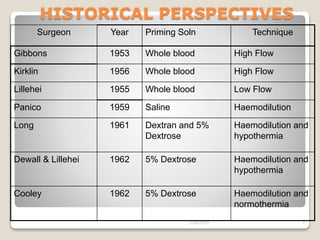
HISTORICAL PERSPECTIVES
Surgeon Year Priming Soln Technique
Gibbons 1953 Whole blood High Flow
Kirklin 1956 Whole blood High Flow
Lillehei 1955 Whole blood Low Flow
Panico 1959 Saline Haemodilution
Long 1961 Dextran and 5%
Dextrose
Haemodilution and
hypothermia
Dewall & Lillehei 1962 5% Dextrose Haemodilution and
hypothermia
Cooley 1962 5% Dextrose Haemodilution and
normothermia
13/02/2019 2
Prime
 To replace the air in the circuit with fluid
or blood.
13/02/2019 3
Why do we need prime ?
 To fill the circuit
 To check the circuit for leaks or damage
 To test the pump and circuit
 Priming with fluid reduces the blood
dependance.
 Priming fluid causes hemodilution.
 Hemodilution can be beneficial/harmfull.
13/02/2019 4
Necessity to Use Haemodilution
 Homologous Blood Syndrome
 Scarcity and cost of blood
 Oxygenators were inefficient.
Haemodilution increased their efficiency
 To reduce the harmful physiological effect
of blood going through the pump
13/02/2019 5
Advantages of hemodilution
 Decreases blood viscosity
 Improves regional blood flow
 Improved oxygen delivery of tissues.
 Decreased exposure to blood products.
 Improved blood flow at lower perfusion
pressures during hypothermia.
 Decreases bypass related
complications(neurologic,renal and
pulmonary)
13/02/2019 6
Disadvantages of hemodilution
 Extreme hemodilution can cause
1. Decrease in oxygen carrying capacity
2. Tissue edema in various organs
3. Reduces neuro congnitive outcomes
4. Increases the distance between capillaries and
tissues causing tissue necrosis and cell damage
5. Can cause mortality and morbidity
6. Increases lung fluids after CPB
13/02/2019 7
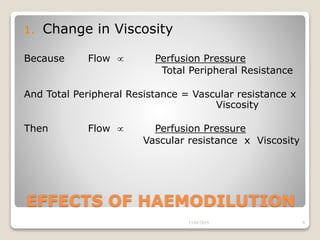
EFFECTS OF HAEMODILUTION
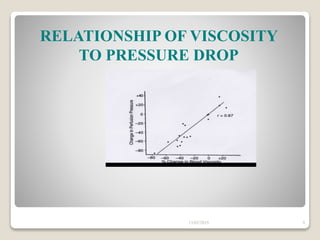
1. Change in Viscosity
Because Flow  Perfusion Pressure
Total Peripheral Resistance
And Total Peripheral Resistance = Vascular resistance x
Viscosity
Then Flow  Perfusion Pressure
Vascular resistance x Viscosity
13/02/2019 8
13/02/2019 9
RELATIONSHIP OF VISCOSITY
TO PRESSURE DROP
13/02/2019 10
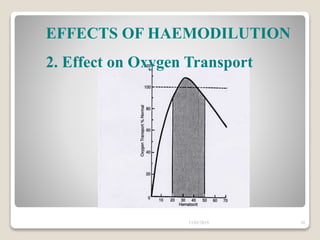
EFFECTS OF HAEMODILUTION
2. Effect on Oxygen Transport
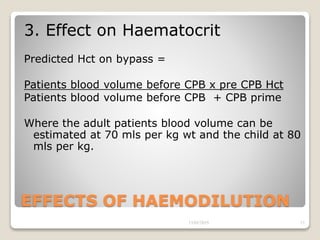
EFFECTS OF HAEMODILUTION
3. Effect on Haematocrit
Predicted Hct on bypass =
Patients blood volume before CPB x pre CPB Hct
Patients blood volume before CPB + CPB prime
Where the adult patients blood volume can be
estimated at 70 mls per kg wt and the child at 80
mls per kg.
13/02/2019 11
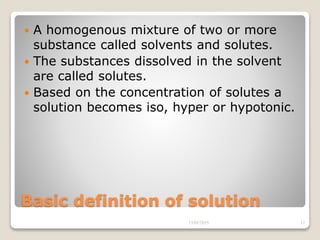
Basic definition of solution
 A homogenous mixture of two or more
substance called solvents and solutes.
 The substances dissolved in the solvent
are called solutes.
 Based on the concentration of solutes a
solution becomes iso, hyper or hypotonic.
13/02/2019 12
Classification of priming fluids
 Crystalloids : fluids with smaller solutes
and lesser atomic weights. Remains in the
circulation for smaller time ( 15 mts) eg:
Ringers soln, Dextrose etc
 Colloids : Fluids with bigger solutes and
greater atomic weight.colloids contain
larger They help in the preservation of
oncotic pressure. Eg : Hemacell, Albumin
etc
13/02/2019 13
Most commonly used primes
 Balanced Salt solutions
 Colloids (Hestril, albumin, plasma &
blood)
 Mannitol
 Heparin
 Bicorbonate as buffer
13/02/2019 14
Tonicity
 ISOTONIC : A solution that has the same
concentration as the cell. There is no
effect on the cell
 HYPERTONIC :A solution more
concentrated than the cell. So osmosis
occurs water moves out of cell and cell
shrinks
 HYPOTONIC : A solution less concentrated
than cell. water moves into cell.(swells)
13/02/2019 15
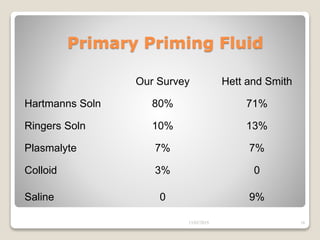
Primary Priming Fluid
Our Survey Hett and Smith
Hartmanns Soln 80% 71%
Ringers Soln 10% 13%
Plasmalyte 7% 7%
Colloid 3% 0
Saline 0 9%
13/02/2019 16
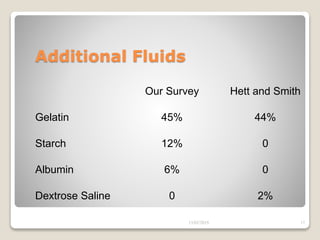
Additional Fluids
Our Survey Hett and Smith
Gelatin 45% 44%
Starch 12% 0
Albumin 6% 0
Dextrose Saline 0 2%
13/02/2019 17
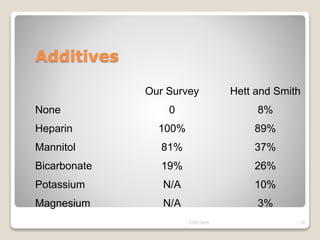
Additives
Our Survey Hett and Smith
None 0 8%
Heparin 100% 89%
Mannitol 81% 37%
Bicarbonate 19% 26%
Potassium N/A 10%
Magnesium N/A 3%
13/02/2019 18
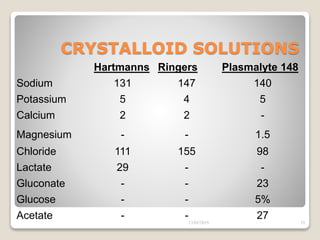
CRYSTALLOID SOLUTIONS
Hartmanns Ringers Plasmalyte 148
Sodium 131 147 140
Potassium 5 4 5
Calcium 2 2 -
Magnesium - - 1.5
Chloride 111 155 98
Lactate 29 - -
Gluconate - - 23
Glucose - - 5%
Acetate - - 2713/02/2019 19
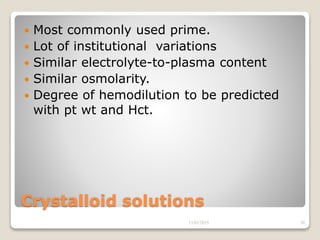
Crystalloid solutions
 Most commonly used prime.
 Lot of institutional variations
 Similar electrolyte-to-plasma content
 Similar osmolarity.
 Degree of hemodilution to be predicted
with pt wt and Hct.
13/02/2019 20
Colloidal primes
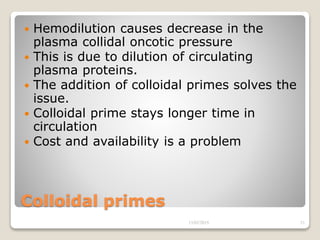
 Hemodilution causes decrease in the
plasma collidal oncotic pressure
 This is due to dilution of circulating
plasma proteins.
 The addition of colloidal primes solves the
issue.
 Colloidal prime stays longer time in
circulation
 Cost and availability is a problem
13/02/2019 21
PLASMA VOLUME EXPANDERS
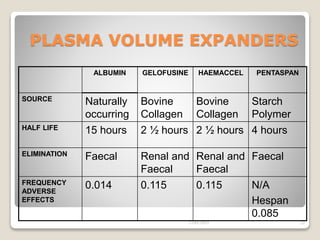
ALBUMIN GELOFUSINE HAEMACCEL PENTASPAN
SOURCE Naturally
occurring
Bovine
Collagen
Bovine
Collagen
Starch
Polymer
HALF LIFE 15 hours 2 ½ hours 2 ½ hours 4 hours
ELIMINATION Faecal Renal and
Faecal
Renal and
Faecal
Faecal
FREQUENCY
ADVERSE
EFFECTS
0.014 0.115 0.115 N/A
Hespan
0.085
13/02/2019 22
ALBUMIN
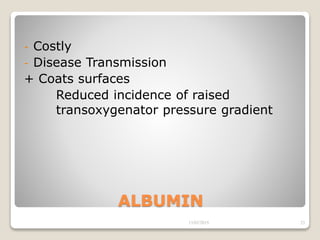
- Costly
- Disease Transmission
+ Coats surfaces
Reduced incidence of raised
transoxygenator pressure gradient
13/02/2019 23
COLLAGENS
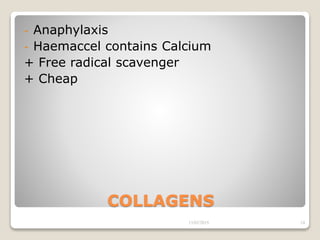
- Anaphylaxis
- Haemaccel contains Calcium
+ Free radical scavenger
+ Cheap
13/02/2019 24
PENTASPAN
- ? Incorporated in clot formation
- ? Coagulopathies
13/02/2019 25
DEXTROSE
 Increases cerebral damage upon reperfusion
 However cerebral damage on bypass is due
to emboli therefore there is no reperfusion
 Dextrose can act as an osmotic agent
 Complications associated with
hyperglycemia have led to its withdrawal.
13/02/2019 26
MANNITOL
 Increases osmotic pressure and thus
reduces the onset of oedema
 Is an osmotic diuretic
 Is a free radical scavenger
 May help protect the kidneys from the
ischaemic insult of bypass
13/02/2019 27
Experimental priming solutions
 Blood substitues
1. Perflurocarbons
2. Cross-linked Hb
3. Polymerized Hb
4. Conjugated Hb
13/02/2019 28
Contd.,
 They can carry dissolved Oxygen
 They have ability to permit oxygen
delivery in anemic conditions
 Inslouble in blood (must be emulsified)
 Chemically inert substance
 Oxygen sloubility is linear
 They can release O2 irrespective of Ph
and temp
13/02/2019 29
Draw backs
 Unexpected safety concerns
 Unanticipated physiologic effects like
vasoconstriction etc.
 Clinical trials suspended in US
13/02/2019 30
Allowable hemodilution
 Large institutional variations in
“acceptable hemodilution”.
 Most centers try to achieve a hematocrit
below 30 % during CPB.
 Lower hct below 25% preferred if temp is
below 25 deg c.
 For adults hct b/w 22 to 25% is
acceptable.
13/02/2019 31
Assessing adequecy of perfusion
with hemodilution
 Perfusion pressure decreases with CPB.
 Hemodilution results in uncoupling of the
relation b/w perfuion pressure and blood
flow.
 Adequecy of perfusion must be assessed
by means other than BP.
 Flow rates should me modified according
to age,wt and temperature.
13/02/2019 32
Goals of prime in CPB
 To reduce the hemodilution as much as
possible
 To minimize the exposure of blood to
foreign surface
 To reduce the prime to as minimum as
possible
 To preserve the blood components
13/02/2019 33
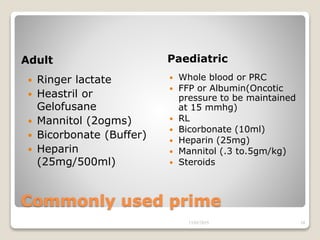
Commonly used prime
Adult Paediatric
 Ringer lactate
 Heastril or
Gelofusane
 Mannitol (2ogms)
 Bicorbonate (Buffer)
 Heparin
(25mg/500ml)
 Whole blood or PRC
 FFP or Albumin(Oncotic
pressure to be maintained
at 15 mmhg)
 RL
 Bicorbonate (10ml)
 Heparin (25mg)
 Mannitol (.3 to.5gm/kg)
 Steroids
13/02/2019 34
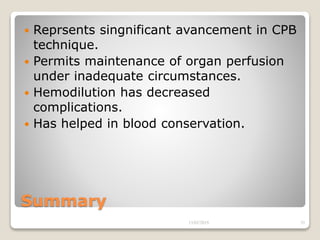
Summary
 Reprsents singnificant avancement in CPB
technique.
 Permits maintenance of organ perfusion
under inadequate circumstances.
 Hemodilution has decreased
complications.
 Has helped in blood conservation.
13/02/2019 35

Priming fluid and hemodilution

  • 1.
    Priming Fluids and hemodilution ManuJacob Perfusionist KMCT MCH 13/02/2019 1
  • 2.
    HISTORICAL PERSPECTIVES Surgeon YearPriming Soln Technique Gibbons 1953 Whole blood High Flow Kirklin 1956 Whole blood High Flow Lillehei 1955 Whole blood Low Flow Panico 1959 Saline Haemodilution Long 1961 Dextran and 5% Dextrose Haemodilution and hypothermia Dewall & Lillehei 1962 5% Dextrose Haemodilution and hypothermia Cooley 1962 5% Dextrose Haemodilution and normothermia 13/02/2019 2
  • 3.
    Prime  To replacethe air in the circuit with fluid or blood. 13/02/2019 3
  • 4.
    Why do weneed prime ?  To fill the circuit  To check the circuit for leaks or damage  To test the pump and circuit  Priming with fluid reduces the blood dependance.  Priming fluid causes hemodilution.  Hemodilution can be beneficial/harmfull. 13/02/2019 4
  • 5.
    Necessity to UseHaemodilution  Homologous Blood Syndrome  Scarcity and cost of blood  Oxygenators were inefficient. Haemodilution increased their efficiency  To reduce the harmful physiological effect of blood going through the pump 13/02/2019 5
  • 6.
    Advantages of hemodilution Decreases blood viscosity  Improves regional blood flow  Improved oxygen delivery of tissues.  Decreased exposure to blood products.  Improved blood flow at lower perfusion pressures during hypothermia.  Decreases bypass related complications(neurologic,renal and pulmonary) 13/02/2019 6
  • 7.
    Disadvantages of hemodilution Extreme hemodilution can cause 1. Decrease in oxygen carrying capacity 2. Tissue edema in various organs 3. Reduces neuro congnitive outcomes 4. Increases the distance between capillaries and tissues causing tissue necrosis and cell damage 5. Can cause mortality and morbidity 6. Increases lung fluids after CPB 13/02/2019 7
  • 8.
    EFFECTS OF HAEMODILUTION 1.Change in Viscosity Because Flow  Perfusion Pressure Total Peripheral Resistance And Total Peripheral Resistance = Vascular resistance x Viscosity Then Flow  Perfusion Pressure Vascular resistance x Viscosity 13/02/2019 8
  • 9.
    13/02/2019 9 RELATIONSHIP OFVISCOSITY TO PRESSURE DROP
  • 10.
    13/02/2019 10 EFFECTS OFHAEMODILUTION 2. Effect on Oxygen Transport
  • 11.
    EFFECTS OF HAEMODILUTION 3.Effect on Haematocrit Predicted Hct on bypass = Patients blood volume before CPB x pre CPB Hct Patients blood volume before CPB + CPB prime Where the adult patients blood volume can be estimated at 70 mls per kg wt and the child at 80 mls per kg. 13/02/2019 11
  • 12.
    Basic definition ofsolution  A homogenous mixture of two or more substance called solvents and solutes.  The substances dissolved in the solvent are called solutes.  Based on the concentration of solutes a solution becomes iso, hyper or hypotonic. 13/02/2019 12
  • 13.
    Classification of primingfluids  Crystalloids : fluids with smaller solutes and lesser atomic weights. Remains in the circulation for smaller time ( 15 mts) eg: Ringers soln, Dextrose etc  Colloids : Fluids with bigger solutes and greater atomic weight.colloids contain larger They help in the preservation of oncotic pressure. Eg : Hemacell, Albumin etc 13/02/2019 13
  • 14.
    Most commonly usedprimes  Balanced Salt solutions  Colloids (Hestril, albumin, plasma & blood)  Mannitol  Heparin  Bicorbonate as buffer 13/02/2019 14
  • 15.
    Tonicity  ISOTONIC :A solution that has the same concentration as the cell. There is no effect on the cell  HYPERTONIC :A solution more concentrated than the cell. So osmosis occurs water moves out of cell and cell shrinks  HYPOTONIC : A solution less concentrated than cell. water moves into cell.(swells) 13/02/2019 15
  • 16.
    Primary Priming Fluid OurSurvey Hett and Smith Hartmanns Soln 80% 71% Ringers Soln 10% 13% Plasmalyte 7% 7% Colloid 3% 0 Saline 0 9% 13/02/2019 16
  • 17.
    Additional Fluids Our SurveyHett and Smith Gelatin 45% 44% Starch 12% 0 Albumin 6% 0 Dextrose Saline 0 2% 13/02/2019 17
  • 18.
    Additives Our Survey Hettand Smith None 0 8% Heparin 100% 89% Mannitol 81% 37% Bicarbonate 19% 26% Potassium N/A 10% Magnesium N/A 3% 13/02/2019 18
  • 19.
    CRYSTALLOID SOLUTIONS Hartmanns RingersPlasmalyte 148 Sodium 131 147 140 Potassium 5 4 5 Calcium 2 2 - Magnesium - - 1.5 Chloride 111 155 98 Lactate 29 - - Gluconate - - 23 Glucose - - 5% Acetate - - 2713/02/2019 19
  • 20.
    Crystalloid solutions  Mostcommonly used prime.  Lot of institutional variations  Similar electrolyte-to-plasma content  Similar osmolarity.  Degree of hemodilution to be predicted with pt wt and Hct. 13/02/2019 20
  • 21.
    Colloidal primes  Hemodilutioncauses decrease in the plasma collidal oncotic pressure  This is due to dilution of circulating plasma proteins.  The addition of colloidal primes solves the issue.  Colloidal prime stays longer time in circulation  Cost and availability is a problem 13/02/2019 21
  • 22.
    PLASMA VOLUME EXPANDERS ALBUMINGELOFUSINE HAEMACCEL PENTASPAN SOURCE Naturally occurring Bovine Collagen Bovine Collagen Starch Polymer HALF LIFE 15 hours 2 ½ hours 2 ½ hours 4 hours ELIMINATION Faecal Renal and Faecal Renal and Faecal Faecal FREQUENCY ADVERSE EFFECTS 0.014 0.115 0.115 N/A Hespan 0.085 13/02/2019 22
  • 23.
    ALBUMIN - Costly - DiseaseTransmission + Coats surfaces Reduced incidence of raised transoxygenator pressure gradient 13/02/2019 23
  • 24.
    COLLAGENS - Anaphylaxis - Haemaccelcontains Calcium + Free radical scavenger + Cheap 13/02/2019 24
  • 25.
    PENTASPAN - ? Incorporatedin clot formation - ? Coagulopathies 13/02/2019 25
  • 26.
    DEXTROSE  Increases cerebraldamage upon reperfusion  However cerebral damage on bypass is due to emboli therefore there is no reperfusion  Dextrose can act as an osmotic agent  Complications associated with hyperglycemia have led to its withdrawal. 13/02/2019 26
  • 27.
    MANNITOL  Increases osmoticpressure and thus reduces the onset of oedema  Is an osmotic diuretic  Is a free radical scavenger  May help protect the kidneys from the ischaemic insult of bypass 13/02/2019 27
  • 28.
    Experimental priming solutions Blood substitues 1. Perflurocarbons 2. Cross-linked Hb 3. Polymerized Hb 4. Conjugated Hb 13/02/2019 28
  • 29.
    Contd.,  They cancarry dissolved Oxygen  They have ability to permit oxygen delivery in anemic conditions  Inslouble in blood (must be emulsified)  Chemically inert substance  Oxygen sloubility is linear  They can release O2 irrespective of Ph and temp 13/02/2019 29
  • 30.
    Draw backs  Unexpectedsafety concerns  Unanticipated physiologic effects like vasoconstriction etc.  Clinical trials suspended in US 13/02/2019 30
  • 31.
    Allowable hemodilution  Largeinstitutional variations in “acceptable hemodilution”.  Most centers try to achieve a hematocrit below 30 % during CPB.  Lower hct below 25% preferred if temp is below 25 deg c.  For adults hct b/w 22 to 25% is acceptable. 13/02/2019 31
  • 32.
    Assessing adequecy ofperfusion with hemodilution  Perfusion pressure decreases with CPB.  Hemodilution results in uncoupling of the relation b/w perfuion pressure and blood flow.  Adequecy of perfusion must be assessed by means other than BP.  Flow rates should me modified according to age,wt and temperature. 13/02/2019 32
  • 33.
    Goals of primein CPB  To reduce the hemodilution as much as possible  To minimize the exposure of blood to foreign surface  To reduce the prime to as minimum as possible  To preserve the blood components 13/02/2019 33
  • 34.
    Commonly used prime AdultPaediatric  Ringer lactate  Heastril or Gelofusane  Mannitol (2ogms)  Bicorbonate (Buffer)  Heparin (25mg/500ml)  Whole blood or PRC  FFP or Albumin(Oncotic pressure to be maintained at 15 mmhg)  RL  Bicorbonate (10ml)  Heparin (25mg)  Mannitol (.3 to.5gm/kg)  Steroids 13/02/2019 34
  • 35.
    Summary  Reprsents singnificantavancement in CPB technique.  Permits maintenance of organ perfusion under inadequate circumstances.  Hemodilution has decreased complications.  Has helped in blood conservation. 13/02/2019 35