
RHEUMATOID ARTHRITIS
A COMMON
AUTOIMMUNE DISEASE
DIANA GIRNITA MD PhD
RHEUMATOLOGY
TRIHEALTH PHYSICIAN PARTNERS
Learning objectives
 Understanding the most common clinical
presentation of RA, laboratory testing and
differential diagnosis
 Understanding that RA is a systemic disease
with emphasis on the increased cardiovascular
risk
 Current treatment options in RA and the
importance of early aggressive treatment
RA chronic, systemic disease
◻ Rheumatoid arthritis (RA) is a symmetric,
inflammatory, peripheral polyarthritis
◻ If untreated, inflammation can lead to joint
destruction, deformity, significant disability and
shortened life expectancy.
Epidemiology
◻ Annual incidence: 30/ 100,000 persons
worldwide.
◻ Female predominance ( F: M is 5:1 < age 50)
◻ Can develop at any age
◻ Peak age of onset 30 to 55 years
PATHOGENESIS
Genetic Factors
◻ Account for 60% of an individual’s susceptibility to
RA
◻ HLA-DR genes (DR4, DR1, DR14) account for 30%
to 40% of genetic predisposition
◻ Genetic loci outside the MHC have been
associated with an increased risk
◻ Polymorphisms of PTPN22, TRAF1-C5, STAT4,
TNFAIP3, and PADI4
Hormones?
◻ Reduced risk in women who have had children/
breastfed > 1 year
◻ Disease activity often subsides during pregnancy
and flares postpartum
Environmental Factors
◻ Smoking the best characterized
environmental risk factor increases
the OR for developing RA 12-fold in
susceptible monozygotic twins, 2.5-
fold in dizygotic twins, and 1.8-fold in
smokers (>20 pack-yrs). This risk
persists for 10 to 20 years after a
person quits smoking.
◻ Periodontal disease
◻ Asbestos/ silica exposure
◻ Parvovirus/ EBV virus –low evidence
RF and CCP
◻ The presence of Rheumatoid factor (RF) or anti-
CCP (citric citrullinated peptides) antibodies in the
blood is associated with increased risk of RA
◻ RF is absent in 30% of patients with rheumatoid
arthritis; present in 10% of healthy individuals
◻ Anti-CCP antibodies are absent in 40% of patients
with the disease.
CLINICAL PRESENTATION
RA is a systemic disease
 Joints
 Heart
 Lungs
 Brain
 Bones
 Eyes
 GI
 Skin
 Kidney
“Classic” RA
◻ Symmetric, bilateral polyarthritis of small,
medium, and large joints
◻ Morning stiffness >1h
Most common joints affected in RA
Rheumatology secrets, 3rd ed, 2016
Symmetric, bilateral synovitis PIPs, MCPs
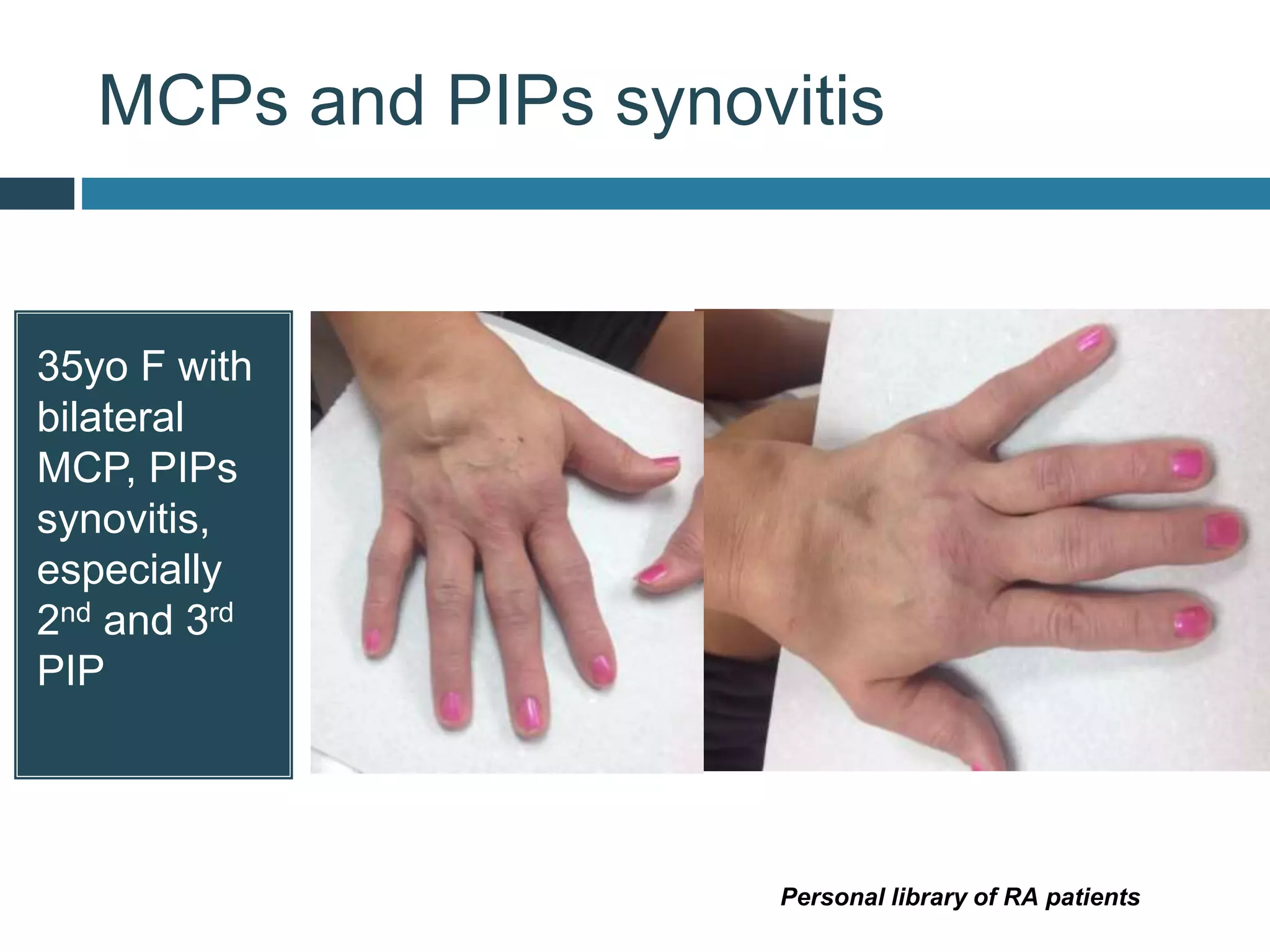
MCPs and PIPs synovitis
35yo F with
bilateral
MCP, PIPs
synovitis,
especially
2nd and 3rd
PIP
Personal library of RA patients
Symmetric deformities
40yo female
presented
with bilateral
MCP
synovitis and
“boutonniere
” deformity of
4th digit
Personal library of RA patients
RA-deformities of the hands
A.”Butonniere” deformity“
B. “Swan neck deformity” -
hyperextension of the PIP
and extension of the DIP
Kelleys’ Rheumatology Chapter 70, Clinical
RA
RA–late disease
Personal library of RA patients
“Butonniere” deformities in late RA
disease
Hands - Ulnar deviation
Rheumatolo
gy Image
bank-ACR
website
RA mutilans – late stage
Rheumatology Image bank-ACR website
RA nodulosis
Rheumatology Image bank-ACR website
Other forms of RA
◻ Palindromic rheumatism — episodic, one to
several joints affected sequentially for hours to
days, alternating with symptom-free periods
◻ Monoarthritis — Persistent single joint
arthritis (wrist, knee, shoulder, hip, or ankle)
RA extra-articular manifestations
Ocular
Brain
Heart
Pulmonary
GI
Renal
Skin
Extra-articular manifestations
Ocular involvement
Episcleritis Scleromalacia
Rheumatology Image bank-ACR website
Scleromalacia perforans –severe, uncontrolled RA
Personal library of RA patients
78yo patient with longstanding RA. MRI of the brain showed diffuse
leptomeningeal enhancement over the right frontal and parietal lobes.
Leptomeningeal biopsy showed a granulomatous inflammatory reaction
(arrow) consistent with rheumatoid pachymeningitis.
Brain - Pachimeningitis
Rheumatology Image bank-ACR website
Cardiac involvement
Rheumatology Image bank-ACR website
Lung involvement –interstitial lung disease
52 YO M,
seropositive RA
who presented
with dyspnea
and hypoxemia.
Chest X-ray w/
increased
interstitial
markings with
volume loss and
tracheal
deviation.
CT scan-
honeycombing
and traction
bronchiectasis
consistent with
ILD associated
with RA.
Rheumatology Image bank-ACR website
RA pulmonary nodules
Rheumatology Image bank-ACR website
Caplan’s syndrome refers to a type of large nodule formation found in
lungs of patients, many of whom are coal miners with rheumatoid
arthritis (Multiple nodules (3 cm or more in diameter in both lungs).
The remaining pulmonary parenchyma demonstrates micronodularity
typical of pneumoconiosis and fibrosis. There is marked prominence of
RA-Caplan’s Syndrome
Skin involvement –vasculitis
Images demonstrates of the finger from a woman with RA complicated
by systemic vasculitis numerous ischemic lesions.
Note the swan-neck deformity from erosive RA.
Rheumatology Image bank-ACR website
Sternoclavicular Joint
Girnita DM- Case Report: Sternoclavicular Erosions in a Patient with Uncontrolled RA;
The Rheumatologist, December 17, 2015 issue
Renal involvement
Girnita DM et al. Case report: Rheumatoid Arthritis & Autoimmune
Glomerulonephritis; The Rheumatologist; June 13, 2016
 69-year-old African
American female with
25 years’ history of
seropositive, erosive
RA with nephrotic
syndrome and
worsening Cr.
 Renal Biopsy :
immune mediated
MPGN, no signs of
vasculitis
RA - DIAGNOSIS
ACR 2010 Criteria for RA Classification
RA>= 6/10
criteria
ARTHRITIS &
RHEUMATISM
Vol. 62, No. 9,
September 2010, pp
2569–2581
Imaging in RA
Plain XRAYs
◻ Marginal erosions
◻ Symmetric joint-
space narrowing
◻ Periarticular
osteopenia
◻ Baseline and every 2
years
RA at diagnosis and 10 years later
10 years later-progression of osteopenia,
development of ulnar deviation,
subluxation of MCP and loss of joint
space.
Rheumatology Image bank-ACR website
At diagnosis: juxtaarticular
osteopenia.
Feet involvement
 Marginal
erosions
 Osteopenia
 Lateral
deviation, and
subluxation of
all the MTPs
 Hallux valgus
Rheumatology Image bank-ACR website
Elbows and Knees
Elbow erosion Knee erosion
Rheumatology Image bank-ACR website
Ultrasound detects synovitis and early bone erosions.
Rheumatology Image bank-ACR website
MRI detects bone erosions earlier than Xrays
Rheumatology Image bank-ACR website
Cervical spine involvement
MRI cervical spine
demonstrating pannus
formation of the C1–C2
articulation (long arrow)
and impingement of the
odontoid on the spinal
cord (arrow).
Rheumatology Image bank-ACR website
Cervical Spine, Atlantoaxial Subluxation
The lateral radiograph in flexion
shows separation between the
anterior inferior aspect of C1
and the odontoid process of
greater than 2.5 mm.
Rheumatology Image bank-ACR website
Differential diagnosis
Spondylarthropaties -Ankylosing spondylitis,
psoriatic arthritis, inflammatory bowel disease,
reactive arthritis
CTD-SLE, Sjogren, scleroderma, sarcoidosis
Crystal induced arthritidis (CPPD, Gout)
Infections (Hepatitis B, C, HIV, parvovirus, Lyme,
bacterial endocarditis)
Polymyalgia rheumatica/Giant cell artheritis
Osteoarthritis
Rheumatoid arthritis vs Osteoarthritis
The significance of RF and anti-
CCP
Rheumatoid factor (RF)
 RF -70% to 80% with a specificity of 86% for RA
 High-titer RF appears to be a better predictor of a
severe disease course
 Stronger correlation with extraarticular manifestations
(ILD) and subcutaneous nodules, and with increased
mortality
 The RF titer does not correlate with disease activity so
it does not have to be repeated
 Positive RF - hepatitis C (40%), SLE (20%), Sjögren’s
syndrome (70%), and subacute bacterial endocarditis
High titer of RF more erosive disease
van Zeben D et al. Clinical significance of rheumatoid factors in early rheumatoid arthritis: results of
a follow up study. Ann Rheum Dis. 1992;51(9):1029.
Numberoferosions
Anti-CCP better specificity than
RF
Nishimura K et al. Meta-analysis: diagnostic accuracy of anti-cyclic citrullinated peptide antibody and
rheumatoid factor for rheumatoid arthritis. Ann Intern Med. 2007 Jun 5;146(11):797-808.
Zeng X et al. Diagnostic value of anti-cyclic citrullinated Peptide antibody in patients with rheumatoid
arthritis. J Rheumatol. 2003;30(7):1451. Ann Rheum Dis. 2006 Jul; 65(7): 845–851.
Other autoimmune tests
 ANA: +30%; patients tend to have more severe
disease and a poorer prognosis;+ secondary
Sjögren’s syndrome.
 ANCA: usually negative. If it is positive, it should not
have specificity against PR3 or myeloperoxidase.
 Complement (C3, C4, CH50): normal or elevated. If
it is low, consider a disease other than RA.
Poor outcome/ severe disease
RF ;anti-CCP + and poor functional status at presentation
Generalized polyarthritis (small and large joints >13 joints)
Extraarticular disease(nodules and vasculitis)
Persistently elevated ESR or CRP; ANA +
Radiographic erosions within 2 years of disease onset
HLA-DR4 genetic marker
Education level <11th grade (frequently have a manual labor job
contributing to joint damage)
Increased cardiovascular risk in RA
US - Mortality Data
 1997, RA accounted for 22% of all
deaths due to arthritis and other
rheumatic conditions in the US
 40% of all deaths in RA patients are
due to CV causes (ischemic heart
disease, stroke, premature death)
Sacks JJ, Helmick CG, Langmaid G. Deaths from arthritis and other rheumatic conditions, United States, 1979-1998 1.
J.Rheumatol. 2004;31(9):1823-1828; Symmons DP, Gabriel SE. Epidemiology of CVD in rheumatic disease, with a focus
on RA and SLE. Nat Rev Rheumatol. 2011;7(7):399-408.
Wolfe F et al. The mortality in RA. Arthritis & Rheumatism; 37 (4) 481-494, 1994
Increased mortality in RA patients
Premature
atherosclerosis
MI, Stroke in RA
Roman MJ. Preclinical carotid atherosclerosis in patients
with RA Ann Intern Med. 2006;144:249-256.
Solomon DH et al, Circulation. 2003;107:1303-1307
Unrecognized MI in RA patients
Maradit-Kremers et al. Arthritis Rheum. 2005 Mar;52(3):722-32.
Increased risk of MI, stroke and CV death
in RA patients
Solomon DH et al. Ann Rheum Dis 2006; 65:1608-1612
Increased risk of Heart failure in RA
Nicola PJ et al. The risk of congestive heart failure in rheumatoid arthritis: a population-based study over 46 years.
Arthritis Rheum. 2005 Feb;52(2):412-20. Crowson C et al. ARTHRITIS & RHEUMATISM 2005(10:52), pp 3039–3044
TREATMENT IN RA
Early, aggressive treatment is the key in RA
 Once the diagnosis of RA is established, all patients
(with rare exception) should begin DMARD therapy
 Bone erosions and joint space narrowing develop
within the first 2 years of disease in most patients
and are progressive from that point onward
 Patients with evidence of active disease (synovitis,
morning stiffness, etc.), bony erosions or deformities,
or extraarticular disease
DMARD
(disease modifying anti-rheumatic drugs)
 Drug must change the course of the disease for
at least 1 year as evidenced by
 sustained improvement in physical function
 decreased inflammatory synovitis
 slowing or prevention of joint destruction
DMARDs
Abbas AK et al, Basic Immunology: Functions and Disorders of the Immune System
Cytokine-
targeted
therapies
TNF
inhibitors
Etanercept, Infliximab,
Adalimumab, Golimumab,
Certolizumab
IL-1 inhibitors Anakinra
IL-6 inhibitors Tocilizumab, Sarilumab
IL12/23
IL-17
Ustekinumab
Secukinumab, Ixekizumab
Jak inhibitors Tofacitinib, Baricitinib
B-cell targeted
therapies
Rituximab (anti-CD 20)
B cell growth factor inhibitors: Belimumab
T-cell targeted
therapies
Abatacept (anti-CD80/ 86)
TNF alpha -inhibitors
IL-6 inhibitors (Tocilizumab)
JAK inhibitors (Tofacinib)
Koenders MI et al.Novel therapeutic targets in rheumatoid arthritis, Trends in Pharmacological Science,
2015, vol36:4, p189-195
T cell targeted therapy (Abatacept)
B-cell targeted therapy
(Rituximab)
2015 ACR
guidelines
for RA
treatment
Singh JI et al, Arthritis Care & Research
2015, American College of Rheumatology
Wheel of empiric therapy
Kelley's Textbook of Rheumatology, 9th edition, Treatment in RA
Triple therapy HCQ+SSZ+MTX
 Improved disease
activity of triple
therapy vs
monotherapy
TEAR trial - Etanercept vs triple therapy
Moreland LW et al. A randomized comparative effectiveness study of oral triple therapy vs
etanercept plus methotrexate in early aggressive rheumatoid arthritis: the treatment
of Early Aggressive Rheumatoid Arthritis Trial. Arthritis Rheum. 2012 September ; 64(9): 2824–2835.
PREMIER trial- Adalimumab+methotrexate is
superior to either alone
Breedveld FC, Weisman MH, Kavanaugh AF, et al: A multicenter, randomized, double-blind clinical trial of
combination therapy with adalimumab plus methotrexate versus methotrexate alone or adalimumab alone in
patients with early, aggressive rheumatoid arthritis who had not had previous methotrexate treatment, Arthritis
Rheum 54:26–37, 2006
Effect of Biologic therapies in RA
Targeted therapies changed the
course of RA
No
deformities
No
synovectomies/
splinting
Resolution
of nodules
Less RA
lung
Less
Mortality
from CVD
Low
incidence of
lymphoma
The role of the PCP
PCP
Rheumatologi
st
Patient
Recognize disease early, early
referral
Monitor and aggresively treat CV
risk factors
Monitor and treat osteoporosis
Immunization prior DMARDs/ biologics
Recognize side effects from
medication
Rheumatoid arthritis: SUMMARY
 Autoimmune disease -SYSTMIC effect (joints, heart,
lung, eyes, etc)
 RF and CCP are helpful in diagnosis, but remains a
CLINICAL diagnosis
 Treatment needs to start early and had been proven
to help restore the functional capacity of patients
 Targeted therapies have changed the course of
Rheumatoid arthritis
 Arthritis foundation website www.arthritis.org
THANK YOU!

Rheumatoid arthritis

  • 1.
    RHEUMATOID ARTHRITIS A COMMON AUTOIMMUNEDISEASE DIANA GIRNITA MD PhD RHEUMATOLOGY TRIHEALTH PHYSICIAN PARTNERS
  • 2.
    Learning objectives  Understandingthe most common clinical presentation of RA, laboratory testing and differential diagnosis  Understanding that RA is a systemic disease with emphasis on the increased cardiovascular risk  Current treatment options in RA and the importance of early aggressive treatment
  • 3.
    RA chronic, systemicdisease ◻ Rheumatoid arthritis (RA) is a symmetric, inflammatory, peripheral polyarthritis ◻ If untreated, inflammation can lead to joint destruction, deformity, significant disability and shortened life expectancy.
  • 4.
    Epidemiology ◻ Annual incidence:30/ 100,000 persons worldwide. ◻ Female predominance ( F: M is 5:1 < age 50) ◻ Can develop at any age ◻ Peak age of onset 30 to 55 years
  • 5.
  • 6.
    Genetic Factors ◻ Accountfor 60% of an individual’s susceptibility to RA ◻ HLA-DR genes (DR4, DR1, DR14) account for 30% to 40% of genetic predisposition ◻ Genetic loci outside the MHC have been associated with an increased risk ◻ Polymorphisms of PTPN22, TRAF1-C5, STAT4, TNFAIP3, and PADI4
  • 7.
    Hormones? ◻ Reduced riskin women who have had children/ breastfed > 1 year ◻ Disease activity often subsides during pregnancy and flares postpartum
  • 8.
    Environmental Factors ◻ Smokingthe best characterized environmental risk factor increases the OR for developing RA 12-fold in susceptible monozygotic twins, 2.5- fold in dizygotic twins, and 1.8-fold in smokers (>20 pack-yrs). This risk persists for 10 to 20 years after a person quits smoking. ◻ Periodontal disease ◻ Asbestos/ silica exposure ◻ Parvovirus/ EBV virus –low evidence
  • 9.
    RF and CCP ◻The presence of Rheumatoid factor (RF) or anti- CCP (citric citrullinated peptides) antibodies in the blood is associated with increased risk of RA ◻ RF is absent in 30% of patients with rheumatoid arthritis; present in 10% of healthy individuals ◻ Anti-CCP antibodies are absent in 40% of patients with the disease.
  • 11.
  • 12.
    RA is asystemic disease  Joints  Heart  Lungs  Brain  Bones  Eyes  GI  Skin  Kidney
  • 13.
    “Classic” RA ◻ Symmetric,bilateral polyarthritis of small, medium, and large joints ◻ Morning stiffness >1h Most common joints affected in RA Rheumatology secrets, 3rd ed, 2016
  • 14.
  • 15.
    MCPs and PIPssynovitis 35yo F with bilateral MCP, PIPs synovitis, especially 2nd and 3rd PIP Personal library of RA patients
  • 16.
    Symmetric deformities 40yo female presented withbilateral MCP synovitis and “boutonniere ” deformity of 4th digit Personal library of RA patients
  • 17.
    RA-deformities of thehands A.”Butonniere” deformity“ B. “Swan neck deformity” - hyperextension of the PIP and extension of the DIP Kelleys’ Rheumatology Chapter 70, Clinical RA
  • 18.
    RA–late disease Personal libraryof RA patients “Butonniere” deformities in late RA disease
  • 19.
    Hands - Ulnardeviation Rheumatolo gy Image bank-ACR website
  • 20.
    RA mutilans –late stage Rheumatology Image bank-ACR website
  • 21.
  • 22.
    Other forms ofRA ◻ Palindromic rheumatism — episodic, one to several joints affected sequentially for hours to days, alternating with symptom-free periods ◻ Monoarthritis — Persistent single joint arthritis (wrist, knee, shoulder, hip, or ankle)
  • 23.
  • 24.
  • 25.
  • 26.
    Scleromalacia perforans –severe,uncontrolled RA Personal library of RA patients
  • 27.
    78yo patient withlongstanding RA. MRI of the brain showed diffuse leptomeningeal enhancement over the right frontal and parietal lobes. Leptomeningeal biopsy showed a granulomatous inflammatory reaction (arrow) consistent with rheumatoid pachymeningitis. Brain - Pachimeningitis Rheumatology Image bank-ACR website
  • 28.
  • 29.
    Lung involvement –interstitiallung disease 52 YO M, seropositive RA who presented with dyspnea and hypoxemia. Chest X-ray w/ increased interstitial markings with volume loss and tracheal deviation. CT scan- honeycombing and traction bronchiectasis consistent with ILD associated with RA. Rheumatology Image bank-ACR website
  • 30.
    RA pulmonary nodules RheumatologyImage bank-ACR website
  • 31.
    Caplan’s syndrome refersto a type of large nodule formation found in lungs of patients, many of whom are coal miners with rheumatoid arthritis (Multiple nodules (3 cm or more in diameter in both lungs). The remaining pulmonary parenchyma demonstrates micronodularity typical of pneumoconiosis and fibrosis. There is marked prominence of RA-Caplan’s Syndrome
  • 32.
    Skin involvement –vasculitis Imagesdemonstrates of the finger from a woman with RA complicated by systemic vasculitis numerous ischemic lesions. Note the swan-neck deformity from erosive RA. Rheumatology Image bank-ACR website
  • 33.
    Sternoclavicular Joint Girnita DM-Case Report: Sternoclavicular Erosions in a Patient with Uncontrolled RA; The Rheumatologist, December 17, 2015 issue
  • 34.
    Renal involvement Girnita DMet al. Case report: Rheumatoid Arthritis & Autoimmune Glomerulonephritis; The Rheumatologist; June 13, 2016  69-year-old African American female with 25 years’ history of seropositive, erosive RA with nephrotic syndrome and worsening Cr.  Renal Biopsy : immune mediated MPGN, no signs of vasculitis
  • 35.
  • 36.
    ACR 2010 Criteriafor RA Classification RA>= 6/10 criteria ARTHRITIS & RHEUMATISM Vol. 62, No. 9, September 2010, pp 2569–2581
  • 37.
  • 38.
    Plain XRAYs ◻ Marginalerosions ◻ Symmetric joint- space narrowing ◻ Periarticular osteopenia ◻ Baseline and every 2 years
  • 39.
    RA at diagnosisand 10 years later 10 years later-progression of osteopenia, development of ulnar deviation, subluxation of MCP and loss of joint space. Rheumatology Image bank-ACR website At diagnosis: juxtaarticular osteopenia.
  • 40.
    Feet involvement  Marginal erosions Osteopenia  Lateral deviation, and subluxation of all the MTPs  Hallux valgus Rheumatology Image bank-ACR website
  • 41.
    Elbows and Knees Elbowerosion Knee erosion Rheumatology Image bank-ACR website
  • 42.
    Ultrasound detects synovitisand early bone erosions. Rheumatology Image bank-ACR website
  • 43.
    MRI detects boneerosions earlier than Xrays Rheumatology Image bank-ACR website
  • 44.
    Cervical spine involvement MRIcervical spine demonstrating pannus formation of the C1–C2 articulation (long arrow) and impingement of the odontoid on the spinal cord (arrow). Rheumatology Image bank-ACR website
  • 45.
    Cervical Spine, AtlantoaxialSubluxation The lateral radiograph in flexion shows separation between the anterior inferior aspect of C1 and the odontoid process of greater than 2.5 mm. Rheumatology Image bank-ACR website
  • 46.
    Differential diagnosis Spondylarthropaties -Ankylosingspondylitis, psoriatic arthritis, inflammatory bowel disease, reactive arthritis CTD-SLE, Sjogren, scleroderma, sarcoidosis Crystal induced arthritidis (CPPD, Gout) Infections (Hepatitis B, C, HIV, parvovirus, Lyme, bacterial endocarditis) Polymyalgia rheumatica/Giant cell artheritis Osteoarthritis
  • 47.
  • 48.
    The significance ofRF and anti- CCP
  • 49.
    Rheumatoid factor (RF) RF -70% to 80% with a specificity of 86% for RA  High-titer RF appears to be a better predictor of a severe disease course  Stronger correlation with extraarticular manifestations (ILD) and subcutaneous nodules, and with increased mortality  The RF titer does not correlate with disease activity so it does not have to be repeated  Positive RF - hepatitis C (40%), SLE (20%), Sjögren’s syndrome (70%), and subacute bacterial endocarditis
  • 50.
    High titer ofRF more erosive disease van Zeben D et al. Clinical significance of rheumatoid factors in early rheumatoid arthritis: results of a follow up study. Ann Rheum Dis. 1992;51(9):1029. Numberoferosions
  • 51.
    Anti-CCP better specificitythan RF Nishimura K et al. Meta-analysis: diagnostic accuracy of anti-cyclic citrullinated peptide antibody and rheumatoid factor for rheumatoid arthritis. Ann Intern Med. 2007 Jun 5;146(11):797-808. Zeng X et al. Diagnostic value of anti-cyclic citrullinated Peptide antibody in patients with rheumatoid arthritis. J Rheumatol. 2003;30(7):1451. Ann Rheum Dis. 2006 Jul; 65(7): 845–851.
  • 52.
    Other autoimmune tests ANA: +30%; patients tend to have more severe disease and a poorer prognosis;+ secondary Sjögren’s syndrome.  ANCA: usually negative. If it is positive, it should not have specificity against PR3 or myeloperoxidase.  Complement (C3, C4, CH50): normal or elevated. If it is low, consider a disease other than RA.
  • 53.
    Poor outcome/ severedisease RF ;anti-CCP + and poor functional status at presentation Generalized polyarthritis (small and large joints >13 joints) Extraarticular disease(nodules and vasculitis) Persistently elevated ESR or CRP; ANA + Radiographic erosions within 2 years of disease onset HLA-DR4 genetic marker Education level <11th grade (frequently have a manual labor job contributing to joint damage)
  • 54.
  • 55.
    US - MortalityData  1997, RA accounted for 22% of all deaths due to arthritis and other rheumatic conditions in the US  40% of all deaths in RA patients are due to CV causes (ischemic heart disease, stroke, premature death) Sacks JJ, Helmick CG, Langmaid G. Deaths from arthritis and other rheumatic conditions, United States, 1979-1998 1. J.Rheumatol. 2004;31(9):1823-1828; Symmons DP, Gabriel SE. Epidemiology of CVD in rheumatic disease, with a focus on RA and SLE. Nat Rev Rheumatol. 2011;7(7):399-408.
  • 56.
    Wolfe F etal. The mortality in RA. Arthritis & Rheumatism; 37 (4) 481-494, 1994 Increased mortality in RA patients
  • 57.
    Premature atherosclerosis MI, Stroke inRA Roman MJ. Preclinical carotid atherosclerosis in patients with RA Ann Intern Med. 2006;144:249-256. Solomon DH et al, Circulation. 2003;107:1303-1307
  • 58.
    Unrecognized MI inRA patients Maradit-Kremers et al. Arthritis Rheum. 2005 Mar;52(3):722-32.
  • 59.
    Increased risk ofMI, stroke and CV death in RA patients Solomon DH et al. Ann Rheum Dis 2006; 65:1608-1612
  • 60.
    Increased risk ofHeart failure in RA Nicola PJ et al. The risk of congestive heart failure in rheumatoid arthritis: a population-based study over 46 years. Arthritis Rheum. 2005 Feb;52(2):412-20. Crowson C et al. ARTHRITIS & RHEUMATISM 2005(10:52), pp 3039–3044
  • 61.
  • 62.
    Early, aggressive treatmentis the key in RA  Once the diagnosis of RA is established, all patients (with rare exception) should begin DMARD therapy  Bone erosions and joint space narrowing develop within the first 2 years of disease in most patients and are progressive from that point onward  Patients with evidence of active disease (synovitis, morning stiffness, etc.), bony erosions or deformities, or extraarticular disease
  • 63.
    DMARD (disease modifying anti-rheumaticdrugs)  Drug must change the course of the disease for at least 1 year as evidenced by  sustained improvement in physical function  decreased inflammatory synovitis  slowing or prevention of joint destruction
  • 64.
  • 65.
    Abbas AK etal, Basic Immunology: Functions and Disorders of the Immune System
  • 67.
    Cytokine- targeted therapies TNF inhibitors Etanercept, Infliximab, Adalimumab, Golimumab, Certolizumab IL-1inhibitors Anakinra IL-6 inhibitors Tocilizumab, Sarilumab IL12/23 IL-17 Ustekinumab Secukinumab, Ixekizumab Jak inhibitors Tofacitinib, Baricitinib B-cell targeted therapies Rituximab (anti-CD 20) B cell growth factor inhibitors: Belimumab T-cell targeted therapies Abatacept (anti-CD80/ 86)
  • 68.
  • 69.
  • 70.
    JAK inhibitors (Tofacinib) KoendersMI et al.Novel therapeutic targets in rheumatoid arthritis, Trends in Pharmacological Science, 2015, vol36:4, p189-195
  • 71.
    T cell targetedtherapy (Abatacept)
  • 72.
  • 73.
    2015 ACR guidelines for RA treatment SinghJI et al, Arthritis Care & Research 2015, American College of Rheumatology
  • 74.
    Wheel of empirictherapy Kelley's Textbook of Rheumatology, 9th edition, Treatment in RA
  • 75.
    Triple therapy HCQ+SSZ+MTX Improved disease activity of triple therapy vs monotherapy
  • 76.
    TEAR trial -Etanercept vs triple therapy Moreland LW et al. A randomized comparative effectiveness study of oral triple therapy vs etanercept plus methotrexate in early aggressive rheumatoid arthritis: the treatment of Early Aggressive Rheumatoid Arthritis Trial. Arthritis Rheum. 2012 September ; 64(9): 2824–2835.
  • 77.
    PREMIER trial- Adalimumab+methotrexateis superior to either alone Breedveld FC, Weisman MH, Kavanaugh AF, et al: A multicenter, randomized, double-blind clinical trial of combination therapy with adalimumab plus methotrexate versus methotrexate alone or adalimumab alone in patients with early, aggressive rheumatoid arthritis who had not had previous methotrexate treatment, Arthritis Rheum 54:26–37, 2006
  • 78.
    Effect of Biologictherapies in RA
  • 79.
    Targeted therapies changedthe course of RA No deformities No synovectomies/ splinting Resolution of nodules Less RA lung Less Mortality from CVD Low incidence of lymphoma
  • 80.
    The role ofthe PCP PCP Rheumatologi st Patient Recognize disease early, early referral Monitor and aggresively treat CV risk factors Monitor and treat osteoporosis Immunization prior DMARDs/ biologics Recognize side effects from medication
  • 81.
    Rheumatoid arthritis: SUMMARY Autoimmune disease -SYSTMIC effect (joints, heart, lung, eyes, etc)  RF and CCP are helpful in diagnosis, but remains a CLINICAL diagnosis  Treatment needs to start early and had been proven to help restore the functional capacity of patients  Targeted therapies have changed the course of Rheumatoid arthritis  Arthritis foundation website www.arthritis.org
  • 82.