Department of
ARTIFICIAL INTELLIGENCE & DATA SCIENCE
M.Tech. 3rd Semester
SEMINAR TOPIC
Three main Architectures For Parallel Database
PRAGATI NARBOLIKAR
SG22ADS012
 In Parallel Databases, mainly there are three architectural designs for parallel DBMS.
They are as follows:
1. Shared Memory Architecture
2. Shared Disk Architecture
3. Shared Nothing Architecture
Let’s discuss them one by one:
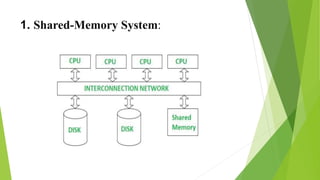
1. Shared-Memory System:
Shared-Memory System:
• Description: In a shared-memory system, multiple CPUs (Central Processing Units) are
connected to a common pool of main memory through an interconnection network.
• Functionality: All CPUs can access and share data stored in the common main
memory.
Advantages :
1. It has high-speed data access for a limited number of processors.
2. The communication is efficient.
Disadvantages :
1. It cannot use beyond 80 or 100 CPUs in parallel.
2. The bus or the interconnection network gets block due to the increment of the
large number of CPUs.
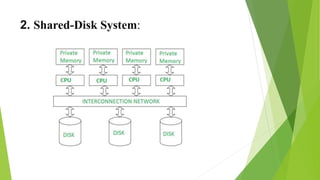
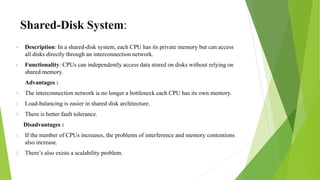
2. Shared-Disk System:
Shared-Disk System:
• Description: In a shared-disk system, each CPU has its private memory but can access
all disks directly through an interconnection network.
• Functionality: CPUs can independently access data stored on disks without relying on
shared memory.
Advantages :
1. The interconnection network is no longer a bottleneck each CPU has its own memory.
2. Load-balancing is easier in shared disk architecture.
3. There is better fault tolerance.
Disadvantages :
1. If the number of CPUs increases, the problems of interference and memory contentions
also increase.
2. There’s also exists a scalability problem.
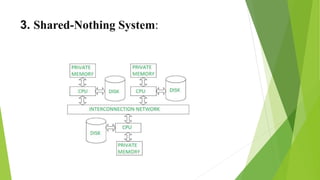
3. Shared-Nothing System:
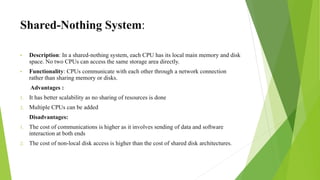
Shared-Nothing System:
• Description: In a shared-nothing system, each CPU has its local main memory and disk
space. No two CPUs can access the same storage area directly.
• Functionality: CPUs communicate with each other through a network connection
rather than sharing memory or disks.
Advantages :
1. It has better scalability as no sharing of resources is done
2. Multiple CPUs can be added
Disadvantages:
1. The cost of communications is higher as it involves sending of data and software
interaction at both ends
2. The cost of non-local disk access is higher than the cost of shared disk architectures.
THANK YOU!!

Three main Architectures For Parallel Database.pptx

  • 1.
    Department of ARTIFICIAL INTELLIGENCE& DATA SCIENCE M.Tech. 3rd Semester SEMINAR TOPIC Three main Architectures For Parallel Database PRAGATI NARBOLIKAR SG22ADS012
  • 2.
     In ParallelDatabases, mainly there are three architectural designs for parallel DBMS. They are as follows: 1. Shared Memory Architecture 2. Shared Disk Architecture 3. Shared Nothing Architecture Let’s discuss them one by one:
  • 3.
  • 4.
    Shared-Memory System: • Description:In a shared-memory system, multiple CPUs (Central Processing Units) are connected to a common pool of main memory through an interconnection network. • Functionality: All CPUs can access and share data stored in the common main memory. Advantages : 1. It has high-speed data access for a limited number of processors. 2. The communication is efficient. Disadvantages : 1. It cannot use beyond 80 or 100 CPUs in parallel. 2. The bus or the interconnection network gets block due to the increment of the large number of CPUs.
  • 5.
  • 6.
    Shared-Disk System: • Description:In a shared-disk system, each CPU has its private memory but can access all disks directly through an interconnection network. • Functionality: CPUs can independently access data stored on disks without relying on shared memory. Advantages : 1. The interconnection network is no longer a bottleneck each CPU has its own memory. 2. Load-balancing is easier in shared disk architecture. 3. There is better fault tolerance. Disadvantages : 1. If the number of CPUs increases, the problems of interference and memory contentions also increase. 2. There’s also exists a scalability problem.
  • 7.
  • 8.
    Shared-Nothing System: • Description:In a shared-nothing system, each CPU has its local main memory and disk space. No two CPUs can access the same storage area directly. • Functionality: CPUs communicate with each other through a network connection rather than sharing memory or disks. Advantages : 1. It has better scalability as no sharing of resources is done 2. Multiple CPUs can be added Disadvantages: 1. The cost of communications is higher as it involves sending of data and software interaction at both ends 2. The cost of non-local disk access is higher than the cost of shared disk architectures.
  • 9.