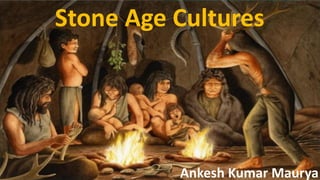
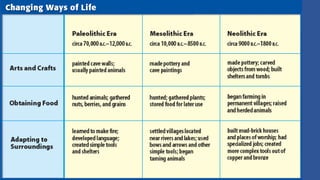
Stone Age Cultures
Ankesh Kumar Maurya
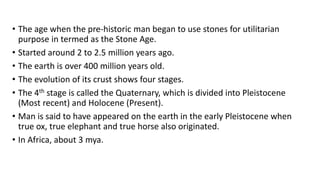
• The age when the pre-historic man began to use stones for utilitarian
purpose in termed as the Stone Age.
• Started around 2 to 2.5 million years ago.
• The earth is over 400 million years old.
• The evolution of its crust shows four stages.
• The 4th stage is called the Quaternary, which is divided into Pleistocene
(Most recent) and Holocene (Present).
• Man is said to have appeared on the earth in the early Pleistocene when
true ox, true elephant and true horse also originated.
• In Africa, about 3 mya.
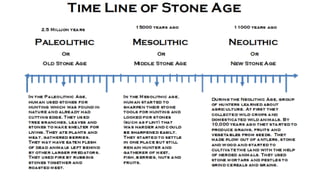
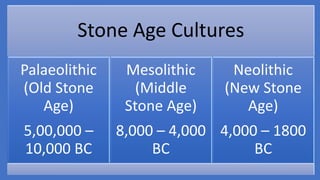
Stone Age Cultures
Palaeolithic
(Old Stone
Age)
5,00,000 –
10,000 BC
Mesolithic
(Middle
Stone Age)
8,000 – 4,000
BC
Neolithic
(New Stone
Age)
4,000 – 1800
BC
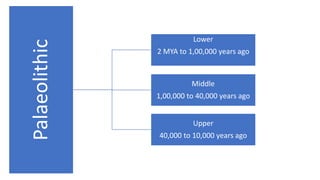
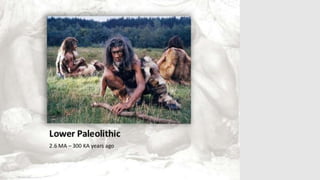
Palaeolithic Lower
2 MYA to 1,00,000 years ago
Middle
1,00,000 to 40,000 years ago
Upper
40,000 to 10,000 years ago
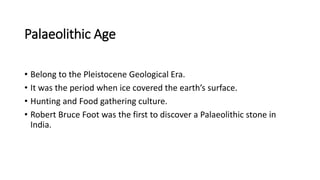
Palaeolithic Age
• Belong to the Pleistocene Geological Era.
• It was the period when ice covered the earth’s surface.
• Hunting and Food gathering culture.
• Robert Bruce Foot was the first to discover a Palaeolithic stone in
India.
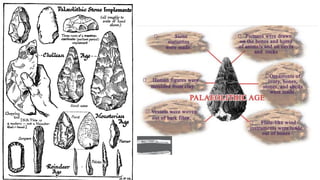
Tools
• Club, Sharpened Stone, Chopper, Hand Axes, Scraper, Spear, Bow and
Arrow, Harpoon, Needle etc.
• Hard rock Quartzite
• Quartzite Man (Palaeolithic Man).
Lower Palaeolithic Age (2MYA to 1,00,000
years ago)
• It covers the greater part of the Ice age.
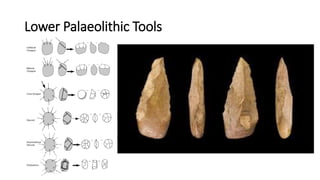
• Tools- Hand Axes, Cleavers, Choppers, Chopping Tools.
• Quartzite
• In Hunsgi (Karnataka) – Limestone
• In Lalitpur – Pink Granite
• In Maharashtra – Besalt
Lower Palaeolithic Tools
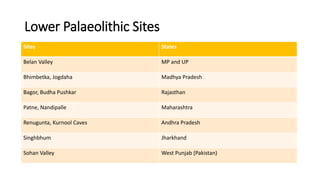
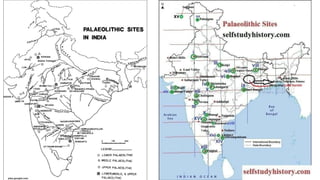
Lower Palaeolithic Sites
Sites States
Belan Valley MP and UP
Bhimbetka, Jogdaha Madhya Pradesh
Bagor, Budha Pushkar Rajasthan
Patne, Nandipalle Maharashtra
Renugunta, Kurnool Caves Andhra Pradesh
Singhbhum Jharkhand
Sohan Valley West Punjab (Pakistan)
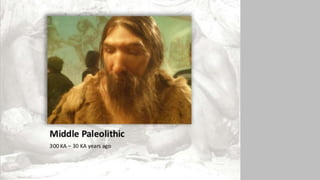
Middle Palaeolithic Age(1,00,000 – 40,000 BC)
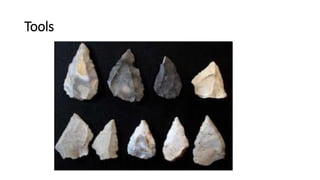
• Its tool pattern is based upon flakes and crude pebble industry.
• Smaller, lighter flake tools, blades, points, borers.
• This stage is also known by several names such as Series II, Nevasian
and Middle Stone Age in India.
• H.D. Sankalia in 1955 first discovered and identified Middle
Palaeolithic cultural phase at Nevasa on the Pravara river valley.
• The site revealed a number of artifacts such as scrapers, points and
borers made on flakes.
• The raw materials used for making these artifacts are siliceous
materials like chert, chalcedony, agate and jasper.
Life During Middle Palaeolithic Age
• During the Middle Palaeolithic period, open-air sites along streams,
hill slopes, stable dune surfaces and rock shelters continued to be
used.
• Sanghao cave in modern Pakistan, sand dunes of Didwana, river
valleys of Chambal, Narmada, Son, Hunsgi, Kortallayar etc.
Tools
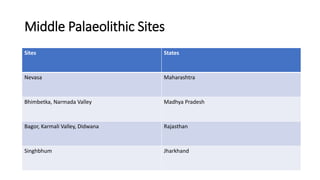
Middle Palaeolithic Sites
Sites States
Nevasa Maharashtra
Bhimbetka, Narmada Valley Madhya Pradesh
Bagor, Karmali Valley, Didwana Rajasthan
Singhbhum Jharkhand
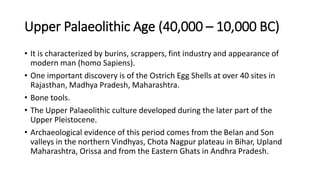
Upper Palaeolithic Age (40,000 – 10,000 BC)
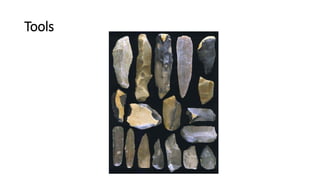
• It is characterized by burins, scrappers, fint industry and appearance of
modern man (homo Sapiens).
• One important discovery is of the Ostrich Egg Shells at over 40 sites in
Rajasthan, Madhya Pradesh, Maharashtra.
• Bone tools.
• The Upper Palaeolithic culture developed during the later part of the
Upper Pleistocene.
• Archaeological evidence of this period comes from the Belan and Son
valleys in the northern Vindhyas, Chota Nagpur plateau in Bihar, Upland
Maharashtra, Orissa and from the Eastern Ghats in Andhra Pradesh.
Tools
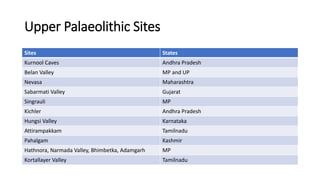
Upper Palaeolithic Sites
Sites States
Kurnool Caves Andhra Pradesh
Belan Valley MP and UP
Nevasa Maharashtra
Sabarmati Valley Gujarat
Singrauli MP
Kichler Andhra Pradesh
Hungsi Valley Karnataka
Attirampakkam Tamilnadu
Pahalgam Kashmir
Hathnora, Narmada Valley, Bhimbetka, Adamgarh MP
Kortallayer Valley Tamilnadu
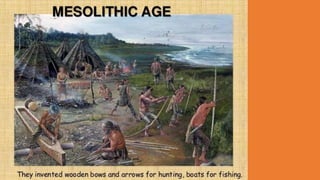
Mesolithic Age (8000 – 4000 BC)
• Hunters and Herders
• Transitional phase between the Palaeolithic and Neolithic
• Microliths or Small Pointed and Sharp Stone Tools
• Favourable changes in the climate and changes in tools
• Rise in temperature
• Warm and Dry/Humid Climate
• E.g.- Birbhanpur (WB)- Increasing Aridity
• Higher Rainfall e.g.- Didwana, RJ (Salt lake sediments and Pollen grains)
• Icecaps melted forming rivers as an effect of global warming
• Availability of new resources (Human Migration)
• Increased Population
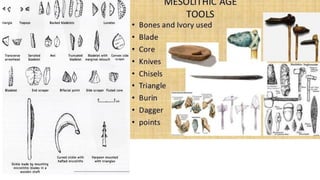
Tools
• Smaller in size and better in finishing
• More Geometric
• Microliths (Small Stone Tools) (1 to 8 cm)
• Main Types- Blade, Core, Point, Triangle, Lunate, Trapeze
• Components of Spearheads, Arrowheads, Knives, Sickles, Harpoons,
Daggers
• Use of Bow and Arrow – Hunting
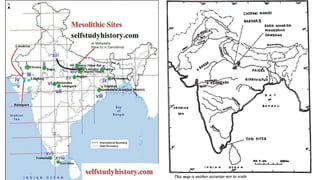
Mesolithic Sites
• First major human colonization of the Ganga plains took place during
this period
• There are more than 200 Mesolithic Sites found in Allahabad,
Pratapgarh, Jaunpur, Mirzapur and Varanasi
• Adamgarh (MP) and Bagor (RJ) provide the earliest evidence for the
domestication of animals like cows, horses and other poultry and
farm animals.
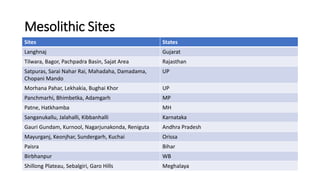
Mesolithic Sites
Sites States
Langhnaj Gujarat
Tilwara, Bagor, Pachpadra Basin, Sajat Area Rajasthan
Satpuras, Sarai Nahar Rai, Mahadaha, Damadama,
Chopani Mando
UP
Morhana Pahar, Lekhakia, Bughai Khor UP
Panchmarhi, Bhimbetka, Adamgarh MP
Patne, Hatkhamba MH
Sanganukallu, Jalahalli, Kibbanhalli Karnataka
Gauri Gundam, Kurnool, Nagarjunakonda, Reniguta Andhra Pradesh
Mayurganj, Keonjhar, Sundergarh, Kuchai Orissa
Paisra Bihar
Birbhanpur WB
Shillong Plateau, Sebalgiri, Garo Hills Meghalaya
Habitation
• Pemanent/Semi-Permanent
• Coastal Areas, Rock Shelters, Flat Hill Tops, River Valleys, Lakesides,
Sand Dunes, Alluvial Plains
• Sand Dunes – GJ and Marwar
• Rock Shelter- Vindhya, Satpura, Kaimur Hills
• Alluvial Plains- Birbhanpur (WB)
• Rocky Plains- Deccan Plateau
• Lake Shore – Gangetic Regions (Allahabad and Pratapgarh)
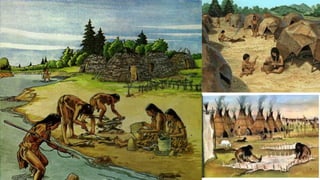
Subsistence Pattern and Social Life
• Economy – Based on Hunting, Fishing and Gathering
• Domestication of Animals (Adamgarh and Bagor)
• Meat and Vegetal Food
• Cave Paintings
• Hut Decoration
• Sowing Seeds
• Pottery Making
• Dancing and Singing
• Material Buried Along With
Changes in Life – Mesolithic Era
• From Nomadism to Sedentary Settlements
• First disposal of dead and making of graves
• Burials - Bagor, Langhnaj, Bhimbetka
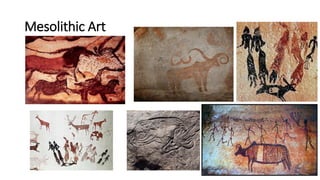
• Emergence of Arts – Paintings
• Red and White Pigments
• Related to Human Social and Religious life
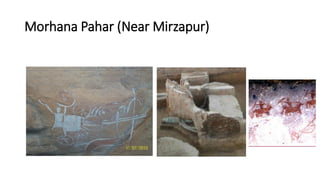
• E.g. – Morhana Pahar Group of Rock Shelters near Mirzapur
• First Plants- Wheat and Barley
• First Domestication- Dog, Cattle, Sheep, Goat
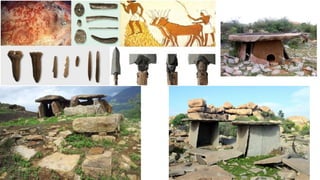
Mesolithic Art
Morhana Pahar (Near Mirzapur)
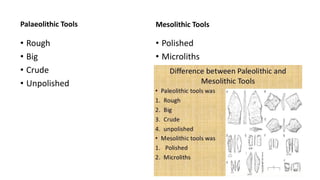
Palaeolithic Tools
• Rough
• Big
• Crude
• Unpolished
Mesolithic Tools
• Polished
• Microliths
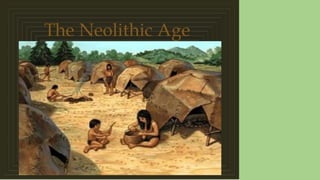
Neolithic Age (4000 – 1800 BC)
• Food Producers
• New Stone Age
• Last Phase of Stone Age
• Domestication of Plants and Animals
• Invention of Pottery
• Coined by Sir John Lubbock
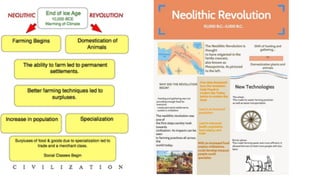
• V. Gordon Childe – Neolithic Revolution
• Practice of Agriculture
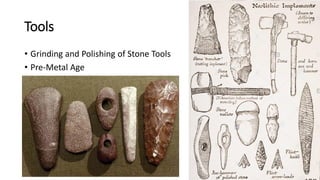
Tools
• Grinding and Polishing of Stone Tools
• Pre-Metal Age
Features
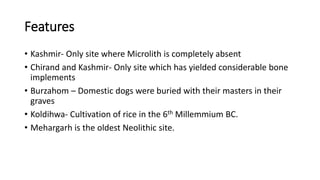
• Kashmir- Only site where Microlith is completely absent
• Chirand and Kashmir- Only site which has yielded considerable bone
implements
• Burzahom – Domestic dogs were buried with their masters in their
graves
• Koldihwa- Cultivation of rice in the 6th Millemmium BC.
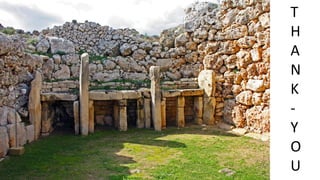
• Mehargarh is the oldest Neolithic site.
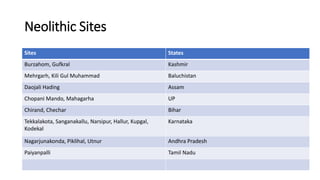
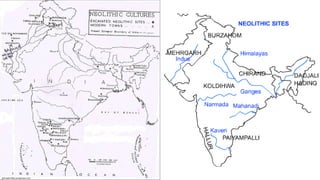
Neolithic Sites
Sites States
Burzahom, Gufkral Kashmir
Mehrgarh, Kili Gul Muhammad Baluchistan
Daojali Hading Assam
Chopani Mando, Mahagarha UP
Chirand, Chechar Bihar
Tekkalakota, Sanganakallu, Narsipur, Hallur, Kupgal,
Kodekal
Karnataka
Nagarjunakonda, Piklihal, Utnur Andhra Pradesh
Paiyanpalli Tamil Nadu
T
H
A
N
K
-
Y
O
U

Stone Age Cultures

  • 1.
  • 5.
    • The agewhen the pre-historic man began to use stones for utilitarian purpose in termed as the Stone Age. • Started around 2 to 2.5 million years ago. • The earth is over 400 million years old. • The evolution of its crust shows four stages. • The 4th stage is called the Quaternary, which is divided into Pleistocene (Most recent) and Holocene (Present). • Man is said to have appeared on the earth in the early Pleistocene when true ox, true elephant and true horse also originated. • In Africa, about 3 mya.
  • 6.
    Stone Age Cultures Palaeolithic (OldStone Age) 5,00,000 – 10,000 BC Mesolithic (Middle Stone Age) 8,000 – 4,000 BC Neolithic (New Stone Age) 4,000 – 1800 BC
  • 7.
    Palaeolithic Lower 2 MYAto 1,00,000 years ago Middle 1,00,000 to 40,000 years ago Upper 40,000 to 10,000 years ago
  • 8.
    Palaeolithic Age • Belongto the Pleistocene Geological Era. • It was the period when ice covered the earth’s surface. • Hunting and Food gathering culture. • Robert Bruce Foot was the first to discover a Palaeolithic stone in India.
  • 9.
    Tools • Club, SharpenedStone, Chopper, Hand Axes, Scraper, Spear, Bow and Arrow, Harpoon, Needle etc. • Hard rock Quartzite • Quartzite Man (Palaeolithic Man).
  • 12.
    Lower Palaeolithic Age(2MYA to 1,00,000 years ago) • It covers the greater part of the Ice age. • Tools- Hand Axes, Cleavers, Choppers, Chopping Tools. • Quartzite • In Hunsgi (Karnataka) – Limestone • In Lalitpur – Pink Granite • In Maharashtra – Besalt
  • 13.
  • 14.
    Lower Palaeolithic Sites SitesStates Belan Valley MP and UP Bhimbetka, Jogdaha Madhya Pradesh Bagor, Budha Pushkar Rajasthan Patne, Nandipalle Maharashtra Renugunta, Kurnool Caves Andhra Pradesh Singhbhum Jharkhand Sohan Valley West Punjab (Pakistan)
  • 17.
    Middle Palaeolithic Age(1,00,000– 40,000 BC) • Its tool pattern is based upon flakes and crude pebble industry. • Smaller, lighter flake tools, blades, points, borers. • This stage is also known by several names such as Series II, Nevasian and Middle Stone Age in India. • H.D. Sankalia in 1955 first discovered and identified Middle Palaeolithic cultural phase at Nevasa on the Pravara river valley. • The site revealed a number of artifacts such as scrapers, points and borers made on flakes. • The raw materials used for making these artifacts are siliceous materials like chert, chalcedony, agate and jasper.
  • 18.
    Life During MiddlePalaeolithic Age • During the Middle Palaeolithic period, open-air sites along streams, hill slopes, stable dune surfaces and rock shelters continued to be used. • Sanghao cave in modern Pakistan, sand dunes of Didwana, river valleys of Chambal, Narmada, Son, Hunsgi, Kortallayar etc.
  • 19.
  • 20.
    Middle Palaeolithic Sites SitesStates Nevasa Maharashtra Bhimbetka, Narmada Valley Madhya Pradesh Bagor, Karmali Valley, Didwana Rajasthan Singhbhum Jharkhand
  • 21.
    Upper Palaeolithic Age(40,000 – 10,000 BC) • It is characterized by burins, scrappers, fint industry and appearance of modern man (homo Sapiens). • One important discovery is of the Ostrich Egg Shells at over 40 sites in Rajasthan, Madhya Pradesh, Maharashtra. • Bone tools. • The Upper Palaeolithic culture developed during the later part of the Upper Pleistocene. • Archaeological evidence of this period comes from the Belan and Son valleys in the northern Vindhyas, Chota Nagpur plateau in Bihar, Upland Maharashtra, Orissa and from the Eastern Ghats in Andhra Pradesh.
  • 22.
  • 23.
    Upper Palaeolithic Sites SitesStates Kurnool Caves Andhra Pradesh Belan Valley MP and UP Nevasa Maharashtra Sabarmati Valley Gujarat Singrauli MP Kichler Andhra Pradesh Hungsi Valley Karnataka Attirampakkam Tamilnadu Pahalgam Kashmir Hathnora, Narmada Valley, Bhimbetka, Adamgarh MP Kortallayer Valley Tamilnadu
  • 25.
    Mesolithic Age (8000– 4000 BC) • Hunters and Herders • Transitional phase between the Palaeolithic and Neolithic • Microliths or Small Pointed and Sharp Stone Tools • Favourable changes in the climate and changes in tools • Rise in temperature • Warm and Dry/Humid Climate • E.g.- Birbhanpur (WB)- Increasing Aridity • Higher Rainfall e.g.- Didwana, RJ (Salt lake sediments and Pollen grains) • Icecaps melted forming rivers as an effect of global warming • Availability of new resources (Human Migration) • Increased Population
  • 26.
    Tools • Smaller insize and better in finishing • More Geometric • Microliths (Small Stone Tools) (1 to 8 cm) • Main Types- Blade, Core, Point, Triangle, Lunate, Trapeze • Components of Spearheads, Arrowheads, Knives, Sickles, Harpoons, Daggers • Use of Bow and Arrow – Hunting
  • 28.
    Mesolithic Sites • Firstmajor human colonization of the Ganga plains took place during this period • There are more than 200 Mesolithic Sites found in Allahabad, Pratapgarh, Jaunpur, Mirzapur and Varanasi • Adamgarh (MP) and Bagor (RJ) provide the earliest evidence for the domestication of animals like cows, horses and other poultry and farm animals.
  • 30.
    Mesolithic Sites Sites States LanghnajGujarat Tilwara, Bagor, Pachpadra Basin, Sajat Area Rajasthan Satpuras, Sarai Nahar Rai, Mahadaha, Damadama, Chopani Mando UP Morhana Pahar, Lekhakia, Bughai Khor UP Panchmarhi, Bhimbetka, Adamgarh MP Patne, Hatkhamba MH Sanganukallu, Jalahalli, Kibbanhalli Karnataka Gauri Gundam, Kurnool, Nagarjunakonda, Reniguta Andhra Pradesh Mayurganj, Keonjhar, Sundergarh, Kuchai Orissa Paisra Bihar Birbhanpur WB Shillong Plateau, Sebalgiri, Garo Hills Meghalaya
  • 31.
    Habitation • Pemanent/Semi-Permanent • CoastalAreas, Rock Shelters, Flat Hill Tops, River Valleys, Lakesides, Sand Dunes, Alluvial Plains • Sand Dunes – GJ and Marwar • Rock Shelter- Vindhya, Satpura, Kaimur Hills • Alluvial Plains- Birbhanpur (WB) • Rocky Plains- Deccan Plateau • Lake Shore – Gangetic Regions (Allahabad and Pratapgarh)
  • 33.
    Subsistence Pattern andSocial Life • Economy – Based on Hunting, Fishing and Gathering • Domestication of Animals (Adamgarh and Bagor) • Meat and Vegetal Food • Cave Paintings • Hut Decoration • Sowing Seeds • Pottery Making • Dancing and Singing • Material Buried Along With
  • 35.
    Changes in Life– Mesolithic Era • From Nomadism to Sedentary Settlements • First disposal of dead and making of graves • Burials - Bagor, Langhnaj, Bhimbetka • Emergence of Arts – Paintings • Red and White Pigments • Related to Human Social and Religious life • E.g. – Morhana Pahar Group of Rock Shelters near Mirzapur • First Plants- Wheat and Barley • First Domestication- Dog, Cattle, Sheep, Goat
  • 36.
  • 37.
  • 38.
    Palaeolithic Tools • Rough •Big • Crude • Unpolished Mesolithic Tools • Polished • Microliths
  • 40.
    Neolithic Age (4000– 1800 BC) • Food Producers • New Stone Age • Last Phase of Stone Age • Domestication of Plants and Animals • Invention of Pottery • Coined by Sir John Lubbock • V. Gordon Childe – Neolithic Revolution • Practice of Agriculture
  • 42.
    Tools • Grinding andPolishing of Stone Tools • Pre-Metal Age
  • 43.
    Features • Kashmir- Onlysite where Microlith is completely absent • Chirand and Kashmir- Only site which has yielded considerable bone implements • Burzahom – Domestic dogs were buried with their masters in their graves • Koldihwa- Cultivation of rice in the 6th Millemmium BC. • Mehargarh is the oldest Neolithic site.
  • 44.
    Neolithic Sites Sites States Burzahom,Gufkral Kashmir Mehrgarh, Kili Gul Muhammad Baluchistan Daojali Hading Assam Chopani Mando, Mahagarha UP Chirand, Chechar Bihar Tekkalakota, Sanganakallu, Narsipur, Hallur, Kupgal, Kodekal Karnataka Nagarjunakonda, Piklihal, Utnur Andhra Pradesh Paiyanpalli Tamil Nadu
  • 48.