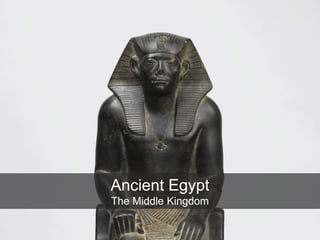
Ancient Egypt
The Middle Kingdom
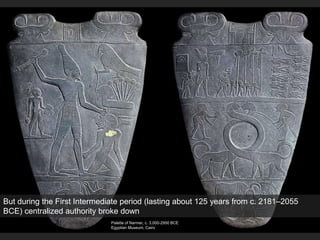
Palette of Narmer, c. 3,000-2950 BCE
Egyptian Museum, Cairo
From the time of King Narmer, Egypt had been unified under one Pharaoh -- and this
stable form of government lasted for over 1,000 years
Palette of Narmer, c. 3,000-2950 BCE
Egyptian Museum, Cairo
But during the First Intermediate period (lasting about 125 years from c. 2181–2055
BCE) centralized authority broke down
Palette of Narmer, c. 3,000-2950 BCE
Egyptian Museum, Cairo
Local chieftains claimed power, and there was a significant decline in artistic production
(major building projects such as the construction of pyramids ceased), and quality
Statue of Nebhepetre Mentuhotep
II in the Jubilee Garment,, c.
2051-2000 BCE
Dynasty 11, Middle Kingdom
Metropolitan Museum
Menuthotep II brought an end to the First Intermediate Period by reuniting Egypt under
centralized authority, marking the beginning of the Middle Kingdom
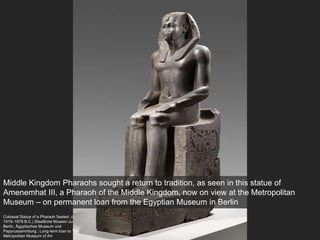
Colossal Statue of a Pharaoh Seated ,c.
1919–1878 B.C.) Staatliche Museen zu
Berlin, Ägyptisches Museum und
Papyrussammlung ; Long‐term loan to The
Metropolitan Museum of Art
Middle Kingdom Pharaohs sought a return to tradition, as seen in this statue of
Amenemhat III, a Pharaoh of the Middle Kingdom, now on view at the Metropolitan
Museum – on permanent loan from the Egyptian Museum in Berlin
A key change is the increase in scale – during the Middle and New Kingdoms, Pharaohs
increasingly resorted to the strategy of colossal size to assert their authority
Senwosret III, c. 1836-1818 BCE
12th Dynasty, Middle Kingdom
Brooklyn Museum
This statue is one of several representing the Middle Kingdom Pharaoh Senwosret III
Senwosret III, c. 1836-1818 BCE
12th Dynasty, Middle Kingdom
Brooklyn Museum
While almost identical to the Seated Statue of Khafre, dating to the Old Kingdom, there
is a significant difference in the representation of the kings facial features
Head of a Statue of Sesostris III c. 1872-1854 BCE
12th Dynasty, Middle Kingdom
Nelson-Atkins Museum of Art
Unlike his predecessors, who were shown with idealized facial features, Senwosret has
heavily lidded eyes, lined and haggard cheeks, and pursed lips
Head of a Statue of Sesostris III c. 1872-1854 BCE
12th Dynasty, Middle Kingdom
Nelson-Atkins Museum of Art
Instead of emphasizing the king’s godlike immortality, the portrait-like features seem to
emphasize his humanity
Face of Senwosret III, c. 1878-1840 BCE
12th Dynasty, Middle Kingdom
Metropolitan Museum
Scholars are uncertain about what caused this shift in representational strategies –
perhaps the goal was to portray the Pharaoh as a more human and care-worn leader of
his people
But the change was short lived; during the New Kingdom there was a return to
representations of the Pharoah as an ageless and immortal god
Thanks for listening
Next up: The New Kingdom

Middle Kingdom Egypt

  • 1.
  • 2.
    Palette of Narmer,c. 3,000-2950 BCE Egyptian Museum, Cairo From the time of King Narmer, Egypt had been unified under one Pharaoh -- and this stable form of government lasted for over 1,000 years
  • 3.
    Palette of Narmer,c. 3,000-2950 BCE Egyptian Museum, Cairo But during the First Intermediate period (lasting about 125 years from c. 2181–2055 BCE) centralized authority broke down
  • 4.
    Palette of Narmer,c. 3,000-2950 BCE Egyptian Museum, Cairo Local chieftains claimed power, and there was a significant decline in artistic production (major building projects such as the construction of pyramids ceased), and quality
  • 5.
    Statue of NebhepetreMentuhotep II in the Jubilee Garment,, c. 2051-2000 BCE Dynasty 11, Middle Kingdom Metropolitan Museum Menuthotep II brought an end to the First Intermediate Period by reuniting Egypt under centralized authority, marking the beginning of the Middle Kingdom
  • 6.
    Colossal Statue ofa Pharaoh Seated ,c. 1919–1878 B.C.) Staatliche Museen zu Berlin, Ägyptisches Museum und Papyrussammlung ; Long‐term loan to The Metropolitan Museum of Art Middle Kingdom Pharaohs sought a return to tradition, as seen in this statue of Amenemhat III, a Pharaoh of the Middle Kingdom, now on view at the Metropolitan Museum – on permanent loan from the Egyptian Museum in Berlin
  • 7.
    A key changeis the increase in scale – during the Middle and New Kingdoms, Pharaohs increasingly resorted to the strategy of colossal size to assert their authority
  • 8.
    Senwosret III, c.1836-1818 BCE 12th Dynasty, Middle Kingdom Brooklyn Museum This statue is one of several representing the Middle Kingdom Pharaoh Senwosret III
  • 9.
    Senwosret III, c.1836-1818 BCE 12th Dynasty, Middle Kingdom Brooklyn Museum While almost identical to the Seated Statue of Khafre, dating to the Old Kingdom, there is a significant difference in the representation of the kings facial features
  • 10.
    Head of aStatue of Sesostris III c. 1872-1854 BCE 12th Dynasty, Middle Kingdom Nelson-Atkins Museum of Art Unlike his predecessors, who were shown with idealized facial features, Senwosret has heavily lidded eyes, lined and haggard cheeks, and pursed lips
  • 11.
    Head of aStatue of Sesostris III c. 1872-1854 BCE 12th Dynasty, Middle Kingdom Nelson-Atkins Museum of Art Instead of emphasizing the king’s godlike immortality, the portrait-like features seem to emphasize his humanity
  • 12.
    Face of SenwosretIII, c. 1878-1840 BCE 12th Dynasty, Middle Kingdom Metropolitan Museum Scholars are uncertain about what caused this shift in representational strategies – perhaps the goal was to portray the Pharaoh as a more human and care-worn leader of his people
  • 13.
    But the changewas short lived; during the New Kingdom there was a return to representations of the Pharoah as an ageless and immortal god
  • 14.
    Thanks for listening Nextup: The New Kingdom