Ancient Indian
Civilization
3rd Civilization
Introduction
India’s Geographical Setting:
-Himalayan Mountains are in the North. -Ghats Mountains are east & west. -
India is a sub-continent plateau
Two main River
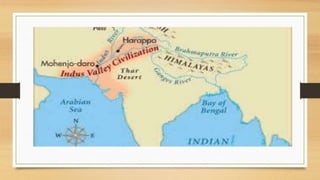
• Monsoons (Seasonal winds with rain) hit India. -India’s two main rivers are;
The Ganges & Indus River -Indus Valley is the cradle of India’s civilization.
Indus Valley Civilization
• The first settlements ca. 3000 B.C.E., when farmers settled along the Indus
River in what is now Pakistan.
Instruction: Watch the video then write at least
four lines about Indian civilization
First Settlement
• The first settlements ca. 3000 B.C.E., when farmers settled along the Indus
River in what is now Pakistan.
• By 2500 B.C.E. the entire region was dominated by two cities called; Harappa
and Mohenjo-Daro
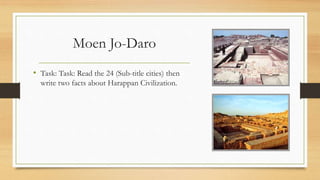
Moen Jo-Daro
• Task: Task: Read the 24 (Sub-title cities) then
write two facts about Harappan Civilization.
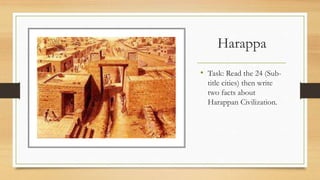
Harappa
• Task: Read the 24 (Sub-
title cities) then write
two facts about
Harappan Civilization.
Economic Life
• Harappan traded with Iran and neighboring regions in India to the east.
• Moen-Jo-Daro traded with the Persia Gulf and Sumer to the west.
Political Structure
• Villages & cities were never politically united; however, they did share a
common language & culture.
• This is very similar to Mesopotamia and China. Region was united only by
trade.
Indus Valley Achievements
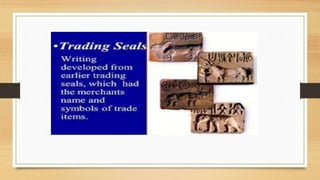
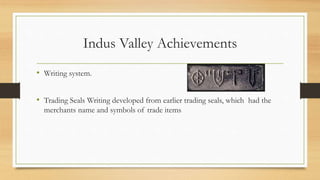
• Writing system.
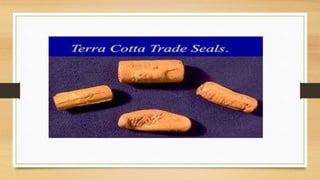
• Trading Seals Writing developed from earlier trading seals, which had the
merchants name and symbols of trade items
Languages
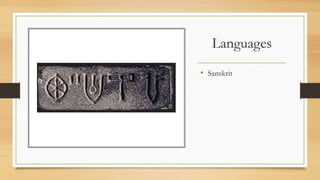
• Sanskrit
Religion
• Task: Read the paragraph related with religion then write your own
understanding about Indian Civilization religion.
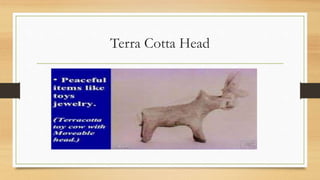
Terra Cotta Head
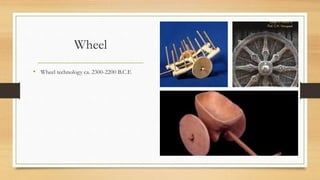
Wheel
• Wheel technology ca. 2300-2200 B.C.E
Task1: List Modern means of transportation and their role in
economy.
• Means of transportation: Example Bus.
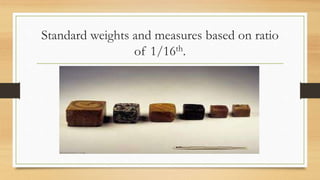
Standard weights and measures based on ratio
of 1/16th.
Task 2: Write the modern standard weight
and their uses.
• Explain
Cotton
• The first civilization to cultivate cotton and make cotton clothes.
• First matrilineal society (female led society.
Religious Beliefs
• •Great Bath Tanks were used for the purification of the body & soul.
• Religion beliefs were centered on the idea of an afterlife, thus bodies were
buried with personal items
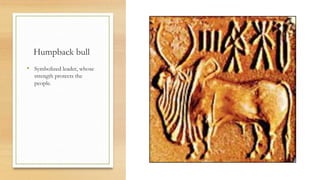
Humpback bull
• Symbolized leader, whose
strength protects the
people.
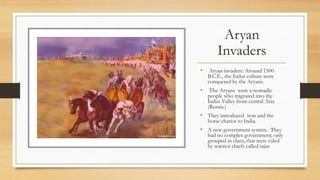
Aryan
Invaders
• Aryan invaders: Around 1500
B.C.E., the Indus culture were
conquered by the Aryans.
• The Aryans were a nomadic
people who migrated into the
Indus Valley from central Asia
(Russia.)
• They introduced iron and the
horse chariot to India.
• A new government system. They
had no complex government; only
grouped in clans, that were ruled
by warrior chiefs called rajas
Aryan
• The Aryan tribes settled in different regions of northwestern India. • The
tribes were called Gana (meaning “collection” of peoples). • The chief of
each tribe was an hereditary job. He had final say on decision; but had to
listen to a committee of the people
Video: Vedic Age
• https://www.youtube.com/watch?v=RCzulW_kGMk
Task 1: Compare and contrast the Aryan
religious beliefs with Islam and Christianity..
• Answer…………….
Vedic Age
• The Vedas “Books of Knowledge”: A collection of poems & sacred hymns,
composed around 1500 B.C.E., that describes the beliefs & daily life of the
Aryans. The period of 1500 – 1000 B.C.E. is called the Vedic Period
The Ramayana &The Mahabharata
• Two Aryan epics written around 1000 B.C.E. They are stories about Aryan
life, and wars during this period. The period from 1000 – 500 B.C.E. is called
the Epic Period. • The Ramayana tells the story in which the (good) king
Rama kills the (evil) pre-Aryan king Ravana.
• Hindu deities: Brahma, the “Creator” Vishnu, the “Preserver” Siva, the
“Destroye
Guru
• A new education system. Children were taught by a guru (teacher). Every
student, including the chiefs son, had to obey the guru. All education was
rigorous and giving orally.
Marriage
• A new marriage tradition. The red dot on an Indian woman’s forehead goes
back to the Aryan tradition of having a groom apply a spot of his blood on
his bride’s forehead, as a sign of marriage
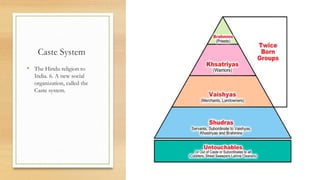
Caste System
• The Hindu religion to
India. 6. A new social
organization, called the
Caste system.
Ancient indian civilization

  • 1.
  • 2.
    Introduction India’s Geographical Setting: -HimalayanMountains are in the North. -Ghats Mountains are east & west. - India is a sub-continent plateau
  • 4.
    Two main River •Monsoons (Seasonal winds with rain) hit India. -India’s two main rivers are; The Ganges & Indus River -Indus Valley is the cradle of India’s civilization.
  • 5.
    Indus Valley Civilization •The first settlements ca. 3000 B.C.E., when farmers settled along the Indus River in what is now Pakistan.
  • 6.
    Instruction: Watch thevideo then write at least four lines about Indian civilization
  • 7.
    First Settlement • Thefirst settlements ca. 3000 B.C.E., when farmers settled along the Indus River in what is now Pakistan. • By 2500 B.C.E. the entire region was dominated by two cities called; Harappa and Mohenjo-Daro
  • 8.
    Moen Jo-Daro • Task:Task: Read the 24 (Sub-title cities) then write two facts about Harappan Civilization.
  • 9.
    Harappa • Task: Readthe 24 (Sub- title cities) then write two facts about Harappan Civilization.
  • 10.
    Economic Life • Harappantraded with Iran and neighboring regions in India to the east. • Moen-Jo-Daro traded with the Persia Gulf and Sumer to the west.
  • 13.
    Political Structure • Villages& cities were never politically united; however, they did share a common language & culture. • This is very similar to Mesopotamia and China. Region was united only by trade.
  • 14.
    Indus Valley Achievements •Writing system. • Trading Seals Writing developed from earlier trading seals, which had the merchants name and symbols of trade items
  • 15.
  • 16.
    Religion • Task: Readthe paragraph related with religion then write your own understanding about Indian Civilization religion.
  • 17.
  • 18.
    Wheel • Wheel technologyca. 2300-2200 B.C.E
  • 19.
    Task1: List Modernmeans of transportation and their role in economy. • Means of transportation: Example Bus.
  • 20.
    Standard weights andmeasures based on ratio of 1/16th.
  • 21.
    Task 2: Writethe modern standard weight and their uses. • Explain
  • 22.
    Cotton • The firstcivilization to cultivate cotton and make cotton clothes. • First matrilineal society (female led society.
  • 23.
    Religious Beliefs • •GreatBath Tanks were used for the purification of the body & soul. • Religion beliefs were centered on the idea of an afterlife, thus bodies were buried with personal items
  • 24.
    Humpback bull • Symbolizedleader, whose strength protects the people.
  • 25.
    Aryan Invaders • Aryan invaders:Around 1500 B.C.E., the Indus culture were conquered by the Aryans. • The Aryans were a nomadic people who migrated into the Indus Valley from central Asia (Russia.) • They introduced iron and the horse chariot to India. • A new government system. They had no complex government; only grouped in clans, that were ruled by warrior chiefs called rajas
  • 26.
    Aryan • The Aryantribes settled in different regions of northwestern India. • The tribes were called Gana (meaning “collection” of peoples). • The chief of each tribe was an hereditary job. He had final say on decision; but had to listen to a committee of the people
  • 27.
    Video: Vedic Age •https://www.youtube.com/watch?v=RCzulW_kGMk
  • 28.
    Task 1: Compareand contrast the Aryan religious beliefs with Islam and Christianity.. • Answer…………….
  • 29.
    Vedic Age • TheVedas “Books of Knowledge”: A collection of poems & sacred hymns, composed around 1500 B.C.E., that describes the beliefs & daily life of the Aryans. The period of 1500 – 1000 B.C.E. is called the Vedic Period
  • 30.
    The Ramayana &TheMahabharata • Two Aryan epics written around 1000 B.C.E. They are stories about Aryan life, and wars during this period. The period from 1000 – 500 B.C.E. is called the Epic Period. • The Ramayana tells the story in which the (good) king Rama kills the (evil) pre-Aryan king Ravana. • Hindu deities: Brahma, the “Creator” Vishnu, the “Preserver” Siva, the “Destroye
  • 31.
    Guru • A neweducation system. Children were taught by a guru (teacher). Every student, including the chiefs son, had to obey the guru. All education was rigorous and giving orally.
  • 32.
    Marriage • A newmarriage tradition. The red dot on an Indian woman’s forehead goes back to the Aryan tradition of having a groom apply a spot of his blood on his bride’s forehead, as a sign of marriage
  • 33.
    Caste System • TheHindu religion to India. 6. A new social organization, called the Caste system.