Thoracic
aorta
By dr.aisha sadaf
Student
m.phil anatomy
Aorta
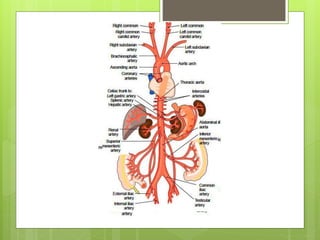
 The aorta is the main arterial trunk that
delivers oxygenated blood from the left
ventricle of the heart to the tissues of the
body. It is divided for purposes of
description into the following parts:
ascending aorta, arch of the aorta,
descending thoracic aorta, and
abdominal aorta
Ascending Aorta
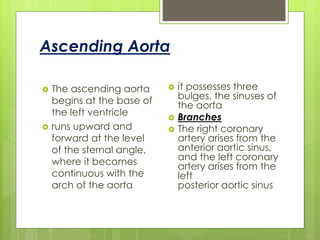
 The ascending aorta
begins at the base of
the left ventricle
 runs upward and
forward at the level
of the sternal angle,
where it becomes
continuous with the
arch of the aorta
 it possesses three
bulges, the sinuses of
the aorta
 Branches
 The right coronary
artery arises from the
anterior aortic sinus,
and the left coronary
artery arises from the
left
posterior aortic sinus
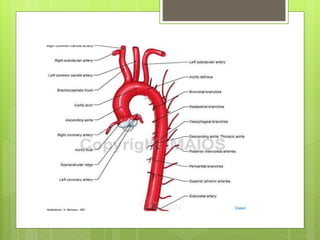
Branches of arch of aorta
1. brachiocephalic artery, it divides into the
right subclavian and right common
carotid arteries behind the right
sternoclavicular joint.
2. left common carotid artery
3. left subclavian artery
Thoracic aorta
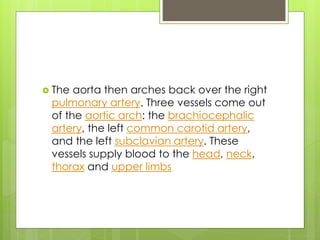
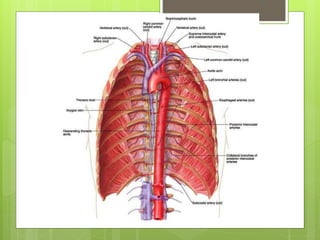
 The thoracic aorta is contained in the
posterior mediastinal cavity.
 It begins at the lower border of the fourth
thoracic vertebra where it is continuous
with the aortic arch, and ends in front of
the lower border of the twelfth thoracic
vertebra, at the aortic hiatus in the
diaphragm where it becomes the
abdominal aorta.
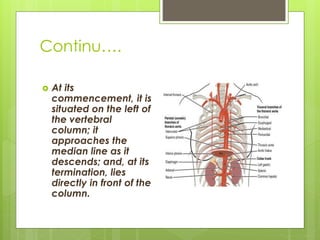
Continu….
 At its
commencement, it is
situated on the left of
the vertebral
column; it
approaches the
median line as it
descends; and, at its
termination, lies
directly in front of the
column.
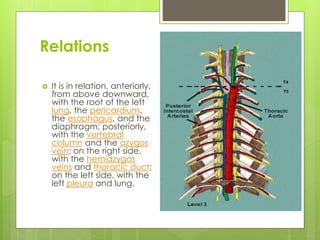
Relations
 It is in relation, anteriorly,
from above downward,
with the root of the left
lung, the pericardium,
the esophagus, and the
diaphragm; posteriorly,
with the vertebral
column and the azygos
vein; on the right side,
with the hemiazygos
veins and thoracic duct;
on the left side, with the
left pleura and lung.
 Thoracic aorta
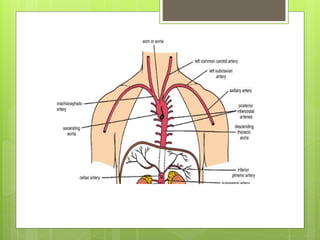
 The aorta then arches back over the right
pulmonary artery. Three vessels come out
of the aortic arch: the brachiocephalic
artery, the left common carotid artery,
and the left subclavian artery. These
vessels supply blood to the head, neck,
thorax and upper limbs
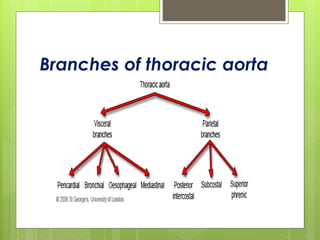
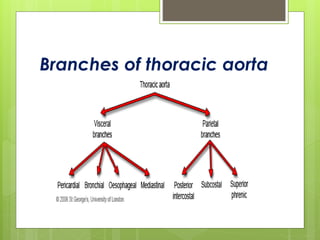
Branches of thoracic aorta
(1) VISCERAL BRANCHES
 Bronchial-oesophageal artery:
 Origin:
 arises at the sixth thoracic vertebra from aorta-it
descends over the right face of the aorta towards
bifurcation of trachea and divided into bronchial
anaoesophagial branches.
 Bronchial Artery:
 It crosses the left face of oesophagous to the
bifurcation of trachea where it divides into right
and left branches.Each enter into hilus of
corresponding lung.
 Oesophageal Artery:
 The esophageal arteries four or five in
number, arise from the front of the aorta, and
pass obliquely downward to the esophagus,
forming a chain of anastomoses along that
tube, anastomosing with the esophageal
branches of the inferior thyroid arteries above,
and with ascending branches from the left
inferior phrenic and left gastric arteries below.
These arteries supply the middle third of the
esophagus.
Pericardial branches
 small branches of thoracic aorta
distributed to the pericardium, in the
region of the oblique pericardial sinus,
and to posterior mediastinal lymph nodes.
Mediastinal branches
 The mediastinal branches are numerous
small vessels which supply the lymph
glands and loose areolar tissue in the
posterior mediastinum.
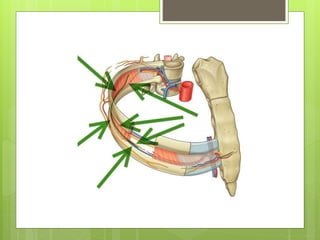
Branches of thoracic aorta
PARIETAL BRANCHES
 Superior phrenic artries:
 The superior phrenic arteries are small and
arise from the lower part of the thoracic
aorta; they are distributed to the posterior
part of the upper surface of the
diaphragm, and anastomose with the
musculophrenic and pericardiacophrenic
Posterior intercostal arteries
 The posterior intercostal arteries are arteries
that supply blood to the intercostal spaces.
 There are eleven posterior intercostal arteries
on each side.
 The 1st and 2nd posterior intercostal arteries
arise from the supreme intercostal artery, a
branch of the costocervical trunk of the
subclavian artery.
 The lower nine arteries are the aortic
intercostals, so called because they arise from
the back of the thoracic aorta.
Subcostal branches
 The subcostal arteries, so named because
they lie below the last ribs, constitute the
lowest pair of branches derived from the
thoracic aorta, and are in series with the
intercostal arteries.
 Each passes along the lower border of the
twelfth rib behind the kidney and in front
of the Quadratus lumborum muscle, and
is accompanied by the twelfth thoracic
nerve.
The end

Thoracic aorta

  • 1.
  • 2.
    Aorta  The aortais the main arterial trunk that delivers oxygenated blood from the left ventricle of the heart to the tissues of the body. It is divided for purposes of description into the following parts: ascending aorta, arch of the aorta, descending thoracic aorta, and abdominal aorta
  • 4.
    Ascending Aorta  Theascending aorta begins at the base of the left ventricle  runs upward and forward at the level of the sternal angle, where it becomes continuous with the arch of the aorta  it possesses three bulges, the sinuses of the aorta  Branches  The right coronary artery arises from the anterior aortic sinus, and the left coronary artery arises from the left posterior aortic sinus
  • 5.
    Branches of archof aorta 1. brachiocephalic artery, it divides into the right subclavian and right common carotid arteries behind the right sternoclavicular joint. 2. left common carotid artery 3. left subclavian artery
  • 6.
    Thoracic aorta  Thethoracic aorta is contained in the posterior mediastinal cavity.  It begins at the lower border of the fourth thoracic vertebra where it is continuous with the aortic arch, and ends in front of the lower border of the twelfth thoracic vertebra, at the aortic hiatus in the diaphragm where it becomes the abdominal aorta.
  • 7.
    Continu….  At its commencement,it is situated on the left of the vertebral column; it approaches the median line as it descends; and, at its termination, lies directly in front of the column.
  • 8.
    Relations  It isin relation, anteriorly, from above downward, with the root of the left lung, the pericardium, the esophagus, and the diaphragm; posteriorly, with the vertebral column and the azygos vein; on the right side, with the hemiazygos veins and thoracic duct; on the left side, with the left pleura and lung.  Thoracic aorta
  • 9.
     The aortathen arches back over the right pulmonary artery. Three vessels come out of the aortic arch: the brachiocephalic artery, the left common carotid artery, and the left subclavian artery. These vessels supply blood to the head, neck, thorax and upper limbs
  • 11.
  • 14.
    (1) VISCERAL BRANCHES Bronchial-oesophageal artery:  Origin:  arises at the sixth thoracic vertebra from aorta-it descends over the right face of the aorta towards bifurcation of trachea and divided into bronchial anaoesophagial branches.  Bronchial Artery:  It crosses the left face of oesophagous to the bifurcation of trachea where it divides into right and left branches.Each enter into hilus of corresponding lung.
  • 15.
     Oesophageal Artery: The esophageal arteries four or five in number, arise from the front of the aorta, and pass obliquely downward to the esophagus, forming a chain of anastomoses along that tube, anastomosing with the esophageal branches of the inferior thyroid arteries above, and with ascending branches from the left inferior phrenic and left gastric arteries below. These arteries supply the middle third of the esophagus.
  • 16.
    Pericardial branches  smallbranches of thoracic aorta distributed to the pericardium, in the region of the oblique pericardial sinus, and to posterior mediastinal lymph nodes.
  • 17.
    Mediastinal branches  Themediastinal branches are numerous small vessels which supply the lymph glands and loose areolar tissue in the posterior mediastinum.
  • 18.
  • 19.
    PARIETAL BRANCHES  Superiorphrenic artries:  The superior phrenic arteries are small and arise from the lower part of the thoracic aorta; they are distributed to the posterior part of the upper surface of the diaphragm, and anastomose with the musculophrenic and pericardiacophrenic
  • 20.
    Posterior intercostal arteries The posterior intercostal arteries are arteries that supply blood to the intercostal spaces.  There are eleven posterior intercostal arteries on each side.  The 1st and 2nd posterior intercostal arteries arise from the supreme intercostal artery, a branch of the costocervical trunk of the subclavian artery.  The lower nine arteries are the aortic intercostals, so called because they arise from the back of the thoracic aorta.
  • 22.
    Subcostal branches  Thesubcostal arteries, so named because they lie below the last ribs, constitute the lowest pair of branches derived from the thoracic aorta, and are in series with the intercostal arteries.  Each passes along the lower border of the twelfth rib behind the kidney and in front of the Quadratus lumborum muscle, and is accompanied by the twelfth thoracic nerve.
  • 23.