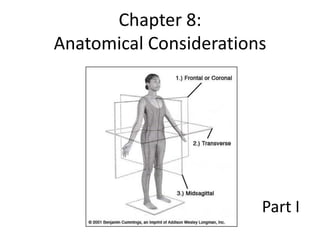
Chapter 8:
Anatomical Considerations


                        Part I
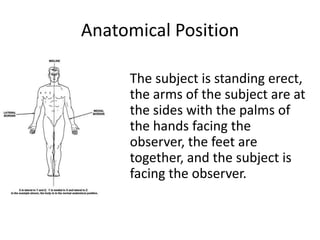
Anatomical Position

    • The subject is standing erect,
      the arms of the subject are at
      the sides with the palms of
      the hands facing the
      observer, the feet are
      together, and the subject is
      facing the observer.
• Anatomical Guide –


• Linear Guide –


• Anatomical Limit –
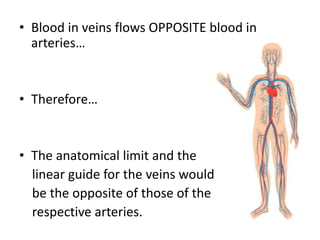
• Blood in veins flows OPPOSITE blood in
  arteries…


• Therefore…


• The anatomical limit and the
  linear guide for the veins would
  be the opposite of those of the
  respective arteries.
• The anatomical guides for arteries and veins
  would be the same.
Common Carotid Artery


• Linear Guide –
Common Carotid Artery


• Anatomical Guide –
Common Carotid Artery
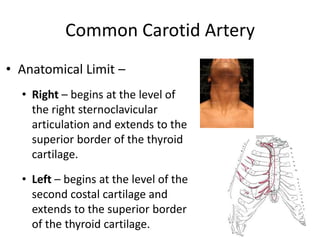
• Anatomical Limit –
  • Right – begins at the level of
    the right sternoclavicular
    articulation and extends to the
    superior border of the thyroid
    cartilage.

  • Left – begins at the level of the
    second costal cartilage and
    extends to the superior border
    of the thyroid cartilage.
Common Carotid Artery

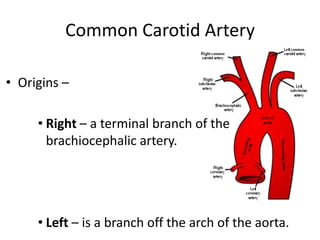
• Origins –

     • Right – a terminal branch of the
       brachiocephalic artery.


     • Left – is a branch off the arch of the aorta.
Common Carotid Artery
• Branches –

     • Right – no branches of the right common carotid,
       except the terminal bifurcation into the right internal
       and external carotid arteries.
     • Left – no branches except the terminal bifurcation into
       the left internal and external carotid arteries.
Common Carotid Artery
• Branches of the Right and Left External
  Carotid Arteries –

     •   Ascending pharyngeal
     •   Superior thyroid
     •   Lingual
     •   Facial
     •   Occipital
     •   Posterior auricular
     •   Maxillary
     •   Superficial temporal
Common Carotid Artery
• Branches of the Right and Left Internal Carotid
  Arteries –

     • Branches arising
       within the carotid canal
     • Ophthalmic
     • Anterior cerebral
     • Middle cerebral
     • Posterior communicating
     • Choroidal branches
Common Carotid Artery
• Relationship of the Common Carotid to the
  Internal Jugular Vein –
             • The internal jugular vein lies…
Common Carotid Artery
• Contents of the Carotid Sheath –

     • Internal jugular vein
     • Vagus nerve
     • Common carotid artery


     What is the carotid sheath?
Axillary Artery


• Linear Guide –
Axillary Artery


• Anatomical Guide –
Axillary Artery
• Anatomical Limit –

  • Extends from a point
    beginning at the lateral
    border of the first rib and
    extends to the inferior
    border of the tendon of the
    teres major muscle.
Axillary Artery


     • Origin –

          • A continuation of the
            subclavian artery.
Axillary Artery
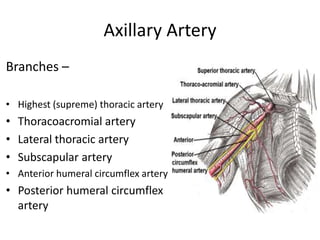
Branches –

• Highest (supreme) thoracic artery
• Thoracoacromial artery
• Lateral thoracic artery
• Subscapular artery
• Anterior humeral circumflex artery
• Posterior humeral circumflex
  artery
Axillary Artery
• Relationship of Axillary Artery to the Axillary
  Vein –
     • The axillary artery is located…
Axillary Artery


• Incision for Raising the Axillary Vessels –
Brachial Artery


• Linear Guide –
Brachial Artery


• Anatomical Guide –
Brachial Artery

• Anatomical Limit –


             • Extends from a point beginning at the
               inferior border of the tendon of the
               teres major muscle and extends to a
               point inferior to the antecubital fossa.
Brachial Artery

• Origin –

     • The brachial artery is a
       continuation of the axillary artery.
Brachial Artery
• Relationship of the Brachial Artery and the
  Basilic Vein –

                • The accompanying basilic vein is
                  located…
Brachial Artery

• Location of the Incision –
Radial Artery


• Linear Guide –
Radial Artery


• Anatomical Guide –
Radial Artery
• Anatomical Limit –

  • Extends from a point approximately 1 inch below
    an in front of the bend
    of the elbow to a point
    over the base of the
    thumb (thenar
    eminence).
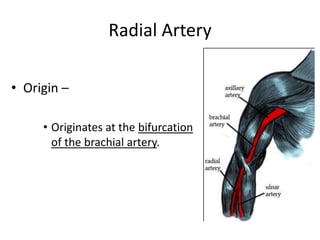
Radial Artery

• Origin –

     • Originates at the bifurcation
       of the brachial artery.
Radial Artery
• Relationship of the Radial Artery and the Venae
  Comitantes –

                   • Two small veins (venae
                     comintantes) lie…
Ulnar Artery


• Linear Guide –
Ulnar Artery


• Anatomical Guide –
Ulnar Artery
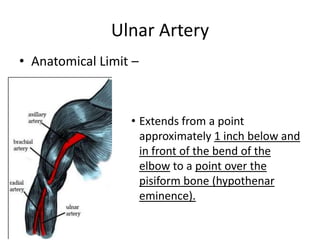
• Anatomical Limit –


                  • Extends from a point
                    approximately 1 inch below and
                    in front of the bend of the
                    elbow to a point over the
                    pisiform bone (hypothenar
                    eminence).
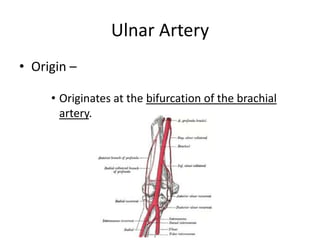
Ulnar Artery
• Origin –

     • Originates at the bifurcation of the brachial
       artery.
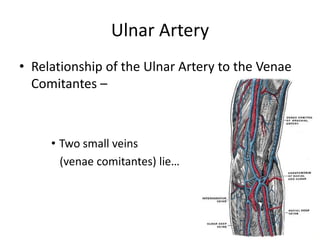
Ulnar Artery
• Relationship of the Ulnar Artery to the Venae
  Comitantes –


     • Two small veins
       (venae comitantes) lie…
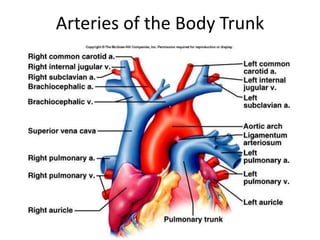
Arteries of the Body Trunk
• Ascending Aorta

• Arch of the Aorta

• Right Subclavian

• Left Subclavian

• Descending Thoracic Aorta

• Descending Abdominal Aorta
Arteries of the Body Trunk
Ascending Aorta
• Originates at the left
  ventricle.


• Branches –
     • Right Coronary
       Artery
     • Left Coronary Artery
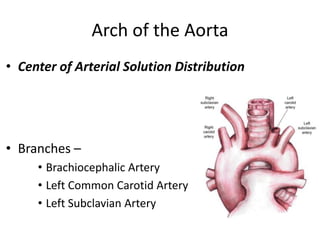
Arch of the Aorta
• Center of Arterial Solution Distribution


• Branches –
     • Brachiocephalic Artery
     • Left Common Carotid Artery
     • Left Subclavian Artery
Right Subclavian
• Begins at the right sternoclavicular articulation
  and extends to the lateral border of the first
  rib.
• For full autopsy (neck organs removed) –
  branches need to be clamped.

• Braches –
     • Vertebral Artery
     • Internal Thoracic artery
     • Inferior Thyroid
Left Subclavian


     • Begins at the level of the
       left second costal cartilage
       and extends to the lateral
       border of the first rib.
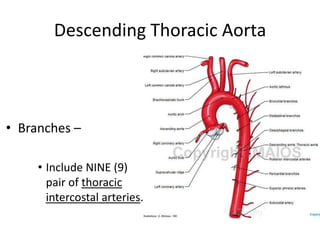
Descending Thoracic Aorta


• Branches –

     • Include NINE (9)
       pair of thoracic
       intercostal arteries.
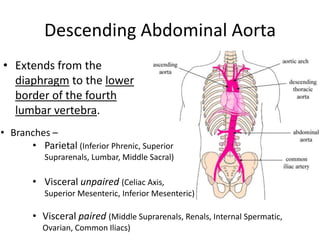
Descending Abdominal Aorta
• Extends from the
  diaphragm to the lower
  border of the fourth
  lumbar vertebra.
• Branches –
      • Parietal (Inferior Phrenic, Superior
           Suprarenals, Lumbar, Middle Sacral)

        • Visceral unpaired (Celiac Axis,
           Superior Mesenteric, Inferior Mesenteric)

        • Visceral paired (Middle Suprarenals, Renals, Internal Spermatic,
          Ovarian, Common Iliacs)
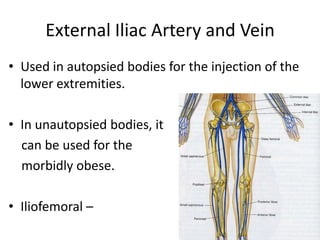
External Iliac Artery and Vein
• Continuation of the common iliac artery.

• Common iliac is a terminal branch of the
  abdominal aorta.

• Extends to a point under the center of the
  inguinal ligament.

• Lies exactly at this ligament lateral to the external
  iliac vein.
External Iliac Artery and Vein
• Used in autopsied bodies for the injection of the
  lower extremities.

• In unautopsied bodies, it
  can be used for the
  morbidly obese.

• Iliofemoral –
Chapter8

Chapter8

  • 1.
  • 2.
    Anatomical Position • The subject is standing erect, the arms of the subject are at the sides with the palms of the hands facing the observer, the feet are together, and the subject is facing the observer.
  • 3.
    • Anatomical Guide– • Linear Guide – • Anatomical Limit –
  • 4.
    • Blood inveins flows OPPOSITE blood in arteries… • Therefore… • The anatomical limit and the linear guide for the veins would be the opposite of those of the respective arteries.
  • 5.
    • The anatomicalguides for arteries and veins would be the same.
  • 6.
    Common Carotid Artery •Linear Guide –
  • 7.
    Common Carotid Artery •Anatomical Guide –
  • 8.
    Common Carotid Artery •Anatomical Limit – • Right – begins at the level of the right sternoclavicular articulation and extends to the superior border of the thyroid cartilage. • Left – begins at the level of the second costal cartilage and extends to the superior border of the thyroid cartilage.
  • 9.
    Common Carotid Artery •Origins – • Right – a terminal branch of the brachiocephalic artery. • Left – is a branch off the arch of the aorta.
  • 10.
    Common Carotid Artery •Branches – • Right – no branches of the right common carotid, except the terminal bifurcation into the right internal and external carotid arteries. • Left – no branches except the terminal bifurcation into the left internal and external carotid arteries.
  • 11.
  • 12.
    Common Carotid Artery •Branches of the Right and Left External Carotid Arteries – • Ascending pharyngeal • Superior thyroid • Lingual • Facial • Occipital • Posterior auricular • Maxillary • Superficial temporal
  • 13.
    Common Carotid Artery •Branches of the Right and Left Internal Carotid Arteries – • Branches arising within the carotid canal • Ophthalmic • Anterior cerebral • Middle cerebral • Posterior communicating • Choroidal branches
  • 14.
    Common Carotid Artery •Relationship of the Common Carotid to the Internal Jugular Vein – • The internal jugular vein lies…
  • 15.
    Common Carotid Artery •Contents of the Carotid Sheath – • Internal jugular vein • Vagus nerve • Common carotid artery What is the carotid sheath?
  • 16.
  • 17.
  • 18.
    Axillary Artery • AnatomicalLimit – • Extends from a point beginning at the lateral border of the first rib and extends to the inferior border of the tendon of the teres major muscle.
  • 19.
    Axillary Artery • Origin – • A continuation of the subclavian artery.
  • 20.
    Axillary Artery Branches – •Highest (supreme) thoracic artery • Thoracoacromial artery • Lateral thoracic artery • Subscapular artery • Anterior humeral circumflex artery • Posterior humeral circumflex artery
  • 21.
    Axillary Artery • Relationshipof Axillary Artery to the Axillary Vein – • The axillary artery is located…
  • 22.
    Axillary Artery • Incisionfor Raising the Axillary Vessels –
  • 23.
  • 24.
  • 25.
    Brachial Artery • AnatomicalLimit – • Extends from a point beginning at the inferior border of the tendon of the teres major muscle and extends to a point inferior to the antecubital fossa.
  • 26.
    Brachial Artery • Origin– • The brachial artery is a continuation of the axillary artery.
  • 27.
    Brachial Artery • Relationshipof the Brachial Artery and the Basilic Vein – • The accompanying basilic vein is located…
  • 28.
    Brachial Artery • Locationof the Incision –
  • 29.
  • 30.
  • 31.
    Radial Artery • AnatomicalLimit – • Extends from a point approximately 1 inch below an in front of the bend of the elbow to a point over the base of the thumb (thenar eminence).
  • 32.
    Radial Artery • Origin– • Originates at the bifurcation of the brachial artery.
  • 33.
    Radial Artery • Relationshipof the Radial Artery and the Venae Comitantes – • Two small veins (venae comintantes) lie…
  • 34.
  • 35.
  • 36.
    Ulnar Artery • AnatomicalLimit – • Extends from a point approximately 1 inch below and in front of the bend of the elbow to a point over the pisiform bone (hypothenar eminence).
  • 37.
    Ulnar Artery • Origin– • Originates at the bifurcation of the brachial artery.
  • 38.
    Ulnar Artery • Relationshipof the Ulnar Artery to the Venae Comitantes – • Two small veins (venae comitantes) lie…
  • 39.
    Arteries of theBody Trunk • Ascending Aorta • Arch of the Aorta • Right Subclavian • Left Subclavian • Descending Thoracic Aorta • Descending Abdominal Aorta
  • 40.
    Arteries of theBody Trunk
  • 41.
    Ascending Aorta • Originatesat the left ventricle. • Branches – • Right Coronary Artery • Left Coronary Artery
  • 42.
    Arch of theAorta • Center of Arterial Solution Distribution • Branches – • Brachiocephalic Artery • Left Common Carotid Artery • Left Subclavian Artery
  • 43.
    Right Subclavian • Beginsat the right sternoclavicular articulation and extends to the lateral border of the first rib. • For full autopsy (neck organs removed) – branches need to be clamped. • Braches – • Vertebral Artery • Internal Thoracic artery • Inferior Thyroid
  • 44.
    Left Subclavian • Begins at the level of the left second costal cartilage and extends to the lateral border of the first rib.
  • 45.
    Descending Thoracic Aorta •Branches – • Include NINE (9) pair of thoracic intercostal arteries.
  • 46.
    Descending Abdominal Aorta •Extends from the diaphragm to the lower border of the fourth lumbar vertebra. • Branches – • Parietal (Inferior Phrenic, Superior Suprarenals, Lumbar, Middle Sacral) • Visceral unpaired (Celiac Axis, Superior Mesenteric, Inferior Mesenteric) • Visceral paired (Middle Suprarenals, Renals, Internal Spermatic, Ovarian, Common Iliacs)
  • 47.
    External Iliac Arteryand Vein • Continuation of the common iliac artery. • Common iliac is a terminal branch of the abdominal aorta. • Extends to a point under the center of the inguinal ligament. • Lies exactly at this ligament lateral to the external iliac vein.
  • 48.
    External Iliac Arteryand Vein • Used in autopsied bodies for the injection of the lower extremities. • In unautopsied bodies, it can be used for the morbidly obese. • Iliofemoral –